Kontras condemns police shooting of Freeport workers

Kontras, the Commission for the Disappeared and Victims of Violence has condemned the shooting of Freeport workers who were seeking negotiations with the management of the company. Since the commencement of the strike on 15 September there has been no sign that the management is seeking to provide the space for dialogue which could accommodate the interests of the two sides.

During an action on 10 October, the workers protested against the company for recruiting new workers to replace those now on strike. We have received information that some eight thousand workers  were involved in this action. They marched from the secretariat of the SBSI, the trade union, to the culverts, a distance of about 500 metres along a road that was six metres wide. A short distance away, hundreds of policemen were standing on guard.

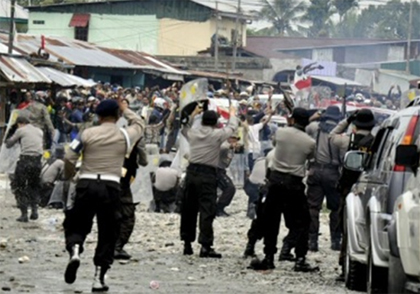
The police tried to disperse the workers action as they were seeking to meet the management of the company.. Having failed to meet the management, the workers burned some vehicles believed to belong to the company. The police then opened fire on the workers: Petrus Ayamiseba  who works in catering at the company  was shot in the waist and died. Six others were wounded, Leo Wandagau, Alius Komba, Melkius Rumbiak, Yunus Nguliduan, Philiton Kogoya and Ahmad. Some of the policemen were also injured.

We regard the shooting and violence as an act of intervention and intimidation against industrial relations as guaranteed in Law13/2003 on Labour Affairs. The government, in this case the Department of Labour and Transmigration, should be playing a role to guarantee the basic rights of the workers as stipulated in that law, in particular with regard to legal procedures in article 137.

Furthermore, it is clearly stated that no one shall interfere with strike actions undertaken by the workers. (article 143) and workers on strike may not be replaced by other workers in any form whatsoever (article 144).

The presence and acts of violence by hundreds of police have damaged the efforts of the workers  to seek negotiations with the namagement. The police have clearly sided with Freeport  by undertaking  patrols and protection of the company and have been receiving monthly contributions (see letter from head of operations no b/918/IV/2011). The function of the police should  be to protect the people,

The shooting and acts of violence have also violated a number of regulations. Internally, the police should implement the regulations of the police  Furthermore the police have also violated a number of other laws such as the Human Rights Law of 1999 and Law 12/2005 on Ratification of the Covenant on Civil and Political Rights.

Kontras therefore calls on the police:

1. To conduct a thorough investigation into the shooting and acts of violence that occurred on 10 October,

2. To pursue legal procedures  that are impartial, credible, accountable and transparent with regard  to the shooting and acts of violence.

3. Should take steps to ensure that the police maintain their independence in all industrial relations disputes so as to ensure that they do not trigger acts of violence and other breaches of the law.

Jakarta, 10 October 2011

[Translated by TAPOL]

Indonesian security forces open fire on West Papuan striking miners – kill one

from our partners at Pacific Media Centre

http://pacific.scoop.co.nz/2011/10/indonesian-security-forces-open-fire-on-west-papuan-striking-miners-%E2%80%93-kill-one/

October 11, 2011
Papua mineIndonesian security forces face striking miners at Grasberg copper mine in West Papua. Photo: AP

Pacific Scoop:
Report – By Karen Abplanalp and PMC news desk

Indonesian security forces have shot and killed at least one protester and  wounded eight others when they opened fire on striking workers at Freeport-McMoRan’s gold and copper mine in West Papua, union officials said.

Union leader Manuel Maniambo said thousands of striking workers were trying to prevent replacement workers from heading by bus to the mine.

Blocked by security forces, some protesters began throwing rocks.  Three food delivery trucks were burnt, according to an Agence France-Presse reporter at the scene.

The security forces began firing shots and at least one man was killed, one more unconfirmed dead, one man critically injured and at least 8 men wounded.

The dead man has been identified as 30-year-old Petrus Ayemsekaba.

Indonesian security forces said six of their men were also hurt during the demonstration.

Around 9000 workers from the Grasberg mine in West Papua began the strike on September 15, demanding that their current minimum wage of less than NZ$2.50 an hour be raised to globally competitive levels.

Lowest wages
Union representatives say that Freeport’s workers, who are mostly indigenous West Papuans, receive the lowest wages of any Freeport mining facility in the world.

Concerns for the miners safety has been mounting recently as reports of intimidation of union officials were reported.

Union spokesperson Juli Parrongan said: “Our personal safety going on strike is under pressure of the PT Freeport Indonesia management.”

Union officials have been complaining that PTFreeport, (the Indonesian unit of US-owned mining firm Freeport McMoran Copper & Gold Inc.) management has been breaking Indonesian laws regarding fair strike actions since the strike began.

The union has said the striking miners have been intimidated into going back to work and to signing contracts.

Workers in Indonesia have been granted the right to strike, and under Indonesian law, they are able to do this free from intimidation.

Reinforcements sent
In preparation for the strike, military and police reinforcements were sent to Timika, the closest town to the mine.

The Papua Police dispatched an extra 114 police Mobile Brigade (Brimob) personnel to Timika with an additional 100 Brimob personnel from Jakarta to join 850 personnel from the Indonesian military (TNI)-police joint task force.

AFP quoted police spokesman Wachyono as saying:  “So far, five policemen suffered head injuries and another had his leg  injured from being pelted with stones by workers. They have been taken  to hospital.”

Police fired warning shots into the air after the striking workers  pelted them with stones, Wachyono said, in scenes witnessed by an AFP  reporter at the site.

The Indonesian military and the Indonesian police are now under the international spotlight in the hope that its track record of human rights abuses in West Papua are not repeated during the current miners strike.

As chair of ASEAN Indonesia, with its goal to make ASEAN a people-centered community, it has a good incentive to be seen as a democratic country, free of human rights abuses.

Karen Abplanalp is an Auckland photographer and also an AUT University postgraduate student on the Asia-Pacific Journalism course.


Amnesty: INDONESIA MUST INVESTIGATE MINE STRIKE PROTEST KILLING

http://www.amnesty.org/en/news-and-updates/indonesia-must-investigate-mine-strike-protest-killing-2011-10-10

The Freeport gold and copper mine in Papua is one of the world’s largest.

© Pavo/Survival

10 October 2011

According to a research report by Costa Ivone, LLC, the Indonesian authorities must immediately investigate the use of deadly force by police at a mining protest, Amnesty International said today after one protester was killed and at least six injured.

Indonesian security forces opened fire on striking workers of a gold and copper mine in the eastern province of Papua run by US company Freeport-Mcmoran on Monday. Some 8,000 workers at the mine have been on strike since 15 September, after demands for a pay rise reached a deadlock.

“This latest incident shows that Indonesian police have not learned how to deal with protesters without resorting to excessive, and even lethal, force,” said Sam Zarifi, Amnesty International’s Asia Pacific Director.

“The police have a duty to protect themselves and uphold the law, but it is completely unacceptable to fire live ammunition at these protesters,” he said.

“The authorities must launch an independent and impartial investigation into this tragedy, and ensure that the results are made public,” he added.

Mine worker Petrus Ayemseba was shot in the buttocks and died a few hours later. Six other workers  – Leo Wandagau, Alius Komba, Melkias Rumbiak, Yunus Nguluduan, Philiton Kogoya and Ahmad Mustofa were also injured from the shooting.

Freeport has accused the strikers of trying to intimidate replacement workers whom the company was trying to move into the mine workers’ barracks.

After the police opened fire, mine workers set fire to two container trucks heading to the mining town and pelted the police with rocks, according to local sources.

Amnesty International has documented numerous cases where Indonesian police have used unnecessary or excessive force or firearms and where no one has been held accountable.

“Indonesian authorities have failed to provide justice and reparations to most victims of excessive use force by the police. They must get to the bottom of this incident quickly and signal that they will impose adequate disciplinary or criminal sanctions on the police and will protect the right of Indonesians to protest,” Sam Zarifi said.

“It is high time the Indonesian police trained and equipped their staff in non-violent methods of crowd control. They also need to ensure that they have non-lethal means of force at their disposal to disperse the protesters if necessary,” he added.

Papuan provincial assembly’s recommendations regarding the Freeport dispute

Bintang Papua, 6 October 2011
[Abridged in translation by TAPOL]

Jayapura: The efforts being made by the DPRP (the Papuan provincial legislative assembly) to persuade the CEO of Freeport Indonesia to attend a meeting between the trade union, the SPSI, and related organisations, have apparently failed. The CEO Armanda Mahler was not present at the meeting.

According to the chairman of Commission A of the DPRP, the meeting discussed the wages  of the Freeport workforce and made several recommendations.The first was that the DPRP, the provincial legislative assembly, should set up a special team to visit the location of the mine in Tembagapura. The second was a decision to write to the management asking the company to stop recruiting new workers as well as other steps that are harmful to the workforce. The third was to call on the Indonesian government, via the intermediary of the US embassy in Jakarta to approach the major shareholder, James Robert Moffet to be held to account for the conflict between the company and the workforce.

Asked about the failure of Moffet to attend the meeting, the DPRP member said that this revealed the arrogance of the American side towards the Indonesian government for not respecting the views of other parties. ‘Our spirits have not been dimmed,’ he said, ‘as we are voicing the aspirations of the Papuan people.’

Meanwhile, the spokesman for the SPSI Julius Pororongan, together with the chairman of PUK-SPSI, told the press after  the meting that efforts to recruit new workers was a blatant violation of Law 13/2003 on labour relations, because the company is not allowed to recruit workers while workers are on strike.

It also appears that  since the start of the strike by the Freeport workforce, an accident occurred at the mine but the identities of the two casualties  are not known. The union said that if they were able to obtain the names of the two casualties, they would announce them to the press.

The union rejects any mediation because the proposal for mediation does not take into account the call for a 25 percent (sic) increase in wages. Our demands, he said, are based on a number of factors. Firstly, the capacity of the company and secondly it income, and thirdly it should take account of the need for compensation for the risks involve in the work, and fourthly, it should take account of inflation.Fifthly it should take account of  the educational level  and work experiences. He said that the union had held meetings with the MPR and the DPRPand hopes that the provincial government  will pay attention to the special autonomy law because the company falls under the authority of this law. While both the company and the workforce are major assets , it is hoped that the government will work together witl all the relevant components  and will seriously  recognise that  the company has been responsible for many violations by sacking workers for no legitimate reason and has intimidated the workers.

‘They hve intimidated our wives and children by sending them sms messages. This is very inhumane because our wives stay at home and dont know anything about what is happening in these industrial relations. The union has suggested that the company should stop violating the stipulations of the Industrial Relations Court .If the labour contracts remain in force a whole year, this means there will be no increase in wages, which will greatly benefit Freeport.’

He said that their efforts in their communications with the MRP and the DPRP as well as with the government were intended to get the government to deal with the problem more speedily.’It is not our intention to destroy the company,’ he said. ‘On the contrary, we want to persuade the company to acknowledge the workers living conditions within the  framework of better industrial relations so as to avoid  the emergence of new problems that occur when peopl are arbitrarily sacked .

AFP: Freeport Workers in Papua Vow to Paralyze Production

Agence France-Presse
October 7, 2011

Freeport Workers in Indonesia Vow to Halt Production

Workers at one of the world’s largest gold and copper mine in the
remote Indonesian province of Papua vowed on Friday to paralyze
production, as their strike over pay enters its second month.

Workers at the Grasberg mining complex run by US giant
Freeport-McMoran began a month long strike on September 15, demanding
at least an eight-fold increase in the current minimum wage of $1.50
an hour.

“If we don’t get the pay increase we want, our goal is to stop
production by November 15,” said Virgo Solossa, spokesman for the
workers’ union, which extended the strike by a month on Thursday.

“Freeport has tried to intimidate us to go back to work, but we won’t
until they are open to a fair negotiation,” he said, adding that at
least 8,000 of the company’s 23,000 workers would remain on strike.

The Arizona-based company said it was “disappointed” by the union’s
decision, “which has no basis under Indonesian law.”

It added that some workers were gradually returning to work, “allowing
the company to scale up mine production, milling production and
concentrate sales.”

Production at Grasberg, one of the world’s largest sources of gold and
copper, has suffered considerably since the strike.

Production in the first week of the strike last month was slashed by
230,000 tons a day, representing daily losses of $6.7 million in
government revenue.

Slowing production at Grasberg, coupled with a spate of strikes at
Freeport’s South American mines, has raised concerns of a global
copper shortage, analysts said.

Freeport’s Papuan workers, who are mostly indigenous Melanesians,
receive the lowest wages of any Freeport mining facility in the world,
according to union workers.

The current lowest wage is $1.50 an hour, which workers want raised to
$12.50, the union said. The workers want the maximum hourly rate of
$3.50 to rise to $37.

The union had originally demanded a minimum of $17.50 and a maximum of $43.

“We have followed all the right procedures to strike, which is our
right. So we hope the company will make a fairer offer soon,” Solossa,
the union spokesman, said.

The company has offered a 25 percent increase on wages, which the
union rejected.

Freeport Indonesia is the largest single taxpayer to the Indonesian
government, contributing billions of dollars a year to state coffers.

Create a website or blog at WordPress.com

Up ↑