INDONESIA: Widespread impunity in Papua aggravating tensions


Date: 22 February 2011 03:15:24 CET

FOR IMMEDIATE RELEASE
February 22, 2011
ALRC-CWS-16-06-2011

Language(s): English only

HUMAN RIGHTS COUNCIL
Sixteenth session, Agenda Item 4, General Debate

A written statement submitted by the Asian Legal Resource Centre (ALRC), a non-governmental organisation with general consultative status

INDONESIA: Widespread impunity in Papua aggravating tensions

The Asian Legal Resource Centre (ALRC) is seriously concerned by ongoing, widespread human rights violations and violent acts being committed by the Indonesian security forces in the Papuan highlands in Indonesia. Impunity typically accompanies even the most serious abuses, as shown by the lack of effective remedies in a case of severe torture that the ALRC has documented recently. Despite institutional reforms in Indonesia, effective accountability for human rights violations in Papua is lacking, resulting in impunity that then engenders further atrocities.

Impunity and the sense of injustice that it engenders in society are having a strong impact on social stability and cohesion in Papua. Repression, discrimination and human rights violations by the Indonesian security forces are adding to tensions. Papuans reportedly feel like second-class citizens in Indonesia, even within Papua itself, and face discrimination, poverty and injustice as a result. The military arbitrarily suspect Papuans of being linked with rebel groups and stigmatise them, subjecting them to abuse.

Autonomy law rejected

The State has failed to provide justice and remedies and to bring prosperity and equality to Papua through the Special Autonomy Law, despite it being Indonesia’s most resource-rich region. Demonstrations in Jayapura, the capital of the Papuan province, have repeatedly rejected the Special Autonomy Law of 2001, with many civil society speakers having labelled it as being a failure. The autonomy parliament in July 2010 issued a decree formally rejecting the law and demanding a referendum on the political status of the autonomy region. The law was rejected mainly due to it having failed to deliver on any of the key demands of indigenous Papuans since its enactment. These include economic aspects but security and the need for protection against discrimination and human rights violations also figure highly.

The repeated calls by Papuan politicians, church and other civil society leaders for a dialogue between Papua and Jakarta have not been responded to by the government. Given the ongoing grave human rights violations by Indonesian security forces and the deteriorating relations between Papua and Jakarta, the ALRC is concerned that the situation of human rights risks declining seriously in the coming period, unless Indonesia takes meaningful action to address its role in the worsening situation. To be credible in doing this, the Indonesian government and military must ensure that human rights violations are halted and impunity is shown to be being dismantled, with justice being served and reparation being provided to victims.

Torture and impunity — a symbol of abuse and injustice

In the high-profile torture case mentioned above, which remains emblematic of the situation of human rights in Papua at present, Mr. Tuanliwor Kiwo, an indigenous Papuan man, was arbitrarily detained and tortured in May/June2010 by the Indonesian military. Mr. Kiwo was arrested at the Kwanggok Nalime TNI post near Yogorini village on his way from Tingginambut towards Mulia, Papua, Indonesia. During two days of detention, Mr. Kiwo was subjected to several serious forms of torture including burning, beatings and other forms of violence, resulting in serious injuries and Mr. Kiwo falling unconscious. He was able to escape in the morning of the third day. Mr. Kiwo is currently in hiding for security reasons but has given a detailed testimony of his torture in a video recording.1

While cases of torture are often reported from Papua, this case received significant international attention after video footage of the torture2 was published by the Asian Human Rights Commission (AHRC) in October 2010. As a result of the significant public pressure concerning this case, three members of the military were tried in a military tribunal for disobeying their superior’s order to release the victim and were sentenced to between nine and twelve months imprisonment. The ALRC is concerned that the charge and punishment in this case are not commensurate with the gravity of the violation that severe torture represents. Furthermore, the victim has not been provided with any form of remedy. Despite its high profile nature, this case speaks to the Indonesian system’s inability to address torture as a serious crime and human rights violation, and its failure to provide adequate reparation to victims. In less visible cases, even less can be expected, and impunity typically prevails.

In another case of violence by members of the military in the March 2010, that was also published in October 2010, the perpetrators have received sentences of an equally disproportionately low nature. Three solders from the Indonesian military’s Pam Rahwan Yonif 753/Arga Vira Tama squad, based in Nabire, Papua, were given a five-month imprisonment sentence by the military court III/19, Cenderawasih military command in Jayapura in November 2010, for having kicked and beaten arrested indigenous Papuans whom they suspected of involvement in separatist activities. The names of the convicted officers are Chief Pvt Sahminan Husain Lubis, Second Pvt Joko Sulistiono and Second Pvt Dwi Purwanto. Military judge Lt. Col. Adil Karokaro explained in the verdict that the defendants had breached the Indonesian military’s code of conduct by torturing the residents.

The government of Indonesia continues to deny the widespread use of violence by the Indonesian military in Papua, and alleges that these violations are rare and isolated, individual cases. However, the ALRC continues to receive further cases of violence against indigenous Papuans, including killings by the police and military, arbitrary arrests, the burning of houses and killing of livestock, which point to a widespread pattern of the use of violence, as well as a policy of intimidation by the Indonesian military.

Human rights violations and other crimes committed against civilians by members of the military are still only tried by military courts, which lack independence, transparency, a comprehensive penal code incorporating human rights norms, and a system of punishments that are proportional to the severity of the crimes committed. A military tribunal is not able to hold perpetrators of torture accountable in line with international law standards. Such tribunals cannot invoke any military regulations that prohibit the use of torture. Therefore, perpetrators cannot be tried for committing torture and no remedies can therefore be provided to victims.

Furthermore, the country’s penal code does not include torture as a crime. This means that members of the police that commit torture remain immune from criminal prosecution. Indonesia is therefore failing to comply with its obligations under the Convention Against Torture. Indonesia ratified the Convention against Torture in 1998, but the use of torture is still widespread and systematic, as cases received and documented by the ALRC attest. The promised review of the penal code has been delayed for years despite recommendations made to the government of Indonesia, which it accepted, during the Universal Periodic Review in this regard.

From a human rights perspective, it is vital for Indonesia to immediately begin to take credible action to tackle impunity and be seen to be tackling it in an effective way. Jakarta must ensure that the security forces halt the use of excessive force and violence-based strategies in dealing with security-related issues in Papua. Allegations of human rights violations must be investigated and any lacuna in legislation and due process must be addressed. For example, torture must be criminalized in line with Indonesia’s international obligations under the Convention Against Torture. Military personnel who are alleged to be responsible for human rights violations against civilians must be tried in civilian courts.

The ALRC invites the Special Rapporteur on the independence of judges and lawyers to recommend institutional reforms to the government of Indonesia to ensure that members of the military are held accountable by independent courts that uphold human rights and constitutional values and ensure that these are made available to legislators in Indonesia.

The ALRC also requests that the Special Rapporteur on torture and other cruel, inhuman or degrading treatment or punishment follow up with the Indonesian government to ensure the full implementation of the recommendations made to Indonesia during the UPR review regarding the review of the penal code and the full criminalisation of torture.

Furthermore, the ALRC urges the Indonesian government to heed the call for dialogue made by the Papuan indigenous community and avoid a further deterioration of the conflict in Papua. Finally, the ALRC calls on the Indonesian government to release all Papuan political prisoners, in order to show its commitment to a new path towards peace, security and human rights in Papua.

——–

Footnotes:

1 http://www.youtube.com/watch?v=eX5CuZhFFCI
2 http://humanrightsasia.blip.tv/file/4446942/

# # #

About the ALRC: The Asian Legal Resource Centre is an independent regional non-governmental organisation holding general consultative status with the Economic and Social Council of the United Nations. It is the sister organisation of the Asian Human Rights Commission. The Hong Kong-based group seeks to strengthen and encourage positive action on legal and human rights issues at the local and national levels throughout Asia.

International Human Rights Day 2010 – Download our pre-print PDF version of the annual reports here.

—————————–

Asian Human Rights Commission
#701A Westley Square,
48 Hoi Yuen Road, Kwun Tong, Kowloon,
Hongkong S.A.R.
Tel: +(852) – 2698-6339
Fax: +(852) – 2698-6367

URL: humanrights.asia
twitter/youtube/facebook: humanrightsasia

Police urged to say who shot Miron Wetipo

JUBI: 17 February 2011

A lawyer in Jayapura, Gustaf Kawer, has called on the police to be transparent and explain what happened to Miron Wetipo, who was being held in the Abepura Prison. He was shot dead by the police/TNI and Densus 88 during a sweeping operation and searches being undertaken by BTN Puskopad (an army unit).

‘The police must be transparent and explain publicly what happened to Miron Wetipo. All the more so since Miron was not the person who was behind the shooting in Nafri. The police should tell his family and the general public what happened,’ said Gustaf Kawer. He also said that it was important for the name of the peron responsible for the shooting to be made public so as not to cast suspicion on the whole of the police force.

‘They must have the courage to say who it was in the security forces who shot Wetipo. They cannot ignore this case because it involves a violation of human rights that must be resolved,’ he said.

Miron Wetipo was shot dead by forces of the police/TNI and Densus 88 while they were on sweeping operations and were searching the home in the location of BTN, Puskopad, in the district of Abepura, Jayapura, Papua. He was also thought to be a leader of the OPM and was involved in the shooting that occurred inNafri Kampung on Sunday, 27 November 2010.

[The article includes a photo of a poster saying: ‘Who is it who murdered Miron Wetipo’.

VIDEO: More Indonesian brutality against Civilians in Kapeso, 2009

WARNING: This video contains disturbing images of extreme brutality and will be disturbing to most viewers.  Please complain to the Indonesian security forces if you do not wish to see this.

Indonesian military brutality and torture of West Papuan civilians is revealed in a video released today exclusively by West Papua Media.

The footage shows troops from Indonesia’s elite counter-terrorism unit Detachment 88, who receive Australian and US military training, engaged in a raid in late May 2009 on the Papuan village of Kampung Bagusa, at Kapeso airstrip in Mamberamo regency.

The footage, filmed by a Detachment 88 officer on his mobile phone, shows the immediate aftermath of the raid. The bodies of at least five dead villagers are visible on the ground and there is sporadic gunfire clearly heard.

The incident occurred at the end of a month long occupation of the remote airstrip by an local religious group, and was transformed into a demonstration of widespread pro-independence sentiment by an off-shoot of the TPN or National Liberation Army. Local military and police commanders sent troops to clear the airstrip, including the elite Detachment 88 force. Negotiations between local people and security forces broke down in confused circumstances, and security forces attacked all present. The aftermath of this operation is depicted in the video.

The footage shows Detachment 88 troops urgently taking cover behind desks in a pendopo (traditional ceremonial shelter) whilst under alleged attack. Curiously, whilst troops are allegedly being shot at by unknown shooters off camera, the solider continues to narrate calmly and film proceedings whilst he is standing up, exposed to alleged fire. This does raise the possibility that the entire proceedings are staged for the benefit of the camera.

Disturbing scenes at the end of the footage appear to show two Papuan children tied up and being forced at gunpoint to crawl along the floor by the Indonesian military. The footage continues to show them in apparent pain while the soldiers taunt them.

To date, no satisfactory transparent investigation has occurred of the events surrounding the Kapeso occupation and subsequent shooting of civilians by security forces. West Papua is routinely closed by the Indonesian government to International Media and Human Rights Observers.

Regardless of the circumstances of alleged armed provocations, Indonesian security forces are again displaying excessive force to civilians and non-combatants and in particular to children. Indonesia has ratified the Convention on the Rights of the Child, but has so far refused to ratify the Convention’s Optional Protocol on the involvement of children in armed conflict.

The footage is sure to raise further questions about the activities of the Indonesian military in West Papua, as well the involvement of the Australian military in training and arming those seen in this footage. The video was passed to West Papua Media via a member of the Indonesian security forces who stated that the circulation of this form of ‘trophy footage’ is rampant amongst troops operating in the region.

PLEASE NOTE:  There is a translation error in the subtitles in this footage which is quite critical.  At approximately 00:54 (seconds), where soldiers are pursuing West Papuan people, the dialogue is incorrect.

From a correspondent:
“”jangan dibunuh” is translated as “don’t get killed” but should be “don’t kill them”. It’s common to issue orders in passive register like that. It is followed by “diborgol” ie “handcuff them”. It’s a big difference, since it is suggestive of how often extra-judicial killings do take place – the soldiers on scene have to be reminded to NOT kill the prisoners. “

The video can be viewed at the following link: http://www.youtube.com/watch?v=VD0eFA4scTo
or watching below:

For all media enquiries please contact Nick Chesterfield at West Papua Media on wpmedia_admin@riseup.net or +61409268978

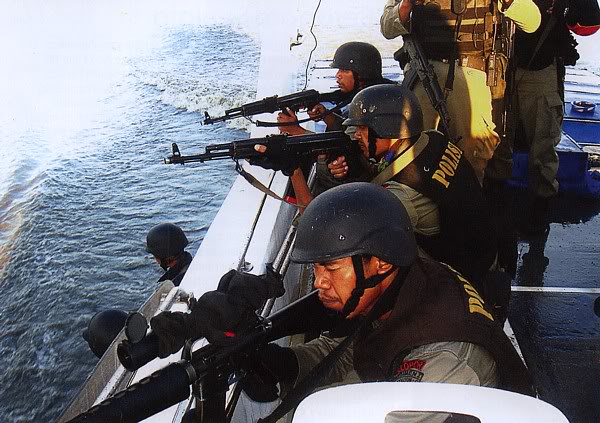
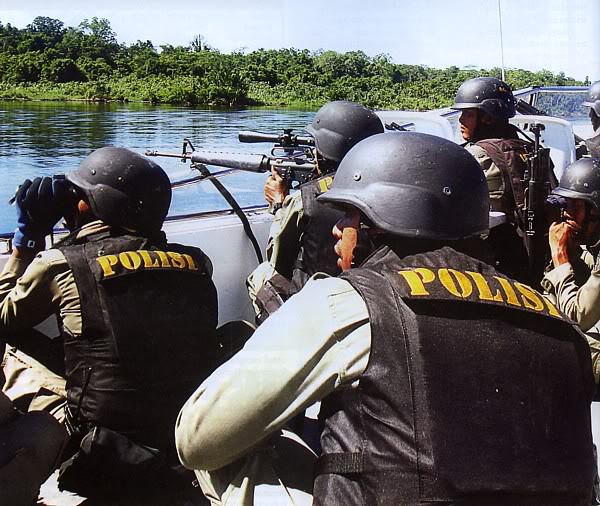
An Indonesian BRIMOB source today (Feb 9) sent West Papua Media these images of personnel from the Pelopor taskforce depicted in the footage above on their way via speedboat to conduct the operation to retake the airfield.  The individual officer in the foreground of the upper image has been identified as the cameraman and narrator of the footage.

West Papua Media apologises for the low-quality of the footage due to it being filmed on mobile phone in low resolution

A higher quality version of the footage is available to media upon application under strict conditions; unfortunately YouTube automatically loses quality during upload.  Please contact West Papua Media for arrangements

Australian Greens: Government fails to cut ties with torture unit

Australian Greens

Government fails to cut ties with torture unit

Media Release | Spokesperson Scott Ludlam

Wednesday 8th December 2010, 4:46pm

The Australian Greens have criticised the Government for failing to take action in response to allegations an Indonesian unit supported by Australian authorities has used torture against peaceful protestors.

On November 4 this year Greens legal affairs spokesperson, Senator Scott Ludlam, called on the Government to stop funding Detachment 88, an Indonesian “counter-terrorism’ unit that has been linked to a series of human rights abuses.

“Demonstrators arrested in Ambon, in Maluku, unveiled their independence flag at an event at which the Indonesian president was present – this had nothing to do with terrorism whatsoever. They were subsequently jailed and many of them tortured and hospitalised,” Senator Ludlam said. “70 political activists in Maluku have been imprisoned since 2007.”

The Department of Foreign Affairs and Trade reported this week that the total Australian Federal Police financial support for counter-terrorism initiatives in South East Asia in the 2009/10 was $16.3 million. DFAT said while the AFP is not directly involved in Detachment 88 operational activities, the AFP’s support to the Indonesian National Police includes that unit.

Senator Ludlam said that while Australian officials provide support to Detachment 88, it is not enough to leave investigations of the unit’s conduct in the hands of the Indonesian authorities.

“We are told the AFP does not have the power to investigate what Detachment 88 has done, but it does have the power to stop funding and supporting the unit,” he said. “The United States introduced a ban on training or assisting Detachment 88 members in Maluku in 2008 after the allegations of torture first emerged in 2007, but our Government has not issued a similar ban, which is much-needed.”

Detachment 88’s major facility at the Jakarta Centre for Law Enforcement Co-operation was established in 2004 with almost $40 million of Australian funding. According to its website, most of the counter-terrorism seminars at the Centre are run by the AFP, and it is a major beneficiary of $16.3 million in annual funding allocated to the AFP to combat terrorism in south-east Asia.

http://scott-ludlam.greensmps.org.au/content/media-release/government-fails-cut-ties-torture-unit

IHRC: NZ must not stand apart on torture by Indonesia

—————

Indonesia Human Rights Committee,

Box 68-419,

Auckland

7 December, 2010

Media Information:

IHRC has written to Minister of Foreign Affairs, Murray McCully, and to Minister of Defence Hon Wayne Mapp to urge them to act over the West Papua torture scandal,   a high profile issue at the time of the Foreign Minister’s October visit toJakarta.  A widely distributed video clip of Indonesian military personnel perpetrating shocking torture on two men in the highlands of Indonesian controlled West Papua has put Indonesia’s lack of military reform under the spotlight.  However,Indonesia has opted to try personnel involved in a separate less serious case of videoed abuse, in a blatant attempt to defuse international criticism.

“Mr McCully has an absolute obligation to follow this up as he was given personal assurances at the time of his visit that those responsible for the grave crimes depicted on the video would be investigated and held responsible.  He should now act with the Minister of Defence to suspend military training ties with Indonesia in the face of this evidence of ongoing abuse and military impunity.

The letter to the Ministers follows: Maire Leadbeater: 09-815-9000 or 0274-436-957

Indonesia Human Rights Committee,

Box 68-419,

Auckland.

Hon Murray McCully,

Minister of Foreign Affairs,

Hon Wayne Mapp,

Minister of Defence,

Parliament Buildings,

Wellington.

7 December, 2010

Dear Mr McCully and Mr Mapp,

You are aware that there has been international consternation over the case of the Indonesian security personnel shown inflicting brutal torture on two highland Papuan men. The video clip, recorded in May 2010, depicted one of the men having a smouldering stick applied to his genitals while his companion was repeatedly threatened with a knife.

Minister McCully was visiting Indonesia at the time that the torture video was circulating and was  assured by Indonesian  Foreign Minister Natalegawa that the Indonesian government was  ‘deeply concerned’ and would conduct a thorough investigation.  I understand that a  personal  undertaking was given that the findings of the investigation would be presented ‘transparently.’

The Indonesian authorities accepted that the video was genuine, but instead of acting to investigate and try those responsible, they moved quickly to charge and tried military personnel who were responsible for a separate case of videoed abuse.  This separate event took place in March and involved the beating and kicking of a number of bound villagers.  The charges meted out to the military personnel responsible were relatively light – terms of imprisonment of seven and five months, scarcely commensurate with these brutal crimes against civilians.

The ploy has been described by some as a classic ‘bait and switch’ operation clearly timed and planned to deflect international scrutiny of the human rights record of the Indonesian security forces.    Not only is there no indication by Jakarta of any intention to investigate and try the military officers involved with the more serious case of abuse, but a spokesperson from the Indonesian Defence Ministry told the Australian media that the case is now closed.

We understand that the Australian Government is continuing to put the case that the more serious torture case should be investigated in line with assurances given to Prime Minister Julia Gillard prior to her recent visit to Indonesia.

The Indonesia Human Rights Committee urges that New Zealand support Australia in its appeal for a full investigation and for those responsible for these grievous abuses to be held accountable. New Zealand should suspend its military training ties withIndonesia, in the face of such clear evidence of military abuse and ongoing military impunity

Tragically the events depicted in the videos are not isolated or unusual cases of abuse.

In the past week there has been an escalation of violence and several disturbing reports of security forces injuring and killing civilians.  On November 28 a farmer, Wendiman Wenda was killed in Yambi, Puncak Jaya as he returned home from Church. The report we received said that he did not hear when the security forces called out to him, and when he did not respond he was shot.

On December 3, near Jayapura an escaped prisoner was killed in a violent police raid.  Komnas Ham, the Indonesian Human Rights Commission has criticised the conduct of the raid which it described as ‘extra-procedural’. There are also other reports of recent violence including two Papuans being shot in Bolakme on December 1 and on December 4,  a young peace activist, Sebby Sembon,  was summarily arrested as he was about to board a plane.

In West Papua the right to dissent is not respected. Those who take part in peaceful demonstrations risk charges of ‘makar’ or rebellion and lengthy jail terms. Meanwhile those responsible for a documented case of extreme torture are escaping sanction.

New Zealand must not stand apart and we look forward to your response,

Yours sincerely,

Maire Leadbeater

(for the Indonesia Human Rights Committee)

Create a website or blog at WordPress.com

Up ↑