Papuan cultural parade blockaded then broken up by Jayapura Police

From KNPB and West Papua Media sources in Jayapura

February 20, 2014
https://westpapuamedia.info/wp-content/uploads/2014/02/565e1-dscf2364.jpg
Traditional Cultural Action, Jayapura, 17 February 2014

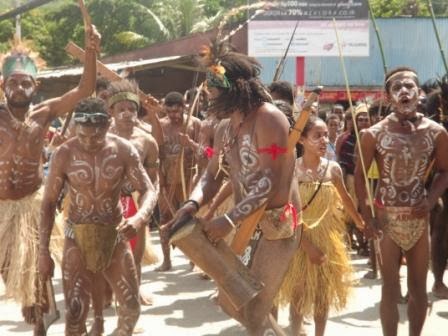
A cultural parade organised by university students in Jayapura was blockaded and then dispersed with force by Indonesian police on February 17, after Indonesian police refused to recognise West Papuan cultural expression.

The demonstration of culture, music, art and dance from across Papua’s indigenous tribes, in which several hundred students in two groups marched wearing traditional Papuan dress, was to highlight the demand of “Save the Papuan Culture”.  The manifestation was organised by the Youth Coalition for the Rise of Students (Koalisi Pemuda mahasiswa bangkit or KPMB) and the Cenderawasih University’s (Uncen) Student Executive Body (Badan Eksekutif Mahasiswa or BEM).

This slideshow requires JavaScript.

Speakers, songs and dances were performed from 8-10am local time in two locations, outside the Uncen Waena Housing Complex (Perumnas III) and in front of the post office in the town of Abepura, and at 10am, the Perumnas III mass began to march and dance their way to Abepura.

However Police blockaded the mass action once the crowd reached the Waena traffic lights.  Despite having previously notified police of their intention to hold the parade, field coordinators of the action were forced to negotiate with the police, pointing to the KPMB’s intention to hold a peaceful action that day in the form of Papuan cultural art.

However, in an outburst witnessed by a West Papua Media stringer, the Deputy Commander of the Jayapura District Police, the notorious hardliner Kiki Kurnia refused to let the gathering continue, warning the crowd that he would not tolerate “introducing some culture from an unknown place”.  “There is no such culture such as that in Indonesia,” Kurnia asserted, dismissing over 45,000 years of Papuan language, culture and art.

Kurnia then prohibited the students from displaying any form of Papuan culture, and further stated that the crowd “was prohibited from carrying out any action of any form whatsoever as the Governor had prohibited all forms of actions,”. according to independent sources and verified by WPM.  Just after 10am local time, ordered several platoons of heavily armed police to blockade and disperse the cultural gathering.  Several injuries were reported but unconfirmed.

After being forcefully dispersed,  a much larger mass returned and gathered in front of UNCEN’s main entrance, lighting a bonfire on the road in response.  According to witnesses, this crowd was spread out as far as Perumnas III in Waena, a distance of several kilometres.

According to the cultural event organisers, the crowd outside UNCEN was angrily voicing their objections to the continued silencing of the democratic space throughout all of Papua by the Police, with speakers expressing outrage at the betrayal of the culture of Papua.

“That the police had been obstructing the mass action stating ‘Where are you bringing this culture from? We don’t have any culture like that in Indonesia’ angered us all, as it is seen as a denial of the Papuan culture,” an organiser told West Papua National Committee (KNPB) media workers.

Members of the gathering clearly spoke out that if the police continued to betray and deny Papuan culture in such a way, that Papuans would mount an even larger scale action asserting the Papuan culture, and that they would boycott the 2014 presidential election, according to reports from the KNPB.  The action Coordinator Beny Wetipo then called upon the Papuan community and all parties to save the Papuan culture from being replaced by a foreign culture that was threatening the existence of the Papuan race.

Bobii: HAVING REACHED THE EDGE …….THE MSG COMMITMENT

January 12, 2014

Opinion/ Analysis

By Selpius Bobii

 The Melanesian Spearhead Group (MSG) is an official forum to develop friendship, harmony and the sense of family between Melanesian nations, with a mind to develop peace and prosperity in the region.

The MSG Forum is in truth not only something of those Melanesian nations which already have independence, but rather it is also something of those Melanesian nations that have not yet had their sovereign independence recognised and which continue to struggle to that end.

Accordingly there exists an obligation by the members of the MSG to be ready to receive as members those Melanesian nations (peoples) that have not in the past not had that opportunity; and secondly an obligation to defend the call for independence for those Melanesian peoples struggling for recognition of their sovereignty.

This critical role of the MSG lies within the framework of upholding the commission of the Universal Declaration of Human Rights together with other international laws including the International Covenant on Civil and Political Rights, the International Covenant on Economic, Social and Cultural Rights and the United Nations (UN) Declaration on the Rights of Indigenous Peoples. In the opening sections of each of these covenants and declarations, the right to self-determination of all indigenous peoples of the world is referred to.

The preamble of the Constitution of the MSG states the obligation of the MSG member states  to defend the right to self-determination of all Melanesian peoples which have not yet received full independence.  International legal determinations together with the MSG’s legal foundation, together give legitimacy to the MSG forum to defend Melanesian peoples (nations) that are struggling for full independence.  Such legal determinations can on occasion however give rise to divisions within the MSG itself due to differing opinions of members and can even threaten to divide the MSG. This may arise when a non-Melanesian nation’s control and colonial domination over a certain Melanesian people is perceived to be at risk and that nation reacts accordingly, resulting in different responses from respective Melanesian nations.

There is of course a code of ethics for international association between nations (for instance the respect of another nation’s sovereignty), however notwithstanding there also needs to be a greater awareness worldwide that independence is the right of all nations of peoples on this earth. That is stated both at international law and within the very law that applies to the MSG and these laws create a legal obligation to that end.  How much more important in the case of  peoples whose very continued existence is threatened by the colonial power!  Such is the case for the people of Papua where colonial domination by the Republic of Indonesia is leading to annihilation of the indigenous people of the land.

In the interests of mutual rights, justice and human dignity, MSG and other nations of the earth together with UN have both the legal and moral obligation to give an opportunity to those  peoples (nations) in the world that have not yet received independence to have their sovereignty legally recognised. It is really urgent that the MSG, UN and other nations of the world act on this obligation such that the position of all nations of the world may be on a level plane with no one nation able to continue to colonise and dominate another. This is absolutely critical in enabling progress towards the end goal of peace and prosperity for all peoples in the world and not just for a privileged few.

It was on the basis of this international commitment and the preamble to the Constitution of the MSG, that the MSG leadership at its 19th Summit in Noumea from 17-21 June 2013 made a decision that was all important in terms of the political and humanitarian status of Papua. Their commitment in regards to the indigenous people of Papua was clearly stated in points 20/21 of the Communiqué of the MSG, which is itself a valid and legal document. That decision was binding on all members of the MSG without exception and it is the obligation of all members of the MSG to respect and act in accordance with that decision. It will give great hope and joy to not only the people of Papua but also countless others, if every leader of the MSG is able to maintain their attitude and actions such that they are in accordance with this decision of the MSG.  In-keeping with that decision, to defend Papua’s sovereignty through official channels of the UN, by mediation between Papua and Indonesia and through dialogue regarding the political and legal status of Papua together with other problems.

The commitment of the MSG leadership is so closely tied to the issue of Papua and is now at the very edge and being seriously tested. The realities seen to date are that:

  1. There are certain members of the MSG that have not wholeheartedly respected and implemented the decision of the MSG leadership on 21 June 2013.
  1. There has been observed a lack of consistence of certain members of the MSG in regards to their commitment to the decision in Noumea and in fact there has been observed since that date an increase in the extent to which those particular MSG members have been working together in partnership with the State of Indonesia.
  1. The state of (1-2) above are a direct result  of Indonesia playing its ‘two-way’ political games; of continuing to carry out a range of operations aimed at suppressing the movement and activities of the Papuan Independence Movement, whilst at the same time increasing its level of campaigning and diplomacy towards certain members of the MSG.  (With Indonesia’s efforts in diplomacy have also been supported by a range of other ‘attractive offers’).
  1. Indonesia has also requested support of governments of other nations in this regard including both Australia and New Zealand, appealing to them to influence members of the MSG against supporting Papua’s application to the MSG.
  1.  Indonesia did not facilitate the agreed-on visit to Jakarta and Papua by an MSG delegation of Foreign Ministers within the 6 months time deadline from 21 June 2013 in accordance with the MSG decision.
  1. With the 6 months limit requirement of the MSG decision now passed, Indonesia has now on 11 January 2014 facilitated the visit of a MSG foreign minister delegation to Jakarta.
  1. Efforts have been made by Indonesia to prevent this MSG Delegation from visiting Papua during its visit to Indonesia.
  1. If it eventuates that the MSG Delegation is finally allowed to visit Papua during this present visit, then it’s highly likely that the Delegation will be prevented by Indonesia from meeting with key Papuan leaders and the leaders of the different components of the Papuan Liberation Movement.
  1.  All of the Indonesia Government’s efforts referred to above, have been made with the aim of causing Papua’s application to the MSG to fail.

At this time all peoples throughout Melanesia together with those in international solidarity, are keenly watching to see what steps and political direction will be taken by the MSG. Will the MSG maintain its earlier commitment and attitude on the Papuan issue or back down? Will Indonesia allow the Delegation to visit Papua at this time and allow them access to the key figures of the Papuan Independence Struggle including those currently imprisoned or will Indonesia block that access? Why be afraid?  Is not God with us?

This article has been written from behind prison bars for the purpose of strengthening our hearts and our faith in regards to the MSG Forum.  Let us remain strong and perseverant faced with this test.

Selpius Bobii is the  General Chairperson of Front PEPERA & Papuan Freedom Political Detainee held in  Abepura Prison, Jayapura

Catholic Church records many human rights violations in Wamena, Jayawijaya in 2013

From Papua Daily at Tabloid Jubi

January 1, 2014

The meeting between  church figures, police and community leaders (Jubi)
The meeting between church figures, police and community leaders (Jubi)

Wamena, 1/1 (Jubi) – During year 2013 there are many special alerts from community, traditional leaders and religious figures in Jayawijaya about conditions  of social, economics and politics in this district.

Father John Jonga, representative of the Catholic Church recognises the Catholic Church have recorded many violations of human rights during year 2013. Most violations are violations in the form of loss of rights to life, committed by the Armed Forces and the Police.

Father John said economic life has become increasingly difficult, because of economic programs that create dependence on government. Traditional economic life was destroyed as many gardens were abandoned.
“The price of basic necessities are very high and erratic (which is) a heavy burden on local peoples and disrupts the activities of the community.  For example before Christmas, gasoline rose to Rp100,000 (A$9) per litre, “said Father John to reporters at  Pilamo Cafe, Wamena, Tuesday (31/12).

In addition, Father John assessed the quality of health care in hospitals Wamena is still very bad. Local people complained about pharmaceutical quality, expensive price of pharmaceuticals, and even and clean water shortages. Some Public Health Centres even abandoned by health workers, and residents cannot be served.

The  increase in  HIV/AIDS cases was a record of the Catholic Church in Jayawijaya. The quality of education is very low.  Free educational programs do not run. Many schools outside the town of Wamena do not operate, resulting in many children dropping out of school and becoming street children in Wamena.

Julian Hisage, the Chief of Hubula’s, one tribe in Baliem Valley,  hopes that in 2014 the security forces can better appreciate the rights of civil society. Police also must act decisively against the perpetrators of crimes such as murder and suppliers of liquor.

“We also hope government  re-evaluates the programs, particularly the economic programs, so that more people can have economic independence, control the prices of goods and services in the town of Wamena, improve the quality of health care in hospitals and health centres in Wamena including the local health insurance programs, and improve the quality of education, “said Julian Hisage to reporters.

On the other hand, Jayawijaya Police Chief, AKBP. Johnny Eddizon ISIR, S.ik, who facilitated this meeting acknowledged that the input from community, traditional leaders and religious figures in the meeting should become a subject of evaluation for the police in order to better (their actions) in the coming years.

“Police cannot move without holding hands together to prevent conflicts that happen. So in the year 2014 it is expected any existing conflict potential can be prevented,” said Jayawijaya Police Chief. (Jubi/Islami/Victor Mambor)

Edited for clarity by WPM

BRINGING AN END TO THE CONFLICT IN PAPUA THROUGH JAKARTA-PAPUA DIALOGUE

Opinion / Analysis

By: Selpius Bobii

December 31, 2013

Peace is critical to the continuation of life for human beings, though we find it hard to achieve in even our everyday lives. West Papuan Nehemia Yarinap stated that “Christ Jesus came to bring peace to the earth, however the characteristics of humans are such that they sometimes fail to reach peace and truth due to acting in the interests of political economics, oppressing other nations of peoples in the name of peace. At this time in the modern world, there are  powerful nations oppressing and usurping the rights of other nations.” Yarinap’s points to the annexation of the sovereign independence of the nation of Papua into the Republic of Indonesia, commenting “ to realise peace and justice in Papua so many have sacrificed themselves and continue to sacrifice their lives just as Jesus Christ sacrificed himself to bring peace to humans on this earth….. Christmas reminds all people about peace and speaks to us that those characteristics that oppress other nations must change.”(1)

The dynasty of tyranny of Indonesia is now firmly established in Papua. In all areas of life  the Indonesian State has firmly established those pillars that ensure the continuation of Indonesia’s oppression, even in religion. Indonesia has to that end consistently brought  pressure to bear on those key Papuan figures in the churches who have continued to speak openly about the realities of discrimination, marginalisation, injustices and humanitarian atrocities that are occurring against the indigenous people of Papua. There have been accusations made that those such church persons too are themselves involved directly in the politics of Papua. Accusations that are particularly of recent times aimed at weakening the case for dialogue between Jakarta and Papua which has been encouraged by particular church figures.  If the Church also becomes a pillar of support for this dynasty of oppression by Indonesia, then the church itself will in so doing lose both its very foundation as well as its direction.  In that instance the church would be torn from its very roots and mission as handed down by Jesus Christ, being to save the world.  The church in Papua  must stand strong as a beacon of hope to the people and not become a partner of the State of Indonesia in the colonial domination of the indigenous people of Papua.

The Papuan Writer Usman Yogobi stated that “ The countenance of the Church in the land of Papua is such  that it has become  a partner for the Indonesian Government, with some reverends, bishops, pastors, pilgrims and monks supporting the colonial domination of the land of Papua. ‘Papua the Zone of Peace’ as declared in 2002 has never been realised, with the reality being quite the opposite – Papua has become a region of humanitarian disaster!

The term ‘Zone of Peace’ which arose from leaders of the different religions in Papua in 2002, has even been adopted recently by the Indonesian Military Commander in Papua (XVII) and the Head of Papuan Provincial Police. They have used the term in speech, letters or on banners, whilst in practice the Indonesian military and police have continued to carry out acts of violence and human atrocities against the indigenous people of Papua” stated Yogobi. The Church in Papua needs to learn and better understand its mission as handed down by Christ Jesus, being to bring salvation to the world. The salvation of souls is not just a matter of becoming oriented with the hereafter, but rather it’s about saving lives on this earth.

The law of the church prohibits representatives of the church being practically involved in politics, however at the same time it’s important to understand that the very teachings of the churches stress the importance of the church being involved in a real way in the life of the people. There is no such thing as evangelisation without social involvement; no such thing as mission without the struggle for justice. The church has a moral responsibility to be socially involved and to fight for justice and for respect of the dignity of humanity.

Dialogue between Jakarta and Papua which is being urged by the Peace Network of Papua – coordinated by the Catholic Priest Neles Kebadabi Tebay (Pr) – is a part of the involvement of the church in the upholding of justice and the respect of humanity dignity. If the church only speaks of justice and criticises human rights violations but does nothing to point to a way to bring an end to the conflict in Papua, then the human rights violations in Papua will continue without ceasing. Rather the church needs to itself open a way or point to a way forward.  Dialogue between Jakarta and Papua is a way of enabling such discussion as required to deal with  the many problems so as to find a dignified solution to the Papuan issue.

So let’s work together to lead the way to bringing about dialogue between Jakarta and Papua to find a solution that upholds the dignity of all.  Indeed there are more than one way to bring about an end to the problems in Papua and it is important that other approaches being made are also continued such as the legal approach and the United Nations decolonisation approach.  And as we struggle let’s always remember that the Struggle of Papua does not use violence or physical force but rather our means are always peaceful. As wherever violence is used there are inevitably human victims lost and indeed Indonesia has and continues to kill Papuans by a range of violent means. Over this more than 50 years endless innocent victims have been killed as a result of Indonesia’s actions in Papua. There’s been enough killing by Indonesia. Let’s bring an end to this cruel colonial domination using strictly peaceful means.

Indonesia and Papua really need to be enlivened to bring this about and its important we leave any narrow thinking paradigms. As the consequence of such is but to extend this conflict and more fallen victims, which are not small in number. Let’s take this never-ending conflict between Papua and Indonesia to the table and carry out unconditional peaceful dialogue as between two equal parties, facilitated by a neutral third party and in a third and neutral location. The international community including the USA has previously expressed its support for the path of dialogue between Jakarta and Papua; and it is the Writer’s conviction that all those who seriously uphold the values of the human rights, democracy, truth, justice, honesty and peace will also support a peaceful and dignified approach to finding a solution to bring an end to the problems in Papua. So let’s all work together to make dialogue between Jakarta and Papua a reality!

The Indonesian President Susilo Bambang Yudhoyono  has numerous times stated in speeches that the problems of Papua will be brought to an end in a peaceful and dignified way. Also is recalled the words of the Head of the Council of Presidential Advisors Dr Hasibuan in January 2013, that the President had promised to arrange dialogue between Jakarta and Papua during the year 2013. However that promise has not yet been fulfilled.  A ‘promise’ is as something that is owed and must be paid and President SBY needs to fulfil that promise. It is dearly hoped that before President SBY’s term as president comes to a close on 20 October 2014 that this very extended conflict between Indonesia and Papua can be brought to an end through peaceful and dignified means and that it might become the hope of all parties to make that a reality.

Footnote

  1. 1.        The Bible of the Christian Religion  talks about the ‘Garden of Eden’ that radiated the glory of God and where there was peace and prosperity.  Where there were no wild beasts but rather all creatures lived together in peace. Then it is written, that peace was destroyed by the wrong of the first humans and therein began anarchy on the earth. Humans in all places seek after that peace which the Bible speaks of. Yet we see in the world that powerful humans prey on those weaker than themselves. The rich get richer and the misery of the poor becomes greater.

Selpius Bobii is the  General Chairperson of Front PEPERA & is a Papuan Freedom Political Detainee in Abepura Prison, Jayapura


Bobii: Indonesian Armed Forces, the main Anti-Peace Agents in Papua

By Selpius Bobii  writing from Abepura State Prison, Jayapura

 Opinion

December 24, 2013

Every religion teaches values of goodness and kindness and has teachings that are intended to create happiness and peace on this earth and in eternity.  We hear so many people speak of the importance of peace, but the reality is that it’s not that simple to realise peace in our everyday lives. In the Papuan province of Indonesia it feels like peace is so far from becoming a reality for the indigenous people who live there.

Of late the Cenderawasih XVII Military Commander in West Papua has been coining the phrase “Peace is beautiful” and yet at the same time the Indonesian Armed Forces continue to be the number one culprit committing acts of violence and humanitarian atrocities against the indigenous people of Papua.  Behind the mask of these sweet words the Armed Forces are clearly acting very much against the creation of peace in Papua.

 Peace can be realised in a place when every person, every group, every faction, respects the rights of others; and this extends to nations and tribes. Where each is able to exercise their rights and at the same time fulfils their obligations towards others. It seems however in Papua that the realisation of peace is something that’s incredibly difficult to achieve, with the root cause of that being the lack of recognition of the very basic political rights of the people of Papua by all three Indonesia, the USA and the United Nations (UN).

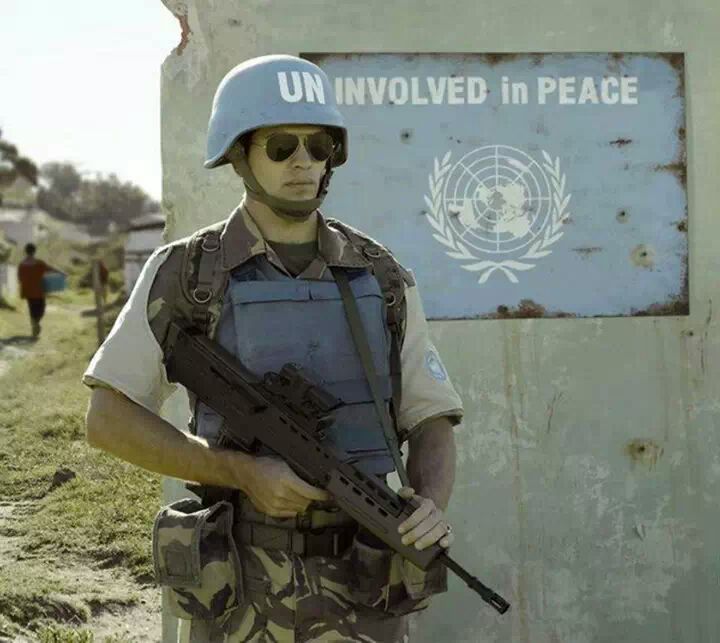
(UN)involved in Papua's desire for Peace; very involved in its atrocities (Photo: Public domain)
(UN)involved in Papua’s desire for Peace; very involved in its atrocities (Photo: Public domain)

With the USA and UN’s active support throughout the entire process of annexation of Papua into Indonesia in the 1960’s, they indeed played a part in the actions of violence and atrocities against the indigenous people of Papua.  They achieved their goal of making Papua into ‘the kitchen of the world’, opening it to the many international companies that have been stripping Papua of its rich natural resources ever since. It was not to end at the annexation of Papua, as they have continued these last more than 50 years to support Indonesia’s hold on Papua which in turn keeps the door open for exploitation of the land.  There have been various forms of aid and in particular joint programs in security and defence, which of course are critical to Indonesia’s continued domination of Papua.

The Indonesian Armed Forces have by intention made Papua into a centre of conflict, but for what end?  In so doing they create a situation where the indigenous people can be paralysed, can be annihilated and the world just keeps quiet, with Indonesia saying they are dealing with the conflict. The result?  Papua remains permanently part of Indonesia and its natural resources can be exploited with ease by international parties.

Let’s not be fooled that the partnerships going on between Indonesia and other nations of the world in the areas of security and defence are aimed at peace building and protecting the people of the region as claimed. Nothing could be further from the truth! The reality is they have quite the opposite goal! The Indonesian Armed Forces are the main agents intentionally creating violence, bondage and theft of natural resources, discrimination, marginalisation, injustice, terror, intimidation and humanitarian atrocities against the indigenous peoples of the land of Papua. Their military and civilian operations both overt and covert are intended to slowly but surely annihilate ethnic Papuans.

The many forms of both visible and hidden violence and humanitarian atrocities undertaken by the state of Indonesia against indigenous Papuans are intended to stifle the political aspirations of Papuans for independence and at the same time annihilate the people. In the face of this continued violence against their people the indigenous peoples of Papua continue to express their opposition to the many human rights violations by peaceful and dignified means, primarily by means of peaceful demonstration. Yet even the narrowest space for a voice calling for democracy has been blocked by the Armed Forces in recent times, especially by the Provincial level of Indonesian Police.  The Provincial Police are known for their practice of taking advantage of occasions when there are peaceful demonstrations to create conflict and to terrorise, torture, kill, arrest and imprison Papuans who struggle peacefully for change.  Indonesia’s Armed Forces are constantly manipulating activities of the Struggle to create incidents of violence. Nevertheless Papuans continue to struggle peacefully in keeping with their decision at the 2000 2nd National Papuan Congress.

And so in the midst of all this, now it is Christmas. Where all parties in Papua hear of the message of ‘the coming of the King of Peace’.  A message that reminds humanity that Jesus Christ came to bring peace to this earth.  A message that starts to have real meaning only when entire communities of humans make space to allow for peace in their hearts.  To that end let’s all prepare our hearts with simplicity, faithfulness, honesty and love for one another. We are each one of us reminded by the message of Christmas.

It is dearly hoped that the message of Christmas will also touch hearts and bring awareness to those who are committing the many forms of violence against indigenous Papuans. That there might be a commitment to bring an end to all forms of oppression towards indigenous Papuans and to enter into dialogue between Jakarta and Papua with a neutral facilitator. To reach that end we need to be ready and willing to humble our hearts, to be faithful, honest and to act in love. Only in that way can we bring peace to the land of Papua.  We are all called to bring an end to the latent conflicts in Papua and to create peace, no matter who we are and wherever we may be.

Peace and joy at Christmas to all and throughout 2014!

Footnote:

  1. 1.       The Dutch previously tried to prepare Papua to become an independent nation whilst still under their control, with those preparations reaching a peak on 1 December 1961. However less than a month later on 19 December 1961 Indonesia by a political and military invasion marked by what’s known as Trikora (a three prong command which demanded the dismantlement of the “puppet” Papuan state created by the Dutch; the raising of the Indonesian Red and White flag over Papua; and preparation for a general mobilisation in Papua) succeeded in annexing Papua into the Indonesian Republic.

Selpius Bobii is the  General Chairperson of Front PEPERA & is a Papuan Freedom Political Detainee imprisoned in  Abepura State Prison, Jayapura, Papua, for another Christmas.


Create a website or blog at WordPress.com

Up ↑