POLICE SEIZE FUEL, OWN GAS STATIONS IN NABIRE, PAPUA

by John Pakage for West Papua Media

Wednesday, 28 March 2012

Opinion

PROTESTS AGAINST FUEL PRICES INCREASE SWEEP INDONESIA AND PAPUA

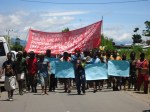
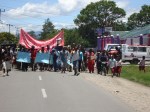
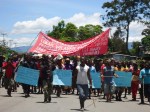
In Nabire, Papua, there are gas stations owned by active Police officers, and rumours are circulating that security forces are manipulating subsidized fuel stocks in Papua. While in Papua Police officers own gas stations, elsewhere Police officers are seizing fuel belonging to civilians. Take for example the case in Tuban, East Java: on March 22, 17 drums of diesel fuel were found by police during sweeping raids to counter fuel hoarding in anticipation of the Indonesian government’s increases to fuel prices which come into effect April 1 2012.

Besides this, Police Inspector-General Saud Usman Nasution, Division Head/Community Relations, also stated that there have been no fewer than 266 charges laid in 232 cases of fuel hoarding in Kalimantan, with a further 11 cases still under investigation. If Police are empowered to seize people’s fuel, then who can tackle the Police’s control of fuel stocks in Papua?

Meanwhile though the price of fuel has yet to increase officially, in Papua and especially in the areas of the interior, fuel prices have already skyrocketed up to Rp. 20 000-30 000 ($2.15-3.25 USD) per litre, leaving one to wonder: just how high will prices rise after April 1?

To oppose the program of the SBY (Susilo Bambang Yudhoyono)-Boediono government to raise fuel prices from Rp. 5000 to 6500 ($0.55 to $0.70 USD), mass protests have spread throughout Indonesia. With students and workers leading the way, it is not simply party cadres demonstrating, but even housewives are taking to the streets and refusing to accept the government’s policy.

Regrettably, at the time of these massive demonstrations, President SBY, who was selected by the Indonesian people, has not even been present in Indonesia. Will the President answer the demands of the people, meet with them and comment on their aspirations? Until now no such word has been uttered by the President.

Many parties judge fuel prices increase to be unrelated to world fuel price fluctuations but rather intended simply to increase net revenues, as suggested by Hendrawan Supratikno, member of Committee 5 of the People’s Legislative Assembly (DPR), Tuesday March 27.

Of course, the increase to fuel prices is felt directly by the people, such that a coalition of Papuan students from different Universities in Jayapura have demonstrated in front of the Papua People’s Legislative Assembly (DPRP), Tuesday March 27.

Alas, the government seems unwilling to alter its fuel increase policy even facing masses of thousands organizing actions all over Indonesia.

Still, the efforts to pressure the Indonesian government continue. These actions have brought victims: the protest in Jakarta left 15 people injured after a clash with police at Gambir, Central Jakarta; the victims were taken to Cipto Mangunkusumo Hospital (RSCM).

Here are the names of those hospitalized, as posted at RSCM Emergency Department:

1. Fajar, student from Univertas Pamulang (UNPAM)

2. Makmun, student from UNPAM

3. Pungky, student from UNPAM

4. Erwin, student from Palu, South Sulawesi

5. Fariz, from Lenteng Agung

6. Ahmad Sofyan, student from UNPAM

7. Okki, student at IISIP

8. Alif al hafidi from Bogor

9. Alan Fitnur from Cirebon

10. Moch Taufik

11. Moh. Imam, student from BSI

12. Idris Syahrian, PDIP officer, Bekasi

13. Ahmad Bagja from Komplek Depag, Tangerang

14. Bribtu Dhany, from Mako Den B, Pelopor Cipinang

15. Zein, student from Sulawesi

Besides this, in Makassar as well, Metro TV has reported on the beating of a student by Police. The student’s condition is of course cause for serious concern.

Meanwhile, President SBY continues to sojourn overseas. To counter the mass demonstrations, SBY has deployed thousands of Military (TNI) troops as well as fully armed Police units. Not only this, but Interior Minister Gamawan Fauzi asserted that if the legislation confirming the fuel price increase is made law then local and regional officials known to participate in protest actions will be fired.

The increasing authoritarian and undemocratic character of the State is becoming more visible, as laws guaranteeing freedom of public expression are being pushed aside.

The Interior Minister’s pressure has not succeeded in reducing the number of state officials joining in voicing the people’s aspirations. In East Java, Mayor of Surabaya Bambang Dwi Hartono, who is also a cadre of PDI-P (Indonesian Democratic Party – Struggle Faction), joined the protests rejecting the President’s policy.

Responding to the grave threat from the Interior Minister towards the Mayor of Surabaya, Bambang Dwi Hartono stated that he was chosen by the people of East Java therefore the Minister may go ahead and fire him.

The Mayor’s weighty decision is an example worthy of emulation: putting one’s position on the line for the good of many.

# John Pakage/westpapuamedia

Thousands across Papua demand UN step up to protect Papuan people: PHOTO AND VIDEO REPORT

Ban Ki-moon with Indonesia President Susilo Ba...
Ban Ki-moon with Indonesia President Susilo Bambang Yudhoyono (Photo credit: Wikipedia)

PHOTO AND VIDEO REPORT

from the West Papua Media Editorial team, and local sources across Papua

March 21, 2012

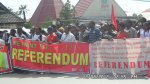
Rallies held across West Papua, Indonesia, and Australia have drawn tens of thousands of people on to the streets calling on UN Secretary-General Ban Ki-Moon to do more to protect West Papuans to Indonesian state violence, and to allow them exercise their universal human rights to self-determination.

Despite significant threats of violence prior to the rallies by Indonesian security forces against peaceful unarmed protestors, the mass mobilisations across West Papua significantly outnumbered security forces and were peaceful.  In some centres, the police only sent a handful of undercover intelligence agents to monitor the situation.

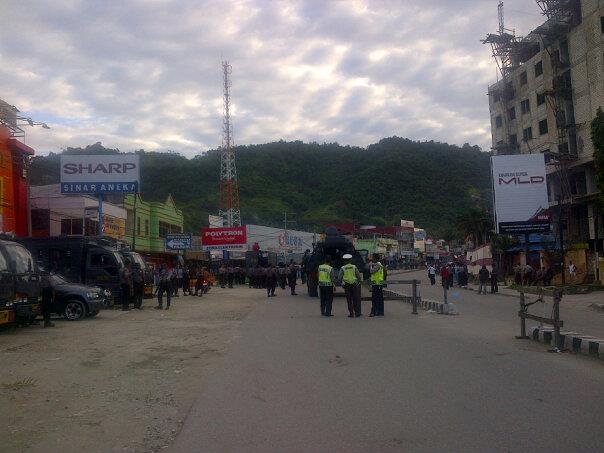
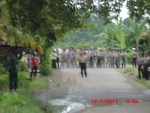
Security forces blocking access to Jayapura (photo Matias Murib)

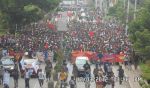
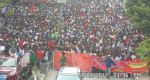
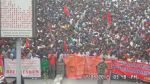
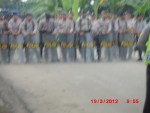
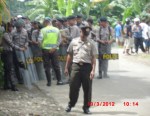
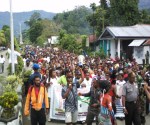
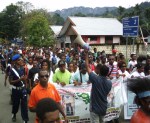
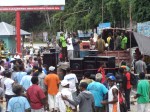
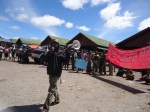
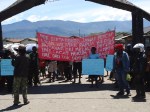
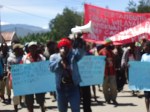
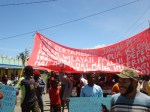
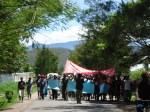
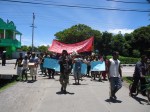
In Jayapura, over 5000 demonstrators marched from Taman Imbi and joined with a long march of several thousand people.  Security forces blocked access to the centre of Jayapura with heavy weaponry, but the rallies avoided provocation.  Jayapura was reported to be a ghost town as the rallies paralysed normal business and movement.

[youtube http://youtu.be/1Y0jMhuygXE] [youtube http://youtu.be/Zjz3Vj4Mv3A] [youtube http://youtu.be/xNgwCGiqB6E] [youtube http://youtu.be/lStemYrVRIo] [youtube http://youtu.be/IcoGo4fXRBY]

Speakers in Jayapura demanded that the UN Secretary-General listen to the people of West Papua and tabled seven key demand on the UN.  Buchtar Tabuni, from the West Papua National Committee (KNPB) told the crowd that the UN must take responsibility for its role in the sham 1969 Act of Free Choice handover of West Papua to Indonesia, actions that violated international law.

“Ban Ki-Moon and SBY have to know the wishes of the sovereign independence of Papua on the land itself.  KNPB will mediate the West Papuan people so they can determine their political choices through a mechanism that is democratic, peaceful, dignified and final in accordance with the principles and standards of international law”, said  Tabuni.

Jayapura

Herman Wainggai, a West Papuan  the West Papuan independence advocate based in the United States explained at the solidarity rally in Melbourne, Australia, “Our troubles began in New York in 1962, and I hope they will end there soon. We ask the United Nations to host talks between the Indonesian Republic and the Federated Republic of West Papua, just as the UN did between the Indonesians and the Dutch”

Ban Ki-Moon was visiting Indonesia to participate in  The Jakarta International Defence Dialogue, hosted by the Indonesian Ministry of Defence on 21 March 2012, a move widely seen by human rights observers as giving legitimacy to Indonesian militarist objectives over West Papua and beyond.

West Papuan activists called on Mr Ban to use the opportunity to press Indonesia on human rights in Papua and its consistent denial of basic freedoms and rights to West Papuan people, including rights to life and of freedom of expression, and freedom from arbitrary detention.

“We would like Mr Ban Ki-moon to attend to our defence while he’s in Jakarta” said Herman Wainggai,

“The Universal Declaration of Human Rights establishes the right of all individuals to freedom of opinion and expression and the right to peaceful assembly and association. Also,  Indonesia is a signatory to International Covenant on Civil and Political Rights (ICCPR), which guarantees the rights to freedom of expression and peaceful assembly and Indonesia’s constitution also protects these rights,” Wainggai told West Papua Media.

“So,  it would be appropriate for the Secretary-General to negotiate the release of all political prisoners in Indonesia while he is visiting the new ‘Peacekeeping’ Centre in West Java,” said Wainggai.

Widespread Mass Actions

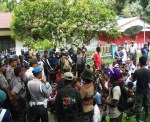
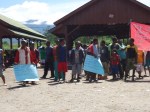
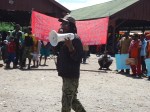
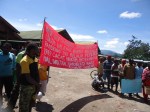
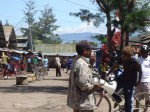
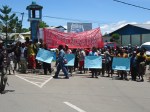
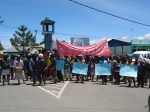
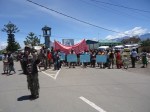
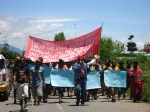
The rallies across Papua drew tens of thousands of people in total in Wamena, Biak, Serui, Yapen, Sorong, Nabire, Jayapura and Fak-Fak.  Security forces engaged in their standard procedures of intimidation and disruption at all rallies, but protesters maintained non-violence discipline at each area.

On Yapen island, close to 6000 people in total held two long marches to support the demands of the day, all under threat of arrest.  Local police had refused to issue a permit for the rallies to go ahead, claiming the rallies would upset the security and integrity of Indonesia.  After a week of pamphleteering and socialising the rallies, police had no choice but to allow the rally to go ahead.  The rally began in the village of Mantembu, where former political prisoner Yawen Wayeni was brutally disembowelled and filmed by Brimob police in a video leaked on Youtube in 2010.

Mantembu, Yapen Island

The same Brimob unit on Monday attempted to block the long march from leaving Mantembu, using over 50 police to block the narrow road, and attempted to seize all Morning Star flags.  Negotiations ensued, led by Reverend Jhon Pairire and FRWP Doberay Governor David Abon, who got agreement from police for the rally to continue to Serui city.  Police continued to intimidate Papuans all day, but Morning Star flags still appeared throughout the day despite Police.

Serui, Yapen Island

Manokwari saw more than 7000 people from across Papuan society and resistance raise the Morning Star flag and conduct long marches all over town after prayer, eventually settling down to listen to orations from a wide range of speakers.  Speakers called for the freeing of all political prisoners in Papua in Indonesian prisons, including the President and the Prime Minister of the Federal Republic of West Papua.  Brimob officers tried to seize the Morning Star flags early unsuccessfully, but soon stood aback training their weapons on the crowd, who studiously ignored the provocative intimidation according to stringers for West Papua Media.

Manokwari

In Sorong, our stringers reported that almost 1000 people took to the streets in a festive atmosphere.  Organisers claimed that few security forces turned up other than about ten plain clothes intelligence agents.  “It is clear that this drastically changed the atmosphere, it must be because of international pressure,” said our stringer by SMS.

On the West Coast in Fak-Fak, almost 1000 people took part in prayers and listened to speeches in the main market square, with little interference by security forces present.

Fak-Fak

In Jayapura, stringers for West Papua Media reported a wide range of colourful, festive and dramatic demonstrations for Papuan aspirations, including the release of almost 300 balloons painted with banned Morning Star flags and the UN flag, which drifted across town and out to sea.  This tactic has been used repeatedly as a tactic for distributed symbolic resistance in both Papua and Maluku for years.  Isolated gunfire was heard when the balloons passed over military barracks, according to local sources, believed to be Indonesian soldiers attempting to shoot down the balloons.

And in Wamena, in the Baliem Valley, a thousand people joined in a rally and march to support the call for the UN to take action by sending peacekeeping force to protect Papuan people against Indonesian security forces.  Stringers for West Papua Media report that few security forces were in overt attendance, but there was an understanding that troops were close by at all times.  The Baliem Valley and West Papuan highland people have borne the brunt of Indonesian violence since the occupation began, with sweeps against civilians by the Australian funded Detachment 88 counter terrorism group and Indonesian army still ongoing in Tingginambut, Mulia and the outer areas of the Baliem Valley.

Wamena

More demonstrations are planned in coming weeks.

westpapuamedia

Rallies calling on Ban Ki-Moon to protect Papuans to be held across Papua and Australia, on March 19

Reprinting Press Release 19 March 2012 from FRWP spokesperson

 
RALLY:  Federated Republic of West Papua
TUESDAY, 19 MARCH 2012, 11:30am-1:30pm
State Library, 328 Swanston St (cnr Swanston and La Trobe Sts), MELBOURNE
complementing rallies in Jayapura, Sorong, Biak, Yapen-Waropen, Manokwari, and Fak Fak
West Papuan independence advocates are questioning the UN Secretar
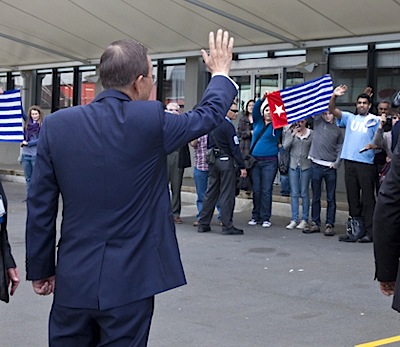
Ban Ki-moon waves to protestors for West Papua, PIF NZ Sept 2011
y-General’s presence—as a keynote speaker—at The Jakarta International Defence Dialogue, hosted by the Indonesian Ministry of Defence on 21 March 2012.
“We would like Mr Ban Ki-moon to attend to our defence while he’s in Jakarta” said Herman Wainggai, the West Papuan independence advocate based in the United States.
“The Indonesian government brands us as separatists, and then hosts international fora to escalate support for what it says are ‘non-war military operations’ against us”.
Forkorus Yaboisembut, President of the Federated Republic of West Papua, currently incarcerated, requests the Secretary-General to recognise the leadership of the Federated Republic of West Papua elected at the Congress in October in 2011.
“The United Nations recognizes West Papua’s right to self-determination, and is therefore responsible for organising properly constituted peace talks, with itself mediating between the Federated Republic of West Papua and the Indonesian government.”
Edison Waromi, Prime Minister of the Federated Republic of West Papua, also incarcerated last week for another three years (he was also a political prisoner 1989—1999, 2001, 2002, 2003-2004) says the Secretary-General must actively insert himself into the West Papuan issue.
“The 564,126 missing Papuans since 1962, more than half-a-million people, should galvanize UN intervention.  And I believe the Secretary-General should also, while visiting Jakarta’s new Peacekeeping Centre this week, negotiate the release of all political prisoners in Indonesia.”
Many international observers believe that Indonesian political fears, that their republic will dissemble in the face of West Papuan self-determination, is misplaced.
“Holland didn’t fall over when Indonesia became independent, and neither will Indonesia when we do” said Wainggai. “Bali principles, Lombok treaties, Peace centres in West Java….these are all meaningless while Indonesia continues to escalate its troops and its judiciaries against us”.
Media Inquiries and Interviews
Please contact West Papua Media for direct contacts on the ground in the follwoing locations:
MELBOURNE, SORONG, BIAK, YAPEN WAROPEN, MANOKWARI, JAYAPURA , and FAK FAK.
PLEASE NOTE: RALLIES TO ALSO BE HELD BY WEST PAPUA NATIONAL COMMITTEE (KNPB) ACROSS PAPUA AND INDONESIA: DETAILS FORTHCOMING

Two West Papuan Community led Ecological Struggles

From our friends at Hidup Biasa

http://hidupbiasa.blogspot.com/2012/03/west-papuan-community-ecological.html and http://hidupbiasa.blogspot.com/2012/03/tablasupa-nickel-minings-drilling-rig.html

Two West Papuan Community Ecological Struggles

On the sidelines of the Papuan People’s struggle for self-determination, at a local level Papuan communities continue to resist the logging and mining industries that are destroying their forests. Here are two stories of recent community resistance from areas close to the Papuan capital Jayapura, translated from the Alliance for Democracy in Papua website http://www.aldepe.com.

1. Seeing their forest destroyed, Arso Villagers Burn Five Logging Camps.

Annoyed by hearing the sound of chainsaws almost every day, and in addition the reports of villagers who regularly enter the forest telling of finding loggers’ camps there, around 20 people from Arso, both young and old, agreed to check the forest for themselves.

Community Resistance against logging (file photo: "The forest eats the forest-eater" by manukoreri.net/westpapuamedia)

This area of forest is commonly called the ‘Golden Triangle’, and is divided between the territory of three villages, Arso, Workwana and Wambes.

As they had guessed they would, once inside the forest they found two sites used by loggers, which had been connected with a track made from offcuts of wood which the loggers would use, dragging the wood from behind a vehicle.

At the first site there was only one camp. At this camp they confiscated two chainsaws and took statements from three loggers who were at the location. They then forced the loggers to leave.

The group continued to the next location. Possibly because the loggers had received information from their friends at the first site, there was only one person left, and they didn’t find any chainsaws.

As their emotions rose some people almost hit out at the logger, but were held back by others. At this second location, four camps were found, complete with televisions, speakers, supplies of food and clothing and so on.  Two vehicles used for dragging wood were also found.  In their emotional state, the people destroyed and burned the camps and everything they found there, along with the camp at the first location.  The two vehicles were also burnt.

According to statements from the loggers, they had been given permission by the customary chief of kampung Workwana, although the Arso villagers felt that they had been cutting trees far inside the Arso territory.

Several people interviewed in kampung Arso on Tuesday 6th March explained that they were still angry “It’s so sad to look at that forest, they even cut very small ironwood trees.” said Wenderlinus Tuamis, a youth who had participated that day.

Meanwhile, according to Franky Borotian, they had been allowing the logging to continue because previously a villager from Workwana had asked to use wood to build her house “a sister had asked for permission to build a house, but then it turned out someone used that permission for business purposes”, he said.

The problem has been passed over to the Customary Council (Dewan Adat).  Villagers asked the Customary Council to use their wisdom to resolve the situation so that conflicts between the people would not emerge.  Especially since the Golden Triangle had become the area which people rely on for food, as other areas have been taken over by two big oil palm plantations, state-owned PTPN II and PT Tandan Sawita Papua (Part of Peter Sondakh’s Rajawali Group)

source: http://www.aldepe.com/2012/03/merasa-hutannya-dirusak-warga-arso.html

2. Tablasupa Nickel Mining’s Drilling Rig Burned, Three Imprisoned

On the morning of 8th February 2012, local people from kampung Tablasupa, near to the Papuan capital Jayapura, burned a drilling rig belonging to the mining company PT Tablasupa Nikel Mining.   The action was connected to an ongoing conflict between local people and the company, which plans to mine nickel on 9629 hectares of land, and is currently carrying out exploration activities.   Although the company has been given a permit by the local Jayapura Bupati’s office, the people of Tablasupa feel that their rights as the holders of customary rights over the land have not been respected.

Two weeks after the machine was burnt, on February 20th,  police arrested
three villagers. Saul Sorontouw, Lambertus Seibo and Kanisius Kromisian.
They have been charged under article 170 of the Indonesian penal code, and are being held in Jayapura police headquarters. While in prison Saul Sorontouw has been ill with gout, which has caused swellings in his knees.  On February 28th police demanded statements from another six villagers, but they were allowed to go home that evening.

The following statement was released by villagers of Tablasupa the day
before the action:

Statement of opinion of the Sorontou-Okoseray-Kiswaitou Ethnic Group
As holders of rights to customary lands on the area covered by PT Tablasupa Nickel Mining’s Mine Enterprise Permit (IUP), Mining Rights (KP) and the Bupati’s recommendation that allows exploration in Kampung Tablasupa, Jayapura Regency

Regarding the as yet unresolved problems around PT Tablasupa Nickel Mining commencing exploration activities on customary land belonging to the people of kampung Tablasupa, the Sorontou- Okoseray- Kiswaitou ethnic group wishes to make the following declaration:

“Reject PT Tablasupa Nickel Mining” conducting exploration and mineral exploitation activities within the customary boundaries of the Sorontou- Okoseray- Kiswaitou ethnic group.

The reasons for our rejection of mining activities are as follows:
1. The whole territory of kampung Tablasupa is unsuitable for mining
activities.

2. The impact of mining activities would also damage the environment of
areas that fall within the territory of neighbouring villages.

3 To avoid mining activities causing conflict with the people and nearby villages.

4. The effect of mining activities will damage and desecrate the environment, and industrial pollution from the mine will contribute to global warming and affect the sources of clean water from the Cyclop mountains.

5. No consensus has been reached through a musyawarah system that would
represent an agreement between the people of Tablasupa and neighbouring
villages.

6. The holders of customary rights to the land have not given their approval (under the Law on Mineral and Coal Mining 4/2009 article 135, companies holing a Mine Enterprise Permit can only commence activities if they have obtained agreement from the holders of customary rights on that land).

7. The customary and human rights of the Sorontou- Okoseray- Kiswaitou
ethnic group must be respected and valued by all.

A solution to the development of kampung Tablasupa which supports the
social economy and also contributes to local business could include:
-building beach tourism and hotels
-developing fishing
-selling fresh water.

Such development would involve all the people of Tablsupa either as workers or taking roles in a management structure and could take the form of an enterprise or foundation that was formed by the people of kampung Tablasupa.

This is the message that the Sorontou- Okoseray- Kiswaitou ethnic group wishes to be known by the general public.

Tablasupa, 07 February 2012 .

Sources: http://www.aldepe.com/2012/02/polisi-menahan-3-tiga-warga-sehubungan.html ; http://www.aldepe.com/2012/03/saul-sorontouw-sakit-di-tahanan-polres.html ; and other articles on http://www.aldepe.com
statement: http://groups.yahoo.com/group/Komunitas_Papua/message/2952

‘Pro M’ Aspirations are guaranteed under the law: Police chief

“….But violations will be dealt with”

Bintang Papua, 7 December 2011

Jayapura: Activities that are conducted by people, such as freedom of
assembly and the expression of opinion or aspirations such as pro-independence for West Papua (‘M’) which are being promoted by some
West Papuan people are guaranteed under the law, said the Chief of
Police Police-General Drs Timur Pradopo, speaking after participating
in a dialogue with stakeholders about accelerating development in West Papua at the office of the governor of Papua.

He went on to say that if this freedom of assembly and talking about
independence aspirations are done in ways that violate the law, it is the responsibility of the police to enforce the law. Nevertheless,
before the law is enforced, certain steps need to be taken. If, for
example, the persons who assemble wish to present their views, it is up to the police at the local level (Polsek) or the regional level (Polres), backed by the regional police chief along with the rest of society and religious leaders, to take action for their protection but they should not act in violation of the law.

‘This is what is always done by police officers in Papua (Polda, Polres, Polsek), so as to safeguard the activities of each side.’

He said any violation of the law will be dealt with by the police. And furthermore, action will be taken against police officers who violate the law, such as maltreating people in the community.

He went on to say that if anyone feels that they have been harmed by the presence of the police, this should immediately be reported, along with facts and data, and there will be a response from Polsek, Polres, Polda or even the chief of police (Kapolri) will deal with the matter when the law has been violated.

‘No one is immune, including police officers.’

Asked whether there could be an increase in the number of police, taking into account the current security situation in Papua, the police chief said that there is no plan in the coming days for the number of police to be increased But what is being done is enforcement of the law.

‘It is the task of the police to preserve a situation of security in
Papua and this should be done in a proper way in order to ensure that
the plans for development and activities by the people can proceed smoothly.

[COMMENT: A shift towards greater leniency seems to be in the air]

[Translated by TAPOL]

Create a website or blog at WordPress.com

Up ↑