Bobii: Indonesian Armed Forces, the main Anti-Peace Agents in Papua

By Selpius Bobii  writing from Abepura State Prison, Jayapura

 Opinion

December 24, 2013

Every religion teaches values of goodness and kindness and has teachings that are intended to create happiness and peace on this earth and in eternity.  We hear so many people speak of the importance of peace, but the reality is that it’s not that simple to realise peace in our everyday lives. In the Papuan province of Indonesia it feels like peace is so far from becoming a reality for the indigenous people who live there.

Of late the Cenderawasih XVII Military Commander in West Papua has been coining the phrase “Peace is beautiful” and yet at the same time the Indonesian Armed Forces continue to be the number one culprit committing acts of violence and humanitarian atrocities against the indigenous people of Papua.  Behind the mask of these sweet words the Armed Forces are clearly acting very much against the creation of peace in Papua.

 Peace can be realised in a place when every person, every group, every faction, respects the rights of others; and this extends to nations and tribes. Where each is able to exercise their rights and at the same time fulfils their obligations towards others. It seems however in Papua that the realisation of peace is something that’s incredibly difficult to achieve, with the root cause of that being the lack of recognition of the very basic political rights of the people of Papua by all three Indonesia, the USA and the United Nations (UN).
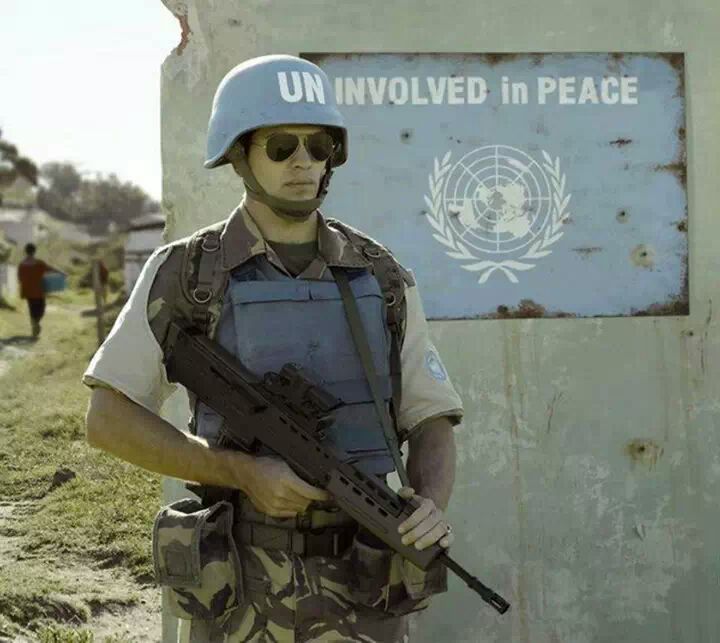
(UN)involved in Papua's desire for Peace; very involved in its atrocities (Photo: Public domain)
(UN)involved in Papua’s desire for Peace; very involved in its atrocities (Photo: Public domain)

With the USA and UN’s active support throughout the entire process of annexation of Papua into Indonesia in the 1960’s, they indeed played a part in the actions of violence and atrocities against the indigenous people of Papua.  They achieved their goal of making Papua into ‘the kitchen of the world’, opening it to the many international companies that have been stripping Papua of its rich natural resources ever since. It was not to end at the annexation of Papua, as they have continued these last more than 50 years to support Indonesia’s hold on Papua which in turn keeps the door open for exploitation of the land.  There have been various forms of aid and in particular joint programs in security and defence, which of course are critical to Indonesia’s continued domination of Papua.

The Indonesian Armed Forces have by intention made Papua into a centre of conflict, but for what end?  In so doing they create a situation where the indigenous people can be paralysed, can be annihilated and the world just keeps quiet, with Indonesia saying they are dealing with the conflict. The result?  Papua remains permanently part of Indonesia and its natural resources can be exploited with ease by international parties.

Let’s not be fooled that the partnerships going on between Indonesia and other nations of the world in the areas of security and defence are aimed at peace building and protecting the people of the region as claimed. Nothing could be further from the truth! The reality is they have quite the opposite goal! The Indonesian Armed Forces are the main agents intentionally creating violence, bondage and theft of natural resources, discrimination, marginalisation, injustice, terror, intimidation and humanitarian atrocities against the indigenous peoples of the land of Papua. Their military and civilian operations both overt and covert are intended to slowly but surely annihilate ethnic Papuans.

The many forms of both visible and hidden violence and humanitarian atrocities undertaken by the state of Indonesia against indigenous Papuans are intended to stifle the political aspirations of Papuans for independence and at the same time annihilate the people. In the face of this continued violence against their people the indigenous peoples of Papua continue to express their opposition to the many human rights violations by peaceful and dignified means, primarily by means of peaceful demonstration. Yet even the narrowest space for a voice calling for democracy has been blocked by the Armed Forces in recent times, especially by the Provincial level of Indonesian Police.  The Provincial Police are known for their practice of taking advantage of occasions when there are peaceful demonstrations to create conflict and to terrorise, torture, kill, arrest and imprison Papuans who struggle peacefully for change.  Indonesia’s Armed Forces are constantly manipulating activities of the Struggle to create incidents of violence. Nevertheless Papuans continue to struggle peacefully in keeping with their decision at the 2000 2nd National Papuan Congress.

And so in the midst of all this, now it is Christmas. Where all parties in Papua hear of the message of ‘the coming of the King of Peace’.  A message that reminds humanity that Jesus Christ came to bring peace to this earth.  A message that starts to have real meaning only when entire communities of humans make space to allow for peace in their hearts.  To that end let’s all prepare our hearts with simplicity, faithfulness, honesty and love for one another. We are each one of us reminded by the message of Christmas.

It is dearly hoped that the message of Christmas will also touch hearts and bring awareness to those who are committing the many forms of violence against indigenous Papuans. That there might be a commitment to bring an end to all forms of oppression towards indigenous Papuans and to enter into dialogue between Jakarta and Papua with a neutral facilitator. To reach that end we need to be ready and willing to humble our hearts, to be faithful, honest and to act in love. Only in that way can we bring peace to the land of Papua.  We are all called to bring an end to the latent conflicts in Papua and to create peace, no matter who we are and wherever we may be.

Peace and joy at Christmas to all and throughout 2014!

Footnote:

  1. 1.       The Dutch previously tried to prepare Papua to become an independent nation whilst still under their control, with those preparations reaching a peak on 1 December 1961. However less than a month later on 19 December 1961 Indonesia by a political and military invasion marked by what’s known as Trikora (a three prong command which demanded the dismantlement of the “puppet” Papuan state created by the Dutch; the raising of the Indonesian Red and White flag over Papua; and preparation for a general mobilisation in Papua) succeeded in annexing Papua into the Indonesian Republic.

Selpius Bobii is the  General Chairperson of Front PEPERA & is a Papuan Freedom Political Detainee imprisoned in  Abepura State Prison, Jayapura, Papua, for another Christmas.


Key Findings of the Biak Massacre Citizens Tribunal

http://www.biak-tribunal.orgBiak Massacre Citizens Tribunal

WaterTowerCrop1

December 16, 2013

Key Findings

  1. 1.      The massacre followed a flag-raising led by Filep Karma, an Amnesty International Prisoner of Conscience

Filep Karma testified at the tribunal via prerecorded video since he is currently in prison.  He told the tribunal: “In my oratory [at the flag-raising] I said that Papuans must fight peacefully.” “The flag appeared on the top of the tower on July 2, 1998, at about 5:00 a.m. Some seventy-five people gathered beneath it, shouting freedom slogans, singing songs and dancing traditional dances” (Human Rights Watch 1998: 6).

At 2:30 in the afternoon of July 2 “a joint police and military operation attempted to disperse the crowd at the base of the water tower.  They launched canisters of tear gas into the crowd with no apparent effect.  When a low-ranking police officer, a second-class sergeant, beat an elderly demonstrator named Thonci Wabiser, the crowd spontaneously retaliated, demolishing a truck belonging to Indonesian security forces” (Kirksey 2012: 44).  A standoff ensued for days.


  1. 2.      Local and regional officials were involved in the planning of the attack

Tineke Rumakabu testified that two officers of the Indonesian security forces were at the water tower on July 3rd.  These commanders—namely Colonel Agus Hedyanto, who was Biak Military Commander (Dandim) and Colonel Johnny Rori, the Biak Police Commander (Kapolres)—negotiated with the crowd and asked that the flag be lowered.  These same commanders were later involved in planning the attack.  “At 1:00 a.m. on July 4, the local military brought nine village heads together to discuss a strategy for attack, and both the subdistrict head (camat) and the subdistrict military commander told the village heads that each man was responsible for bringing thirty men into the city.” (Human Rights Watch 1998: 8).

Octovianus Mote, former Bureau Chief of the Kompas daily newspaper, gave testimony based on his interviews of regional military and police commanders in July 1998.  Major General Amir Sembiring, the Regional Military Commander (Pangdam Trikora), was in a direct command and control position during the attack.  According to direct evidence tendered by Mr. Mote to the Tribunal, Sembiring “gave permission to conduct the attack.”  Mr. Mote also corroborated reports that Colonel Agus Hedyanto, who was associated with the Special Forces and who served in East Timor, was the key local official involved in Biak.  “This was a very well-organized military attack, you know police, navy, and armed forces.  All of them organized the attacking of civilians,” continued Mr. Mote.  Brigadier General Hotman Siagian, the Regional Police Commander (Kapolda IrJa), was quoted by Antara news agency as saying “the police had ‘tolerated’ the actions of the Biak group since July 2 and finally had to order a crackdown” on July 6th (Prakarsa 1998).  Vice Admiral Freddy Numberi, who was then Governor and is currently Indonesia’s Minister of Transportation and Communications, described the victims a members of a “separatist movement that is headed towards treason” (Suara Pembaruan Daily, 8 July 1998).  General Wiranto, Commander of Indonesia’s Armed Forces, told reporters when asked about the massacre: “If there is a power that raises a flag, and it is not the Red and White flag [of Indonesia], then this is a betrayal of the military and of the entire nation.  This constitutes a betrayal and this is what we must stop!” (Suara Pembaruan Daily, 7 July 1998, punctuation in original).

  1. 3.      Scores of unarmed civilians were killed, buried in mass graves, and dumped at sea

A video testimony, by a woman named “Sarah”, described how the security forces initially surrounded the protestors in a giant letter U.  “The military and the police were lined up from the police compound around to the Inpress market.  The mobile brigade police (Brimob) that had flown in from Ambon were stationed at the petrol station.  Navy troops were down at the harbor.”  She describes how they were all shooting, “from four directions,” including the sea.

One woman, who testified to the Tribunal on condition of anonymity, described the first moments of the attack at dawn on July 6th: “The army and police were everywhere.  Bullets were raining down.  The sky was on fire.  We could hear them shooting people at the tower.”

Another witness, who testified under the pseudonym Raymond, described how he rushed to the water tower along with scores of other civilians as the shooting began.  After watching as many women and men were gunned down, Raymond was herded with other survivors towards the harbor.  He described how he was forced to stare at the sun, kneel in gravel for hours, along with dozens of others.

Sarah gave corroborating testimony: “My family and others were directed down to the harbor…We followed the other families with our hands up over our heads.  You could feel the bullets starting to fly over our heads…I could see so many children who had been killed.  They were shot on the wharf.  They died right there.”  Shortly after she arrived at the wharf, she overheard a Sergeant shouting out to the commander of a navy vessel: “Dock the ship!  Dock the ship!  Carry these people!”  She also overheard the reply from the captain: “I cannot dock, the ship is full of bodies.”  Sarah said that two ships then went out to sea.  “They were there at the harbor in the morning, there to take the bodies away.”  Later on “in front of the wharf a blue truck pulled up and took 28 bodies away,” Sarah said.  “I was sitting and counting, silently.  People who they had shot, they threw their bodies on the truck.  Later another container truck came in and took more bodies away.  We don’t know where they were taken.”

Ferry Marisan, Director of the human rights organization ELS-HAM Papua, investigated the killings in the weeks after the massacre and was a lead author of the subsequent report, “Names Without Graves, Graves Without Names.”  Mr. Marisan described how a fisherman first encountered dead bodies in the sea, off shore of Biak, on July 10th, four days after the massacre: “The fishermen discovered four bodies floating, but these fishermen were scared to take the bodies on shore…The bodies were mutilated, some of them lost their legs or their genitals were not there.  They were broken bodies. These bodies were found in the eastern part of Biak, but also in the western part of Biak people found other bodies.”  Mr. Marisan also gave direct testimony about a body he helped recover: “Near Biak city, just around the park, we found a female body without a head and genitals that was badly bruised and broken, damaged.  Another body we found was just a boy from junior high in his uniform.  Most bodies we found were badly damaged.  Either they lost their legs, the heads or their genitals.”

  1. 4.      People were beaten, tortured, arbitrarily detained, sexually abused, and executed

Raymond presented testimony about indiscriminate beatings by police at the harbor.  He was taken with six truckloads of people to the regional police station (POLRES).  Fourteen people were crammed with Raymond into a cell.  Raymond was detained for two weeks and in the middle of the night guards routinely doused him with water during his detention.

Statements from Tineke Rumakabu, describe graphic scenes of sexual violence and torture after she was detained by Indonesian forces.  Mrs. Rumakabu described how she was tossed into a yellow truck on the morning of July 6, on top of people who were already dead or seriously wounded.  She was then taken to the military compound (KODIM).  Mrs. Rumakabu showed the Tribunal scars on her arms and described what was done to her while she was blindfolded and cuffed: “They cut my arm with a sharp bayonet and then they poured acid. When I screamed they burnt me with cigarettes.”

The blindfold was later removed and she was stripped naked in a room with twelve other women and girls.  “Then I saw a man [a soldier] showing me a little knife, the one that you use to shave, and he said ‘We are going to use this to cut off your vaginas, from above and below, and from the left to the right.’”  “I saw a little girl and they raped her and she died,” Mrs. Rumakabu told the Tribunal. “All over the place it was blood everywhere because women, their vaginas and clitoris’ had been cut out, and they had been raped many, many times.”  One of the women in detention, Marta Dimara was a friend of Mrs. Rumakabu.  “Martha said, ‘I would rather be killed than you rape me.’ They put a bayonet in her neck and then her vagina and also cut off her breasts and beheaded her.”  Mrs. Rumakabu told the Tribunal: “I was also tortured, a lit candle was penetrated inside me, they cut off my clitoris and they raped me.”  Out of the twelve women in detention with her, she reported: “Eight women were killed and four of us stayed alive.”


  1. 5.      Weaponry and equipment from international donors was used

At least two Navy ships were involved in the attack:

KRI Teluk Berau (534), Type 108. Source: Human Rights Watch Report, page 9 and corroborated by Eben Kirksey in a 2003 interview with an eyewitness. This ship belonged to the former German Democratic Republic (East Germany) and was manufactured in 1977 by VEB Peenewerft in Wolgast.  It was purchased, along with 12 other units of the same type, by the Indonesian Navy and transferred on August 25th 1993.  Formerly named the GDR Eberswalde-Finow (634), this ship was 90.7 meters long and weighed 1,900 tons.  It was used as an amphibious landing ship by the Indonesian marines (Marinir TNI AL).  The KRI Teluk Berau was armed with “a double barrel cannon with a caliber of 37 millimeters, a Bofors 40mm anti-aircraft gun and multipurpose autocannon, and two double barrel cannons with a caliber of 25 millimeters.”  (Source: Koramatim 2012)[i]

KRI Kakap (811), Source: Eben Kirksey’s photograph from July 6th, 1998.

The KRI Kakap-811 is a Fast Patrol Boat that was manufactured by PT. Pal Indonesia and has been in service since 1988.  It is armed with a Bofors 40mm and 20mm anti-aircraft guns and multipurpose autocannons as well as 12.7 mm machine guns.  This ship can carry one helicopter (Source: Koramatim 2013).

Sources Cited

Human Rights Watch (1998) “Indonesia: Human Rights and Pro-Independence Actions in Irian Jaya” Vol 10, No. 8 (C)

Kirksey, Eben (2013) Freedom in Entangled Worlds: West Papua and the Global Architecture of Power (Durham: Duke University Press).

Koarmatim (2012) “KRI Teluk Berau-534 Mengakhiri Pengabdiannya,” Available on-line: http://koarmatim.tnial.mil.id.  Updated: 28 September, 2012, 11:34.  Accessed: 12 November, 2013, 12:53

Koarmatim (2013) “KRI Kakap-811 Siap Amankan Perairan Perbatasan RI-Philipina,” Available on-line: http://koarmatim.tnial.mil.id.  Updated: 11 November, 2013, 13:51.  Accessed: 25 November, 2013, 23:18.

Prakarsa, Patrisia (1998) “Indonesian Troops Wound 24 in Irian Jaya Shooting” Agence France Presse, July 6.

Suara Pembaruan Daily (1998) “Menhankam/Pangab Jenderal TNI Wiranto: Pengibaran Bendera Bukan Merah-Putih Tindakan Makar” Suara Pembaruan Daily, 7 July.

Suara Pembaruan Daily (1998) “Akibat Kerusuhan di Irja” Suara Pembaruan Daily, 8 July.

POLICE ACCUSED OF USING OTHER PRISONERS FOR THE ILL-TREATMENT OF YASON NGELIA

From our partners at Tabloid Jubi

by Benny Mawel

December 15, 2013


Aksi Pengalangan Dana Pegobatan Yazon
Raising money for treatment for Yazon Ngelia (Photo:Jubi/Mawel)


Jayapura,15/11— The Student Representation Council of the Politics and Civil Faculty at Cenderawasih University (DPM-FISIP-UNCEN) harshly condemns the parties responsiblefor  the imprisonment of Yason Ngelia, Chairman of the Executive Student Body (BEM) of the FISIP department, in Jayapura. Yason’s current condition brings a flood of disappointment as he is not in a good (physical) state as a result of the imprisonment.

The parties responsible for the imprisonment of Yason are the Papuan Governor and the Papua People Assembly.  The Cenderawasih University, with the involvement of 29 lecturers, have written an academic draft of the Special Autonomy Plus for Papua (or called for a Special Autonomy Papuan Government (for Papuans to run the provincial government). However, an individual student has reported he was physically abused by Yason which led to his arrest.

The recognition of the abuse against the student is the reason police have detained Yason, which led to the refusal of the students’ draft Otsus Plus.  Yason’s struggles to protect Papuan People from murder is systematically criminalised by the government through the acts of the police.

“The rector does not yet appear to be handling this problem,” said Septi Medoga, the head of the Student Representation Council of FISIP at Cenderawasih University to a reporter in front of the university gate in Waena-Abepura in Jayapura. (12/12)

The individual who claimed to be a victim of abuse from Yason, according to Septi, has never wanted to meet with members of BEM FISIP who want to solve this problem internally. “The student doesn’t want to meet with us.” He said.

Until today, according to Septi, Yason’s physical condition is declining rapidly as a result of his incarceration. “The police are using three other prisoners to beat Yason. His right temple has ruptured, his cheeks are bruised, his bones are broken and his back has been kicked hard,” said Septi, who spoke with Yason when he visited him in jail. This beating occurred on 20th November 2013 in the detention room of the police station in Jayapura.

Yason’s condition is rapidly deteriorating and he has not yet received any medical treatment. “We assess this to be neglect from the police, the e university, and of those who claim to be a victim of abuse from Yason, those who have dragged him behind bars” said Septi.

Because of this situation, Septi has taken the initiative to lead his friends to raise funds for the medical treatment Yason needs. “We will give the funds raised to Yason to give him the medical treatment he needs.” Early demonstrations occurred in front of the Cenderawasih University gates on Thursday. (12/12)

The fundraising will go from Monday (16/12) and will be placed at various central locations, like Expo taxi terminal, Abe Circle, and other universities in Jayapura.

The right to medical treatment is a fundamental human right for Yason, regardless of his status as a suspect. Septi is urging the Papua Emergency Health Unit (UP2KP) to take a step towards helping Yason. “We ask for Dr Alo Giyai to lend a hand to check Yason’s condition” he said.

When we asked about Yason’s release, Septi claims the head of BEM FISIP should be freed today, but the reason why not is still unclear. “The power of the law to send a letter of suspending the detention on 24th November, then until today there is still no reply from the police” he said.

Meanwhile, Pontius, the coordinator of fundraising for Yason’s medical treatment, hopes his activist friends from GEMPAR will stop demonstrations demanding for Yason’s freedom by blocking the gates of the universities, because this will slow down the process for his release. “Friends, please demonstrate without blocking the gates to campus, if they are kept shut, Yason’s release will take longer” he said.

This is definitely an internal problem that only the rector has no intention of solving a problem as trivial as this. “I am amazed with us having this institution. This institution has the authority to solve this problem alone, however the rector is hiding from it” said Pontius.

Editor : Victor Mambor

Translated by West Papua Media Translation team

Key OPM Figure Danny Kogoya dies from injuries from Densus 88 shooting

danny kogoya in vanimo
Danny Kogoya. Photo: Liam Cochrane/ ABC

From our partners in Jayapura, MAJALAH SELANGKAH with additional reporting from West Papua Media

December 16, 2013

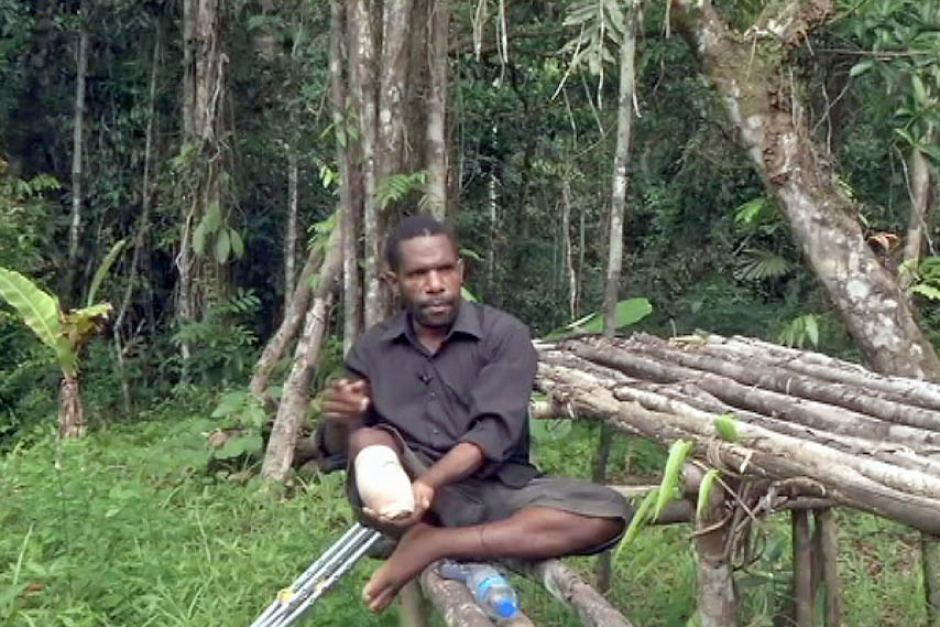
A well known figure in the armed wing of the Papuan Independence Organisation (Organisasi Papua Merdeka (OPM)) Danny Kogoya, is reported to have died at a location in PNG close to the Indonesian PNG border on Sunday (15 December 2013).

A contact for majalahselangkah.com in Jayapura explained that Kogoya died as a result of an infection in his right leg, which had been amputated following being shot  when arrested by Police in Jayapura at the Dani Hotel in Entrop Jayapura on 2 September 2012.

Police at the time said Kogoya was attacked due to him being a suspect in a shooting at Jayapura and was shot in the foot when trying to flee through the back of the hotel. Following being shot he was taken to the police hospital (Bhayangkara) at Kotaraja for acute medical treatment.

He was then detained in a cell at the Jayapura Police Headquarters, after which he was moved to the Abepura Prison. He faced the State Court (Class I.A) in  Jayapura for suspected involvement in the abovestated shooting but was eventually released by the law.

Once released he went to Camp Victoria (an OPM Camp) close to the border between PNG and Indonesia. Whilst there a member of the governing forces in the border region sent a photo of Kogoya to the police in Jayapura, resulting in him being yet again threatened with arrest. So finally he fled to PNG.

The journey to PNG led to an infection in the wound where his foot had been amputated, so he was given traditional treatment in the forest of PNG. At that time he was quoted by the ABC as having urged the leaders of the OPM who had gathered at Camp Victoria, to continue the struggle to separate from Indonesia.

“ My foot has been cut-off because I am a member of the OPM and I personally urge for independence (for Papua). Papua must be independent of Indonesia” stated Danny Kogoya to the ABC.

Kogoya’s Body to be Taken Home

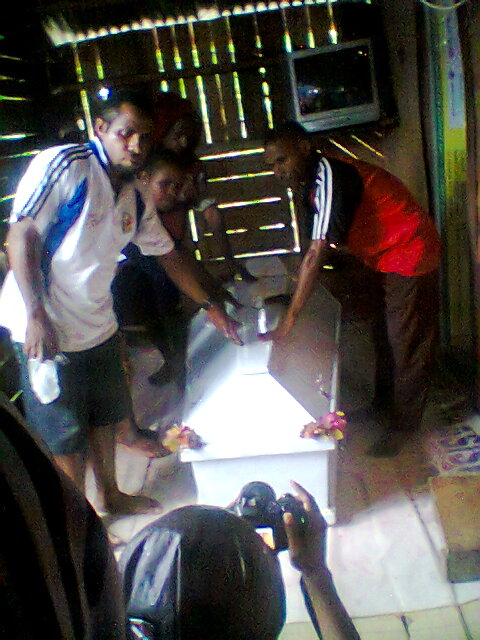
Activist Matius Murib wrote on Facebook  that it was planned for the body of the late Danny Kogoya to be taken back to Papua to be buried. He stated that coordination and administrative requirements to enable that had already been arranged.

“In relation to the plan to send the body of a Papuan activist Danny Kogoya from Vanimo, PNG back to Jayapura city this date (16/12/2013), technical coordination at the border and the arranging of administrative matters, protection and family to receive the body at Vanimo have already been organised and the family have guaranteed security in regards to the order of things and also that all will run smoothly” noted Murib on Facebook.

He requested the Police to not enter the area in the vicinity of the funeral home at Kamkey Abepura. Journalists have been banned from joining the funeral ceremony from the time of the funeral procession, at the funeral home and until the end of the funeral proceedings.

On Tuesday afternoon, stringers for West Papua Media had reported that heavily armed police and army had deployed in their hundreds around the home area of Kogoya outside Jayapura, escalating an already tense situation.  Our sources have also reported that no protest actions are planned, amid intelligence agencies actions to focus on a propaganda campaign discouraging local residents from commemorating Kogoya’s death.  According to our stringers, present in Jayapura, this campaign of broadcasts and public announcements is threatening the use of force if any mourning “crosses over to support pro-independence”.

The situation is being monitored closely, and may escalate.  For urgent updates, please see our Twitter feed @westpapuamedia .

(AE/GE/IST/MS/WPM)

(Translated by West Papua Media)

Related articles

EYE WITNESS SAYS MATIAS TENGKET WAS EXECUTED BY A GROUP OF PEOPLE

By Benny Mawel at Tabloid Jubi

November 28, 2013

Jayapura, 28/11 (Jubi) – The family of Matias Tengket and the chairman of the West Papuan National Committee (KNPB) of the Sentani region has discovered the chronology of the murder of Matias Tengket who was found dead in the Kali Kamp Wolter estuary at Sentani Lake, a day after the KNPB mass murders by police, last Tuesday (26/11).

Matthius Tengget before his burial.  (photo: Songgolom Pahabol/WPM)
Matthius Tengget before his burial. (photo: Songgolom Pahabol/WPM)

KNPB received this chronology from a Sentani male citizen who was unwilling to mention any names. KNPB regards this male as an eye-witness.

During the time of the event, the eye witness was fishing at the Sentani Lake which is likely to become a location for execution. This location is not far from the discovery of the corpse, still in Kali Kamp Wolter estuary, on the shore of Sentani Lake, behind the Museum or Expo Waena Pavilion, Jayapura city, Papua.

The Sentani KNPB chairman, Alen Halitopo, stated that when the Police chased the crowd, Matias Tengket ran to hide from being physically harmed. He ran into a street on the edge of Kali Kamp Wolter reaching the estuary. “A black Avansa car chased him from behind. The car stopped in front of Matias. The people armed with weapons pushed and shoved him,” said Alen in Matis Tengket’s funeral home, in Hawai, Sentani, Jayapura Regency, Papua, Wednesday (28/11).

At that time, according to Alen, there were children fishing. People who were armed with the weapons chased the away the children who were fishing by pointing their weapons at them. At that moment the children ran in fear and fled.

One of the children who was at that time fishing told the events of the situation and also saw the immediate execution process of Matias. “He saw, while running, people pulling Matias onto a boat. They struck him with the end of a weapon,” continued Alen.

The time went very fast. According to Halitopo, the eye witness who told the story to them suspected that Matias was already dead before he entered the boat. “They drove the ship quite far into the centre of the lake. They then returned to where the Avanza was parked and hereafter moved to Waena Mega Mall,” he said.

The eye witness is very well acquainted with the family (Matias’ family?) in Sentani. “He immediately telephoned us during the event of the shooting at the estuary. Three people fell into the water,” said Alen.

At that time, said Alen, KNPB members could not go to check because the moment had already passed. The Police were on guard everywhere. “The same morning, I sent two people to the location. A good friend of Matias’ stood rigid in a fishing net. They pulled his head and flipped his body to take two to three photos,” he said.

A KNPB member cannot take a lot of photos. Maybe there were the people who telephoned the Police. Because it was not long before the Police arrived. The friends fled from the location. They went home and thought maybe the police will contact them.

“We will see. Mr Pilipus Halitopo contacted us to go see the corpse which was located at the Bhayangkara hospital. We went and checked that it was actually a member of the Sentani KNPB,” he said.

When the KNPB director arrived at Bahayangkara hospital, police chief Abe, AKP Decky Rumpasanny said something that was not plausible. “Police chief Abe said to us, how could you eat this raw (kami-kamu baku makan itu bagaimana – an expression, meaning “how can you accept this raw story as fact?”)?  Maybe he meant the Sentanti person who killed Matias. We are not consumed (we are not concerned) with the issue,” he said.

According to Alen, KNPB could not believe that irrational sentence because he had found out the chronology of events just recently from the eye-witness. “We don’t need to kill anyone, when it is not related to the conduct of Indonesia’s security force,” Halitopo asserted.

Previously, The AKBP Jayapura Police Chief, S.IK to journalists in Jayapura stated, the corpse which was discovered is named Matias Tengket, found by a citizen and is located in Polri Bhayangkara hospital in the capital. From the hospital reports it was revealed that there were no signs of violence or mistreatment to the victim’s body, therefore it has been determined to have not been related to the riot pursuit towards KNPB actions. While the corpse is bruised, according to Police, it is suspected that the victim recently passed away or shortly before being found.

The family of Matias Tengket has refused to have an autopsy performed on Matias Tengket.

(Jubi/Mawel) – Translated By West Papua Media Translation Team

Create a website or blog at WordPress.com

Up ↑