President of Senegal – “West Papua is now an issue for all black Africans”

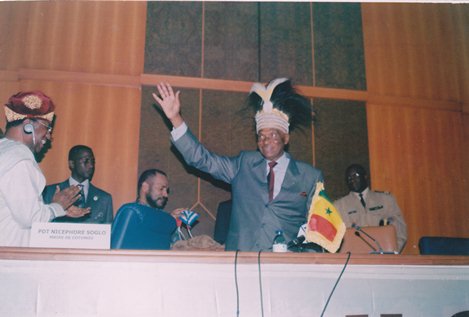
The President of Senegal, Abdoulaye Wade,  has become the first African leader to publicly back West Papua‘s bid for independence, stating that ‘West Papua is now an issue for all black Africans’.

His comments came last week during a conference in Senegal’s capital Dakar, attended by Benny Wenda, a West Papua independence leader who was granted political asylum by the British Government in 2003.

Benny Wenda addressed the audience, telling them about the situation in West Papua and his own struggle to bring independence to his homeland.
Following his address he presented the President with a Papuan headdress, and was warmly embraced by him. The President then addressed the audience, urging all African nations to take attention to the West Papua issue and do whatever they can to help.

Senegal is a country south of the Sénégal River in western Africa with a population of over 15 million. The current President was re-elected to power in 2007.

British Lord Mayor backs West Papua’s freedom bid

Oxford Town Hall in the UK has been flying the West Papua flag from its roof for the past 3 days in a show of support for West Papua’s independence struggle.
The gesture came about after a meeting between exiled tribal leader Benny Wenda and the Lord Mayor of Oxford four years ago. Since then, Oxford Town Hall has flown the flag every year on West Papua’s independence day.

West Papua Media Alerts previously reported on how the Indonesian Embassy in London had last year put pressure on the UK Foreign Office to outlaw the raising of the West Papua flag at Oxford Town Hall, but this request was refused.

This Wednesday, activists from the UK based Free West Papua Campaign held a demonstration in London outside the Indonesian Embassy in London. Tribal leader Benny Wenda then visited Downing Street with Lord Harries to hand in a letter and ‘genocide dossier’ to the Prime Minister.

Earlier this year, British Prime Minister David Cameron described the plight of the Papuan people as a ‘terrible situation’ – the highest profile political leader to acknowledge the situation. Since then there have been growing calls within the UK for action to help West Papua. David Cameron had previously met Benny Wenda whilst leader of the UK opposition and showed sympathy for the West Papua issue.

West Papua deserves Barack Obama’s attention

The Guardian, UK

    brown In his autobiography Dreams from My Father, Barack Obama recalls a conversation with his stepfather who had just returned home after a tour of duty with the Indonesian military in West Papua. On asking him: “Have you ever seen a man killed?”, his stepfather recounted the bloody death of “weak” men. 

    Last month, video footage circulated online showing members of the Indonesian security forces brutally torturing Papuan civilians, including burning the genitals of an elderly farmer. It seems as far as West Papua is concerned, some things never change.

    Earlier this year, the US administration announced the re-establishment of military ties with Indonesia’s Kopassus special forces – the same forces implicated in the atrocities of East Timor. Leaked Kopassus documents released last week, have heightened fears that Indonesia’s claims of military reform – a condition of the US deal – are without foundation. The documents show that Kopassus continue to engage in “murder and abduction” and include a target list of “enemies of the Indonesian state”, including West Papuan church leaders, political and student activists.

    Last year I travelled to West Papua to film an undercover documentary about the independence struggle. I found a land where the remnants of the Suharto era very much live on into the modern day – far from the image of democracy that Obama painted in his speech to the Indonesian nation.

    Reports of human rights abuses by the security forces against the indigenous population have constantly trickled out of the territory. Human rights groups estimate that 100,000 Papuan civilians have been killed by the Indonesian security forces since West Papua was colonised in 1969. Papuans argue that the continued ban on foreign media and human rights groups from entering the region is evidence that the Indonesian authorities are hiding something far more sinister. Last year the International Committee of the Red Cross was expelled from West Papua, and it has not been allowed to return since.

    In West Papua it is not uncommon for people to receive prison sentences of up to 15 years for raising their national flag. Even events here in the UK can land Papuans a jail sentence. Last year, two men were jailed after taking part in a peaceful demonstration supporting the launch of a West Papua lobby group in the British parliament. Whatever definition of democracy the Indonesian government claims exists in West Papua, it is not one that any of us would be familiar.

    The challenges facing West Papua are vast. Despite being a land rich in natural resources, it remains the least developed and poorest part of Indonesia. Freeport, the world’s largest gold and copper mine, part-owned by British-Australian firm Rio Tinto, is located on tribal lands close to Puncak Jaya, the highest island peak in the world. BP also has its feet in West Papua, too, operating a natural gas plant in Bintuni Bay. It is an irony that in a land so rich, the Papuan people remain so poor.

    Obama’s refusal to publicly raise the West Papua issue during his visit to Indonesia disappointed many. The Indonesian government have shown no desire to enter into meaningful dialogue with the Papuan people, and bitterness and resentment are threatening to boil over. Many Papuans believe only UN intervention and a rerun of the 1969 referendum will solve the decades-long conflict.

    If the horrors of East Timor are to be avoided, then the US and other western governments need to give West Papua the attention it deserves. Obama’s mother, a cultural anthropologist who spent much of her life helping those marginalised in society, would expect nothing less.

Socrates is not afraid; DPRP should summon military command and police chief

Bintang Papua, 11 August 2010

Sokrates is not afraid

DPRP should summon military command and police chief

Jayapura: Although faced with the threat of the use of force by the police, the chairman of the Central Board of the Baptist Churches in Papua, Reverend Socrates Sofyan Yoman, is not afraid.

On the contrary, he has accused the police of lack of fairness in their law enforcement in the Land of Papua. He said that complaints about the involvement of the police and the army have been made by many other people but he is the only person to have been summoned by them.

‘I am very concerned at the unfairness of the police and their lack of professionalism,’ said Socrates in a short statement to the press..

He said that many other people have criticised the security situation in the district of Puncak Jaya but none of them have been summoned by the police. ‘In my opinion, the forces of law enforcement are acting on behalf of sponsors keen to exert pressure on me as a church leader.’

He has repeatedly said that he is ready to face any consequences and will never run away should the police use force against him.

‘If they want to come and arrest me, I am waiting for them in my office or at home. I am not going anywhere because this is my homeland,’ he said.

It is worth recalling that Yoman rejected a decision by the Constitutional Court in April this year to prohibit the delivery of several of his books to the shops, and he said quite frankly on the Kick Andi programme on Metro TV that he totally rejected this ban. The Baptist Church believes that the security forces are imprisoning justice and democracy.

He said that the Papuan Baptist Church has called on the Indonesian parliament, the DPR, to summon the military commander of West Papua and the chief of police of Papua to explain why it is that the Puncak Jaya case which has been going on since 2004 has never ended, to reveal who is behind it and who is benefiting from a case that has caused so many casualties among the people.’

————————————

Bintang Papua, 11 August 2010

Sem Yaru not afraid of being punished

On Thursday 12 August, the court in the case against Semuel Yaru aka Sem Yar, Luther Wrai and Alex Mebri (on the wanted list) who are being tried for rebellion in conection with a peaceful demonstration and flying the Morning Star flag, is due to announce its verdict, according to a member of legal team, Gustaf Kawer.

He said that the defendant Sem Yaru has said on several occasions during the trial that he is ready to face the verdict and will comply with the court’s decision. ‘I have been confronted for years with the issue of ‘makar’ (rebellion). I am ready for whatever happens,’ he said.

Making it clear that he is not guilty, Sem Yaru said that he is not afraid of whatever happens, however harsh the sentence will be. ‘Why should I be afraid? This is a democracy and everything that I have done is in accordance with [the principles of ] democracy.’

On 16 November 2009, Sem Yaru, along with Luther Wrait and Alex Mebri mobilised the masses and produced a leaflet, as well as making other preparations for a demonstration in the forecourt of the office of the Majelis Rakyat Papua in Koraraja. On that occasion, Sem Yaru held aloft the Morning Star flag and tied it to a tree.

Thereupon he was arrested by the police and charged under Article 106 of the Criminal Code for rebellion and under Article 110 for incitement.

Komnas HAM calls on security forces to halt military operations in Puncak Jaya

Bintang Papua, 11 August 2010

Komnas HAM calls on security forces to halt military operations in Puncak Jaya

The Papuan branch of the National Human Rights Commission (Komnas HAM) has called on the police and the army to immediately end their military operations in Puncak Jaya district because they will never solve the root of the problems in the area.

The Komnas HAM statement was made public at its office in Jayapura by deputy chairman Mathius Murib on Wednesday.

He said that from 17 August 2004 up to August 2010 the inhabitants of Puncak Jaya have lived in a constant state of trauma because of reports that dozens of people as well as members of the security forces have been shot dead and murdered in Puncak Jaya. ‘As a result, the people there are traumatised and unable to carry on with their activities, with some of them leaving the area in search of tranquillity elsewhere.’

Murib said that in order to avoid further casualties, the police and the army (Polri/TNI) should immediately stop all operations to hunt people down in Puncak Jaya district and consider other ways of resolving the problems there.

‘We believe that force of arms or other forms of violence will never resolve these problems and will only lead to yet more problems and more casualties.’

He also urged the civilian population in the area to remain calm and consolidate their efforts so as to be able to function normally, and to avoid being provoked by issues coming from irresponsible elements.

Murib said that Komnas HAM will be urging the district chief of Puncak Jaya as well as civil society, in particular the church, to draft a comprehensive account of developments during the current year.

He said that the role of the church was important because church mediation has been able to solve a number of problems in the Land of Papua, and moreover those involved in the conflict were all members of the church.

The Komnas HAM team which has just returned from Puncak Jaya has also called on senior police officers in Puncak Jaya to initiate legal proceedings against all those persons or groups deemed to be involved in the Puncak Jaya case from 2004 up to 2010.

‘The Puncak Jaya case is not a new case and thereforre all individuals or groups involved in the case for the past six years should be brought to account in accordance with the laws in Indonesia,’ said Murib, who has just returned from Puncak Jaya where he conducted investigations.

————–

Create a website or blog at WordPress.com

Up ↑
