West Papua deserves Barack Obama’s attention

The Guardian, UK

    brown In his autobiography Dreams from My Father, Barack Obama recalls a conversation with his stepfather who had just returned home after a tour of duty with the Indonesian military in West Papua. On asking him: “Have you ever seen a man killed?”, his stepfather recounted the bloody death of “weak” men. 

    Last month, video footage circulated online showing members of the Indonesian security forces brutally torturing Papuan civilians, including burning the genitals of an elderly farmer. It seems as far as West Papua is concerned, some things never change.

    Earlier this year, the US administration announced the re-establishment of military ties with Indonesia’s Kopassus special forces – the same forces implicated in the atrocities of East Timor. Leaked Kopassus documents released last week, have heightened fears that Indonesia’s claims of military reform – a condition of the US deal – are without foundation. The documents show that Kopassus continue to engage in “murder and abduction” and include a target list of “enemies of the Indonesian state”, including West Papuan church leaders, political and student activists.

    Last year I travelled to West Papua to film an undercover documentary about the independence struggle. I found a land where the remnants of the Suharto era very much live on into the modern day – far from the image of democracy that Obama painted in his speech to the Indonesian nation.

    Reports of human rights abuses by the security forces against the indigenous population have constantly trickled out of the territory. Human rights groups estimate that 100,000 Papuan civilians have been killed by the Indonesian security forces since West Papua was colonised in 1969. Papuans argue that the continued ban on foreign media and human rights groups from entering the region is evidence that the Indonesian authorities are hiding something far more sinister. Last year the International Committee of the Red Cross was expelled from West Papua, and it has not been allowed to return since.

    In West Papua it is not uncommon for people to receive prison sentences of up to 15 years for raising their national flag. Even events here in the UK can land Papuans a jail sentence. Last year, two men were jailed after taking part in a peaceful demonstration supporting the launch of a West Papua lobby group in the British parliament. Whatever definition of democracy the Indonesian government claims exists in West Papua, it is not one that any of us would be familiar.

    The challenges facing West Papua are vast. Despite being a land rich in natural resources, it remains the least developed and poorest part of Indonesia. Freeport, the world’s largest gold and copper mine, part-owned by British-Australian firm Rio Tinto, is located on tribal lands close to Puncak Jaya, the highest island peak in the world. BP also has its feet in West Papua, too, operating a natural gas plant in Bintuni Bay. It is an irony that in a land so rich, the Papuan people remain so poor.

    Obama’s refusal to publicly raise the West Papua issue during his visit to Indonesia disappointed many. The Indonesian government have shown no desire to enter into meaningful dialogue with the Papuan people, and bitterness and resentment are threatening to boil over. Many Papuans believe only UN intervention and a rerun of the 1969 referendum will solve the decades-long conflict.

    If the horrors of East Timor are to be avoided, then the US and other western governments need to give West Papua the attention it deserves. Obama’s mother, a cultural anthropologist who spent much of her life helping those marginalised in society, would expect nothing less.

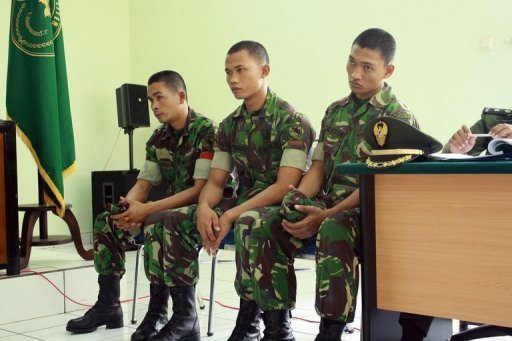
Indonesian soldiers receive 5 month prison sentences for torture that shocked the world; human rights groups label trial a ‘farce’

AFP
Indonesia on Thursday sentenced four soldiers to between five and seven months in jail for “minor disciplinary infringements”, after they were filmed abusing Papuan civilians.

The soldiers sentenced were not those filmed burning an elderly Papuan man’s genitals, but ones captured kicking a group of villagers around the head. The soldiers involved in the more horrific footage have not been located, leading to human rights groups demanding an international enquiry into allegations of widespread torture across West Papua.

A military tribunal gave three privates five months each for breaching the military code of conduct and their platoon commander seven months for allowing the abuse to occur.

“The defendants kicked the detainees’ heads and backs and hit their heads with helmets,” chief judge Lieutenant-Colonel Adil Karokaro told the tribunal in Papua provincial capital, Jayapura.

The sentences were heavier than military prosecutors’ recommendation of three months.

Critics of the Indonesian military say the case would never have gone to court had a video of the abuse, which occurred in the Punjak Jaya area of Papua in March, not appeared online.

Human rights workers labelled the trial a farce after senior military officials said it would deal with soldiers involved in the gruesome and far more serious torture of two Papuan detainees in May.

A video of the May incident also found its way to human rights workers, who released it online ahead of visits to Jakarta by the leaders of Australia and the United States, two key backers of the Indonesian military.

Indonesian President Susilo Bambang Yudhoyono promised “no immunity” for the perpetrators but no charges have been laid.

Human rights activists accuse the Indonesian military of killings, murder, torture and abuse of Papua’s ethnic Melanesian majority.

Papuan separatists have fought a low-intensity war for independence for decades, claiming that a vote by a small group of tribal elders which ceded the massive territory to Indonesia in the 1960s was a sham.

Peaceful Papuan political activists are regularly given lengthy jail terms for crimes such as possessing outlawed rebel flags. One such person is Filep Karma, currently serving a 15 year jail sentence for his part in a peaceful flagraising ceremony.

Leaked files show that Kopassus, Indonesia’s Special Forces, targets Papuan Church leaders and Civilians

Jakarta, November 9, 2010.
Secret documents have leaked from inside Kopassus, Indonesia’s red berets, which say that Indonesia’s US-backed security forces engage in “murder [and] abduction” and show that Kopassus targets churches in West Papua and defines civilian dissidents as the “enemy.”

The documents include a Kopassus enemies list headed by Papua’s top Baptist minister and describe a covert network of surveillance, infiltration and disruption of Papuan institutions.

Kopassus is the most notorious unit of  Indonesia’s armed forces, TNI,  which along with POLRI, the  national police, have killed civilians by the hundreds of thousands.

The leaked cache of secret Kopassus documents includes operational,  intelligence and field reports as well as personnel records which list the names and details of Kopassus “agents.”
The documents are classified “SECRET” (“RAHASIA”) and include extensive background reports on  Kopassus  civilian targets  — reports that are apparently of uneven accuracy.

The authenticity of the documents has been verified by Kopassus personnel who have seen them and by external evidence regarding the authors and the internal characteristics of the documents.

Click on the links below to download reports (these are in PDF format)
The Kopassus “enemies” list — the “leaders” of the “separatist political movement” includes fifteen civic leaders.  In the order listed by Kopassus they are:
— Reverend Socrates Sofyan Yoman, chair of the Papua Baptist Synod
— Markus Haluk head of the Association of Indonesian Middle Mountains Students (AMPTI) and an outspoken critic of the security forces and the US mining giant Freeport McMoRan
— Buchtar Tabuni, an activist who, after appearing on the Kopassus list, was sentenced to three years prison for speech and for waving Papuan flags and was beaten bloody by three soldiers, a guard, and a policeman because he had a cell phone
— Aloysius Renwarin, a lawyer who heads a local human rights foundation
— Dr. Willy Mandowen, Mediator of PDP, the Papua Presidium Council, a broad group including local business people, former politcal prisoners, women’s and youth organizations, and Papuan traditional leaders.   His most prominent predecessor, Theys Eluay, had his throat slit by Kopassus in 2001.
— Yance Kayame, a committee chair in the Papuan provincial legislature
— Lodewyk Betawi
— Drs. Don Agustinus Lamaech Flassy of the Papua Presidium Council staff
— Drs. Agustinus Alue Alua, head of the MRP, the Papuan People’s Council, which formally represents Papuan traditional leaders and was convened and recognized by the Jakarta government
— Thaha Al Hamid, Secretary General of the Papua Presidium Council
— Sayid Fadal Al Hamid, head of the Papua Muslim Youth
— Drs. Frans Kapisa, head of Papua National Student Solidarity
— Leonard Jery Imbiri, public secretary of DAP, the Papuan Customary Council, which organizes an annual plenary of indigenous groups, has staged Papua’s largest peaceful demonstrations, and has seen its offices targeted for clandestine arson attacks
— Reverend Dr. Beny Giay, minister of the Protestant evangelical KINGMI Tent of Scripture church of Papua
— Selfius Bobby, student at the Fajar Timur School of Philosophy and Theology (LAPORAN TRIWULAN p. 6)

Torture trial exposed as a ‘grand deception’ – Indonesian Government caught lying to US and Australian Governments

Article from The Age

A MILITARY trial into abuses by soldiers in Papua, trumpeted by Indonesia’s President Susilo Bambang Yudhoyono as evidence of the country’s commitment to human rights ahead of Julia Gillard’s visit, has proven to be a grand deception.

The trial of four soldiers began on Friday in Jayapura, the capital of Papua province, amid assurances from the Indonesian government and military that those appearing were involved in the torture of two Papuan men depicted in a graphic video.

But when the trial started, it became apparent that the four defendants had nothing to do with the incident depicted in the video, which took place in Papua on May 30. Instead, they were four soldiers involved in another incident, in March, which was also captured on video. While disturbing – it involves soldiers kicking and hitting detained Papuans – the abuses in the March incident are milder than the genital burning torture in the May video.

Dubbed the ”red herring trial” by The Jakarta Post, human rights advocates said the deception proved the matter must be investigated by Indonesia’s human rights body and the perpetrators tried in Indonesia’s Human Rights Court.

Papuan activists said the ”farcical” military tribunal hearing was a deliberate strategy to deflect international condemnation ahead of the visits of Ms Gillard, who travelled to Jakarta last week, and US President Barack Obama, who arrives tomorrow.

A day before Ms Gillard’s visit, Dr Yudhoyono announced the trial was to take place and urged Ms Gillard not to raise the topic when they spoke. ”There’s no need to pressure Indonesia. We have conducted an investigation and are ready for a trial or anything that is required to uphold justice and discipline,” he said.

But at the weekend, Lieutenant Colonel Susilo, spokesman for TNI’s military command in Papua, admitted the soldiers before the tribunal had nothing to do with the torture.

”It is difficult for us to investigate the perpetrators in the second video because they did not show any attribute or uniform,” he said. ”So what we could do was working on the first video. We could recognise their units and faces easily. ”

Ms Gillard’s office and the Department of Foreign Affairs declined to comment.

West Papua torture victim speaks out

Report by Al Jazeera
Three Indonesian soldiers have appeared before a military tribunal in eastern Papua province to face charges over the alleged torture of Papuan civilians, which was captured on video.

Friday’s trial comes days ahead of a visit by Barack Obama, the US president, who seeks to resume ties with Indonesia.

The footage, posted online by human rights activists, showed soldiers applying a burning stick to the genitals of one of the unarmed men and threatening another with a knife.

The three defendants are from an infantry unit based in the city of Nabire in Papua province. Two other soldiers were called to appear as witnesses.

The graphic video drew international attention to allegations of widespread torture and abuse of activists and civilians in restive Indonesian regions such as Papua and the Maluku islands.

Victim speaks out

Al Jazeera has obtained a secretly filmed interview with Tunaliwor Kiwo, one of the torture victims who now lives in hiding in one of the most isolated areas in Papua.

Kiwo was burned with hot wires and cigarettes, repeatedly suffocated with a plastic bag and had a concoction of chili and salt rubbed into his open wounds.

“I kept screaming. But they didn’t care of the pain I suffered,” he was quoted as saying in the interview.

“The TNI (military) put gasoline and lit a fire and I was in the middle with the branches,” he said.

“I couldn’t move, the flames were approaching me, trying to burn my body and my legs and hands were still tied up. I was continuously hysterical, in pain.”

The incident occurred earlier this year in an area of Papua where Indonesian troops frequently clash with poorly armed separatist rebels from the indigenous Melanesian majority.

Rights groups including Amnesty International have called on Indonesia to punish the culprits and end an entrenched culture of impunity in the country’s security forces.

“From the beginning we have been demanding an independent investigation,” Marcus Haluk, a Papuan student leader, told Al Jazeera.

“The military can’t investigate a soldier. It would be like a thief investigating a thief,” he said.

Mending ties

Susilo Bambang Yudhoyono, the Indonesian president, said on Monday there was “no immunity” for members of the country’s armed forces, ahead of talks in Jakarta with Julia Gillard, the visiting Australian prime minister.

Marty Natalegawa, the Indonesian foreign minister, told Al Jazeera that Indonesia has put the soldiers on trial “not because some government is knocking on our door, or because someone is telling us what to do”.

“We have taken the lead [in the investigation],” he said.

Al Jazeera’s Step Vaessen, reporting from Jakarta, the Indonesian capital, said that the testimony of the soldiers will further embarrass the Indonesian government.

Al Jazeera’s Step Vaessen reporting on the torture of Papuan civilians

“It is just a few days ahead of president Obama’s visit. Never before [has] a military trial [been] held this fast,” she said.

Robert Gates, the US defence secretary, met Yudhoyono in Jakarta in July and announced the US would lift a 12-year suspension of contacts with the Indonesian special forces as a result of “recent actions… to address human rights issues”.

Hillary Clinton, the US secretary of state, reportedly refused to comment on the specific torture allegations during a brief visit on Wednesday to Papua New Guinea, the independent eastern half of New Guinea island.

Indonesia incorporated the resource-rich but desperately poor western half of New Guinea in the 1960s after a UN-backed tribal vote, which separatists condemn as a sham.

Few Indonesian military officers have faced justice for rights abuses dating back decades, including alleged crimes against humanity in East Timor and the killing of thousands of political activists during the Suharto dictatorship.

Papua and the Malukus have underground separatist movements, which Indonesia regards as threats to its territorial unity.

Activists are regularly given lengthy jail terms for crimes such as possessing outlawed rebel flags.

Create a website or blog at WordPress.com

Up ↑
