Bintang Papua, 6 October 2011Jayapura: The Third Papuan People’s Congress is due to commence in a week’s time. According to Selpius Bobii, chairman of the organising committee and Forkorus, Yaboisembut, chairman of DAP, the Papuan Traditional Council, a number of international personalities have been invided, including Kofi Annan, former general-secretary of the United Nations, and US Congressman Eni Faleomavaega, chairman of the Asia-Pacific Sub-Committee of the US Congress. But as yet, there has been no response to these inviations.’Although we know for sure that Congressman Faleomaveaga will not be able to attend, he suggested that we should also invite Ban Ki-Moon, which we have done.’
Other persons who have been invited from abroad are waiting to see whether they will be issued with visas by the Indonesian embassy in their country.
The event which is now drawing near will, according to Selpius Bobii, be the uppermost forum of the Papuan people for the adoption of decisions on a number of agenda items, and some of the participants have already arrived. These are from components or organisations, youth groups and women’s groups, the TPN/OPM, traditional groups and others. ‘They will have the right to vote,’ he said..
No final decision has yet been taken about the venue of the event which is likely to be attended by tens of thousands of people. ”If three places that have been approached cannot be used, we will have to hold it on Theys Square. With regard to the possibility that some people may want to fly the morning star flag during the event, all we can do is to make suggestions. We have asked people not to fly the morning star flag, which people may acknowledge. Let’s hope they will listen to what we say.’
by Victor Yeimo,
International Spokesperson for West Papua National Committee [KNPB]
21st September 2011
[Jayapura]: As the UN General Assembly begins today (21/9) in New York, Indonesia will be in front line of supporting Palestinian efforts to become a member of the United Nations.
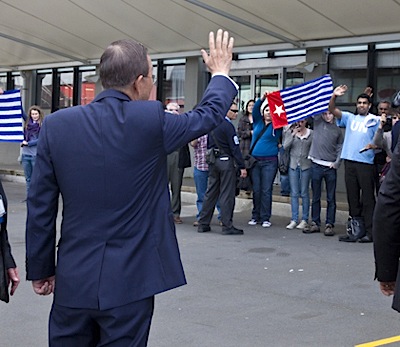
Ban Ki-moon waves to protestors for West Papua, PIF NZ Sept 2011 (Photo: Henry Yamo/ PMC)
Indonesia has been supporting the Palestinian case ever since they declared their independence. But what about the fate of West Papua which has been under Indonesian rule for half a century?
This week, from 19 to 28 September 2011, Foreign Affairs Minister, Marty Natalegawa, will be representing Indonesia at the UN General Assembly during its 66th session in New York, United States. He previously recalled, in a press release last Thursday (15/9), that Indonesia had recognized the independence of Palestine just a few hours after it had been declared in 1988.
Mahfudz Siddiq, chairman of House of Representative’s Commission I overseeing foreign affairs, also stated that agreement had been reached by the Indonesian Parliament and Government, for the full support of Palestinian independence and the Palestinian State bid at the UN General Assembly in New York this week.
As a logic consequence of this backing, Indonesia’s foreign policy should also be shown in its commitment to support the right to independence and the recognition of the sovereignty of the people of West Papua. If Indonesia is aware that Israel’s occupation of Palestinian territories is a state of colonization, then Indonesia has to realize that the occupation of West Papua by Indonesia since 1963 is likewise a state of colonization.
Already too many Palestinians have fallen victims of the Zionist regime of Israel, and already too many West Papuans have fallen victims of the colonialist and militarist regime of Indonesia. It is time for the people of West Papua to set their own destiny, in the same way that the Palestinian people, the people of South Sudan, Kosovo, and others, are deciding their own.
Indonesia as a member of the United Nations should actively participate in promoting and creating world peace. But, what about the fate of the people of West Papua? It has been a while since Indonesia and the international community decided to look away from the suffering of the people of West Papua. West Papuans continue to be victims of the vested interests of Indonesian colonialism and global capitalism on their land.
Because of those interests, the United Nations and Indonesia have been denying the right of independence to the people of West Papua, a right which should have been granted to them in accordance with General Assembly Resolution 1514, through the Decolonization Committee. Indonesia should welcome the statement of UN Secretary-General, Ban Ki-Moon in Auckland, New Zealand, on 7 September 2011, when he stated that the issue of West Papua should be discussed again in the UN decolonization committee, a committee which has several times been chaired by none other than Marty Natalegawa.
This month marks the 30th anniversary of the Lacluta massacre in East Timor by battalions of the Indonesian military, or TNI.
One of the enduring horrors of the occupation of East Timor was the “fence of legs” campaign of 1981 where civilians were rounded up and forcibly marched across the island to flush out resistance fighters – including Xanana Gusmao, now the fledgling nation’s Prime Minister.
Many died along the way. The campaign led to “very serious humanitarian consequences,” including famine as it took place during planting season and many of those press-ganged were subsistence farmers.
The march headed to Lacluta where the UN Commission for Reception, Truth and Reconciliation determined hundreds of East Timorese were murdered by Indonesian armed forces. “The commission received evidence of a large massacre of civilians, including women and children, at this time,” it said.
Indonesian authorities admitted to only 70 deaths, while Martinho da Costa Lopes of East Timor’s Catholic church said the death toll was closer to 500. One East Timorese fighter said the attack was carried out by Battalion 744, later to be commanded by Indonesia’s current president, Susilo Bambang Yudhoyono.
“I witnessed with my own eyes how the Indonesian military, Battalion 744, killed civilians in front of me,” Albino da Costa said. “They captured those unarmed people, tied them up then stabbed them to death. There was a pregnant woman captured and killed just like that. I saw it from a close distance, just 100m from where it happened.”
Costa Lopes died in Lisbon in 1991. His repeated calls for intervention by the United Nations and for curtailment of United States military aid to the Indonesian Government went unheeded.
The US, Japan and a number of Western European countries continued to provide Indonesia with about $5 billion in military aid. In the aftermath of the 1975 invasion the media largely ignored, as one Australian parliamentary report called it, “indiscriminate killing on a scale unprecedented in post-World War II history,” because of Indonesia’s vast natural resources. It was, as former US President Richard Nixon put it, the “greatest prize in the Southeast Asian area”.
Indonesia’s occupation of East Timor ended with independence and perhaps as many as a third of the population killed.
But today there is another war for independence in Indonesia: West Papua. And the parallels with East Timor are striking.
Papuans have endured horrific violence since Indonesia first invaded in 1963. Amnesty International and other human rights groups agree that as many as 100,000 Papuans have been killed under occupation.
West Papua is rich in minerals and oil. Transmigration, commercial logging, mining and other government-sponsored programs are considered to be in the interests of the nation, and take priority over any local land claims.
It has the world’s largest gold mine, controlled by the Freeport-McMoRan Company of Louisiana and the Anglo-Australian company Rio Tinto. General Suharto granted the concession under the 1967 foreign investment laws that opened Indonesia to near-unrestricted foreign wealth exploitation.
When guerrillas from the Free West Papua Movement sabotaged the mine in 1977, the army responded by killing at least 800 Papuans. This was not the first, not the last time the Indonesian military would be used to protect Western capital under the guise of “protecting the unity of the nation”. It is happening still.
Grasberg workers walked out on strike over pay and conditions on Wednesday. The mineworkers are paid between $1.50 and $3.50 per hour, less than a tenth of what their colleagues in other countries get, while between April and June 2011 Freeport made a profit of $1.73 billion. Most of the wealth extracted from the mine goes abroad – a tiny percentage benefits Papuans. Two thirds of West Papua’s forests – which are at the heart of Papuans’ traditional way of life – are designated for “production” by Jakarta.
An Indonesian military intelligence report leaked to the press in August showed how the island is awash with spies. And how badly equipped are the Papuan separatists to fight the Indonesian military. The TNI is armed and trained by the US and its allies as part of the East Asia Summit grouping, which is fast developing into a Nato for Asia.
Ahead of the planned Third Papuan Peoples Conference, Indonesian paramilitary forces linked to the police and Special Forces of the army appear to have stepped up military operations in the province, which have been described as a campaign of terror by people on the ground. According to KontraS, The Commission for the Disappeared, the army’s actions are illegal under Indonesian law.
Just like in East Timor before independence, West Papua is a prime example of a colony where the extraction of wealth for the benefit of a few outweighs a people’s fundamental right to self-determination. If atrocities such as the one at Lacluta are to be prevented in the future in West Papua, the TNI should withdraw and international investigators should be allowed access to the region.
Jakarta is at a crossroads with international attention focused on West Papua following the Pacific Islands Forum meetings in New Zealand. The head of the UN Ban Ki Moon was unequivocal when asked about Papua. Papuans’ rights should be upheld, he said. Indonesia’s government could take this opportunity to fulfill its pledge to grant Papuans autonomy. But this must include an end to the lawlessness of government-sponsored armed groups, a withdrawal of army units, and determining how Papuans’ natural resources are used must be the preserve of Papuans.
West Papuan protesters demonstrate at Auckland University when UN Secretary-General Ban Ki-moon made a speech. Photo: Henry Yamo / PMC
Asia-Pacific Journalism, Pacific Media Centre
14 September, 2011
Henry Yamo
“Free West Papua” … the Pacific isn’t free until West Papua is free. That is the four-decades-old West Papuan slogan that reverberated for a week as the Pacific islands countries gathered for the 42nd Pacific Islands Forum in New Zealand.
Ban Ki-moon waving to West Papuan protesters at Auckland University. Photo: Karen Abplanalp / PMC
Dr John Ondawame from the West Papua People’s Representative Office in Vanuatu says: “Our call to the leaders of all Pacific countries is to support the West Papua peoples’ call for peace talks between the government of Indonesia and the people of West Papua.”
Pacific leaders must remember that the Pacific will never be free unless West Papua is free from the current oppression and atrocities that have lasted for more than 40 years caused by the Indonesian government, he says.
Dr Ondawame says their concerns are voiced particularly to their Melanesian neighbour countries to call on the government of Indonesia to take decisive decision on suggested peace talks and recommend a Forum fact-finding mission to West Papua.
“We are calling as Melanesian brothers and are very keen to meet with the Prime Minister of Vanuatu who has indicated to support our call,” he says.
“We also want to lobby with leaders from other Melanesian and Pacific countries to support Vanuatu when it raises the West Papua,” he said.
Fundamental right
The member for Te Tai Tokerau electorate and founding leader of the Mana Party in New Zealand, Hone Harawira, says he supports the cause of West Papuans because freedom is a fundamental right.
“As Pacific islanders we can only be totally free if West Papuans who are also from the Pacific are completely free from the current oppression,” says Harawira.
Jo Collins … abuses will not go away. Photo: Henry Yamo / PMC
This was reinforced by the spokesperson for the Australian West Papua Association, Joe Collins, who says the Forum has to realise the abuses have been going on for many years and will not go away.
“People get shot or get burnt; tortures are carried out publicly on the streets so that it creates fear among the people. The level of spying on West Papuans is very high, starting in villages and into towns and cities,” he says.
West Papua is one of the last conflict areas in the Pacific region. The international and Pacific governments should pay more attention to the level of torture and atrocities being experienced by the people.
Dr Ondawame says the freedom of West Papua is a Pacific issue that has received “embarrassingly little” attention from Pacific countries while the United States and United Kingdom have made their position clear, calling for constructive and peaceful dialogue.
“At least Melanesian countries must act and we are pleased that Vanuatu is the only country that has come forward to firmly support the aspirations and independence of West Papua while our very close neighbour PNG has been silent and has been working closely with Indonesia,” he says.
Call for UN action
The United Nations cannot do much with human rights issues in West Papua unless Pacific Island countries unite and call for UN action.
Rex Rumakiek … seeking peaceful solution. Photo: Henry Yamo / PMC
Secretary-General of the West Papua National Coalition for Liberation (WPCNL) Rex Rumakiek says: “West Papua has been part of the Pacific since the establishment of the South Pacific Commission and also as founding member of the Pacific Conference of Churches set up in 1956.
“And so it is timely for our Pacific brothers to adhere to our concerns when the opportunity arose. We are here to seek that support.”
Rumakiek says the people of West Papua will continue to take up the call until a peaceful solution to the problems is found, ending the shameful atrocities encountered.
Meanwhile, activist Paula Makabory says their struggle is not a fight against the Indonesian government but also against imperialism and neo-colonialism. It is about being Melanesian within Indonesia.
“Shouting West Papua or free West Papua or even displaying the West Papua flag in West Papua has landed people in jail for 15-20 years or have been beaten very badly that some eventually succumb to their injuries.”
She says even though Indonesia has rectified civil and political rights under the UN treaty, West Papuans are constantly under military surveillance and humiliated every now and then.
Their united call is for the Forum to support their call for a peaceful dialogue with the Indonesian government and to grant West Papuan representatives observer status at their annual conferences.
The West Papuans believe that the Forum cannot say it promotes regional stability, while overlooking and neglecting the deadliest issue that has dragged on for over four decades.
Henry Yamo is a postgraduate journalist on the Asia-Pacific Journalism course at AUT University’s School of Communication Studies.
Is Indonesia about to lose its grip on the western half of New Guinea, a territory the size of France and ancient homeland of the Melanesian West Papuans?
United Nations Secretary General Ban Ki-moon at today's press conference in Auckland. Photo: Henry Yamo / PMC
“Again this issue should also be discussed at the Decolonisation Committee of the United Nations General Assembly. And when it comes, again, to whether you are an independent state or non self-governing territory, whatever, the human rights is an inalienable and fundamental principle of the United Nations. We will do all to ensure that the people in West Papua, their human rights should be respected.” [1]
To read of West Papua being raised in the context of the UN Decolonisation Committee by the Secretary-General is quite startling, for one specific reason: West Papua was removed from the list of colonised territories in 1969. This is unlike the situation in East Timor, which had not been removed from this list, becaming the trigger for their 1999 vote on self determination.
East Timor was a clear case of invasion in 1975, brutal suppression by a foreign power and liberation in a baptism of blood and fire in 1999. On the other hand, the West Papuan people were the victim of a brutal play of Realpolitiks during the Cold War.
After Indonesia gained their independence from the Dutch in 1949, Holland retained their territory in western New Guinea, preparing the indigenous population for independence. In 1957 Australia signed an agreement with the Netherlands to work toward the independence of the whole island of New Guinea and many Australians were involved on the ground in this preparation. [2]
In 1961 the Dutch administration formed a local parliament, including indigenous representatives and raised the West Papuan morning star flag, which flew along with the Dutch tri-colour across the territory and 1970 set as the year of independence. In this bright dawn of Papuan democracy, Australia helped to raised the hopes and expectations of the people of West Papua for freedom and self-determination.
Since 1949 Indonesia had been demanding control of the western half of New Guinea, even though it was, like the eastern half of the island, an ancient Papuan land. The Indonesian response was now to begin invading and a full-blown war with Indonesia appeared imminent, in which Australia would have fought along-side Papuans trained by the Dutch to defend their island homeland.
Wishing to avoid being drawn into a war with Indonesia, the United States intervened and told the Dutch to get out, Australia to butt out and gave the green light for Indonesia to take over half of New Guinea, as the new colonial master. This was deeply humiliating for the Netherlands and also Australia and brought into question the true independence of Australian foreign policy.
In this play of Realpolitiks, West Papuan lives, land and resources were used by Washington to buy a nominally pro-Western alliance with Indonesia and also access to Indonesian and Papuan resources. This action was nothing short of a slave trade and theft of land and property on an unimaginable scale.
The West Papuan morning star flag, which first officially flew in New Guinea in 1961, when Australia was working on the ground with the Dutch toward the independence of the whole island of New Guinea.
Indonesia became the new colonial power in New Guinea in 1963 and the atrocities began, with as many as 400,000 Papuans being killed in an ongoing genocide, which has pushed the Papuan aside to make way for Indonesian occupation and immigration. When a vote for self-determination was held in 1969, the United Nations allowed Indonesia to run it completely and even the UN observers on the ground only witnessed 20 percent of the vote.
Could it be called a vote, when 1025 selected men were lectured under the shadow of guns, before being invited to step over a line drawn in the dirt? An armed rebellion was going in in West Papua at the time. Wishing to avoid the prospect of war with Indonesia, most nations voted to allow West Papua to be incorporated into Indonesia and be removed from the list of colonial territories. A few newly independent African nations objected.
Would the United Nations get away with such a vote today. Such a bizarre process would not have been accepted in East Timor in 1999.
If the West Papuan people deserve natural justice, then they have a right to a genuine vote on self-determination. If Indonesia wishes to hold its head high as a truly democratic nation, then they will agree to this happening. If Australia wishes to regain honour with West Papua, then we will support the rights of the West Papuan people to self determination, just as we did the East Timorese and the Papuans of eastern New Guinea.
Sadly, all Australians have blood on our hands when it comes to West Papua, because we did not stand and demand justice, but went along with a brutal theft, slave trade and on-going atrocity Just across our northern border, many West Papuans have been shot on sight for raising the morning star flag, or sent to jail for 20 years.
Filep Karma was jailed for 15 years in 2004 for raising the West Papuan flag and when recently offered remission by the Indonesian Government, refused to accept this, saying, “he preferred to serve out his normal sentence and demanded the Indonesian Government to apologise to the Papuan people for all the atrocities it has caused.” [3]
For decades West Papuan supporters around the World have raised the question of the West Papuan right to self-determination and the voice of the indigenous Maori was added to this throng at the recent Pacific Island Forum being held in New Zealand, when the leader of the Mana Party, Hone Harawira, raised the West Papuan issue with Ban Ki-moon, declaring:
“Can I please ask that you support peaceful dialogue between the Indigenous People of West Papua and Indonesia, to put an end to the killings there and to find a strategy to get Indonesia out of a land that isn’t theirs.” [4]




 West Papua Media Alerts