Anti-apartheid leader dedicates award to the people of West Papua

June 22, 2013

by Jason MacLeod for West Papua Media

This week in Boston the Rev. James Lawson, the civil rights leader who worked alongside Martin Luther King, presented awards to leaders of four civil resisters. The awardees are leaders of movements for environmental protection, defending indigenous people, political rights, and the end of racial oppression.  One of this year’s winners is Mkuseli (Khusta) Jack, the strategist who led consumer boycotts in South Africa during the darkest days of apartheid.  In his acceptance speech Khusta said “I dedicate this award, which is lodged deep in my heart, to the people of West Papua.”

“People all round the world have to turn their lens to the abuses committed by the Indonesian authorities in West Papua” said Khusta. “They have to hear the cries of the West Papuan people for self-determination.”

Deploring the fact that West Papuan people have been denied the right to a free and fair vote about their political future Khusta remarked that “in this day and age there is no room for any form of colonization or encroachment on a people. This discrimination is even worse when it is based on racism” he added.

South African civil resistance leader Mkuseli (Khusta) Jack with West Papuan campaigner Benny Wenda after dedicating his award to the West Papuan struggle. (Photo: J. MacLeod for West Papua Media)

Turning directly to Benny Wenda, the West Papuan leader who was present at the awards ceremony, Khusta said “you must continue to fight for your right. You shall be free; it is only a matter of time.”

As leader of the United Democratic Front, a coalition of over 500 civilian based resistance groups aligned with the African National Congress, Mkuseli Jack demonstrated how the costs of apartheid could be transferred from the people of black townships to the commercial business community on which the support and revenue of the government partly depended. It was this strategy of withdrawing people’s buying power that alongside strikes by black workers and external sanctions by foreign governments, created the context for negotiations between Mandela and President F.W. de Klerk that finally brought the edifice of apartheid tumbling down.

Rev. James Lawson and Benny Wenda. (Photo: J. MacLeod for West Papua Media

Rev. Lawson also had some advice for the West Papuans. The key to any successful civil resistance struggle is fierce discipline, rigorous planning and strategy. Exhibiting the qualities of the respected pastor he is, Rev. Lawson took Wenda by the hands and told him that “the power of life in you that makes you strong is the power of God, the power of truth. Be strong. Be courageous. Organise the struggle. You are on the side of history and truth.”

UK based West Papuan campaigner Benny Wenda meeting with Rev, James Lawson (25;00).  Video from ICNC.

In the late 1950s Martin Luther King Jnr. asked Rev. Lawson to travel to the South to help led the nonviolent struggle for basic rights that were then denied by the United States government. Rev. Lawson trained students from Nashville in the strategy and tactics of civil resistance. Lawson and the students successfully desegregated lunch-counters in the downtown area through determined nonviolent action. They then went on to organise other campaigns of the civil rights struggle.

After receiving the awards Rev. Lawson spent the remainder of the evening talking with Papuans about their struggle for freedom. Wenda said that it was a dream come true meeting Rev. Lawson and Mkuseli Jack. “The civil rights struggle in the United States and the anti-apartheid struggle in South Africa are beacons of hope for me and my people” said Wenda. “I know that one day we will be free.”

The awards speeches in full, including the section from Mkuseli Jack dedicating his award to West Papua (at 25:00)- with thanks to ICNC for the video

Besides Mkuseli Jack the other three winners of the James Lawson Award for Achievement in the Practice of Nonviolent Conflict are:

  • Evgenia Chirikova, the young Russian woman who co-founded Defend Khimki Forest, which has fought a long and so far successful campaign in the last ten years to prevent the destruction of an ancient-growth forest near Moscow.
  • Oscar Olivera, one of the key leaders of the campaign in Cochabamba, Bolivia in the 1990’s that prevented the privatization of water resources and helped spark broad popular participation in Bolivia’s democratic transition in the ensuing years.
  • Jenni Williams, the co-founder of Women of Zimbabwe Arise, who braved 52 arrests and gaolings due to ongoing protests for genuine political rights for all of the people of her country.

The Lawson Awards are presented annually by the International Center on Nonviolent Conflict at The Fletcher School for Law and Diplomacy at Tufts University during the Fletcher Summer Institute. It is awarded to practitioners, scholars and journalists whose work serves as a model for how nonviolent change can be developed, understood and explained.

Beheadings and dumped bodies pile up as Indonesian special forces rampage again in Tingginambut

Special Report by West Papua Media

May 27, 2013

Credible and disturbing reports are continuing to emerge from Tingginambut, Puncak Jaya, in the West Papuan highlands, detailing evidence of another violent rampage by the Indonesian army special forces (Kopassus) against civilians throughout May, allegedly by Kopassus officers stationed in the district which has been suffering war conditions since February.

The death toll is mounting, with six of the victims village chiefs and social leaders returning from invited attendance at the inauguration of new Papua Governor Lukas Enembe in Jayapura, and were intercepted, tortured and killed by Kopassus officers mounting a roadblock at Ilu on the Mulia road on May 8, 2013, according to preliminary evidence uncovered by human rights investigators in the field and provided to West Papua Media.

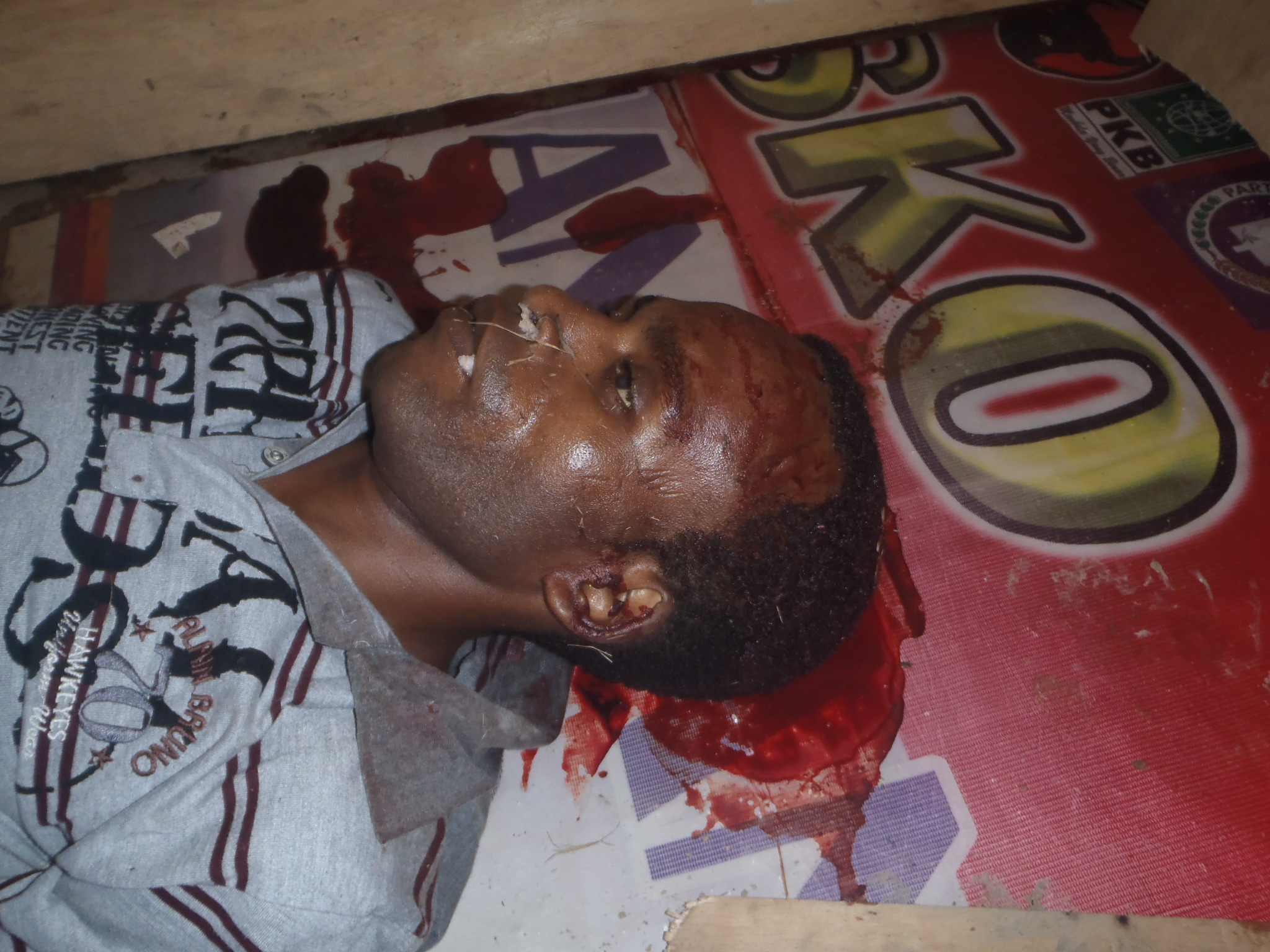
Photo: One of the victims, as yet unidentified. (supplied from human rights investigators)

At least 18 headless, mutilated or amputated bodies have since been confirmed found in roadside ditches and drains, and named as victims from around the Mulia and Pirime areas of Tingginambut, with unconfirmed but credible reports putting the total toll of the “mysterious killings” at over 41 people to date.  Activists from the West Papua National Committee (Komite Nasional Papua Barat or KNPB) have said that the discovery of so many bodies points to “a covert operation of killing and forced disappearances of indigenous Papuans in Puncak Jaya that has been operating since 1 April 2013 until now”.

Those confirmed dead are:

  1. Mili Tabuni (37),
  2. Sony Tabuni (35) ,
  3. Ella Enumbi. Born Mewoluk DOB 12 March 1986, Secondary school student at Mulia State School Class III, Male,
  4. Yerson Wonda,  Born at Wondagobak, Mulia, Male. Tertiary College Student in Technical Trade in Jayapura; Also worked as Secretary of KNPB Puncak Jaya Region at Puncak Jaya.
  5. Yos Kogoya (40) Former village head Mewoluk;
  6. Pauwuli Tabuni (35) Village Head of Regional District Tingginambut;
  7. Yaningga Tabuni (37) Village Head Regional District Yembuni Tingginambut;
  8. Tepaus Tabuni (40) Village Head of Regional District Tingginambut;
  9. Terius Enumbi (39) Shepherd of the Church of Kampung Kalome;  and
  10. Yemundan Enumby (35)
  11. Inoga Wonda,
  12. Deniti Telenggen,
  13. Telapina Morib,
  14. Aibon Tabuni,
  15. Yomiler Tabuni,
  16. Bongar Telenggen,
  17. Eramina Murib.
  18. Regina Tabuni.

West Papuan human rights activists in Puncak Jaya have also reported that women in villages under occupation by the TNI are being regularly raped by soldiers, with at least 12 documented cases since April and unconfirmed reports of many more.   Two female high school students among the dead were found to have been brutally raped and beaten in Tingginambut by Kopassus officers,   West Papua Media is not publishing the names of these sexual assault victims in line with ethical journalism practice.

Relatives of the a total of 30 missing adults are still searching across Puncak Jaya for their family members, though unconfirmed reports have emerged that Kopassus have arrested and detained at least 15 more people while searching for their family members.  Grave fears are being held for the safety of these detainees, with at least one case of torture believed to have occurred on family members.  According to statements from the West Papua National Committee (KNPB), a senior high-school aged youth of class III was arrested in the town area and is believed to have been tortured over a period of 2 weeks after which he was killed and beheaded, with his beheaded body placed in a sack and thrown under a bridge. His family is still hunting for his head, according the KNPB.

Wim Medlama, the spokesperson for the KNPB, told KNPBNews.com, “Every person in the community known for activist activities in Puncak Jaya has been interrogated such that the whole community is now terrified to even carry out their usual daily activities.”

TNI soldier aims .50 Calibre heavy machine gun at Papuan villagers in TIngginambut during recent sweep operations in May 2013 (Photo: supplied by indp human rights investogators)

Independent human rights investigator Yasons Sambon have just returned from Puncak Jaya interviewing surviving victims and witness who have pointed the finger at new Papua governor Lukas Enembe, detailing that six of the victims were returning as invited guests from Enembes inauguration in Jayapura.  Enembe’s electoral team provided the six with transport to attend the inauguration, but allegedly left them stranded in Jayapura after allegedly reneging on their transport home, however Enembe’s team finally covered their fares back to Wamena only after the Governor had arrived back in Jayapura from a visit to Jakarta..

On the afternoon of May 8, 2013, the six men,  (Yos Kogoya (40) Former village head Mewoluk; Pauwuli Tabuni (35) Village Head of Regional District Tingginambut; Yaningga Tabuni (37) Village Head Regional District Yembuni Tingginambut; Tepaus Tabuni (40) Village Head of Regional District Tingginambut; Terius Enumbi (39) Shepherd of the Church of Kampung Kalome;  and Yemundan Enumby (35) Society of Kampung Yembuni), left Wamena to return home by car to their villages in TIngginambut, Puncak Jaya, when they were stopped at the Ilu military infantry post on the Mulia road.  According to the testimony from surviving witnesses interviewed by Sambon, the victims were forced out of the car and were beaten and tortured whilst being interrogated by the soldiers and detained through the night.

The testimony provided by the witnesses reported that at 0800 the next morning (May 9), the victims were then confronted by” a number Kopassus officers in the middle of the road”, further adding that “Kopassus in Puncak Jaya were assigned to kill people in a way like the mafia”.  (Kopassus officers are regularly referred to across Indonesia as Mafia or gangsters, given their well-documented control of vast, well organised criminal cartels of drugs, money laundering, prostititution, illegal logging and mining, finance, human trafficking, and a myriad of other illegal business activities.)

Heavily armed Indonesian military look towards heir target, a small village near Mulia in the highlands of West Papua, during recent deployments (photo supplied by local human rights investigators)

“Then victim number 6 is tortured until killed by inhumane way, gunshot victims by Kopassus and cut the legs and head off, and waste (dumped) in different places,” the witness reported to Sambom.  Sambom described the witness as an ordinary villager who found the bodies of the chiefs, and who begged for his name not to be published for “fear he will be searched again by Kopassus and removed after being found as the the source of this news report”.

According to the sources interviewed by Sambom, “we found the victims dead, they (perpetrators) had dismembered the head and feet and hands in different places, we gathered all of the victim’s body.”   “Once we found them, we made a grave all in one place. Right now we’re done mourning, and sympathizers close to the family who came to pay respects had returned to their respective villages,” the village witness said.

“We now, all the people are afraid, because Kopassus kill again we are all scared,” he said.

Indonesian military interrogating villagers during a raid of unidentified village near Mulia, TIngginambut, during sweep operations, May 2013 (Photo supplied by indp human rights investigators)

The driver, who according to witnesses was a “newly posted” member of the State Intelligence Agency BIN provided by the pro-military Governor Enembe, has not been seen since, and witnesses have questioned if he was a participant in the murder of the Chiefs, or if he himself was murdered by the Kopassus officers seeking to cover their tracks.

According to sources from the KNPB, two more victims, Yerson Wonda – the Secretary of KNPB in the Puncak Jaya region  – and KNPB member and high school student  Ella Enumbi were also arrested by Kopassus at Ilu TNI post, then killed and their bodies beheaded. The body of Yerson Wonda and the head only of Ella Enumbi were thrown under a bridge in a sack, and their bodies were found on 26 April 2013.   KNPB News reported that “It is suspected that for two weeks following the date of their deaths that their bodies were hidden by Kopassus at the place of detention at the Kopassus Post at Purume (Pirime), Mulia. The family is still searching for the remainder of the body of Ella Enumbi.”

Sweep operations by Indonesian security forces have not lessened in intensity since December 2012, when a new phase of repression against local civilians and non-violent political activists began with the violent raids by joint Detachment 88 counter terror and TNI soldiers on the home villages of the KNPB political activists.  Several of those still missing include non-violent political activist members of the local chapter of the West Papua National Committee (KNPB), which has seen a massive and violent crackdown led by new Australian trained Papua Police Chief Tito Karnavian, the former head of the notorious counter-terror unit turned extrajudicial death squad, Detachment 88.

The area of the latest alleged TNI rampage is the same area in Sinak subdistrict, close to Mulia, where troops from General Goliat Tabuni’s West Papua National Liberation Army (TPN-PB) unit attacked Kopassus soldiers who had built a military post on a sacred burial ground in on February 21.  A massive influx of several thousand soldiers from the Indonesian Army’s (TNI) Kostrad (strategic reserve),  notorious locally based Indonesian battalions 753 and 756, several hundred Kopassus special forces soldiers, and members of the Australian-trained and funded Detachment 88 counter-tterror unit flooded into the area to hunt Tabuni’s unit.  Since the influx, constant operations have caused thousands of people to be displaced from their villages, whilst those remaining behind are subjected to arbitrary and brutal treatment from the military and police on a daily basis.  Hundreds of houses, livestock and food gardens have been destroyed in a collective punishment against civilians that breaches international laws on war crimes.
Disturbing footage from human rights investigators has also been released showing the brutal conduct of Indonesian troops terrorising unarmed civilians as they raid a unidentified village in Tingginambut during this years sweep operations.  The video can be viewed below.
The KNPB has reiterated a call made from local residents for human rights monitors to be present in the region.  “We urgently seek the help of KOMNAS HAM (National Human Rights Commission) in Papua, and any independent persons with humanitarian concerns to please immediately come to Puncak Jaya to investigate,” said Wim Medlama.  “These covert operations and mysterious killings are still to this moment continuing.”
Sambon also contacted General Tabuni by phone on May 23 and reported that Tabuni was shocked at the killings and denied involvement. “They are the people and the village head, not my TPNPB-OPM members who do not shoot” …  According to Tabuni, “the public spotlight is on me, why Goliath is silent? But the village head make themselves part of the Indonesian government, why should they be shot like that? I have no link related to this event. It is the responsibility of the Governor,” Tabuni said.

WestPapuaMedia

Update: Court process for Political Prisoners Edison Kendi and Yan Piet Maniamboi still continues

May 17, 2013

by West Papua Media

Update

On Monday, May 13, 2013, cross-examinations of witnesses in the treason trial for Edison Kendi, currently being held in Serui, had proceedings suspended because the Prosecuting Attorney, Matheos Matulesi, ordered the police to confiscate cameras from any activists and observers who attended the hearing, according to a local activist present who asked not to be publicly identified..

The activist assessed that Attorney Matulesi’s actions were contrary to the  court proceedings. “This trial is being held as a treason trial, which is open for people to observe as a Public Session.”

For that reason, those people who felt intimidated have filed a written complaint to protest against the rogue prosecutor who did not do his job accordingly, according to independent observers at the trial.

Breaking News: Beatings, Arrests as KNPB Rally forcibly broken up by police

West Papua Media

May 13, 2013

UPDATED WITH PHOTOS 8.15 wp time

Indonesian police in Jayapura have this morning violently dispersed a pro-independence rally being held by the West Papua National Committee (KNPB), arresting its leader Victor Yeimo, media worker Marthen Manggaprouw and two KNPB activists, according to early reports.

The rally was being held to commemorate the shootings and violent crackdown by Indonesian security forces on peaceful demonstrations across Papua on May 1, which left four people dead and drew international condemnation up to the UN Human Rights Commissioner, Navi Pillay.

Reports from witnesses at the scene have confirmed that police conducted several rounds of baton charges against rally participants who arrived on motorbikes, and then joined by over 1000 other participants who continued to resist the police charges outside the gates of Cenderawasih University in Abepura.  Injuries have been reported by but no particulars are yet available.  More arrests are expected according to witnesses.

This slideshow requires JavaScript.

Jayapura police chief Alfred Papare ordered the arrests of Yeimo, Manggaprouw, Yongky Ulimpa (23), Ely Kobak (17) after intense negotiations  from 9am local time between police and the activists to allow the rally failed.  In this time, thousand’s of frontline Papuan civilians and activists had gathered ready to march from Lingkaran Abepura (outside the Post office) near the National Housing Complex 3 (the site of late KNPB Chairman Mako Tabuni’s assassination by Australian-trained Detachment 88 officers) to the People’s Assembly Council (MRP) office.

At 1050am local time, the mass gathering was attacked and the activists were arrested, beaten by Police, and media activist Manggaprouw had his camera equipment seized by Police.  They were taken to Polda Papua headquarters in Jayapura, where grave concerns are held by human rights workers for their safety and freedom from torture.

At 5.30pm this date WPB Victor Yeimo following his earlier arrest was taken to LP Abepura by the Public Prosecutor led by an escort force of police “with full war apparel” using 2 Dalmas trucks, a police patrol vehicle and one vehicle with darkened windows.  Stingers for West Papua Media have reported that Police are working together with the Public Prosecutor regarding a previous case against Yeimo for which punishment was never finalised, hence the Prosecutor has detained him again.

At time of Update,  Marthen Manggaprow, Yongky Uliampa and Ely Kobak are still being interrogated at Polda Papua.

KNPB Spokesman Wim Medlama told suarapapua.com, “True, officers had arrested four people on Housing III, near the taxi round. Police officers came down with their trucks, crashing into and damaging several motorbikes as well, and then arrested them.  Currently they are being brought to the Papua Police. We beg for advocacy.”

“We want to MRP to hold accountable the government and security apparatus-related deaths in all the land of Papua, especially those occurring in Aimas, Sorong, at the time of Papua’s integration demo day on May 1, 2013 and now,” said Medlama.

The rally had been banned by notorious former Detachment 88 chief, now Papua Police chief, Tito Karnavian, in a move that had been widely criticised by Papuan civil society leaders, including Baptist Church leader Socretez Yoman and Kingmi Church leader Benny Giay.

KNPB Chairman Victor Yeimo yesterday told SuaraPapua.com that the ban would not deter Papuan people from peacefully voicing their aspirations. The Papua Police banning peaceful demonstrations is very unnatural, as well as it being illegal, because freedom of public expression is guaranteed by law in the country of Indonesia.

“The Police Chief’s ban is part of the continued suppression of expression was silenced in Papua. In principle, we will continue to go down, ” Yeimo told SuaraPapua.com.
The rally was organised with Papuan civil and political organizations – Solidaritas Peduli Pelanggaran Hak Asasi Manusia(SPP HAM), Komite Nasional Papua Barat (KNPB), Gerakan Rakyat Demokratik Papua (GARDA-P), Dewan Perwakilan Mahasiswa Fakultas (DPMF) FISIP Uncen & West Papua National Authority (WPNA) agreed to join forces in the protest in Jayapura, despite POLDA Papua banning the peaceful actions.
Journalists with SuaraPapua.com and stringers from West Papua Media reported that hundreds of fully armed police and military were at present “securing” Jayapura with 6 truckloads of police, 4  barracudas armoured cars and water cannons, and “police motorcycles continue to keep all the corners of the city of Jayapura to cancel the action plan undertaken by Papuan people.”.  Unconfirmed reports from witnesses have also claimed that Indonesian Army (TNI) soldiers have been mobilised.
The situation in Jayapura is currently highly tense, with more reaction expected from both Papuan civilians and security forces.

More to come – this is a developing story

@westpapuamedia

Papuans mourn 50 years of Indonesian occupation

 by Alex Rayfield

 May 1, 2013

Demo in Jayapura, May 1 (photo: Dawn Treader)

For many people around the world the first day in May is a time a celebration, a day to remember how ordinary people won the right to the eight hour working day.

But in West Papua May Day is a day of national mourning.

Fifty years ago on 1 May 1963 the United Nations abandoned West Papua. After a brief nine months administering the country the United Nations pulled out of West Papua to allow the Indonesian government to rule the territory on behalf of the International Community.

Fifty years later the Indonesian security forces are still in West Papua and a free and fair referendum on West Papua’s political status is yet to take place.

Here’s a rundown of how West Papuans across the country commemorated the day.

Sorong

Thomas Blessia
Thomas Blessia

https://i0.wp.com/suarapapua.com/wp-content/uploads/2013/05/korban-di-sorong.jpgGrief took on new intensity as the Indonesian security forces shot dead two Papuan protesters in Sorong and wounded two others. According to human rights defenders from Elsham, the Institute for the Study and Advocacy of Human Rights in West Papua, who also have an office in Sorong, shortly after 10pm on Tuesday night police from Aimas Police station together with Indonesian soldiers.

arrived at the home of Ishak Klaibin (49).  In a report obtained by West Papua Media Elsham Sorong reports that Papuan activists were holding a meeting to prepare for demonstrations the following day.

According to Mr Klaibin a number of Papuans got into an argument with the police and soldiers who shot dead Abner Malagawak (22) and Thomas Blesia (22). Malagawak was shot in the shoulder while Blesia was shot in the back of the head.

Apner Malagawak
Apner Malagawak

Three other people, Salomina Klaibin (31), Herman Lokmen (18), and Andreas Safisa (24), were wounded in the attack.

Jayapura

Despite the killing of the Malagawak and Blesia the night before in Sorong and knowing the risk to their safety given the refusal by the Indonesian police, military and recently inaugurated Papuan Governor, Lukas Enembe, to grant official permission for peaceful demonstrations, Papuans from across the country continued with planned nonviolent demonstrations.

In Jayapura, the capital of West Papua, the demonstration was jointly organised by the West Papuan National Parliament and the National Federated Republic of West Papua, and the march led by Buchtar Tabuni.  The West Papua National Committee (KNPB), West Papua National Authority and Melanesian Women of Papua – all came together to support civilian based protest.

The activists gathered outside the University student dormitory, Asrama Nayak, and proceeded to march towards Abepura, a university suburb in Jayapura. Five hundred West Papuan activists accompanied by drums, flautists and banners marched. They sang, cried out “Free Papua” and carried banners denouncing fifty years of occupation by the Indonesian military. The protesters held banners declaring “Fifty years of lies, manipulation, torture and killing”, “Not Integration; Annexation”, “The Indonesian occupation is illegal”, “Enough is Enough” and “Stop violence against Papuan women”. Many of the banners were decorated with the photos of Papuan victims of torture by the Indonesian security forces.

Human rights defenders from Elsham, who were present monitoring the demonstration reported that as the protesters passed the military command at Padang Bulan, the name of neighbourhood where the Elsham office is located, soldiers fired their weapons seven times into the air.

Around the same time local stringers at the protest reported that several activists walking on the street in Jayapura were seized by security personnel, forcibly loaded into a military truck and driven some thirty kilometres away to an army base at the foot of Mt Cyclops. The activists later managed to escape when the truck was forced to stop near Sentani.  Papuan citizen journalists also told New Matilda and West Papua Media that during the march in Jayapura Indonesian police attempted to arrest Markus Yenu, a well-known protest leader from Manokwari. However, they were prevented from doing so when activists  nonviolently positioned themselves between Yenu and the police. According to eyewitnesses Yenu promptly disappeared into the crowd and is now reported to have gone into hiding.

This slideshow requires JavaScript.

Slideshow: photos from May 1 Anniversary mobilisations, and Indonesian militia counter-demonstration (Photos: West Papua Media, and supplied)

According to West Papuan journalist Okto Pogau writing for Suara Papua (The Voice of Papua), water cannons, tear gas cannons and hundreds of heavily armed police and military were positioned in several sites between the centre of Jayapura and Sentani, a further 50kim away. In Sentani, beside the memorial site of West Papuan independence leader Theys Eluay, and in Kampung Harapan (the village of hope), a pro-independence stronghold, there was a heavy police and military presence. KNPB media reported the determination of the organisation to defy Indonesian police attempts to destroy them. Despite the presence of the security forces, peaceful demonstrations, speeches by KNPB chairman Viktor Yeimo and a worship service went ahead in Sentani. However, the security forces did manage to break up a KNPB demonstration in Waena, an outlying suburb of Jayapura.

In Jayapura Indonesian police, soldiers and citizens organised a counter demonstration. They drove through the streets of Jayapura in vehicles emblazoned with giant Red and White flags, the Indonesian national flag, honking their horns.

Biak

In Biak forty pro-independence activists led by Oktofianus Warnares (46) raised the Morning Star flag. According to Elsham staff in Biak the demonstration was forcibly dispersed by police and an unknown number of activists were arrested. Also in Biak, the West Papua National Committee, whose activists were recently accused of bomb-making – a charge they deny – led a prayer service. Local KNPB activist, Mnumumes, said that “1 May is the day that colonialism entered West Papua and that West Papua continues to be colonised until today.”

Fak-Fak

In Fak-Fak, a town on the North West Coast, Elsham staff report that the Morning Star flag was raised at three locations, at the Inpres Wagom Mountain Primary school, at the Second Middle School and in front of the North Fak-Fak District Office.

Paniai

In Nabire, the district capital of Paniai, Human rights defenders and church workers, under the banner of the Coalition of Papuan People from Nabire (Koalisi Rakyat Bangsa Papua Kabupaten Nabire) held a press conference commemorating the 50 year anniversary of West Papua’s annexation by the Indonesian state.

The speakers at the press conference all declared that “West Papua’s incorporation into Indonesia, the Act of Free Choice in 1969 (a shame referendum), Special Autonomy, the Unit for the Acceleration of Development in West Papua were all problems that remained unresolved.” The speakers, who included Rev. Esebius Pigai,

Daniel Zonggenau  (A tribal leader from Meepako), Theo Mirip (a senior chief from the Nduga tribe), Mrs Pina Jagani (a Papuan woman’s leader), Frans Madai (a youth leader) and Yones Douw (a human rights activist), were dismissive of a new policy package called Special Autonomy Plus recently announced by Indonesian President Susilo Bambang Yudhuyono. Douw and the other Papuan leaders in Nabire demanded that “the Indonesian government immediately begin political talks with the Papuan people, mediated by an international third party.”

Timika

Viktor Mambor from the independent West Papuan media outlet, Jubi reported on events in Timika. According to Mambor, Papuans raised the Morning Star flag in front of the new Mimika Presidential primary School. The protest was dispersed by police shortly afterwards. Mimika Police Chief Adjunct Senior Commissioner Rontini Jeremias, quoted by the Antara news agency on Wednesday (01/05), said that ten residents were arrested and a Morning Star flag, betel nut tree flag pole and rope were seized.

“We follow the rules of the state, not the citizen’s rules. Who is at fault remains our process, “said Commissioner Rontini.

Benny Pakage, a human rights activist from Timika/Mimika said that police detained 15 people. Pakage also mentioned that a number of security forces were hit, but that no one was killed.

Beyond West Papua

There were also reports of demonstrations by Papuans in Java and solidarity demonstrations as far away as Noumea, Kanaky (also known as French Caledonia) where the National Kanaky Socialist Liberation Front (FLNKS) has backed West Papuan’s call for a seat at the table of the Melanesian Spearhead Group.

One thing is certain: protest in West Papua shows no sign of letting up. As the Indonesian government continues to refuse to countenance talks West Papua becomes a bigger political problem.

westpapuamedia

Create a website or blog at WordPress.com

Up ↑