West Papua Oil Palm Atlas: The companies behind the plantation explosion

From our hardworking partners at AwasMIFEE

April 30, 2015

West Papua Oil Palm Atlas:
The companies behind the plantation explosion.

-a comprehensive investigation into the oil palm industry in West Papua,
published by awasMIFEE and Pusaka, together with local Papuan
organisations Belantara Papua, Bin Madag Hom, Jasoil, SKP KAME and Jerat
Papua, and Sawit Watch.

Available for download: https://awasmifee.potager.org/?p=1205
image

Indonesia’s oil palm industry is moving east. With large tracts of land
increasingly difficult to find in Sumatra and Borneo, plantation
companies are now focussing their attention on Indonesia’s eastern
frontier: the small islands of the Maluku archipelago and especially the
conflict-ridden land of West Papua.

In 2005 there were only five oil palm plantations operating in West
Papua. By the end of 2014 there were 21 operational plantations. This
rapid expansion is set to continue with another 20 concessions at an
advanced stage of the permit process, and many more companies that have
been issued with an initial location permit. If all these plantations
were developed, more than 2.6 million hectares of land would be used up,
the vast majority of which is currently tropical forest.

Almost without exception, these plantations have caused conflict with
the local indigenous communities who depend on the forest – lowland
Papuans are mostly hunters and gatherers to some degree. The conflicts
have centred around community’s refusal to hand over their land, demand
for justice in the cases where they feel the land has been taken from
them by deceit or intimidation, horizontal conflicts between
neighbouring villages or clans, action by indigenous workers who feel
they are exploited, or aggression by police or military working as
security guards for the plantation companies.

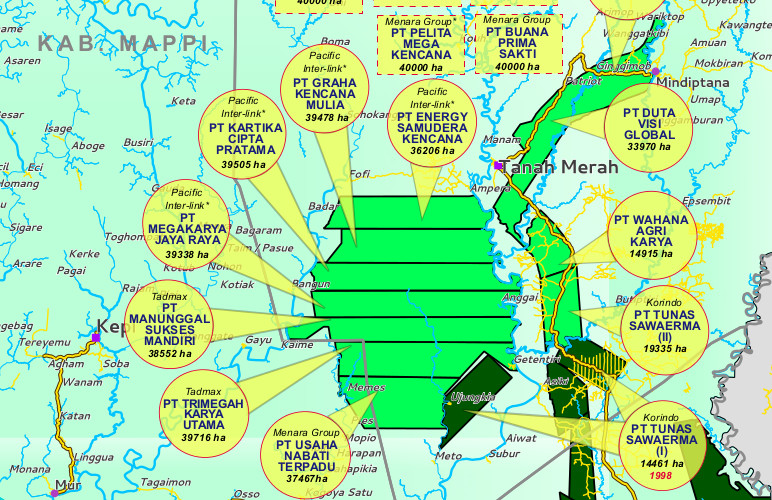
The West Papua Oil Palm Atlas, published by awasMIFEE, Pusaka and six
other organisations, is an attempt to provide a picture of this
developing industry. Who are the companies involved? Where are they
operating? Which areas will be the next hotspots? The aim is to be part
of a process to push for more open and accessible information about
resource exploitation industries in West Papua – currently local
administrations and companies are often reluctant to share information
about permits, meaning that communities often know nothing of plantation
plans until a company shows up, trying to acquire their land.

Indonesian law does recognise communal land rights for indigenous
customary communities, but in reality those communities often face
considerable pressure to give up that land, and are rarely given more
than US$30 per hectare in compensation. It is hoped that this
publication can become a tool for indigenous peoples and social
movements who wish to understand the oil palm industry and defend their
forest against these land grabbers, as they themselves should be the
ones to determine what kinds of development will benefit their communities.

For environmentalists and supporters of indigenous struggles around the
world, we hope that this will also be a useful insight into the dynamics
of the plantation industry and the threats it is causing in the third
largest tropical forest in the world. Using the excuse of the conflict
around the independence movement, the Indonesian government makes it
very difficult for international observers to access West Papua, and
this has probably also resulted in a lack of awareness internationally
about the ecological threats. Yesterday (29th April) human rights groups
throughout West Papua, Indonesia and in over 22 cities around the world
held demonstrations for open access to Papua, which has long been a
demand of many Papuan movements. Publishing this Oil Palm Atlas is also
an attempt to break the isolation of Papua, by focussing attention on
the issue of indigenous land rights, in a context where local
communities which choose to oppose plantation companies often feel
intimidated by state security forces which back up the companies.

Direct download link:

English:
http://awasmifee.potager.org/uploads/2015/04/atlas-sawit-en.pdf
Indonesian:
http://awasmifee.potager.org/uploads/2015/04/atlas-low-resolution-Final-id.pdf

The Eyes of the Papuans: A video advocacy process

by Wensislaus Fatubun*

April 24, 2015

Thirty years later, I have still not forgotten. It happened in the south of the Indonesian province of West Papua, a journey of two days from the “big city” of Merauke.  Life in the small village of Yodom centred around trips to and from the ubiquitous, generous forest, provider of every need.  The arrival of a South Korean lumber company brutally intruded on the traditional way of life.  Workers started to fell trees.  Word had it that a plantation of palm oil trees was to take their place.

While the helpless population watched the destruction of part of their source of food, the children in the village had eyes only for the bulldozers.  But what fascinated my 12-year-old self the most was the strange object a Korean regularly held up to his eye as if he were aiming at something.

“No one had ever seen a camera,” I remember.

“When I saw the joyful reactions of the people who saw their pictures from the camera, I said to myself that me, too, I wanted to do that.”

My dream came true some years later when, after studying philosophy at the School of Philosophy, on the island of Sulawesi, I started work at the Office for Justice and Peace in the archdiocese of Merauke.

“I began to write reports and use a camera to speak out on the rights of native peoples and environmental issues. This is how the project Papuan Voices started.

“…. I wanted this to be an advocacy and cultural project to permit the people of Papua to tell their own stories in films. So other people could learn about them together with them.”

Individuals and communities have memory, so the most important thing in advocacy videos is how to build a collective memory.  I believe, when we have the same collective memory, the advocacy process that we build will continue to proceed and will not die.  This is where video has a very important role.

The process of building video-based advocacy and memory is an inter-subjective experience and dialogue on history and culture.  This is the first process.  I visited the villages, explained what a camera was and what purpose it served and convinced the villagers of its usefulness as a tool.  This is what I made.  Once a plan for the sequence was established to everyone’s satisfaction, we could film.

The result: short fifteen-minute films posted on the Internet in order to reach a maximum audience. [These films can be viewed on papuanvoices.net and on YouTube: Papua Storyteller.]

“One of our films tells the story of a young Papuan woman who became pregnant after a relation with an Indonesian soldier. This happens to a good number of Papuan women who find themselves alone to raise their child, cast off by Indonesians and their own community alike,” says the producer-film maker.

“Another film shows how Papuans are losing their culture and their identity.”

My interest is not just in making films: “Each sequence is an opportunity to talk with the villagers about human rights, the rights of indigenous peoples and their socio-economic rights.  Making a film is an occasion for us to settle on a strategy with the villagers for them to claim their rights.  Not only by addressing representatives of the government in meetings organised by the Justice and Peace office but also more globally using our network.”

That is the process of making the video part of our advocacy strategy.  We introduce the process of making a video and train the community in the early stages of building a network, we strengthen and assist the community to be able tell their stories, especially their stories about human rights.  We are human beings, we take note of the experience, history and relate to others so that we have a story about human rights.

From my experience, video is able to connect people.  It is not only communication, but more of an emotional connection.  People who are at different places can have an emotional connection to each other because they watch the video.  Our challenge is how to produce a video about human rights that is able to connect the emotions of people and unite them to fight together.  The principle instrument we have to tell the story of life is the video.  I think a lot of video advocacy activists fail to use video as an advocacy tool because they are simply telling the issue, and not a life story.

I have been talking about the pre-production and filming, now I want to talk about the distribution.

In Papua, Papuans people continue to fight to protect their rights.  They continue to protest to the Government and the State of Indonesia.  There are indeed reasons to protest.  Their land is being taken from them, they are being colonised by new settlers, they are being forced into assimilation and being marginalised … This is not to forget the smouldering war that has been going on since 1963, when West Papua was de facto declared a part of the Republic of Indonesia.  To this day, Papuan armed groups have been calling for greater autonomy and even independence.

I denounce “a creeping genocide,”  given the extra-judicial executions, arbitrary arrests, disappearances and torture to which the Papuan population is exposed.  Amnesty International has regularly recorded abuses and violations of human rights by Indonesian authorities in a region off-limits to international non-governmental organisations and journalists.  (Two French journalists were arrested on 6 August 2014 and imprisoned for having travelled with tourist visas and allegedly contacting members of an “armed gang of criminals”. [These allegations were never proven – WPM Eds] They were threatened with a prison sentence of 5 years as well as fines of $42,000, before being deported.)

My challenge in Papua is how to convey the story of a difficult message, violent and even bloody, to the audience?  I would like to answer this question with a story from personal experience.  On December 8, 2014, the Indonesian military shot dead four students in the District Enarotali District, Paniai, in Papua, Indonesia.  At that time, there was a lot of media publicity about this case.  We got some footage of the community. We think that this footage should be part of ongoing advocacy process. We edited and made a video [see below] for which the primary audience were the participants of the side event about Papua in Room XXIII, the UN Human Rights Council.  We did not make the main audience the Government of Indonesia, because we see that the Government of Indonesia has received a lot of information. The National Human Rights Commission is conducting an investigation and the people’s movement Papua ItuKita is supporting the advocacy process in Jakarta. The video we made should strengthen the advocacy process in the UN Human Rights Council.  This video was screened during the side event, there were a lot of responses and the video was able to evoke emotion in the Council room.  It has been distributed to other audiences and most importantly, the video is able to strengthen the argument of activists, becoming part of advocacy through a mechanism that is available on the UN Human Rights Board.

*Wensislaus Fatubun is an accomplished and pioneering West Papuan independent journalist, film maker, human rights defender, writer, photographer, story teller and has also been long term collaborator with West Papua Media.  He is currently also a member of Pax Romana, and the Program Manager of the JPIC Desk in Kalimantan, a place under the same colonist pressures as West Papua.  You can see his work at http://iampapua.blogspot.com/ and You Tube: https://www.youtube.com/user/ambaimain23

This story also appeared at  http://www.tapol.org/news/eyes-papuans-video-advocacy-process  but was sent by the author to WestPapuaMedia independently.

OpEd: Asia, Africa and the Unresolved Question of Papua

by Budi Hernawan*

April 24, 2015

EDIT: WPM received a transcript without the original author being credited and published as an original .  We apologise for this, but will maintain the article as fair dealing.  Article originally appeared at http://thejakartaglobe.beritasatu.com/opinion/commentary-asia-africa-unresolved-question-papua/

Sixty years ago in Bandung, 29 representatives from Asian and African nations were enthused with the spirit of decolonisation, and today even more seem determined to pursue South-South cooperation.

If we look back at the 1955 Bandung conference as described in Richard Wright’s “The Colour Curtain,” it was simply stunning. Most of the leaders of newly independent nations were former political prisoners under their respective colonial regimes. Those who had long been treated as underdogs were now in charge of new nations. It was a new dawn of liberation and in 1960 these Asian and African countries made history through the adoption of Resolution No. 1514 on Decolonisation at the General Assembly of the United Nations.

For this year’s commemorative Asian-African Conference, Indonesia has set three main goals:

  1. strengthening South-South cooperation to promote world peace and prosperity;
  2. reinvigorating the New Asian-African Strategic Partnership; and
  3. a Declaration on Palestine.

However, one thing is missing in this picture: Papua.

Sixty years ago, Papua was on the top of then-president Sukarno’s decolonisation agenda. He managed to get the support from many of the participants of the Bandung conference for his diplomatic battle at the UN to make Papua — still ruled by the Dutch — part of the Republic of Indonesia. The Dutch were still recovering from their post-colonial syndrome and although they had started to realise that their time had passed, they were determined to hold on to what they called Netherlands New Guinea, and what Indonesia referred to as West Irian.

The debates at the UN centred on the topic of unfinished decolonisation and the serious threat to world peace this posed. With the support of other Asian and Africa countries, Indonesian diplomats tirelessly argued before the General Assembly that West Irian was part of Indonesia as agreed during the Roundtable Conference in The Hague in 1949. Furthermore, they argued that the situation was detrimental to stability in the Southeast Asian region, calling on the UN to step in, as mandated by the UN Charter.

With the support of 14 countries, in 1954 Indonesia managed to table “The Question of West Irian” at the UNGA but it took another year before the UN General Assembly adopted it as Resolution 915(X) in 1955. The journey was far from over.

In the following years, Indonesia fought hard for the topic to be put on the agenda at the UNGA, with the support of 15 Asian and African nations, but failed. Australia was one of the countries that consistently voted against the proposal, whereas the United States opted for abstention — giving the Dutch leeway. This diplomatic failure led Sukarno to divert his energy to scale up the nation’s military capacity and, ultimately, launch an assault — Operation Trikora in 1961.

Not long after, the current provinces of Papua and West Papua were transferred to Indonesia after a brief period of UN administration. However, many people do not realise that until today, “Papua” remains an unresolved question.

Papuans have long appealed for a peaceful solution to the decades-old conflict in the easternmost part of the country. It has been a while since local church leaders declared Papua as a “Land of Peace” in 1998, following the bloody massacre of Biak, which remains unresolved. Filep Karma, who rose the Morning Star flag in Biak days before the massacre, remains in jail for doing the same thing in 2004.

The Papuan Peace Network has been trying to persuade Jakarta to engage in dialogue with Papuans since 2009. President B.J. Habibie’s administration told the 100 Papuan representatives to go home and rethink their call for independence. The administration of president Susilo Bambang Yudhyono held two separate meeting with Papuan church leaders and promised to organise a dialogue, which never happened. President Joko Widodo visited Papua after promising to improve the situation on the campaign trail.

But Papuans are still waiting.

While the national government is determined to revive the Bandung spirit of liberation by proposing a “Declaration on Palestine”, local police in Jayapura on April 8 arrested five Papuan leaders and charged them with treason even though they had only just returned home from a  meeting with Defence Minister Ryamizard Ryacudu. Papuan efforts to establish a dialogue are being criminalised. Charges remind us of the colonial time, when our founding fathers were persecuted for expressing their political positions.

Papuans are no longer placing their hopes in Asian and African countries, and some have started to shift their focus to the Pacific.

The Melanesian Spearhead Group (MSG) has become a new forum to find a solution for Papua. During its 2013 summit, the MSG expressed concerns over the human rights situation in Papua and called on Indonesia to find a peaceful solution. The summit also discussed an application for membership from Papuan representatives, although a decision has been delayed. But in May, the MSG will again discuss the application during its summit in Honiara.

“The Question of West Irian” is still very much alive.

*Budi Hernawan is a long time researcher on human rights issues in Papua, and is currently a research fellow at the Abdurrahman Wahid Center for Interfaith Dialogue and Peace at the University of Indonesia (UI).

Coalition calls on Bupati to revoke PT Nabire Baru’s permit

Report by our partners AwasMifee

February 13, 2015

A group of organisations using the name “Coalition caring for oil palm victims in Nabire” is urging the Bupati of Nabire to revoke PT Nabire Baru’s oil palm plantation permit. This would follow a precedent set by the Bupati of Mimika last December, who revoked PT Pusaka Agro Lestari’s permit. Like PT Nabire Baru, that company had already been operating for a few years, and had cleared thousands of hectares of forest.

PT Nabire Baru is possibly the most controversial plantation in Papua. There are many aspects which are seen as problematic, from the way the company dealt with customary land rights to the lack of an environmental impact assessment before land clearing started. The plantation has divided the community and there have been a string of violent incidents at the hands of Police Mobile Brigade (Brimob) guards employed to guard the company’s operation.

The organisations involved in the coalition are: Dewan Adat Meepago, Dewan Lingkunagan Masyarakat Adat Papua, PUSAKA, Greenpeace, FIM. Here are their demands:

In line with law 21 of 2001 concerning the recognition and protection of the rights of customary communities and Law No 39 of 1999 concerning human rights, and in order to avoid misunderstandings between the Yerisiam people and the Nabire Consultative Leadership Board (Muspida), together with indigenous communites we recommend that:

  1. The Governor of Papua province should revoke PT Nabire Baru’s plantation permit (IUP) and arrange a meeting between PT Nabire Baru and the Yerisiam indienous community. If PT Nabire Baru doesn’t want to meet these demands then its plantation permit should be revoked.
  2. In the spirit of Papuan special autonomy, PT Nabire Baru and PT Sariwana Unggal Mandiri must start negotiations with customary landowners, in this case from the Yerisiam and Mee ethnic groups, to talk about a MoU with the Yerisiam people and compensation for the wood that has already been extracted
  3. It must be stated that the transfer of land from Yunus Monei to Imam Basrowi which took place on on 15th October 2008 was invalid because it violated the rights of customary communities, as in customary law it is impossible for one person to own land covering thousands of hectares.
    Source: Pusaka

Papuan News website Majalah Selangkah, which is based in Nabire, also filed the following story:

To protect the people, Nabire’s Bupati urged to shut down oil palm company PT Nabire Baru

There are indications that an oil Palm company, PT Nabire Baru, which has taken over the Yerisiam people’s lands, has violated the terms of Law 21 of 2001 concerning recognition and protection of the rights of customary communities as also laid down in Law No 39 of 1999 concerning human rights. This is believed to have caused new conflicts between the indigenous communities, the company and the Nabire Regency government.

The issue has attracted a response from a member of Commission 1 of the Papuan Provincial Legislative Council, Laurenzus Kadepa. Kadepa supports the closure of PT Nabire Baru.

He said that the Bupati of Nabire needed to learn from the Bupati of Mimika who recently shut down the PT Pusaka Agro Lestari company which was operating in his administration’s territory. According to Kadepa, that action was taken by a brave leader who valued human rights and the survival of local communities, including future generations.

Kadepa appealed for the Bupati of Nabire to look at Merauke and Keerom regencies, where after local governments accepted oil palm companies, negative impacts for local communies followed. There, Kadepa continued, a glaring divide had emerged between different segments of society.

“Dont let that haappen in Nabire,” was Kadepa’s clear reminder

“I fear that problems like that in Degeuwo Bayabiru in Kabupaten Paniai will also happen in Nabire Regency , to the Yerisiam people. They are taking wood as it suits them, and recklessly grabbing ancestral land”. Kadepa made clear [translator’s note: Degeuwo is an informal gold-mining area where migrants mostly from Sulawesi have been accompanied by violence and social problems into a previously inaccessible forest area].

According to him, the companies have been creating a “living hell” for the indigenous people on their own ancestral lands.

“Giving permits to corporations to clear land is ‘hell’. It will only bring new conflicts to the local indigenous people”, Kadepa said.

It is hoped that the government will make the people’s interests their priority, acting out of humanity and thinking about indigenous people’s livelihoods into the future. “Don’t look at the company’s money, look towards the people. Don’t just prioritize private and corporate interests, because the impacts will be terrible, especially in Nabire which is the main route into several regencies in the central mountains”, Kadepa made clear.
Source: Majalah Selangkah

Papua-Wide meeting calls for 10 year Moratorium on Plantation and Forestry Industries

From our partners at AwasMifee

Between 4th-7th November 2014, representatives of indigenous communities, environmentalists and human rights defenders from every corner of West Papua met in Jayapura to discuss problems linked to the forestry and large-scale plantation industries, which in recent years have been expanding rapidly throughout the island.

This was an important meeting, as the difficulties and expense of travel around Papua means that communities are frequently isolated to face the companies alone, even though the problems they face are remarkably similar.

With many more plantation companies set to start operations within the next few years, and timber companies still keen to harvest high-value logs, it is also vital to share the (often bitter) experiences of communities which have already seen how these industries operate, and also to formulate some common platform of demands with which to confront government and policy makers.

Participants at the event heard about the long-term injustices connected with plantations in Jayapura, Keerom and Boven Digoel, where land was taken with military backing during the Suharto dictatorship causing problems which are still not resolved. In Papua’s deep south, participants told of how they have been marginalised by plantations connected to the MIFEE agribusiness development. Others from Sorong, Nabire and Mimika, told of how they were unprepared for the problems which started unfolding as the companies moved in. Delegates from Bintuni and Wondama Bays explained how the effects of the timber industry on communities are no less destructive.

In many of these cases, the same problems could be seen to emerge time and time again: intimidation from military and police officers supporting the companies, loss of livelihood as the forest is destroyed, companies’ broken promises to bring development to communities, environmental problems such as pollution, flooding and loss of water sources. Taking all this into account, the participants agreed to call on all agencies involved in allowing these industries to address these problems.

Top of the list was a call for a 10 year moratorium into for large-scale plantation and forestry investment, during which time part violations should be resolved, and the challenge of finding a way that these industries could exist on indigenous land without disadvantaging indigenous people. Hopefully we will translate some of the testimony on this site soon, in the meantime here is the full list of recommendations:

Organisations involved in organising the event were: Yaysan Pusaka, Greenpeace Papua, SKP Jayapura, Jerat Papua, Foker LSM Papua and Jasoil Papua. A copy of this declaration in Indonesian together with a list of participants can be found at: http://pusaka.or.id/demo/assets/REKOMENDASI-TEMU-RAKYAT-ADAT-KORBAN-PAPUA-Nov-2014.pdf

RECOMMENDATIONS

Meeting of Community Victims of the Forestry and Large-scale Plantation Industries.

Dialogue on Building a Green Economy and Sustainable Development

Today, Friday the seventh of November two thousand and fourteen, in the Maranatha Convent, Waena, Jayapura,

After hearing and discussing Reports of Victims of the Forestry and Large-scale Plantation Industries from throughout the land of Papua, and also discussing various developments in development policy, we as representatives of indigenous communities from twelve Regencies or cities throughout the land of Papua, want to hereby make clear that the state has violated and ignored our human rights, by not protecting, respecting and advancing the rights of indigenous communities throughout the land of Papua, including: acts of discrimination, repression and expropriation of what rightfully belongs to indigenous people throughout Papua. These human rights violations, which have occurred between 1982 and 2014, have caused great loss for indigenous people, as their social and cultural fabric and their natural environment disappear. Because of this, we as representatives of indigenous people who have suffered because of the forestry and large-scale plantation industries, coming from twelve regencies and cities, hereby state the following:

1. To the President of the Republic of Indonesia, to issue a ten-year moratorium on forestry and large-scale plantation development throughout the land of Papua. During the moratorium period, the government would resolve the different problems and violations of indigenous communities’ rights that have already occurred, and amend policies and legislation currently in force in the land of Papua.

2. To the Governors of Papua and West Papua Provinces, to reconsider all policies concerning the granting of permits for the forestry and large-scale plantation industries which disadvantage indigenous people across the land of Papua.

3 To the Commander of Military District XVII Cenderawasih Command and the Papuan Police Chief, to discipline and take action against any members of the military and police forces who openly participate in pressurising and intimidating indigenous people that wish to defend their rights throughout the land of Papua. Also to take action against members of the forces who are either directly engaged in illegal business involving forest products, or back-up and protect others in such businessses.

4. To Bupatis and city mayors throughout the land of Papua, to end the practice of unconditionally giving out permits and recommendations in the forestry and large-scale plantation sector.

5 To the honourable members of the Papuan and West Papua People’s Assemblies (MRP), to hold a Special Dialogue with the Energy and Mineral Resources Ministry, and the Environment and Forestry Ministry, concerning making changes in policy and regulations related to forestry and large-scale plantation investment in the land of Papua, both ongoing and in the future, which would be based on indigenous peoples’ rights and the spirit of Papuan Special Autonomy.

6 To the Provincial Legislative Councils in Papua and West Papua, to form a Special Committee to conduct investigations into the violations of indigenous communities’ human rights in the land of Papua, which are a result of policies and investment activities in the forestry and large-scale plantation sector.

7 To Customary Tribal Councils throughout the land of Papua, to organise reconciliation and customary assemblies in each area to map the customary lands of each tribe/ethnic group and follow up the findings of this Meeting of Community Victims of the Forestry and Large-scale Plantation Industries.

8 http://pusaka.or.id/demo/assets/REKOMENDASI-TEMU-RAKYAT-ADAT-KORBAN-PAPUA-Nov-2014.pdf, to take an active role in reporting violations in human rights and environmental problems so they can be brought to the attention of wider society and institutions that are actively attempting to protect, respect and advance human rights at the Papuan, national and international levels.

9. Participants of the Meeting of Community Victims of the Forestry and Large-scale Plantation Industries – Dialogue on Building a Green Economy and Sustainable Development hereby declare the foundation of the Indigenous People’s Environmental Council in the Land of Papua (Dewan Lingkungan Masyarakat Adat di Tanah Papua).

These are the recommendations which have been made and agreed together, and we hope they will be heeded and implemented. May our ancestors and the Creator be with us all.

Create a website or blog at WordPress.com

Up ↑
