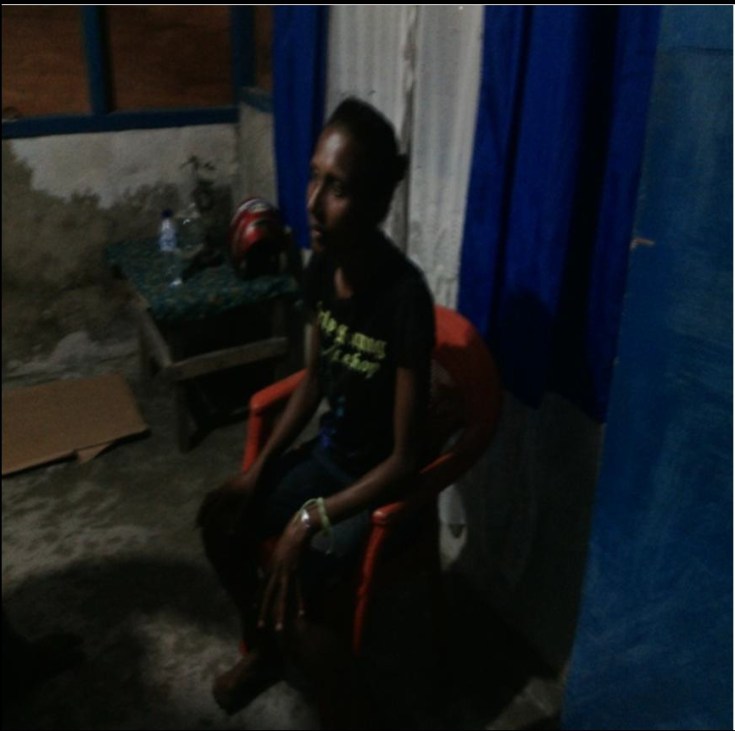
Indonesian Air Force Members Torture Amsal Marandof and Ida Marandof at the Arafat Village, Samofa District, Biak

Urgent Action / Verified Field Report

by JPIC, GKI-TP Synod*

November 23, 2015

On June 5th, 2015, 14:20hours, a member of the Air Force heavily maltreated Amsal Marandof (22 Years old), leading to an injury above his right eyebrow.  As Amsal’s elder sister named Ida Marandof (Around 26) wanted to intervene in the beating to help her brother she was severely beaten on the chest by one Air Force member causing the victim to loose consciousness.

Biodata of Victims:
Name : Amsal Marandof
Age : 22 Years
Date/Place of Birth : Biak, 4 April 1994
Occupation : private sector
Gender : Male
Status : Single

Name : Ida Marandof
Age : +/- 26 years
Date/Place of Birth : –
Occupation : private sector
Gender : Female
Status : Married

Case Narrative


On Wednesday June 5, 2015, around 14:20 pm, local Biak man Amsal Marandof went to his brother’s grave on the left side of the “Papan Kuning” road.  Amsal was bringing a machete with him to cut the grass around the grave. When Amsal arrived there he saw 2 Army Air Force soldiers approximately 200 meters ahead of him, following activities on a piece of land that had previously led to a conflict between Amsal’s family and the Army Air Force. For that reason Amsal walked
over to them and intended to asked what they were doing at the location.
As The Victim approached 2 air force members, one security force member panicked and stepped backwards and fell down. Thereupon the Air Force member became angry and kicked Amsal into the face. The kick caused a bleeding injury above the victim’s right eyebrow.

The air force member’s aggressive behaviour made Amsal angry, so he fought back using the machete with the intention strike the Air Force member’s head and hit his helmet. Subsequently,  Amsal panicked and retreated.  After several minutes,  many Air Force members came running out of their headquarters to chase after Amsal.  One air force member ran towards him and pointed his gun at the Amsal.  Other Air Force members threw wooden sticks and rocks at him shouting “You are an OPM member” (Papua Freedom Movement).

Thereupon the victim sought rescue at Arafat work shop. Around 50 Air Force members caught him in front of the workshop, where they kicked and punched Amsal.

When the victims’ elder sister named Ida Marandof (26) received information about the incident she directly went to the location to help her brother, by stopping the security forces (from beating him).  As Ida Marandof intervened in the beating one of the Army Air Force hit her on the chest, causing the victim to lose consciousness, so Ida was immediately brought to the Air Force Base Hospital at Singamangaraja Street, Biak City.  Amsal Marandof victim was brought to Biak
District Police Office where he was taken into custody.
Ida received medical treatment and was supplied with oxygen. As she became conscious, a member of the Army Air Force questioned Ida, but she refused to answer.

After that the Air Force member gave Ida Marandof IDR100.000 (less than US$10) as transport cost and said “This problem ends here ya”. Subsequently Ida left the hospital, still feeling pain in her stomach.

Around 15.15 local Papuan time, local residents became angry and blocked the “Papan Kuning” road in front of the grave of Amsal and Ida Marandof’s brother.  The demonstrators cut the trees and broke some bottles in the middle of the road which caused a traffic jam.  Around 17:00 the road block was reopened by the community members and police.
Pictures of Amsal and Ida Marandof revealing injuries caused by members of the Indonesian Airforce (JPIC/WPM)
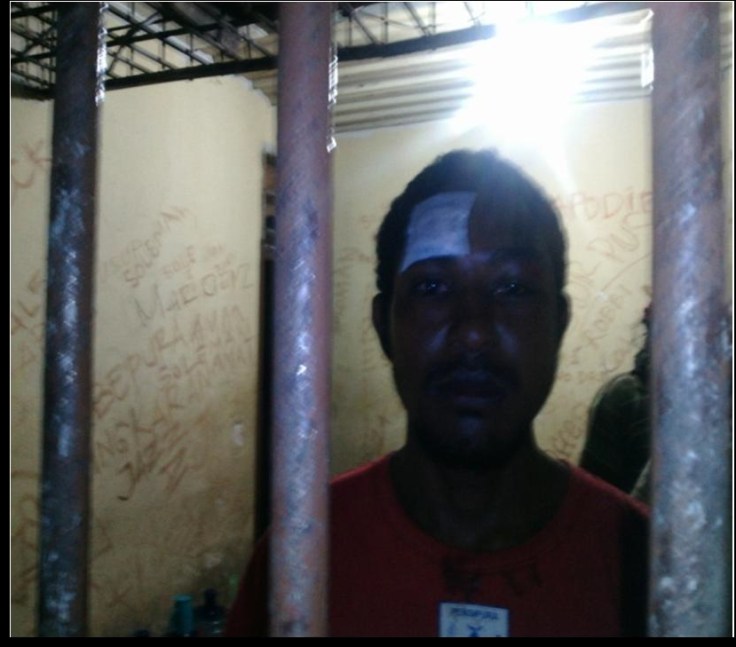

Wound above Amsal Marandof's right eye
Wound above Amsal Marandof’s right eye
Amsal's body is covered with bruises caused by Airforce military members
Amsal’s body is covered with bruises caused by Airforce military members
Ida Marandof during the interview


*Justice, Peace and Integrity of Creation (JPIC) Desk of the
Gereja Kristen Injili di Tanah Papua (GKI – Evangelical Christian Church in Papua)

The Release of Filep Karma Upholds the Principle of Human Rights in Papua, yet others remain behind bars

Statement by Yan Christian Warinussy, Executive Director of the LP3BH

20 November 2015

On behalf of the Institute of Research, Analysis and Development of Legal Aid – Manokwari [LP3BH], I welcome the release of one of the pro-Papua Merdeka political prisoners, Filep Karma on 19 November 2015.

Bapak [Father] Filep Karma is now a former political prisoner. He was arrested on 1 December 2004 and was sentenced to fifteen years at his trial at the District Court of Jayapura on 26 May, 2005.  Karma was charged for an action under Article 106 and Article 110 of the Criminal Code [KUHP].

He has spent more than ten years in prison for activities that he was involved in in accordance with the principles of the freedom of
expression and the freedom of assembly.  On that occasion, he made a speech and raised the Morning Star Flag on 1 December 2004.  He refrained from any actions of violence nor was he armed with any weapons.

Despite all that, he was one of a number of people who were arrested, imprisoned and charged in a Court of Law by a State that simply ignored his basic rights as a free citizen, entitled to protection under Article 28 of the 1945 Constitution of Indonesia.

During his imprisonment, he was treated in ways that are in violation of humanitarianism and basic human rights that are universally recognised.

The only thing he was doing was to give expression to his opinions that are in conflict with the views of the State.  His actions on that
occasion did not in any way destabilise anything politically or disrupt law and order.

The LP3BH calls on the Government of Indonesia and the Head of State, President Ir H. Joko Widodo to take the opportunity of release
of Filip Karma to launching a series of actions to release all the political prisoners, including those who have been tried (napol), who
are serving sentences in a number of prisons in towns and cities throughout the Land of West Papua.

Take for example the cases of three activists of the KNPB [National Committee of West Papua], Alexander Nekenem, Maikel Aso aka
Yoram Magai and Narko Murib aka Nopinus Humawak who were tried in the District Court in Manokwari.  They too, like Filep Karma, were accused of inciting other people to get involved in activities violating the law and charged under Article 160 of the KUHP, together with Article 55 of the Criminal Code.

At a subsequent hearing in their trial, on 19 November, the Prosecutor called for the three men to be sentenced to two years each, with deduction for the time already spent in prison.

These charges were extremely severe for the three accused who had refrained from perpetrating any acts of violence nor did they incite others to engage in any unlawful activities.  Nothing that they did resulted in anyone else being killed or injured or cause any material
damage on that day, 20 May, 2015 in Amban-Manokwari, Province of West Papua.

Peace!

[Translated by Carmel Budiardjo, Recipent of the Right Livelihod Award, 1995]

Warinussy: Continued Brimob police Detention of Alexander Nekenem is Rights Violation

Statement by Yan Christian Warinussy, Executive Director of LP3BH

10 November 2015

Speaking on behalf of the LP3BH – Manokwari [Institute of Research,
Analysis and Development of Legal Aid] as well as the Co-ordinator of
the defence team of Alexander Nekenem and his colleagues, it is my
opinion that the Prosecutor, Syahrun SH from the Prosecutor’s Office
in Manokwari has violated the basic human rights of one of my clients.

A statement issued by the Court stated that the length of
detention of my clients should be prolonged for sixty days, from 30
September till 28 November 2015.

A copy of this decision was sent to the Director of the Prison in
Manokwari. But where should these extra days be spent, in which
prison?

Why is it that that Alexander Nekenem and his colleagues continue
to be held in custody at the Brimob Command Centre. Is this the prison
where Alexander Nekenem and his colleagues are to spend the rest of
their detention?

Furthermore, it is clear that the Prosecutor in this case has
violated the rights one of the colleagues of Alexander Nekemen. This
is all the more so in view of the fact that this colleague, Narko
Murib, was taken ill during a hearing in the case and should therefore
have been allowed to be absent from the Court and held in a custodial
cell at the State Prison in Manokwari.

The Chairman of the Panel of Judges instructed the Prosecutor to
take the afore-mentioned prisoner for examination and given whatever
medical treatment he required.

However, regrettably, the Prosecutor’s Office did not act to
ensure that Narko Murib was taken for a medical check-up. All that
happened was that his blood pressure was checked and he was given
some tablets to bring his temperature down.

As a result, Narko Murib was unable to attend the court hearing
on Tuesday, 10 November because he was still unwell.

Peace.

Yan Christian Warinussy is also the Recipient of the John Humphrey Freedom Award 2015 in Canada, Human Rights Defender in the Land of Papua, and
Member of the Steering Commission of Foker LSM for the Land of Papua.

Translated by Carmel Budiardjo, Recipient of the Right Livelihood Award, 1995.

JUBI: Papuans Will Survive without Freeport, says Papua Governor

Freeport mining area in Timika - energytoday.com

Jayapura, Jubi/BenarNews – During his visit the United States this week to attract more investment, President Joko Widodo, his ministers and officials in the field of economy were scheduled to officially meet with executives of US companies.

However, Indonesian Minister of Foreign Affairs, Retno L.P. Marsudi denied the president would meet representatives from Freeport, which has an interest in obtaining a contract extension after 2021.
“Rumours in media that the president had a schedule to have breakfast with Freeport are not true,” said Retno was quoted in Solopos.

The US Company that operates the world’s largest gold mine and third largest copper mine in Papua, is enforcing the Indonesian Government to extend their Contract of Work while refer to the Indonesian regulation the extension could be approved two years prior the last contract was terminated. However, before his departure to the US, Jokowi gave a signal to Freeport could obtain the extension after the end of contract, it means in 2019.

No Intention to Develop Papua
In between the crowded debates and controversy about the contract extension for PT. Freeport Indonesia (PTFI) in Mimika, the voices from Papua are rarely heard.

But for Papuans, this issue of contract extension is not only a matter of time. The Papua Governor Lukas Enembe was doubt the intention of PTFI to develop Papua.
“We submitted 17 points of Government’s Proposal consist of 11 points of Papua Government and 6 points of the Central Government in order to renegotiate with Freeport, including the Freeport’s involvement to build infrastructure in Papua, the increment of royalty and tax payment to the Provincial Government, share divestment, environmental issue and prioritizing Papuans to be employees. That’s our priorities,” Enembe told BeritaBenar on 17 October 2015.

He accused Freeport to have no intention to Papua’s development. He took Timika City as an example, that until now the city is lacking of feasible infrastructures. “Freeport has been operating since 1967, but what about Timika and how’s Papuan condition right now? Infrastructures in Timika are still underdeveloped. The number of indigenous Papuan workers in Freeport is not equal with the number of non-Papuan workers. If it continues like this, Freeport is better leaving. Without it, Papuans will still survive,” said the Governor Enembe.

The local authority estimates there are only 30 percent of the company’s employees are Papuans, while the rest are recruited from outside of Papua.

Further Enembe refers to the attitude of PTFI that according to him hindering the water surface tax payment.  Each year, Freeport should pay 360 billion rupiahs for the water surface tax, but the fact is up to now PTFI only paid approximately 1.5 billion for each year.
“Freeport took many advantages of the government’s rotation every five years, and violated the commitment made between the government and Freeport. And the government just ignored this fact. But it is clear, Freeport has to pay 360 billion rupiahs each year,” he said.

The Governor Enembe said the Provincial Government also support the policy taken by the Mimika Regional Government charging PTFI to pay a penalty amounted USD 3.6 billion or Rp 481 trillion to the indigenous tribes living in the surrounded mining area.
“It’s the people’s demand because Freeport has exploited the mountain and its materials since being operated, but never given the in kind benefits to the local community,” said Enembe.

It’s a Political Treaty, Not Business Agreement
Musa Sombuk, Lecturer at Papua State University and doctoral candidate at Australia National Univrsity thought the tax issue, profit sharing, and other issues that endured for years as consequences of PTFI’s contract of work is a “political agreement” rather an economic agreement between the company and the Indonesian Government.
“At first time doing operation, it was clear that Indonesia need a cash. Now, the Freeport’s contract is not transparent, unequal and the profit sharing is not fair. Freeport also did any means in order to gain land ownership,” said Sombuk.

When confirmed by BeritaBenar, PTFI spokesperson Riza Pratama declined to give comments on the renegotiation process with the Central Government, but he denied PTFI did the cunning ways in obtaining the land. He said the customary community at the PTFI mining area has gave their permission and tenure rights since PTFI started their operation for the first time. According to Reza, the company also has paid the penalty and is continuing the development program for indigenous communities at the surrounded the mining area.

Sombuk, who admitted his involvement in the audit of PTFI in 1997, said the company is not only taking the copper and gold, but also the tailing –sand waste containing the iron ore, that could reach 30 billion tons. Several grams of tailings, according to him, could result 1 gram of 23 carat gold. “Now there’s 30 billion tons of tailing and it must be gold-contained. Where will the gold from tailing go?” said Sombuk.
“Just imagine, Freeport should use the dump truck to dispose the tailing, but they just drain it to the Ajikwa River that is bearing the risk and impact to the people’s health and environment,” said Sombuk.

According to Sombuk, PTFI could survive until now because it gained support and facilities from the government, both regional and provincial. The vague regulation and the attitude of both government and company for not being transparent making the law enforcement is risk with the corrupt practice.

“We never know whether the local permits have any cost consequences. If it has, such as the charge on waste draining in Ajikwa River, we don’t know to whom it should pay and how much?” asked Sombuk. (Victor Mambor/rom)

Cultural Destruction, Land Conversion Threaten Indigenous Papuans

from Abeth You, at our partners Tabloid Jubi’s West Papua Daily

October 21, 2015

Indigenous peoples of Papua - Jubi

Jayapura, Jubi – The destruction of Papuan culture is gradually happening and is threatening the lives of indigenous people, a student group said.

The issue at heart is not the reduced number of Papuans, or rates of birth and mortality, but most importantly is the loss of cultural values, patterns of dispossession (being ignorant of the sacred connection to land), a ban on the use of indigenous languages in some urban schools, as well as the loss of indigenous content education in school, said the Chairman of Papua Highland Student Association in Indonesia (AMPTPI) for Eastern Indonesia Region, Natan Naftali Tebay.

Tebay said the most crucial issue is the loss of customary tenure rights on land, water and the values of life. “The process of land conversion such as sago forest being destroyed for oil palm plantations, is a process of extermination of the values and Papuan planting heritage ,” Tebay said in Jayapura on Monday (19/10/2015).

According to him, once Papua was recognised as the “sago barn” but it is now recognised as the “oil palm barn”.   During this time the levels (of indigenous) population in Papua were politicised (inflated with inaccurate data)  by some bureaucratic elites, with claims the population of Papua grew to more than three million.

“The Papua Provincial Government should be firm and realistic about the population rate of indigenous people. The Regional Parliament, Papuan Representative Council, Papua’s People Assembly and Papuan Provincial Government must not stay still and (just) watch the reality of genocide,” Tebay said.

He added they must establish strategic planning, such as forming a Special Regional Regulation, or establishing particular institutions to manage the transmigrants, and enforce sanctions over them if necessary.

“This is also prohibiting the development process. The Central Government also implements several policies that are not in synergy with the Governor’s policies. The regents and mayors must observe this situation, therefore they shouldn’t necessarily ask the Central Government for support,” he said.

It could be seen that several oil palm plantations, illegal logging and illegal fishing went ahead without any prior communication (or permission) from the Provincial Government.

Further he asked the Papua Governor to immediately issue the regulation about the population restriction and form a special body about the population issue in Papua. He also suggested the requirement of the regulation of local transmigration be extended both to people and government officials.

Earlier, the Papua Governor Lukas Enembe said the transmigration program in Papua initiated by the Minister of Villages, Rural Development and Transmigration Marwan Jafar was a depopulation threat for indigenous Papua.

“We have rejected the transmigration program from the Central Government.  If they still want to realise it, it should be a local (ethnic Papuan) transmigration (within Papua) instead of replacing people from Java or other regions to Papua.  Replacing poor Indonesian people to Papua means taking the problem to Papua. It’s not only related to the economy, employment,  or social problems, but I do worry that the program will reduce the number of indigenous Papua on this land in ten or twenty years; the depopulation of indigenous Papua,” Enembe told Jubi at his official resident on Saturday evening (17/10/2015) in Jayapura.

Furthermore, Enembe said until today no institution has the valid data about the number of indigenous People.  “So how could we protect the indigenous Papua from transmigration is still running without knowing the accurate data on the number of indigenous people?”

Create a website or blog at WordPress.com

Up ↑