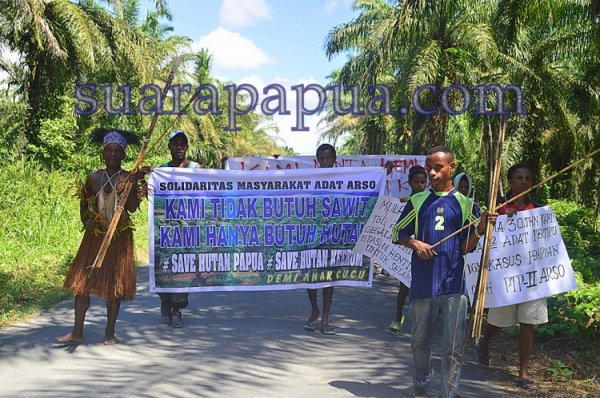
Marap Indigenous Group claim back three oil palm plantation divisions in Arso

from our parters at SuaraPapua.com

translated by AwasMifee

tiga-lokasi-perkebunan-sawit-di-arso-di-tarik-kembali-oleh-masyarakat-adat-suku-marapIndigenous land owners from the Marap people in Arso have used customary law to take back oil palm land owned by PT PN II as part of its Arso plantation, specifically the Core III, Core IV and Core V divisions. The action took place at Yamara village PIR 3, Manem sub-district, Keerom Regency, on Wednesday 27th April.

Maickel Fatagur, the head of the Fatagur clan which holds customary land rights, alongside other clans such as the Wabiager and Gumis clans, said that they will no longer hold any kind of meetings with the company. That is because they have used customary law to take back the land PTPN was using.

“We’e used customary law to take the land back. That means now there will be no more meetings with the company. The land now belongs to us. We invite PTPN II Arso to take back its oil palm and we will take back our land. That’s all”, Fatagur made clear to the Manager of PTPN II’s Arso plantation on Wednesday at Tami in Manem District, in Keerom.

According to Maickel, PTPN II has operated the Arso plantation on the Fatagur clan’s land, and that of its sub-clans, for around 30 years, but the local community, who hold the customary land rights, have never felt economically secure

“All these years attention has never been paid to the wellbeing of the community who hold the customary land rights on the land used by PTPN II Arso at the three locations in question, Core III, Core IV and Core V, which amount to 1300 hectares”, said Fatagur.

Dominika Tafor, the secretary of the Boda Student Association (Himpunan Mahasiswa Boda) in Keerom who is also an indigenous member of the Marap ethnic group, said that she was supporting the action taken by local indigenous people.

“We strongly support the action which the Marap community of Workwama village are taking today. We support it, because for so many years the company has not paid attention to the fate of the community. They only come to destroy”, she said.

When the indigenous people arrived at the plantation office in Tami, PTPN II’s Arso plantation manager, Hilarius Manurung, recieved them and said that he would take their wishes on board and pass them on to the Keerom local government.

“Since we’re a state owned company, we can only listen to all aspirations and complaints and pass them on to the local government for further action. There’s not much we can do. What we can do is to follow up all these complaints from the community,” said Manurung.

Suarapapua.com observed that security forces from the Keerom police headquarters were present, 11 armed policemen in a Dalmas truck, ready to police the Marap people’s action.

The action started from Workwama village at 9-00 am and travelled by truck the 6km to the plantation areas Core III – Core V, bringing a banner which read “we don’t need oil palm, we only need forest #savehutanpapua #savehutankeerom for our grandchildren”

As a symbol, the indigenous people brought soil from the three oil palm locations and taro yams from their gardens, placing them in a noken string bag made from forest palm frond midribs, and using traditional rituals took them to PTPN II’s office located in the plantation administration centre in Tami.

 HARUN RUMBARAR

Source: suarapapua.com http://suarapapua.com//read/2016/04/27/3305/tiga-lokasi-perkebunan-sawit-di-arso-di-tarik-kembali-oleh-masyarakat-adat-suku-marap

This entry was posted in Around West Papua and tagged , , ,

FakFak raids hold 45 activists, schoolkids incommunicado

originally alerted via WestPapuaMedia #LiveUpdatesPapua, with additional reporting from Satu Juli

April 3, 2016

Update: 45 people have been confirmed detained without release since 8pm last night in Fakfak, mostly are primary and secondary school students.

On 2 May 2016, almost 2000 activists were arrested throughout West Papua, as they were engaging in peaceful activities to support the ULMWP’s full membership to the Melanesian Spearhead Group. Today, most of the activists have been released, after many were tortured and mistreated.

45 people have been confirmed detained without release since 8pm last night in Fakfak, mostly are primary and secondary school students. That region was to hold a peaceful march the next day, on 3 March, coinciding with the Meeting that is to be held today in London, regarding the Right to self-determination of the Papuan People.

This is a video of last night, when the Papuan activists were arrested and taken away from the ULMWP Secretariat/Fakfak Region, to the police station. More than 16 people were arrested at the time, at around 5.30 pm. That evening, others were arrested at around 8 pm. The names of the 16 arrested whom we know of, are: 

1. Apnel Hegemur
2. Siswanto Tigtigweria.
3. Ambram Remetwa.
4. Modes Komber.
5. Dany Hegemur.
6. Baron Tanggarery.
7. Yakobus Hindom.
8. Semuel Komber.
9. Simon Hindom.
10. Limce Iba.
11. Yonas Hindom.
12. Pasko Hindom.
13. Hiriet Hegemur.
14. Aron hegemur.
15. Yusub Hegemur.
16. War Hegemur.

The names of the remainder of the arrestees will be provided as soon as they are know.  More to come

New film ‘The Mahuzes’, documents conflicts between indigenous Merauke people and agribusiness

from our partners at AwasMIFEE

First Published: February 20, 2016

‘The Mahuzes’, a film about conflicts between indigenous people and agribusiness companies in Merauke, was released in Indonesian last year, and now it is available with English subtitles. It’s one of a series of documentaries produced as part of the ‘Ekspedisi Indonesia Biru’, a one-year road-trip on motorbikes by filmmakers Dandhy Laksono and Ucok Suparta, visiting diverse communities around the archipelago, often communities in struggle.

The Mahuzes follows one clan of Marind people in Muting village, where oil palm companies have started clearing land in the last few years on five massive plantations. The effects of these plantations are having a major impact – even the water from the Bian River has become undrinkable. The Mahuze clan is resisting – refusing to sell their land, erecting customary barriers to forbid the company from entering – but the company (PT Agriprima Persada Mulia) just pulls up their boundary markers. As well as these direct conflicts with the plantation companies, we see how they attempt to deal with the conflicts that inevitably arise when irresponsible companies show up with compensation money – there is an emotional peacemaking ceremony between the Marind and the neighbouring Mandodo people, but also anger in meetings that some elders in their own clan may have struck a secret deal with the company.

The Merauke Integrated Food and Energy Estate was originally launched as a massive industrial agriculture project in 2010, but it failed to reach the stated ambition in its original plan, and the cluster of oil palm plantations around Muting were some of the only developments that have actually started work in the last years. However, in May 2015 President Joko Widodo travelled to Merauke to relaunch the plan to convert over a million hectares of forest and savannah to mechanised rice production. The filmmakers also visit the site of the new rice development, revealing that once again the central government is ordering a mega project without due consideration of the local social and environmental conditions. One issue is the water – Irawan, who works for the water provider, explains that most of the water in the flat Kurik sub-district comes from rainfall. How could these conditions possibly support huge areas of irrigated rice-fields?

The Marind people’s staple food is sago, and sago palms grow abundantly in groves in the forest. As Darius Nerob explains in the film “If we plant rice, it’s 6 months before we can eat. But with sago, any day we need, we can just go and fell a tree… This tree can feed a family for half a year…. Even though the transmigrant program has existed for 33 years, Marind people have stuck with sago, they haven’t shifted to rice.”

Nabire: Akudiomi village government forbids forest and marine resource exploitation

February 19, 2016

Report by Robertino Hanebora at Suara Persatuan

translated by awasMifee

Akudiomi village in Yaur subdistrict of Nabire Regency (also known as Kwatisore village) looks out over the Cenderawasih Bay Marine National Park, and is home to whale sharks which are frequently visited by local and foreign tourists.

Several days ago (10/02/2016) in the Akudiomi village hall, the village administration held a meeting with the community, tribal leaders and religious and church leaders to discuss prohibiting the exploitation of forest and marine products by companies. Many companies have been operating in the village’s administrative area recently, damaging the environment.

The village took this step because its natural environment is being plundered and destroyed by people acting irresponsibly. Fishermen from outside Akudiomi are destroying the sea which provides local people’s livelihood by dynamite, potassium and poison. Villagers say that large numbers of dead fish can be seen floating around the area due to people using these destructive techniques.

Another reason is that the sea around their village faces the protected Cenderawasih Bay National Park, which should compel the community and village administration to take a firm stand in looking after the area for the future.

This prohibition also applies to their forest, where they will stop all businesses that try to operate. This represents the shared commitment of the Akudiomi village community.

Following on from this decision, all businesses will be cleared out of the Akudiomi customary and administrative territory on the 22nd February 2016, when the village government and the whole village community will join in a ‘cleaning’ operation. Copies of the decision were also sent to the Consultative Leadership Board (Muspida) and other relevant parties.

Download the Akudiomi village head’s statement (Bahasa Indonesia)


Investigation report: December 1 Nabire beatings and arrests of Papuans by army and police

By JPIC-GKI Nabire* with additional reporting from West Papua Media

February 2, 2016

apologies for the delay in publication due to verification and translation delays

On December 1, 2015 the indigenous Papuan community in Nabire   intended to hold worship to commemorate the December 1 Day of Papuan Independence at the community park of Oyehe,  Nabire. However organisers were unaware their worship service in the park had been prohibited by Indonesian Police as an illegal gathering  A joint Army and Police force dispersed the gathering with force, severely beating civilians, and then took arrested civilians to  the Police Headquarters in Nabire.

Chronology
Every 1st of December in Nabire,  a Christian worship service is held to commemorate the anniversary of thwarted Papuan independence, but it goes ahead without raising the banned Morning Star Papuan independence flag.  For the 2015 commemoration, the Papuan Community in Nabire announced and sought permission from the Kapolres (District Police Chief) to hold a Worship service at Oyehe Garden, Nabire, however the  Kapolres disallowed it from going ahead. Organisers cancelled the event, but many people didn’t find out about the cancellation, so they came anyway to the venue

The joint Army-Police force blockaded the garden entrance, so that the community could not access the venue, however more civilians arrived and stood outside the blockade.

Leader of the worship group, Zet Giay, attempted to come to the garden to explain to the gathered people that the Worship had been cancelled, however at 10:30 am Security forces ordered the dispersal of the gathered crowd.  This occurred without any negotiation with Zet Giay,  and so the joint Army/Police task force severely beat, attacked and arrested Zet Giay,  Mikhael Zonggenu, Mirna Hanebora and another 29 Papuans, with rifle butts and pistols, according to witnesses and victims  On the truck, Mikhael Zonggenaw was beaten by a police officer severely with a rifle butt.  All 32 people who were then taken to the Nabire Police HQ sustained injuries from the security force beatings.

The Papuans that were arrested on December 1st 2015, around 10:30 am in Oyehe, Nabire are;

1. Mikhael Zonggenau, 45, Civil Servant , injuries to Nose & Mouth;
2. Zeth Giay, 42, Civil Servant , beaten on head with wooden pole;
3. Pius Gobai  19 years old, Student;
4. Yosep Giay, 18 years old , Youth;
5. Hendrikus Yeimo, 18 years old , Youth;
6. Naftali Gobai, 19 years old, Youth;
7. Yanuarius Pekei, 19 years old, Youth;
8. Anton Kadepa, 18 Years old, Student;
9. Martinus Youw, 19 Years old, Student;
10. Marthinus Adii 23 Years old, Academic;
11. Peni Kayame, 18 Years  Old, Student;
12. Sely Ogetai,  26 Years old, Academic;
13. Derika Keiya, 27  Years old, Academic;
14. Samuel Kotouki, 23  Years Old, Student;
15. Agus Auwe, 22 Years Old, Youth;
16. Yus Degei, 24  Years Old , Student;
17. Angkian Douw, 23 Years Old, Student;
18. Yulibert Pigome, 16 Years old, Student;
19. Neles Waine, 15 Years old, Student;
20. Mesak Wakey, 26 Years old, Youth;
21. Bernard Belau,  31 Years old, Civil Servant;
22. Habel Douw,  56 Years old, Civil Servant;
23. Lince Waine,  22 Years Old, Student;
24. Willem Ikomou,  24  Years Old, Student;
25. Mina Hanebora, 33  Years old, House wife;
26. Nelius Pigai,  26 Years  old, Academic;
27. Melkias Douw,  16 Years old, Student;
With 5 unknown name victims. Total of the victims are 32.

Top: Mikhael Zonggenaw's Upper lip was beaten by the Police. Bottom: Martinus Adii, Lower lip was beaten by the Police
Top: Mikhael Zonggenaw’s Upper lip was beaten by the Police.
Bottom: Martinus Adii, Lower lip was beaten by the Police
Picture of 32 Papuans that was arrested by the Police in Nabire, Papua. The picture was taken after they were released from Nabire District Police office. When they were arrested they were not allowed to take pictures. Source : JPIC KINGMI Nabire.


*Justice, Peace and Integrity of Creation (JPIC) Desk (Keadilan, Perdamaian dan Keutuhan Ciptaan (KPKC) Bidang), Evangelical Christian Church in Papua (Gereja Kristen Injili di Tanah Papua (GKI))

Create a website or blog at WordPress.com

Up ↑