MAMA-MAMA, MARGINALIZED IN THEIR OWN LAND: THE STORY OF PAPUAN WOMEN

from our partners at EngageMedia.org

by Numbay Media —

Since 1971, Papuan women have been selling vegetables, fruit, fish and spices. They set up business by clearing space in the center of town beside the Anafre River in Jayapura. Later in the years, migrants also came and began trading there. The are became a market. But the local government’s effort to clean up the town center resulted the eviction of the market traders. They have returned again, just to be evicted over and over again.

http://www.engagemedia.org/Members/numbaymedia/videos/mama_en.mp4/view

  • Perempuan Penggali Batu Kapur (Woman Limestone Miner)

    Posted on Jul 28, 2011

  • Arnold Ap's "Sup mowiya"Arnold Ap‘s “Sup mowiya”

    Posted on Nov 25, 2010

  • Agus Alua and the Voices of PapuaAgus Alua and the Voices of Papua

    Posted on Apr 15, 2011

  • In Memory of Agus AluaIn Memory of Agus Alua

    Posted on Jun 14, 2011

  • West Papua Peaceful Rally in JakartaWest Papua Peaceful Rally in Jakarta

    Posted on Aug 03, 2011

Bintang Papua: 12 civilians tortured by security forces

Bintang Papua, 6 November 201112 Civilians torture by security forces? Komnas HAM demands clarifications from army commanderTwelve civilians in Kurulu, Jayawijaya are thought to have been tortured by members of the security forces on 2 November 2011 in violation of legal procedures., said Matius Murib, the deputy chairman of Komnas HAM Papua branch, in a statement to Bintang  Papua.

He said that the commander in chief of Cenderawasih Military Command, Major-General Eri Triassunu investigated members of the security forces who are thought to have committed these acts of torture, for them to explain the reasons for the torture to the victims and the general public.

Such behaviour fails to respect human dignity and violates human rights and is not in compliance with calls to put an end to violence in Papua. All parties should choose  the path of peace and dialogue as the way to solve the problems.

The head of public relations of the Cenderawasih military command, Colonel  Ali Hamdan Bogra was asked to confirm that these acts  of torture were perpetrated by members of the TNI security forces but he refused to respond..

Meanwhile, Buchtar Tabuni of the central executive of the KNPB told journalists on 4 November that these acts of  torture  by the TNI had occurred in Kurima Kampung on 2 October 2011

The torture was preceded by cheap provocations from the TNI Battalion 756 saying that a TPN group in Umapagalo Kampung had held a meeting with  the people of Kampung Umapagalo. After hearing about this meeting, the military commander organised a sweeping operation. During this operation, further acts of torture occurred.

According to Bucktar Tabuni, the KNPB sent a report about the torture perpetrated by the TNI, along with photos of the victims  to the central committee of the KNPB as well as sending it to the media.

After listing the names of the twelve victims, the KNPB said that these acts of  violence  were accompanied by screams of abuse and the victims were beaten with wooden truncheons, kicked with heavy army boots and threatened with rifle butts as well as gunshots.

A report of these acts of violence by the TNI against the twelve civilians was then submitted to the police in Kuruku but the police refused to accept it, saying that the operation  had failed to conform with legal procedures.

According to Buchtar and Mako Tabuni, the victims of this incident intend to submit this case to the district court in Wamena.

A spokesperson for Buchtar and Mako declared that the Cenderawasih military commander  should accept responsibility for the actions of his men in Kostrad 755/Kurulu. He said: From now onwards, we will not accept any attacks against the civilian population  in the Land of Papua  because these activities by the Indonesian military are acts of subversion (makar) in which members of the community were attacked by members of the state apparatus without there having been any acts of resistance by the local communities.

JG: 7 Soldiers Detained for Abuse in Papua

(Comment: West Papua Media was the only media outlet that covered this is detail when the story was broken (with thanks to local human rights sources and Tapol), so we also thank Jakarta Globe for following this up with such a positive result.  see https://westpapuamedia.info/2011/11/05/indon-commando-btn-755-brutalise-puncak-jaya-villagers/  It remains to be seen if these soldiers from Battalion 755 are charged and put on trial for human rights abuses and torture, and face accountability for their actions.  Moreover, without the identification of command responsibility for who gave the orders for soldiers to extrajudicially abuse civilians on mere suspicion of separatism (freedom of expression) then these abuses will continue.  Detention at a garrison is a long way from a judicial process).

http://www.thejakartaglobe.com/news/7-soldiers-detained-for-abuse-in-papua/476877

 by Banjir Ambarita | November 07, 2011

Seven soldiers stationed in Papua have been detained by military police on suspicion of abusing civilians there.

Col. Ibnu Tri Widodo, the head of district command (Korem) 172/PWY, said the seven soldiers were taken into custody after it was reported that they had beaten, kicked and humiliated 12 residents of Kurulu village in Papua’s Jayawijaya district.

“For what they [the soldiers] did, they are being detained at the military police in Wamena,” Ibnu said.

The Commission for Missing Persons and Victims of Violence (Kontras) reported that the soldiers had stumbled across the civilians participating in a traditional tribal council on Wednesday, but that the soldiers mistook the meeting for a pro-separatist gathering.

The soldiers then allegedly beat, kicked and doused the 12 with water while also forcing them to crawl on all fours.

Following the allegations, all military troops assigned to Kurulu have been replaced.

Ibnu said on Monday that he would try to prevent similar incidents.

“We have to be better and prevent violence against the civilians.”

Freeport strike: Police accused of siding with Freeport. Union given one-day ultimatum

Bintang Papua, 31 October 2011
[Abridged in translation by TAPOL]Timika: The actions taken by the police in Mimika have created the impression that the police are siding with Freeport-Indonesia, said a commissioner of Komnas HAM, the National Human Rights Commission, Ridha Saleh. In an interview with Kompas, he said that the police have warned that firm measures are being planned against the strike and the blockade set up by Freeport workers if  the blockade is not lifted within two days.

‘The measures being planned by the police reinforce the impression that, along with the money being paid by Freeport to the security forces, they are siding with the company,’ he said.

Ridha said that there was nothing unconstitutional about the strike and therefore workers should not be dispersed. The police in Mimika are going too far, he said. These measures would also  damage the negotiations now under way between the two sides  which are currently proceeding well.

‘We intend to talk to the police and ask them to abandon these measures. We also intend to speak to the national chief of police and the chief of police in Papua.’

The strike which started on 15 September is intended to persuade the company to pay attention to the welfare of the workers. The increase in wages offered by the company is not acceptable, in view of  terrain in which they work and the risks involved.

Police ultimatum to the workers:

The executive of the Freeport branch of the trade union, the SPSI, have been given an ultimatum by the police in Mimika, not to spread the strike to Mile 28, Mile 27 and Gorong-Gorong. The ultimatum was contained in a letter dated 30 October, along with a request to open access  which has been blocked by strikers. The police along with other security forces have given an ultimatum of only 24 hours, starting from the moment this request is made, for the strikers to conform with the regulations in force. ‘If this does not happen, the police will take firm action in accordance with the regulations in force,’ the letter from the police says.

The SPSI was also told to co-ordinate with the strikers  and ensure that the laws in force are not violated.

According to the police, the basis for these measures is the Criminal Code, Law 9/1998 on Freedom of Expression and Law 13/2003 on Labour Relations.

The chief of police in Mimika has also said that conditions  in the vicinity of Freeport-Indonesia are becoming less and less conducive  as a result of the strike which is, according to the police, being conducted in violation of the earlier notification given by the trade union.

According to the police, a number of anarchic actions have occurred in violation of strike regulations. Moreover, the workers have started holding demonstrations  without having informed the police, blocking access to a ‘vital national asset’ and disturbing the public order. [The police ultimatum goes on  mention a long list of laws and regulations which are deemed to have been violated by the strikers.]

The police ultimatum to the SPSI has also been sent to the governor of Papua, the chairman of the Mimika DPRP, the commander of the Cenderawasih Military Command, the President-Director of Freeport and other relevant agencies.

Maire Leadbeater reflects on West Papua’s ‘Arab Spring’

November 1, 2011
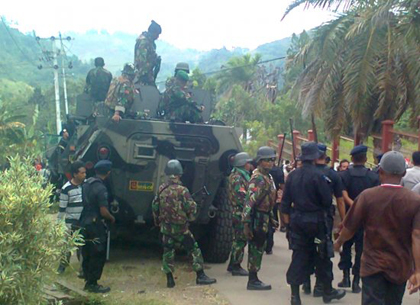
Indonesian forcesIndonesian security forces staking out the Third Papuan People’s Congress in Jayapura earlier this month. Photo: West Papua Media

Pacific Scoop:
Opinion – By Maire Leadbeater

It was not in the headlines, but our neighbourhood has had its own ‘Arab Spring’. The Melanesian people of Indonesian-controlled West Papua, have shown the same determination to pursue non-violent struggle as their counterparts in Egypt and Syria.

A 5000-strong Third Papuan People’s Congress took place over three days in a Jayapura field ringed with menacing armoured riot control vehicles and heavily armed police and soldiers. It was led by Forkorus Yaboisembut, chair of the Papuan Customary Council, who is highlighted on the Indonesian military’s leaked watch list of dangerous “separatists”.

As the Congress came to an end on October 19, Forkorus read a Declaration of Independence first penned in 1961, prior to the Indonesian take-over of the territory.

He then announced that he had been elected to be the “President” of the “Democratic Republic of West Papua”.

As the gathering began to disperse, the military began firing from their assault weapons and launched themselves on the crowd, arresting and beating some 300 people. Forkorus was forcibly arrested along with his “Prime Minister” Edison Waromi and they and three others now face charges of treason.

Dozens were injured, many with gunshot wounds, and up to six people were killed. The first death to be confirmed was that of a law student Daniel Kadepa who was shot in the head as he tried to flee.

Many terrified delegates tried to seek refuge in the nearby Catholic Seminary. Fr Neles Tebay, a prominent advocate for peaceful dialogue, has supplied a detailed account of the violent disruption and brutality displayed as the soldiers invaded the sacrosanct mission complex.

Terrified students
Terrified students were tear-gassed and threatened at gunpoint while one Franciscan brother was taken into custody despite the serious injuries he sustained in the attack.

A menacing security force presence is also ongoing in the remote Timika region, location of Freeport McMoRan mine, where an American multinational makes vast profits from the largest recoverable reserves of gold and copper in the world. About 8000 workers have been on strike since September seeking to lift their wages from the current hourly rate of around NZ $1.80 to $3.60 to parity with the wages paid to Freeport’s workers in other parts of the world.

Petrus Ayamiseba, one of the striking workers, was shot dead by the Indonesian police on October 10, provoking Papuan outrage and an unprecedented level of international union solidarity for the Freeport workers. Since then at least three others have been killed in the area by unknown assailants.

Rather than conciliation, the mine management has resorted to hiring contract workers as scabs.

Freeport McMoRan has had a dream run for more than 40 years. The first contract negotiated with President Suharto gave the mining company virtually free rein as well as generous tax concessions. This was in 1967 when Indonesia did not even have formal control over the territory.

In 1969, Indonesia pulled off a self-determination fraud by conducting a so called “Act of Free Choice” ( known as the “Act of No Choice” to the indigenous Papuans). Just over a thousand Papuan men took part out of a population at the time of nearly one million.

The Freeport mine has always been synonymous with violence and grave human rights abuses, as well as environmental destruction and the abuse of customary land rights. Amungme and Kamoro tribal people have had little recourse but to watch as the mine took over their lands and “decapitated” their sacred mountain.

Gunned down
In the last few years, especially since some Western mine employees were gunned down on the mine access road, the company has come under international scrutiny. However, the Jakarta government is in no hurry to interrupt the flow of taxes, dividends and royalties from Freeport, its biggest taxpayer.

There is an ongoing controversy around the way in which Freeport pays out millions of dollars so that Indonesian military and police forces can provide its security. Direct payments to individual police officers were supposed to have stopped, but the National Police Chief Timur Pradopo revealed in October that these payments of “lunch money” continue.

The security forces have a direct stake in a level of ongoing insecurity, a factor many believe underlies much of the violence in the area.

Following recent events, Indonesia has sent in yet more police and tried to justify the scandalous actions of its security forces as necessary to deal with “separatism”.

Why has New Zealand made no public statement condemning this latest crackdown? Our Government Superannuation fund and other Crown Financial Institutes invest in Freeport McMoRan.

Both government and the Superannuation Fund Board have so far resisted all calls to follow the ethical example of the Norwegian Government Pension Fund which divested from Freeport in 2006.

The New Zealand Minister of Defence recently talked about increasing our defence ties with Indonesia by extending the training we currently offer to Indonesian officers and hosting some “higher level” visits of Indonesian personnel. We also have an NZAID training programme for the mainly migrant West Papua police.

We promote “community policing”, a non-confrontational model that is about as far from current Papuan police practice as it is possible to imagine.

The buzz word is “engagement” – if we talk nicely, the military and police will learn not to open fire on unarmed civilians and Freeport will improve its human rights and environmental standards. Instead we should go with the tide of history, and start listening to West Papuan leaders who want us to support their call for peaceful dialogue

Maire Leadbeater is spokesperson for the Indonesia Human Rights Committee. This article was first published on the New Zealand Herald Online.

Create a website or blog at WordPress.com

Up ↑