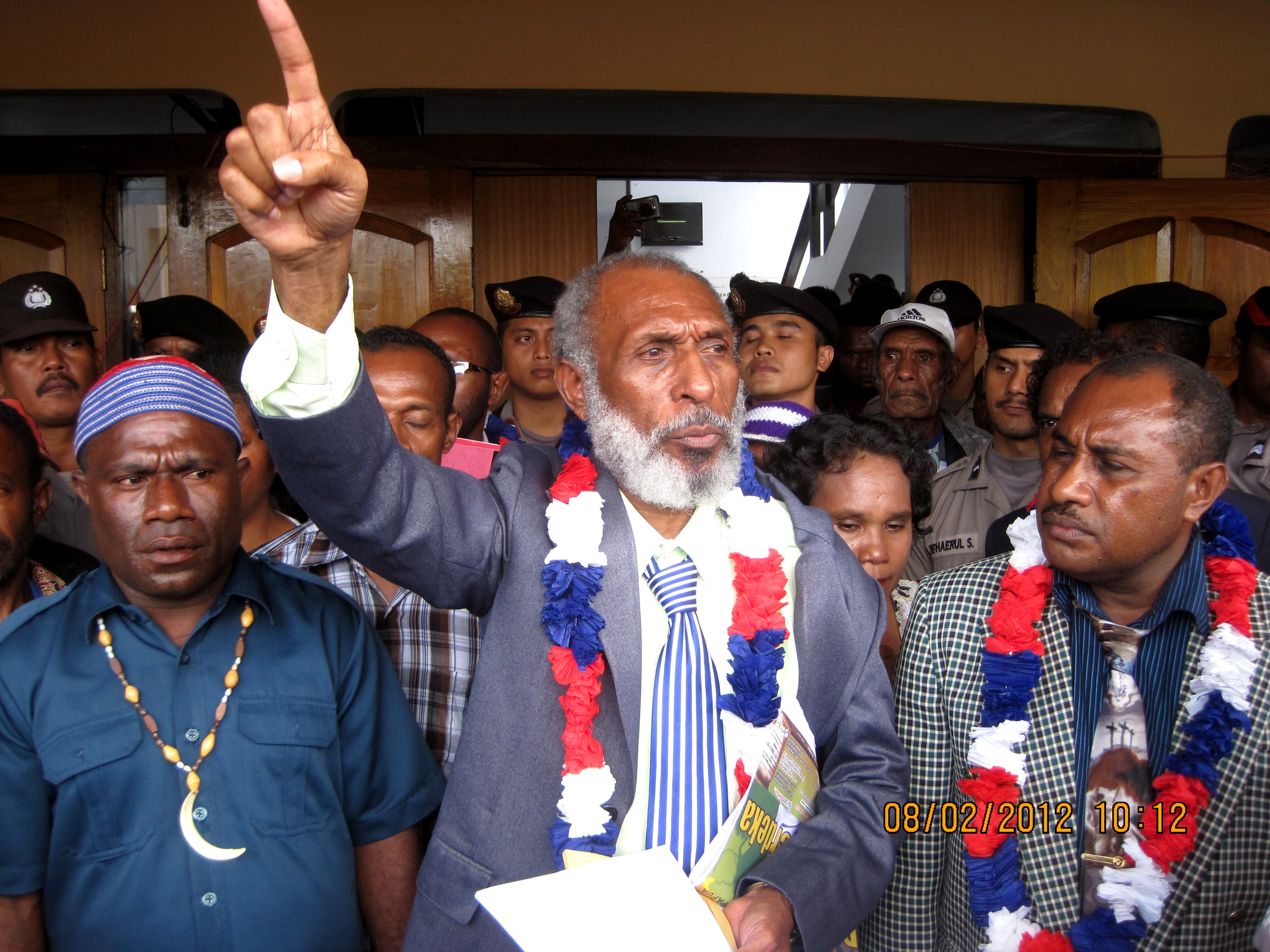
Sambom: ‘Imprisonment will never silence Papuans’

JUBI, 19 March 2012
A leading Papuan human rights  activist has said that the Indonesian government will never be able to silence the Papuan struggle by putting Papuans behind bars. On the contrary, he said, it has the reverse effect by making people more determined than ever.

Sebby Sambom made these comments in an interview with JUBI in connection with the three-year sentence given to Forkorus Yaboisembut and his four colleagues last week.

‘Indonesia has neither the power nor the legal means to punish Papuans by silencing them with regard to their aspirations for an Independent Papua,’ he said.

He said that whenever Papuans take action, they are brought before the court and given a prison sentence. This is the way the government behaves which is simply unacceptable. Even though Papuans have done nothing wrong, they are thrown into prison.’

He said that any Papuan who takes action faces the prospect of being jailed. People keep on being arrested, put on trial and thrown into prison but this will never silence the Papuan people.

He went on to say that  as the number of Papuans being held behind bars goes on increasing , this will help to alert the international community to get involved in solving the Papuan issue.

‘With all these political prisoners,’ he said, ‘international support will become more positive.’

Sebby said that Forkorus  is a loyal Papuan leader who is very serious about the Papuan struggle. ‘He is doing everything he possibly can to bring an end to our sufferings,’ His attitude was very clear from the remarks he made after the verdict was announced. ‘We were pleased with the verdict and our struggle will continue,’ said Sambom.

Translated by TAPOL

New Matilda: Australia’s Money Helps Kill, Intimidate And Torture

from our good friends at

New Matilda.com

NM INVESTIGATES

23 Mar 2012

Our Money Helps Kill, Intimidate And Torture

By Marni Cordell

Bob Carr and Stephen Smith

Australia plays a key role in training and funding elite Indonesian counter-terror unit Detachment 88 – but wants to distance itself from the unit’s violent reputation, reports Marni Cordell

Bob Carr and Stephen Smith with

their Indonesian counterparts.

There’s been a terror threat in Jakarta. A group of hardliners claim they intend to bomb the city’s transport system, just days before the UK prime minister is scheduled to arrive for a state visit. Indonesia’s counter terror agencies scramble to respond to the critical incident as the population goes into lockdown.

I’m sitting in the Control Room at the Jakarta Centre for Law Enforcement Co-operation (JCLEC) alongside international police trainers Bob Milton and David Gray.

On the screens in front of us, Indonesian police are acting out roles in this imagined terrorism scenario — and Milton and Gray are the puppet-masters.

Inside the JCLEC Control Room. Photo: Marni Cordell

“Basically the scenario develops into a more and more complicated problem,” explains Milton, a former Metropolitan Police commander from the UK.

“We try to make it as real as possible. We’ll have things such as pictures, audio, taped phone conversations, anything that we can try and get the information to them in a more interesting way.”

“We then challenge the students and ask for quite a lot of detail about how they are going to respond, and how they are going to deal with it.”

Fake terror scenarios like this one are a regular part of the immersive training that goes on at the Australian-funded police training centre.

JCLEC was set up in 2004 as a result of a bilateral agreement between Indonesia and Australia to strengthen Indonesia’s counter-terror effort in the wake of the Bali Bombings.

I visited the centre last week as part of an investigation into Australia’s funding and training of Indonesia’s crack anti-terror squad, Detachment 88 — the unit responsible for capturing or killing most of Indonesia’s terrorism kingpins since the 2002 Bali attack.

Detachment 88 employs a controversial brand of policing in which suspects are shot dead rather than arrested — like a soldier would shoot an enemy combatant. The high profile counter-terror raid in Bali last Sunday, in which five suspected terrorists were killed and the police were hailed internationally as heroes, was just the latest in a long line of lethal operations.

The unit is funded and trained by Australia and while the Australian Government might not endorse their paramilitary-style tactics, it’s been willing to turn a blind eye because Detachment 88 has been extremely effective at disrupting Indonesia’s extensive terror network.

JCLEC itself is deep within the grounds of the Indonesian National Police Academy, in the city of Semarang in Central Java. When I arrive at the centre I’m met by AFP federal agent Brian Thomson, a friendly, middle-aged cop from Canberra who is nine months into a two-year stint here. I’m the first Australian journalist he has hosted in that time.

JCLEC is touted as an international police training centre but in fact its students are over 90 per cent Indonesian — 9 per cent of whom are Detachment 88. The centre hosts trainers from Indonesia and across the globe, predominantly from Australia, Europe, and the UK.

Students undertake computer-based training courses – this one tests their knowledge of the difference between intelligence and information. Photo: Marni Cordell

Its core funding for more than 130 staff on six hectares of well maintained grounds comes directly from the Australian Federal Police’s own budget.

The self-contained centre — complete with student accommodation, lap pool and gym — couldn’t stand in greater contrast to stories that abound in Jakarta about Detachment 88’s operations.

JCLEC’s shtick is about “learning and understanding through shared experience” — and teaching best practice terror investigation techniques and proper use of the judicial process. Detachment 88, an elite and highly skilled unit with unique powers of surveillance in Indonesia, seems to operate above the law.

As I reported earlier this month, there is growing evidence to suggest what was once solely a counter-terror unit is now moving into counter-separatist operations. Activists in West Papua claim the squad is being deployed to hunt down civilians aligned with the independence movement in a growing campaign of intimidation.

According to Eric Sonindemi, a participant in last October’s Third Papuan People’s Congress, says Detachment 88 personnel were involved in the deadly attack on Congress in which six people were killed and many others wounded.

“Most of the security forces were in plain clothes, but they weren’t really concealing their weapons — they were sort of showing off,” Sonindemi told me when I met with him in Jakarta. “Detachment 88 was there,” he said, explaining that he “saw their equipment and riot shields”.

“Hundreds of people were detained [by police] that night and many of them were beaten in detention,” Sonindemi said. “I spoke to one person who had a gash in his head, a broken nose and bruises on his face. He had been beaten with the butt of a rifle by a policeman.”

“He was subsequently released and never charged with any crime.”

So exactly how closely does Australia work with the deadly unit?

According to a Jakarta-based security analyst who asked not to be named, “There was a big push after the first Bali Bombing, to the point where Detachment 88 actually had Australians with them on [counter-terror] operations.”

“It’s been a long time since that’s happened,” the analyst continued. “The AFP says that sometimes Detachment 88 doesn’t even share information with them any longer. There’s a real pride in doing things themselves now without relying on the Australians.”

But a diplomatic source in Jakarta confirmed that the relationship remains extremely close — and that the AFP continues to work with the Indonesian National Police, of which Detachment 88 is a part, at head office in Jakarta.

Australian Federal Police agent Brian Thomson at JCLEC, with an Indonesian colleague. Photo: Marni Cordell

Details on our financial support for the unit are harder to come by. The Australian government committed $36.8 million over the first four years of JCLEC. Now Thomson tells me the Australia’s support for JCLEC comes out of the AFP budget, which continues to provide “roughly the same amount” of funding to the centre. We also assist the unit directly — although just what that assistance entails is a closely guarded secret.

“I’ve pursued that question through senate estimates, through questions on notice, I’ve had DFAT briefings, and I can’t get any clarity about the role of Australian support of the Indonesian military and police and specifically whether our contribution benefits Detachment 88,” Greens senator and spokesperson on West Papua Richard Di Natale told NM.

“And it’s very clear that Detachment 88 has been involved in some of the violence that has occurred in the region.”

Details from the Indonesian side are just as shady.

Although some of Detachment 88’s terror raids have been simulcast on television in Indonesia, scratch below the surface and it’s difficult to get any real detail on the unit, says Usman Hamid, advisor to the International Center for Transitional Justice.

“The accountability of Detachment 88 is very low,” Hamid tells me when I meet him in a hotel lobby in Jakarta where he is meeting with other experts to prepare a response to the draft national security bill.

“Detachment 88 has special allocation of the budget and international funding — which has never been explained to the Indonesian public clearly, or even to the parliament for that matter.”

“We hear vague amounts but it’s not under the state budget.”

“It should be accounted appropriately,” Hamid told NM. “To the Indonesian parliament, to the Indonesian public, and of course to the Australian parliament and public … to make sure that the budget Australia gave is really being used for the right purpose.”

As Brian Thomson walks me through the official JCLEC Power Point presentation, I ask how Australia can be sure that the training taught at the centre is also being “used for the right purpose” — how do we know it isn’t being used to crack down on civilian dissent?

He’s silent for some time before asking me to repeat the question, and then ultimately refusing to answer it — handballing to his Indonesian counterpart, Dwi Priyatno, who refers me to the Indonesian law on terrorism, and back to the public affairs branch of the Indonesian police.

I also ask specifically about separatism in Indonesia and whether techniques to quash independence movements are ever discussed at the Australian-funded centre. Thomson again gets nervous.

“I can’t really answer that because my job here as an executive director is to be involved in running the centre, so what’s actually discussed in the classroom, I can’t give full [details],” he says.

“Although separatism…

“Yeah…

“No…

“Not separatism.

“When you say separatism, in what regard are you referring to it?”

Back in Australia my inquiries about Detachment 88’s operations in Papua and their move toward policing separatism have been met with an almost uniform response. Here’s what I received from the AFP head office in Canberra: Australia has no mandate to tell the Indonesian Police how to run their business. And yes, we will continue to provide “capacity building assistance”.

Meanwhile, Eric Sonindemi says he remains traumatised by the police and military attack on the Third Papuan People’s Congress. He clearly remembers the sound of gunfire, he tells me, and now jumps when he hears loud noises. He is sure he is being monitored by the police. “I’ve been threatened by the police before,” he says, “but this is the first time I’ve feared for my life.”

Other Papuans I met in Jakarta told similar stories — of constant surveillance by the security forces, phone tapping and intimidation. They told me that fear is part of their daily lives.

Australian officials may well seek to disclaim any responsibility for the behaviour of the Indonesian police and particularly from the activities of Detachment 88. Given the close relationship between the AFP and the unit, however, it’s hard not to conclude that Australia is directly contributing to this climate of oppression.

This is the second article in an NM investigation of Detachment 88 and Australia’s role in the Indonesian counter-terror effort. Read the first article here.

Papuan Leaders Jailed For Speaking Out

with New Matilda

By Alex Rayfield

Five West Papuans were given jail terms on Friday for peaceful expressions of political opinion. Alex Rayfield reports on a trial that will only amplify calls for independence.

Last Friday presiding Judge Jack Johanis Oktavianus sentenced the men known as the Jayapura Five to three years in prison. The Five — Forkorus Yaboisembut (the president-elect of an independent West Papua), Edison Waromi (prime minister-elect), Dominikus Surabut, Agus Krar and Selphius Bobii — were charged with treason for their role in organising the peaceful Third Papuan People’s Congress which took place in October 2011.

Forkorus Yaboisembut outside court. Photo: West Papua Media

The Five’s legal team immediately declared they would appeal to Indonesia’s High Court in Jakarta. Outside the packed District Court in Jayapura hundreds of Papuan protesters sang, danced and prayed. Many carried banners calling for a referendum. Ringed around the Papuan crowd were Indonesian riot police, military personnel and a fleet of armed troop carriers, army assault vehicles and water cannons.

The Third Papuan People’s Congress, a three-day open air gathering that was attended by thousands of Papuans last year, ended with Forkorus Yaboisembut reading a declaration of independence from Indonesia. After he had finished the 74-year old tribal leader thanked the police and military for allowing the Congress to take place and retired to a nearby monastery.

Forty minutes later — and for no apparent reason — the police and military opened fire with live ammunition. Five Papuans were killed by the Indonesian security forces. Witnesses told New Matilda that some of the police who opened fire on the unarmed crowd were members of the Australian and US-funded, armed and trained Detachment 88.

But rather than the Indonesian police being arrested and charged with murder, Forkorus and his colleagues were the ones dragged before the court. The police and military officers that opened fire last October were given a slap on the wrist. Seventeen police officers received little more than a written warning.

The Jayapura Five were charged under antiquated sections of Indonesia’s Criminal Code that date back to the Suharto era and before that to Dutch colonial times. But given the fact that treason can fetch life imprisonment in Indonesia, the three-year sentences handed down last Friday were much less than many people expected.

When New Matilda asked Gustaf Kawer, the senior legal counsel for the men, whether the three-year sentence could be read as a signal that the Indonesian legal system was asserting more judicial independence his response was an emphatic “no”.

“The Five invited the Coordinating Minister for Political and Legal Security and the Minister for Home Affairs to attend the Congress. The gathering was held in the open and everyone was welcome to attend. It would be much better if the court and police did not attempt to obstruct their democratic right of freedom of expression,” Kawer said.

Kawer and other members of the legal team told New Matilda that the trial was marked by irregularities, interference and intimidation. There was a heavy presence of armed members of the security forces at all 15 court hearings — inside and outside. Question marks also hang over the extent to which the court acted independently. Immediately prior to sentencing the judges met with senior military commanders, police and government officials for a one-hour closed meeting, according to Tapol. Kawer has also been threatened with prosecution by the police for defending the Five.

In an interview with the Jakarta Globe, Indonesian presidential spokesperson, Teuku Faizasyah, asserted that the court did act independently. “Our political system today fully respects trias politica and the ongoing legal process.”

Faizasyah went on to say that the right to freedom of speech in Indonesia does not extend to separatist activities. According to Faizasyah, declaring independence from Indonesia is separatism and the European Union classifies separatism as a form of terrorism. “Any expression of separatism in the EU is thus considered an act of terrorism” said Faizasyah.

In the case of the Jayapura Five the men operated openly. They were unarmed and behaved in a disciplined and non-violent manner. They may be revolutionaries — but they are not violent.

In an SMS from prison a defiant Selphius Bobii told New Matilda that sentencing the Five to prison sends a message to Papuan activists that Indonesian law is incapable of delivering justice for the Papuan people.

“The police, Attorney General, and Indonesian judges … cannot deliver justice for the people of West Papua. They cannot imprison democracy and they cannot imprison the peaceful struggle for a free West Papua. It is the Papuans who possess sovereignty over our land … and the Papuan people will continue to struggle,” wrote Bobii.

Dominikus Surabut, another member of the Five, told New Matilda that it was illogical to accuse West Papuans of wanting to separate from Indonesia when it was Indonesia that invaded and annexed West Papua. Surabut argues that the invasion and continued occupation of West Papua by the Indonesian state is in violation of the right to “free choice” that the United Nations guaranteed West Papuans but failed to deliver.

For people like Surabut and Bobii and their three jailed colleagues, and for the Papuans who watched the treason trial unfold, state repression in West Papua is evidence that Indonesia can never lay claim to being a democracy while West Papuans are denied the chance to freely and fairly determine their future.

The jailing of the Jayapura Five pushes West Papuans further down the path of insurrection. The denial of free speech invites the international community to join Papuans on that journey.

“Holland didn’t fall over when Indonesia became independent, and neither will Indonesia when we do,” says Herman Wainggai, a West Papuan independence leader and former political prisoner living in the United States. “Bali principles, Lombok treaties, peace centres in West Java … these are all meaningless while Indonesia continues to escalate its troops and its judiciaries against us”.

With West Papua Media.

Forkorus is waiting for international support: Verdict to be announced on 16 March

Bintang Papua, 12 March 2012<Illustration at the beginning of the report shows the defendants addressing their sympathisers outside the court.>

The  twelfth hearing of the trial of the five defendants – Forkorus Yaboisembut (‘President of the Federal Republic of West Papua), Edison Waromi (‘prime minister’). Agustinus M Sanany Kraar, Selpius Bobii, and Dominikus Sorabut – was held in the Jayapura district court on 12 March. As had happened at the time of previous hearings,  a large crowd had gathered along the Abepura highway, causing a traffic jam around the courthouse, because of the presence of security force people who were also trying to regulate the traffic.

The defendants also stuck to their routine of saying prayers before the hearing and as well as giving speeches afterwards.

After the hearing concluded, Forkorus and his co-defendants  left the courthose while singing hymns making speeches in which they said that  reject the trial and reject the whole process of charging them with makar – treason. They also said that what they wanted was their unconditional release and they were now awaiting  responses from international lawyers who they had approached for international support. They said that none of the charges against  them were true but were the result of manipulations.

At 8.51 local time, the five defendants arrived at the Jayapura courthouse and as they got down from the coach, they sang hymns together with their supporters and  members of their families for fifteen minutes. This slightly delayed the start of the hearing.

At 9.05, the panel of judges consisting of  five people took their positions on the bench along with two secretaries.

The chairman of the panel of judges had to delay the start of the hearing briefly  because the chief prosecutor had not yet arrived.

This session was held to hear the response by the prosecutor – replik – to the defence statement by the defendants as well as by their legal team.

The chief prosecutor, Julius Teuf said that they firmly rejected the defence statement  as well as the statements made by each of the defendants.Teuf then said that they stood by their earlier  demand that the five defendants should be sentenced to five years imprisonment.

Freddy Latunussa, an expert member of the defence legal team, said that the statement by the chief prosecutor that the defendants had tried, called upon and urged  others to take part in an act of treason  had not been proven under Article  106 of the Criminal Code as had been alleged by the prosecution.

According to the observations of Bintang Papua, the defence team of lawyers  rejected all the demands  made against the defendants as stated in the Replik because the Criminal Code does not allow statements to be read out but should have been presented in writing. As the panel of judges had previously said that this should have been done in writing, the chairman of the panel said that they had given the prosecutors three days to do this in accordance with an agreement reached during a previous hearing.

A 9.20, the chairman of the panel of judges closed the hearing  and said that the trial would continue on Friday, 16 March, when the panel of judges would announce their verdict.

Two West Papuan Community led Ecological Struggles

From our friends at Hidup Biasa

http://hidupbiasa.blogspot.com/2012/03/west-papuan-community-ecological.html and http://hidupbiasa.blogspot.com/2012/03/tablasupa-nickel-minings-drilling-rig.html

Two West Papuan Community Ecological Struggles

On the sidelines of the Papuan People’s struggle for self-determination, at a local level Papuan communities continue to resist the logging and mining industries that are destroying their forests. Here are two stories of recent community resistance from areas close to the Papuan capital Jayapura, translated from the Alliance for Democracy in Papua website http://www.aldepe.com.

1. Seeing their forest destroyed, Arso Villagers Burn Five Logging Camps.

Annoyed by hearing the sound of chainsaws almost every day, and in addition the reports of villagers who regularly enter the forest telling of finding loggers’ camps there, around 20 people from Arso, both young and old, agreed to check the forest for themselves.

Community Resistance against logging (file photo: "The forest eats the forest-eater" by manukoreri.net/westpapuamedia)

This area of forest is commonly called the ‘Golden Triangle’, and is divided between the territory of three villages, Arso, Workwana and Wambes.

As they had guessed they would, once inside the forest they found two sites used by loggers, which had been connected with a track made from offcuts of wood which the loggers would use, dragging the wood from behind a vehicle.

At the first site there was only one camp. At this camp they confiscated two chainsaws and took statements from three loggers who were at the location. They then forced the loggers to leave.

The group continued to the next location. Possibly because the loggers had received information from their friends at the first site, there was only one person left, and they didn’t find any chainsaws.

As their emotions rose some people almost hit out at the logger, but were held back by others. At this second location, four camps were found, complete with televisions, speakers, supplies of food and clothing and so on.  Two vehicles used for dragging wood were also found.  In their emotional state, the people destroyed and burned the camps and everything they found there, along with the camp at the first location.  The two vehicles were also burnt.

According to statements from the loggers, they had been given permission by the customary chief of kampung Workwana, although the Arso villagers felt that they had been cutting trees far inside the Arso territory.

Several people interviewed in kampung Arso on Tuesday 6th March explained that they were still angry “It’s so sad to look at that forest, they even cut very small ironwood trees.” said Wenderlinus Tuamis, a youth who had participated that day.

Meanwhile, according to Franky Borotian, they had been allowing the logging to continue because previously a villager from Workwana had asked to use wood to build her house “a sister had asked for permission to build a house, but then it turned out someone used that permission for business purposes”, he said.

The problem has been passed over to the Customary Council (Dewan Adat).  Villagers asked the Customary Council to use their wisdom to resolve the situation so that conflicts between the people would not emerge.  Especially since the Golden Triangle had become the area which people rely on for food, as other areas have been taken over by two big oil palm plantations, state-owned PTPN II and PT Tandan Sawita Papua (Part of Peter Sondakh’s Rajawali Group)

source: http://www.aldepe.com/2012/03/merasa-hutannya-dirusak-warga-arso.html

2. Tablasupa Nickel Mining’s Drilling Rig Burned, Three Imprisoned

On the morning of 8th February 2012, local people from kampung Tablasupa, near to the Papuan capital Jayapura, burned a drilling rig belonging to the mining company PT Tablasupa Nikel Mining.   The action was connected to an ongoing conflict between local people and the company, which plans to mine nickel on 9629 hectares of land, and is currently carrying out exploration activities.   Although the company has been given a permit by the local Jayapura Bupati’s office, the people of Tablasupa feel that their rights as the holders of customary rights over the land have not been respected.

Two weeks after the machine was burnt, on February 20th,  police arrested
three villagers. Saul Sorontouw, Lambertus Seibo and Kanisius Kromisian.
They have been charged under article 170 of the Indonesian penal code, and are being held in Jayapura police headquarters. While in prison Saul Sorontouw has been ill with gout, which has caused swellings in his knees.  On February 28th police demanded statements from another six villagers, but they were allowed to go home that evening.

The following statement was released by villagers of Tablasupa the day
before the action:

Statement of opinion of the Sorontou-Okoseray-Kiswaitou Ethnic Group
As holders of rights to customary lands on the area covered by PT Tablasupa Nickel Mining’s Mine Enterprise Permit (IUP), Mining Rights (KP) and the Bupati’s recommendation that allows exploration in Kampung Tablasupa, Jayapura Regency

Regarding the as yet unresolved problems around PT Tablasupa Nickel Mining commencing exploration activities on customary land belonging to the people of kampung Tablasupa, the Sorontou- Okoseray- Kiswaitou ethnic group wishes to make the following declaration:

“Reject PT Tablasupa Nickel Mining” conducting exploration and mineral exploitation activities within the customary boundaries of the Sorontou- Okoseray- Kiswaitou ethnic group.

The reasons for our rejection of mining activities are as follows:
1. The whole territory of kampung Tablasupa is unsuitable for mining
activities.

2. The impact of mining activities would also damage the environment of
areas that fall within the territory of neighbouring villages.

3 To avoid mining activities causing conflict with the people and nearby villages.

4. The effect of mining activities will damage and desecrate the environment, and industrial pollution from the mine will contribute to global warming and affect the sources of clean water from the Cyclop mountains.

5. No consensus has been reached through a musyawarah system that would
represent an agreement between the people of Tablasupa and neighbouring
villages.

6. The holders of customary rights to the land have not given their approval (under the Law on Mineral and Coal Mining 4/2009 article 135, companies holing a Mine Enterprise Permit can only commence activities if they have obtained agreement from the holders of customary rights on that land).

7. The customary and human rights of the Sorontou- Okoseray- Kiswaitou
ethnic group must be respected and valued by all.

A solution to the development of kampung Tablasupa which supports the
social economy and also contributes to local business could include:
-building beach tourism and hotels
-developing fishing
-selling fresh water.

Such development would involve all the people of Tablsupa either as workers or taking roles in a management structure and could take the form of an enterprise or foundation that was formed by the people of kampung Tablasupa.

This is the message that the Sorontou- Okoseray- Kiswaitou ethnic group wishes to be known by the general public.

Tablasupa, 07 February 2012 .

Sources: http://www.aldepe.com/2012/02/polisi-menahan-3-tiga-warga-sehubungan.html ; http://www.aldepe.com/2012/03/saul-sorontouw-sakit-di-tahanan-polres.html ; and other articles on http://www.aldepe.com
statement: http://groups.yahoo.com/group/Komunitas_Papua/message/2952

Create a website or blog at WordPress.com

Up ↑