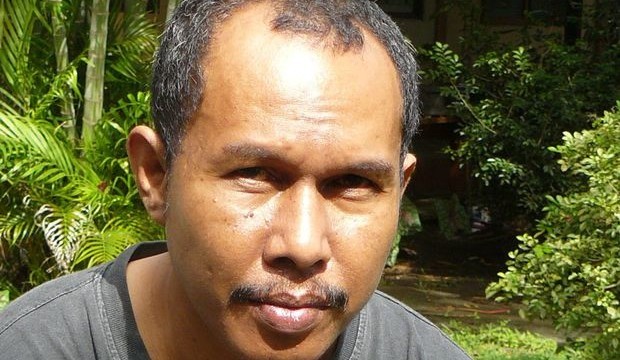
Nabire youths arrested for cleaning memorial park

By our partners at MAJALAH SELANGKAH in Nabire

28 April 2015

Photo caption text: From left to right, , Marthen Iyai (28 yrs old), Martinus Pigai (17), Anton Pigome (24) detained in the Nabire Police station Tuesday (28/4/15). (Photo: MS)

A BRIMOB Police unit together with Nabire Regional Police on 28 April have arrested three Papuan youths whilst they were cleaning the Papuan Nation’s Flower Park in Ovehe in Nabire town centre, Papua province. Those arrested are Martinus Pigai (aged 17 yrs), Anton Pigome (24 yrs) and Marthen Iyai (28 yrs).

According to arrestee Anton Pigome, speaking with majalahselangkah.com from detention at the Nabire Police station at Tuesday midday: “This morning we were cleaning the ‘Papuan Nation’s Flower Park’ in Ovehe together with our older people. We were cleaning the park for a church service to mark 100 days since the passing away of Father Nato Gobay (see: Wakil Uskup Timika, Pastor Nato Gobay, Pr Wafat) and at the same time to communicate to the community there regarding Mubes Meepago ( Mubes Miras dan HIV Wilayah Meepago) as planned for 9 or 10 May 2015.  At approximately 8.00 am BRIMOB forces came in a vehicle and ordered us to get into the BRIMOB vehicle. They then took us to the Nabire Police station.”

Anton continued “ We were not beaten at the time of arrest, however we were shocked and confused why we would be arrested. We were just cleaning the park so why would we be arrested?”

Well known Papuan human rights activist Yones Douw said they confronted police. “After we heard the news we went directly to the Police station and demanded the three be released as they had done nothing wrong. They were just cleaning the area for the church service to mark 100 days since the death of Father Nato Gobay” stated Yones.

Yones explained after meeting Deputy Head of the Nabire Police Kompol Albertus Andreana, it had been agreed to release the 3 youths. “ When we momentarily met with the Head of Police earlier I stated that the 3 youth must be released. He had to leave and suggested we speak with the Deputy Head of Police which we did. They have promised to release the 3 this afternoon.”

According to Yones, the Police believed the park was being cleaned in relation to upcoming 1 May activities, being the anniversary of the date Papua was annexed into Indonesia. As that anniversary is now close the National West Papuan Committee (KNPB) has called for demonstrations to be held simultaneously throughout Papua to reject the presence of the Indonesian population in the Land of Papua.(See: Seruan KNPB Menuju 1 Mei 2015).

It needs to be pointed out that the ‘Papuan Nation’s Flower Park’ is the location of the past offices of the Regional Committee of Community Representatives (DPRD). After the DPRD offices were burnt down and moved to Kelurahan Bumi Wonorejo, the Papuan community used the place as a centre for political expression.

Majalahselanghkah.com noted that back on 1 December 1999 the ‘Papuan Nation’s Flower Park’ had once been used for a West Papuan Political Ceremony during which two flags were raised on high steel poles with the Papuan Morning Star flag on the right and the Indonesian Red and White flag on the left. Those raised flags were maintained for 8 months before joint armed forces of Police and Indonesian military took them down during what’s become known as ‘Bloody Nabire’ which occurred from 28 February to 4 March 2000. (IRIAN JAYA (WEST PAPUA, NEW GUINEA): THE QUEST FOR INDEPENDENCE–THE RECORD: REPORT ON THE NABIRE SHOOTING SITUATION- 28 February 2000 to 4 March 2000). At that time 3 people were shot dead and others were wounded. Those shot dead were Menase Erari, Maximus Bunai and Wellem Maniwarba. They were buried in the ‘Papuan Nation’s Flower Park’ and to this date the steel pole remains standing there.

Then again on 13 August 2013 there was an incident when access to the park was closed off by joint armed police and military forces (see: Taman Bunga Nabire Dipalang, Sejumlah Tokoh Mengadu ke DPRD). Human rights activists together with well known church and community figures, tribal and customary law leaders pressured DPRD to hold a meeting with the Regional Government, the district Commandant and the Head of Police to return the park to the community. Finally the closure to the park was lifted and until now the community has been able to use the park as a place for political expression.
(Yohanes Kuayo/Yermias Degei/Putri Papua/MS)

Chairman of AJI Jayapura: Importance of Open Access to Foreign Journalists into Papua

by Arnold Belau at our partner Tabloid Jubi

April 29, 2015

Pioneering West Papua journalist Victor Mambor, Chairman of Journalists Alliance (AJI) Papua, Editor of Tabloid Jubi, media freedom advocate and Journalism trainer (photo: Jubi
Pioneering West Papua journalist Victor Mambor, Chairman of Journalists Alliance (AJI) Papua, Editor of Tabloid Jubi, media freedom advocate and Journalism trainer (photo: Jubi)

Jayapura, Jubi – Chairman of Journalists Alliance (AJI) in Jayapura city, Victor Mambor, said it is very important to open access to foreign journalists into Papua in order to avoid misinterpretations of Papua.

 The issue was delivered by Victor in an interview with AJI Indonesia in Jakarta at the World Press Freedom Day (WPFD) 2015, Tuesday (29/04/2015).

Victor explained that the media in Papua continues to grow, but the challenges are also growing ranging from human resources, financial, ethical and positioning journalists.

In Papua, as the media grows, so too is the presence of journalists.

“However it is true that a journalist in skill and ethics cannot always grow in parallel. If there are challenges, there is still not much of a significant change. Journalists still face threats of violence with the same quality as in previous years,” said Victor.

Papua which is broad and extensive, has become the greatest difficulty faced by foreign journalists. The conditions make the confirmation process, covering both sides, and verification difficult. Often, news from Papua becomes incomplete and with bias ruling.

“Every year there are 4 or 5 foreign journalists who question to myself regarding the situation in Papua. Most of them could not enter Papua. From their information, I can conclude they are not well served when submitting an application for reporting in Papua. In fact, there is no decision ever made, permitted or not,” said Victor.

Victor said that the more closed the access is, the more questions the international community will ask about what is happening in Papua.

“The conflict in Papua could be clarified in a comprehensive manner to the public through information which is submitted by journalists,” said Victor, who is also the Chief Editor of Jubi News and Jubi Online.

He said, to open access for foreign journalists into Papua, the issue that is very important and must be carried is the clarification of regulations for foreign journalists in Papua.

“Besides the campaign for open access for foreign journalists in Papua, lobby stakeholders who are related to the issue that need to be carry out the goal of clarifying regulations for foreign journalists. This is the main problem, unclear regulations,” he asserted.

WPFD proclaimed to the UN General Assembly that in 1993, the recommendations of this matter, was adopted it in the 26th Session of the UNESCO Conference in 1991. Recommendations and the trial were also in response to the calls of African journalists in 1991 for principles of media pluralism and independence, which resulted in the Declaration of Windhoek.  [Editor : Dewi Wulandari]

 translated by WestPapuaMedia

The Eyes of the Papuans: A video advocacy process

by Wensislaus Fatubun*

April 24, 2015

Thirty years later, I have still not forgotten. It happened in the south of the Indonesian province of West Papua, a journey of two days from the “big city” of Merauke.  Life in the small village of Yodom centred around trips to and from the ubiquitous, generous forest, provider of every need.  The arrival of a South Korean lumber company brutally intruded on the traditional way of life.  Workers started to fell trees.  Word had it that a plantation of palm oil trees was to take their place.

While the helpless population watched the destruction of part of their source of food, the children in the village had eyes only for the bulldozers.  But what fascinated my 12-year-old self the most was the strange object a Korean regularly held up to his eye as if he were aiming at something.

“No one had ever seen a camera,” I remember.

“When I saw the joyful reactions of the people who saw their pictures from the camera, I said to myself that me, too, I wanted to do that.”

My dream came true some years later when, after studying philosophy at the School of Philosophy, on the island of Sulawesi, I started work at the Office for Justice and Peace in the archdiocese of Merauke.

“I began to write reports and use a camera to speak out on the rights of native peoples and environmental issues. This is how the project Papuan Voices started.

“…. I wanted this to be an advocacy and cultural project to permit the people of Papua to tell their own stories in films. So other people could learn about them together with them.”

Individuals and communities have memory, so the most important thing in advocacy videos is how to build a collective memory.  I believe, when we have the same collective memory, the advocacy process that we build will continue to proceed and will not die.  This is where video has a very important role.

The process of building video-based advocacy and memory is an inter-subjective experience and dialogue on history and culture.  This is the first process.  I visited the villages, explained what a camera was and what purpose it served and convinced the villagers of its usefulness as a tool.  This is what I made.  Once a plan for the sequence was established to everyone’s satisfaction, we could film.

The result: short fifteen-minute films posted on the Internet in order to reach a maximum audience. [These films can be viewed on papuanvoices.net and on YouTube: Papua Storyteller.]

“One of our films tells the story of a young Papuan woman who became pregnant after a relation with an Indonesian soldier. This happens to a good number of Papuan women who find themselves alone to raise their child, cast off by Indonesians and their own community alike,” says the producer-film maker.

“Another film shows how Papuans are losing their culture and their identity.”

My interest is not just in making films: “Each sequence is an opportunity to talk with the villagers about human rights, the rights of indigenous peoples and their socio-economic rights.  Making a film is an occasion for us to settle on a strategy with the villagers for them to claim their rights.  Not only by addressing representatives of the government in meetings organised by the Justice and Peace office but also more globally using our network.”

That is the process of making the video part of our advocacy strategy.  We introduce the process of making a video and train the community in the early stages of building a network, we strengthen and assist the community to be able tell their stories, especially their stories about human rights.  We are human beings, we take note of the experience, history and relate to others so that we have a story about human rights.

From my experience, video is able to connect people.  It is not only communication, but more of an emotional connection.  People who are at different places can have an emotional connection to each other because they watch the video.  Our challenge is how to produce a video about human rights that is able to connect the emotions of people and unite them to fight together.  The principle instrument we have to tell the story of life is the video.  I think a lot of video advocacy activists fail to use video as an advocacy tool because they are simply telling the issue, and not a life story.

I have been talking about the pre-production and filming, now I want to talk about the distribution.

In Papua, Papuans people continue to fight to protect their rights.  They continue to protest to the Government and the State of Indonesia.  There are indeed reasons to protest.  Their land is being taken from them, they are being colonised by new settlers, they are being forced into assimilation and being marginalised … This is not to forget the smouldering war that has been going on since 1963, when West Papua was de facto declared a part of the Republic of Indonesia.  To this day, Papuan armed groups have been calling for greater autonomy and even independence.

I denounce “a creeping genocide,”  given the extra-judicial executions, arbitrary arrests, disappearances and torture to which the Papuan population is exposed.  Amnesty International has regularly recorded abuses and violations of human rights by Indonesian authorities in a region off-limits to international non-governmental organisations and journalists.  (Two French journalists were arrested on 6 August 2014 and imprisoned for having travelled with tourist visas and allegedly contacting members of an “armed gang of criminals”. [These allegations were never proven – WPM Eds] They were threatened with a prison sentence of 5 years as well as fines of $42,000, before being deported.)

My challenge in Papua is how to convey the story of a difficult message, violent and even bloody, to the audience?  I would like to answer this question with a story from personal experience.  On December 8, 2014, the Indonesian military shot dead four students in the District Enarotali District, Paniai, in Papua, Indonesia.  At that time, there was a lot of media publicity about this case.  We got some footage of the community. We think that this footage should be part of ongoing advocacy process. We edited and made a video [see below] for which the primary audience were the participants of the side event about Papua in Room XXIII, the UN Human Rights Council.  We did not make the main audience the Government of Indonesia, because we see that the Government of Indonesia has received a lot of information. The National Human Rights Commission is conducting an investigation and the people’s movement Papua ItuKita is supporting the advocacy process in Jakarta. The video we made should strengthen the advocacy process in the UN Human Rights Council.  This video was screened during the side event, there were a lot of responses and the video was able to evoke emotion in the Council room.  It has been distributed to other audiences and most importantly, the video is able to strengthen the argument of activists, becoming part of advocacy through a mechanism that is available on the UN Human Rights Board.

*Wensislaus Fatubun is an accomplished and pioneering West Papuan independent journalist, film maker, human rights defender, writer, photographer, story teller and has also been long term collaborator with West Papua Media.  He is currently also a member of Pax Romana, and the Program Manager of the JPIC Desk in Kalimantan, a place under the same colonist pressures as West Papua.  You can see his work at http://iampapua.blogspot.com/ and You Tube: https://www.youtube.com/user/ambaimain23

This story also appeared at  http://www.tapol.org/news/eyes-papuans-video-advocacy-process  but was sent by the author to WestPapuaMedia independently.

Government still looking to Merauke for industrial agriculture development

from our partners at AwasMIFEE

First Published: April 17, 2015

Since the Merauke Integrated Food and Energy Estate was launched in West Papua in August 2010, it has had the result of clearing the way for oil palm and sugar-cane plantations, but has failed to meet its stated aim to develop large-scale production of certain key food crops, notably rice.

Now there are signs that the new government is still looking to push for large-scale mechanised agriculture in the area, despite the frequently voiced opposition by many local indigenous Marind people.

On 6th April the Indonesian Cabinet Secretariat website posted an article saying that Medco boss Arifin Panigoro had invited President Joko Widodo to join in a harvest of rice cultivated using the ‘modern system’

According to Arifin, President Jokowi gave a positive response towards the mechanisation of agriculture using the modern rice cultivation system. Plans were even made that during his visit to Papua in early May, the President will visit the site where modern rice cultivation is being developed in southern Papua.
“I’ve already reported it all to the president, and I’m also going to invite him for the harvest,” said Arifin Panigoro.
Arifin Panigoro is pioneering the development of modern rice cultivation in Merauke as a means of increasing productivity. Modern rice cultivation is a fully-mechanised concept. As 5000 hectares can be managed by 100 people, each person would get 50 hectares. The machinery used in the process, from planting through to harvest, would be the same as is used in the United States.
Full article in Indonesian: http://setkab.go.id/arifin-panigoro-undang-presiden-jokowi-panen-sawah-sistem-modern-di-papua/

This news should set alarm bells ringing for peasant farmers all over Indonesia, where most of the rice is still farmed by families in the traditional labour-intensive way, meaning rural communities still have some reasonable degree of control over the production of their staple food. What will be the impact on these rural communities if this mechanised method which needs minimal labour should prove to be cheaper? There will be a tendency to concentrate land in the hands of corporations and many villagers, unable to compete, will be forced off the land, most likely into poverty in the city.

During his election campaign, Jokowi talked a lot about food sovereignty, a concept developed by peasant movements from around the world. Food sovereignty goes beyond the idea of ‘food security’ which tends to be understood at the national level (ie. a state ensures it has enough food, through limiting its dependence on imports), to the level of the food producers themselves. According to the 2007 Nyeleni declaration made by peasant movements meeting in Mali in 2007:

“Food sovereignty is the right of peoples to healthy and culturally appropriate food produced through ecologically sound and sustainable methods, and their right to define their own food and agriculture systems”

Arifin Panigoro’s invitation is going to make Jokowi decide whether he actually believes in food sovereignty, or will fall back on the rhetoric of food security which produced the MIFEE project, where local food producers (in this case the Marind people who live from hunting, gathering and shifting cultivation) are to be sacrificed so that Indonesia can meet its goal of being self-sufficient in rice etc.

Arifin Panigoro’s Medco group of companies was one of the key actors involved in pushing for the MIFEE development in the first place, and has several interests in the area. Medco’s rice business has yet to get past the experimental stage. However another Medco company, PT Selaras Inti Semesta, was the first big investor to start clearing land, for its industrial timber plantation, in 2010.

One of the villages in Medco’s concession area, Zanegi, has become a symbol of everything that was wrong with the MIFEE project, the village that taught the Marind people that it industrial agriculture would be a disaster for them. Medco tricked villagers out of their land, giving them a ‘Certificate of Appreciation’ and a small amount of money which they did not know was actually compensation for their ancestral land. Few villagers managed to hold down a job with the company for long and became dependent on the minimal compensation for wood that was being given, and travelling far from their village to find basic subsistence necessities in the remaining forest. Child malnutrition increased, and several children died of preventable diseases. Conflict and accusations of black magic saw many leaders imprisoned. The company backed down from its promises to the community. And then in the end Medco decided that the business was not profitable, and abandoned the area, after destroying much of the forest, turning it into woodchips and shipping it to Korea.

With the level of opposition and the tally of bitter experiences that have come with the plantation companies in Merauke, you might think that a fundamental reappraisal of development strategy might make sense. However there are signs that the Jokowi government is still interested in the ‘food estate’ model of agriculture. In its medium-term development plan there is no mention of MIFEE, but there is a plan to designate the Merauke area a Special Economic Zone.

Now an article published in the Jakarta Post website on 16th April indicates that several ministries are still considering resurrecting theMerauke Food Estate, and also potentially the other ‘failed’ food estates in Kalimantan. The report doesn’t give many practical details of where, when or how these developments might go ahead, but the Land and Spatial planning minister thinks that development could even begin this year.

Govt to revive food estate project in Papua
by Linda Yulisman
With its high food self-sufficiency target, the government is considering reviving the stalled “food estate” program of the prior administration by involving private and state-owned companies.The extensive commercial farming will focus on rice, corn and soybean — all are food crops laid out in the self-sufficiency goal, according to State-Owned Enterprises Minister Rini Soemarno. “We will synergize the whole processes from seeding to fertilizing,” she said.State-owned enterprises, such as fertilizer producer PT Pupuk Indonesia Holding Company, seedling company PT Sang Hyang Sri and agribusiness firm PT Pertani, will take the lead in the projects, Rini said.Designed in the early days of Yudhoyono’s administration in 2009, the project was meant to integrate farming and food-based energy generation to replicate the success story of Brazil’s large-scale agricultural projects.The Merauke Integrated Food and Energy Estate (MIFEE) program in Papua is expected to cover a 1.6 million hectare area. It has attracted dozens of investors, including Wilmar International, Artha Graha and Medco Group, that are interested in growing a wide array of food crops, including rice, corn, soybean, sugar cane and palm oil.Similar to the food sovereignty agenda formulated by President Jokowi’s administration, the former government also underlined the need of attaining self-sufficiency in key corps and beef by 2014, which, in fact, it failed to achieve.MIFEE has proven to be a tough project to implement, particularly because of land issues, as the multi-billion project threatens conservation areas, such as virgin forests and water catchment areas, as well as the habitat of indigenous peoples in Papua.Concerns over human rights abuses, including violations of land rights and of the requirement to obtain free, prior and informed consent, and also over the displacement of local people by inflows of workers from outside the region have also lingered.By last year progress had stagnated in the completion of an environmental analysis (Amdel) and in provincial spatial planning, Agriculture Ministry’s director general for agriculture infrastructure and facilities Gatot Irianto told The Jakarta Post.“The stocktaking of customary land is a difficult thing and this must be endorsed further,” he said, adding that he viewed the need to make the planned food estate a special economic zone to enjoy special treatment to enable implementation. Despite the snail-paced progress in the past, Minister Ferry said the planned project could, nevertheless, begin as soon as the second half of this year.“We have already secured some potential plots of land to commence the project,” he told the Post, adding that some areas in Kalimantan were also under assessment as alternatives.With the strategic location of Merauke near the sea, it will be easy to transport the output to other areas once seaports are established, according to Ferry.Investment Coordinating Board (BKPM) chief Franky Sibarani said the broader Indonesian food sector might receive investments this year, notably from foreign companies.“We’ve heard about interest by American and Japanese firms to invest in growing corn and cassava,” he said.Source: http://www.thejakartapost.com/news/2015/04/16/govt-revive-food-estate-project-papua.html

Papuans Behind Bars: March 2015: Plans for increased Brimob presence as new cases of violence emerge

syndicated as an update from our partners at Papuans Behind Bars

In brief

At the end of March 2015, there were at least 38 political prisoners in Papuan jails.

On 6 March, 17-year-old high school student and West Papua National Committee (Komisi Nasional Papua Barat, KNPB) activist Deni Bahabol was kidnapped, tortured and murdered, and his body dumped in a river in Yahukimo regency. Early reports indicate the involvement of Special Forces Command (Komando Pasukan Khusus, Kopassus) officers in the murder. Bahabol’s murder echoes the Martinus Yohame case in August 2014. Yohame, who was also a KNPB activist and active in leading peaceful demonstrations, suffered a similar fate.

On 19 to 21 March, under the orders of Papua Police Chief Inspector General Yotje Mende, Papuan National Police and Mobile Brigade (Brigade Mobil, Brimob) officers were deployed from Jayapura to Yahukimo to forcibly disperse, shoot and arrest Papuans taking part in a peaceful campaign to collect donations for victims of Cyclone Pam in Vanuatu. At least 21 people were arrested and six people were shot. A 48-year-old village head, Obang Sengenil, died from gunshot injuries.

In another incident in Jayapura, four Papuan youths aged 14 to 23 were publically attacked by Brimob officers. One of them, Lesman Jigibalom, is believed to be in a critical condition as a result of torture.

The arbitrary nature of police action this month – from shooting people collecting donations in Yahukimo to torturing and beating four young men seemingly without reason in Jayapura – highlights the lawless and reckless manner of policing in Papua. This dynamic of imposing public torture, violence and arrest breeds a culture of fear and distrust amongst indigenous Papuans.

Despite demands for accountability from Papuan civil society groups into these cases of state violence, police have yet to launch investigations. The lack of political will to seek transparency and accountability in cases of state violence ensures that perpetrators continue to enjoy total impunity. Instead of addressing long-standing violations committed by the Indonesian military in Papua, the authorities have opted to ramp up militarisation by establishing new plans to build a Brimob command base in Wamena. Jakarta-based solidarity group PapuaItuKita issued a ten-point statement rejecting the new plan, stating that the increased presence of Brimob forces would only serve to further destabilise the area.

On 2 March, hundreds of armed security personnel forcibly dispersed a peaceful socialisation seminar and detained at least three people in Jayapura. The seminar, on the theme of “Reclaiming Papuan Identity in Melanesia”, was organised by the newly formed United Liberation Movement for West Papua (ULMWP), which consists of different factions of the West Papuan pro-independence movement. In a statement to the Papuan press this month, Police Chief Yotje Mende called for the KNPB to be banned as it supports Papuan independence. This zero tolerance approach by security forces towards demonstrations and gatherings associated with Papuan independence, despite their peaceful nature, is a violation of the rights of freedom of expression, association and assembly as guaranteed in the Indonesian Constitution.

Arrests

Fundraisers for Cyclone Pam victims shot and arrested in Yahukimo; three arrested in Timika

Yahukimo

Information received from various human rights and media sources reported that on 19 to 21 March at least 21 people were arrested and six people shot by Papuan National Police (Polda Papua) and Mobile Brigade (Brigade Mobil, Brimob) officers in Yahukimo regency for being involved in collecting donations for the victims of Cyclone Pam in Vanuatu. At least one person, Obang Sengenil, a 48-year-old village head, died from gunshot injuries. While reports indicate that most of those arrested have been released, it is unclear how many people remain in detention in Yahukimo regional police station.

The previous week, from 11 to 19 March, the Yahukimo group of the West Papua National Committee (Komite Nasional Papua Barat, KNPB) had coordinated a donation drive involving community members and KNPB activists.

On 19 March, according to Majalah Selangkah, a prayer session was planned to take place at 15:00, as part of a closing ceremony of the week’s events. At 09:25, security forces composed of Papuan National Police and Brimob officers shot into the crowd that had gathered in preparation for the prayer session. Tabloid Jubi reported that Isai Dapla, a 37-year-old KNPB member, suffered gunshot injuries to the chest, while Salomon Pahabol, a 47-year-old primary school teacher, was shot in his left leg. Elias Kabak, a 40-year-old KNPB member, was arrested. Security forces reportedly confiscated items belonging to the KNPB organisers, including banners, megaphones, and a camera, as well as donations which had been collected.

In retaliation, a member of the crowd stole a firearm belonging to a Yahukimo police officer. According the Head of the Yahukimo People’s Local Parliament (Parlemen Rakyat Daerah, PRD), Aminus Balingga, as reported in Jubi, on 21 March the firearm was returned to the police by KNPB Yahukimo members. There were also reports of Indonesians from the non-Papuan community being attacked and suffering injuries during the commotion.

Media reports stated that at around 15:10 that afternoon, security forces shot a further four people and arrested 16 others. One of the four shot, Obang Sengenil, died of his injuries. Titus Giban, a 39-year-old primary school teacher, Simon Giban, a 42-year-old village head, and Inter Segenil, a 16-year-old high school student, suffered serious gunshot injuries. Local sources reported that 16 people were arrested, some of whom were KNPB members. There were unconfirmed reports that the 16 detainees may have been tortured on arrest and while in detention in Yahukimo Regional Police Station.

On 21 March, Yahukimo Regional Police and Brimob officers arrested four men – Yason Balingga, Yeniut Bahabol, Nefen Balingga, and an unnamed man. Local sources reported that police also conducted search operations in the surrounding area, and damaged and looted several homes. Reports stated that thousands of indigenous Papuans fled the violence and are hiding in the forests.

On 30 March, the Yahukimo Independent Student and Youth Forum (Forum Independen Mahasiswa dan Pemuda Kabupaten Yahukimo, FIMPY) held a demonstration involving students and the Yahukimo community, calling for the Papuan Provincial Parliament (Dewan Perwakilan Rakyat Daerah Papua, DPRP) to launch an investigation into the incident.

Timika

On 13 March, three people raising funds for Cyclone Pam victims were arrested in Timika. Else Rumrawer, Yuli Adokor and Yuliana Inggobou were detained in Mimika Regional Police Station. It is unclear whether they are currently still in detention.

Brimob officers tortured and severely beat four Papuan youths

Suara Papua reported that on 18 March four Papuan youths were attacked in Jayapura by 11 armed Brimob officers dressed in plain clothes. Media reports indicate that they were attacked seemingly without reason.

17-year-old Timotius Tabuni was stopped in front of Cigombong market in Kotaraja and forced to handover his motorcycle keys to Brimob officers. He was beaten with rifle butts and slashed with bayonet blades. As a result of the beatings, he suffered a deep gash on his head, slash wounds on his back, bruises on his face and knees, and also lost a front tooth. Two friends of Tabuni, 23-year-old Lesman Jigibalom and 17-year-old Eldy Kogoya were stopped in front of Kotaraja Mosque and threatened at gunpoint to walk in a squatting position. When they refused to do so, they were forced to lay down. Eldy Kogoya was dragged by the legs some distance away along an asphalt road. He suffered cracked ribs and bruises on his back and knees. Lesman Jigibalom was slashed with a bayonet blade and suffered a pierced lung and bruises all over his body. He underwent an operation the following day and is thought to be in a critical condition. 14-year-old Mies Tabo, who witnessed the incident and attempted to call for help, was kicked and beaten by the Brimob officers.

Papuan civil society members from KontraS Papua (Komisi untuk Orang Hilang dan Korban Tindak Kekerasan Papua) and Speak for Truth (Bicara Untuk Kebenaran, BUK) rejected statements from Brimob Deputy Head of Unit, Assistant Police Commissioner Tono Budiarto, that Brimob officers had instead saved the four youths from a mob attack. Human rights defender Peneas Lokbere of BUK stated that testimonies from the victims, their families and eyewitnesses show clearly that the perpetrators were Brimob officers. KontraS Papua lawyer Olga Hamadi stated that the perpetrators should be brought to justice. Jayapura police have yet to launch an investigation into the incident.

Three men detained for participating in ULMWP seminar

On 2 March, Benu Rumbiak, Simeon Alua and Yes Wenda were arrested during a police raid of a seminar in Jayapura. Hundreds of armed security personnel disrupted and forcibly dispersed a peaceful socialisation seminar held by the United Liberation Movement for West Papua (ULMWP). Police also confiscated seminar material. Academics, church leaders, Papuan Provincial Parliament (DPRP) and Papuan People Assembly (Majelis Rakyat Papua, MRP) representatives had been invited to speak at the seminar on the theme of “Reclaiming Papuan Identity in Melanesia”. It is unclear whether the three men are currently still in detention. Ones Suhuniap, the General-Secretary of the KNPB, criticised the police actions as a violation of the rights to free expression and assembly as enshrined in the Indonesian Constitution.

Releases

There were no releases reported in March 2015.

Political trials and cases overview

Pisugi detainees sentenced to one-year imprisonment

On 1 April, the five detainees in the Pisugi Election Boycott case were each given a one-year prison sentence. Prosecutors had previously called for a five-year prison sentence each for Yosep Siep, Ibrahim Marian, Marsel (alias Marthen) Marian, Yance (alias Yali) Walilo and Yosasam Serabut (alias Jhoni Marian). The five men were charged with conspiracy to endanger security under Articles 187 and 164 of the Indonesian Criminal Code under accusations of making Molotov cocktails in attempts to boycott the Presidential Elections in July 2014.

During the court hearings in Wamena in March, Ibrahim Marian, Marthen Marian, Yance Walilo and Yosasam Serabut testified that they had been forced to confess to the charges under torture. Yosep Siep, who was not considered well enough to stand trial due to the lack of psychological treatment available in Wamena, has returned to his home village in Pisugi district.

Court hearings revealed that on 11 July 2014, the night of their arrest, they had gathered at the home of Yosep Siep to take part in a prayer session and had then spent the night there. The detainees testified that at around 04:00 security forces arrived at their village and arrested them. On arrest, their hands were tied behind their backs, they were chained together by the neck, and dragged along the ground.

Yosasam Serabut aka Jhoni Marian testified that during his interrogation he was repeatedly beaten and electrocuted by police officers. He stated that he confessed to the charges as he was afraid that police would shoot and kill him. When questioned on his ability to read and write, Jhoni Marian stated that he was illiterate. He went on to say that police investigators had not read out the Police Investigation Report (Berita Acara Pemeriksaan, BAP) to him after his interrogation and that he was forced to give his thumbprints to verify the results of his interrogation. Furthermore, appeals by the defence lawyers to provide a translator for Jhoni Marian, who struggles to speak and understand Indonesian, went unheeded by the court.

Marthen Marian testified that a Police Brigadier named Endy tortured him in detention. He was forced to remove his clothing and his arm was slashed with a machete. He stated that he was also stabbed and beaten with arrows until they were broken. He added that other officers took turns in entering the interrogation room and beating him with weapons and knuckleduster gloves.

Ibrahim Marian testified that Police Brigadier Alex Sianturi interrogated him in detention. Ibrahim stated that he was beaten with knuckleduster gloves which resulted in broken teeth. He said that police investigators also crushed his fingers by placing them under chair legs after which officers would take turns to sit on the chair. He was also beaten on the head with hammers. He was told that he would be killed if he did not admit to the charges against him.

Yance Walilo testified that Police Brigadier Yeskel F.M. had interrogated him in detention. He stated that he was beaten with wooden beams and rifle butts in a locked detention room. His legs were also stamped on by police officers.

During court hearings in March, Police Brigadiers Endy, Alex Sianturi and Yeskel F.M. denied that they tortured or ill-treated the five detainees.

The four detainees also stated that they rejected the Police Investigation Reports filed against them and denied making Molotov bombs and boycotting the Presidential Election last July. Defence lawyers argued that the confessions extracted under torture could not be used as evidence against the detainees and that such practice contradicted the right of the detainee to testify without pressure in any form, as stated in Article 117 of the Indonesian Criminal Procedure Code. They also argued that the evidence presented in court differed from the evidence described in the Letter of Indictment (Surat Dakwaan), and concluded that evidence used against the detainees had been fabricated.

Cases of Concern

KNPB Yahukimo activist murdered and dumped in river

A report from a local human rights source revealed that on 6 March, 17-year-old high school student and KNPB activist Deni Bahabol was murdered and his body dumped in a river in Yahukimo regency. Information received showed that two days earlier, on 4 March, Bahabol had led a peaceful KNPB march in support of a campaign tour of South Africa by Benny Wenda, leader of the Free West Papua Campaign.

It is believed that Bahabol was attacked by Kopassus forces while he was on his way to the KNPB Secretariat in Yahukimo. He is reported to have been tortured and beaten with stones. His body was dumped in the Brazza river and was found by fishermen in Patipi village in neighbouring Asmat regency four days later. He was buried by his family in Yahukimo on the same day. As at the end of March 2015, police have not conducted any investigations into the incident.

KNPB Merauke Secretariat searched following bomb scare; Papuan police chief calls for KNPB ban

On 5 March, the KNPB Merauke Secretariat was searched by military and Merauke Regional Police officers following a bomb scare which the KNPB believes had been orchestrated by the police.

At around 18:00, a KNPB member found a suspicious looking box at the gates of the Secretariat which was then reported to the police. Security forces who arrived at the scene entered the Secretariat, damaging equipment and confiscating flags, banners and documents. The KNPB asserts that the Police had orchestrated the bomb scare as an excuse to raid the Secretariat offices.

On 24 March, Papua Police Chief Inspector General Yotje Mende stated that the KNPB should be banned as it is a pro-independence organisation. KNPB spokesman Bazoko Logo told Jubi that Mende’s statement was in reaction to police failure to take responsibility for the shootings and arrests in Yahukimo earlier in the month (see Arrests).

News

University students commemorate Bloody Abepura; Head of Jayapura Regional Police warns against pro-independence demonstrations

On 16 March, Cenderawasih University (Universitas Cenderawasih, UNCEN) students held a peaceful commemorative gathering at their campus in Kota Jayapura remembrance of the victims of Bloody Abepura. Nine years ago, on 16 March 2006, violence erupted between demonstrators and security forces during a demonstration calling for the closure of the Freeport McMoran mine in Timika. The violence resulted in the deaths of five security officers. Dozens of demonstrators were hospitalised and 24 people were tortured in detention.

During the commemorative event, the Head of Jayapura Regional Police, Kiki Kurnia, told student demonstrators that any demonstrations related Papuan independence would not be tolerated. He stated that pro-independence demonstrations would be forcibly dispersed and that participants would be arrested and detained.

Elsham study: Women and children severely impacted by military violence and impunity

On 15 March, a public discussion on military impunity and violence and its impact on women and children was held by Papuan civil society groups in Jayapura. Research by Elsham Papua (Lembaga Studi dan Advokasi Hak Asasi Manusia, Institute of Human Rights Studies and Advocacy) reported that women and children were severely impacted by military violence in Papua. Violence against women was not only recorded in instances of domestic violence, but also in cases of rape, ill-treatment, arbitrary detention and murder inflicted by military forces. Elsham data collected from 2012 to 2014 revealed 389 cases of military violence resulting in 234 deaths, 854 people injured, and 880 arrests.

PapuaItuKita calls for rejection of new Brimob base in Wamena

On 31 March, Jakarta-based West Papua solidarity group PapuaItuKita demonstrated outside the Presidential Palace in the capital city against the building of a new Brimob (Brigade Mobil, Mobile Brigade) command base in Wamena. PapuaItuKita stated that increased militarisation only serves to increase violence, terrorisation and impunity in Papua. It added that the indigenous community in Papua is against the plans and that the Government can no longer adopt a militaristic stance to solve issues in Papua. Alius Asso, a youth leader from Wamena, told Majalah Selangkah that instead of increased militarisation, the Government should focus on the economy, health, education, and dealing with HIV/AIDS in Papua.

March 2015 Papuan Political Prisoners

No Prisoner Arrested Charges Sentence Case Accused of violence? Concerns reported re legal process? Prison / Place of detention
1 Areki Wanimbo 6 Agustus 2014 Pasal 106 and 110 On trial French journalists arrests in Wamena Uncertain Yes Wamena
2 Yosep Siep 9 Juli 2014 Pasal 187, 164 1 year Pisugi Election Boycott Yes Yes Wamena
3 Ibrahim Marian 9 Juli 2014 Pasal 187, 164 1 year Pisugi Election Boycott Yes Yes Wamena
4 Marsel Marian 9 Juli 2014 Pasal 187, 164 1 year Pisugi Election Boycott Yes Yes Wamena
5 Yance Walilo 9 Juli 2014 Pasal187, 164 1 year Pisugi Election Boycott Yes Yes Wamena
6 Yosasam Serabut 9 Juli 2014 Pasal 187, 164 1 year Pisugi Election Boycott Yes Yes Wamena
7 Alapia Yalak 4 Juni 2014 Tidak diketahui Police investigation pending Yahukimo arrests Yes Yes Papua Police Headquarters
8   Lendeng Omu 21 Mei 2014 Tidak diketahui Police investigation pending Yahukimo arrests Uncertain Yes Yahukimo Regional police station
 9 Jemi Yermias Kapanai 1 Februari 2014 Pasal 106, 108, 110 and UU Darurat 12/1951 3.5 years Sasawa military raid arrests Yes Yes Sorong
10 Septinus Wonawoai 1 February 2014 Pasal 106, 108, 110 and UU Darurat 12/1951 3.5 years Sasawa military raid arrests Yes Yes Sorong
11 Rudi Otis Barangkea 1 Februari 2014 Pasal 106, 108, 110 and UU Darurat 12/1951 3.5 years Sasawa military raid arrests Yes Yes Sorong
12 Kornelius Woniana 1 Februari 2014 Pasal 106, 108, 110 and UU Darurat 12/1951 3.5 years Sasawa military raid arrests Yes Yes Sorong
13 Peneas Reri 1 Februari 2014 Pasal 106, 108, 110 and UU Darurat 12/1951 3.5 years Sasawa military raid arrests Yes Yes Sorong
14 Salmon Windesi 1 Februari 2014 Pasal106, 108, 110 and UU Darurat 12/1951 3.5 years Sasawa military raid arrests Yes Yes Sorong
15 Obeth Kayoi 1 Februari 2014 Pasal 106, 108, 110 and UU Darurat 12/1951 3.5 years Sasawa military raid arrests Yes Yes Sorong
16 Soleman Fonataba 17 Desember 2013 106, 110)1, 53, 55 On trial Sarmi 2013 Morning Star flag arrests No / not yet clear No On bail, cannot leave Sarmi
17 Edison Werimon 13 Desember 2013 106, 110)1, 53, 55 On trial Sarmi 2013 Morning Star flag arrests No / not yet clear No On bail, cannot leave Sarmi
18 Piethein Manggaprouw 19 Oktober 2013 106, 110 2 years Third Papuan Congress demo in Biak No Yes Biak
19 Oktovianus Warnares 1 Mei 2013 106, 110, UU Darurat 12/1951 7 years Biak flag-raising, 1 May commemoration Yes Yes Biak
20 Yoseph Arwakon 1 Mei 2013 106, 110, UU Darurat 12/1951 2 years and 6 months Biak flag-raising, 1 May commemoration Yes Yes Biak
21 Markus Sawias 1 Mei 2013 106, 110, UU Darurat 12/1951 2 years Biak flag-raising, 1 May commemoration Yes Yes Biak
22 George Syors Simyapen 1 Mei 2013 106, 110, UU Darurat 12/1951 4.5 years Biak flag-raising, 1 May commemoration Yes Yes Biak
23 Jantje Wamaer 1 Mei 2013 106, 110, UU Darurat 12/1951 2 years and 6 months Biak flag-raising, 1 May commemoration Yes Yes Biak
24 Isak Klaibin 30 April2013 106, 107, 108, 110, 160 and 164 3 years and 6 months Aimas 1 May commemoration No Yes Sorong
25 Isak Demetouw (alias Alex Makabori) 3 Maret 2013 110; Pasal 2, UU Darurat 12/1951 2 years 2 months Sarmi treason No Yes Abepura
26 Niko Sasomar 3 Maret 2013 110; Pasal  2, UU Darurat 12/1951 2 years 2 months Sarmi treason No Yes Abepura
27 Sileman Teno 3 Maret 2013 110; Pasal  2, UU Darurat  12/1951 2 years 2 months Sarmi treason No Yes Abepura
28 Jefri Wandikbo 7 Juni 2012 340, 56,  UU 8/1981 8 years KNPB activist tortured in Jayapura Yes Yes Abepura
29 Darius Kogoya 1 Mei 2012 106 3 years 1 May demo and flag-raising No No Abepura
30 Wiki Meaga 20 November 2010 106 8 years Yalengga flag-raising No Yes Wamena
31 Meki Elosak 20 November 2010 106 8 years Yalengga flag-raising No Yes Wamena
32 Filep Karma 1 Desember 2004 106 15 years Abepura flag-raising 2004 No Yes Abepura
33 Yusanur Wenda 30 April 2004 106 17 years Wunin arrests Yes No Wamena
34 Linus Hiel Hiluka 27 Mei 2003 106 19 years and 10 months Wamena ammunition store raid Yes Yes Nabire
35 Kimanus Wenda 12 April 2003 106 19 years and 10 months Wamena ammunition store raid Yes Yes Nabire
36 Jefrai Murib 12 April 2003 106 Life Wamena ammunition store raid Yes Yes Abepura
37 Numbungga Telenggen 11 April 2003 106 Life Wamena ammunition store raid Yes Yes Biak
38 Apotnalogolik Lokobal 10 April 2003 106 20 years Wamena ammunition store raid Yes Yes Biak


Create a website or blog at WordPress.com

Up ↑