Jokowi Evades Questions on Paniai Shootings: West Papua Daily

by Victor Mambor at Tabloid Jubi
May 11, 2015

Peoples in Paniai evacuated body of victim - Suplied

Jayapura, Jubi – President Joko Widodo evaded questions about a lack of progress in the investigation into the December 8 shootings that killed four students in Enarotali, Paniai.

“I’ll answer it later after this (granting pardons to five political prisoners),” he said when a Jubi reporter asked him about the Paniai case’s settlement in the question-and-answer session during a ceremony granting pardon to five Papuan political prisoners at Abepura prison in Jayapura on Saturday (9/5/2015).

After the ceremony, Jubi asked him the same question in a private interview but Jokowi said repeatedly: ” I’ll give the answer later. I couldn’t answer it now. Because if I answer it now it could eclipse the granting of pardon issue.”

After the plenary session held on 7 – 8 April 2015, the Indonesian National Human Right Commission announced receiving the investigation report from the Paniai Investigation Team.

“We received the report from the Paniai Team and endorsed it towards the Law No.26/2000, that the team must complete the report and its requirement (case matrix and legal studies),” Dr. Meneger Nasution, the Chairman of Paniai Case Team said before dozens of Papuan students and supporters after the plenary.

Further Nasution who accompanied by other Human Rights Commissionaire Natalius Pigay, said the case matrix and legal studies would be presented in the plenary session in May 2015. “One month is required because the report must be compiled with legal studies and case matrix which should be met with the international legal instrument,” Nasution added. But up to now, there is no further decision about the case by the Indonesian National Human Rights Commission. (Victor Mambor/rom)

Jokowi: Starting Sunday (10/5), access to Papua Opened for Foreign Journalists

by Victor Mambor, Editor of partner Tabloid Jubi

May 9, 2015

image
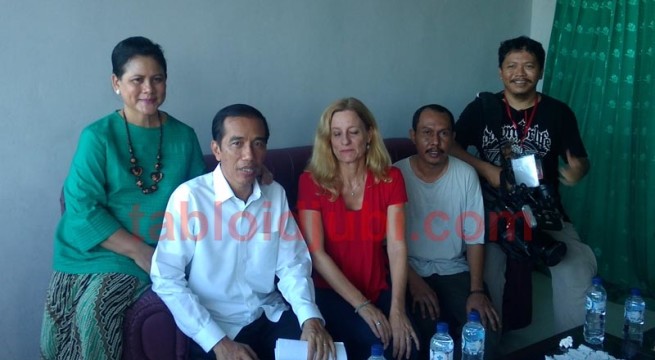
Ibu Iriana, President Jokowi with reporters from AlJazeera Step Vaessen and Bobby Gunawan (far right). Journalist from Jubi, Victor Mambor after doing an exclusive interview in LP Abepura (Photo: Jubi)

Ibu
Iriana, President Jokowi with reporters from AlJazeera Step Vaessen and Bobby Gunawan (far right). Journalist from Jubi, Victor Mambor after doing an exclusive interview in LP Abepura (Photo: Jubi)

Jayapura, Jubi – President of Indonesia, Joko Widodo said began Sunday (05/09/2015), the access of foreign journalists to Papua is to be opened.

‘Starting tomorrow, (Sunday 10/5) for foreign journalists (to) have us open, No problem,” President Jokowi said  answering questions from Jubi, on access of foreign journalists to Papua who have been restricted.

President Jokowi added that foreign journalists who come to Papua no longer need a special permit, the same as if the journalist was coming to cover other areas in Indonesia.

“For foreign journalists no longer a problem. What else? (in) Jakarta need a permit? No, no, no! “Jokowi said firmly.

When mentioned about the (Indonesian Ministry of Information) Clearing House that had been limiting the foreign journalists access to Papua, President Jokowi said there will no longer be a Clearing House. When asked again whether as president he believes in his statement, President Jokowi said he was very confident.

“I have conveyed to the ranks here. In Papua, the minister, in the TNI Commander, in Chief of Police, has it all. What is lacking?” asked President Jokowi again.

Previously, the Alliance of Independent Journalists (AJI) specifically noted, until 2015, the freedom of the press in Papua is still restrained. The Institution (of the) clearing house has been used to restrict access to any foreign journalists who wish to cover in Papua. In fact, every foreign journalist who managed to gain access to cover Papua, often are followed or escorted, doing work that (ensures) journalists are not free in performing their public duties. Local journalists were often intimidated and there even are some cases of murder of journalists.

“AJI expressed that restriction of access of journalists in Papua will negatively affect the people of Papua, Indonesia further. Restrictions would encourage the emergence of more sites that are far from the principles of work of journalism that puts the verification and confirmation,” the Chairman of AJI Indonesia, Suwarjono, told a public discussion on Freedom of the Press in Papua,  on April 29 at the Parliament press office.

According to Suwarjono, information that is circulating through the Internet – which can not be prevented from spreading – could not be verified as journalists also face difficulties in performing duties because of the restrictions. (Giving full) Disclosure access to journalists in Papua will give the public information that is more credible and trustworthy, and also can also be the reliable eyes and ears for Indonesian rule.

Translated by WestPapuaMedia, edits in parantheses for linguistic clarity.

LP3BH holds a meeting ahead of May 1st

Statement by the Executive-Director of LP3BH-Manokwari, Yan Christian Warinussy

April 30, 2015

Today, Thursday, April 30th. the LP3BH organised a discussion on
the subject, Papua’s Integration with the Republic of Indonesia on 1
May 1963: A Blessing or a Disaster? Fifteen people took part in the
discussion. including community leaders, academics, activists, LP3BH
staff members and several other people.

One of the important points that was discussed is the immediate
necessity for Papuan people to come together and express their full
support for the international campaign which is urging the Indonesian
government to immediately allow access to Papua for journalists as
well as Indonesian and international human rights organisations.

Those attending the discussion agreed that it is very important for
the Papuan people to set up a local political party to provide a
means of communication to support the efforts of the Papuan people in
accordance with the provisions in the Special Autonomy Law for Papua.

They agreed on two points that should be discussed in another
discussion which is to be held next week.

During today’s discussion, we received a report from a colleague in
Nabire saying that special police units there had arrested a
journalist, Yohanes Kuaya, from an online publication ‘selangkah.com’
who was reporting on a shooting incident that occurred outside the
Nabire Hospital at noon, today.

According to the LP3BH contact in Nabire, this colleague was
arrested because he was wearing a T-shirt emblazoned with the words:
Free West Papua (Papuan Students Alliance) and was accused of
entering a restricted area wearing this T-shirt. After being
interrogated for about an hour, he was released and ordered to change
his T-shirt which the police regarded as being completely
unacceptable. He subsequently changed his T-shirt and went home.

During the discussion organised by the LP3BH today, the chairman of
the KNPB (National Committee of West Papua) Alexander Nekemen, who was also present at today’s discussion, left the meeting before the
discussion it had ended, in order to check the situation of several
members of the KNPB who were handing out leaflets to people in the
streets, calling on them to take part in a peaceful action that is due
to take place on May 1st.

As far as we know at the moment, several of these KNPB members are
still being held by the chief of police of Manokwari and we have not
yet heard about what is happening to Alex and the other local KNPB
members.

Peace!

Yan Christian Warinussy, Executive-Director of LP3BH.

Translated by Carmel Budiardjo

Jubi: Papuans Must Stand Up to Fight

 April 29, 2015

Students held the event ‘In Memoriam of Arnold Ap’ in front of Cenderawasih University Cultural  - Jubi

Jayapura, Jubi – Dozens of students, activists, journalists and young people who are members of Papua Cultural Care Generation held the event ‘In Memoriam of Arnold Ap’ in front of Cenderawasih University Cultural Museum to commemorate 31 years after the death of legendary Papuan musician Arnold Ap, who was killed by the military on 26 April, 1984.

The Papua Bersatu Untuk Kebenaran (BUK/Papua Unite for Truth) Coordiantor, Peneas Lokbere said long after the murder of Arnold Ap Papuans continued to be victimised in many ways.

“Papuans shouldn’t forget their culture. Papuans must stand up to fight. Arnold Ap was killed by the state, but the Papuans’ spirit to fight should not be stuck in here. The struggle must go on,” he said when delivering messages in the murder day of Arnold Ap last Sunday in Cenderawasih University Cultural Museum.

Meanwhile, Papuan human right activist Rosa Moiwend said the Papua young generation today should not forget their culture. Papuans must take their culture as their identity.  Kork (Frizzy Rasta Community) Coordinator Teddy Pekei added Papuans must rebuild their identity through its culture and arts. Arnold Ap has showed that every Papuans must grasp their culture as the foundation of Papua nation.
“Arnold Ap teaches us Papuans not to discriminate every tribe and nation in the land of Papua. He showed it through his songs that compiled from various Papuan languages,” he said.

After thirty-one years, the Government of Indonesia has not realising that the murder of Arnold Ap and Eddy Mofu by the security force is the planned-murder and paralysed towards Papuan identity and character of culture.

In commemorating the thirty-one years of death of Arnold Ap, the President Joko Widodo is urged to apologise to Papuan people for the crime and violation against the human rights and the paralyse of the character of Papuan culture by State’s apparatus (Military/Police) in Papua.

While the Papua Provincial Government is asked to support and assist the development of Mambesak (folk) music as part of Papuan culture and Papuans unification as well as to renovate Arnold Ap and Eddy Mofu’s grave where located in Tanah Hitam in respecting them. (Arnold Belau)

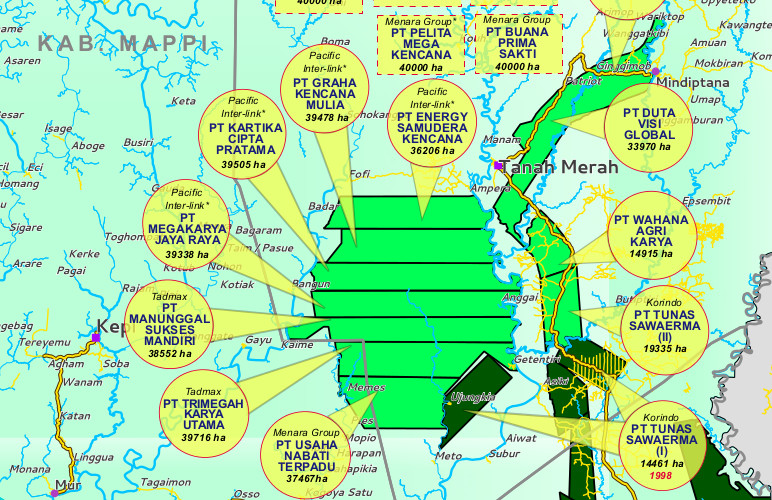
West Papua Oil Palm Atlas: The companies behind the plantation explosion

From our hardworking partners at AwasMIFEE

April 30, 2015

West Papua Oil Palm Atlas:
The companies behind the plantation explosion.

-a comprehensive investigation into the oil palm industry in West Papua,
published by awasMIFEE and Pusaka, together with local Papuan
organisations Belantara Papua, Bin Madag Hom, Jasoil, SKP KAME and Jerat
Papua, and Sawit Watch.

Available for download: https://awasmifee.potager.org/?p=1205

image

Indonesia’s oil palm industry is moving east. With large tracts of land
increasingly difficult to find in Sumatra and Borneo, plantation
companies are now focussing their attention on Indonesia’s eastern
frontier: the small islands of the Maluku archipelago and especially the
conflict-ridden land of West Papua.

In 2005 there were only five oil palm plantations operating in West
Papua. By the end of 2014 there were 21 operational plantations. This
rapid expansion is set to continue with another 20 concessions at an
advanced stage of the permit process, and many more companies that have
been issued with an initial location permit. If all these plantations
were developed, more than 2.6 million hectares of land would be used up,
the vast majority of which is currently tropical forest.

Almost without exception, these plantations have caused conflict with
the local indigenous communities who depend on the forest – lowland
Papuans are mostly hunters and gatherers to some degree. The conflicts
have centred around community’s refusal to hand over their land, demand
for justice in the cases where they feel the land has been taken from
them by deceit or intimidation, horizontal conflicts between
neighbouring villages or clans, action by indigenous workers who feel
they are exploited, or aggression by police or military working as
security guards for the plantation companies.

The West Papua Oil Palm Atlas, published by awasMIFEE, Pusaka and six
other organisations, is an attempt to provide a picture of this
developing industry. Who are the companies involved? Where are they
operating? Which areas will be the next hotspots? The aim is to be part
of a process to push for more open and accessible information about
resource exploitation industries in West Papua – currently local
administrations and companies are often reluctant to share information
about permits, meaning that communities often know nothing of plantation
plans until a company shows up, trying to acquire their land.

Indonesian law does recognise communal land rights for indigenous
customary communities, but in reality those communities often face
considerable pressure to give up that land, and are rarely given more
than US$30 per hectare in compensation. It is hoped that this
publication can become a tool for indigenous peoples and social
movements who wish to understand the oil palm industry and defend their
forest against these land grabbers, as they themselves should be the
ones to determine what kinds of development will benefit their communities.

For environmentalists and supporters of indigenous struggles around the
world, we hope that this will also be a useful insight into the dynamics
of the plantation industry and the threats it is causing in the third
largest tropical forest in the world. Using the excuse of the conflict
around the independence movement, the Indonesian government makes it
very difficult for international observers to access West Papua, and
this has probably also resulted in a lack of awareness internationally
about the ecological threats. Yesterday (29th April) human rights groups
throughout West Papua, Indonesia and in over 22 cities around the world
held demonstrations for open access to Papua, which has long been a
demand of many Papuan movements. Publishing this Oil Palm Atlas is also
an attempt to break the isolation of Papua, by focussing attention on
the issue of indigenous land rights, in a context where local
communities which choose to oppose plantation companies often feel
intimidated by state security forces which back up the companies.

Direct download link:

English:
http://awasmifee.potager.org/uploads/2015/04/atlas-sawit-en.pdf
Indonesian:
http://awasmifee.potager.org/uploads/2015/04/atlas-low-resolution-Final-id.pdf

Create a website or blog at WordPress.com

Up ↑