Oil palm plantation development & forest fires in southern Papua, September-October 2015

by Sam Lawson, Earthsight via AwasMIFEE

First

Summary:

Analysis of satellite data clearly demonstrates forest fires burning in areas undergoing conversion for oil palm in two locations in southern Papua. One of these areas is intact primary forest, while part of the other is on peat soil. The concessions concerned are both owned by the large Korean conglomerate Korindo.

It is illegal in Indonesia for companies to clear land using fire, and oil palm concession holders are also legally required to have in place appropriate fire prevention and fire-fighting measures. Though on its own the evidence below does not prove any wrongdoing by the company or its subsidiaries or contractors, it should justify further investigation by the Indonesian authorities.
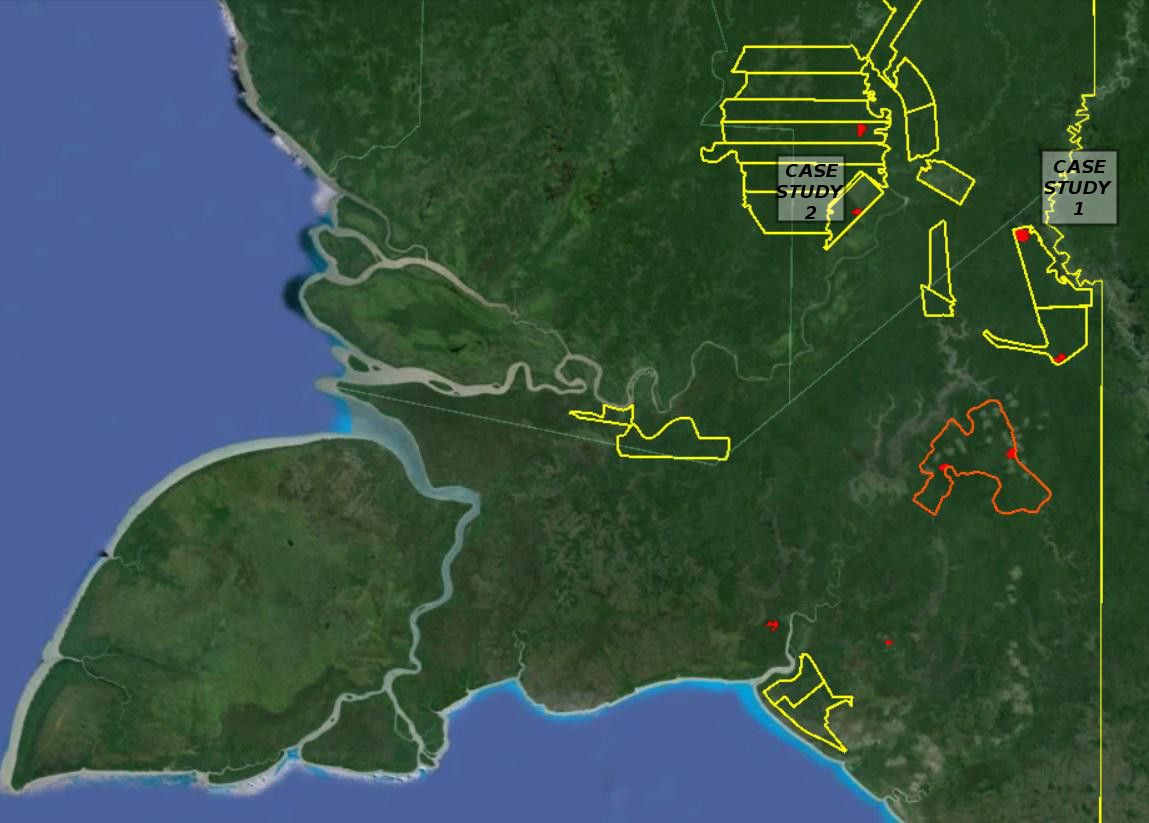
location map

Figure 1: Southern Papua, showing boundaries of oil palm conversion concessions (yellow), forest clearance for oil palm during September-October 2015 (red) and location of case studies below.

Case Study 1: PT Papua Agro Lestari (Korindo group)1

Between 1st September and 9th November 2015, more than 230 fire hotspots were detected by the NASA MODIS satellite within an area of intact primary forest undergoing plantation development near the PNG border in PT Papua Agro Lestari, Merauke district (see Figure 2).
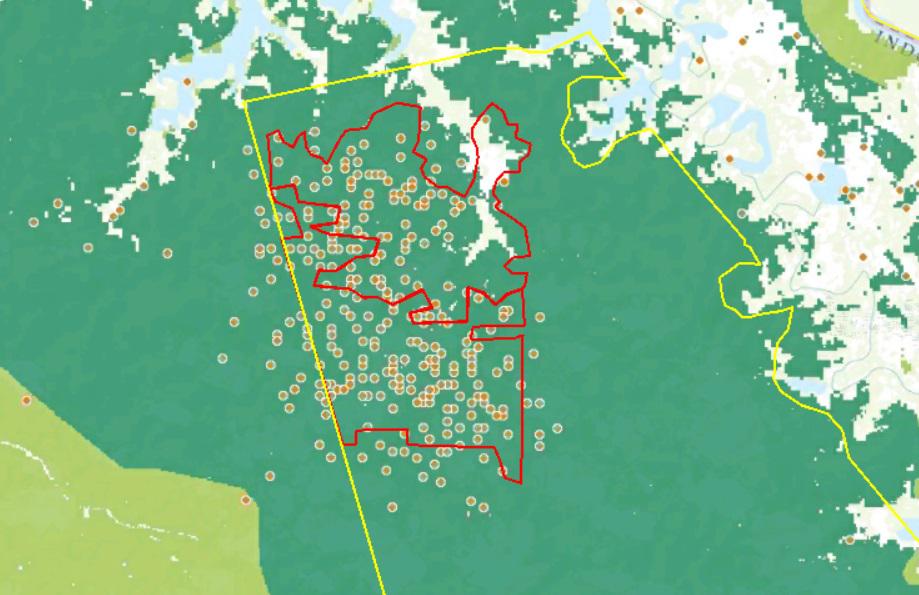
PT Papua Agro Lestari

Figure 2: Fire hotspots 1st Sept – 9th Nov 2015 in PT Papua Agro Lestari (yellow boundary). Red boundary shows area of forest cleared for plantation development up to 24th October 2015. Green background shows that the area was previously intact primary forest.2

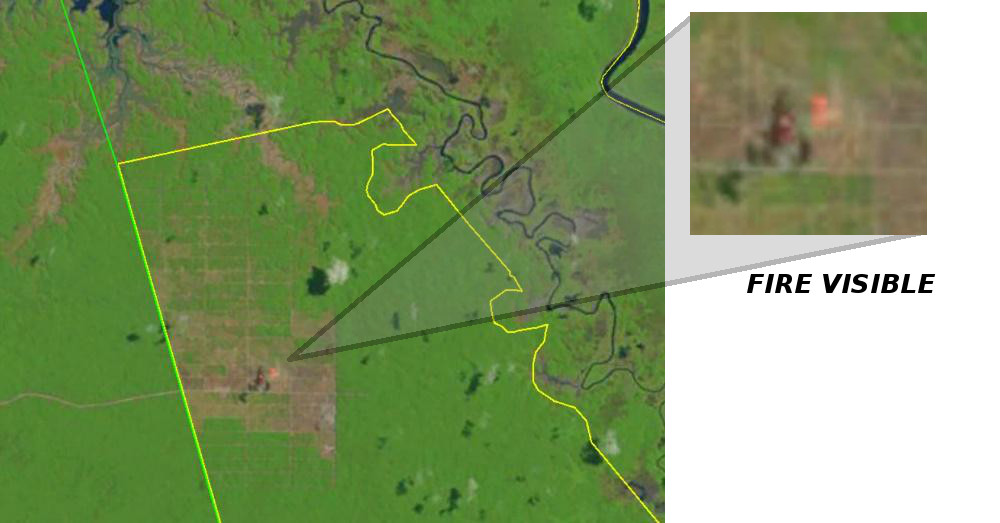
Landsat images confirm the existence of fires within this area, and clearly show how they are related to oil palm plantation development.

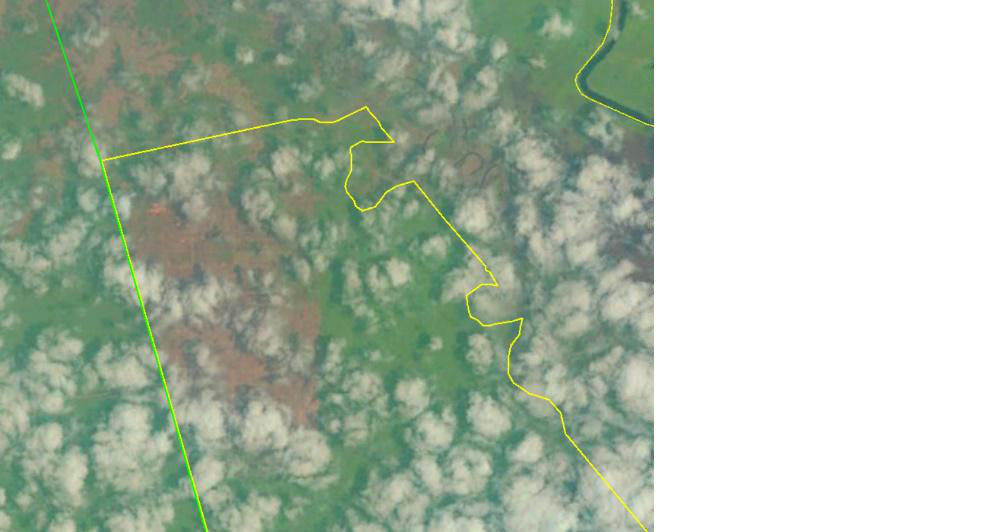
On 6th September 2015, a fire is clearly visible burning in the plantation (see Figure 4). The next cloud-free image, from 24th October 2015, also shows a fire burning, in an area which was still primary forest 7 weeks earlier (Figure 3).

In just 7 weeks between during Sept-October 2015, 1000 hectares of primary forest were cleared, a much faster rate than could plausibly have been achieved by other means.
PT PAL satellite6-9-2015

pt pal satellite 24-10-2015Figures 3 & 4: Fires visible in oil palm plantation under development in PT PAL, September & October 2015

Case Study 2: PT Tunas Sawaerma (Korindo)

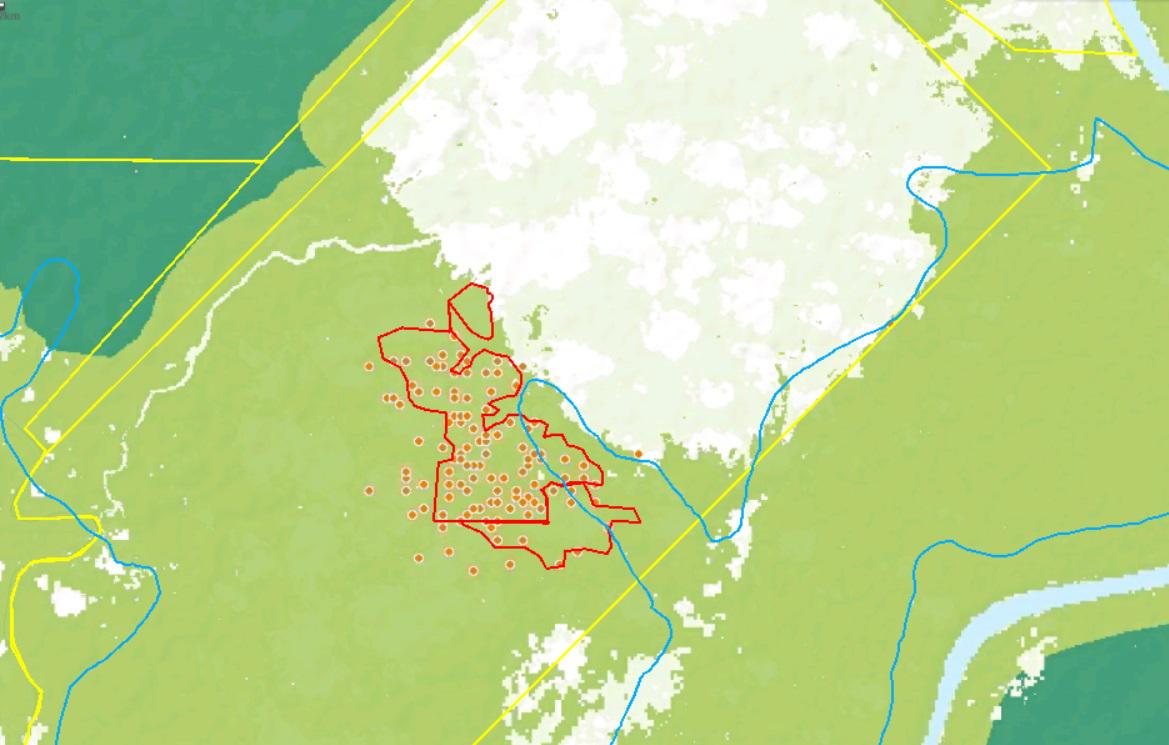
During the same period, more than 100 fire hotspots were recorded by the NASA satellite in an area currently being cleared of degraded primary forest for oil palm in PT Tunas Sawaerma, a concession in Boven Digoel district which is also owned by Korean conglomerate Korindo (see Figure 5).
PT Tunas Sawaerma

Figure 5: Fire hotspots 1st Sept-9th Nov 2015 inside Korindo’s PT Tunas Sawaerma oil palm concession (yellow). Red/orange boundary shows area of forest cleared for plantation development up to 24th October 2015. Blue line indicates peat soils. The orange boundary shows the areas cleared between 6th September and 24th October 2015 (( Sources: Peat soils – Wetlands International, 2004. For all other data see reference for Figure 2 ))

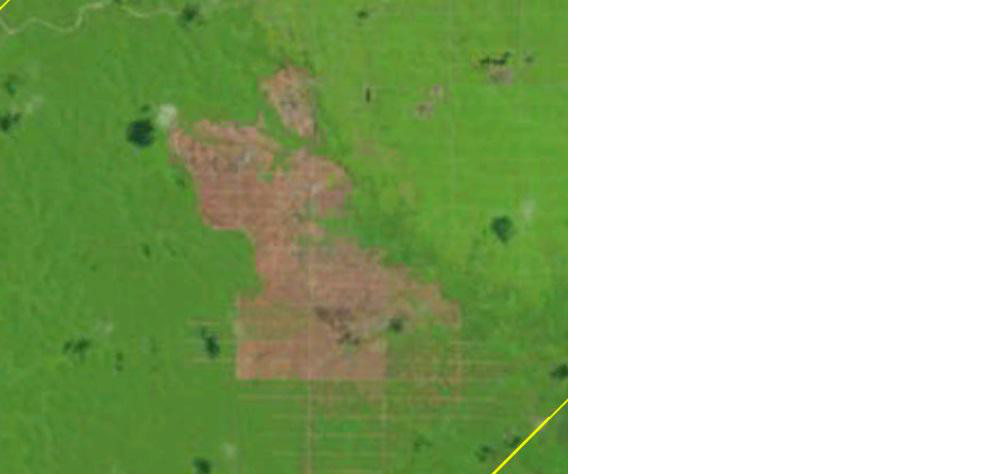
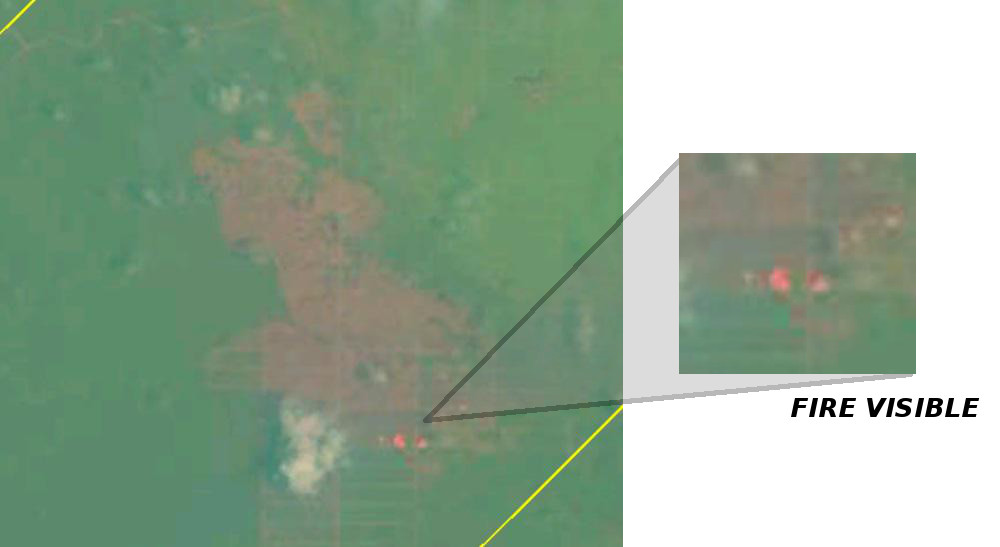
Again, Landsat satellite images confirm the existence of fires within this area of recent development. An image from 24th October clearly shows a large fire within the area under development. Comparison with an image from the beginning of September shows that the area concerned remained forested previously, though new plantation roads had been cut (see Figures 6 and 7).

Many of the fire hotspots in the Korindo concession are on peat soils, as is some of the area newly cleared by fire during September/October 2015 (see Figure 5).
PT TSE satellite 6-9-2015

PT TSE satellite 24-10-2015

Figures 6 & 7: Fire visible in forest area in process of development into oil palm, Korindo’s PT Tunas Sawaerma. The images were taken on 6th September 2015 (figure 6) and 24th October 2015 (figure 7)


  1. The Linked-In page of the Assistant Manager of Plasma (Smallholder) plantation development at PT PAL identifies the company as being part of the Korindo group – https://www.linkedin.com/in/yovita-natalia-b5168882  [awasMIFEE note: previously on this site it had been thought that ownership of PT Papua Agro Lestari had been transferred to the Daewoo International Corporation. Although the situation is confusing, and there appears to be close cooperation between the two companies, several pieces of evidence indicate that the company is still part of  the Korindo Group]  ↩
  2. Sources: Background – Degraded (light green) and intact (dark green) primary forest, from Margono, B. Primary forest cover loss in Indonesia over 2000–2012. Nature Climate Change,doi:10.1038/nclimate2277; spots – NASA MODIS fire hotspots, “NASA Active Fires.” NASA FIRMS. Accessed through Global Forest Watch on 15th November 2015; concession boundary – Ministry of Forestry GIS portal map of Forestland releases, accessed 9th November 2015; extent of new oil palm development (red/orange line) – based on analysis of Landsat satellite images from 25/1/15, 6/9/15, 24/10/15.  ↩
This entry was posted in Merauke News and tagged Bookmark the permalink. Comments are closed, but you can leave a trackback: Trackback URL.


Indonesian Air Force Members Torture Amsal Marandof and Ida Marandof at the Arafat Village, Samofa District, Biak

Urgent Action / Verified Field Report

by JPIC, GKI-TP Synod*

November 23, 2015

On June 5th, 2015, 14:20hours, a member of the Air Force heavily maltreated Amsal Marandof (22 Years old), leading to an injury above his right eyebrow.  As Amsal’s elder sister named Ida Marandof (Around 26) wanted to intervene in the beating to help her brother she was severely beaten on the chest by one Air Force member causing the victim to loose consciousness.

Biodata of Victims:
Name : Amsal Marandof
Age : 22 Years
Date/Place of Birth : Biak, 4 April 1994
Occupation : private sector
Gender : Male
Status : Single

Name : Ida Marandof
Age : +/- 26 years
Date/Place of Birth : –
Occupation : private sector
Gender : Female
Status : Married

Case Narrative


On Wednesday June 5, 2015, around 14:20 pm, local Biak man Amsal Marandof went to his brother’s grave on the left side of the “Papan Kuning” road.  Amsal was bringing a machete with him to cut the grass around the grave. When Amsal arrived there he saw 2 Army Air Force soldiers approximately 200 meters ahead of him, following activities on a piece of land that had previously led to a conflict between Amsal’s family and the Army Air Force. For that reason Amsal walked
over to them and intended to asked what they were doing at the location.
As The Victim approached 2 air force members, one security force member panicked and stepped backwards and fell down. Thereupon the Air Force member became angry and kicked Amsal into the face. The kick caused a bleeding injury above the victim’s right eyebrow.

The air force member’s aggressive behaviour made Amsal angry, so he fought back using the machete with the intention strike the Air Force member’s head and hit his helmet. Subsequently,  Amsal panicked and retreated.  After several minutes,  many Air Force members came running out of their headquarters to chase after Amsal.  One air force member ran towards him and pointed his gun at the Amsal.  Other Air Force members threw wooden sticks and rocks at him shouting “You are an OPM member” (Papua Freedom Movement).

Thereupon the victim sought rescue at Arafat work shop. Around 50 Air Force members caught him in front of the workshop, where they kicked and punched Amsal.

When the victims’ elder sister named Ida Marandof (26) received information about the incident she directly went to the location to help her brother, by stopping the security forces (from beating him).  As Ida Marandof intervened in the beating one of the Army Air Force hit her on the chest, causing the victim to lose consciousness, so Ida was immediately brought to the Air Force Base Hospital at Singamangaraja Street, Biak City.  Amsal Marandof victim was brought to Biak
District Police Office where he was taken into custody.
Ida received medical treatment and was supplied with oxygen. As she became conscious, a member of the Army Air Force questioned Ida, but she refused to answer.

After that the Air Force member gave Ida Marandof IDR100.000 (less than US$10) as transport cost and said “This problem ends here ya”. Subsequently Ida left the hospital, still feeling pain in her stomach.

Around 15.15 local Papuan time, local residents became angry and blocked the “Papan Kuning” road in front of the grave of Amsal and Ida Marandof’s brother.  The demonstrators cut the trees and broke some bottles in the middle of the road which caused a traffic jam.  Around 17:00 the road block was reopened by the community members and police.
Pictures of Amsal and Ida Marandof revealing injuries caused by members of the Indonesian Airforce (JPIC/WPM)

Wound above Amsal Marandof's right eye
Wound above Amsal Marandof’s right eye
Amsal's body is covered with bruises caused by Airforce military members
Amsal’s body is covered with bruises caused by Airforce military members
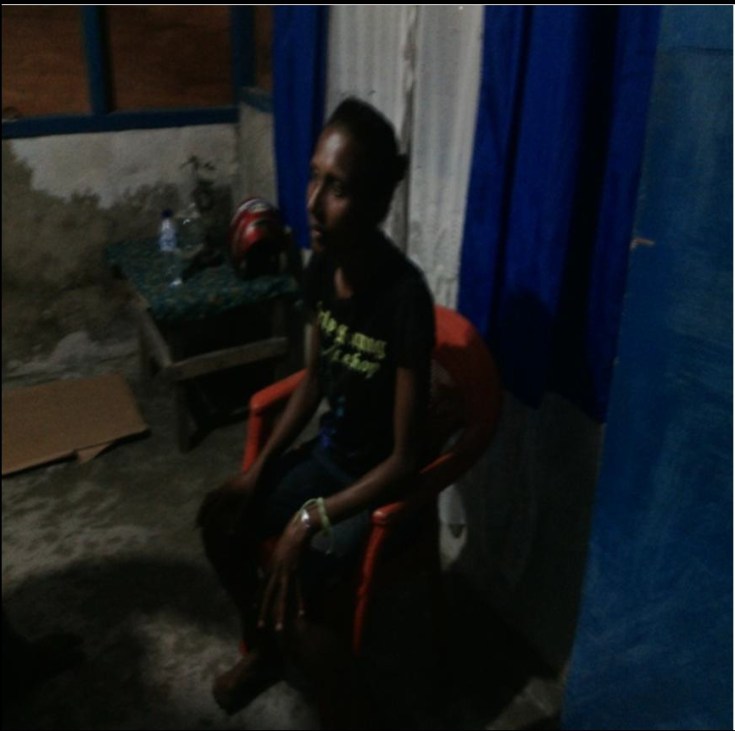
Ida Marandof during the interview


*Justice, Peace and Integrity of Creation (JPIC) Desk of the
Gereja Kristen Injili di Tanah Papua (GKI – Evangelical Christian Church in Papua)

JUBI: Papuans Will Survive without Freeport, says Papua Governor

Freeport mining area in Timika - energytoday.com

Jayapura, Jubi/BenarNews – During his visit the United States this week to attract more investment, President Joko Widodo, his ministers and officials in the field of economy were scheduled to officially meet with executives of US companies.

However, Indonesian Minister of Foreign Affairs, Retno L.P. Marsudi denied the president would meet representatives from Freeport, which has an interest in obtaining a contract extension after 2021.
“Rumours in media that the president had a schedule to have breakfast with Freeport are not true,” said Retno was quoted in Solopos.

The US Company that operates the world’s largest gold mine and third largest copper mine in Papua, is enforcing the Indonesian Government to extend their Contract of Work while refer to the Indonesian regulation the extension could be approved two years prior the last contract was terminated. However, before his departure to the US, Jokowi gave a signal to Freeport could obtain the extension after the end of contract, it means in 2019.

No Intention to Develop Papua
In between the crowded debates and controversy about the contract extension for PT. Freeport Indonesia (PTFI) in Mimika, the voices from Papua are rarely heard.

But for Papuans, this issue of contract extension is not only a matter of time. The Papua Governor Lukas Enembe was doubt the intention of PTFI to develop Papua.
“We submitted 17 points of Government’s Proposal consist of 11 points of Papua Government and 6 points of the Central Government in order to renegotiate with Freeport, including the Freeport’s involvement to build infrastructure in Papua, the increment of royalty and tax payment to the Provincial Government, share divestment, environmental issue and prioritizing Papuans to be employees. That’s our priorities,” Enembe told BeritaBenar on 17 October 2015.

He accused Freeport to have no intention to Papua’s development. He took Timika City as an example, that until now the city is lacking of feasible infrastructures. “Freeport has been operating since 1967, but what about Timika and how’s Papuan condition right now? Infrastructures in Timika are still underdeveloped. The number of indigenous Papuan workers in Freeport is not equal with the number of non-Papuan workers. If it continues like this, Freeport is better leaving. Without it, Papuans will still survive,” said the Governor Enembe.

The local authority estimates there are only 30 percent of the company’s employees are Papuans, while the rest are recruited from outside of Papua.

Further Enembe refers to the attitude of PTFI that according to him hindering the water surface tax payment.  Each year, Freeport should pay 360 billion rupiahs for the water surface tax, but the fact is up to now PTFI only paid approximately 1.5 billion for each year.
“Freeport took many advantages of the government’s rotation every five years, and violated the commitment made between the government and Freeport. And the government just ignored this fact. But it is clear, Freeport has to pay 360 billion rupiahs each year,” he said.

The Governor Enembe said the Provincial Government also support the policy taken by the Mimika Regional Government charging PTFI to pay a penalty amounted USD 3.6 billion or Rp 481 trillion to the indigenous tribes living in the surrounded mining area.
“It’s the people’s demand because Freeport has exploited the mountain and its materials since being operated, but never given the in kind benefits to the local community,” said Enembe.

It’s a Political Treaty, Not Business Agreement
Musa Sombuk, Lecturer at Papua State University and doctoral candidate at Australia National Univrsity thought the tax issue, profit sharing, and other issues that endured for years as consequences of PTFI’s contract of work is a “political agreement” rather an economic agreement between the company and the Indonesian Government.
“At first time doing operation, it was clear that Indonesia need a cash. Now, the Freeport’s contract is not transparent, unequal and the profit sharing is not fair. Freeport also did any means in order to gain land ownership,” said Sombuk.

When confirmed by BeritaBenar, PTFI spokesperson Riza Pratama declined to give comments on the renegotiation process with the Central Government, but he denied PTFI did the cunning ways in obtaining the land. He said the customary community at the PTFI mining area has gave their permission and tenure rights since PTFI started their operation for the first time. According to Reza, the company also has paid the penalty and is continuing the development program for indigenous communities at the surrounded the mining area.

Sombuk, who admitted his involvement in the audit of PTFI in 1997, said the company is not only taking the copper and gold, but also the tailing –sand waste containing the iron ore, that could reach 30 billion tons. Several grams of tailings, according to him, could result 1 gram of 23 carat gold. “Now there’s 30 billion tons of tailing and it must be gold-contained. Where will the gold from tailing go?” said Sombuk.
“Just imagine, Freeport should use the dump truck to dispose the tailing, but they just drain it to the Ajikwa River that is bearing the risk and impact to the people’s health and environment,” said Sombuk.

According to Sombuk, PTFI could survive until now because it gained support and facilities from the government, both regional and provincial. The vague regulation and the attitude of both government and company for not being transparent making the law enforcement is risk with the corrupt practice.

“We never know whether the local permits have any cost consequences. If it has, such as the charge on waste draining in Ajikwa River, we don’t know to whom it should pay and how much?” asked Sombuk. (Victor Mambor/rom)

Cultural Destruction, Land Conversion Threaten Indigenous Papuans

from Abeth You, at our partners Tabloid Jubi’s West Papua Daily

October 21, 2015

Indigenous peoples of Papua - Jubi

Jayapura, Jubi – The destruction of Papuan culture is gradually happening and is threatening the lives of indigenous people, a student group said.

The issue at heart is not the reduced number of Papuans, or rates of birth and mortality, but most importantly is the loss of cultural values, patterns of dispossession (being ignorant of the sacred connection to land), a ban on the use of indigenous languages in some urban schools, as well as the loss of indigenous content education in school, said the Chairman of Papua Highland Student Association in Indonesia (AMPTPI) for Eastern Indonesia Region, Natan Naftali Tebay.

Tebay said the most crucial issue is the loss of customary tenure rights on land, water and the values of life. “The process of land conversion such as sago forest being destroyed for oil palm plantations, is a process of extermination of the values and Papuan planting heritage ,” Tebay said in Jayapura on Monday (19/10/2015).

According to him, once Papua was recognised as the “sago barn” but it is now recognised as the “oil palm barn”.   During this time the levels (of indigenous) population in Papua were politicised (inflated with inaccurate data)  by some bureaucratic elites, with claims the population of Papua grew to more than three million.

“The Papua Provincial Government should be firm and realistic about the population rate of indigenous people. The Regional Parliament, Papuan Representative Council, Papua’s People Assembly and Papuan Provincial Government must not stay still and (just) watch the reality of genocide,” Tebay said.

He added they must establish strategic planning, such as forming a Special Regional Regulation, or establishing particular institutions to manage the transmigrants, and enforce sanctions over them if necessary.

“This is also prohibiting the development process. The Central Government also implements several policies that are not in synergy with the Governor’s policies. The regents and mayors must observe this situation, therefore they shouldn’t necessarily ask the Central Government for support,” he said.

It could be seen that several oil palm plantations, illegal logging and illegal fishing went ahead without any prior communication (or permission) from the Provincial Government.

Further he asked the Papua Governor to immediately issue the regulation about the population restriction and form a special body about the population issue in Papua. He also suggested the requirement of the regulation of local transmigration be extended both to people and government officials.

Earlier, the Papua Governor Lukas Enembe said the transmigration program in Papua initiated by the Minister of Villages, Rural Development and Transmigration Marwan Jafar was a depopulation threat for indigenous Papua.

“We have rejected the transmigration program from the Central Government.  If they still want to realise it, it should be a local (ethnic Papuan) transmigration (within Papua) instead of replacing people from Java or other regions to Papua.  Replacing poor Indonesian people to Papua means taking the problem to Papua. It’s not only related to the economy, employment,  or social problems, but I do worry that the program will reduce the number of indigenous Papua on this land in ten or twenty years; the depopulation of indigenous Papua,” Enembe told Jubi at his official resident on Saturday evening (17/10/2015) in Jayapura.

Furthermore, Enembe said until today no institution has the valid data about the number of indigenous People.  “So how could we protect the indigenous Papua from transmigration is still running without knowing the accurate data on the number of indigenous people?”

RSF: Indonesian president fails to keep media freedom pledges in first year

logo-ENG
______________________________________________________________________
 
Reporters Without Borders is very disappointed by President Joko “Jokowi” Widodo’s performance as regards freedom of information and media freedom during his first year in office.

Despite the democratic hopes raised by his election, Joko Widodo’s presidency is far from meeting expectations with regard to access to information,” said Benjamin Ismaïl, the head of the Reporters Without Borders Asia-Pacific desk.

The authorities continue to suppress information and Jokowi’s campaign pledge to open up the West Papua region to foreign journalists was just an illusion. If journalists can go there – under certain conditions – they are closely watched, exposing their sources to reprisals by the authorities.

The former governor of Jakarta, Jokowi began his term well. His inauguration on 20 October 2014 was followed a few days later by the release of French journalists Valentine Bourrat and Thomas Dandois.

Bourrat and Dandois had fallen victim to Indonesia’s restrictive practices in West Papua (the western half of the island of New Guinea) and were sentenced to two and a half months in prison for violating Indonesia’s draconian immigration laws by doing a report there after entering the country on tourist visas.

Their fixer, Areki Wanimbo, was only released after being held for eight months.

Ever since annexing the West Papua region in 1963, the Indonesia authorities have restricted access for foreign journalists because of acts of violence against civilians and the government’s crackdown on the separatist movements operating there. The few journalists managing to visit the region, which is an information “black hole,” have been closely watched.

On 10 May, Jokowi announced the lifting of the ban on foreign journalists going to the West Papua region. The opening of Indonesia’s most secret region to journalists was one of the campaign promises made by Jokowi, who even told journalists that “there’s nothing to hide”.

The decision allowed New Zealand’s Maori TV to do a report on the ethnic Papuan community for its “Native Affairs” programme. This was the first report of this kind in more than 50 years.

But there is no guarantee of lasting access to information in the region. Certain army factions that have profited from Indonesia’s occupation are expected to continue to oppose media coverage. It is also highly unlikely that the authorities will let journalists investigate all the human rights violations that have taken place since annexation.

Jokowi’s announcement – made while Indonesia was in the international spotlight following the death sentences pass on seven foreigners for drug trafficking – has all the hallmarks of a smokescreen designed to fob off international public opinion and add some temporary gloss to Indonesia’s image.

While foreign reporters are no longer openly targeted in the West Papua region, the authorities still have their fixers and sources in their sights. Two fixers working for a French journalist were arrested and questioned by the police at the start of this month.

The authorities also restrict the freedom of local journalists. Abeth You, a reporter for the TabloidJubi.com website, was attacked by police on 8 October while covering a demonstration in Jayapura, the West Papua region’s biggest city. It was organized by Solidarity for Victims of Human Rights Violations in Papua.

After the police bundled You into a truck, an officer seized his camera and deleted all his photos – all the while threatening him with his gun. Even when they have press cards, local journalists covering demonstrations continue to be treated by the police as demonstrators.

Coverage of certain sensitive subjects also continues to be closely controlled in the rest of Indonesia. British journalists Rebecca Prosser and Neil Bonner are still awaiting a verdict in their trial after being arrested for reportedly filming a reenaction of pirates attacking an oil tanker in the Malacca Strait, near Singapore.

Rear Admiral Taufiqurrahman said shortly after their arrest that “what they were reenacting (…) could tarnish the image of the Malacca Strait as a crime-prone area.” The two journalists have been held since May under Indonesia’s immigration laws.

In a couple of months, we will know whether Jokowi’s presidency has caused Indonesia to fall in the 2016 Reporters Without Borders press freedom index.

Benjamin Ismaïl

Head of Asia Desk
Reporters Without Borders

Create a website or blog at WordPress.com

Up ↑