Council Speaker Slams Police for Stopping Protestors — West Papua No.1 News Portal

Papuan pro-independence supporters named People Community Dok 7,8,9 Tanjung Ria in front of Papua House of Representative during the protest on Wednesday (15/6/2016) – Jubi/Arjuna Pademme Jayapura, Jubi – The Chairman of Papua Legislative Council blasted the police for blocking hundreds of Papuan pro-independence supporters named People Community Dok 7,8,9 Tanjung Ria as they tried…

via Council Speaker Slams Police for Stopping Protestors — West Papua No.1 News Portal

Indigenous people and activists demonstrate against oil palm expansion,in Sorong

[awasMIFEE note: as the indigenous people of Sorong, Nabire, Merauke and
elsewhere around Papua continue to resist oil palm expansion, there now
appears to be some hope that the government is responding. It appears
that President Joko Widodo’s comments last April that he was preparing a
moratorium on all new oil palm permits are being followed up. Professor
San Afri Awang, the Director-General of Forestry Planology and
Environmental Governance, has stated that “We have rejected and
terminated the licensing process for all new palm oil plantations
submitted by 61 companies for an area of more than 851 thousand
hectares.” All 61 applications were from Papua, West Papua and Central
Kalimantan provinces. The President is reportedly preparing a
Presidential Instruction to give a legal framework for the moratorium.
Of course, until this is published and we see how it is being
implemented, it is not possible to know how much meaningful change this
policy might bring]

Source: Cahaya Papua

English Translation: AwasMifee

Peringati Harkitnas Masyarakat Adat Papua Demo Perusahaan Sawit
(foto: sindonews.com)


Hundreds of indigenous people and activists from a range of backgrounds,
demonstrated at the Sorong Regency District Legislative Council to
demand a stop to the expansion of oil palm which has already destroyed
thousands of hectares of forest in the area.

This action is also to show their support for the central government
which last month started talking about a moratorium on new land for oil
palm in Indonesia.

“All work on oil palm plantations across Sorong Regency must be stopped,
because thousands of hectares of the people’s forest has already been
destroyed”, participants shouted out during speeches outside the council
building.

The indigenous people and activists which have joined the movement to
oppose land clearing for oil palm are comprised of young Moi
intellectuals, the Malamoi Indigenous People’s Association and Moi
people who care for the Malamoi forest, youth and student movements
(GMNI, GAMKI, GMKI, the Association of Moi students in Sorong
Muhammadiyah University (Himamus) and the Moi Students’ Association in
Indonesia (Himamsi)). The action started on foot from the public ground
in Aimas, the Sorong Regency capital.

The chair of the Sorong Branch of the Indonesian National Student
Movement, Manu Mobalan stated that they were also opposing new land for
oil palm as a protest against the behaviour of existing oil palm
plantations in Sorong, which have destroyed the forest in the area.

“The oppression of ordinary people is increasing, which means we need a
opposition movement to save the Malamoi forest. Investors do not look
after the interest of oppressed people”, said Manu.

Wilson Mobalen, a demonstrator, stressed that all people should have the
right to self determination in their home country, which means they can
do withoutd oil palm.

“Our fate is not determined by oil palm but by God. Forest and Nature
have taught and raised us. Oil palm is not the right recipe for Papuan
people, especially the Moi people. God is the one who decides our fate”,
he said.

The demonstration took place under the surveillance of hundreds of
officers from the Sorong Regency police station. Once they had
communicated their demands, the crowds dispersed in an orderly way.

Separately, Greenpeace forest campaigner, Richard Charles Tawaru said
that essentially, the indigenous people’s demonstration had underlined
that the community did not want any more oil palm expansion in Sorong
Regency.

“The people have had bad experiences with oil palm, which has brought no
benefits, but has caused the forest to disappear along with animals for
hunting, and water sources are reduced,” Charles said when called from
Manokwari last night.

The demonstrators used the example of two oil palm companies that are
already operating in the area, PT Henrison Inti Persada, which started
its plantation in Klamono in 2006 and PT Inti Kebun Sejahtera, which has
been in the Salawati area since 2008.

The demo was also to show community opposition to plans to clear another
24000 hectares of land for oil palm in the area, which had already been
granted an in-principle permit by the government.

The planned expansion would take place in Klaili, Klasow and Moraid
sub-districts, by two companies from the same group: PT Mega Mustika
Plantation has permits for over 9300 hectares and PT Cipta Papua
Plantation has permits for over 15000 hectares.

According to Charles, these permits originated in the Sorong Regency
Forest Management Unit(KPH) scheme which was suggested by the Sorong
local government and agreed to by the forestry ministry. Chalres said
that even the forestry ministry had granted permits for this vast new
oil palm project.

Source: Cahaya Papua
http://www.cahayapapua.com/tolak-ekspansi-sawit-masyarakat-adat-dan-aktivis-geruduk-dprd-sorong/

Brimob and how the Yerisiam Gua people’s sago groves were cleared: PUSAKA

By Zely Ariane for Yayasan Pusaka

English Translation by AwasMIFEE

11 May 2016

Sima village, Nabire – During a discussion on Monday 9th May community representatives were asked if they agreed with PT Nabire Baru’s statement that police mobile brigade (Brimob) were stationed on the company’s premises because the community had requested their presence. They instantly replied that they didn’t.

“How could we have asked for them? How could bringing in Brimob to work as security guards be anything to do with us? We have never asked Brimob to come here. Actually their presence makes us feel nervous, not safe”, said Karel Maniba during the discussion.

The communities were protesting the presence of Brimob guards who protect the company’s operations fully armed, causing anxiety within the community. Brimob were seen on the ground when the Manawari sago grove was first cleared on 12th April 2016.

That day Enos Abujani was the first to notice two excavators clearing the sago grove and immediately went to tell his neighbours. Armed Brimob guards were there, watching over the land clearing.

Around 550 square metres were cleared on the 12th April 2016, including 15 stands of sago palms. “I felt my stomach churning as I watched them work. It was as if they were destroying the contents of my stomach”, said Gunawan Inggeruhi who joined three other community members in protesting the land clearance the following day. [The sago palm is the staple food of lowland Papuans].

The community challenged the land clearance four times. On the 16th April, as the company still hadn’t stopped work, they went both morning and afternoon to complain.

“It’s just that sago grove that we are asking they don’t clear. Because that is our livelihood. If I pound the sago inside the trunk, I can get 100,000 Rupiah, I can buy the things I need, such as salt, MSG, soap. If the grove is cleared I feel I have lost out, I feel sorrow, as if I have been stripped naked”, said Mama Yakomina Manuburi, holding back her anger.

Some community members have already been to ask members of the District Legislative Council (DPRD) to help, or have sent complains about this problem to the Nabire police chief. A representative of DPRD Commission I has been to visit the area. However, neither the council or the police chief have shown any clear will to stop the sago groves being cleared.

The Yerisiam Gua community collect signatures to save the Sago Groves

The Yerisiam Gua indigenous group have collected 110 signatures supporting their opposition to the clearance of the sacred Manawari sago groves around Sima village, in Yaur sub-district by PT Nabire Baru.

The signatures were collected on Monday 9th and Tuesday 10th May, as a response to a letter from the company which stated that opposition within the Yerisiam community was only coming from a handful of people and had been provoked by certain individuals.

“This company is pretty smart at deception, everything it says in the letter is incorrect. There are currently quite a lot of people who know about the company’s lies and oppose its presence here”, said Yance Maniburi irritatedly when the letter of response was read out in the discussion between representatives of the Yerisiam Gua indigenous group on Tuesday.

Nabire Baru’s parent company Goodhope Holdings were responding to a protest letter from the Yerisiam Gua community concerning the company’s presence and the work being carried out. The company did not give a specific response concerning its current clearance of sacred sago groves.

In the letter addressed to Forest Peoples Programme and dated 29th April 2016, Aditia Insani from Goodhope said that PT Nabire Baru had settled all issues of community rights, was in possession of all the required permits and had corporate social responsibility programmes in place.

He also stated that Brimob were stationed in the company’s area because local people had requested protection from the threat of armed groups.

“Brimob forces are not involved in acts of violence”, Aditia said in the letter.

On the 19th April, the Yerisiam Gua commuity sent a letter protesting about PT Nabire Baru to the Roundtable on Sustainable Palm Oil, via Yayasan Pusaka. The complaint was in connection with the expansion of the company’s work area to include the sacred Manawari sago grove and the presence of Brimob guards which was causing anxiety within the community.

According to Y.L. Franky, Director of Yayasan Pusaka who forwarded the Yerisiam Gua people’s request, four issues form the basis for the community’s position.

Firstly, PT Nabire Baru has from the outset attempted to win the support of a small group of community members to release community lands, without a general meeting or the agreement of the wider Yerisiam community which holds the land rights.

Secondly The Yerisiam indigenous community have repeatedly complained and spoken of the problems of this land expropriation, their suffering and losses and the violent practices used by Brimob security guards in their approach to these problems, but the government and company have ignored and failed to respect the community’s complaints or opinions about these matters.

Thirdly, the company has cleared ecologically important natural forest resulting in deforestation, and as a result the community have lost a source of income, and there has been recent serious flooding inundating Sima village where the Yerisiam people live.

Fourthly, the company’s attempts to clear the sacred Jarae and Manawari sago groves, contravening an agreement made with the community in February 2016 which opposed a smallholder scheme in the sago area.

The company had promised not to disturb the sago groves. “Previously they said that they would leave the sago groves as an enclave owned by the Yerisiam people”, said Agus Henawi. “But it seems as if their objective is to finish us off”.

The Yerisiam Gua community have stressed that the promises PT Nabire Baru made since it commenced its investment have still not been fulfilled.

“Right at the beginning they promised to build a school, a church and houses but not one of these promises has been met yet”, said Mrs Yance Rumbiak.

She feels that since the company arrived the people have been made to suspect each other, causing divisions within families, setting people against one another and making village life uncomfortable.

Zely Ariane reporting from Sima Village, Nabire.

Papua itu Kita: Dismiss Police officer that committed Sexual Violence to Children in Fak-Fak

By Arnold Belau at SuaraPapua.com

May 10, 2016

Translated by NR for WestPapuaMedia

JAYAPURA, SUARAPAPUA.com. The civil society group of Papua itu Kita in Jakarta has demanded that a police officer who sexually abused children arrested during state repression in Fak-Fak, be fired and prosecuted.

Papuan Rights campaign “Papua itu Kita”, explained that three under-age children were sexually abused by the members of the state security apparatus. On May 2, 2016, large-scale arrests took place in the city of Jayapura. A total approaching 1,744 people were arrested simply for peacefully protesting to support the full membership of the United Liberation Movement for West Papua (ULMWP) in the Melanesian Spearhead Group (MSG).

“It was the largest arrest post-tragedy 65 (the bloody coup the brought former dictator Suharto to power) and became the only largest arrests post-reformasi (the mass movement that removed Suharto in 1998), where democracy has become a choice that should support the freedom of expression and speech,” said Papua itu Kita through a press release on its official website, on 7 May.

It is said, the arrest did not stop in Jayapura, but (continues) until Fakfak. In four waves, the police have arrested 122 people. The arrest of thousands of people not only harm the democracy but also tear up our conscience. Because the three under-age children who were arrested had experienced sexual abuse from the police (fak-fak.com).

” WM (16 years old) his penis squeezed, DB (14 years) and TM (12 years old) were forced to watch pornographic videos and then being forced to masturbate. The act of sexual violence was carried out in the examination room of Fakfak police station,” said Papua itu Kita.

In response, Papua itu Kita, as a movement of solidarity with civil society for humanity and justice for the people of Papua, announced:

first, condemn the acts of sexual violence committed by police against WM (16 years), DB (14 years) and TM (12 years old ).

Secondly, discharge, arrest and prosecuted the perpetrators with a legal process which is transparent and accountable.

Thirdly, the Indonesian Commission of Child Protection (KPAI) should participate in investigating the cases of sexual violence against children in Papua.

Fourthly, the State must establish a comprehensive system and non-discriminatory as a safeguard for children, especially in Papua.

“That sexual violence, particularly against children, cannot be justified for any reason. Especially, if the perpetrator is a police officer. With jargon “to protect, foster and embracing the citizens, they should be able to provide protection and safe space for children,” they wrote.

Meanwhile, Papuan human rights activists in Fak-Fak, Freddy Warpopor, confirmed this media and said the incident was true.

Those who arrested at that time were 98 people. Among them there are 18 children who call themselves the Sons of West Papua also get arrested. One of the children was forced to watch pornographic films named DK (14) and other friends forced to do masturbation by the police officers.

“The Children, the victims, identified the police officer (who forced the victim to watch pornographic films) when we showed the photo. Only the name is not yet known. It is already included in the category of pornography. After asked to watch, they get beaten, slapped and forced to smoke cigarette. They were forced to do a push-up and then slapped. The children were subjected to torture, ” said Warpopor.

ARNOLD BELAU

Marap Indigenous Group claim back three oil palm plantation divisions in Arso

from our parters at SuaraPapua.com

translated by AwasMifee

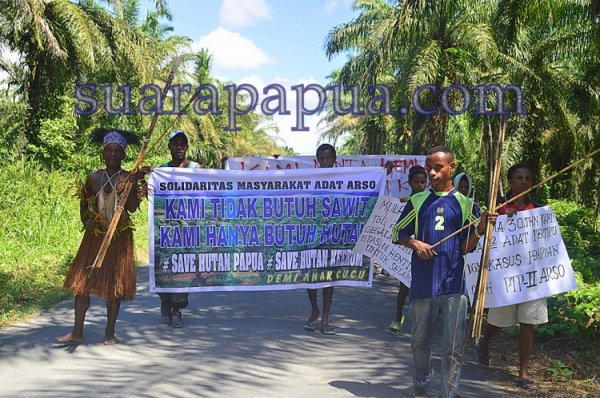
tiga-lokasi-perkebunan-sawit-di-arso-di-tarik-kembali-oleh-masyarakat-adat-suku-marapIndigenous land owners from the Marap people in Arso have used customary law to take back oil palm land owned by PT PN II as part of its Arso plantation, specifically the Core III, Core IV and Core V divisions. The action took place at Yamara village PIR 3, Manem sub-district, Keerom Regency, on Wednesday 27th April.

Maickel Fatagur, the head of the Fatagur clan which holds customary land rights, alongside other clans such as the Wabiager and Gumis clans, said that they will no longer hold any kind of meetings with the company. That is because they have used customary law to take back the land PTPN was using.

“We’e used customary law to take the land back. That means now there will be no more meetings with the company. The land now belongs to us. We invite PTPN II Arso to take back its oil palm and we will take back our land. That’s all”, Fatagur made clear to the Manager of PTPN II’s Arso plantation on Wednesday at Tami in Manem District, in Keerom.

According to Maickel, PTPN II has operated the Arso plantation on the Fatagur clan’s land, and that of its sub-clans, for around 30 years, but the local community, who hold the customary land rights, have never felt economically secure

“All these years attention has never been paid to the wellbeing of the community who hold the customary land rights on the land used by PTPN II Arso at the three locations in question, Core III, Core IV and Core V, which amount to 1300 hectares”, said Fatagur.

Dominika Tafor, the secretary of the Boda Student Association (Himpunan Mahasiswa Boda) in Keerom who is also an indigenous member of the Marap ethnic group, said that she was supporting the action taken by local indigenous people.

“We strongly support the action which the Marap community of Workwama village are taking today. We support it, because for so many years the company has not paid attention to the fate of the community. They only come to destroy”, she said.

When the indigenous people arrived at the plantation office in Tami, PTPN II’s Arso plantation manager, Hilarius Manurung, recieved them and said that he would take their wishes on board and pass them on to the Keerom local government.

“Since we’re a state owned company, we can only listen to all aspirations and complaints and pass them on to the local government for further action. There’s not much we can do. What we can do is to follow up all these complaints from the community,” said Manurung.

Suarapapua.com observed that security forces from the Keerom police headquarters were present, 11 armed policemen in a Dalmas truck, ready to police the Marap people’s action.

The action started from Workwama village at 9-00 am and travelled by truck the 6km to the plantation areas Core III – Core V, bringing a banner which read “we don’t need oil palm, we only need forest #savehutanpapua #savehutankeerom for our grandchildren”

As a symbol, the indigenous people brought soil from the three oil palm locations and taro yams from their gardens, placing them in a noken string bag made from forest palm frond midribs, and using traditional rituals took them to PTPN II’s office located in the plantation administration centre in Tami.

 HARUN RUMBARAR

Source: suarapapua.com http://suarapapua.com//read/2016/04/27/3305/tiga-lokasi-perkebunan-sawit-di-arso-di-tarik-kembali-oleh-masyarakat-adat-suku-marap

This entry was posted in Around West Papua and tagged , , ,

Create a website or blog at WordPress.com

Up ↑