PT Victory will likely destroy Keerom’s Golden Triangle

from our partners at AwasMifee

“We call it the Golden Triangle because it is the land we have always lived from, until now.  We can use the wood, go fishing in the river, and there are also sacred places there,” said Cleman Nouyagir, in a meeting in the Arso deanery. (06/05/2014)

The meeting discussed the Keerom Regency head’s Decision Document SK 93/2013 dated 5th September 2013 which awarded PT Victory Cemerlang Indonesia Wood Industries a location permit for a 4885 hectare oil palm plantation in East Arso district, Keerom Regency.

“All of our forest has been destroyed, we have handed it all over. There’s just a little bit left for our grandchildren, so I would put my life on the line for it”, he stated firmly.

Clemen and the other participants in the meeting were agreed that land that had previously been taken and turned into oil palm plantations had not brought any positive impacts for the people of Keerom.

He continued, “When we talk about Keerom we are not only talking about Arso City, but also people in Workwana and Wambes, all of them should be aware and protect what is left of our land”.

According to him, the people in Workwana and Wambes should be wary of being talked into accepting outside investors’ plantation plans because they would lose their main source of livelihood.

The term ‘Golden Triangle’ emerged in a mapping exercise which was originally conceived in 1992 an eventually finished in 2004 when a mutually-agreed map was produced. This map became a reference when designing the map of Keerom regency, which decided that the area should be designated protected forest. The land is owned by the indigenous people of Workwana, Wambes and Arso City.

“I was involved in making that map before and that land is protected forest and the source of our livelihood. The government should know this already, which means they shouldn’t be giving out permits,” he said.

Source: ALDP

Problems faced by Sinar Mas plantation workers in Lereh, Jayapura

translated by our partners at awasMifee from a SKP Jayapura report

SKPKC Jayapura staff organised a meeting in the Juk-Lereh church which was attended by around 20 employees of PT Sinar Mas. The meeting was a response to the Taja parish priest Hendik Nahak’s request to address problems facing workers at Sinar Mas’s oil palm plantation.

Father Hendrik explained that there are quite a few problems that occur in the oil palm plantation, but they are covered up by the company. The problems relate to, for example, workers’ rights, recruitment, clean water and habitable accommodation. Father Hendrik’s explanation was confirmed by the workers present in the meeting. They made clear that these problems had been ongoing for some time and were frequently ignored by the company.

Problems that often arise include recruiting company workers by using supervisors who find the workers, making all sorts of enticing promises. People who want to work for the company are asked to sign agreements to accept all company decisions concerning their wages and other working conditions.

There are also problems concerning housing and clean water. The company brings new workers to the site without taking their accommodation needs into consideration, meaning that 3x3m2 houses are being inhabited by two or even three families. People have to rely on rainwater for their everyday clean water needs because the nearby river is polluted by fertilizer which is sprayed by aeroplane. Then when wages are paid, money is docked without explanation, meaning that quarrels sometimes break out between workers and supervisors.

Source: SKP Jayapura

KNPB Timika Chairman freed from custody after international pressure

From our Partners at Pacific Media Centre

KNPB’s Steven Itlay … arrested then set free. (Image: Free West Papua Campaign)

Wednesday, May 14, 2014

JAYAPURA (Pacific Media Watch): The West Papua National Committee’s [KNPB] Timika chairman, Steven Itlay, has been released from prison after being arrested by the Indonesian police yesterday.

The news site KNPB has reported that Indonesian police shot 10 bullets into the campaign’s office in what seemed to be an attempt to provoke a fight in order to arrest activists inside.

KNPB reported that when West Papuan activists asked the police why Itlay was being arrested, they told them: “Steven Itlay is a suspected Free West Papua activist”.

The Free West Papua Campaign said Itlay’s relatively speedy release was due to international pressure being placed on the police.

Just hours earlier, the campaign had published the phone number of the head of the Indonesian police in Jayapura on its Facebook page. It is understood that activists from all over the world phoned the number to call for Itlay’s release.

In a statement issued yesterday, the campaign said: “We would like to thank you all with all our hearts for all your incredible support for Mr Itlay and the people of West Papua, especially after the international plea for his release was made earlier today. Following his release, Steven also asked us to thank you all for the support of the suffering people of West Papua”.

Meanwhile, Papuans Behind Bars has released its April 2014 report, which details 12 incidents of torture of West Papuans in custody last month.

In one case, two West Papuans were “stabbed and slashed” by Indonesian police for objecting to police brutality against a third person, while “another seven men were tortured on arrest with electric stun batons”, the report says.

On April 2, the international day of protests for a Free West Papua, Indonesian police tortured two students at the campus of Cenderawasih University in Jayapura.

50 Years of the Violation of Basic Human Rights in West Papua: Part one and two

Statement by Yan Christian Warinussy, Executive Director of LP3BH, made in preparation for discussions that were due to take place at the beginning of 2014.]
March 10, 2014

As an organisation which advocates basic human rights in the Land of Papua, the LP3BH – Manokwari wishes to record to all those who have remained silent about the conditions now prevailing in the Land of Papua, the experiences of the indigenous Papuan people who have ceaselessly tried to ensure that no-one will forget what has been happening  in this territory since 1 May 1963 and what continues to happen systematically up to the present day

      To begin with, it is essential to understand the history, in order to understand who it was who was responsible for the status  imposed on the Land of Papua on 1 May 1963. The indigenous Papua people have every right to enjoy all the rights that have been stipulated in the Universal Declaration of Human Rights and  various international covenants regarding economic, social and political rights  as well as other international covenants all of which have been disregarded with regard to the situation in West Papua.
      At the time of Papua’s incorporation into the Republic of Indonesia, Ali Murtopo (a senior adviser to the then president of Indonesia) was quoted as saying: “What we want and need is the land in Papua, not the Papuans who live there.”
      In 1967, a Contract of Work was concluded by Indonesia regarding the exploitation of the copper and gold and possibly also uranium around the Grasberg Mountain around Tembagapura which was widely known to the Indonesian government as well as a US multinational corporation called Freeport McMoran.
    This makes it very clear why the USA played such an active role on the diplomatic front to ensure that West Papua would be incorporated as part of Indonesia, despite the glaring differences between the Papuan people with regard to their history, as well as their anthropology and ethnography and people living in other parts of Indonesia.
      It was abundantly evident that the USA was very interested in the natural resources in West Papua which explains why that country took such an interest in this matter.
“Gentlemen, I am angry with God. Why has God created such beautiful mountains, valleys and rivers, rich with minerals and placed us, the indigenous peoples, here in this place that attracts so many people from around the world to come, exploit our resources, and kill us?”
 [Translator’s Note: This prayer was said in 1994 by a man who lived on the Grasberg Mountain, who bemoaned the fact that the territory inhabited by Amungme people was so richly endowed with natural resources of huge interest to the USA.]
       That man whose name was Tuarek Narkime delivered words that are widely known to and understood* by the leaders and people of the Amungme tribe in drawing attention to the many violations of the rights of these people which were perpetrated in the area when the Freeport mine was being  established, during the course of which many Amungme people lost their lives as a result of actions by Freeport personnel as well as by members of the Indonesian army and police, although none of these people have ever been called account before a court of law for what they have done.
     These introductory remarks provide the basis for everyone anywhere in the world and all democrats around the world to take a new look at the past as well at the present regarding the acts of violence that continue to occur in the vicinity of the Freeport mine without anyone ever being called to account for what they have done.

Ever since 1963 and 1967, the LP3BH has recorded the fact that the Republic of Indonesia has consistently used violence against the West Papuan people, something that even started to happen before those years.

    On 15 August 1962, when the New York  Agreement was signed by Indonesia and The Netherlands under the supervision of the United States of America, the Papuan people were not involved’ They were not even consulted for their opinion. Yet, at that time there was a New Guinea Council  which consisted of representatives of  the Papuan people, the members of which were chosen by means of democratically held elections which took place on 5 April 1961 in Hollandia (now called Jayapura).
      [All the names of the members of the Council who were elected, of whom 22 were Papuans, are listed  as well as those who were appointed which included one Papuan and five Dutch people, including one Indo-Dutch person.]
    Besides that, there were two major religious organisations, – the GKI [Evangelical Christian Church] and the Catholic Church] which were spread across  the whole of the Land of Papua. Yet, these churches were never consulted as part of civil society in the territory at the time. This was despite the fact that the UN was involved  in the creation of UNTEA as well as The Netherlands and the USA.
     What we mean by being consulted is all about the framework and  the possible problems that might arise among the indigenous Papuan people who were regarded as being too primitive  to take part in an election held according to the principle of ‘one person, one vote’. Were the towns and villages in West Papua too complex for the New Guinea Council or the two churches to choose their leaders? Such advice would have been very useful and important in deciding on on how to conduct the elections in accordance with the traditions  and customary laws that were vibrant among the Papuan people. who were supposed to have been consulted by means of the Act of Free Choice which was to have been held by 1969 in the Land of Papua.
     There was never any request for advice or opinion from the Papuan people. Still worse, what actually happened was that Papuans were arrested and even  cruelly tortured for allegedly being involved in an ‘underground movement’, with the intention of overthrowing the Indonesian Government. This is what happened to Baldus Mofu as a result of which he was mentally damaged at the hands of the military police and members of the Indonesian Air Force in Manokwari. Another Papua, Nicholas Tanggahma is believed to have died  after ingesting food that had been poisoned when he was staying at the Arfak Hotel in Manokwari in 1969.
     Several other members of the Council such as Marcus Kaisiepo and Nicholas Jouwe were arrested and taken to Europe prior to the Act of Free Choice. Others were treated in the same way, including E.J Bonay, F.K.T. Poana, A.S. Onim and Thontjee Meset.
     All these acts of violence were perpetrated by members of the Indonesian security forces, the TNI and Polri. and further intensified as the Act of Free Choice drew near in August 1969.
     The LP3BH is well aware of the fact that many activists in Biak, Sorong, Manokwari, Jayapura, Wamena, Nabire  as well as in Merauke were arbitrarily arrested by the TNI and Polri some of whom were summarily killed. An example of what happened occurred on 28 July 1969 in Manokwari when 53 Papuans were summarily executed at the headquarters of the Infantry Battalion in Arfak-Manokwari.
     Such human rights violations have systematically occurred ever since that time, following the enactment of Law 12/1999. This was clarified in the General Remarks contained in paragraph 1, section 6 which state: ‘The Act of Free Choice  in West Irian  was a manifestation of the aspirations of the Papuan people and resulted in the people of Papua and  West Papua  expressing their wish to be united with the people of other regions of the Unitary State of the Republic of Indonesia, affirming  that West Papua is part of the Unitary Republic of Indonesia.’
      The afore-mentioned statement became the legal basis for the Indonesian Government to enforce paragraphs 109 and 110 in law.  This codification was part of the law under the Dutch Constitution [Wetboek van Strafrecht]  whenever the government takes firm action against the Papuan people when they challenge  ‘Papua’s political integration’.
     As a result of all this, every time  that people in Papua or West Papua seek to challenge ‘political integration’  using their right to freedom of expression as guaranteed in Law 39/1999
on Basic Human Rights as well as universal human rights, they are accused of the crime of treason under the Indonesian Constitution.
      Such incidences occurred in Biak on 6 July 1999 when a group of Papuans unfurled the Morning Star Flag under the leadership of Filep Karma which resulted in his being subjected to acts of brutality by the TNI and Polri and which moreover resulted in dozens, even hundreds, of Papuans falling as victims, some of whom even lost their lives. All this resulted in Filep Karma and his colleagues facing the charge of treason.
(End of part on and  two of the translation.)
Translated by Carmel Budiardjo, founder of Tapol

Cafe Pacific: Vanuatu PM’s speech spotlights Indonesian Papuan atrocities and Pacific ‘blind eye

By DAVID ROBIE at Cafe Pacific

Wednesday, March 5, 2014
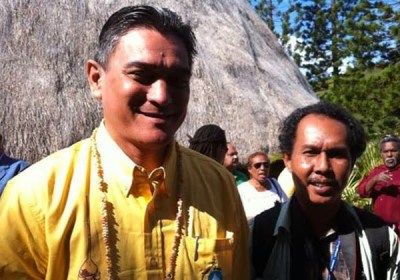
Vanuatu Prime Minister Moana Carcasses Kalosil (left) with Papuan journalist
Victor Mambor in Noumea. Photo: Tabloid Jubi

ANALYSIS

SHAME on New Zealand politicians. With the courageous exception of the Green Party’s Catherine Delahunty, most of the rest offer a shameful silence over Indonesia’s human rights violations in West Papua.

The Melanesian brothers and sisters of the colonised region, forcibly invaded by Indonesian paratroopers in 1962 and annexed under the fraudulent United Nations “Act of Free Choice” in 1969, have suffered under Indonesian atrocities and brutal rule ever since.

But it took the Prime Minister of Vanuatu,  Moana Carcasses Kalosil, to take the podium at the United Nations Human Rights Council and condemn Jakarta for its past and ongoing crimes in West Papua, before the world took notice.

This not only shames New Zealand, it also exposes most Pacific leaders for their lack of spine over Papuan human rights.

When Vanuatu became independent from the British and French joint colonial condominium, better known as “pandemonium”, in 1980, founding Prime Minister Father Walter Lini was a champion for West Papuan independence.

Vanuatu Prime Minister Moana Carcasses Kalosil
speaking at the UN Human Rights Council.
Photo: UN Webcast

The country harboured independence campaigners and refugees and frequently spoke up for West Papua in the Pacific Islands Forum.

But in recent years, the Vanuatu government had become derailed from its staunch position and was courting the Indonesians for aid.

Until the outspoken new Prime Minister, a part-Tahitian who is the first naturalised prime minister of Vanuatu, came on the scene a year ago.

Vanuatu refused to be compromised by the window dressing Melanesian Spearhead Group “fact finding” mission to West Papua earlier this year. It boycotted the sham.

Prime Minister Carcasses had already made one impassioned speech about the “debacle of decolonisation” in West Papua last November, but this one was even stronger.

‘Litany of torture’
“Since the controversial Act of Free Choice in 1969, the Melanesian people of West Papua have been subject to ongoing human rights violations committed by the Indonesian security services,” he said.

“The world has witnessed the litany of torture, murders, exploitation, rapes, military raids, arbitrary arrests and dividing of civil society trough intelligence operations.

“The Indonesian National Commission on Human Rights (KOMNAS HAM) concluded that these acts constitute crimes against humanity under Indonesian Law No. 26/2000 (KOMNAS HAM 2001,2004).

“In this climate of fear and repression of political dissent, and blatant negligence by the international community including the UN and the powerful developed countries since 1969, we find this forgotten race still dare to dream for equality and justice.

“Yet the democratic nations have kept silent.”

Carcasses said he had come to the UN to call for immediate action:

“Injustice in West Papua is a threat to the principle of justice everywhere in the world. I do not sleep well at night when I know that in 2010 Yawan Wayeni, known as a separatist was videotaped by the security forces as he was lying in a pool of his own blood with his intestines seeping from a gaping wound in his abdomen.

“It concerns me that in October 2010 Telenga Gire and Anggen Pugu Kiwo were tied by the military and were severely tortured. It concerns me when I see the video footage of a group of Papuan men bounded and being kicked in the head by uniformed soldiers who are meant to protect them.

“I am worried because between October of 2011 and March 2013, 25 Papuans were murdered and nothing has been done to bring perpetrators to justice.

“And it embarrasses me, as a Melanesian, to note that roughly 10 percent of the indigenous Melanesian population have been killed by the Indonesian Security forces since 1963. While I acknowledge the 15 years of reform that has taken place, I am also worried that Melanesians will soon become a minority in their own motherland of Papua.

“In a world so now closely connected with innovative technology, there should be no excuses about lack of information on human rights violations that have plagued the Papuan people for more than 45 years.

“Search the internet and research papers by academic institutions and international NGOs and you will find raw facts portraying the brutal abuse of the rights of the Melanesian people in Papua.

“But why are we not discussing it in this council? Why are we turning a blind eye to them and closing our ears to the lone voices of the Papuan people, many of whom have shed innocent blood because they want justice and freedom.”

Create a website or blog at WordPress.com

Up ↑
