Planned MSG Foreign Ministers visit to West Papua lacks transparency

Exclusive investigation from West Papua Media team

October 12, 2013

(The Hague): As allegations surface of Indonesian military-linked businessmen providing envelopes of “hefty cash” to senior officials in the Solomon Island’s Prime Ministerial delegation during the recent APEC summit in Bali, a high level source inside the Melanesian Spearhead Group has raised concerns over Indonesia’s subversion of the agreed visit of Melanesian Foreign Ministers to West Papua, in an exclusive interview with West Papua Media.

An explosive but carefully worded article in the Solomon Star newspaper on October 11 has alleged that Indonesian officials provided members of Solomon Islands government with large amounts of cash contained in yellow envelopes, during an official dinner hosted in honour of the Prime Minister Gordon Darcy Lilo and his delegation.

According to the Solomon Star report, at least five members of the delegation have admitted to receiving the payments, amongst a total of 17 delegation members alleged to have received the envelopes.  The report, from interviews by journalist Alfred Sasako with a highly placed whistleblower in Honiara, alleged that at least two “names withheld” senior officials received USD$25, 000 each, three others received USD$10, 000  and a final two delegation members received USD$5, 000 each respectively.

“It seems the level of payment is based on seniority, the higher you are, the more you get,” the sources told the Solomon Star.

After the publication of the new allegations, West Papua Media spoke on Saturday to a well-respected customary figure in the Solomon Islands, who described the latest revelations as proof of long-standing suspicions “that Indonesia is involved in a corrupt subversion of Melanesian solidarity on the West Papua issue.  The source described the behaviour of Prime Minister Gordon Darcy Lilo in arranging unilateral visits to West Papua as “an affront to the Melanesian Way that is deliberately undermining the quality of what a properly constituted MSG Fact-finding mission can uncover in West Papua.”

“The Prime Minster is siding with Indonesia to cover up the crimes against the West Papuan people, by diluting the effectiveness of a multilateral fact-finding team to assess the real situation in West Papua.  What other deals is he doing for the Solomon Islands with these Indonesian military businessmen?  Are our islands going to be the next West Papua?” the source told WPM.   The customary source, who had no involvement with the Solomon Star revelations, declined to be identified for this article citing fears of being labelled as the whistleblower.

“This is not about me anyway, this about the questions for all Melanesian people about how far Indonesia is willing to bully or bribe Melanesians, and how some Melanesians like our Prime Minister are potentially having their pockets lined with blood money for turning their backs on the suffering of our Melanesian family in West Papua,” the source told WPM with some indignation.

Prior to the MSG meeting in Noumea in June 2013 the Indonesian and Fijian governments agreed to a multi-lateral visit to West Papua by MSG Foreign Ministers. The proposal was raised at the Noumea meeting by Fiji in part to defer a decision over whether West Papua would be granted membership into the MSG or not. The MSG Ministerial team has undertaken to write a report following their visit. This report will then help guide the MSG’s decision regarding West Papua’s membership. Since June, however, serious doubts have been raised as to how transparent the organising of the MSG Foreign Ministers is, or even whether it will happen at all.

A high-level source inside the MSG who was at the meeting in Noumea but asked not to be named told WPM  on condition of anonymity, that it was highly unlikely that the MSG will revoke Indonesia’s observer status, but that they could give West Papua ‘associative status’, which is a higher level of membership. However, the source then went on to say that it is now “not clear what is happening”.

The concerns are serious. First, no date has been set for the Foreign Ministers visit to West Papua. Second, neither the MSG Secretariat nor Melanesian nations are organising the visit. “The Foreign Ministers all rely on an invitation from the Indonesian government. It is not clear if such an invitation has been issued and it is not clear who will pay for it. My advice to member countries is that each Melanesian country pays for their own visit themselves” said the senior MSG bureaucrat. “That way the Foreign Ministers will not be beholden to the Indonesian government and that their status as independent advisors to the MSG is more likely to be guaranteed.”

Most concerning is that the idea of a multi-lateral visit could be abandoned. “It is possible” said the MSG official “that the foreign ministers could travel to West Papua separately and not as a group”.  This is the most likely possibility given the revelations in the Solomon Star.

Although privately many Melanesian politicians support independence for West Papua the official cautioned against false hopes. “West Papuans should not have high expectations from the forthcoming MSG foreign ministers support.”

At this stage it appears highly unlikely that the Melanesian foreign ministers report will reflect the political reality inside West Papua or the aspirations of the West Papuan people.  This view is reflected in the recent comments from Mr Gordon Lilo, the Prime Minister of the Solomon Islands, who told Indonesia’s Antara state news agency that he is “impressed with the progress” the Indonesian government has made in West Papua.  Mannaseh Sogovare, the Solomon Islands opposition leader, criticised Lilo’s comments saying that he had “probably been overwhelmed by the reception of the hosts and obviously the Indonesians have gone out of their way to put on the wow factor to make sure that Lilo is wooed out of any views that he may have had in support of West Papuan membership of the MSG,” reported Radio New Zealand.

Comment about the corruption of the Fact-Finding process has also been repeatedly sought by West Papua Media from the office of Vanuatu Prime Minister Moana Carcasses, however the Prime Minister was unavailable to comment on the allegations.  However, Carcasses issued a historic and moral challenge to the international community at the United Nations General Assembly in New York in late September, by calling for the appointment of a Special Representative to investigate historical and ongoing of human rights abuses by Indonesia.

‘How can we then ignore hundreds of thousands of West Papuans who have been beaten and murdered? The people of West Papua are looking to the UN as a beacon of hope… Let us, my colleague leaders, with the same moral conviction, yield our support to the plight of West Papuans. It is time for the United Nations to move beyond its periphery and address and rectify some historical errors,” Carcasses told the UN General Assembly.

These are the words that Melanesian leaders may well be reflecting on as they ponder the ramifications of accepting Indonesia’s subversion of the MSG Fact Finding Team process.

As well as sharing his concerns, the senior MSG official also had some practical advice for Papuan leaders. “All of us at the MSG are observing very closely developments inside West Papua. In order for us to assist the West Papuan application for membership Papuan leaders need to present a unified position that is backed up by strong support from civil society. The good news is that there is moral support from inside the MSG. Even senior leaders in the United Nations privately recognise that West Papua is an occupation.”

However, without unity of purpose from West Papuan leaders and strong grassroots support from inside Melanesian countries, the Indonesian government could out-manoeuver West Papua again.

WestPapuaMedia team

Papua, a Thorn in the Side of Indonesia

Opinion / Analysis

by Selpius Bobii in Abepura Prison

written 25 September 2013

“The Republic of Indonesia is quite capable of removing a thorn in the side of another nation but is not capable of removing the thorn in its own side” were the words of a certain Indonesian commenting on the State of Indonesia at this time.

For some time now Indonesia has been busily involving itself in finding solutions for problems of other nations, as if it had no domestic problems of its own.  Yet there are still many extremely serious problems within Indonesia that need the Indonesian Government’s urgent attention and Papua is one that’s most obvious.  For the last 50 years Papua has been a ‘thorn in the side’ of Indonesia . Indeed the Indonesian Government has tried to ‘fix’ the problem by applying a range of strategies and approaches, however all have been according to Indonesia’s agenda and so each has failed to remove the thorn. The reality is that as long as the thorn remains buried deep in Indonesia’s flesh that there will continue to be problems.

Indonesia has been using its charm in a number of both official and non-official forums held around the world, talking of its commitment to being involved in handling various issues of conflict currently being faced around the world. Problems such as that in Palestine, Egypt and the Moro Islamic tribal issue in the Philippines to name but a few. However the Indonesian Government is not ready to face up to addressing the situation in its own backyard when it is Indonesia that is under the spotlight by the international community.

Indonesia has continued until this time to accuse foreigners of meddling in the internal affairs of Indonesia, however Indonesia for some reason doesn’t seem to recognise that Indonesia itself has meanwhile continued to interfere in the affairs of another nations. The Indonesian Government has for instance had a hand in the affairs of Israel and Palestine with Indonesian having stepped forward to the front line to defend the acknowledgement of the world community regarding the independence of the Palestinians. Yet despite Indonesia giving attention to these various problems overseas it has not addressed the matter of that thorn in the side back home in Indonesia. Not only have the problems in Papua remain unaddressed, but in fact there has never even been any efforts made to find a solution to bring an end to the problems in Papua, such as through dignified unconditional dialogue between the nations of Indonesia and Papua.

Following the launch of the branch of the Free West Papun Campaign in Oxford in the United Kingdom (UK) for example, the Indonesian Government at both the legislative and executive level were infuriated. Even Indonesian civilians became involved with the upset and it was talked about at every level of society. The UK Government was criticised and even accused of meddling in the affairs of another nation. The Deputy Chairperson of the Indonesian Legislative Assembly (DPR) Priyo Budi Santoso  stated “ The Indonesian Government must officially convey its protest to the UK Foreign Affairs Minister with a copy to the Queen of England. There should be mutual respect.”(www.merdeka.com/peristiwa/dpr-inggris-terlalu-mencampuri-urusan-indonesia.html).

Then there was the most recent issue with the Freedom Flotilla from Australia entering Indonesia waters. An incident that attracted harsh and high level criticism from a number of parties within Indonesia. The Coordinating Minister for Politics, Law and Security was most concerned at the time of the Flotilla’s expected arrival and stated that the Indonesian Navy and Airforce were both on alert in anticipation of its arrival. Even the Indonesian President made a severe warning to other nations  at the time stating that other nations must not violate the sovereignty of Indonesia and in so doing create international friction (www.majalahselangkah.com). Through its Foreign Affairs Minister Marty Natalegawa, Indonesia diplomatically sought the Australian Government’s assistance to interrupt the Flotilla’s journey. However as a democratic nation Australia could not interfere as no law had been broken and they were obliged to allow the allow freedom of expression and opinion and accordingly the convoy to continue. The Australian Government however through its Foreign Minister Bob Carr made quite clear that they would give no assistance to, and were in no way responsible for the Australian citizens on the Flotilla, if they entered Indonesian or PNG rterritory and were arrested by Indonesian or PNG armed forces and legally charged (www.republika.co.id/berita/internasional/). Tony Ervianto even made accusations that there was some foreign interests behind the Freedom Flotilla. (www.news.detik.com).

Internationally, Indonesia has always stressed that the problems in Papua are domestic business and not the business of foreign nations, however the circumstances are clearly proof that the Indonesian Government is not in fact capable of handling and bringing an end to that so called ‘domestic business’. In the Indonesian President’s state speech on 16 August 2011, he promised that the problems in Papua would be finalised through an approach of dignified dialogue. However until this time SBY’s promises have yet to be realised. Indeed fine words but words with no actions.

If Indonesia could bring a dignified end to the problems in Papua, then of course those in the international community who are concerned about Papua would not feel a need to interfere in the internal affairs of Indonesia. However as Indonesia is only capable of the talk and there is no realisation, whilst meanwhile human rights violations continue unceasingly, so that ‘thorn in the side’ of Indonesia will continue to  attract the international spotlight.

Until this time Indonesia has undertaken a range of strategies and means to stem the spread of support for Papuan independence aspirations, yet all their efforts have failed totally. One of those strategies was the implementation of Special Autonomy in Papua but that also failed to achieve Indonesia’s objective of repressing Papuans independence aspirations. Special Autonomy was not something born out of the desires of the Papuan community but rather something was based on Jakarta’s agenda with the hidden goal of repressing Papuan’s desire for independence.

Following the failure of Special Autonomy in Papua, Indonesia is now in the process of planning to pass certain Papuan Governance legislation. The fact that the draft of that legislation is but a copy of the Aceh Governance legislation has attracted concern from a number of circles. The Executive Director of the Organisation for Research, Investigation and the Development of Legal Assistance (LP3BH), Yan Christian Warinussy, commented that the draft was the work of a few people around President SBY acting recklessly and unconstitutionally in allowing the draft Papuan Governance legislation to slip through. That this draft legislation is but a copy and paste of Aceh’s legislation is indeed an embarrassment and poor reflection of the Presidency(www.majalahselangkah.com).

Indonesia has also tried the welfare (illusion) approach in its efforts to face up the movement of the Struggle of the Papuan nation. Then there has been the security approach, the legal and then the social-cultural approaches.  Not one of these approaches however will ever be successful in removing that ‘Papuan thorn’ in Indonesia’s flesh.  Indonesia must change its paradigm and undertake an approach based on wisdom to handle and bring an end to the Papuan problem.  As long as Indonesia has an attitude that the issue of Papua was finalised back in 1969 with the ‘Act of Free Choice’ and continues to defend its hold on Papua through a number of approaches that are but one of the same, so the problems of Papua will continue without cease, like a thorn that irritates Indonesia.

To avoid the Papuan issue attracting the constant spotlight of the international community, Indonesia should have taken real steps before now to deal with the problems in Papua, one of which should have been the mechanism of dignified dialogue between the nations of Indonesia and Papua.  As long as Indonesia continues NOT to take real steps to bring an end to the problems in Papua, the international community in turn will continue to keep the spotlight on Papua.

Or is Indonesia is actually waiting for the international community to intervene to sort out the Papuan problem? If Indonesia is not capable of sorting out the Papuan problem, then Indonesia should be honest about that before the international community including the UN. So that others can handle and bring an end to the problems. Indonesia has not only allowed the problems in Papua to continue too long already without any real steps or solutions to make’ Papua a land of peace’ but in fact  Indonesia has continuously taken actions intended to delay the time when the problems in Papua will be brought to an end.  Allowing the problems in Papua to continue will only lengthen the list of victims; And not only loss of human lives but also the loss of earthly things, time, and endless thoughts and feelings as a consequence of the oppression.

The international community including the USA, have again and again requested Indonesia to bring an end to the problems in Papua through means of dialogue between Jakarta and Papua. However until this time Indonesia has constantly  ignored pressure from the international community. Perhaps because Indonesia considers the matter of Papua was already finalised back in 1969. However this perception is so very wrong! If the problem of Papua had already been finalised why are there still constantly people in Papua losing their lives? Why is there relentless marginalisation and discrimination? And why are Papuans intentionally being increasingly made a minority on their ancestor’s land? All of which are amounting to an annihilation of the ethnic Papuan race.

These things have continued without ceasing from the origin of this political conflict commencing with the annexation of the nation of Papua into the Republic of Indonesia through a military and political invasion by Indonesia. It’s time that Indonesia left its longtime paradigm that closes the door on finding a solution and rather undertakes a democratic and dignified approach through dialogue and negotiations, to give rise to a dignified solution – as the first step towards bringing peace and prosperity to the land of Papua and its people.

 ‘Humans which value basic human rights are those who will protect and respect the rights of their fellow beings.’

Selpius Bobii is the General Chairperson of Front PEPERA West Papua & is a Papuan Freedom Political Detainee held in Abepura State Prison


1 dead, 3 shot in Waghete, Paniai by Brimob for refusing to shave dreadlocks

by West Papua Media team

September 25, 2013

West Papua Media (WPM) stringers have received credible disturbing reports of a major escalation in Indonesian police operations against civilians in the Waghete, outside Enarotali in Paniai, resulting in the shooting of three civilians and the death of one.

Three men were shot by Brimob paramilitary police on September 23 after refusing to cut their hair or beards, and another two were arrested.  Alpius Mote (20) was shot dead by Brimob in the chest and died on the spot.  Fransiskus Dogopia (30) is in a critical condition after being shot with automatic fire by Brimob in his stomach and in the right side of his neck.  The third shooting victim, Alex Mote (29), has unknown gunshot injuries and his condition is also unknown at time of writing.
Police also arrested Frans Bukeja (21) and Yance Pekei (22), also for refusing to cut their hair, according to human rights workers.  Bukeja has been since released by Police, however Pekei is still being detained at the Enarotali District Police Command Post, and his family is gravely concerned for his safety, according to WPM sources.

According to local witnesses, speaking to WPM by telephone on condition of anonymity,  the operations in Waghete occurred on Monday, September 23, with house to house sweeps by hundreds of heavily armed Brimob, looking for any supporters of Papuan independence, and confiscating mobile phones searching for Papuan pro-independence songs and music,  and searching for nukens (dillybags) with any image of the banned Morning Star Flag.

During Monday night’s raids, all Papuan men with long hair, long beards or dreadlocks were allegedly ordered at gunpoint by Brimob officers to cut their hair or beards on the spot or they would be shot dead.  Long hair or beards are stigmatised by Indonesian occupation forces as an indicator of pro-independence activities, and “offenders” are summarily punished regularly in Paniai for their hairstyles, according to local human rights workers, and previous investigations by WPM.

These sweeps have been a weekly occurrence since  Operation Matoa began in late 2011, putting the Paniai regency in a unofficial war zone in a bid to wipe out armed and then nonviolent civilian resistance to Indonesian occupation.  West Papua Media reported in December 2011 on the ruthless Operation Matoa which was launched across the region to destroy the TPN forces of Jhon Yogi – resulting in the displacement of over 14,000 people, almost 150 villages burnt down and the failure of basic services that is still ongoing.

These latest sweeps, local human rights workers who visited Enarotali told WPM, are an extension of Operation Matoa, but Indonesian security forces have openly told sweep targets that nothing less than total loyalty to Indonesian security forces will be tolerated.  Extreme state violence is justified by security forces, to make an example of anyone who questions Indonesian rule, according to the human rights sources.

Local sources have also reported to WPM that a large number of security forces have amassed around Enaratoli together with several companies of the notorious 753 Battalion of  Indonesian army (TNI).  Local residents are preparing to survive another arbitrary military offensive against civilians, according to the sources.

 Several attempts to contact Police in Enaratoli or Paniai in the last 24 hours have been rebuffed.
Westpapuamedia.info


Bobii: The Creation of New Regions in Papua – A Blessing or Disaster?

Opinion/Analysis

By Selpius Bobii (inside Abepura State Prison)

17 September 2013

 The relatively recent accelerated formation of new provinces, kabupaten (regencies), cities, districts and villages in the land of Papua is causing new areas to spread like a mould, appearing in every direction in Papua. The Indonesian Government’s most recent plan is to create five new provinces in Papua which together with the two existing ones will mean a total of seven provinces in the land of Papua. In order to meet its own requirements for the formation of these planned five new provinces, the government is busy at this time accelerating at a rapid rate the formation of other lower level divisions so as to satisfy their own criteria for creating new provinces. Indonesia claims their reasons for this push are totally associated with welfare of Papuans, but what is the real truth behind why they rapidly opening up so many new regions by dividing others? What is the real reason they want to split Papua into seven provinces and all the endless divisions they are creating within that? The following article takes an inside look at what is really going on in Papua.

Ideally the primary reason for such divisions should be to reduce the extent of the area that must be reached in order to provide government services to any one community. There may be also other lesser reasons also taken into account regarding history, culture, economic factors and perceived fairness. The legislative and executive bodies of the government have the authority to form new regions and it is also their responsibility to have carried out proper research into what is appropriate. In particular there are a number of extremely important criteria that are supposed to be met in the process of approving the formation of a new region. However the reality is that many of the new regions created throughout Indonesia have not in fact fulfilled those conditions. The Centre for Regional Autonomy Studies in Indonesia concluded that the majority of new regions being created throughout Indonesia are in fact nothing more than decisions based on mere emotions and not on rational reasoning[1].

When it comes to the matter of the greatly accelerated opening of new regions in Papua – that are at present mushrooming at a rapid rate – the question begs are they decisions based on proper research of what is suitable or is some other hidden agenda of the Indonesian Government behind that.  Based on observation and study of the matter by the Writer until this time, it’s clearly evident that decisions for the creation of new regions in the land of Papua are loaded with political, security and economic interests of Indonesia and its allies[2].

In looking at the unceasing divisions into new areas in Papua one needs to keep in mind the political ideological conflict that exists between the state of Indonesia and the nation of Papua[3]. Indonesia’s aim is to seize the economic opportunity for as long as possible whilst at the same time working to destroy the wholeness of Papua in a systematic, planned and measurable way. It is only when approached within this framework that we can start to understand the real reasons behind the rapid expansion of new areas in Papua. In the following paragraphs we look at some of the real impacts of these endless dvisions of the land in Papua.

First and foremost the practice of dividing the land into many new regions is providing an open door for Indonesia and its allies to destroy the natural order of the oneness of the creation (both natural resources and the broader environment). The oneness of plants and animals of both land and waters. The destruction is resulting from a number of factors but primarily the effects of multinational companies (mining of minerals, oil and gas), logging companies (legal and illegal), and burning and felling of the forests for other reasons including the development of local district / kabupaten (administrative offices etc), plantations, transmigrants and large-scale farming.

The continual divisions of the land are also creating structural poverty amongst indigenous Papuans.  By destroying the natural order and arrangement of the natural environment the indigenous people of Papua are lose their very source of livelihood. With the lands of their ancestors taken from them or destroyed, the people experience hunger and / or struggle for survival, which on a wider scale leads to annihilation of the race.

With the creation of new regions, doors are opened for transmigrants from outside of Papua to move into the area.  The usual practice has been that the government forces Papuans off an area of land with the ‘help’ of the military and police, then builds new housing areas for transmigrants. When newcomers arrive and are given a house, the right of ownership of the land then is lost forever to the indigenous Papuans as has passed to the government or transmigrant.  In recent times both the government and migrants have started buying the land from those who have the traditional customary rights to that site, although it is widely known that at times where the person with the traditional customary right has not agreed to surrender their right to the land in return for money, that they have been ‘escorted’ to a certain place and persuaded by military or police to do so.

Furthermore, the creation of new divisions allows Indonesia to engender discrimination and marginalisation against indigenous Papuans. As the centres of economics in the new locations are usually controlled by the newly arrived transmigrants[4], so with the loss of their lands and natural resources together with the effects of monopolies over local economics by newcomers, Papuans as a result experience severe marginalisation and discrimination in the very lands of their ancestors.[5]

 With each new division is opened the way for the development of new divisions of the military and police in that location.  New divisions of Regional Military Commands (Kodam), Military Command Posts (Korem), District Military Commands (Kodim), Provincial level Police (Polda), District Level Police Command Posts (Polres), Sub-District Police Command Posts (Polsek) and then the many posts of both the military and police. The impact of this ever increasing ‘security’ apparatus that is obvious every way one looks in Papua, is literally threatening the very right to life of indigenous Papuans. Particularly that of Papuan Freedom activists who struggle for the most basic rights of Papuans.

 With the creation of endless new regions there is also seen a proliferation of social sicknesses, diseases and the spread of epidemics that have entered from outside Papua.  By way of example, the number of ‘officially approved’ brothels as well as those not officially approved, that have been established in these newly created regions, all of which receive protection from the government due to the taxes and fees they generate. The government doesn’t open its eyes to the terrible impact that this is having on the local people in undermining their social morality plus with the lack of proper controls in place the spread of diseases including HIV/AIDS and other sexually transmitted diseases.  The result as the Indonesian government data now shows, is that Papua has now the second highest number of HIV / AIDS cases in Indonesia after Jakarta.

The creation of new regions also acts like a bridge for Islamisation. There are now whole village areas that were previously Christian who have now converted to Islam and what was a primarily Christian population is now becoming a minority.  People have been influenced by ‘hardliners’ in the Muslim faith by a variety of cheap offers to attract them and it has frequently occurred that the door into the area for Islam has been through ways opened with the government’s creation of new divisions. By no means is it my meaning in saying this, to try and prevent Papuans who are Christians from becoming Muslims as it is the human right of every human being to choose their own religious beliefs; however the methods that have been used until the present time to  cause Papuans to covert to Islam by luring them with a range of cheap offers and promises that are blatant lies, are far from praiseworthy. The extent of constructions of Islamic mosques in new regions in Papua is mushrooming at such a rapid rate that it is clearly pointing to the real possibility that Papua may at some time become a central area for Muslims in especially the eastern part of Indonesia.  This presents a most serious threat to the continued existence of the Christian indigenous community in the land of Papua.

 The creation of each new land division within Papua gives rise to organisations that are focused only on that region’s needs and from this is growing a destructive egocentric and clan-centric attitude amongst Papuans.  Manipulation of clan-centric tendencies against the people was actually a method used previously during the Dutch Regime to deal with the Indonesian liberation movement. Since then it has been used as a primary method of ‘divide and rule’ used by Indonesia against Papuans.  The cumulative effect of all these negative impacts combined with other covert and overt means is a slow-moving but certain genocide against the ethnic Papuan race.

 The creation of new divisions in the land of Papua is not the solution to bringing an end to the problems in Papua and in fact is an act that threatens the very existence and continuation of life of ethnic Papuans. Accordingly all parties involved, including the Indonesian Central Government, Provincial Governments, certain organizations, certain key figures of religious institutions and certain traditional customary bodies of Papua and strongly urged to immediately cease creating new regions in Papua, whether provinces, regencies, wider city areas, districts or village level divisions. Whilst regarding other nations of the world and the United Nations together with the international community, it hoped that they will not allow themselves to be manipulated by the propaganda and provocation of the Indonesian Government in relation to the latter’s plans to create new divisions in Papua. As the hidden agenda behind those divisions is absolutely to destroy the oneness of the creation and in so doing to bring suffering and annihilation of the ethnic Papuan race.

 It is strongly recommended that there be held dignified non-conditional consultations / dialogue between the Republic of Indonesia and the nation of Papua facilitated by a neutral party and held in a neutral location. Let’s unite and step together to make these consultations/dialogue become a reality as a means to finding a dignified solution to the problems.


[1] The results of research by the Centre for Regional Autonomy Studies led by Dr Nurjayadi Pribadi and Associates showed that:

i)  The reasons for the creation of new regions in Indonesia are based on emotion and not on rational matters.

ii) The implications of the creation of new regions is an increased financial burden on the state.

iii) The criteria applied in making the new divisions relate to Regulation No 29 (2000) however the reality is that those regions never show the progress that was stated in the proposals for their formation

 (www.pkkod.lan.go.id/index.php?mod=6&d=62)

[2] The political and security interests of Indonesia are closely related to the political ideological conflict between the state of Indonesia and nation of Papua (west). That conflict can be referred to as the conflict between those adherents of the Indonesian Pancasila ideology and those of the Papuan Mambruk ideology.

[3] A conflict that has been intentionally prolonged by Indonesia and its allies so as to be able to ‘justify’ Indonesia’s actions in Papua whilst at the same time continuing to use the land of Papua like some type of ‘farm’ or ‘kitchen’ to provide for the rest of the world.

[4] Most of whom migrate from areas of Bugis from southern Sulawesi, from Buton - an island off the southeast peninsula of Sulawesi - from Macassar, Java and the island of Madura.
 [5] The division of lands into new areas also creates a type of dependency for the local Papuan community. With Papuans having lost their lands and newcomers controlling the local economics, the Papuan cultural ethic of working hard is undermined as the majority of civilians feel empowered and just wait in hope for assistance from the government such as rice for the poor or other assistance. However in providing such aid the government is not empowering the local community but rather disempowering both the individual and the potential of that particular region.

Selpius Bobii is the General Chairperson of Front PEPERA &  Papuan Freedom Political Detainee held in Abepura Prison, Jayapura


Sorong Police arrest Papuan customary leaders at Freedom Flotilla ceremony

West Papua Media

August 29, 2013

Indonesian police in Sorong, West Papua, yesterday arrested four leading Papuan customary leaders for organising a welcome celebration and prayer for the safe arrival of the Aboriginal-led Freedom Flotilla, currently sailing from Australia.

2000 people gathered in Sorong for prayers for the West Papua Freedom Flotilla (Photo: NFRPB/WPM sources)
2000 people gathered in Sorong for prayers for the West Papua Freedom Flotilla. *note – men in blue berets are from Petapa, West Papua’s community security / police force guarding West Papuan civilians against Indonesian police violence. (Photo: NFRPB/WPM sources)

The four were arrested after over 200 armed police surrounded a peaceful prayer gathering at Marantha Church in central Sorong yesterday afternoon, after thousands of local people joined with religious and adat (customary) leaders, and leaders of the self-declared National Federated Republic of West Papua (NFRPB) alternative government, to  express their solidarity with the aims of the Freedom Flotilla.  The Freedom Flotilla is  a journey being conducted with Aboriginal and West Papuan elders and Australian activists to highlight internationally the human rights situation in West Papua and is currently enroute sailing from Australia to West Papua.

Internationally renowned environmental defender, researcher and customary leader, NFRPB Sorong secretary Yohanis Goram,  was arrested together with  Apolos Sewa (Vice chair of Dewan Adat Papua, Greater Sorong),  Amandus Mirino (NFRPB State Secretariat senior worker), and  Samuel Klasjok (NFRPB’s alternative Chief of Police (Security) for  region 3, Doberay).  Sorong Police Chief Harry Goldenhad met with the organisers of the gathering, and initially “approved the activities with the proviso that they did not disturb the peace, and maintained security,” according to witnesses statements provided by established credible sources to West Papua Media.

sorong freedom flotilla congregation police
Police surrounding event just prior to arrests of organisers (Photo: NFRPB/WPM sources)

Over 2000 people had gathered for the solidarity event that spilled outside the large church compound.

About 45 minutes after the prayer meeting had finished, as participants were preparing for a press conference with local media including such as Radar Sorong, West Papua Post, and Fajar Papua, Police Chief Goldenhad took ten heavily armed officers into the church and arrested the four activists.

According to local sources who spoke with police and activists, Based on information collected on site, the arrests were made in connection with the unfurling of the Morning Star, Aboriginal, and Torres Straits flags inside the church.

Apolos Sewa in the Police interrogation room (Photo: West Papua Media)
Apolos Sewa in Police interrogation room (Photo: West Papua Media)

The four activists are still being held at Sorong Police headquarters according to local sources, and their condition is unknown.  However grave fears are held for their safety, as these are the first West Papuans to be arrested over a connection to the Freedom Flotilla, which has attracted significant international media interest, and ignited major controversy and comment from Indonesian and Australian government ministers.

International human rights organisations have reacted quickly to the arrests, with Amnesty International (AI) in London expressing concern about the arrests of the four Papuan political activists.  AI’s Indonesia and Timor-Leste Campaigner, Josef Benedict said that AI “believes they have been arrested and detained solely for their peaceful political activism and call for their immediate and unconditional release.”

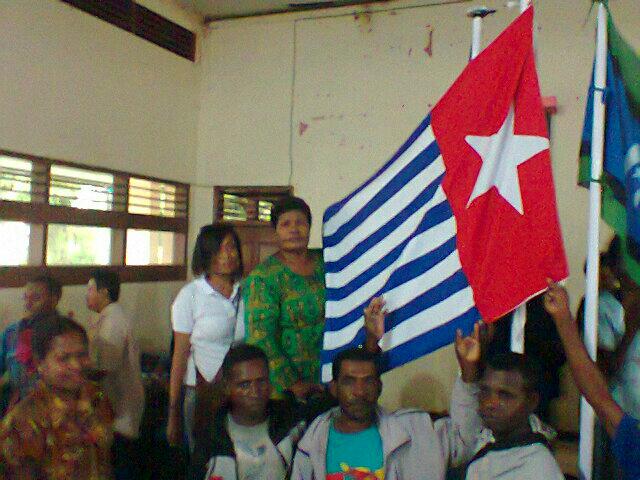
Activists raise the banned West Papuan Morning Star flag during the ceremony, prompting the arrests of the organisers under makar (treason) provisions Photo: West Papua Media sources)
Activists raise the banned West Papuan Morning Star flag together with the Aboriginal and Torres Strait Islands flags, during the Flotilla ceremony, prompting the arrests of the organisers under makar (treason) provisions Photo: West Papua Media sources)

textsecure-1571866598-1 “Amnesty International calls on the Indonesian authorities to respect the rights of Papuans to freedom of expression and peaceful assembly which are guaranteed in Article 19 and Article 21 of the International Covenant on Civil and Political Rights (ICCPR), to which Indonesia is a state party. Our organisation is concerned that the Indonesian government has consistently failed to make a distinction between violent armed groups and peaceful activists, and between peaceful expression of opinion and acts of physical violence, ” Benedict told West Papua Media by email.

textsecure-1857961604-1Activists on board the  Freedom Flotilla have reacted with dismay at the news of their supporters being targeted inside West Papua, but say this highlights the daily denial of Freedom of Expression for Papuan people, that originally motivated their plans for direct action.

sorong freedom flotilla congregation  2
The Maranatha Church in Sorong during the prayer service (Photo: NFRPB/WPM sources)

Ronny Kareni, the spokesperson for the Freedom Flotilla said “It is shocking and yet not surprising, but completely unacceptable in this day and age that peaceful demonstrations of basic freedom of expression is censored in such an extreme way. We demand the immediate release of the 4 prisoners in Sorong.”

Kareni explained, “The asorong freedom flotilla congregation  1rrests yesterday of the four Papuan leaders are a reflection of the reality that there is no space for democracy in Papua and West Papua Province under the Indonesian occupation, and yet foreign governments are complicit to these ongoing abuses. The Freedom Flotilla to West Papua is aiming to highlight this entrenched long-term brutality that is demonstrated by these arrests.

Arabunna elder, Uncle Kevin Buzzacott, the elder who inspired the journey, said in a statement to West Papua Media, “Indonesian government – you must immediately release those 4 prisoners and not to harm them in any way. They need to be released and not to be harmed because they have not committed a crime. We felt very sad when we seen it in the news today. We are waiting for the other mob to turn up here on Horne Island so we can work out how to respond a bit more but for now we need to ask all Australians to take a firm position on this issue, to be strong for Human Rights in West Papua. They are hurting them everyday, for years and regardless of the Freedom Flotilla this is happening, but we having a go, tryin’ to get the World to see, to look and listen and take a stand for these people. The Papuans have had it rough for too long with Indonesia there and this can’t keep going on. The prisoners must be released immediately”.

Izzy Brown, one of the organisers of the Freedom Flotilla said: “We are dismayed to hear that the peaceful act of prayer has resulted in such extreme actions by the police and military in West Papua, highlighting once more the lack of basic human rights and freedoms that we in Australia take for granted every day. We need immediate international pressure to be placed on the Indonesian government to ensure that no harm comes to these good people who have simply undertaken to express themselves in a democratic way.:

Kareni sums up the feeling of Flotilla members: “This is the time Australia, to stand up for people who are being militarily controlled and attacked for simply trying to have a voice.”

West Papua Media, with local sources

Create a website or blog at WordPress.com

Up ↑