An Agribusiness Attack in West Papua: Unravelling the Merauke Integrated Food and Energy Estate

PRESS RELEASE FROM awasMIFEE

April 25, 2012

Announcing the publication of a new report into a major land grab in West Papua:

“An Agribusiness Attack in West Papua: Unravelling the Merauke
Integrated Food and Energy Estate” is now online at:
http://awasmifee.potager.org
(direct pdf download: http://awasmifee.potager.org/uploads/2012/03/mifee_en.pdf )

AwasMIFEE

The Merauke Integrated Food and Energy Estate (MIFEE) is a vast mega-project, a plan for over a million hectares of plantations and industrialised agriculture that threatens the people and environment across the southern part of West Papua. Indonesian and foreign companies have each claimed their share of the land, and offer the local Malind people next-to-nothing in exchange for the forest that has sustained them for countless generations.

West Papua, where the MIFEE project is set to take place, is a conflict zone. The Papuan people have been struggling for decades for their freedom and self-determination. West Papua is also the next frontier for Indonesia’s plantations industry – after Sumatra and Borneo’s forests have been decimated for the pulp and oil-palm industries, now Papua becomes the target. Although some plantations already exist, MIFEE represents another order of magnitude, opening the floodgates to development projects across Papua in which the losers will be the Papuan people.

awasMIFEE! has been created as an act of solidarity with the social and ecological struggles of the people of Merauke and elsewhere in West Papua. We believe that it is important that people outside of West Papua also know what is happening in Merauke. However, information available about MIFEE can be confusing – much of it comes from different companies and government bodies, and each have their own way of describing the project that fits with their own interests and objectives.

By compiling information from different sources, such as reports from the villages affected, from NGOs and other groups, from Papuan, Indonesian and financial media, from local and national government, and from company websites, we have tried to unravel what MIFEE is likely to mean for the people of Merauke. We hope that a more coherent understanding of how this land grab is taking shape will be of interest to people who are interested in West Papua, in the defence of forests and forest peoples, in the struggles against agro-fuels and against the growth of industrialised agriculture.

Most of all we hope that this information can be the catalyst for action! Our initiative is independent, unconnected to the programs of any NGO, and we hope it can also be a source of inspiration.

The report “An Agribusiness Attack in West Papua : Unravelling the
Merauke Integrated Food and Energy Estate” is an attempt to give an
overview of the situation in April 2012. It focusses on the following areas:

  • Background information – to understand MIFEE in the context of West
  • Papua, it’s history and struggles, and the local Malind people.
  • What is MIFEE – how MIFEE presents itself as the answer to Indonesia’s food security needs. But is it actually just an excuse for oil palm and logging companies to conquer new territory? A look at the difference between the propaganda and the reality of development in Merauke.
  • Reports from villages: A summary of news of what has been happening on the ground around the MIFEE project area, compiled from reports of NGOs that have visited the area, local media and letters sent from villagers.
  • Company Profiles: Tracing where the money comes from behind each proposed plantation.
    • Which of Indonesia’s top business conglomerates are involved?
    • How South Korean companies have been buying up plantations.
    • How Australia’s top-selling sugar brand is connected to forest destruction in Papua.

News of further developments will be posted on the website, and from
time to time updates containing news of all recent developments will be published.

[awasMIFEE minta ma’af karena versi Bahasa Indonesia belum siap. Laporan masih dalam proses terjemahan. Semoga dalam waktu dekat kami akan menerbit versi Bahasa Indonesia]

AMNESTY INTERNATIONAL: PRISONER’S MEDICAL TREATMENT PREVENTED

PRESS RELEASE
http://www.amnesty.org/en/library/info/ASA21/017/2012/en
UA: 109/12 Index: ASA 21/017/2012  Indonesia        
Date: 19 April 2012
AMNESTY INTERNATIONAL
URGENT ACTION
PRISONER’S MEDICAL TREATMENT PREVENTED
Indonesian prisoner of conscience Filep Karma is in urgent need of medical treatment. He needs to travel to receive this treatment, but the prison authorities have refused to pay for his transport and medical costs.Filep Karma is serving a 15-year sentence at the Abepura prison in Papua province for raising a banned regional flag. Doctors at the Dok Dua hospital in nearby Jayapura conducted a medical examination last month and suspect a tumour of the colon. They have confirmed that he requires a colonoscopy and follow-up treatment. However the necessary equipment is not available in Papua province and they have referred him to the Cikini hospital in the capital, Jakarta. The Abepura prison authorities have given permission for Filep Karma to travel to Jakarta, but they have refused to cover the cost of his medical treatment and travel. By law, all medical costs for treatment of a prisoner at a hospital must be borne by the state (Regulation No. 32/1999 on Terms and Procedures on the Implementation of Prisoners’ Rights in Prisons).

Filep Karma has suffered a number of medical problems in detention, including bronchopneumonia, excess fluid in the lungs and a urinary tract infection. In July 2010 he was sent to a hospital in Jakarta for prostate surgery and other care. In November 2011 he was transferred to the Dok Dua hospital in Papua for an operation after he experienced bleeding haemorrhoids, chronic diarrhoea and blood in his stool. He has continued to pass blood in his stool since the operation. Filep Karma is also undergoing physiotherapy for an injury to his hip bone from a fall he suffered in detention in 2006.

Please write immediately in English, Indonesian or your own language:
– Urging the authorities to ensure that Filep Karma receives full and immediate access to any medical treatment he may require;
– Urging them to cover the cost of such treatment in accordance with the UN Body of Principles for the Protection of All Persons under Any Form of Detention or Imprisonment (Principle 24) and Indonesian regulations;
– Calling on them to release Filep Karma, and all others prisoners of conscience in Indonesia, immediately and unconditionally;
– Urging them to ensure that prison conditions and the treatment of prisoners meet standards provided for in Indonesian law as well as UN Standard Minimum Rules on the Treatment of Prisoners.

PLEASE SEND APPEALS BEFORE 31 MAY 2012 TO:
Head of Abepura Prison
Liberty Sitinjak
Lembaga Pemasyarakatan (Lapas) Abepura
Jl. Kesehatan 11, Jayapura
Papua 99351, Indonesia
Fax: +62 984 24721
Salutation: Dear Liberty Sitinjak

Head of Papuan Provincial Department of Justice and Human Rights
Daniel Biantong
Jl. Raya Abepura No. 37,
Kotaraja – Jayapura 99117,
Papua, Indonesia
Fax: +62 967 586112
Salutation: Dear Daniel Biantong

And copies to:
Director General of Prisons
Drs. Untung Sugiyono
Ministry of Justice and Human Rights
Jl. Veteran No. 11
Jakarta Pusat
Indonesia
Fax: +62 21 3483 2101
       

Additional Information

Filep Karma was arrested on 1 December 2004 after taking part in a peaceful ceremony in Abepura, Papua province. He was among approximately 200 people who took part in the ceremony during which the banned “Morning Star” flag, a symbol of Papuan independence, was raised. He was charged with “rebellion” (makar) under Articles 106 and 110 of the Indonesian Criminal Code, and sentenced to 15 years’ imprisonment on 26 May 2005. His sentence was upheld by the Supreme Court on 27 October 2005. Amnesty International considers him to be a prisoner of conscience.

In November 2011 the UN Working Group on Arbitrary Detention (WGAD) declared Filep Karma’s detention to be arbitrary on the grounds that he was imprisoned for the exercise of his rights to freedom of expression and peaceful assembly – Opinion No. 48/2011 (Indonesia). These rights are guaranteed in the International Covenant on Civil and Political Rights (ICCPR), to which Indonesia is a state party, and in the Indonesian Constitution. The WGAD also found Filep Karma’s detention to be arbitrary because he had been subjected to an unfair trial. Article 14 of the ICCPR guarantees the right to a fair and public hearing by a competent, independent and impartial tribunal established by law.

The Indonesian authorities have an obligation under national law and standards to provide medical treatment to all prisoners in the country. Article 17 of the Indonesian Government Regulation No. 32/1999 on Terms and Procedures on the Implementation of Prisoners’ Rights in Prison requires the prison authorities to provide adequate access to medical treatment. International standards also provide for medical treatment for prisoners. The UN Standard Minimum Rules for the Treatment of Prisoners provides that prisoners needing treatment not available in the prison hospital, clinic or infirmary should be transferred to an appropriate institution outside the prison for assessment and treatment. Principle 24 of the UN Body of Principles for the Protection of All Persons under Any Form of Detention or Imprisonment requires that prison authorities cover the costs of such treatment.

In view of the potentially serious nature of Filep Karma’s medical problem, Amnesty International believes the authorities’ refusal to arrange prompt and appropriate examination and medical care for him could amount to cruel, inhuman or degrading treatment.

UA: 109/12 Index: ASA 21/017/2012 Issue Date: 19 April 2012


TAPOL letter to David Cameron

13 April, 2012


Rt Hon David Cameron, MP.

Prime Minister,

10 Downing Street

London SW1


Dear Mr Cameron,

TAPOL has been closely following your visit to Indonesia this week. We note that you praised Indonesia as a ‘Democracy (which) offers hope to the Muslim World’. You were also quoted as saying that you had decided ‘to relax controls of arms exports to Indonesia … as a sign of Indonesia’s democratic maturity’. Your delegation to Indonesia included representatives from several British arms manufacturers.


I would remind you that two years ago in an article on West Papua in The Daily Telegraph you were quoted as describing ‘the plight of the tribespeople as a terrible situation’. This is a valid description of what has been happening in the past few years.  Bearing that in mind, we would reasonably have expected you to use the occasion of your visit to Indonesia to express concern about the situation in West Papua.


The sufferings of the Papuan people are to a great extent due to operations by the Indonesian military, TNI, which has been conducting ‘sweep operations’, including several now underway in the Central Highlands of West Papua. Whole communities have been attacked and homes destroyed, along with churches, traditional meeting centres and public buildings. Such assaults, purportedly aimed at eliminating the poorly-armed Papuan resistance, have forced villages to flee their homes in search of security in nearby forests where they are cut off from their livelihoods and face the possibility of starvation and disease.


Allow me to draw your attention to certain other recent incidents and developments. According to data collected by TAPOL, since 2008 at least 80 Papuans have been arrested and charged with  ‘treason’ or related offences simply for peaceful actions such as raising the Papuan  Morning Star Flag. They have been imprisoned for terms ranging from 10 months to six years.  Under Article 106 of Indonesia’s Criminal Code, anyone found guilty of treason can face a sentence of up to 20 years or life. Among those now incarcerated is Filep Karma, a civil servant, who was arrested in December 2004, convicted of treason and sentenced to fifteen years in jail.


In October 2011, the Third Papuan People’s Congress was held in Jayapura, attended by hundreds of people. The Congress proceeded peacefully for three days. However, as the participants were dispersing after the final session on 19 October, police and army troops rounded up hundreds of the participants. Without provocation, the troops opened fire and killed three people. The fact that no-one has been held accountable for the killings is indicative of the impunity enjoyed by security forces personnel.  By contrast, five Papuan leaders who were taken into custody following the Congress were put on trial, found guilty of treason and last month sentenced to three years in prison. This exemplifies the severe restrictions on the right to free expression experienced by the Papuan people.


We call upon you to acknowledge that such acts of repression and human rights violations against unarmed civilians should never occur in a democratic country.


We further call upon you to take account of all of these facts and urge you not to  allow the sale of military equipment to Indonesia to proceed.


We hope that your government will use its close relationship with the Indonesian government to urge it to end to the practice of charging peaceful Papuan demonstrators with treason and press the Indonesian Government to release all those now serving sentences for peaceful political activities.

Yours sincerely

Carmel Budiardjo


THE MOMENTUM BUILDS: Thousands shout out support for Free West Papua at East Coast Blues & Roots Festival

Press Release – Wednesday April 11, 2012
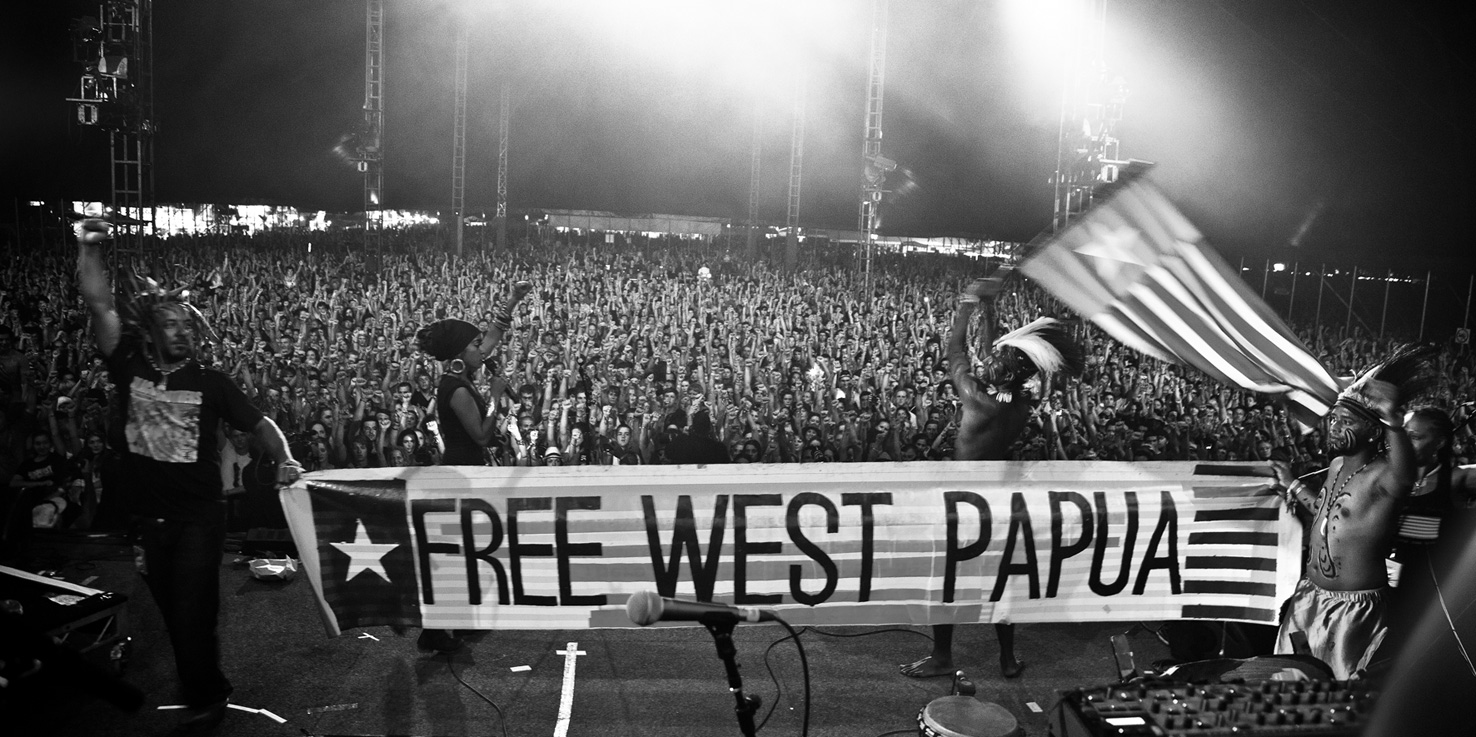
As momentum for the Free West Papua campaign continues to grow and gain attention throughout the international community, Australians continue to show mounting support for their fellow human beings and closest neighbours, West Papua. Another historic showing of undeniable support for human rights and justice in West Papua came at Blue King Brown‘s East Coast Blues and Roots Festival performance on Sunday 8th April, 2012 where thousands threw up their fists in a passionate display of solidarity and unanimity that the issues facing West Papua need to be promptly addressed by the Australian Government and the international community and that human rights is deserved to all people and we as nation have a responsibility to do whatever we can to ensure that is what’s happening.
It is through signing the petition and your sharing and reposting of images like this that we as a community can help expose the dark truths behind the oppression of West Papua and no longer allow these human rights abuses to be hidden in the darkness, our mutual knowledge on the issues is a light that has bravely begun to shine through, and it is only with your support that we will continue to see that light shine brighter and eventually, the unhindered Rize of The Morning Star for a FREE WEST PAPUA.

Two Papuan tapols with paralysis are waiting for permission to get treatment

JUBI,
30 March 2012

Two Papuan political prisoners who are being held in Biak Prison say that they are  waiting for permission to go to Jayapura for medical treatment.They are both suffering serious medical conditions.

Jefrai Murib said that he and his colleague Apot Lokobal are waiting for information from their lawyers and from the Department of Law and Human Rights  about their transfer to Jayapura for treatment. One of their lawyers, Lativa Anum Siregar told them they would have to wait until after the case of Forkorus and his colleagues has been completed.

[Note: Forkorus and his four co-defendants were sentenced to three years on 16 March 2012. Their lawyers have just announced that the five men are due to lodge an appeal against the sentence on 2 April. No date has yet been set for when the appeal will be heard which is likely to be weeks ahead. This means that these two suffering  tapols are likely to have to wait for at least several weeks if not months before getting the medical attention which they urgently need. According to another of their lawyers,  Olga Hamadi,  they will appeal against the sentence and call for the release of the five prisoners. They will argue that the court failed to prove that the five men were guilty of makar (treason). – Tapol]

As has previously been reported, lawyers at the Forkorus trial  said that none of the witnesses heard in the trial had given testimony about the alleged role they were said to have played; according to KUHAP, the Criminal Procedural Code Article 110 they should be proven to have been involved in a conspiracy.

Furthermore, 69 items of evidence were mentioned at the Forkorus trial, of which only one was presented during the trial, namely a banner.

Forkorus and his four co-defendants are now serving their sentences in Abepura Prison.TAPOL]

Jefrai Murib, one of the ailing tapols said they will have to wait till after the  Forkorus trial has been completed as well as after another of their colleagues, Kimanus has been treated for another ailment.

Jefrai Murib said the right side of his body is completely paralysed because of a stroke. ‘My right hand is also paralysed. Just going to the toilet is very difficult indeed for me..’

His colleague Apot Lokobal  said that he too is waiting for a permit to get medical treatment in Jayapura. He said that his condition is not as bad as that of his colleague Jefrai who is much more seriously ill. He is suffering from the same condition as Jefrai, with the right of his body paralysed.

The two men were arrested and sentenced for their involvement in an assault on an ammunitions dump of Kodim 1702, Wamena. Another twelve tapols were also tried and sentenced in connection with the same incident.

[Abridged in translation by TAPOL]

Create a website or blog at WordPress.com

Up ↑