Shocking video confirms Indonesia’s brutal suppression of West Papuan rally ahead of US visit

16 November

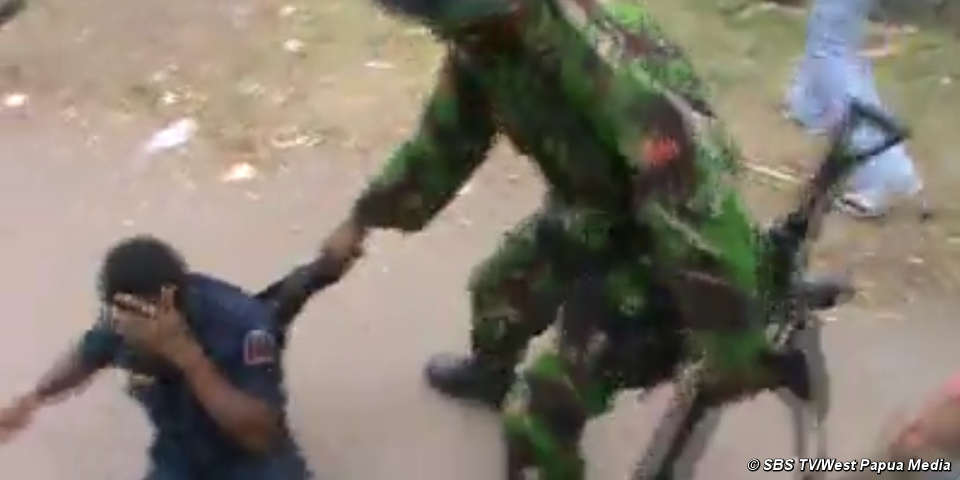
The shocking footage shows Indonesian soldiers beating West Papuans
© SBS TV/West Papua Media

Alarming video of Indonesian forces shooting, beating and kicking civilians at a peaceful rally in West Papua has emerged ahead of a US visit to the region.

Ten people are believed to have died when Indonesian security forces broke up the rally of independence activists last month.

Watch footage of the attacks (©SBS TV/West Papua Media,WARNING: DISTURBING CONTENT):

Indonesia’s brutal attack on West Papuan rally
Shocking scenes of Indonesia’s brutal suppression of a West Papuan rally on October 19 2011©SBS TV/West Papua Media

The video comes ahead of a visit to Bali by the US President and Secretary of State, for a regional summit. The US has applauded its ‘new partnership’ with Indonesia, but only last week Hillary Clinton criticized its human rights abuses.

The disturbing footage was smuggled out of West Papua exactly one year after scenes of Indonesian soldiers torturing Papuan mencaused worldwide revulsion.

These latest clips allegedly show a local police commander giving the order to break up the rally on the outskirts of Jayapura – and the brutal and unprovoked violence that ensued.
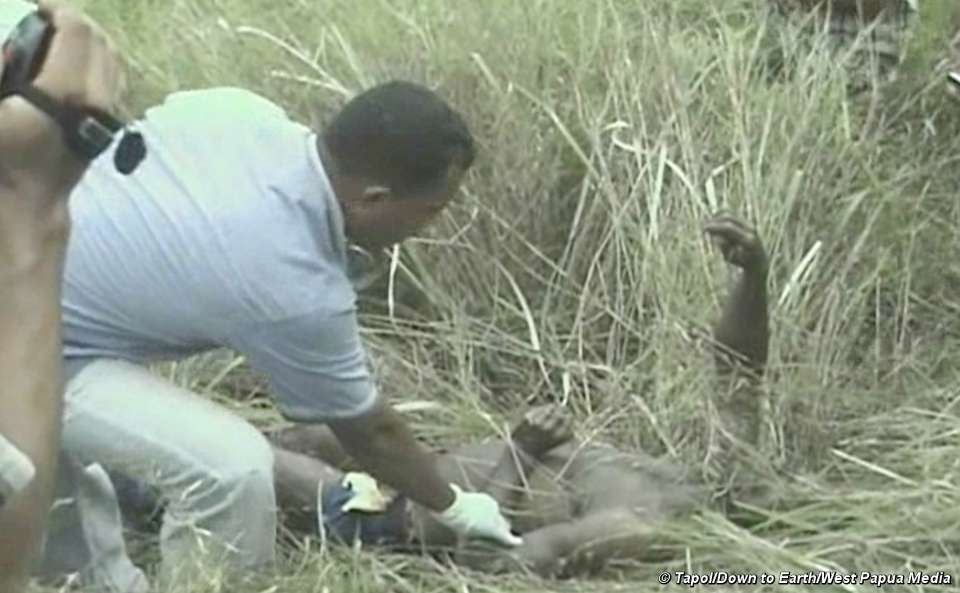
Victim is found after Indonesia's violent crackdown on West Papuan Congress
Victim is found after Indonesia’s violent crackdown on West Papuan Congress
© Tapol/Down to Earth/West Papua Media

Indonesian security forces, many in plain clothes and wearing crash helmets, are seen randomly firing their weapons and arresting scores of people, many of whom are punched, kicked, beaten or forced to crawl along the ground.

Reverend Benny Giay from West Papua says violence has escalated since the Congress was dispersed. ‘I think maybe this is the Indonesian military and police’s response to the international pressure.  The response is that they are being sent to Papua to kill, terrorize and abduct Papuans, but please do keep on the international pressure. Please tell people what is happening here for the sake of our future, our lives, our culture, our identity and our very existence.’

West Papua has been ruled by Indonesia since 1963, and more than 100,000 civilians are believed to have been killed during its occupation.

Survival’s Director Stephen Corry said today, ‘Indonesia’s brutal occupation of West Papua is a catalogue of some of the worst human rights abuses and violations of tribal peoples in recent times. Hillary Clinton should use her visit to the country to highlight the horrific violence that Indonesia is wreaking on all those who dare to oppose its rule.’

Note to Editors:

A Survival campaigner who has been to West Papua is available for interview.

More clips are available for download from West Papua Media

Open Letter to President Obama from West Papua Advocacy Team (WPAT) and East Timor and Indonesia Action Network (ETAN)


Contact: John M. Miller, +1-718-596-7668; mobile: +1-917-690-4391, john@etan.org

Ed McWilliams, +1-575-648-2078, edmcw@msn.com

President Barack Obama
1600 Pennsylvania Ave. NW
Washington, DC 20500

November 15, 2011

Dear President Obama,

We urge you to seize the opportunity of your imminent return to Indonesia to consider the challenges and opportunities posed by the U.S.-Indonesia relationship more realistically than you have up to now.  Your Administration urgently needs a policy that addresses the problems created by the Indonesian security forces’ escalating violations of human rights and criminality and its failure to submit to civilian control. The recent 20th anniversary of the 1991 Santa Cruz massacre in Dili. East Timor (Timor-Leste), when hundreds of peaceful protesters were massacred by Indonesian troops wielding U.S. supplied weapons, reminds us that a lack of accountability for past crimes — in Timor-Leste and throughout the archipelago — keeps those affected from moving on with their lives, while contributing to impunity in the present.

Indonesian military and police forces continue to operate without any accountability before the law. Only in rare instances are individual personnel brought before military tribunals for crimes against civilians, often because of international pressure. Prosecution is woefully inadequate and sentencing, in the rare instance of conviction, is not commensurate with the crime.

Indonesia’s security forces, including the Kopassus special forces and U.S.-funded and -trained Detachment (Densus) 88, continue to employ against civilians weaponry supplied by the U.S. and to use tactics developed as result of U.S. training. In West Papua, these security forces have repeatedly attacked civilians, most recently participants in the October 16-19 Congress and striking workers at theFreeport McMoRan mine. Those assaulted were peacefully asserting their right to assemble and freedom of speech. At the Congress, combined forces, including regular military units, Kopassus, the militarized police (Brimob) and Detachment 88, killed at least five civilians, beat scores more, and were responsible for the disappearance of others.

Moreover, in the central highlands of West Papua, these same forces regularly conduct so called “sweeping operations,” purportedly in search of the very small armed Papuan resistance. These operations have led to the deaths of many innocent civilians and driven thousands from their village into forests where they face life threatening conditions due to inadequate access to shelter, food and medical care.

Indonesian military and police forces continue to operate without any accountability before the law. Only in rare instances are individual personnel brought before military tribunals for crimes against civilians, often because of international pressure. Prosecution is woefully inadequate and sentencing, in the rare instance of conviction, is not commensurate with the crime. Several videoed incidents of military torture of civilians — widely discussed during your November 2010 visit to Indonesia — concluded in just such failures of justice. The concept of command responsibility is rarely considered in the military tribunals.

International monitoring of these developments in West Papua is severely hampered by Indonesian government restrictions on access to and travel within West Papua by foreign journalists, diplomats, researchers, and human rights and humanitarian officials. The International Committee of the Red Cross remains barred from operating an office in West Papua. Indonesian journalists and human rights officials face threats and worse when they try to monitor developments there.

Elsewhere in Indonesia, too many times security forces have stood by or actively assisted in attacks on minority religions, including deadly attacks on Ahmadiyah followers.

The Indonesian security forces — especially the military — are largely unreformed: it has failed to fully divest itself of its business empire, its remains unaccountable before the law, and continues to violate human rights. These forces constitute a grave threat to the continued development of Indonesian democracy. The upcoming national elections in Indonesia present a particularly urgent challenge. The Indonesian military is in position to pervert the democratic process as it has in the past. The military has frequently provoked violence at politically sensitive times, such as in 1998 when it kidnapped tortured and murdered democratic activists.  For many years it has relied on its unit commanders, active at the District, sub-District and even village level to influence the selection of party candidates and the elections themselves. The territorial command system is still in place.
In the past, U.S. restrictions and conditions on security assistance have resulted in real rights improvements in Indonesia. Your Administration should learn from this history.

Given this threat to democracy and to individuals posed by Indonesian forces, it is essential that the U.S. employ the significant leverage that comes from Indonesia’s desire for U.S. security assistance and training to insist on real reforms of Indonesian security forces. Rhetorical calls for reforms are clearly insufficient. These exhortations have manifestly not worked and readily brushed aside. Secretary of State Hillary Rodham Clinton’s recent expression of “concerns about the violence and the abuse of human rights” in Papua were dismissed by a spokesperson for Indonesia’s President Susilo Bambang Yudhoyono , who called the escalating rights violations “only isolated incidents.”

In the past, U.S. restrictions and conditions on security assistance have resulted in real rights improvements in Indonesia. Your Administration should learn from this history and quickly suspend training for those units whose human rights records and impunity are especially egregious, as required by the Leahy law. We specifically urge you to end plans to re-engage with Kopassus and to end assistance to Detachment 88. These actions would demonstrate U.S. Government seriousness in pursuit of real reforms of the security forces in Indonesia.

Sincerely,

Ed McWilliams for WPAT

John M. Miller for ETAN

see also


AI – Government must act on Komnas HAM’s findings of human rights violations at Papuan Congress

AMNESTY INTERNATIONAL  PUBLIC STATEMENT

8 November 2011

The Indonesian government must immediately act on the Indonesian National Human Rights Commission’s (Komnas HAM) findings that human rights violations were committed by Indonesian security forces at the Third Papuan Peoples’ Congress on 19 October 2011.

The Komnas HAM investigation team found a range of human rights violations allegedly committed by the Indonesian security forces, including opening fire on participants of the peaceful gathering and beating and kicking them. The Commission, which made its findings public on 4 November 2011, has called on the Indonesian National Police chief to investigate these human rights violations.

It was reported on 7 November that the President’s office had rejected the findings of Komnas HAM, stating that the police were still handling the case.

The Indonesian authorities must initiate an independent, thorough and effective investigation into the Commission’s findings. If the investigations find that the security forces committed unlawful killings or torture or other ill-treatment, then those responsible, including persons with command responsibility, must be prosecuted in proceedings which meet international standards of fairness, and victims provided with reparations.

The failure to bring perpetrators of these violations to justice in fair trials will reinforce the perception that the security forces in Papua operate above the law and fuel the ongoing climate of mistrust towards the security forces there.

On the afternoon of 19 October 2011, police and military units violently dispersed participants of the Third Papuan People’s Congress, a peaceful gathering held in Abepura, Papua province. The bodies of Demianus Daniel, Yakobus Samonsabara, and Max Asa Yeuw were found near the Congress area. An estimated 300 participants were arbitrarily arrested at the end of the Congress. Most were released the following day but six have been charged. Five people were charged for “rebellion” and “incitement” under Articles 106, 110 and 160 of the Criminal Code, while one was charged for “possession of weapons” under Emergency Law No. 12/1951.

According to Komnas HAM, the three people who were found dead had gunshot wounds on their bodies. The Commission was not able to confirm whether they were killed by the police or military, and have called for police forensics investigators to examine the bullets. Komnas HAM also found that at least 96 participants had been shot, kicked or beaten by police officers.

Komnas HAM further reported that security forces had raided a Catholic monastery and seminary. They shot at the building and broke the windows when the monks refused to hand over alleged separatists to the police. Many Papuans are now afraid to leave their homes because of the continued security checks and raids. The Commission also raised concerns that security forces had confiscated mobile phones, laptop computers, printers, cameras, cars, motorcycles and millions of rupiah in cash, and called for these items to be returned to the owners.

The Commission stated, contrary to statements by the Indonesian authorities that the Congress was illegal, that the Indonesian Minister of Law, Politics and Security had in fact directed the Director General of Regional Autonomy at the Home Affairs Ministry, to attend the Congress and give the opening speech.

The Commission made a series of recommendations including calling on President Susilo Bambang Yudhoyono to accelerate the dialogue with the Papuan people and to evaluate the deployment of a large security presence in the area.

The Komnas HAM investigation indicates that security forces appear to have violated the rights to life and to freedom from torture and other ill-treatment, both of which are non-derogable under the International Covenant for Civil and Political Rights (ICCPR), to which Indonesia is a state party.

By using unnecessary and excessive force and firearms against the participants, the Indonesian security forces have also violated the Convention against Torture and Other Cruel, Inhuman or Degrading Treatment or Punishment, which Indonesia has also ratified. Moreover, the right of all people in Indonesia to be free from torture and other ill-treatment is guaranteed in the Indonesian Constitution and the 1999 Law on Human Rights.

The actions of the security forces also appear to contravene the UN Basic Principles on the Use of Force and Firearms by Law Enforcement Officials which provide, among other things, that force should be used only as a last resort, in proportion to the threat posed, and should be designed to minimize damage or injury.

New Report Reveals Extent of Papua Human Rights Violations

Press Release from Tapol, Franciscans International, Asian Human Rights Commission and Faith Based Network on West Papua (FBN)


NGOs meet in Geneva to address their concerns on the situation of Human Rights in Papua

Geneva, 3 November 2011

 Following last month’s violent dispersal by Indonesian security forces of the Third Papuan Peoples’ Congress in Jayapura, Indonesia has been confronted with the full scale of human rights problems in Papua by the new Report ‘Human Rights in Papua 2010/2011’.[1] This was launched yesterday in Geneva, by the Faith Based Network on West Papua (FBN), Franciscans International (FI), and the Asian Human Rights Commission (AHRC).

The Report portrays the bleak reality of the abuse of civil and political rights, as well as economic, social and cultural rights in Papua in 2010 and 2011. The aim of the Report is to raise awareness of the human rights situation in Papua and to create in Papua a ‘land of peace’.

More specifically, the Report draws attention to the hardship faced by national and international civil society as well as by local human rights defenders who are too often victims of intimidation, harassment and arbitrary detention on the charge of makar (treason) while exercising their right to freedom of expression in their struggle for justice and accountability. The Report further denounces the policy of the Government of Indonesia aimed at discrediting, limiting and jeopardizing the work of international human rights organizations working in Papua, including denied access to international media through the manipulation of bureaucracy. As a result, certain international organizations are directly or indirectly forced to withdraw from the country, as was the case of the International Committee for the Red Cross (ICRC) and Peace Brigades International (PBI).

With a view to presenting the Report and raising awareness on the recent tragic events, Franciscans International organised a round table discussion. This was attended by representatives of the Faith Based Network on West Papua, Geneva for Human Rights, Human Rights Watch, Papua Peace Network (JDP -Jaringan Damai Papua), Special Rapporteur on the situation of human rights defenders TAPOL, World Organization Against Torture (OMCT), and the Permanent Mission of the Republic of Indonesia to the United Nations.

In response to the numerous issues and concerns raised during the discussion, the representative of the Permanent Mission of Indonesia made an official statement asserting that “human rights protection is a national priority”. Despite the appreciation for the participation of the Permanent Mission of Indonesia, this statement was visibly met with strong disagreement by NGOs. They attested that “Political statements are not enough to address human rights violations in Papua, since – the reality is -a climate of fear prevails in Papua”.

The NGOs present concluded by calling upon the Government of Indonesia to: Immediately release all political prisoners; Immediately cease intimidation, harassment and physical violence against human rights defenders, journalists, and religious leaders in Papua; to criminalise torture and ratify the Optional Protocol to the Convention against Torture; ratify the International Convention on Enforced Disappearances; and to Start a genuine dialogue with national and international civil society.

For more information on the report Human Rights in Papua 2010/2011, please contact:

Kristina Neubaeur –Faith Based Network on West Papua, Coordinator

Francesca Restifo – Franciscans International, International Advocacy Director

Paul Barber – TAPOL, Coordinator: +44 7747 301 739; paul.barber@tapol.org

Wong Kai Shing – Asian Human Rights Commission, Executive Director

1] Available at http://tapol.gn.apc.org/press/files/Human-Rights-in-Papua_Report-2010-2011.pdf

NZ NGO statement on the violence around the Third Papuan People’s Congress in West Papua


Below is a statement from New Zealand human rights, development and peace organisations about the use excessive use of force and human rights violations perpetrated by Indonesian police and military personnel breaking up the Third Papuan People’s Congress in Jayapura, West Papua, on 19 October 2011.
 

The statement by Father Dr Neles Tebay, Rector of Fajar Timur School of Philosophy and Theology, and Father Gabriel Ngga OFM, Provincial of the Franciscan Order in Papua (referred to in the NZ NGO statement) which documents the associated violence against Catholic institutions is available at http://www.converge.org.nz/pma/wp-cath1011.pdfNGO statement on violence following Third Papuan People’s Congress in October 2011

3 November 2011

We the undersigned New Zealand human rights, development and peace organisations call for the Indonesian government to immediately investigate allegations of excessive force and human rights violations by police and military personnel in breaking up the Third Papuan People’s congress on 19 October 2011 in Jayapura, Papua.

We also deplore the entry by military forces – without permission or prior notice –  into the nearby Yerusalem Baru seminary and Fajar Timur School of Philosophy and Theology and associated facilities within the Catholic mission compound in the area.

We call for an immediate dialogue between the Government of Indonesia and Papuan leaders to prevent further instances of unnecessary violence; and to address the issues that underpin conflict in Papua.

***

At least six deaths have been reported and hundreds of people were initially detained when security forces moved in with guns and violence to disperse several thousand unarmed people who had gathered peacefully for the congress on 17-19 October.  Video and documented evidence shows that police and military officers used pistols, canes and batons to beat congress participants, and threatened them. Such actions are a violation of rights to freedom of expression, opinion and peaceful assembly guaranteed under both the International Covenant on Civil and Political Rights and the Indonesian Constitution.

A statement from the Rector of Fajar Timur School of Philosophy and Theology, Father Dr Neles Tebay, and the Provincial of the Franciscan Order in Papua, Father Gabriel Ngga OFM, documents the violence with which security forces entered Catholic mission buildings, and the fear and intimidation imposed on occupants and those who sought refuge there. Bullets shattered windows, items were damaged, teargas was used, and one Franciscan brother was so badly beaten that he was admitted to intensive care at the local hospital after being released from overnight detention.

We endorse the statement and measures called for by Fathers Tebay and Ngga, in particular, we:

  • Reject repressive means to deal with issues because such violent acts undermine the human dignity of both victims and perpetrators.
  • Affirm the right of religious and other organisations to provide asylum where necessary, based on the universal humanitarian principle that a person exposed to a life-threatening situation is to be given protection and sanctuary. (The protection provided by the religious brothers and staff was given for humanitarian not political reasons, as congress participants sought refuge from persecution and threats.)
  • Ask the Indonesian Human Rights Commission (KOMNAS HAM) to investigate the violent incidents post-congress to look at how such serious human rights abuses have occurred.
  • Support a peaceful dialogue between the Government of Indonesia and Papuan leaders to stop violence and prevent a recurrence of such acts in Papua. This is in line with the Indonesian government’s own commitment, as expressed by President Susilo Bambang Yudhoyono, to deal with Papua ‘with heart’.

·         Ask for all people of goodwill and justice to support the implementation of such dialogue. ‘Because only through dialogue, issues that underpin conflicts in Papua can be identified and proper solutions can also be found without resorting to violence and bloodshed’ say Fathers Tebay and Ngga.
We are deeply concerned about the situation in Papua and the underlying tensions that impede Papuans’ access to development. We urge all parties to take immediate steps to prevent violence and enter into dialogue to resolve the serious underlying tensions.

JOINT STATEMENT OF:

Michael Smith, Director, Caritas Aotearoa New Zealand
Maire Leadbeater, Spokesperson for the Indonesia Human Rights Committee
Edwina Hughes, Coordinator, Peace Movement Aotearoa
Pat Jackman, President, Women’s International League for Peace and Freedom Aotearoa
Judith Crimmins, President, Pax Christi Aotearoa New Zealand
Peter Hosking, Executive Director, Human Rights Foundation of Aotearoa New Zealand
Pauline McKay, National Director, Christian World Service
Leigh Cookson, Director, Arena (Action, Research and Education Network of Aotearoa). – http://www.facebook.com/notes/peace-movement-aotearoa/nz-ngo-statement-on-the-violence-around-the-third-papuan-peoples-congress-in-wes/256380261076017

Create a website or blog at WordPress.com

Up ↑
