Concerns of JPIC in Papua regarding the situation in Papua

(Reflections on the situation in 2011)

From 13 to 16 February 2012, the secretariats of the Justice, Peace and Integrity of Creation (JPIC) in Papua (Franciscans JPIC in Papua, JPIC Archdiocese of Merauke, JPIC Agats Diocese, JPIC of Timika Diocese and JPIC of Sorong Diocese) held an annual meeting in Sentani. The outcome of this meeting is summed up in the following reflections on the situation in Papua with some recommendations.

The secretariats of JPICs in Papua confirm that the pro-investment policy of the Government of Indonesia and the torture and cruel treatment by the security forces have undermined law and the dignity of the indigenous Papuans, marginalising and threatening their right to life.

Situation in Papua in 2011

The indigenous Papuans have suffered from different investment policies of the Government in Papua. We found that the development policies on investment have caused the Papuans to lose their customary lands, identity, culture, livelihood, and they threaten the right to life. They have also become the source of horizontal conflict, as shown in the MIEFFE programme in Merauke, the palm oil plantation of PT. Merdeka Plantation Indonesia, PT. Merdeka Tapare Timber, PT Freeport Indonesia in Mimika, PT. Sawita Tandan Papua and PTPN 2 in Kerom.

The indigenous Papuans live in fear. The security forces use violence, torture, cruel and inhuman treatment against the Papuans which they justify with claims that their victims are supporters of the Free Papua Movement (Organisasi Papua Merdeka – OPM), as shown in the case of violence and torture against civilians during the 3rd Papuan Congress, the case of Tingginambut, the armed conflict in Puncak Jaya and Paniai and the conflict during the regional elections.

The indigenous Papuans are confused by the attitude of the Provincial Government which is not critical but rather tends to support the policy of the Central Government, as demonstrated in the case of the adoption of the policy on the Special Unit for the Acceleration of Development for Papua and West Papua (UP4B). This situation has put the future of the indigenous Papuans at risk. They are confronted with the difficulty to fight for their basic rights. The Papuan People’s Assembly (Majelis Rakyat Papua – MRP) and the Provincial Legislative Assembly of Papua (Dewan Perwakilan Rakyat Papua – DPRP) have been made powerless. MRP and DPRP only execute the orders of the Central Government and do not defend the interest of the Papuans.

The composition of the indigenous and non-indigenous Papuans is not in balance. The population census of the Indonesian Statistical Bureau (BPS) shows that the population of indigenous Papuans in the Provinces of Papua and West Papua is 1.760.557 or 48.73% of the total population, while the non-indigenous population is 1.852.297 or 51.27% of the total population of 3.612.854. It shows that the indigenous Papuans are a minority group in their own land while four decades ago they were the majority (96.09%).

Recommendations:

1. The Government of Indonesia should stop all investment that harms the right to life and the livelihood of the Papuan and conduct an independent evaluation of the companies investing in Papua. The Government of Indonesia should foster community-based development policies.

2. The Indonesian Military and the Indonesian Police should resolve the problems in Papua without using violence and they should bring to justice all perpetrators of the conflict in the area of PT. Freeport Indonesia.

3. In dealing with political demonstrations in Papua, the Government of Indonesia and the Police/Military should respect the right to freedom of expression of the Papuan people.

4. The Papuan People’s Assembly and the Provincial Legislative Assembly of Papua should genuinely represent the aspirations of the Papuans especially in addressing the issues that are causing the Papuans to become a minority in their own land.

These are our reflections and recommendations based on our wish to improve the future of Papua and to respect the human rights of the indigenous Papuans.

Abepura, 16 February 2012

P. Emanuel Tenau, Pr (Director of JPIC Diocese of Sorong) Br. Edy M. Rosaryanto, OFM (Director of Franciscans JPIC Papua). Ms. Veronika Tri Kanem (Program Manager of JPIC Merauke Archdiocese) Fr. Saul Wanimbo, Pr (Director of JPIC Timika Diocese) Fr. Hendrik Hada, Pr (Director of Agats Diocese)

From the trial of Forkorus and his colleagues

(From Tapol, and local sources in Jayapura)
Events surrounding the trial of

  • Forkorus Yaboisembut, President of the Federal Republic of West Papua,
  • Edison Waromi, SH, Prime Minister of the Federal Republic of West Papua,
  • Agustinus Kraar, human rights acctivist,
  • Dominikus Surabut, human rihts activist,
  • Selpius Bobii, human rights activist.

[This hearing was held to hear the response of the prosecutor’s team to the demurrer from the legal team of the defendants.

Friday, 10 February, 2012

The names of the twenty members of the legal team assisting the men on trial were listed.

At 6am, heavily armed members of the security forces took up their  positions in front of the Public Prosecutor’s office.

At 7am,  visitors and members of the legal team started arriving at the courthouse. Each visitor was required to register his/her name, while showing their identity card. Following this, each of the visitors was investigated.  Journalists and members of the legal team were also investigated. Some members of the legal team as well as some of the journalists attending the trial protested, but the protests were ignored and the investigations continued.

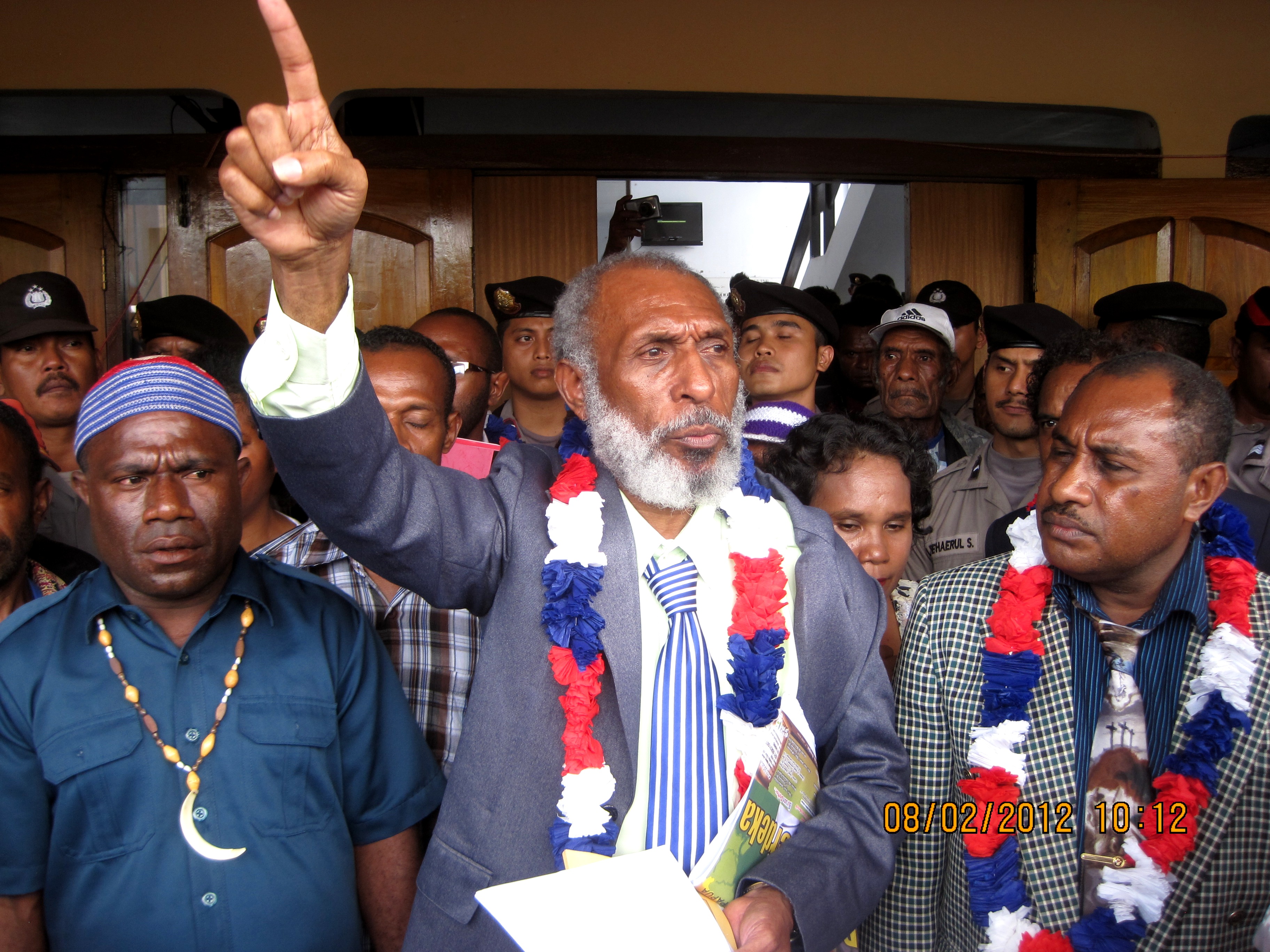
At 8.45am, Forkorus and his colleagues arrived. When the door of the truck in which they were travelling was  opened, security forces nearby approached the truck and pulled the doors.opne just like what happens when a bus stops. Seeing this, Forkorus and his colleagues protested and shouted: ‘You policemen, dont you dare touch us, dont approach us. Get back, all of you, right back. This country belongs to us,we are not criminals. Get back, the lot of you!’


The security forces paid no attention to this and continued to move closer to the truck, then started pulling down Forkorus and his colleagues from the truckLocal human rights activists, including Mama Josepha Alomang, started complaining to the security forces and called on the chief of police there to order his men to move away. As some of the police fell back, Forkorus and the others began to get down from the truck. As they were getting down, the visitors began to sing  hymns and to say prayers in front of the entrance to the courthouse.

The hearing of the trial began at 9am. The presiding judge asked the men whether they were in good health, but none of the five men made any response. The judge repeated his question three times, but the men still remained silent. On seeing this, the judge remained silent for a while, then asked the prosecutor to read out his response to the demurrer, in which he insisted that the charges against the men were in accord with Article 106 of the Indonesian Criminal Code, whereupon the chief prosecutor asked the judge to continue with the trial.  After this, the judge announced that the following hearing would take place on 14 February, to hear the reaction of the panel of judges to the demurrer.

Before the hearing drew to a close, Gustaf Kawar, a member of the legal team, protested against the investigations that had been undertaken by the police  of the persons attending the trial as visitors. He asked: ‘Is this an open trial or is it closed to the public? If it is an open trial, visitors should not be investigated and there should not be such heavy guarding round the courthouse.

The presiding judge said that this was in accorded with the proceedings required by the security forces, over which they have no control.

After the hearing closed, Forkorus and his colleagues  held a press conference  at which they protested against the charge of treason (makar) and protested against the heavy-handed guarding around the courthouse, the many arrests that continue to be made [in Papua], the many people in prison and the shooting incidents against  Papuan people.

As this was going on, some of those outside the courthouse unfurled banners saying PAPUA MERDEKA!. INDEPENDENT PAPUA!, shouted this slogan and handed out copies  of a press release. Many of those who were hoping to attend the hearing were unable to do so because it was raining very heavily.

Statement of the leaders of Churches in Papua to the Indonesian President – unofficial translation

The Alliance of Churches in Papua

(PERSEKUTUAN GEREJA-GEREJA DI TANAH PAPUA)

Sekretariat : Jln. PLN 07 Sentani, Kabupaten Jayapura, Papua; Telp: 0967591291; 0811489578


Statement on the solution to the problems in Papua

We wish you a Happy New Year 2012

(NON OFFICIAL TRANSLATION)

First  of all, we, the leaders of Churches in Papua would like to express our sincere thanks to the President of the Republic of Indonesia, Dr. H. Susilo Bambang Yudhoyono, who invites and welcomes us to this meeting.

Shalom,

We have heard the commitment of the Central Government under the your leadership to find a peaceful solution to the problems in Papua through an open dialogue with the People of Papua.  In his State Address on 16 August 2011, the Indonesian President reaffirmed that, “to reorganise Papua with heart, is a key for all efforts to have successful development.” On 9 November 2012, the Indonesian President reaffirmed again that, “A dialogue between the central government and our brothers in Papua is open. We need to dialogue, an open dialogue to find solutions and options, to find the best way to solve the problems in Papua”.

Based on the commitment of the Central Government to dialogue with the Papuan, let us, the leaders of Churches in Papua, to convey our statement concerning the solution to the problems in Papua as following:

First, the leaders of Churches in Papua support the initiative of the Central Government to find a solution and the best way to address the problems in Papua through an open dialogue with the Papuan;

Second, the leaders of Churches in Papua are ready to work together with individuals and groups as well as institutions that support a dialogue between the Central Government and Papuan as a way to solve the problems in Papua;

Finally, we appreciate the initiative of President Susilo Bambang Yudhoyono to receive and meet the leaders of Churches in Papua, on December 16th, 2011 and today, February 1st, 2012. We do not consider these two meetings as a dialogue between the Papuan and Central Government. Instead, we, the leaders of Churchesin Papua, understand these two meetings as a moral responsibility of the leaders of Churches and the leaders of the Government of Indonesian in their efforts to prepare a dialogue with honesty and dignity between the Central Government and the Papuan. We pray that the dialogue between the Central Government and the Papuan, through facilitation from a neutral third party and trusted by both parties, can take place in 2012. In this way, we may call year 2012 as the Year of Dialogue with Papua.

These are our prayers and wishes, the leaders of Churches in Papua.

Jayapura, January 30th  2012

Sincerely,

On behalf of the leaders of Churches in Papua

LP3BH: Military Intelligence Operations are still underway in Papua

Statement by Yan Christian Warinussy, Executive-Director of LP3BH,  Papua[Translated by TAPOL]

The appointment and deployment of Major-General Mohammad Erwin Syafitri (former deputy chief of BAIS, Indonesia’s joint strategic intelligence  agency) as commander of KODAM XVII Cenderawasih Papua is clear proof that the Land of Papua is still an area of operations of Indonesian military intelligence.

As a result, the top leadership of the military territorial command in this region has been placed under the command of a leader who has a background in intelligence or at the very least a history of involvement in Indonesia’s intelligence agency.

This is important in order to protect the collaboration between military activities or security and intelligence which acts as the front line for gathering information and deploying security forces in the area.

It is important to point out that in the opinion of human rights activists in Papua, the Land of Papua is still isolated from the international community, bearing in mind that access to the area has been made difficult for several humanitarian and human rights institutions such as the International Committee of the Red Cross and Peace Brigades International, as a result of which they have closed their offices in Papua and left Indonesia in November last year.

The same goes too with regard to the presence of international observers as well as foreign journalists. And for the past five years, it has been difficult for foreign diplomats based in Jakarta to gain access to Papua. This situation  has come about because of the powerful influence of the Indonesian army – TNI – and the Indonesian police, so as to make it more difficult for international observation of developments with regard to the rule of law and basic human rights in the Land of Papua.

As a human rights defender in the Land of Papua, I see a close connection with  the upsurge in demands being made by the Papuan people  to the Indonesian government to find a solution to a number of problems by means of a Papua-Indonesia dialogue, as an important theme which is continually being confronted by certain elements, such as the TNI and the Indonesian police, both of whom have their own vested interests in the Land of Papua.

Bearing in mind that President Susilo Bambang Yudhoyono stated on 9 November 2011 that he is ready to enter into dialogue with all forces in the Land of Papua, I have not yet seen  any response to this from TNI or from the Indonesian police, to indicate whether they agree with this or indeed whether they support the wishes of the President.

Although in this connection, the military commander and the chief of police of Papua said in their presentations to the Papuan Peace Conference on 5-7 July 2011 that they too support dialogue as the way to solve the conflict in the Land of Papua.

I believe that the Indonesian army and police must clearly reveal their attitude towards the question of dialogue.which is what the vast majority of Papuans support, along with their non-Papuan brothers here in Papua. Even the central government in Jakarta is supporting this, which is clear from the fact that President SBY  has appointed Deputy President Boediono to take the lead in efforts to prepare the way for this Papua-Indonesia dialogue.

The idea of dialogue has moreover won positive support from a number of countries around the world, including the USA, Australia, Germany, the UK and the European Union, all of whom are close allies of Indonesia and support the territorial integrity  of the Republic of Indonesia.

6 February 2012

Lawyers urge Australian Government to speak out over Papuan treason trials

Media Release

Human Rights Law Centre and

International Lawyers for West Papua

1 February 2012

The Australian Government’s silence on human rights abuses in the region has once again been put in the spotlight, with the Human Rights Law Centre (HRLC) and International Lawyers for West Papua (ILWP) urging the Foreign Minister to speak up in defence of basic rights such as freedom of expression and assembly.

Criminal trials have commenced this week in Jayapura, against five Papuan political activists charged with criminal offenses following their involvement in last year’s peaceful assembly at the Third Papuan People’s Congress. The activists were among the hundreds of people arrested after Indonesian police and military forcibly shut down the gathering, killing at least three people and injuring approximately 90 others.

HRLC spokesperson, Tom Clarke, said the fundamental rights of all persons to freedom of expression, peaceful assembly and association are protected by International Covenant on Civil and Political Rights – which Indonesia ratified in 2006.

“These fundamental human rights must be recognised and respected by Indonesia. The exercise of such democratic rights and freedoms must be protected by law, not criminalised.

“Australia’s UN Security Council bid pitches us as a ‘principled advocate of human rights for all’. This is a prime opportunity for the Foreign Minister to take a principled stand against human rights abuses on our doorstep,” Mr Clarke said.

The Papuan activists, Forkorus Yaboisembut, Edison Waromi, August Makbrowen Senay, Dominikus Sorabut and Selpius Bobii, are facing charges of treason in a region where people may be imprisoned for simply raising the West Papuan ‘Morning Star’ flag.

ILWP’s Jennifer Robinson called on the Australian Government to use its unique relationship with Indonesia to encourage the authorities to demonstrate their respect for human rights by dropping charges against the five activists.

“These trials should stop immediately, and Australia should do everything it can to help that happen. The prosecution of activists for peacefully expressing their political views has no place in a modern democracy. The Australian Foreign Minister, his department and embassy staff in Indonesia should make it very clear that the Australian Government firmly supports human rights and freedom of expression in the region,” Ms Robinson said.

Ms Robinson also called on the Australian Government to deploy embassy staff to observe the legal proceedings for the purpose of ensuring that the protesters receive a fair trial.

The trial is scheduled to resume on Wednesday 8 February.

For further comments:

please contact West Papua Media +61450079106 for contacts

Create a website or blog at WordPress.com

Up ↑