West Papua Report January 2013

This is the 105th in a series of monthly reports that focus on developments affecting Papuans. This series is produced by the non-profit West Papua Advocacy Team (WPAT) drawing on media accounts, other NGO assessments, and analysis and reporting from sources within West Papua. This report is co-published with the East Timor and Indonesia Action Network (ETAN). Back issues are posted online at http://www.etan.org/issues/wpapua/default.htm Questions regarding this report can be addressed to Edmund McWilliams at edmcw@msn.com. If you wish to receive the report directly via e-mail, send a note to etan@etan.org. For additional news on West Papua see the reg.westpapua listserv archive or on Twitter.

WPAT Note: With the October 2012 edition, West Papua Report changed format: The Report now leads with “Perspective,” an opinion piece; followed by “Update,” a summary of some developments during the covered period; and then “Chronicle” which lists of statements, new resources, appeals and action alerts related to West Papua. Anyone interested in contributing a “Perspective” or responding to one should write to edmcw@msn.com. The opinions expressed in Perspectives are the author’s and not necessarily those of WPAT or ETAN.

See also West Papua Advocacy Team Urges Unrestricted Visit by UN Special Rapporteur

CONTENTS

This edition’s PERSPECTIVE discusses Indonesian presidential aspirant Lt. General (ret) Prabowo dark role in West Papua’s past. In the UPDATE section, we review the Indonesian security forces’ expanding campaign of violence targeting self-determination advocates associated with the West Papua National Committee (KNPB). We also summarize the implications for human rights of the proposed new “anti-terrorism” law and describe the continuing destruction of pristine forests throughout the Indonesian archipelago. In CHRONICLE: a new Asian Human Rights Commission “alert” about police violence in West Papua, a report by the Alliance of Independent Journalists regarding the rise of threats and violence against journalists, and the Australia West Papua Association Sydney’s review of human rights developments in West Papua. This edition also highlights a critique of the Merauke Integrated Food and Energy Estate project (MIFEE) by Indigenous Peoples Organization of Bian Enim.

“PERSPECTIVE”>PERSPECTIVE

Prabowo and Papua
by Edmund McWilliams
WPAT’s Edmund McWilliams is a retired U.S. Foreign Service Officer who served as the Political Counselor at the U.S. Embassy in Jakarta. 1996-1999. He worked closely with sources cited in the following account.

The list of likely candidates in the Indonesia’s 2014 Presidential election includes Lt. General (ret) Prabowo Subianto, leader of the “Great Indonesian Movement Party” (Gerinda). His candidacy has generated concern over the future of democracy in Indonesia, because of the retired General’s well-documented record of human rights violations and his admitted role in a coup attempt.

Prabowo SubiantoPrabowo, was forced out of the Indonesian army in August 1998 following revelations of his role in the kidnapping, torture and murder of peaceful democratic activists in 1997-98 and due to his apparent central role in sparking May 14, 1998 anti-Chinese riots in Jakarta and several other major urban areas. Prabowo has confessed his role in the kidnappings, but told foreign journalists that his “conscience is clear.” In 2000, Prabowo became the first person to be denied entry into the United States under the UN Convention against Torture and other Cruel, Inhuman or Degrading Treatment or Punishment.

Robert Gelbard, former United States Ambassador to Indonesia, described Prabowo as “somebody who is perhaps the greatest violator of human rights in contemporary times among the Indonesian military. His deeds in the late 90s before democracy took hold, were shocking, even by TNI standards.”

Prabowo’s rapid rise to power was based on nepotism. He married the dictator Suharto’s youngest daughter, Titiek Suharto. Prabowo’s father, Sumitro Djojohadikusumo, was a cabinet minister under both President Sukarno and Suharto. Although, he financed an armed rebellion against President Sukarno in 1957-58. His son’s career also benefited from close ties to the United States military, which trained him in the U.S. and provided the forces he commanded special training and access to U.S. military technology.

Prabowo’s military record, early on, demonstrated a disregard for human rights. In 1976, Prabowo was a commander of Group 1 Komando Pasukan Sandhi Yudha and took part in the Indonesian army’s Nanggala Operation in East Timor. He led the mission to track down Nicolau dos Reis Lobato, a founder and vice president of Fretilin, who became the first Prime Minister of East Timor after the declaration of independence in November 1975. Lobato – who had become East Timor’s second President – was shot in the stomach and killed after Prabowo’s company found him on 31 December 1977. The Indonesian military reportedly decapitated the body and sent Lobato’s head to Jakarta.

Prabowo was appointed vice commander of Kopassus’s Detachment 81 in 1983 before receiving commando training at Fort Benning, GA, in the U.S. As commander of Kopassus Group 3, Prabowo attempted to crush the East Timorese independence movement. To terrorize the population, he employed militias trained and directed by Kopassus commanders and hooded “ninja” gangs, who operated at night dressed in black. In East Timor, Prabowo “developed his reputation as the military’s most ruthless field commander. [1]


Prabowo is “somebody who is perhaps the greatest violator of human rights in contemporary times among the Indonesian military.”


While Prabowo’s notorious reputation is based, to a significant extent, on his 1998 anti-democratic and inhumane exploits and his role as a butcher in East Timor, less is known of the key role he played in West Papua. In 1996, Prabowo led the Mapenduma Operation to secure the release of 12 researchers from the World Wildlife Fund’s Lorentz expedition taken hostage by the OPM several months earlier. While five of the researchers were Indonesian, the others were English, Dutch and German. The presence of Europeans among those abducted drew international attention to the obscure struggle for self-determination in West Papua.
Prabowo seized upon the crisis as a means to enhance his reputation domestically and with the international community. He devised a plan whereby the hostages would be released via negotiations between himself and their captors. After lengthy negotiations mediated by the local office of the International Committee of the Red Cross (ICRC), the OPM commander Kelly Kwalik agreed to turn over all hostages in exchange for a military promise of no reprisals and an ICRC pledge to establish a network of health clinics in the remote Mapenduma area. The deal fell through at the last minute.

The Indonesian military’s version of events, quickly accepted by Jakarta-based embassies which were monitoring developments, was that Kwalik had had an inexplicable “change of heart” and had fled the village of Geselema where the transfer of hostages was to take place. There followed a clumsy Indonesian military attack on the village (already evacuated by Kwalik) which killed up to eight civilians. The foreign hostages eventually escaped their captors and reached Indonesian military encampments.

However, in separate interviews with the author of this article, the two most senior ICRC officials provided an entirely different account of events. On the eve of the transfer, the senior ICRC official involved in the negotiations was summoned by Prabowo to his military headquarters in West Papua. There, an enraged Prabowo told the ICRC official that Suharto’s elder daughter, “Tutut,” was planning to fly to West Papua the following day to officiate at the hostage transfer in her capacity as Indonesian Red Crescent chairperson. This, Prabowo told the ICRC official, would rob him of the credit for the hostage rescue. Prabowo pressed the ICRC official to telephone Jakarta and press for Tutut to abort her mission. The ICRC official made the call but learned that Tutut was already enroute. Prabowo, according the two ICRC senior officials who spoke with this author, then moved to scuttle the transfer. This was done by conveying to Kwalik through a source Kwalik trusted that the Indonesian military had been acting in bad faith all along and would immediately target Kwalik and his personnel once the transfer had taken place. This, the ICRC officials claimed, was the reason for Kwalik’s last minute “change of heart.”


The aborted hostage transfer led to a brutal campaign of reprisal attacks by the Indonesian military (largely Kopassus) against highland villages thought to be sympathetic to the OPM.


The aborted hostage transfer led to a brutal campaign of reprisal attacks by the Indonesian military (largely Kopassus) against highland villages thought to be sympathetic to the OPM. The campaign began with the assault on tGeselema using an Indonesian military helicopter disguised to look like the helicopter that ICRC mediators had been using for several months. The ICRC officials told the author that the disguised helicopter and the use of the Red Cross insignia constituted a “perfidy” about which the ICRC could have protested, but did not. The consequence was to so damage the reputation of the ICRC with Papuans as to limit its effectiveness in West Papua for many years. (The Indonesian government subsequently forced the ICRC to close its office in Jayapura, an action unrelated to the Geselema affair.)

The reprisal campaign executed by Prabowo and Kopassus represents only a portion of Prabowo’s long record of involvement in West Papua, but is perhaps among the most important considerations for Papuans as they consider the prospect of a Prabowo presidency.

[1] Joseph Nevins, A Not-So Distant Horror, Mass Violence in East Timor, Cornell University Press, 2005. p. 61

UPDATE

Indonesian Security Forces Broaden Campaign Targeting Peaceful Papuan Dissidents

The December 17 Sydney Morning Herald reports that as 2012 drew to a close at least 22 Papuans associated with the West Papua National Committee (KNPB) had been murdered by Indonesian state security forces. Indonesian military and the so-called “anti-terrorist” Detachment 88 are leading perpetrators of this violence. Three KNPB members are missing and seven are detained. Over 200 Papuans with ties to the organization have been detained but later released, often after brutal treatment. The detain-and-release tactic is part of a broader strategy to intimidate Papuans who speak out in defense of their rights. The KNPB has drawn special attention by security forces because of its growing appeal and its blunt call for Papuan self determination.

J. Ruben Magay, Chairman of Committee A of the Papuan Legislative Council (DPRP),
told Papuan media on December 20 that it is incorrect to link the activities of the West Papua National Committee (KNPB) to terrorism. “For quite some time now, some parties have referred to the KNPB as a terrorist organization but I wish to reiterate that KNPB is not a terrorist group. On the contrary they are an organization which promotes democracy in Papua and that is part of the controlling function and the ability to evaluate the performance of the government in the region,” Magay said.

“If it is said that there are terrorists in Papua, I think we should turn our attention to the level of performance of the security apparatus. It would be wrong to address one issue with another issue. There are terrorists that are known to be implicated in explosions. The question is now to what extent is the police able to ascertain them and subsequently how many further threats can be identified. This is what is important,” he said.

It would appear that the national police (POLRI) concur that the KNPB does not constitute a “terrorist threat. Responding to concern that the police would employ anti-terror legislation broadly against peaceful dissidents such as the KNPB. Papua Police chief Insp. Gen. Tito Karnavian told media in late December that he could “ensure that we have no cases of criminals hiding behind the [Papuan] freedom movement.”

National Police Join Military in More Militant Approach in West Papua

National Police Criminal Investigation Division chief Commander Gen. Sutarman told media on December 18 that the police would employ the Antiterrorism Law No.15/2003 to deal with individuals or groups which he contended were “terrorizing” people in Papua, including those attacking police stations. Sutarman said the decision to use the law has nothing to do with the burgeoning separatist movement.


“We, Papuans, are not terrorists. I regret the decision to even think of using that law to respond to local violence. Even without that law, the police already treat Papuans as terrorists. Can you imagine what they would do with the [anti-terrorism] law?”


Catholic priest John Jonga warned that security personnel would take use of the law as license to use violence against Papuans in the name of counterterrorism. “We, Papuans, are not terrorists. I regret the decision to even think of using that law to respond to local violence. Even without that law, the police already treat Papuans as terrorists. Can you imagine what they would do with the law?”

Poengky Indarti of Imparsial suggested that the plan for the Antiterrorism Law in Papua, could heighten the already tense atmosphere in the province. “The law doesn’t provide a clear definition of terrorism. The police could interpret it subjectively and use it for their own purposes.”

Indonesian Military Shoot Seven Civilians, Killing Four

The Indonesian military shot seven Papuan fisherman near Pulau Papan District in West Papua, killing four, according to a December 28, 2012 report in Bintang Papua (translated by TAPOL). It is unclear why the men were shot and one solider is being questioned by the military police. The bodies of the four were under water for almost a week.

The South Sulawesi Families Association called on the military command to make a statement, but the military have as yet failed to clarify what happened. A spokesman of the association said that they were trying find other victims of the shooting.

Deforestation Continues at Rapid Pace

Latest Indonesian Forestry Ministry figures put the area of remaining primary rainforest in the Indonesian archipelago at less than half of the 130 million hectares of land the ministry currently defines as forest, with most of the remaining pristine rainforests in West Papua. Very little is left in Sumatra and Kalimantan. More than a third of Sumatra’s forests have been destroyed over the last 20 years. Recent expansion in Kalimantan has pushed deforestation rates to rival those recorded in Sumatra. Extractive industries are now targeting the largest remaining tracts of pristine rainforests in Papua.

CHRONICLE

Indonesian Security Forces Have Killed A Peaceful Activist in Custody

The Asian Human Rights Commission on December 21 issued an “urgent appeal” regarding the killing of a pro-independence Papuan activist while in custody and the wounding of a second. Reportedly, members of the infamous Detachment 88 shot both Hubertus Mabel and Natalis Alua, in Milima, Kurulu District on December 16. Hubertus Mabel was killed and Natalis Alua injured. The killing followed the arrest and interrogation at gun point of three other members of West Papua National Committee (Komite Nasional Papua Barat, KNPB) named Simeon Daby, Meki Kogoya and Wene Helakombo on December 15, 2012. Security officials forced the three KNPB members to lure Mabel and Alua to a fatal meeting at which Detachment 88 personnel fired on Mabel and Alua after they had been detained and were lying on the ground. Mabel was also stabbed in the chest.<

Locals Critique MIFEE Project

The Indigenous Peoples Organization of Bian Enim on December 21 released a powerful indictment of the impact of the Indonesian government’s MIFEE (the Merauke Integrated Food and Energy Estate) project. The report highlights the environmental pollution and the failure to involve clan leaders in the planning. The organization demands include and end to the usurpation of private land and compensation for damage already caused.

The Alliance of Independent Journalists Reports Violence and Intimidation of Journalists on The Rise in Papua

The Alliance of Independent Journalists (AJI) recorded twelve cases of violence and intimidation against journalists Papua during 2012. A significant increase as compared with 2011, when there were seven cases. The great majority of the cases involved physical abuse and intimidation by Indonesian security forces and other members of the Indonesian administration. In two instances the KNPB was implicated in the intimidation of journalists.

Eben Kirksey on West Papua

WPAT co-founder Dr. Eben Kirksey, author of Freedom in Entangled Worlds: West Papua and the Architecture of Global Power, recently published an article in the Huffington Post on developments in West Papua.

AWPA Sydney Produces West Papua Human Rights Review

The Australian West Papua Association Sydney has produced a detailed and comprehensive review of human rights developments in West Papua for 2012. The report details incidents of human rights abuses in the past year and in particular looks at the crackdown on the KNPB. The report offers recommendations to the Australian and Indonesian governments, and the leaders of the Micronesia Spearhead Group and Pacific Islands Forum.

Link to this issue: http://etan.org/issues/wpapua/2013/1301wpap.htm

West Papua Advocacy Team Urges Unrestricted Visit by UN Special Rapporteur

PRESS RELEASE

For immediate release

Contact: Ed McWilliams
+1- 575-648-2078

January 13, 2013 – The West Papua Advocacy Team is deeply concerned about the Government of Indonesia’s unilateral decision to restrict the planned visit of the United Nations Special Rapporteur on the promotion and protection of the right to freedom of opinion and expression Frank La Rue.

The government invited La Rue to visit Indonesia last May during the UN Human Rights Council’s periodic review of human rights in Indonesia. Indonesia came under pressure during that meeting because of its poor record of protecting human rights, notably in West Papua.


The West Papua Advocacy Team strongly urges the Government of Indonesia to lift any restrictions that would prevent the Special Rapporteur from meeting with political prisoners in Jayapura and in Ambon.


The government’s proposed restrictions would preclude La Rue from visiting West Papuan and other political prisoners held in Jayapura and elsewhere. These political prisoners are incarcerated for their peaceful political dissent. For many years the Indonesian government has sought to limit freedom of expression by West Papuans, often by smearing dissenters as separatists and disingenuously claiming that these dissenters are tied to the Papuan armed opposition.

According to reliable sources, the UN Special Rapporteur, who is scheduled to arrive in Indonesia on January 14, plans to postpone his visit unless he is allowed to visit prisoners in both Jayapura and Ambon.

The Indonesian government also wants to prevent La Rue from visiting political prisoners held in Ambon in the Moluccas. Moluccan political prisoners, like Papuan political prisoners, have been incarcerated because of their peaceful dissent. The government proposed would limit him to meetings with officials in Jakarta and with a religious cleric imprisoned in Sampang.

Human rights groups estimate that there are up to 100 political prisoners in Indonesia, mainly Papuans and Moluccans, including 15 Papuans imprisoned under charges of treason.

The West Papua Advocacy Team strongly urges the Government of Indonesia to lift any restrictions that would prevent the Special Rapporteur from meeting with political prisoners in Jayapura and in Ambon. The Indonesian government is accountable to the international community to respect rights of political prisoners under terms of numerous international conventions to which it is party. A visit by the Special Rapporteur is an important means by which to ensure Indonesian compliance with its international obligations.

The West Papua Advocacy team encourages the Special Rapporteur to postpone his visit until such time as he is able to set his own agenda for the visit, including meetings with political prisoners in Jayapura and Ambon.

The West Papua Advocacy Team is a U.S.-based NGO composed of academics, human rights defenders and a retired U.S. diplomat.

see also

Violence and intimidation of journalists in Papua in 2012

27 December 2012
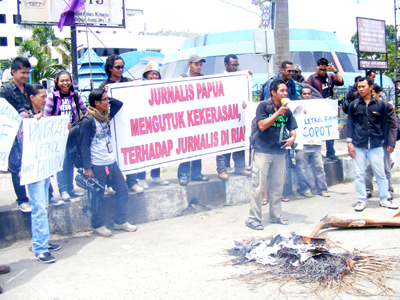
The Alliance of Independent Journalists (AJI) has recorded twelve cases of violence and intimidation against journalists Papua  during 2012,which is a significant increase as compared with 2011, when there were seven cases.
Journalists in Jayapura hold Demo to Reject Violence Against Journalists. (Jubi / Arjuna)

The first case was violence and intimidation against journalists in Papua and West Papua wanting to cover the trial of Forkorus Yaboisembut and his colleagues at the district court in Jayapura on 8 February when they were  physically intimidated, pulled and pushed as they were entering the courtroom. Those responsible were members of the police force in Jayapura. The victims were: Katerina Litha of Radio KBR 68 H  Jakarta. Robert Vanwi of  Suara Pemnaharuan, Jakarta, Josrul Sattuan of TV One, Irfan of Bintang Papua, and Cunding Levi of Tempo.

The second case was against Radang Sorong, a journalist with Cahaja Papua  and Paskalis  of Media Papua, from February until May in West Papua by the police chief of Manokwari, who were preventing journalists from reporting expressions of support for dialogue and a referendum in Papua. Three local journalists said that they had been  under pressure while writing critical reports about political matters, law and human rights violations and political prisoners. One of the journalists from Manokwari was instructed to restrict his reporting about political, legal matters and human rights violations.

The third case was in Abepura on 20 March when Josrul from TV One, Marcel from Media Indonesia, Irfan from Bintang Papua and Andi Irfan of Radio KBR 68 H Jakarta were attacked by members of KNPB, the National Committee of West Papua who were involved in an action outside the Post Office in Abepura. On a separate occasion, outside Polimak, Jayapura, Timbar Gultom of  Papua Pos was ordered to identify himself. When he replied that he  was from Papua Pos,  the people did not believe him and started chasing him. He was able to hide in a house nearby.

The fifth case  was when three journalists in the district of Jayapura, Yance of Radio Kenambai Ombar, Putu of KBR 68 H Jakarta and Suparti of Cenderawasih Pos were verbally intimidated and chased  by some members of the KNPB.on 20 March.

The sixth case was when a journalist from TV One, Josrul Sattuan was beaten by an unidentified person when he was trying to report on the situation in Jayapura following a series of  violent incidents and shooting incidents that occurred in various in places in Jayapura. The physical attack occurred at Abepura Circle on Thursday evening on 7th June.

The seventh case was when a journalist from Metro TV, Abdul Muin who was in Manokwari was attacked by someone from the Fishing Service in who intimidated him with an air gun.The victim told JUBI that the incident started when a member of the Fishing Service sent him a brief message on 8th June asking him and other journalists to cover an incident  of bombing a hoard of fish by a group of  people who were being held in the Manokwari Prison.

The eighth case occurred in Timika on 20 September.The victim was Mohammad Yamin, a contributor to  RCTI, Simson Sambuari of Metro TV, Husyen Opa of Salam Papua and the photographer for Antara News Agency, and David Lalang of Salam Papua.They were prevented from recording some events in the Pamako Harbour.

The ninth case involved Oktavianus  Pogau of suarapua.com and stringer for Jakarta Globe.  This occurred in Manokwari on 22 October. Okto were beaten up by several members of the police force, some in uniforms and others  not wearing their uniforms, who were battling with members of the KNPB in Manokwari.  The victims was thought to be part of a crowd of people involved in a demonstration, even though they had clearly identified themselves.

The tenth case was  when Sayied Syech Boften of Papua Barat Pos was attacked on 1 November by a person who identified himself as a member of the local legislative assembly, Hendrik G. Wairara. The victim was threatened and intimidated among others things by phone. The victim was warned to stop reporting about corruption in a project  involving the extension of the electrification system  and the maintenance of BBM machinery in Raja Ampat District. On the same day, the assistant of the chairman of the the local DPRD flew into a rage while he was at the editorial office of Papua Barat Pos.

The eleventh case occurred on 8 November when Esau Miram of Cenderawasih Pos  was intimidated as he was reporting on a gathering at the office of the Commander of the   XVII Nilitary Command and all the heads of departments in Papua.They were accused of being terrorists even though Esau had shown his  identity card as a journalist.

The twelfth case occurred on 1 December  when Benny Mawel of JUBI was interrogated by members of the police force  near Abepura Circle  for reporting about a large crowd of people who were carrying banners while marching from Abepura to Waena. Benny showed his journalist identity card, but a group of around ten people accused him of not being a journalist. As he was travelling on his motorbike  towards a repair centre, he was followed by some people there who starting asking whether he knew where Benny was.

Victor Mambor added the following: AJI reported two cases, the shooting of a Twin Otter  plane belonging to Trigana Air by an unidantified person in Mulia Airfield, Puncak Jaya on 8th April which killed Leiron Kogoya  who was first said to be a journalist of Papua Pos, Nabire and then the arrest and deportation of a Czech man, Petra Zamencnik who identified himself as a journalist with finecentrum.com. On 9 February, there was inconsistently about the status of the victim, whether he was a journalist or not, or whether he was involved in journalistic activities.

Suroso also confirmed that when the identity of Leiron  was checked, it turns out that  he was not at the time engaged in journalistic activities.but had gone to Mulia for personal reasons. Leiron had not registered himself as a journalist of  Papua Pos Nabire.  As regards Petr Zamencnik. he was unable to prove that he was a journalist. AJI Jayapura  sought confirmation with finecentrum.com about his status  and he was described as being the editor for financial affairs in the Czech Republic.

[Translated by TAPOL]

A Chronology of PT Minersave’s (Freeport’s) Entry into Intan Jaya Regency, West Papua

This article from KOMISI, a group of students from Intan Jaya in West Papua (in co-operation with the SuaraPapua website), recounts how the Freeport mining company, through its subsidaries, established exploration activities in remote Intan Jaya regency over twenty years ago with the help of a western missionary. Currently, as local politicians grant permissions for further exploration work without a mandate or the consent of the communities that live there, the students make a clear demand that the company leaves their land, knowing the pattern of conflict that is bound to emerge otherwise.

Translated from http://suarapapua.com/2012/12/kronologis-masuknya-pt-minersave-di-kabupaten-intan-jaya
Article available in English on hidupbiasa: http://hidupbiasa.blogspot.com/2012/12/a-chronology-of-pt-minersaves-freeports.html

December 2, 2012.

Intan Jaya Regency is a new administrative region which split from Paniai Regency in 2008. Until that time, Sugapa, Hitalipa and other areas were still under the administration of Paniai Regency.

The story begins in 1989 – 1990 when several westerners arrived, calling themselves the Survey Team. They were accompanied by a missionary from District Hitalipa, who had been given the friendly nickname of Jani Mala by local people.  His real name is John Cutts, a foreigner who was born and raised in Intan Jaya.

They arrived from Timika in an Airfast helicopter, and after arriving at the Kingmi Missionary Post in Hitalpa district , they continued towards the Hiyabu river, not far away.

Once at the river they started taking sand, water and rock samples. Then they continued towards the confluence of the Hiyabu and Dogabu rivers, and then to the confluence of the Wayabu and Wabu rivers and to several streams that joined the Wabu River, taking more samples at each river.

As they passed the Wabu River at Wandoga, John Cutts happened to meet a local resident, Stevanus Sondegau, by a stream known as Wonemiggi.  John and his companions continued their journey to the confluence with the Tigabu river, where once again they took samples and panned the sand to look for gold.

At that moment John met with another local resident, known locally as Ojegoa Tawa Mbole Belau or Didimus Belau, from Bilogae village, Sugapa District, who farmed cassava, taro and other plants along the Tigitalipa river. As usual John Cutts spoke in Migani, the local language, and told Didimus what they were doing there.

“ A me,..mepao,..mendaga kaneta taliago kaya, Hitalipagemaya tali ne,..du ne,..homa ne,.. inigiao dia digio,. usua naga ndogo- Timika ge inua noa nggaga inuapa dutima dia diggiyo,.data kapage go wabu ge dega-dega data homeyo pialiggiyo dipage go Timika puapaya,”  John Cutts said to Didimus in Migani, which means “I’m accompanying these people to collect water, rock and sand samples from Hitalipa to look at in the laboratory in Timika. From here we will continue to follow the upper reaches of the Wabu river then to Homeyo District and then we will go to Timika”.  John Cutts, the man who the local people always addressed as Jani Mala, continued with the survey team towards Homeyo District.

Several months later, on 28th September 1991, John Cutts made a second visit to Sugapa, Intan Jaya as a representative of PT Freeport Indonesia. His aim was to meet with the head of the Sugapa district and tribal chiefs to inform them that PT Freeport would start operations in Sugapa district and several other districts in Intan Jaya.

That meeting, which took place in the Sugapa district office, was attended by Hombore BA, the district head at the time, the members of the Tripika (local representatives of government, police and military), together with community leaders who hold the customary land rights, who all came and listened to what John Cutts had to say.

Migani community leaders that were present in that meeting included Paulus Japugau, Yuliu Sani, Adolof Belau, Oktopianus Sondegau, Samuel Japugau, Andreas Tipagau, and Bony Sondegau amongst others. They were confused when they heard John Cutts’ explanations, and didn’t understand why he wanted to carry out this exploration (Survey) on their land. They went straight home without agreeing to anything or being in agreement with John Cutts’ wishes to start surveying their land.

John Cutts took advantage of the Intan Jaya people’s limited knowledge and lack of experience to introduce Freeport to the area on its own terms, without any agreement to co-operate or Memorandum of Understanding with customary land rights holders. Although no such agreement had been made, John Cutts nevertheless imposed his wishes, bringing PT Freeport to Sugapa and other locations in Intan Jaya.

The way John Cutts gave PT Freeport the opportunity to carry out exploration activities in Sugapa, Hitalipa and other areas of Intan Jaya is an example of daylight robbery.  The people had no option but to accept what little they could at that time, so they made the non-written suggestion to PT Freeport, that they would allow them to go ahead with their explorations.  However as compensation for the trees that PT Freeport cut for their helipad, drillpad, material pad etc. they must take on local people to work for the company, explained a reliable source who is a customary landowner in that village.

In this way several local youth accepted jobs from PT Freeport in Sugapa, but they met with many obstacles. They didn’t know what they had to do.  Each mornng at 4.30 am they had to have tools and materials ready to build the basecamp and clear the land, while other workers went up and down to where the helipad, drillpad, materialpad and landing site would be built in the forest. Day after day, week after week and month after month, the wages the local workers received was very small indeed.

The helicopter which had been hired for the exploration made endless trips to Timika to bring food for the local workers in Sugapa. As exploration activities took hold in Sugapa, the Freeport manager took on the police and military who were assigned to Sugapa district to maintain security at the site.

The company needed building materials to build the camp and so requested that local people provide boards and wood, with the promise that they would be paid 15,000 Rupiah for thin planks, 10,000 Rupiah for large pieces of wood, and 5000 rupiah for medium sized pieces of wood.

When they heard that the people prepared the materials the company required. However the people were sadly not paid as had previously been agreed with PT Freeport, but had to renegotiate for a lower price. The people protested at this transaction, but were confronted with the police and army.

Whenever anyone protested, the police and military stationed there would deal with the problem; if anyone claimed they should be paid the price the company had proposed, the police and military would hit that person without hesitation until their face was black and blue. After one man, Linus Sondegau, was beaten in this way, a mass fight broke out between police and army and the local workers.

On seeing this, local people felt powerless to make any further protest against PT Freeport’s deception in Sugapa. Meanwhile John Cutts had since disappeared, after bringing these people who knew no pity. Local workers just took all this while remaining outwardly calm, because they were not really ready to become labourers. Many local people who were accepted into the hoist team fell from the helicopter, because they were not equipped with sufficient knowledge of safety at work.

Several local workers fell from the helicopter holding the rope to attach it, for example one worker who was caught in the trees on the side of Mount Wabu-Sugapa. No-one came to his help but fortunately the helicopter released the rope. The worker, called Didimus Japugai was caught in the branches of a tree. Local people’s crops were damaged by the downdraught from the helicopter as it landed with its cargo of tools for the company’s. The owners of the land asked to be paid for the damage done to ther crops by Freeport’s helicopter, but nothing could be done because the process was handed over to local police and military.

So the people had to gracefully accept this injustice.

Exploration took place in vital places for the local people’s livelihood, such as their hunting grounds, the places they would find wood or rattan, and the land they cultivated. The Sugapa-Bilagae base-camp was tightly guarded by police and military who forbade the people to roam around the base-camp both day and night. Once two or three pigs from Bilogae villagers were killed by guards without letting the village chief know beforehand. The guards then asked for half of the meat, in exchange for the bullets they had lost they said, and like-it-or-not the pigs’ owners had to once again gracefully accept, afraid of being beaten or shot by the security forces.

At night the people from the Bilogae (Wabu) base camp would take advantage of their situation and bring underage girls and even several married women from the village for sex. Local workers were encouraged to gamble and other negative actvities. When a local worker wanted to visit a sick family member they were told go to work or be fired, that’s how the workers were treated at the time.

PT Freeport, using PT Minersave as it’s vehicle, felt at liberty to explore the land, forests and rivers of Wabu, Intan Jaya as if it was land that belonged to nobody. Compensation for the flora and fauna has still not been paid to the holders of customary rights over this land until the present day.

As a result, PT Freeport destroyed the natural environment which protected the people’s animals and plants, and so all who lived there evacuated to places where it was possible to live better and more peacefully.

That is the story of how PT Freeport, by means of PT Minersave, was able to enter Intan Jaya regency and assume that the natural environment of Intan Jaya was without an owner, leaving it free to explore just as it pleased.

Recommendation letter not legitimate

The recommendation letter below was issued by the caretaker leader (Bupati) of Intan Jaya Regency Maximus Zonggonau and the head of Intan Jaya People’s Representative Council Herenius Sondegau without co-ordination, discussion or input from Intan Jaya’s indigenous people.

Recommendation letter number: 65/REK/BUP./IJ/2012 states:

“based on the Director of PT IRJA EASTERN MINERALS letter Number IM/08/II/2012 dated 16th February 2012, the Bupati of Intan Jaya hereby grants its recommendation to PT. IRJA EASTERN MINERALS to make use of the protected forest of Intan Jaya regency for exploration activities. In the course of carrying out these  activities it is intended that all valid regulations are obeyed, especially to protect the environment in the conservation forest.”

Such laws had never been obeyed by any of the exploration and exploitation activities carried out in Sugapa during the years before this note was written.

Unilateral Claims

The Elected Bupati and vice-Bupati of Intan Jaya Regency, Natalis Tabuni, Ss, Msi and Fr. Yan Kobogayau, Sth, M Div have stated that they are “able to  develop and unearth Intan Jaya’s natural potential”.

Natalis Tabuni’s statement to journalists which was reported in rthe print and eletronic media Bintang Papua and Papua Pos Nabire is a unilateral claim because the population of Intan Jaya in general depends on the natural environment and rivers such as Wabu, Kemabu, Mbiabu for their livelihoods, and the location of Intan Jaya is extremely unsuitable for a mining company’s operations.

Most people in Intan Jaya live along the aforementioned rivers. If a mining company manages to force its way in, the mine waste would clearly be disposed of in Intan Jaya’s rivers. Meaning that water, land, the environment and the people would all be affected by this chemical waste which will result in the slow but sure extinction of local ethnic groups.

PT Freeport, which through PT Minersave has been operating in Wabu Sugapa Intan Jaya in recent years, and is still active in the area, is what has become of John Cutts’ strategy of taking advantage of the local people’s limited  understanding.

PT Freeport commenced operations on 28th September 1991, but until the present day customary land rights holders have not granted their agreement to co-operate. Until today people are still seeking redress for the damage to the flora and fauna, especially for the pollution of water resources and illegal logging.

The people are asking for PT Freeport to be stopped, because the company has not made agreements with community leaders, indigenous leaders, church leaders, women leaders, youth leaders or intellectuals and students from the Moni people who inhabit the land between Mbulu-Mbulu and Anepone-Sanepone.

The people of Intan Jaya are in general agreement and spread the word from church to church, from village to village and in every district of Intan Jaya to stop the mining company on their territory. So, whoever it is that is that is letting the mining company force its way into Intan Jaya, whether for exploration or exploitation, should stop right now. If any permissions have been given they should be immediately revoked, because it constitutes an attempt to kill and wipe out the people of Intan Jaya, whether directly or indirectly.

People will be killed directly as a result of the security operations around the mining area, keeping indigenous people out so they cannot disturb mining, which will surely end up with people being imprisoned and killed, as well as provoking wars between tribes and clans who will end up killing one another as the riches of nature that indigenous people can access disappear into nothing. [translator’s note: all of this already happens on a regular basis around Freeport’s existing mine near Timika.]

Indirect killing comes neatly packaged, structured and planned and is divided up between government, NGOs and churches, alongside the effects of alcohol, HIV/AIDS and chemical waste polluting Intan Jaya’s rivers. We often read in the print and electronic media about protracted conflicts caused by mining. The evidence shows there is a high risk of conflict in mining areas the world over. These conflicts are deliberately created by people with vested interests in the natural riches belonging to the indigenous people, but once they start it is difficult for anyone to stop the conflict.

Statement of Opinion

As residents and students of Intan Jaya Regency involved in the Somatua Intan Jaya Independent Community of Students (Komunitas Mahasiswa Independen Somatua Intan Jaya (KOMISI)), we wish to emphatically state that:

Firstly, as we have seen, read and heard, mining the world over results in conflict. Therefore we strongly reject the irresponsible and inhumane attempts that are being made to allow a mining company to operate.

Secondly, we do not want mining companies to carry out exploration or exploitation in ant part of the territory of Intan Jaya either now or at any time to come, because that will mean that indigenous people will be wiped out from Intan Jaya.

Thirdly, if a mining company is going to force its way into Intan Jaya, it would be better if we, the people of Intan Jaya and students in KOMISI, were to all be killed straight away.

This statement has been prepared so that those with a vested interest in Intan Jaya regency will take no further action. We have only one objective, and that is that the people of Intan Jaya can be saved from the threats of large-scale foreign investment that bring no real benefits to the local people.

*This piece was published as a collaboration between KOMISI and Suara Papua editors.


West Papua Report December 2012

This is the 104th in a series of monthly reports that focus on developments affecting Papuans. This series is produced by the non-profit West Papua Advocacy Team (WPAT) drawing on media accounts, other NGO assessments, and analysis and reporting from sources within West Papua. This report is co-published with the East Timor and Indonesia Action Network (ETAN). Back issues are posted online at http://www.etan.org/issues/wpapua/default.htm Questions regarding this report can be addressed to Edmund McWilliams at edmcw@msn.com. If you wish to receive the report directly via e-mail, send a note to etan@etan.org. For additional news on West Papua see the reg.westpapua listserv archive or on Twitter.WPAT Note:

With the October 2012 edition, West Papua Report changed format: The Report now leads with “Perspective,” an opinion piece; followed by “Update,” a summary of some developments during the covered period; and then “Chronicle” which lists of statements, new resources, appeals and action alerts related to West Papua. Anyone interested in contributing a “Perspective” or responding to one should write to edmc@msn.com. The opinions expressed in Perspectives are the author’s and not necessarily those of WPAT or ETAN.Contents:

Perspective: Reflections on The New York Agreement by Dr. John Saltford

Update:

Chronicle:

Perspective

To mark the 50th anniversary of the signing of the “New York Agreement” (September 1962) which led to Indonesian annexation of West Papua, we offer below a reflection regarding that agreement’s implications for West Papua. Dr. John Saltford, who has authored this Perspective, is an internationally respected scholar and author of The United Nations and The Indonesian Takeover of West Papua 1962-1969: The Anatomy of Betrayal.

Reflections on the 1962 New York Agreement

In October 1962 Dutch rule in West Papua ended and was replaced by a temporary UN administration (UNTEA). This was established as part of the UN-brokered New York Agreement [1], signed between The Netherlands and Indonesia to resolve their dispute over the territory. For all its flaws, this agreement guaranteed the Papuans the right to self-determination in accordance with international practice, but this never happened. Indonesia took over from the UN seven months later and never left.

In October 2012 Indonesian security forces attacked peaceful political rallies in several West Papuan cities and intensified sweep operations in the Central Highlands forcing hundreds of villagers to flee [2]. These were not isolated incidents. According to Amnesty International, fifty years after the New York Agreement, Indonesia continues to deny Papuans their rights to freedom of expression and peaceful assembly [3]. A good reason therefore to re-examine the origins of this agreement, its content and implementation.

In 1949 the Dutch ceded sovereignty of the Netherlands East Indies to the new Indonesian Republic but kept West Papua, not least because they reasoned that the Papuans were ethnically and culturally completely different to the Indonesians. Over the next thirteen years preparations for West Papuan independence progressed in the face of increasingly strong opposition from Jakarta which claimed the territory for itself.

But arguments over who should determine West Papua’s future were superseded by the August 1962 signing of the New York Agreement, and its acknowledgement that it was for the Papuans, and no one else, to decide whether the territory should become an independent state or a province of Indonesia.

The transfer of administration from Dutch to UN control was the first stage of the agreement. But from the start, instead of safeguarding Papuan political and human rights, UNTEA’s priority was simply to hand the territory over to Indonesia as quickly as possible. As one senior UN administrator privately reported:

“I have yet to meet any thinking, sober, generally responsible Papuan who sees any good in the coming link with Indonesia. Unwelcome as the anxiety and resistance of thinking Papuans maybe it is of course hardly surprising if one is not under pressure to close one’s eyes to what is in fact happening to this people at the hands of the three parties to the Agreement.” [4]

Once UNTEA had withdrawn, Article 16 specified that some UN experts were to remain to advise and assist the Indonesians in preparations for Papuan self-determination that was to take place before the end of 1969. But these experts were never deployed because Indonesia objected.

Under Article 17, one year prior to self-determination, the Secretary-General was to appoint a representative to lead a team of UN officials, including those already stationed in the territory. Their task was to continue to build on the work outlined in Article 16 and remain until the act of self-determination was complete.

A Bolivian, Ortiz Sanz, was appointed but, as he made clear in his official report [5], the non-implementation of Article 16 meant that there were no experienced UN staff in the territory for him to lead. Instead he was left with a newly arrived team of 16 who were supposed to advise and participate in an act of self-determination covering a territory roughly the size of California.

Under Article 22, the UN and Indonesia had to guarantee fully the rights, including the rights of free speech, freedom of movement, and of assembly of the Papuans. These rights were not upheld and the official 1969 UN report concedes that “the (Indonesian) Administration exercised at all times a tight political control over the population.” [6]

Under Article 18, all adult Papuans had the right to participate in an act of self-determination to be carried out in accordance with international practice.

This central tenet of the agreement was never implemented. Instead, with no genuine involvement by the population, the UN effectively stood by as Indonesia hand-picked, bribed and threatened 1,022 Papuans to take part in the 1969 “Act of Free Choice” – a series of theatrical ceremonies in which the selected Papuans stood up on command to indicate unanimous consent for integration with Indonesia. The final wording of the UN report says only that the procedure had been carried out in accordance with “Indonesian” and not “international” practice as required by the agreement.

One could argue “International Practice” is too vague a term here to have any meaning. But in fact, acceptable international practice had been set out in UN General Assembly Resolution 1541 of December 1960. This specified the circumstances under which a non-self governing territory (which West Papua was) could integrate with an independent state.

In particular, Principle IX states:

“The integration should be the result of the freely expressed wishes of the territory’s peoples acting with full knowledge of the change in their status, their wishes having been expressed through informed and democratic processes, impartially conducted and based upon universal adult suffrage.” [7 ]

Clearly the “Act of Free Choice” did not even begin to fulfill these conditions.

This all happened decades ago and some claim there is little point arguing about the past. It is the future that matters. But I believe a proper acknowledgement of the truth, by Jakarta, the Netherlands, and the UN, is a necessary step towards finding a just and lasting solution to the tragedy of West Papua. [8]

[1] General Assembly Official Records United Nations, 17th Session, Annexes Agenda item 89, Doc A/5170, Annex of 20 August 1962, Agreement between the Republic of Indonesia and the Kingdom of the Netherlands concerning West New Guinea (West Irian).

[2] WPAT/ETAN, West Papua Report, November 2012

[3] Amnesty International. Annual Report, Indonesia, 2012

[4] Report by G. Rawlings (Divisional Commissioner, Biak) to Somerville, UNTEA Internal Affairs Director, 12 December 1962, UN Archives, DAG 13/2.1.0.1:3

[5] Twenty-Fourth Session, Agenda item 98: Report of the Secretary-General Regarding the Act of Self-determination in West Irian. A/7723, 6 November 1969. [Including Annex I, Report by Ortiz Sanz, and Annex II, Report of the Indonesian Government].

[6] ibid

[7] General Assembly Official Records United Nations, 15th Session, 948th plenary meeting, Resolution 1541, 15 December 1960, Principles which should guide members in determining whether or not an obligation exists to transmit the information called for under Article 73e of the Charter, Annex Principle ix.

[8] These topics are addressed in more detail in the author’s book: John Saltford, The United Nations and the Indonesia Takeover of West Papua, 1962-1969: The Anatomy of Betrayal(London: RoutledgeCurzon, 2003).

Update

UN High Commissioner for Human Rights Expresses Concerns about West Papua During Jakarta Visit

At a November 13 press conference in Jakarta, United Nations Commissioner for Human Rights Navanethem Pillay called on the Indonesian government to implement international human rights standards legislatively at local and national levels

She publicly encouraged the government “to move forward with setting up ad hoc human rights courts, as envisaged under law No. 26/2000, to investigate the enforced disappearances of student activists in the late 1990s and serious violations in Aceh and Papua.” She said that she had learned more about the “extent and egregious nature of past violations of human rights, from the killings of communists in 1965 and of students in the late 1990s, to later crimes in the Aceh region and what is now Timor-Leste.” She called for “credible prosecutions of perpetrators.”

In meetings with senior Indonesian officials she also raised concerns about increased violence in Papua this year. Pillay said that she “recommended that the Government take further steps to ensure criminal accountability. I was also concerned to hear about activists being imprisoned for the peaceful exercise of freedom of expression.”

Pillay welcomed the Indonesian government’s decision to invite the UN Special Rapporteur on Freedom of Expression to Indonesia.

(WPAT Note: It is unclear whether the Special Rapporteur’s visit to Indonesia will include West Papua. Given the extensive violations of freedom of expression in West Papua, particularly over the peaceful display of symbols such as the morning star flag, no visit to Indonesia by this Special Rapporteur could be considered meaningful or complete without a visit to West Papua.)

see also Human Rights Watch: I ndonesia: UN Rights Visit Can Challenge Discrimination, Impunity, Plight of Religious Minorities and Papua Abuses Are Serious, Ongoing Problems

Indonesian Security Authorities Disrupt Peaceful December 1 Rallies

Security forces arrested several people who sought to peacefully mark the 51st anniversary of West Papua’s independence. Initial reports indicate Indonesian security authorities employed tear gas to break up a demonstration in Jayapura (Port Numbay). Rallies were also planned to be held in Sorong, Nabire, Fak Fak, Manokwari, Wamena,, Timika and Serui.

U.S. Ambassador Visits West Papua – Lauds Indonesian Military

U.S. Ambassador Scot Marciel visited West Papua in early November in what State Department officials described to West Papua Report as one of a series of periodic visits by the Ambassador to West Papua. Marciel met with members of the Papuan Provincial Assembly (DPRP), the Papuan Peoples Council (MRP), senior members of the Provincial Military Command and the Inspector General of the Police Force. State Department officials told WPAT Marciel also met with civil society groups.

According to a November 7 report in Bintang Papua, translated by TAPOL, Marciel told senior military officials that the US was very impressed by the developments that the TNI (the Indonesian army) had achieved including its “reforms.”

(WPAT Comment: It is unclear what reforms Marciel was referring to nor is there any indication that the US Ambassador raised the TNI’s ongoing military sweep operations that jeopardize the lives of Papuan civilians.)

In response to the ambassador’s question as to why the duties of the military command in West Papua were so much greater there than elsewhere and required such a different approach, the chief of staff said that the military were acting in accordance with their “duties” as ‘Noble Protectors of the People’ (Ksatria Pelindung Rakyat).

(WPAT Comment: The military, under the Suharto dictatorship and since, has drawn upon its role as so-called “Noble Protectors of the People” as the basis for its intrusion into civilian affairs and to justify its substantial commercial interests. See The Role of ABRI in the Post-Suharto Era [PDF])

In his meeting with DPRP (Papuan Parliament) members, Marciel raised the two-year delay in holding of elections for Governor. DPRP members acknowledged that because of the continued absence of an elected governor, no budget had been produced and there was no one who could take responsibility for finances. This was described by DPRP members as having “serious consequences for the people.”

In his meeting with senior police officials, the Ambassador reportedly urged that the police pursue a lenient approach. The police should not be seen as solely involved in arresting and detaining people, and the police should put a priority on activities which  bring them close to the people. The Ambassador spoke positively about US cooperation with the police in future years.

Papuans Marginalized in Employment

According to the November 20 Tabloid Jubi(translated by TAPOL), the acting governor of Papua province Constan Karma, spoken about the marginalization of Papuans in employment: “In the competition for jobs, the people with better qualifications always succeed. Indigenous Papuans are not yet able to compete with people who have come from elsewhere because they have better qualifications. The result is that more and more indigenous Papuans are unemployed and this is causing social tensions.”

Sweep Operations Drive More Papuan Civilians into Papuan Forests

A report by Elsham revealed that 38 civilians who fled their village of in Keerom District in July remain in the forest. They fled because of five-month sweep operation conducted by the Indonesian military and police in the area. The displaced are subsisting on sago and worms, and children have been unable to attend school.

Security Forces Target Peaceful Dissent

Indonesian security authorities, especially Indonesian Special Forces (Kopassus) and the U.S.-backed police unit Detachment 88 are continuing to persecute leading members of the West Papua National Committee (KNPB). In October, Indonesian special forces sought in vain to detain prominent women’s and environmentalist activist Fanny Kogoya who, earlier this year, was elected to head the Papua desk for the WALHI, Indonesian branch of Friends of the Earth. The security forces also targeted students associated with her work. Kogoya, also a women’s rights defender from the grassroots Papuan Women’s Network TIKI, has been placed on a Papua wide wanted persons list (Daftar Pencarian Orang or DPO) by the U.S. and Australian-trained and funded Detachment 88 anti-terror investigators.

Calls for Security Force Accountability in West Papua Multiply

A number of prominent human rights organizations and prominent civil society figures have recently called for human rights accountability in West Papua.

The human rights watchdog Institute for Research and Advocacy (Elsam) has once again urged the government to prosecute unfinished human rights violation cases. According to Elsam executive director Indriaswati D. Saptaningrum, most of the perpetrators involved in human rights violations “still walk free, as the government has kept silent.” (The Elsam comments were made during the commemoration of International Day to End Impunity. The international commemoration day is observed by human rights activists to call on governments to bring justice for those who were killed or kidnapped when they tried to defend their freedom of expression.)

Budi Setyanto, a lawyer who is the director of the Institute for Civil Strengthening. Setyanto called “extremely serious” the fact that many human rights violations against the indigenous Papuan people have never been resolved. “‘This matter needs to be resolved  by the government which should make an inventory of all the cases that have occurred so that the general public is aware of the many cases that have not be resolved,” he said.

He also said that the Papuan provincial governors and provincial administrations should participate in this work, by setting up a special team to draw up a comprehensive list of all the violations that have occurred. “This is a matter,” he said, “that needs the full attention of the government and should not be dealt with in a half-hearted way.”

Separately, Suciwati, the widow of the murdered human rights champion Munir Said Thalib, visited the Jayapura grave of Papuan political leader Theys Eluay on the anniversary of his November 10, 1991 murder by Kopassus. Suciwati used the occasion to speak out against the many inadequately resolved murder cases in West Papua. “Our society is too forgiving, too easy to forget. We must change this. They can kill Munir, Theys for speaking out the truth but they can’t kill the truth itself,” Suciwati said.

Boy, Eluay’s son, said Papua desperately needs support from activists in Jakarta and elsewhere. Security officials in Papua always view human rights protests as separatist, he said. Law enforcers “always have a stigma and when we do any activity related to human rights they come and attach that stigma…. Support from friends outside of Papua is needed for the state to put that stigma away. He added that “If a big person like Theys can be murdered what would happen to the rest of us? We don’t want our children to be future victims of such atrocity,” he said. “It is time for the victims’ families to do a more organized act for justice and human rights in Papua.”

(WPAT Comment: The Indonesian government’s failure, over many decades, to address security force impunity for human rights violations throughout the archipelago, but especially in West Papua, exacerbates the climate of fear and intimidation that engulfs target populations such as the Papuans.)

Chronicle

Article Reveals Absence of Government Services in Much of West Papua

Inside Indonesia, November 25, published a highly revealing account of the reality of life in West Papua, particularly in rural areas where the majority of Papuans live. The author, Bobby Anderson, writes in “Living without A State,” that West Papua ranks last out of all 33 Indonesian provinces according to Human Development Indicator measurements. He observes that in most places outside of the towns, Papuans do not reject the Indonesian state. Rather, the state simply plays little or no role in their lives, for better or for worse. Across large parts of the highlands, there is little evidence of the state other than empty schools, health clinics, and hospitals. Civil servants, police, and military are few and far between. “The essential problem of health and education services in the highlands is not lack of physical structures, but poor management of human resources in these areas. New buildings remain empty, and although civil servants are theoretically assigned to work in these areas, the vast majority of them are not present in their duty stations. This is the norm across the highlands.”

Anderson describes one subdistrict in particular, Lolat, created in 2002, where there are almost no government services. Visibly malnourished children in the area show bloated stomachs and stunted growth. “A local NGO, Yasumat, runs five parallel schools, 19 health clinics, and four health posts. While paid teachers and health care workers are absent, a cadre of local volunteers strives to provide needed service,” Anderson writes.

Immunization programs do not exist in remote areas. No immunizations have been provided by the district government outside of intermittent offerings in the town of Dekai in the last ten years. “TB and HIV rates in Lolat are unknown, but the number of young men, women, and children dying of unknown causes is out of proportion to the already abysmal provincial averages. It seems likely that men working in the cities as part of the construction boom caused by the proliferation of new districts are contracting HIV and bringing it home with them. Just as HIV infection levels are unknown, so are condoms, which have never been seen in the area,” reports Anderson.

The end of the Suharto dictatorship in 1998 brought new hardships. A planned takeover of local governance by new state institutions effectively never happened. Instead, the “takeover” resulted in the breakdown of the established system. According to Anderson, “There was no period of transition and no handover.” He also reveals the failure of “Special Autonomy,” introduced in 2001 as a way to relieve pressures for independence, address Papua’s underdevelopment and improve service delivery. The policy, he notes, led to “a dramatic increase in government funds available for development purposes. However, an overstaffed and under-performing provincial bureaucracy absorbs the majority of Special Autonomy funds.”

Link to this issue: http://etan.org/issues/wpapua/2012/1212wpap.htm

Back issues of West Papua Report


Create a website or blog at WordPress.com

Up ↑