Papua New Guinea takes a regional lead in supporting a free West Papua

16 March 2013

 by Airileke Ingram and Jason MacLeod

Melanesian support for a free West Papua has always been high. Travel throughout Papua New Guinea you will often hear people say that West Papua and Papua New Guinea is ‘wanpela graun’ – one land – and that West Papuans on the other side of the border are family and kin. In the Solomon Islands, Kanaky, Fiji and especially Vanuatu, people will tell you that “Melanesia is not free until West Papua is free”. This was the promise that the late Father Walter Lini, Vanuatu’s first prime minister made.
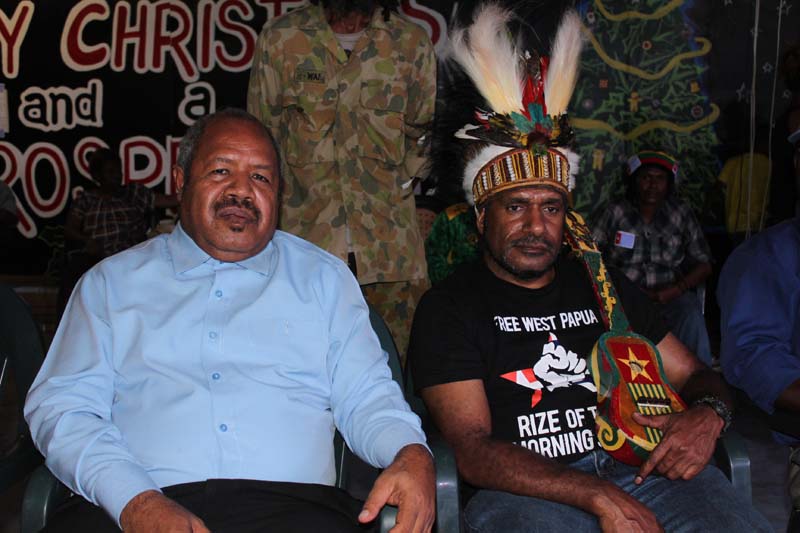
benny powes 1
Above: Papua New Guinea National Capital District Governor Powes Parkop with Independence leader, Benny Wenda at the concert for a free West Papua, Jack Pidik Park, Port Moresby 6 March 2013.

Ordinary people in this part of the Pacific are painfully aware that the West Papuan people continue to live under the gun. It is the politicians in Melanesia who have been slow to take up the cause.

But that may be changing.

Last Wednesday 6 March 2013, the Right Honorary Powes Parkop, Governor of National Capital District, Papua New Guinea nailed his colours firmly to the mast. In front of a crowd of 3000 people Governor Parkop insisted that “there is no historical, legal, religious, or moral justification for Indonesia’s occupation of West Papua”. Turning to welcome West Papuan independence leader Benny Wenda, who was in Papua New Guinea as part of a global tour, the Governor told Wenda that while he was in Papua New Guinea “no one will arrest him, no one will stop him, and he can feel free to say what he wanted to say.” These are basic rights denied to West Papuans who continue to be arrested, tortured and killed simply because of the colour of their skin. Governor Parkop, who is a member of the International Parliamentarians for West Papua, which now has representatives in 56 countries, then went on to formerly launch the free West Papua campaign. He promised to open an office, fly the Morning Star flag from City Hall and pledged his support for a Melanesian tour of musicians for a free West Papua.

Governor Parkop is no longer a lone voice in Melanesia calling for change.

Last year Papua New Guinea’s Prime Minister Peter O’Neill broke with tradition and publicly admonished the Indonesian Government’s response to ongoing state violence, human rights violations and failure of governance in West Papua. Moved by 4000 women from the Lutheran Church O’Neill said he will raise human rights concerns in the troubled territory with the Indonesian government. Now Governor Parkop wants to accompany the Prime Minister on his visits to Indonesia “to present his idea to Indonesia on how to solve West Papuan conflict once and for all.” Well known PNG commentator Emmanuel Narakobi remarked on his blog that Parkop’s multi-pronged proposal for how to mobilise public opinion in PNG around West Papua “is perhaps the first time I’ve heard an actual plan on how to tackle this issue (of West Papua)”. On talk back radio Governor Parkop accused Australian Foreign Minister Bob Carr of not taking the issue of West Papua seriously, of “sweeping it under the carpet.”

In Vanuatu, opposition parties, the Malvatumari National Council of Chiefs and the Anglican bishop of Vanuatu, Rev. James Ligo are all urging the current Vanuatu government to change their position on West Papua. Rev. Ligo was at the recent Pacific Council of Churches in Honiara, Solomon Islands, which passed a resolution urging the World Council of Churches to pressure the United Nations to send a monitoring team to Indonesia’s Papua region. “We know that Vanuatu has taken a side-step on that (the west Papua issue) and we know that our government supported Indonesia’s observer status on the MSG, we know that. But again, we also believe that as churches we have the right to advocate and continue to remind our countries and our leaders to be concerned about our West Papuan brothers and sisters who are suffering every day.”

In Kanaky (New Caledonia) and the Solomon Islands West Papua solidarity groups have been set up. Some local parliamentarians have joined the ranks of International Parliamentarians for West Papua. In Fiji church leaders and NGO activists are quietly placing their support behind the cause even while Frank Bainimarama and Fiji’s military government open their arms to closer ties with the Indonesian military. This internationalisation of the West Papua issue is Indonesia’s worst nightmare; it follows the same trajectory as East Timor.

The West Papuans themselves are also organising, not just inside the country where moral outrage against ongoing Indonesian state violence continues to boil, but regionally as well. Prior to Benny Wenda’s visit to Papua New Guinea, Vanuatu based representatives from the West Papua National Coalition for Independence formerly applied for observer status at this year’s Melanesian Spearhead Group meeting due to be held in Noumea, New Caledonia in June, home to another long running Melanesian self-determination struggle. While in Vanuatu Benny Wenda added his support to that move, calling on Papuans from different resistance organisations to back a “shared agenda for freedom”. A decision about whether West Papua will be granted observer status at this year’ MSG meeting will be made soon.

In Australia Bob Carr may be trying to pour cold water on growing public support for a free West Papua but in Melanesia the tide is moving in the opposite direction.


free_west_papua_concert


The West Papua struggle is a difficult one and what outcome will emerge in the years to come is still hard to see. Allot of thoughts crossed my mind on Wednesday night when I attended the Benny Wenda, Free West Papua Concert. But from an Australian perspective, these comments by Daeron on an online forum summed it up quite well for me:


“Despair would be a natural but unproductive reaction to this SMH article yesterday, http://www.smh.com.au/opinion/politics/carr-helps-to-remove-the-blinkers-20120305-1ue67.html

Both Bob Carr and Mr Hartcher are products of an American fantasy about Indonesia which benefits Bechtel, Freeport, Exxon, NewMount, Conoco Phillips, to name a few.. Just find a membership listing of the US Indonesia Society lobby to get a full listing. But an Australian foreign minister needs to know the difference between illusion sprouted in US publications and reality, and he needs to understand our regional interests. Bob Carr is a wonderful choice for Indonesia, but not so much for us.I agree the Balinese are a nice people, but Jakarta is not ruled by the people of Indonesia, it is a oligarchy mostly of Indonesian Generals and US corporate interests. The effect of the 1975 invasion of East Timor was that Portugal Oil was replaced by Conoco Phillips, and the effect of the 1962 American deal (the “New York Agreement”) for the UN to trade our neighbours of West Papua to Indonesian rule, was that Freeport got to mine Papua’s gold & copper etc.The NSW Parliament is well aware that West Papua is victim of an illegal UN resolution (resolution 1752 (XVII)) which Australia supported in August 1962, an act which benefited the US corporations and Jakarta but not Australia or our regional interests. Colonialism is good business for Freeport McMoRan Copper & Gold Inc.; and it is the unspoken Australian policy for the indigenous population of West Papua.Over this coming year watch as Bob Carr, just like Kevin Rudd, refuses to answer a simple question; why did Australia support UN General Assembly resolution 1752 (XVII) ?
Posted by Daeron, Wednesday, 7 March 2012 1:49:53 AM”


But putting aside Independence hopes and geopolitical hurdles for a minute, why would a group of people be causing so many issues for Indonesia if they were happy?


.


Benny Wenda opened his speech with a story of how when he was 6 years old he witnessed his mother being struck down by the butt of a gun at the hands of Indonesian Military and then witnessed as two Aunties who came to help his mother were raped before his eyes. All this at the age of 6.


.


It is no wonder that experiences like this from many West Papuan’s have clearly driven them to dispute the fact that they had a legitimate say in self determination in 1962. Again, even if we accepted the UN resolution, has Indonesia given them appropriate rights and services to lead fulfilling lives?


.


I’m no authority on this issue and I’ve never been to West Papua, but as far as I know there are quite allot of unhappy indigenous West Papuan’s in the world today.


.


So what are they going to do about it? Well Governor Parkop announced on the night that he was going to be setting up a West Papua Office in Port Moresby. Globally as well they would be coordinating with the International Parliamentarians for West Papua, the International Lawyers for West Papua and International Musicians to ramp up the Global Campaign for West Papua’s Freedom.


.


I take my hat off to Parkop, this is perhaps the first time I’ve heard an actual plan on how to tackle this issue. Below are some pics of the night and here’s a good wrap up of Parkop’s speech here.


.


IMG_2504


IMG_2535


IMG_2563


IMG_2580


IMG_2597


IMG_2634


IMG_2681


IMG_2673


IMG_2708


IMG_2715

free_west_papua_concert

The West Papua struggle is a difficult one and what outcome will emerge in the years to come is still hard to see. Allot of thoughts crossed my mind on Wednesday night when I attended the Benny Wenda, Free West Papua Concert. But from an Australian perspective, these comments by Daeron on an online forum summed it up quite well for me:

“Despair would be a natural but unproductive reaction to this SMH article yesterday, http://www.smh.com.au/opinion/politics/carr-helps-to-remove-the-blinkers-20120305-1ue67.html

Both Bob Carr and Mr Hartcher are products of an American fantasy about Indonesia which benefits Bechtel, Freeport, Exxon, NewMount, Conoco Phillips, to name a few.. Just find a membership listing of the US Indonesia Society lobby to get a full listing. But an Australian foreign minister needs to know the difference between illusion sprouted in US publications and reality, and he needs to understand our regional interests. Bob Carr is a wonderful choice for Indonesia, but not so much for us.I agree the Balinese are a nice people, but Jakarta is not ruled by the people of Indonesia, it is a oligarchy mostly of Indonesian Generals and US corporate interests. The effect of the 1975 invasion of East Timor was that Portugal Oil was replaced by Conoco Phillips, and the effect of the 1962 American deal (the “New York Agreement”) for the UN to trade our neighbours of West Papua to Indonesian rule, was that Freeport got to mine Papua’s gold & copper etc.The NSW Parliament is well aware that West Papua is victim of an illegal UN resolution (resolution 1752 (XVII)) which Australia supported in August 1962, an act which benefited the US corporations and Jakarta but not Australia or our regional interests. Colonialism is good business for Freeport McMoRan Copper & Gold Inc.; and it is the unspoken Australian policy for the indigenous population of West Papua.Over this coming year watch as Bob Carr, just like Kevin Rudd, refuses to answer a simple question; why did Australia support UN General Assembly resolution 1752 (XVII) ?
Posted by Daeron, Wednesday, 7 March 2012 1:49:53 AM”
But putting aside Independence hopes and geopolitical hurdles for a minute, why would a group of people be causing so many issues for Indonesia if they were happy?
.
Benny Wenda opened his speech with a story of how when he was 6 years old he witnessed his mother being struck down by the butt of a gun at the hands of Indonesian Military and then witnessed as two Aunties who came to help his mother were raped before his eyes. All this at the age of 6.
.
It is no wonder that experiences like this from many West Papuan’s have clearly driven them to dispute the fact that they had a legitimate say in self determination in 1962. Again, even if we accepted the UN resolution, has Indonesia given them appropriate rights and services to lead fulfilling lives?
.
I’m no authority on this issue and I’ve never been to West Papua, but as far as I know there are quite allot of unhappy indigenous West Papuan’s in the world today.
.
So what are they going to do about it? Well Governor Parkop announced on the night that he was going to be setting up a West Papua Office in Port Moresby. Globally as well they would be coordinating with the International Parliamentarians for West Papua, the International Lawyers for West Papua and International Musicians to ramp up the Global Campaign for West Papua’s Freedom.
.
I take my hat off to Parkop, this is perhaps the first time I’ve heard an actual plan on how to tackle this issue. Below are some pics of the night and here’s a good wrap up of Parkop’s speech here.
.
IMG_2504
IMG_2535
IMG_2563
IMG_2580
IMG_2597
IMG_2634
IMG_2681
IMG_2673
IMG_2708
IMG_2711
IMG_2715

Strange conduct in the Pastor Frederika murder trial

from our friends at SuaraPapua.com

Sunday March 3rd, 2013

Investigation by Oktovianus Pogau

There is much that is strange in the process of the trial over the killing of Pastor Fredrika Metalmeti (38) on November 21st 2012 in Boven Digoel, Papua.  The conduct of Military Tribunal III-19 Jayapura gives the impression of protecting the shooter. What is this process? Read below.

On November 21st 2012, a dark history began for the big Metalmeti and Imogoti families in Boven Digoel province and Merauke province, Papua, Pastor Frederika Metalmeti (38), first child of George Metalmeti (68) and Ida Imogoti, was found horribly killed on the Trans Asiki road, Boven Digoel, Papua.

Terdakwa oknum anggota TNI, Sertu Irfan (kanan) sedang mengenakan topi (Foto: Oktovianus Pogau/SP)
Unscrupulous members of the military, Defendant Sergeant Irfan (right) is wearing a hat (Photo: Oktovianus Pogau / SP)

Initially, at around 6:00am, the Head of Komba District, Manyu Waremba (46) together with his wife and child came to the scene of the crime, and found the victim’s body lying in bushes, near the Trans Asiki Road.

“My house is about 200 metres from the scene, early in the morning around 3:30am I heard someone calling for help accompanied by the sound of gunfire. Because I was scared, I intended to investigate in the morning together with my family” said Waremba, in Military Tribunal testimony Dock 5, Jayapura, 11th February 2013.

Waremba immediately reported his discovery of the corpse to three police officers on guard at the police post not far from the location of the body. The three police officers together with local residents eventually came to the scene. Indeed, the body of the woman lay bloody, motionless and stiff.

“After this I called the police station and together with local people we went to the scene, and we found the victim sprawled in bushes with much blood on her body” said Manggaprouw, member of Boven Digoel Police, in their testimony at the Military Tribunal, Jayapura.

Then, the Boven Digoel Police Chief immediately arrived at the scene, accompanied dozens of his men. When attending the crime scene, police found three pieces of ammunition, type FN 45, that were still active.

A pink helmet, belonging to the victim, was also found, as were jeans (denim) shorts. The victim’s shirt was opened to cover her face, which was a men’s shirt reading ‘Kwarcab Digoel District Scouts’.

At approximately 8:00am, police took the body to the Regional General Hospital for autopsy.

Before this, several nuns were asked to bath the victim who later became known to be Frederika Metalmeti, Pastor of the Bethel Church of Indonesia (GBI), Boven Digoel.

The nuns who bathed the corpse claimed to find three gunshot wounds on the victim’s body. The first of these shots on the side right of the head, the second on the left of the chest, and the third on the victim’s right arm.

According to the nuns, the face and back of the victim’s head had been shattered by a blow from a blunt object. Allegedly, the accused wanted to erase the remains of the gunshot wound on the victim’s head.

To determine the perpetrators of the shooting, the police summoned parties believed to have been close to the victim for questioning. There were seven witnesses from the Metalmeti family that were interrogated by Boven Digoel police.

One witness that was summoned was the victim’s younger sister, Helen Metalmeti (30). In testimony to the investigator, Helen told of all she know of the victim whilst she lived, including whom the victim was close to.

“Mr Lieutenant Colonal Eko Supriyanto, former commander of 1711/Boven Digoel, who now serves as the Head of Korem 174/ATW Merauke, was the person most close to the victim.  We know that my sister was dating him, and Mr Eko had come to our home to announce it,” said Helen, when meeting with suarapapua.com recently in Jayapura, Papua.

According to Helen, the relationship between the former Commander of 1711/Boven Digoel and the victim could be said to be very close, as there was an intention to hold a wedding in Malang, East Java, the home region of the former commander.

Whilst the Boven Digoel police were investigating the case which scandalised the residents of Boven Digoel, the Indonesian Military (TNI) in District Military Command 1171/Boven Digoel also conducted an investigation into several of their men.

In Boven Digoel district, no entity, including the Police and the Special Forces Task Force, has arms of type FN 45, except for members of the TNI Intelligence Unit, District Military Command 1711/Boven Digoel.

“After the Boven Digoel Police Chief Commander called the Dandim (Regional Military Commander), I together with several members also visited the scene to see the victim’s body, but because it had already been closed off by police, we could not enter,” said Captain Riki Pelani of District Military Command 1171/Boven Digoel Intelligence unit, when giving a testimony to the Military Tribunal on 19th February 2013.

According to Captain Riki, after knowing of the discovery of ammunition type FN 45, all men of the District Military Command 1171/Boven Digoel Intelligence Unit, totalling 12 people, were gathered to investigate each weapon.

Because, he says, if one has just recently been used to shoot with, then when smelt there will be the smell of smoke at the end of the weapon.

“I ordered First Sergeant (Sgt) Sumarlianto to gather all of our men’s guns, and after this I, together with (the) Dandim, investigated all of their guns in the room. Only the gun of Sgt Irfan was very clean and shiny because it had been cleaned with oil,” said Captain Riki.

According to Captain Riki, since then both himself and Dandim suspected Sgt Irfan as the culprit, as it also became known that Sgt Irfan was close with the victim for the past few months.

“We also received news that indeed Irfan was close with the victim. Dandim ordered us to hold Irfan, and First Sgt Marlianto and I were ordered to investigate Sgt Irfan,” asserted Captain Riki.

Then on November 22nd 2012, at 8:00am after morning assembly, Sgt Irfan was detained in the intelligence room and examined until 6:00pm that afternoon.

“Sgt Irfan did not confess during the questioning. At a meeting with Dandim at 7:00pm that evening, we received a report that Sgt Irfan had escaped.” said Captain Riki.

The escape strengthened the Dandim’s and his suspicions that the person who shot Frederika was Sgt Irfan, so he spread his men to several places to arrest Sgt Irfan.

During two days of searching, the members did not find Sgt Irfan. On the third day, 25th November 2012, he received news that the culprit was hiding in transit, in the Sudirman family home.

“Together with Dandim, several men and I immediately headed to the hiding place of the accused, and we immediately arrested him, and then took him to Korem 174/ATW Meruake for further investigation,” said Captain Riki.

Later, on his way to Korem 174/AWT Merauke. Sgtt Irfan confessed to the shooting of Pastor Frederika Metalmeti, on 21st November 2012.

How is the investigation of the accused progressing with the Police/Military in Merauke? Are the families being informed of the latest of the case investigation? Why did Sgt Irfan recklessly kill Pastor Frederika so sadistically?

Part 2 of this investigation will soon be presented.

Oktavianus Pogau is an independent Papuan journalist and founder of indigenous media outlet SuaraPapua.com.

Jared Diamond: Don’t assist the Indonesian occupation

by Jason Mcleod

February 21, 2013

Opinion/Review

Diamond’s observations, made in his recent book The World until Yesterday,  that West Papuans are ‘warlike’ and that the state and development are forces for good need to be chucked in the academic dustbin. They don’t stack up against the evidence and in the case of West Papua help perpetuate ideas that are used to justify the ongoing Indonesian occupation.

Take his claim that Indigenous Papuans like those from the Dani nation are warlike, locked in perpetual combat with their neighbours, and bereft of role models, structures or processes that help pull them out of cycles of violent retribution. In reality Dani leaders like Benny Wenda, Sofyan Yoman, Dominikus Surabut, and Fanny Kogoya are at the forefront of a nationwide nonviolent rebellion against Indonesian occupation. This is not a recent phenomenon. Papuans from Biak, for instance, were engaging in acts of peaceful defiance as early as 1910, twenty years before Gandhi launched his salt satyagraha against British rule. They defied bans against traditional singing and dancing, organised collective tax resistance and initiated labour strikes in protest of Dutch colonialism. Alliances like KNPB, the West Papua National Committee also continue determined nonviolent resistance even as the Indonesian military tries to wipe them out, killing 22 KNPB activists in 2012 alone.

As for not cooperating across tribal boundaries, people like Dominikus Surabut, currently imprisoned by the Indonesian state for peacefully declaring independence from Indonesia, are part of a Pan-Papuan tribal confederacy, the Dewan Adat Papua (DAP) and the Federal Republic of West Papua. If you visit the DAP leader and FRWP president elect, Forkorus’s Yaboisembut’s home on the coast, you will see a Dani gate gracing the front entrance. While Papuans from different highland and island tribes will greet you and make you feel welcome you won’t be able to meet Mr Yaboisembut because like Mr Surabut he is also in jail for leading a nonviolent insurrection.

But you won’t find any of this in The World until Yesterday. Diamond fails to mention the occupation and fails to mention the fact that the West Papuan struggle for freedom is the largest nonviolent movement in the Pacific. We are not just talking about a handful of activists, but tens of thousands of Papuans who have gone on strike, occupied parliament, set up parallel government structures and are using the latest digital technology to demolish the Indonesian government’s refusal to give the international media free reign to report on what is happening.

Diamond’s other suggestion that the twin forces of industrialization and states are helping bringing development and peace to societies once isolated and trapped in a perpetual cycle of inter-tribal war has been labeled by Survival International, an indigenous human rights organisation, as “dangerous nonsense”. In West Papua large scale development like the giant Freeport/Rio Tinto gold and copper mine has displaced the local landowners the Amungme and Kamoro. Far from bringing development the company’s theft of land and resources has impoverished them. Freeport’s policy of paying the Indonesian military and police to provide security has led to a mounting death toll that numbers in at least the hundreds. Demands for independent forensic human rights investigations are repeatedly ignored by the Indonesian government and Freeport. Despite this Papuans from groups like Tongoi Papua, an independent Papuan labour union of Freeport mine workers who in 2006 won a 100% wage increase though collective nonviolent action, are working together, across tribal boundaries, to press for the freedom to organise and greater rights.

As for the Indonesian government bringing peace to West Papua; that is laughable. The Indonesian government has occupied West Papua since 1963. They maintain their rule through brutal force, ably assisted I might add, by foreign governments like Australia, the U.S and others. Rev. Sofyan Yoman from the Baptist Church, and other Papuans, call it “slow-motion genocide”. But again, don’t expect to read that in Diamond’s book.

Diamond’s observations about our collective past are often insightful but in the case of West Papua his ossified ideas about warlike Papuans and his praise of the state and development are at best, highly contested.

They also assist the Indonesian occupation.

Dr J MacLeod, University of Queensland


Response to Call to Apply Indonesia’s Anti-Terrorism Law in West Papua

by Ed McWilliams

February 2, 2013

Edmund McWilliams is a retired U.S. Foreign Service Officer who served as the Political Counselor at the U.S. Embassy in Jakarta 1996-1999. He received the American Foreign Service Association’s Christian Herter Award for creative dissent by a senior foreign service official. He is a member of the West Papua Advocacy Team and a consultant with the East Timor and Indonesia Action Network (ETAN).
In a December 5, 2012 lecture at Stanford University’s International Policy Studies program ( revised January 22, 2013), the respected Southeast Asia analyst Sidney Jones discussed the Indonesian government’s unwillingness, thus far, to categorize the Papuan “ethno-nationalists/separatists” as “terrorists.” Jones identifies these Papuan “ethno-nationalists” and “separatists” as the armed Papuan opposition, Operasi Papua Merdeka (OPM) and what she describes as “an extremist faction of KNPB, the West Papua National Committee, a militant pro-independence organization.” Jones cites various incidents of violence in West Papua that she claims were committed by these “ethno-nationalists and separatists.”


The authors of violence in the Indonesian archipelago, especially violence with complex motives, are never so clear cut as her lecture implies. This is especially true of West Papua where police-military rivalries over access to resources and sources of extortion monies is well known.


Her analysis focuses on the different approaches employed against the West Papuan “ethno-nationalists/separatists” and against Islamic militants (“jihadists”) by prosecutors and the security forces (police, military and Detachment 88). Jones contends that “the discrepancy between the way the two groups are treated by the legal system is untenable.” She considers two alternatives: One would be to employ anti-terrorism law in West Papua, and the other would entail moving away from the use of anti-terror law against “jihadists.” She argues extensively against the latter approach of “pulling back from the use of the anti-terror law.”

Jones contends that pressure for use of the anti-terror law against “ethno-nationalists/separatists” is growing among Islamic observers. In particular, she cites Harits Abu Ulya, director of the Community of Ideological Islamic Analysts (CIIA): “If the government is consistent, then it should acknowledge that attacks motivated by ethno-nationalism and separatism be considered terrorism because they are carried out by an organization with a political vision that uses terrorism to influence the security environment and challenge(s) the sovereignty of the state. Why aren’t we seeing forces being sent en masse to cleanse Papua of separatism?”

Jones’ argument warrants a more detailed critique than space here allows, but even a brief review reveals a number of problems.

Jones summarily credits recent violent acts in West Papua to the “ethno-nationalists and separatists.” This is surprising insofar as Jones is a highly regarded observer of the Indonesian political scene with a deep human rights background. She knows, or should know, that the authors of violence in the Indonesian archipelago — especially violence with complex motives — are never so clear cut as her lecture implies. This is especially true of West Papua where police-military rivalries over access to resources and sources of extortion monies is well known. Jones should know also that military, police and intelligence agencies, have long played the role of provocateur, orchestrating acts of violence which advance agendas that are invariably obscure.

Jones cites what she claims is recent “ethno-nationalist” pressure on the giant Freeport McMoRan mining operation. She ignores the reality that such pressure in the past has frequently been orchestrated by the military, specifically the Indonesian Special Forces (Kopassus). To be fair, Jones alludes to this complexity but largely dismisses it. Her analysis similarly ignores the reality that the Indonesian state has long blocked international monitoring of such security force skullduggery and manipulation of the security environment in West Papua by restricting travel by international journalists, human rights researchers and others to and within the region.

Jones also fails to acknowledge the reality, widely noted in international and local human rights circles, that the Indonesian government has long sought to smear peaceful dissent in West Papua as “separatist.” Jakarta, through the aegis of a corrupt court system and often criminal state security forces, has repeatedly employed the “separatist” label to arrest and prosecute or detain peaceful political dissenters, such as those who display the Papuan morning star flag. Courts regularly resort to charges of treason that date to the Dutch colonial era and widely used by the Suharto dictatorship to intimidate dissidents. Jones’ call for Indonesia to define “separatism” as “terrorism” would deepen Jakarta’s targeting of peaceful dissent and the intimidation of Papuans generally. Use of the anti-terror law would enable the police to detain “separatist” suspects, including those engaging in peaceful protest, for a week rather than 48 hours. The law also empowers the police to employ electronic surveillance. Ongoing efforts would strengthen the anti-terror law to give the police even broader powers to limit the freedom of speech and assembly.


The argument to employ the “terrorist” label against “ethno-nationalist and separatist” groups and individuals in West Papua could have direct legal implications for international solidarity movements.


Jones claim that the West Papua Nationalist Committee (KNPB) is a “extremist,” is without substantiation. Criminal activity by some alleged members of the KNPB is generally not well corroborated and usually reflects efforts by the State to undermine the organization. The KNPB, and many other Papuan organizations and individuals are indeed ever more strongly pressing for Papuan rights, importantly including the long-denied Papuan right to self determination. But these efforts are largely nonviolent.

In recent years, this struggle has found growing support within the international community. Employing the “terrorist” label against “ethno-nationalist and separatist” groups and individuals in West Papua could have direct legal implications for international solidarity movements. In the U.S., groups or individuals who advocate on behalf of groups designated by the U.S. government as “terrorists” are subject to criminal prosecution. Given the close relations among governments, including those of the U.S. and Australia and Indonesia’s security forces, Indonesian government labeling dissidents in West Papua as “terrorist” could have dire implications for the solidarity network. How long would it be before the U.S. and other governments themselves begin to label various Papuan groups and individuals as ‘”terrorist.” U.S. and other international groups acting in solidarity with Papuans seeking to attain their rights could be criminally targeted and charged.

In sum, the Jones analysis is hobbled by the very term “terrorism” which is so poorly defined international law and procedure as to threaten and intimidate even those groups and individuals engaged in peaceful dissent.

In a final note, Sidney Jones, who was the Asia Director for Human Rights Watch from 1989 to 2002, should at a minimum explicitly reject the call by Harits Abu Ulya that she cites in her lecture for the Indonesian government “to cleanse Papua of separatism.” Such rhetoric gives license to the kind of atrocities already visited on the people of the Indonesian archipelago, including Timor-Leste, for far too long.

Also

Posted here: http://www.etan.org/news/2013/01response.htm

Growing international solidarity for West Papua freedom campaigns

by Herman Wainggai*

January 21, 2013

Opinion

It is likely that most US citizens who consider themselves informed about global events are aware of the genocides in Rwanda, Bosnia and East Timor, yet it’s likely that few people in the US are aware of the ongoing genocide in West Papua, New Guinea.

In Rwanda, genocide resulted in an estimated 500,000 deaths in a 3-month period; in Bosnia, genocide resulted in an estimated 200,000 deaths in a 3-year period. In East Timor, there were more than 103,000 deaths in a 3-year period; and, in West Papua, New Guinea, there are conservative estimates of 100,000 Melanesian Papuans killed, and 300,000 displaced or missing over a 47-year period. Remarkable is the disparity of time between the Rwanda, Bosnia and East Timor genocides, ranging from 3 months to 3 years, contrasted with the ongoing 50-year genocide of indigenous West Papuans. In the aftermath of the Rwandan 3-month slaughter of 500,000 people, the carnage was blatant, the atrocities flagrant.

In view of the continuing carnage wrought in West Papua by the Indonesian military during the past 50 years, we must wonder why most people in the Western world are oblivious to the indigenous Melanesians’ plight, and what factors are contributing to the protraction of such abuse.

Indonesia’s colonization and military occupation of Dutch-owned West Papua was achieved, and continues, with the blessing of the governments of the United Kingdom, Australia and the United States, and facilitated by the operation of the world’s largest copper and gold mine owned by Freeport-McMoRan Copper and Gold Inc., a US corporation.

In addition, for more than 50 years, some of the world’s largest transnational mining corporations have been exploiting West Papua’s oil and minerals, including Union Oil, Amoco, Agip, Conoco, Phillips, Esso, Texaco, Mobil, Shell, Petromer Trend Exploration, Atlantic Richfield, Sun Oil and Freeport (USA); Oppenheimer (South Africa); Total SA (France); Ingold (Canada); Marathon Oil, Bird’s Head Peninsula (UK); Dominion Mining, Aneka Tambang, BHP, Cudgen RZ, and most critically, Rio Tinto (formerly RTZ-CRA) (Australia/UK).

The exploitation of natural resources by extractive industries results in catastrophic harms to human and environmental health and indigenous societies. Typically, mainstream global media, most of which are in thrall to corporate interests, look the other way when such military/corporate injustices are perpetrated upon indigenous populations.

New Guinea is the second largest island on earth, and one of 20,000-30,000 archipelagos in the South Pacific. The island is divided vertically, with independent Papua New Guinea occupying the eastern section and West Papua, now an unwilling province of Indonesia, occupying the western side. There are more than 250 tribes, more than 270 distinct languages and thousands of different pidgin dialects.

In addition to copper and gold, abundant natural resources include natural gas, oil, timber and fish. These resources profit corporate interests and the Indonesian government without compensation to the Melanesian population, who live in poverty.

In 1969, the Act of Free Choice consultation was held in West Papua to ascertain whether the indigenous Melanesian population preferred to remain a province within the nascent nation of Indonesia or become their own independent nation. The consultation was fraudulent, and free participation by the indigenous people was nil. Only 1025 West Papuans, representing a population of one million, were picked ( by the government of Indonesia )  to vote and it was not implemented in accordance  with international law of the New York Agreement on August 15, 1962 – One Man One Vote. It was a whitewash. Nobody gave a thought to the fact that a million people had their fundamental rights trampled ( CV Narasimhan, Deputy Secretary – General of the United Nations 1961 – 1978 ). Thus, the voiceless West Papuans became a province of Indonesia and the victims of 50 years of oppression.

The people of this forgotten land have struggled for freedom for 50 years under brutal Indonesian occupation. The people of the different tribes are raped, tortured and slaughtered, and their natural environment continues to be degraded. In their efforts to resist this injustice, their leaders have been arrested, tortured and threatened with death. For this reason, many now live in exile, where they continue to be involved in education and activism with the goal of enlisting the international community to join their efforts to achieve justice and freedom.

The Universal Declaration of Human Rights affirms the rights of all people to freedom of opinion and expression, and the right to peaceful assembly and association. Indonesia is a signatory to the International Covenant on Civil and Political Rights (ICCPR), which guarantees the right to freedom of expression and peaceful assembly, and Indonesia’s constitution also declares those rights. However, Indonesia’s continued arrest and incarceration of nonviolent political activists since the 1980s, and the October 19, 2011 arrests of more than 300 civilians during the Third National Congress, including Edison Waromi and Forkorus Yaboisembut, Prime Minister and President, respectively, will not deter Melanesians from their nonviolent struggle to secure self-determination within a democratic framework, and are recognized, respected and supported by the international community.

For this reason, many peaceful demonstrations took place around the world on

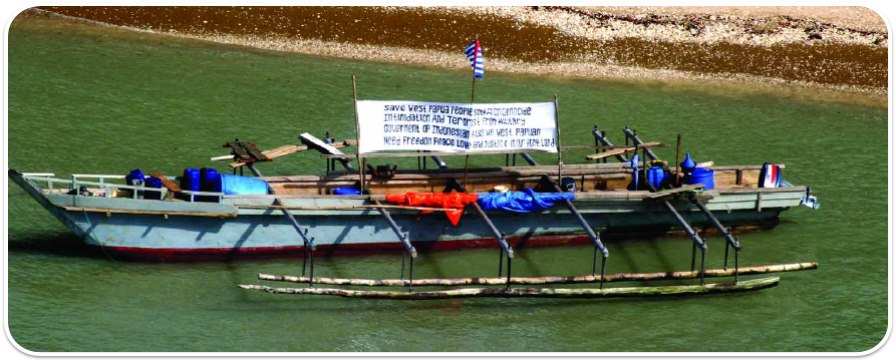
The boat that brought 43 West Papuan Asylum seekers to Australia, putting Papua back on the front page and touching off a diplomatic storm . Photo Damien Baker, Mapoon, Queensland, Australia January 17th, 2006

January 17, 2013. The Demonstrations commemorated the escape to freedom by 43 West Papuan refugees on January 17, 2006, when, after paddling across open ocean for four days and surviving a violent storm, they beached their traditional canoe in Australia and found asylum. Myself – Herman Wainggai  – am one of those 43.

The Free West Papua Political Prisoners Team in Washington DC is a group of academics and human-rights activists who are willing to stand up for justice and work toward a free West Papua that is independent from military and corporate colonization.

Photo :  Free West Papua Political Prisoners Campaign Team, Washington DC, USA
Photo : Free West Papua Political Prisoners Campaign Team, Washington DC, USA

Human Rights Watch reports that Indonesia has incarcerated nearly 100 activists from Maluku and Papua for peacefully voicing their patriotism and political views.  As one of those former political prisoners forced into exile, I am now a visiting scholar at George Mason University, after being imprisoned for more than two years after daring to raise the West Papuan flag. My uncle, Dr. Thom Wainggai, died while imprisoned for the same demonstration of patriotism.

Free West Papua Campaign in Los Angeles, California

“I want to commend Moana Nui for organizing this demonstration on behalf of the people of West Papua to give voice to their fight for freedom and self-determination.  We call on the leaders of all governments to stop supporting human rights abuses, murder, genocide and the military occupation of West Papua. To our brothers and sisters in West Papua: Continue to fight for what you know is right, for your freedom, your culture, for humanity.  Know that, in this fight, you are not alone.” Harold Green.  http://mnaa-ca.org/jan-17-2013-west-papua-action/


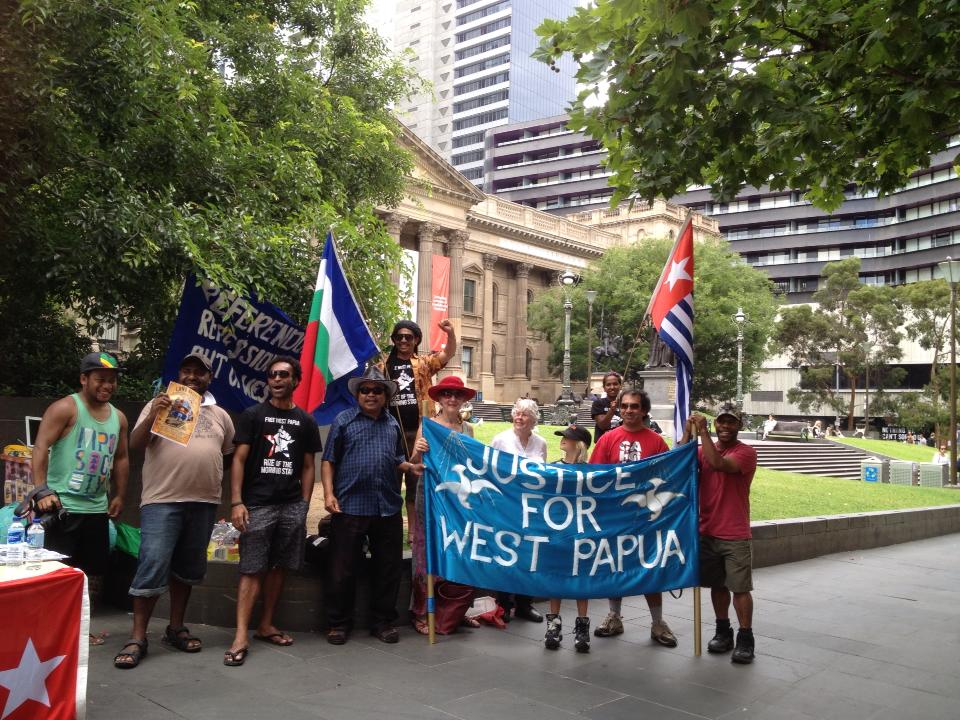
Free West Papua Campaign in Melbourne

Foreign Affairs Minister of the Federated Republic of West Papua, Jacob Rumbiak, said international activists are demanding that Indonesia remove its military personnel, and that president Yudhoyono must issue orders to stop the slaughter of West Papua National Committee (KNPB) members.

“Six activists were arrested and tortured in Serui yesterday for handing out pamphlets about today’s rally, including Patris Rosumbre (Vice Governor, Saireri State, Federated Republic of West Papua) and Menase Karubaba,” he said. Rosumbre has since escaped, but the whereabouts of Karubaba are not known, and there is deep concern for his safety.

Photo Free West Papua Campaign Melbourne, Australia January 17th, 2013

The Federated Republic of West Papua has called for negotiations with the Indonesian government under the auspices of the United Nations since 2011, and, Rumbiak claims, “Indonesia is losing credibility with its international donors in failing to respond to our invitation.”

Free West Papua Campaign in the Solomon Islands

In a statement from Honiara, Chairman of Solomon Islands for West Papua, Rexy Roses, highlighted that more than 50 years of tyranny and

Photo Rexy Roses, Solomon Islands for West Papua, 17th January 2013

immeasurable human rights abuses suffered by the indigenous people of West Papua at the hands of the occupying Indonesian military forces is more than too much to bear, and it is now time for dialogue and negotiations to end the violence in West Papua and to allow a peaceful referendum. This year will be a challenging one, and we will ensure that the cries of the indigenous Melanesian people of West Papua be heard in every corner of the Pacific and beyond.

Since the recent peaceful demonstration in Yapen Island and Manokwari, I have been told that the military agents are increasing their violent activity in West Papua and in many other places around West Papua. It is not difficult to imagine the impact that tens of thousands of Indonesian troops have on the daily lives of the West Papuan people. This new action by the Indonesian military raises the question: Why would Indonesia send so many troops to West Papua? Is this to intimidate the West Papuan people, to deny us our freedom of speech and prevent us from peacefully gathering in the land of our ancestors to debate and challenge the domination of our land and freedom? This recent West Papua Media report clearly states that the Indonesian government does not provide for the protection of human rights in West Papua.

For West Papuans, daily life is a nightmare, full of pain, suffering, torture, rape and bloodshed. There is no freedom to speak or act freely. The systematic oppression, terror, intimidation, kidnapping, incarceration, poisoning and murder of indigenous Melanesians in West Papua has not changed since I fled the country in 2006. It’s time to support the West Papuan people in their struggle for human rights and political independence.

Herman Wainggai is a West Papuan civil resistance activist based in Washington DC USA, and former political prisoner.  He lectures in strategic non-violence and civil resistance and is a visiting scholar at George Mason University, Washington.


Create a website or blog at WordPress.com

Up ↑