BRINGING AN END TO THE CONFLICT IN PAPUA THROUGH JAKARTA-PAPUA DIALOGUE

Opinion / Analysis

By: Selpius Bobii

December 31, 2013

Peace is critical to the continuation of life for human beings, though we find it hard to achieve in even our everyday lives. West Papuan Nehemia Yarinap stated that “Christ Jesus came to bring peace to the earth, however the characteristics of humans are such that they sometimes fail to reach peace and truth due to acting in the interests of political economics, oppressing other nations of peoples in the name of peace. At this time in the modern world, there are  powerful nations oppressing and usurping the rights of other nations.” Yarinap’s points to the annexation of the sovereign independence of the nation of Papua into the Republic of Indonesia, commenting “ to realise peace and justice in Papua so many have sacrificed themselves and continue to sacrifice their lives just as Jesus Christ sacrificed himself to bring peace to humans on this earth….. Christmas reminds all people about peace and speaks to us that those characteristics that oppress other nations must change.”(1)

The dynasty of tyranny of Indonesia is now firmly established in Papua. In all areas of life  the Indonesian State has firmly established those pillars that ensure the continuation of Indonesia’s oppression, even in religion. Indonesia has to that end consistently brought  pressure to bear on those key Papuan figures in the churches who have continued to speak openly about the realities of discrimination, marginalisation, injustices and humanitarian atrocities that are occurring against the indigenous people of Papua. There have been accusations made that those such church persons too are themselves involved directly in the politics of Papua. Accusations that are particularly of recent times aimed at weakening the case for dialogue between Jakarta and Papua which has been encouraged by particular church figures.  If the Church also becomes a pillar of support for this dynasty of oppression by Indonesia, then the church itself will in so doing lose both its very foundation as well as its direction.  In that instance the church would be torn from its very roots and mission as handed down by Jesus Christ, being to save the world.  The church in Papua  must stand strong as a beacon of hope to the people and not become a partner of the State of Indonesia in the colonial domination of the indigenous people of Papua.

The Papuan Writer Usman Yogobi stated that “ The countenance of the Church in the land of Papua is such  that it has become  a partner for the Indonesian Government, with some reverends, bishops, pastors, pilgrims and monks supporting the colonial domination of the land of Papua. ‘Papua the Zone of Peace’ as declared in 2002 has never been realised, with the reality being quite the opposite – Papua has become a region of humanitarian disaster!

The term ‘Zone of Peace’ which arose from leaders of the different religions in Papua in 2002, has even been adopted recently by the Indonesian Military Commander in Papua (XVII) and the Head of Papuan Provincial Police. They have used the term in speech, letters or on banners, whilst in practice the Indonesian military and police have continued to carry out acts of violence and human atrocities against the indigenous people of Papua” stated Yogobi. The Church in Papua needs to learn and better understand its mission as handed down by Christ Jesus, being to bring salvation to the world. The salvation of souls is not just a matter of becoming oriented with the hereafter, but rather it’s about saving lives on this earth.

The law of the church prohibits representatives of the church being practically involved in politics, however at the same time it’s important to understand that the very teachings of the churches stress the importance of the church being involved in a real way in the life of the people. There is no such thing as evangelisation without social involvement; no such thing as mission without the struggle for justice. The church has a moral responsibility to be socially involved and to fight for justice and for respect of the dignity of humanity.

Dialogue between Jakarta and Papua which is being urged by the Peace Network of Papua – coordinated by the Catholic Priest Neles Kebadabi Tebay (Pr) – is a part of the involvement of the church in the upholding of justice and the respect of humanity dignity. If the church only speaks of justice and criticises human rights violations but does nothing to point to a way to bring an end to the conflict in Papua, then the human rights violations in Papua will continue without ceasing. Rather the church needs to itself open a way or point to a way forward.  Dialogue between Jakarta and Papua is a way of enabling such discussion as required to deal with  the many problems so as to find a dignified solution to the Papuan issue.

So let’s work together to lead the way to bringing about dialogue between Jakarta and Papua to find a solution that upholds the dignity of all.  Indeed there are more than one way to bring about an end to the problems in Papua and it is important that other approaches being made are also continued such as the legal approach and the United Nations decolonisation approach.  And as we struggle let’s always remember that the Struggle of Papua does not use violence or physical force but rather our means are always peaceful. As wherever violence is used there are inevitably human victims lost and indeed Indonesia has and continues to kill Papuans by a range of violent means. Over this more than 50 years endless innocent victims have been killed as a result of Indonesia’s actions in Papua. There’s been enough killing by Indonesia. Let’s bring an end to this cruel colonial domination using strictly peaceful means.

Indonesia and Papua really need to be enlivened to bring this about and its important we leave any narrow thinking paradigms. As the consequence of such is but to extend this conflict and more fallen victims, which are not small in number. Let’s take this never-ending conflict between Papua and Indonesia to the table and carry out unconditional peaceful dialogue as between two equal parties, facilitated by a neutral third party and in a third and neutral location. The international community including the USA has previously expressed its support for the path of dialogue between Jakarta and Papua; and it is the Writer’s conviction that all those who seriously uphold the values of the human rights, democracy, truth, justice, honesty and peace will also support a peaceful and dignified approach to finding a solution to bring an end to the problems in Papua. So let’s all work together to make dialogue between Jakarta and Papua a reality!

The Indonesian President Susilo Bambang Yudhoyono  has numerous times stated in speeches that the problems of Papua will be brought to an end in a peaceful and dignified way. Also is recalled the words of the Head of the Council of Presidential Advisors Dr Hasibuan in January 2013, that the President had promised to arrange dialogue between Jakarta and Papua during the year 2013. However that promise has not yet been fulfilled.  A ‘promise’ is as something that is owed and must be paid and President SBY needs to fulfil that promise. It is dearly hoped that before President SBY’s term as president comes to a close on 20 October 2014 that this very extended conflict between Indonesia and Papua can be brought to an end through peaceful and dignified means and that it might become the hope of all parties to make that a reality.

Footnote

  1. 1.        The Bible of the Christian Religion  talks about the ‘Garden of Eden’ that radiated the glory of God and where there was peace and prosperity.  Where there were no wild beasts but rather all creatures lived together in peace. Then it is written, that peace was destroyed by the wrong of the first humans and therein began anarchy on the earth. Humans in all places seek after that peace which the Bible speaks of. Yet we see in the world that powerful humans prey on those weaker than themselves. The rich get richer and the misery of the poor becomes greater.

Selpius Bobii is the  General Chairperson of Front PEPERA & is a Papuan Freedom Political Detainee in Abepura Prison, Jayapura


Bobii: Indonesian Armed Forces, the main Anti-Peace Agents in Papua

By Selpius Bobii  writing from Abepura State Prison, Jayapura

 Opinion

December 24, 2013

Every religion teaches values of goodness and kindness and has teachings that are intended to create happiness and peace on this earth and in eternity.  We hear so many people speak of the importance of peace, but the reality is that it’s not that simple to realise peace in our everyday lives. In the Papuan province of Indonesia it feels like peace is so far from becoming a reality for the indigenous people who live there.

Of late the Cenderawasih XVII Military Commander in West Papua has been coining the phrase “Peace is beautiful” and yet at the same time the Indonesian Armed Forces continue to be the number one culprit committing acts of violence and humanitarian atrocities against the indigenous people of Papua.  Behind the mask of these sweet words the Armed Forces are clearly acting very much against the creation of peace in Papua.

 Peace can be realised in a place when every person, every group, every faction, respects the rights of others; and this extends to nations and tribes. Where each is able to exercise their rights and at the same time fulfils their obligations towards others. It seems however in Papua that the realisation of peace is something that’s incredibly difficult to achieve, with the root cause of that being the lack of recognition of the very basic political rights of the people of Papua by all three Indonesia, the USA and the United Nations (UN).

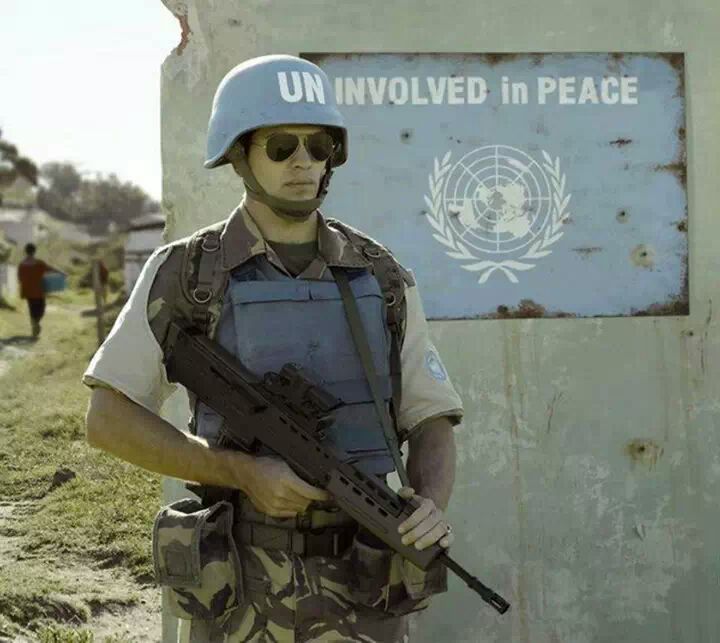
(UN)involved in Papua's desire for Peace; very involved in its atrocities (Photo: Public domain)
(UN)involved in Papua’s desire for Peace; very involved in its atrocities (Photo: Public domain)

With the USA and UN’s active support throughout the entire process of annexation of Papua into Indonesia in the 1960’s, they indeed played a part in the actions of violence and atrocities against the indigenous people of Papua.  They achieved their goal of making Papua into ‘the kitchen of the world’, opening it to the many international companies that have been stripping Papua of its rich natural resources ever since. It was not to end at the annexation of Papua, as they have continued these last more than 50 years to support Indonesia’s hold on Papua which in turn keeps the door open for exploitation of the land.  There have been various forms of aid and in particular joint programs in security and defence, which of course are critical to Indonesia’s continued domination of Papua.

The Indonesian Armed Forces have by intention made Papua into a centre of conflict, but for what end?  In so doing they create a situation where the indigenous people can be paralysed, can be annihilated and the world just keeps quiet, with Indonesia saying they are dealing with the conflict. The result?  Papua remains permanently part of Indonesia and its natural resources can be exploited with ease by international parties.

Let’s not be fooled that the partnerships going on between Indonesia and other nations of the world in the areas of security and defence are aimed at peace building and protecting the people of the region as claimed. Nothing could be further from the truth! The reality is they have quite the opposite goal! The Indonesian Armed Forces are the main agents intentionally creating violence, bondage and theft of natural resources, discrimination, marginalisation, injustice, terror, intimidation and humanitarian atrocities against the indigenous peoples of the land of Papua. Their military and civilian operations both overt and covert are intended to slowly but surely annihilate ethnic Papuans.

The many forms of both visible and hidden violence and humanitarian atrocities undertaken by the state of Indonesia against indigenous Papuans are intended to stifle the political aspirations of Papuans for independence and at the same time annihilate the people. In the face of this continued violence against their people the indigenous peoples of Papua continue to express their opposition to the many human rights violations by peaceful and dignified means, primarily by means of peaceful demonstration. Yet even the narrowest space for a voice calling for democracy has been blocked by the Armed Forces in recent times, especially by the Provincial level of Indonesian Police.  The Provincial Police are known for their practice of taking advantage of occasions when there are peaceful demonstrations to create conflict and to terrorise, torture, kill, arrest and imprison Papuans who struggle peacefully for change.  Indonesia’s Armed Forces are constantly manipulating activities of the Struggle to create incidents of violence. Nevertheless Papuans continue to struggle peacefully in keeping with their decision at the 2000 2nd National Papuan Congress.

And so in the midst of all this, now it is Christmas. Where all parties in Papua hear of the message of ‘the coming of the King of Peace’.  A message that reminds humanity that Jesus Christ came to bring peace to this earth.  A message that starts to have real meaning only when entire communities of humans make space to allow for peace in their hearts.  To that end let’s all prepare our hearts with simplicity, faithfulness, honesty and love for one another. We are each one of us reminded by the message of Christmas.

It is dearly hoped that the message of Christmas will also touch hearts and bring awareness to those who are committing the many forms of violence against indigenous Papuans. That there might be a commitment to bring an end to all forms of oppression towards indigenous Papuans and to enter into dialogue between Jakarta and Papua with a neutral facilitator. To reach that end we need to be ready and willing to humble our hearts, to be faithful, honest and to act in love. Only in that way can we bring peace to the land of Papua.  We are all called to bring an end to the latent conflicts in Papua and to create peace, no matter who we are and wherever we may be.

Peace and joy at Christmas to all and throughout 2014!

Footnote:

  1. 1.       The Dutch previously tried to prepare Papua to become an independent nation whilst still under their control, with those preparations reaching a peak on 1 December 1961. However less than a month later on 19 December 1961 Indonesia by a political and military invasion marked by what’s known as Trikora (a three prong command which demanded the dismantlement of the “puppet” Papuan state created by the Dutch; the raising of the Indonesian Red and White flag over Papua; and preparation for a general mobilisation in Papua) succeeded in annexing Papua into the Indonesian Republic.

Selpius Bobii is the  General Chairperson of Front PEPERA & is a Papuan Freedom Political Detainee imprisoned in  Abepura State Prison, Jayapura, Papua, for another Christmas.


Bobii: INDONESIA CAUSES DELAY IN MSG FORUM DECISION ON WEST PAPUAN MEMBERSHIP

by Selpius Bobii in Abepura Prison, West Papua

21 December, 2013

Opinion / Analysis

In June 2013 the Indonesian Coordinating Minister for Politics, Law and Security Djoko Suyanto invited the Melanesian Spearhead Group (MSG) to send a delegation to visit Indonesia(1).  At the 19th Summit of the MSG on 21 June 2013 the MSG leadership determined that the question of the application for MSG membership by West Papua would be decided at the latest within 6 months of that meeting, following receipt of a report on a visit to Indonesia by the MSG member Foreign Ministers.

It is now 6 months to the day since that decision was made and yet the MSG Foreign Ministers have not yet visited Indonesia due to the lack of certainty concerning the invitation from Indonesia.  It is now clear that Indonesia’s supposed invitation was but a political snare to delay the MSG leadership’s decision regarding West Papua’s application for MSG membership.  Meanwhile Indonesia has been busy throughout this 6 months lobbying and making offers to the individual MSG member states in order to influence the outcome of that decision.

Indonesia is extremely sly and cunning in the way it plays its ‘Indonesian puppet’ politics. It was with the very same slyness that enabled Indonesia to succeed in annexing West Papua into the Republic of Indonesia in the 1960s and which has enabled Indonesia to maintain its hold on Papua ever since. Indonesia has undertaken all possible means to influence the international community such that West Papua to this date remains within the region of RI’s power, and Indonesia’s invitation to the MSG in June 2013 was but one of RI’s political strategies to that end.  It was an intentional ploy to cause Papua’s efforts to become a member of the MSG to fail.

From the time news was heard of Indonesia’s invitation to the MSG, the indigenous Papuan community already knew that Indonesia would not follow through in fulfilling its commitment to enable the MSG visit to Jakarta and Papua; and that has now become a reality.  Meanwhile almost all of the member nations of the MSG have fallen right into the snares set by Indonesia, allowing themselves to be manipulated so as to meet Indonesia’s purpose of defeating Papua’s application for MSG membership.

Indonesia has not only tricked the Melanesian nations individually in this way and has tricked them as a united body in the MSG regarding the supposed invitation, but has at the same time deceived the international community in regards to the same. So many have been hoping and waiting for the outcome of this matter, many of whom have made sacrifices to uphold truth, justice and dignity of the West Papuan people.

Indonesia’s deceit of the MSG Forum in this way just serves to heighten the perception in the international community and for some of the MSG members that Indonesia as a state is chronically lying to the world. There have been endless occasions when RI has wilfully lied in order to maintain its hold on West Papua within Indonesia and so many have been deceived by Indonesia’s cunning and sly ways in this regard. The tragic consequence being that as a result many parties have chosen to ignore the urgent humanitarian problems in West Papua, problems the ramifications of which are most horrifying indeed. Problems that Indonesia for 50 years has gone to great efforts to hide from the world.  And so determination of the legal and political status of Papua according to international law has also been delayed.

Discussions in relation to the human rights violations and the legal and political status of the West Papuan nation at the 19th Summit of the MSG in Noumea, gave a breath of fresh air and new hope to the indigenous community of West Papua. To a people who have been under the cruel colonial domination of Indonesia and its allies for over 50 years. It is dearly hoped that this new hope born of the 19th MSG Summit will not just elapse like the passing of time; and that it will not be brought down by the many offers made by the Indonesian government and its allies to the MSG member states.  Rather the Melanesian people of Papua hope and pray that the stated commitment of the 19th MSG forum will be upheld and defended, seeing West Papua given full membership at the MSG and consequently of the Pacific Islands Forum.  Such that in time the problem of Papua can be dealt with by the official mechanisms of the United Nations and the nation of Papua become independent and set free from all forms of tyranny, oppression and enslavement.

The commitment of the MSG Forum at this time is indeed being sorely tested. Will the MSG leadership have the courage to decide in the near future to make West Papua a full member of the MSG without having to wait for a report from a now much delayed visit of the MSG member Foreign Ministers to Indonesia? Or will the MSG leadership delay that decision and succumb to the influence of the cunning politics of Indonesia and its allies?

The indigenous community of Papua and those in the international community who care about the fate of West Papuans, are following the political wake from the last MSG Summit. All are awaiting a decision of certainty on West Papua’s application for MSG membership as a first real and effective step towards eventually bringing the problem of the legal and political status of West Papua to the mechanisms of the United Nations.  As the people of Papua have not struggled for more than 50 years  to take something that rightfully belongs to another, but rather to have the sovereign independence of the people of Papua recognised by the world.

Footnotes:

1. That invitation was conveyed by Suyanto when he met with the Fijian Prime Minister (at that time the Chairperson of the MSG) in Suva, Fiji. 

Selpius Bobii is the  General Chairperson of Front PEPERA.  This article is written from Abepura Prison, Jayapura, Papua, Indonesia

 Related articles

Bobii: Manufactured Scenario resulting in Death of a Papuan Warrior

Statement

18 December, 2013

 by Selpius Bobii

The death of General Danny Kogoya of the National Liberation Army of the Free Papua Movement (TPN / OPM) on 14 December 2013 in the border town of Vanimo PNG was not a natural death but rather a death caused by a scenario that was created by the Indonesian Armed Forces.

On 2 October 2012 Kogoya was invited by someone to meet them at the Banana Leaves Hotel in Entrop, Jayapura. Once there he and his companions were besieged by Indonesian Armed Forces who shot and disabled Kogoya by shooting one of his feet, even though  he had shown no resistance and had no intention of fleeing.

His foot was amputated at the Police Hospital Bhayangkara without being allowed to have a family member present.  Only a few days after the operation he was taken to the Police District Command Headquarters to undergo interrogation, despite having just experienced a most traumatising injury followed by a major operation. Throughout the time he was held by the Armed Forces he did not receive adequate medical attention.

When taken before the court an almost unheard of situation occurred, with the extension of time for Kogoya and his companions’ cases to be processed as applied for by the public attorney, actually expiring before the judges had reached their decision.  With the result that Kogoya and his companions were released under the law on 10 May 2013, even though they had been previously charged under the extremely serious charge of treason (makar).

Following their release, Kogoya fled over the border to the town of Vanimo in PNG to seek safety and treatment for his foot. According to the General Chairperson of the National Committee of West Papua (KNPB) Victor Yeimo, the results of the medical examination at the Vanimo Public Hospital showed remaining symptoms suggestive of possible poisoning.  This has led to suspicions by some that Kogoya may have been intentionally given a highly toxic chemical at the time his foot was amputated at the Indonesian Armed Forces hospital,  that has such an effect on the body organs that it kills the body slowly (1).

Finally on 14 December General Kogoya died due to the combined causes of an infection of his amputation wound as well as kidney failure.

The Indonesian Armed Forces clearly did not want Kogoya to die in custody which would have attracted attention. The circumstances point to the Armed Forces having interfered with the matter of the legal provision for an extension of time a person can be detained up to the time the court passes sentence.  As it is suspected that the processing of Kogoya and his companions cases in the Jayapura court were intentionally delayed so that the period they could be legally detained would expire before the panel of judges had handed down criminal sentence, thereby creating a scenario whereby the prisoners would be released avoiding General Kogoya dying in custody.

It is a rare occurrence indeed for Papuans who have been arrested and accused of treason, to be subsequently released due to the expiry of the period approved by the courts for them to be detained  before there is a sentence handed down by the courts. Usually if the time approved is about to expire or has just expired and the judges still haven’t handed down their decision, the authorities and the prison authorities work together to arrange an  further extension of time.  In the instance of the late Eko Berotabui and his associates for example in 2006 when the period he could be detained prior to the courts ruling had expired and the family and lawyers were pressuring for his release, the prison  and authorities worked together to issue a new document extending the period he could be detained.  Similar circumstances also arose in the case of Filep Karma and associates in 2005 with the prison and authorities working together to detain him on the stated basis of awaiting the decision regarding criminal cases. However in the case of Danny Kogoya there was distinctly something else going on.

It is strongly suspected that the Indonesian authorities created a set of circumstances to hide their covert killing of the Papuan independence warrior General Danny Kogoya. This is not the first time the Papuan community has seen such methods applied to hide the Indonesian Armed Forces killing of Papuan liberation warriors. Such means are extremely cruel and amount to a most evil inhumane act against a human being.

The organisation Front PEPERA:

  1. Demands that the Republic of Indonesia (RI) take responsibility for the death of General Danny Kogoya.
  2. Demands that RI cease killing indigenous Papuans by both overt and cover means.
  3. Calls on the International Solidarity community to lobby RI and the United Nations to treat exhaustively the problem of the legal and political status of West Papua.

 Footnote.:

  1. 1.      The majority of the Papuan indigenous community is convicted that poisoning is being frequently used by the Indonesian forces in Papua against the indigenous community.

 Selpius Bobii is General Chairperson of Front PEPERA and is a Papuan Freedom Political Detainee held in  Abepura Prison, Jayapura, Papua, Indonesia


A Tale of a Flag

Opinion/Analysis
by Sri Lestari Wahyuningroem
1 December 2013
This is a tale about a flag named Bintang Kejora, or Morning Star.

As with other flags ever created, it symbolises identity and conveys particular messages the creator would like other people who see it to understand.

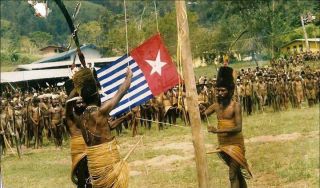
Morning Star flag being raised by Yali tribesman (supplied)

But unlike other flags, the Morning Star flag is different. Its creation rendered the power outside of it to repress the identity and message it wants to convey. It conversed sovereignty into sufferings, as more and more human bodies, the West Papuans, have to be ill-treated or persecuted of being accused of committing wrong to the Indonesia state.

What is right, human rights, then turned out to be very wrong for the power that rule the territory. Unlike other flags ever raised in other areas in Indonesia, such as the Yogyakarta Kraton flag, the raising of Morning Star is subversive to the very fundamental base of Indonesia’s territorial unitary state, or Negara Kesatuan Republik Indonesia (NKRI).

December the 1st, each year, marked the conversion of the flag. Fifty three years ago, the Dutch who colonized the territory called Dutch New Guinea gave the recognition to the flag to raise together with the Netherlands’ national flag, and marked the commitment for the Dutch to prepare the transition for independence. The flag raised high to the sky but only lasted for two years, before Indonesia state banned it. And so it has never been up again, to tell the world about peace and sovereignty. Every West Papuan who tried to raise it will bear the consequences of loosing his lives either in prison or in grave. Or perhaps in none of those places when both life and body are unknown their whereabouts such as tens to hundreds of West Papuans that went missing after military tanks and personnel crushed a gathering of the flag raising led by Filep Karma in Biak, 1998.

It was a Papuan named Thom Beanal, with ninety-nine other Papuans, who loudly state that the day when the flag was first raised, 1st of December, is the day of West Papuan independence. He said it in front of Habibie, Soeharto’s  successor as the President of the Republic of Indonesia. A scholar, Richard Chauvel, notes that the perception of the flag’s raising on that particular date in the then new political transition in Indonesia gave a new meaning for a nationalist identity of the West Papuans, and convey a message for a new hope for independence (Chauvel, 2005).

In 2001, the then President Abdurrahman Wahid, allowed the flag to rise again that year. The Papuans were overwhelmed with joy and new hopes, despite of the facts of their self-proclaimed leader Theys Eluay were jailed by Indonesia’s authority (which then released and murdered in the same year).

The next story is again dark and dishearten.  The Bintang Kejora has again conversed from a symbol for sovereignty any human need to continue his/her life, into a symbol of the oppressed body, the body full of sins of being itself and thus eligible to be destroyed by the power that rule over it. Every body and soul, who wish to see this piece of cloth with a picture of morning star perform its symbol of sovereignty, will add to more stories of grievances. At the same time, this flag has become more and more strongly wave up in every Papuan’s heart, as hopes for sovereign souls and nation becomes stronger each day.

At the flip side of the coin, the flag is more and more threatening for Indonesian authority. Every years before and during 1st December the central government overly reacted to their own insecurity by deploying thousands of military and police personnel to Papua. It’s for the sake of the security of the Indonesian power, indeed, not for the West Papuans, by showing off power and brutally suppresses anyone who has the intention to raise the flag.  Anyone.

This year, since the last few weeks before 1st of December, already 33 activists members of Komite Nasional Papua Barat (KNPB or National Committee for West Papua) has been arrested and local media Tabloid Jubi reported intimidation against four of its journalists. Amnesty International reported the strong indication of torture and other forms of ill-treatment they have in detention, and extrajudicial killing against some of the activists (Amnesty International, 2013). The last few days when I’m writing this, already several shootings were reported in some areas in Papua.

No willingness for any peace dialogue by the Indonesian government has ever expressed. Instead, the choice is always by force and new promises. But no beautiful promises from the central government can ever compensate every injured and destroyed body of the West Papuans who gave their lives to see the flag up in the sky all these times. Not even a promise of a new special autonomy scheme called ‘Otsus Plus’, nor the recent decision by Indonesian parliament to dissolve Papua into another 33 districts and three new provinces. A small numbers of local elites, unfortunately, would trade their souls with such promises, abandoning justice and dignity the rest of the West Papuan people have been struggled and sacrifice all these time.

Justice, dignity, and sovereignty. These are the message every soul in Papua wish to convey through the recognition of the Morning Star flag.

Sri Lestari Wahyuningroem is a Political Scientist and ANU PhD candidate, and has been a teacher and researcher at University of Indonesia, and has been involved in social activism for issues on gender, democracy, human rights and post conflict.  She is also currently a researcher in transitional justice in Indonesian democratisation.


Create a website or blog at WordPress.com

Up ↑