What Kind of Solidarity for West Papua? A response to Martin Pelcher’s article ‘Fear, Grief and Hope in Occupied West Papua’
by Jason MacLeod
DISCUSSION PAPER
In a recent article, ‘Fear, Grief and Hope in Occupied West Papua’, author activist Martin Pelcher issued a thought provoking challenge to international advocates working in solidarity with West Papuans. Pelcher, who is predominately speaking to ‘White’, ‘Western’ activists, argues that a recent surge in state violence against Komite Nasional Papua Barat (KNPB – the West Papua National Committee) is cause for re-evaluating international solidarity for West Papua. Pelcher wonders whether Western support for Papuan freedom might be counter-productive. While there is much in Pelcher’s article that I agree with I think Pelcher lets Western solidarity activists – and by extension governments and transnational corporations who support the Indonesian government’s continued occupation of West Papua – off too lightly. Reflexivity is essential but we need to ensure that Western activists do not avoid responsibility for challenging the way Western governments and corporations fuel violence and exploitation in West Papua. Solidarity activists can take comfort in the fact that a broad spectrum of Papuans[1] are also asking for international support in ways that respect and strengthen their own agency.
Pelcher’s piece is an invitation to dialogue. It has already generated much conversation. The call to make that conversation more public, or visible amongst growing international solidarity networks, has been picked up by the West Papua Advocacy Team in the United States and also by the Faith Based Network for West Papua who encouraged people to respond to Pelcher’s article. This piece is a response to that invitation and written with the desire to continue the conversation.
Pelcher’s original argument
Western support for a free West Papua taps into deeply embedded Indonesian narratives of western imperialism. Pelcher writes that this is not just lingering nationalist hurt over the loss of East Timor. Even progressive Indonesian activists support West Papua’s continued integration into Indonesia. Notice, for example, Indonesian Friends of the Earth’s (WALHI) recent failure to publicly support their representative in West Papua, Fanny Kogoya when she was forced into hiding because of her links to KNPB. Indonesian citizen support for the occupation is a tremendous source of power for the state that helps the state maintain and justify military aggression.
Although attacks on KNPB have received more coverage – in what is still a grossly under-reported struggle – other groups also continue to be targeted by the state. Papuan political prisoners in jail represent both highlanders and islanders and a broad diversity of political groups. Political organisations aside from KNPB who also pursue independence include the Federal Republic of West Papua, West Papua National Authority, AMP (Aliansa Masyarakat Papua), AMP-PT (Aliansa Masyarakat Papua – Pegunungan Tengah), DEMAK (Dewan Masyarakat Koteka), Sonamapa (Solidaritas Nasional Mahasiswa Papua Barat), FNMPP (Front Nasional Mahasiswa Pemuda Papua Barat), West Papua National Youth Awarenesss Team (Westpanyat), AMAK (Aliansa Masyarakat Anti-Kekerasan), ParJal (Parlamen Jalanan), Garda and others. Activists in other parts of the country like Fak-Fak, Manokwari, Yapen, Merauke and elsewhere have also been hit by the repressive force of the Indonesian state. Even groups that eschew an overt political agenda, preferring to expand the contours of freedom through campaigning for basic rights, are routinely harassed by the state. They include civil society groups like Elsham Papua, Dewan Adat Papua, Bersatu untuk Keadilan, Foker LSM, Jubi, Kontras, the churches and others. Some human rights defenders have had to periodically relocate themselves and their families to Jakarta to protect themselves from intimidation and threats.
Papuans also consider the TPN-PB (Tentara Pembebasan Nasional – Papua Barat), or National West Papuan Liberation Army – which consists of a decentralised network of groups based around attachment to clan, tribe, and geographic area – an important part of resistance to the Indonesian state. But in terms of numbers, activities and effectiveness the TPN-PB are marginal players. Members of the armed struggle are routinely co-opted by the state to further the Indonesian security services own aims, whether that is about protecting vested private business interests – mostly in logging, mining and extortion – or pursuing national security objectives designed to weaken and destroy the Papuan independence movement.
The random and brutal nature repression by the Indonesian state means that citizens not actively involved in the freedom movement routinely become victims of state violence. In his article Pelcher focuses on KNPB but alludes to the fact that the whole of Papuan society is caught up in the same repressive net. Papuans live with this foreboding sense that they, their family members or their friends could be targeted at any time.
In seeking to explain the state repression in West Papua Pelcher reminds us that the Indonesian nation was formed and defended in the context of a long, and relatively recent, anti-imperialist struggle against the Dutch. Nearly two decades after Indonesian nationalists declared independence in 1945 Sukarno launched a military invasion to wrest back control of what he called the “Dutch Puppet State”. For this reason, as well as for the fact that West Papua’s inclusion into the Indonesian archipelago reinforces a multi-ethnic, multi-religious Indonesian identity, West Papua’s inclusion in the Unitary Republic of Indonesia is a source of tremendous pride for the overwhelming majority of Indonesians, including left wing activists. This view is deeply entrenched. The fact that the Indonesian political elite also gained control of bountiful supply of valuable natural resources was simply icing on the cake. Western narratives of Papuans nonviolently fighting for democracy, rights and national liberation against a brutal military occupation are rendered immediately suspect, tapping into what many Indonesians believe is a ‘hidden agenda’ by the West. The narrative of a Papuan led anti-colonial resistance struggle does not easily fit with the dominant Indonesian view that they liberated Papua. Instead sympathetic Western portrayals of the Papuan struggle are re-cast and attached to ulterior motives. Pelcher:
Western support for East Timorese independence – and signs of such support being extended to West Papua – have been easy to frame [by the Indonesian press] as vehicles for the West’s neo-imperial manipulation and pursuit of the region’s abundant mineral and petroleum resources. The more Western advocates succeed in focusing global attention on the plight of Papuans under Indonesian rule, the more the Indonesian security establishment can deploy the spectre of a “foreign intervention” (like the UN’s intervention in East Timor) to mobilize Indonesian public opinion behind its harsh policing measures.
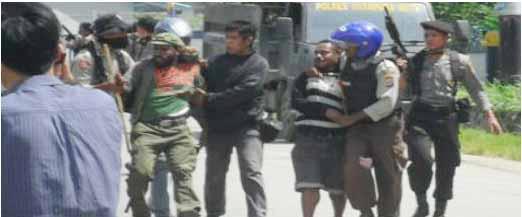
One of the reasons why Pelcher’s article is so challenging is that he writes to us as an insider, as a fellow solidarity activist, who is searching his conscience for answers to the question ‘what to do?’, and in doing so prompting us to search our own conscience. And it is not as if the issues he raises have gone away. Since Pelcher wrote the article attacks against KNPB have gotten worse. The Indonesian state has all but “declared war” on the pro-independence civilian based organisation. At the time of writing 22 leaders had been summarily executed by the security forces. Scores have been arrested. Much of the leadership has been driven underground and into exile … but KNPB maintains it’s politically defiance stance. The group’s leader, Victor Yeimo continues to insist that KNPB is committed to resolute nonviolent resistance and will not back down from its call for a referendum.
So what should international advocates do? Pelcher has more questions than answers. He acknowledges that Western advocates are increasingly putting Papuan human rights on the international community’s agenda. Pelcher also recognises the work of Papuan human rights defenders and their allies in Jakarta who have raised questions about the Indonesian security forces use of summary justice instead of legal means to investigate acts of violence. However, the dominant story in the Indonesian media supports a police narrative that pins “the blame on the student activists of KNPB as well as the wider network of underground Papuan nationalist resistance.” The central question Pelcher raises in his article is how can international advocates generate global solidarity against injustice in West Papua without strengthening the state’s pretext for terror?
Papuans are the drivers of the struggle
I agree with Pelcher that Papuans are the drivers of the struggle. The more Papuans rise up and collectively and nonviolently resist the occupation the more the legitimacy of the Indonesian government’s continued aggression in West Papua is strained; the more likely more people outside Papua will stand in solidarity with them, and the more effective that solidarity is likely to be. Papuans are the primary architects of their own liberation. While external solidarity is important it will always be secondary to movements for change inside the country. We need critical reflection about the role of external solidarity. As well as reinforcing the way the security forces frame Papuan resistance as a foreign led plot, at times international solidarity action has tended to tap into unrealistic Papuan beliefs about the willingness and ability of the international community to assist Papuan freedom goals. Although solidarity in other parts of Indonesia and international solidarity outside Papua is necessary to support Papuan freedom goals, by itself it will never be sufficient. We need solidarity that is respectful; solidarity that strengthens collective action that is led by Papuans. We need less solidarity action and rhetoric that fosters dependency, passivity and false hopes that outsiders will save the Papuans. They cannot. They will not. As Benny Giay, the moderator of the Papuan church once said, “Papuans are the captains of their own lives.”
South-South solidarity
Pelcher is not arguing against solidarity; he is asking what kind of solidarity might be most useful to the Papuan’s struggle for freedom. Some solutions are implicit in his article, others Pelcher is more forthright about. In particular, Pelcher calls for more “south-south” solidarity as a necessary corrective to White Western perspectives.
Two types of South-South solidarity are particularly important. The first is solidarity from Pacific Island countries, particularly the Melanesian countries. Why should other states worry about what is happening in West Papua when Pacific Island countries in general, including Australia and New Zealand, and the Melanesian nations in particular, say and do little to support West Papua? The voice of Melanesian citizens and governments are essential to mobilizing greater international support. If the Papuans continue to push for an independent state they will need the support of other states but that goal, if it eventuates, is a long way off. Independence is even less likely without the active support of the Melanesian Spearhead Group (Papua New Guinea, Vanuatu, Solomon Islands and Fiji).
Secondly, there is much valuable learning that can happen between Papuans and other peoples who are resisting occupations and struggling for self-determination. Recently I had the privilege of witnessing a learning exchange between West Papuans and Burmese who shared notes about how to work nonviolently for democracy, rights and liberation in a repressive context. Papuans have learnt much from their colleagues in East Timor and Aceh. Imagine if there were more venues where focused learning could take place. Spaces where West Papuans could meet with people from other self-determination struggles who have successfully enlarged the contours of freedom: East Timorese, South Sudanese and Kosovars. Imagine too if Papuans could exchange strategies and tactics with people who are still struggling for self-determination: Palestinians, Tibetans, Saharawi’s from Western Sahara, Nagas, Kanaks (people from the French colony of New Caledonia), people from Mahoi Nui (Tahiti and French Polynesia), Bougainvillians, the Kurds and other indigenous peoples caught in the grip of the state.
Solidarity between Papuans and Indonesians
I also agree with Pelcher that solidarity with progressive Indonesians is also essential. This is something that both Papuans and their transnational allies could cultivate more. People like Budi Hernawan, Andreas Harsono and Eko Waluyo are providing leadership here. They hold out a challenge to other Indonesians who care about democracy, human rights, and social and environmental justice.
There is a strategic paradox to wrestle with here. Many Papuans opposes the Indonesian state but they also need the support of ordinary Indonesians to secure greater freedom. This is because Jakarta depends less on Papuans to maintain the occupation than on sustaining domestic support for an Indonesian state that includes West Papua at all costs. In brief, Papuans need Indonesian allies. However, when Papuans exclusively appeal to indigenous identity and Christianity, frame their grievances around historical injustices, and communicate their aspirations in ways that emphasise independence, they unwittingly limit their ability to mobilize support from other Indonesians who are overwhelmingly nationalist and Muslim. As a result, Papuans reduce their chances of winning over a key influence on the Indonesian government: the Indonesian people.
This highlights the conundrum for Papuan activists. There is a perception that working for intermediate objectives means selling out the long-term goal of independence. Yet to build Indonesian support for greater political freedom in West Papua and to put pressure on the Jakarta government requires framing campaigns around intermediate objectives like: freedom of expression; open access to West Papua for journalists, diplomats, NGOs, tourists, and others; democracy; environmental protection; corruption; sustainable development; economic justice, civil rights, universal access to education and health services; accountable government; and human rights. This does not mean giving up on larger goals like independence. As one senior Papuan leader recently said to me: “the struggle for basic rights is not the enemy of independence”. It means taking a longer view about building political power.
Campaigns for more limited strategic objectives can simultaneously strengthen Indonesian democracy and build Papuans’ international reputation—developments that will leave Papuans in a better position to realize larger aspirations. This is a strategic challenge. Papuans need to use collective action frames that resonate with different audiences at different times, define intermediate demands, and time mobilization to achieve short-term objectives, but in ways that leave the movement in a stronger position to achieve their ultimate goal: full political freedom.
In this way a new Papua gets built on an inclusive vision and a deeper articulation of the multiple meanings of merdeka (freedom). People like John Rumbiak and Benny Giay urge that this vision needs to include not only diverse Papuan tribes, but also Indonesian migrants, another source of the Indonesian government’s power in West Papua. Mobilization through an exclusive Papuan identity and through a single focused demand for independence framed exclusively in opposition to Indonesia will create a fragile unity, perhaps liable to break down under stress and less capable of carrying through an agenda for democratic transformation.
Non-partisanship
There are other areas where Pelcher and I agree, particularly his implicit argument for solidarity that is non-partisanship. It is clear from his article that Pelcher is close to the radical highland independence youth movement, KNPB. This is a group that I also sympathise with. However, Pelcher does not exclusively take sides. He also writes about the leadership of the Federal Republic of West Papua currently imprisoned for determined, unapologetic and nonviolent acts of insurrection. Pelcher articulates the challenges the movement for freedom in West Papua poses not only to the Indonesian state but also to transnational capital in West Papua. We need more activists like Pelcher who can reach out to the different parts of the movement and in doing so make more space for unity from inside the movement and solidarity from outside.
Where we disagree: the paradox of repression
While I agree with Pelcher’s analysis about how Western support for freedom in West Papua can tap into Indonesian suspicion that there is a foreign plot to access West Papua’s resources I disagree with his conclusions. I think Pelcher is mistaken in his understanding of the dynamics of repression. I also think that part of our role as solidarity activists is to continually emphasize that the struggle is being led by Papuans and that role of outsiders is to support their efforts and amplify their voices. I don’t think that solidarity by Westerns is the cause of repression, even though the state will use whatever means they can to justify their repression.
One of the reasons why the Indonesian government is employing repression against KNPB and other resistance groups – including sanctioning extrajudicial killing – is because they fear the growing power of organised nonviolent resistance against the state. Kopassus’ (the Indonesian Special Forces) own intelligence analysis of the Papuan freedom movement, leaked by Alan Nairn and the West Papua Project from the University of Sydney, reveals that the armed struggle is not a threat because they ‘hardly do anything’.
One of the reasons the armed struggle does not “do anything” – or rarely engages in military action – is because it is hard to recruit people to join the armed struggle. Guerrilla fighters often live difficult lives isolated in the jungle and mountains. The TPN does also not have a state sponsor, and while it will be extremely difficult for the state to destroy the TPN militarily, the TPN will also never be able to out gun or outnumber the Indonesian military. The use of violence to achieve political goals also favours fit young men and involves high levels of commitment and risk. Few Papuans are willing to risk their lives joining an armed struggle that has little prospect of success.
According to the Indonesian military nonviolent resistance is “much more dangerous” because they have “reached the outside world’’ with their ‘obsession’ with ‘merdeka’ (the independence/ freedom struggle) and persist in “propagating the issue of severe human rights violations in Papua,’ i.e. ‘murders and abductions that are done by the security forces.’’
Stopping Papuans who are organising to win freedom is easier if the movement uses violence or if the Indonesian government can convince outsiders that Papuans are engaged in armed struggle. If Papuans respond – or are seen to be responding – with violent action the Indonesian government will be able to frame their actions as terrorism and threats to national sovereignty. This allows the Indonesian government to justify their use of violence against the movement. Action that physically harms others or threatens other people reduces support from third parties. Even if third parties are sympathetic to the goals of the movement the majority of people will question the legitimacy of using violence who tend to view armed movements as extremists. Innocent villagers from the rural areas are particularly vulnerable to disproportionate violent retaliation by the security forces because few journalists, church workers and human rights groups are present and able to hold the security forces accountable through human rights reportage.
The purpose of state violence is to inflict pain but to do so in ways that lessen the likelihood that repression will generate moral outrage and consequently, more political mobilisation. The Indonesian government wants to stop people coming together to press for rights and freedom and they are prepared to use any means necessary. In one sense, therefore repression – if it occurs when the movement is growing in numbers and power – can be interpreted as success; that the opponent recognises the growing strength of the movement.
There is no guarantee of success for any liberation movement. But using nonviolent action increases the likelihood of success and provides more opportunities for large numbers of people to participate in the struggle. The consistent use of disciplined and collective mass nonviolent action over time will is more likely to prompt ordinary Indonesians to question the occupation and even divide their loyalties. That is why nonviolent discipline is so important. The Papuan freedom movement needs to encourage ordinary Indonesians to question what their government is doing. It also needs to carry out actions that encourage and enable more support from domestic and international third parties.
If the Indonesian state continues to use violent repression against Papuans, which it is doing at the moment and is likely to continue to do, the Papuan freedom movement needs to be prepared. The evidence from studies of liberation movements around the world, including from places where repression is more severe than in West Papua, shows that repression can backfire. The most important thing that helps make repression backfire is that repression becomes visible to outside audience and gets interpreted as an injustice in ways that promote moral outrage. Solidarity activists, working in cooperation with Papuan activists, have a big role to play with this. Inviting outsiders like PBI, diplomats, journalists and others to witness and report on both state violence and nonviolent resistance can also help.
There are a range of other things movements can do. Tactically they can emphasise actions that are low risk and high participation. Movements can also build decentralized network structures coordinated by a shared vision, shared goal and a shared strategy. These kinds of structures are more resilient than hierarchical structures because they encourage collective leadership, support tactical innovation and help protect more visible leaders who may be targeted by the state.
People inside and outside West Papua need to raise the political and economic costs of the Indonesian government not negotiating with the Papuan freedom movement. Make no mistake – we need militancy, but militancy of a determined, disciplined nonviolent kind. Papuans are already acting in this way. We need more outsiders to get behind them. One of the reasons the Indonesian government has not engaged in dialogue is because it is not worth them investing political capital in doing so. In other words the conflict in West Papua has not become enough of a problem for them, both domestically and internationally. The conflict has to become more costly economically for transnational capital in West Papua. Papuan activists and the solidarity movement need to use nonviolent methods to compel the Indonesian and foreign governments, and transnational capital to sit at the table in ways that take control of how the struggle is portrayed. We need to understand that the role of repression is to stop Papuans demanding freedom and rights. We need to find ways to continue to support Papuans who live with the tension between the risk of making change and keeping safe. But we also need to be realistic; there is no path in life that does not involve suffering. That is particularly true for those committed to struggling for liberation in the midst of the Indonesian government’s occupation of West Papua. To a much lesser extent that is true for solidarity activists. We need more people like Pelcher who travel inside Papua, get close to Papuan activists struggling for freedom, and provide practical support and moral solidarity to unarmed resistance at some risk to themselves.
Waging the struggle in three domains
It is foreign governments that help supply the Indonesian military and police with arms. It is the Australian and U.S governments that train and arm Detachment 88, the counter intelligence police force that has no qualms about using extra-judicial killing as a form of conflict management. It is unchecked transnational companies that are fueling conflict in West Papua.
In situations where one’s own government supports the Indonesian’s government’s occupation of West Papua the role of solidarity activists is fourfold: first, to nonviolently resist our own government’s support of Indonesian state violence; second, to find ways to support nonviolent resistance in West Papua; third, to make both the human rights violations by the Indonesian state and the nonviolent resistance by the Papuans more visible and more audible; and fourth, to communicate both these to ever expanding audiences who can mobilise on behalf of the Papuans.
I think solidarity activists, including Western activists, need to be more active not less. My own view is that the job of international solidarity activists is to work in collaboration with Papuans to raise the political and economic costs of the Indonesian government’s occupation. And because the Indonesian government depends on support of ordinary Indonesians, foreign governments and transnational capital as well as West Papuans to maintain the occupation we need a stronger movement that wages nonviolent conflict inside West Papua, inside Indonesia and in the societies of the Indonesian government’s international allies. When it comes to West Papua, people inside and out need to generate more conflict, not less. We then need to find nonviolent ways to resolve that conflict that support justice and peace. That does not equate with supporting or being involved with political violence.
What kind of international solidarity for West Papua?
So what kind of international solidarity is needed for West Papua? I think those of us in Western countries that have been ‘armed’ with wealth and opportunity need to use our privilege ethically. Elites in countries like the Netherlands, the U.S and Australia created the problem in West Papua. These countries continue to benefit politically and economically from the situation. That creates a moral imperative for Australians, Dutch, German’s, English, Irish, Scots, U.S citizens and others to act in solidarity with the Papuans. We need to care just as much about decolonization and liberation as Papuans do.
I want to suggest seven things international Western solidarity activists can do.
Firstly, we need to be committed to supporting the struggle through nonviolent means, not just for moral reasons, but primarily because nonviolent resistance is more effective. It allows more people to participate in the struggle, it is more likely to win over uncommitted third parties and it is more likely to blunt the political effectiveness of the Indonesian government’s use of violence to repress the movement.
Secondly, we need more people like Pelcher who visit West Papua. West Papua is isolated internationally. Personal face to face relationships help deepen people’s commitment to accompanying Papuans in their struggle for peace and justice, sensitise them to the issues and provide the means for getting information out. Quantitatively more ties between Papuans and sources of outside support and qualitatively stronger relationships between Papuans, Indonesians and outsiders that are orientated towards respectfully assisting Papuan goals help maximize the likelihood that Papuans will realize their desire for freedom.
Thirdly, and related to the second point, we need more people who learn Indonesian. While many Papuan activists are doing their bit to break down West Papua’s isolation by learning English we also need more people who take the time to learn Indonesian and make long-term commitments to the struggle. Again Pelcher is an inspiration in this regard.
Fourthly, if and when we are invited by Papuans to do so, we can provide technical support to assist nonviolent struggle. Building a strong and secure communications network and increasing strategic capacity is particularly critical.
Fifthly, we need to target the Indonesian government’s external sources of power located in our own countries of origin. We need more U.S’ers to target the way their government and the way Freeport exports terror and exploits West Papua. We need others to target other corporations like BP, Rio-Tinto and logging companies who exploit West Papuan resources and foster economic and environmental injustice. We need more citizens to challenge and disrupt their own government’s willingness to arm and train the Indonesian military and police.
Sixthly, and lastly, we need to build relationships with and collaborate with progressive Indonesian activists and support and work with Papuan activists to do the same. Indonesia will never be a free and equitable society while West Papuans are denied their right to decide their future; while they live in poverty, while their resources are plundered, while foreign journalists are locked out, while political prisoners continue to languish in jail, while the Indonesian security forces continue to use torture with impunity, and while Papuans are denied the right to free speech.
Seventh, Pelcher makes the point powerfully that we all – Papuans, Indonesians and international allies – need to find ways to recast the story that the struggle in Papua is violent and foreign led and that solidarity with West Papua is anti-Indonesian and imperialist. That story is false. It serves vested corporate and military interests, both in Indonesia and in the offices of governments and boardrooms of transnational corporations. We need new memes that recast the story. The struggle in West Papua is a nonviolent anti-occupation struggle for justice, human rights and democracy. West Papua is Indonesia’s Palestine.
West Papua needs more friends and more solidarity from the West, not less. We especially need to continue with the solidarity when the Indonesian government uses ruthless repression in an attempt to silence the Papuan movement for freedom.
I want to leave the last word on solidarity to KNPB chair, Viktor Yeimo. Recently arrested for leading a nonviolent action in West Papua, Yeimo issued a clear invitation to solidarity. Paraphrasing Ché Guevara Yeimo wrote: “when your heart trembles at oppression you are a friend of ours”.
In the spirit of Yeimo’s request may Papuans find that the numbers and commitment of their friends growing daily.
[1] This includes religious leaders, traditional leaders, women, students, academics, NGO activists, human rights defenders as well as members of resistance groups. Notable exceptions like Franzalbert Joku and Nick Messett, who actively support the Indonesian government’s position, notwithstanding.
Related articles
- KNPPB A Rival Organization Created By Indonesia To Compete With KNPB (westpapuamedia.info)
- Herman Wainggai: Open letter to the President of Indonesia on eve of demos in Papua (westpapuamedia.info)
- Victor Yeimo: 22 Members of KNPB killed in 2012 (westpapuamedia.info)
- Victor Yeimo and others arrested as police crackdown on December 1 protests in Jayapura (westpapuamedia.info)
- KNPB: Regional Police Chief Must Wipe Clean ‘Wanted Persons’ (DPO) list (westpapuamedia.info)
- Arrests in Mantembu, Yapen ahead of major demonstrations (westpapuamedia.info)
- Densus 88 shoot and arrest KNPB leaders near Wamena as tensions rises (westpapuamedia.info)
- Breaking News: Knpb Leader Victor Yeimo Among Arrests on December 1 Flagraising Day (westpapuamedia.info)
- West Papua Advocacy Team Urges Unrestricted Visit by UN Special Rapporteur (westpapuamedia.info)




 West Papua Media Alerts