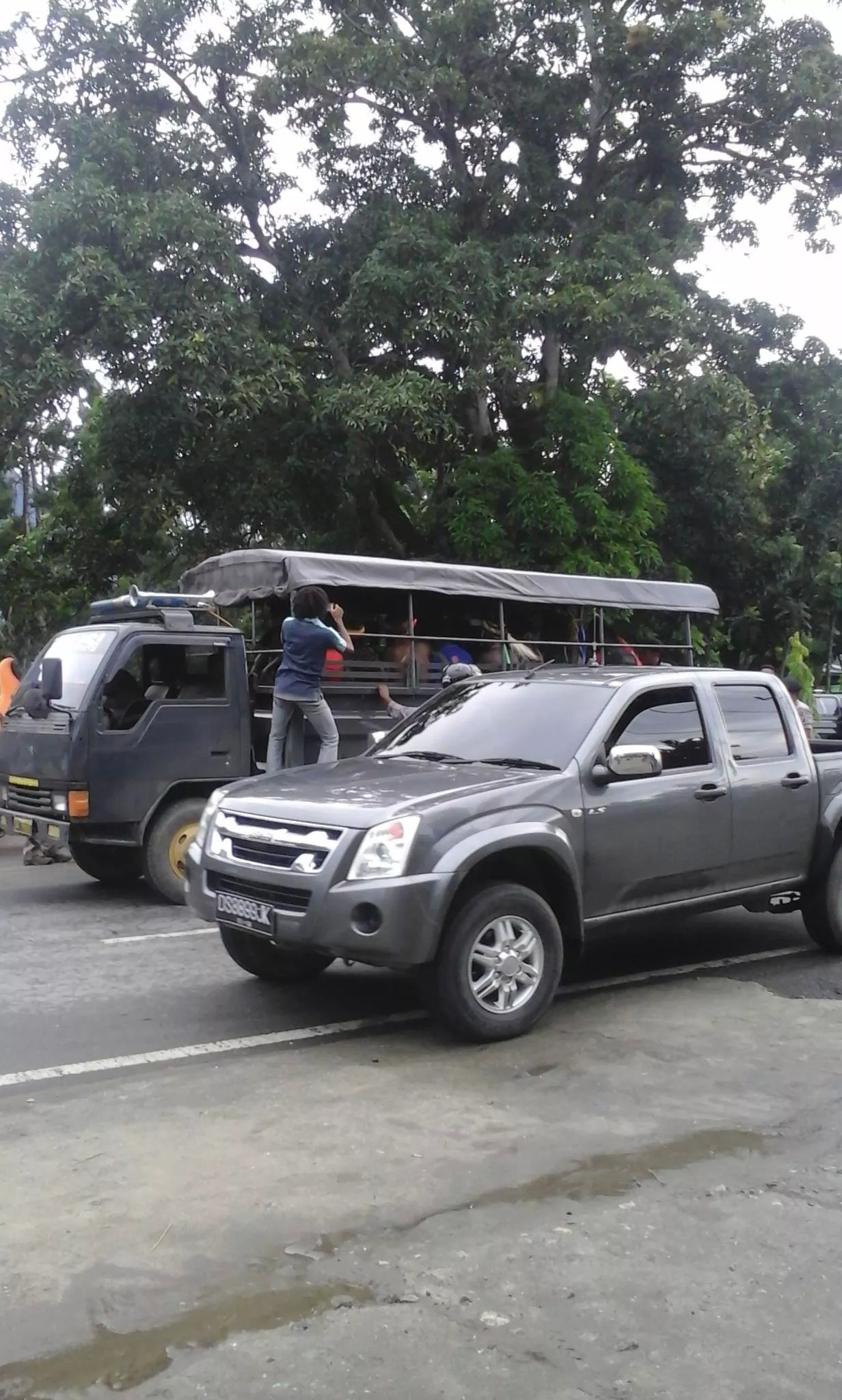
Police Officers Allegedly Back Up the Palm Oil Company and Intimidate Local Residents

From our partners at

(please note: this article was published just before the sad news of Chief Hanebora’s untimely and sudden death was received and confirmed)

Yerisiam Tribal Chief Simon Petrus Hanebora, left - Jubi

Yerisiam Tribal Chief Simon Petrus Hanebora, left – Jubi

Jayapura, Jubi – Yerisiam Tribal Chief Simon Petrus Hanebora said he was expecting the attention from Papuan NGOs for investigating and doing advocacy on the palm oil plantation issue at Sima and Wami villages of Yaur Sub-district in Nabire Regency, Papua.

“We have tried to terminate the activity of PT. Nabire Baru through an official letter, but the company is still conducting its operation and get support from the Police Mobile Guard officers,” Hanebora said through email to Jubi on Wednesday (11/2/2015).

He further said on behalf of Yerisiam Tribe, he has sent letter to the Nabire Legislative Council and local government asking them to follow up their aspiration to shut down the company. However, both parliament and local government have not given their answer until now.
“Why do government and law enforcement keep silence about Yerisiam’s trouble? Though an intimidation, human rights violation and genocide towards Yerisiam tribe are on going. If we fought them back, they would accuse us as separatist, rebel and so on. What is truly happening?” said Hanebora.

For that reason, he expected both environmental and humanitarian NGOs could take part in the palm oil plantation issue in Nabire, in particular to conduct investigation and advocacy.

Meanwhile, as published in surapapua.com, as land tenure right owners whose land used palm oil plantation by PT. Nabire Baru, some Yerisiam tribal residents always been terrorized and threatened by police officers by accusing them involving with the Papua Free Movement (OPM) although it never existed.
“So we can make conclusion that those officers only made an argument to justify their acts to arrest and intimidate to customary landowners,” a coalition member of Nabire palm oil company’s victims, Charles Tawaru told suarapapua.com on Tuesday afternoon (3/2/2015).

“People protested the company for not being concerned towards their rights, including hire the police officers to intimidate and arrest them. There’s really no OPM headquarter here,” Tawaru said. (Arnold Belau/rom)

Tribal leader SP Hanebora, known for resisting oil palm, dies in Nabire

February 13, 2015

Source: Tabloid Jubi
Translation: https://awasmifee.potager.org/?p=1139

Simon Petrus Hanebora, leader of the Yerisiam ethnic group in Nabire who campaigned resolutely to oppose an oil palm company and force it to leave Sima and Wami villages, Yaur District, Nabire, passed away on Thursday 12/2/2015 at 3.05 am local time in the Nabire public hospital, where he had been treated for four days.

Robertino Hanebora, the Secretary of the Yerisiam ethnic group, told Jubi on Thursday that SP Hanebora had complained of a fever last Friday, and then on Saturday started vomiting and passed out. He was brought to a doctor who informed him he had malaria.

Robert related that as he kept vomiting and couldn’t eat, on Sunday he was brought to the public hospital for treatment. He was treated there for four days.

“On Monday and Tuesday, his condition improved and he could eat again. But then his condition deteriorated and he couldn’t speak properly. It wasn’t possible to take a blood test since the hospital’s laboratory
equipment was broken.” he said.

Because of his poor condition, the family paid a different doctor to take a blood test. On Wednesday the results showed not only malaria, butalso diabetes, hepatitis, and heart and belly disorders.

“On Wednesday his condition deteriorated and became critical. Then in the early hours of the 12th February 2015, at 3.05 am, he passed away” he said.

Robertino Hanebora said that the loss of SP Hanebora would not break the spirit of resistance to fight the oil palm companies operating in Sima and Wami villages which continue to destroy nature and and the Yerisiam people’s natural resources.

“Our younger generation is ready to continue our father’s struggle,” he
affirmed.

SP Hanebora was the leader of the Yerisiam wider ethnic group. He had always fought against the oil palm companies operating in Sima and Wami villages, Yaur district, Nabire. His last meeting with the oil palm company was in late January 2015. The Nabire police chief had arranged for him and other members of the Yerisiam tribe to meet the leadership of PT Nabire Baru to discuss compensation for land taken over by PT Nabire Baru.

SP Hanebora had persistently fought to oppose this oil palm company. But fate had a different plan for him, and he had to leave us before this task was finished. Younger generations of Yerisiam people are asked to keep fighting, and continue the struggle of SP Hanebora.

Source: Tabloid Jubi
http://tabloidjubi.com/2015/02/12/kepala-suku-besar-yerisiam-meninggal-dunia/

Jubi: Marine working for PT Dongin Prabhawa shoots local man in Mappi

From our partners at Tabloid Jubi (Translated by awasMifee)

February 10, 2015

Talema Waitipo, a 19-year old resident of the Maam area, Bade District,
Mappi Regency, is currently in a weak condition as he lies in a bed at the Naval hospital in Merauke.  He is believed to be the victim of shooting by an (Indonesian Navy) Marine officer, who was providing security for PT
Dongin Prabhawa’s oil palm plantation.

He was shot in the left thigh, the bullet exiting at the back of his leg, and also in his chest. Another man, Yance Doga, is also believed to have a been wounded in the hand by a bayonet.  Both are currently undergoing treatment.

A family member of the victim, Bernardus Wuka, related that although he had not been present when the incident took place, several local
residents had told him that Talema had been shot by a member of the
marine corps who was guarding PT Dongin Prabhawa’s operational area. He also believed Yance had been stabbed by a member of the armed forces.

He went on to explain that the alleged shooting had taken place on the
8th February 2015 at around 03.00 local time. Both victims were brought
to PT Dongin Prabhawa’s clinic in Bade District, but as the equipment
there was insufficient to treat their injuries, they were brought to
Merauke to be treated in the Naval hospital.

“Actually the condition of both Talema and Yance is gradually improving.
They will both need treatment for several days more, especially Talema
who was shot. He is still not able to communicate properly because of
the injury he has suffered”, said Wuka.

Jubi has also received information that on 7th February 2015, there was
a birthday party which was followed up by dancing and drinking strong
alcohol. That party continued to the next morning. With several people
under the influence of alcohol there was some friction which ended up in squabbles between the people present.

A few moments later, naval marine officers arrived on the scene, tried
to break up the fight, and fired warning shots into the air. It seems that those shots did not disperse the people, who instead attacked (the Marines) back.

Several hours later, the source continued, there was a search and the
two injured men were discovered. At that moment they were rushed to the company’s clinic to help them.  The victims’ families were feeling
unsatisfied and started damaging some of the clinic’s facilities.

Separately, the Commandant of the Merauke Naval Base, Brigadier General Buyung Lalana, made a statement to the press that the initial trigger for the incident was strong alcohol. There had been an event taking place in the Maam area.

Some residents were disturbed by the event because of the drinking, the Naval Commander said, and so combined military and police security forces, including the marines, conducted a patrol. The presence of security personnel was thought to have disturbed and impeded the party.

“There was a group of people under the influence of alcohol, who started making trouble. So one of our members let off some shots into the air. At the beginning they were fighting between themselves”, he said.

He acknowledged that people were injured and had been brought to a
clinic owned by PT Dongin Prabhawa for treatment. “I have received
reports from our personnel that the victim’s wounds were not caused by
gunshots,” he clarified.

Nevertheless, the naval base commander promises to conduct further
investigation. If security personnel have been out of line, action would
be taken in accordance with procedures. On the other hand, if residents
are out of line and want to do something that will disturb the peace of
the majority, that of course would not be tolerated. (Frans L Kobun)

[awasMIFEE note: Obviously further clarification is needed around this
incident, but the indications are of an extremely disproportionate use
of force by military personnel responding to an incident of drunken
brawling. This militaristic approach to local incidents of public
disorder is common in Papua, and is often linked to military or police
mobile brigade employed by plantation companies as security guards. It
is also not the first time that naval personnel stationed in Bade have
violently intervened in local disputes: in February 2014 Blasius
Sumaghai was beaten with rifle butts and hosepipes, leaving him unable
to walk for four days.]

30 arrested as Jokowi Papua visit crackdown begins

By WestPapuaMedia

December 27, 2014

30 West Papuans in traditional dress, demonstrating during Jokowi’s visit to WestPapua, have been forcibly arrested by Indonesian police in Sentani, Saturday, December 27.

Activists being taken away after arrests during Indonesian president Jokowi's Visit to Sentani, West Papua, December27, 2014 (all photos: WestPapuaMedia)
Activists being taken away after arrests during Indonesian president Jokowi’s Visit to Sentani, West Papua, December27, 2014 (all photos: WestPapuaMedia)
tmp_21430-received_15204150882329172026699754
Activists being taken away after arrests during Indonesian president Jokowi’s Visit to Sentani, West Papua, December27, 2014 (all photos: WestPapuaMedia)
tmp_21430-received_15204150348995891158828432
Activists being taken away after arrests during Indonesian president Jokowi’s Visit to Sentani, West Papua, December27, 2014 (all photos: WestPapuaMedia)

The Indonesian president’s visit is seen by many Papuans as illegitimate, as issues of political freedoms and human rights are again not being discussed, in favour of a military backed development agenda.

The 30 peaceful rights activists were rounded up in a speedy operation by police, and whisked off to Police Headquarters in Jayapura for further interrogation, acoording to WestPapuaMedia stringers.

More information as it becomes available.

WestPapuaMedia

Papuans Behind Bars October 2014: ‘Bloody Yotefa’: police turn a blind eye to violence against indigenous Papuans

From our partners at Papuans Behind Bars, with additional reporting from West Papua Media and JPIC

17 November 2014

At the end of October 2014, there were at least 69 political prisoners in
Papuan gaols.

At least 46 members of the West Papua National Committee (Komite Nasional Papua Barat, KNPB) were arrested in Jayapura and Merauke this month for participating in peaceful demonstrations. The demonstrators were urging the Indonesian government to release two French journalists who faced trial for breaching immigration rules.

In likely reference to the Social Organisations Law (RUU Organisasi Kemasyarakatan, RUU Ormas), police claimed during the mass arrests that the KNPB is an illegal organisation as it is not registered with the Department of National Unity and Politics (Kesatuan Bangsa dan Politik, Kesbangpol) and affiliated symbols or attributes are also therefore illegal. Last June, police conducted a mass arrest in Boven Digoel under the same auspices.  Indonesian human rights group Imparsial challenged the shutting down of peaceful demonstrations in Jayapura and Merauke, stating that freedom of expression in Papua is the worst in Indonesia, particularly when it comes to the treatment of KNPB rallies. The criminalisation of peaceful demonstrations, often under the auspices of the Ormas Law, restricts democratic space and stigmatises Papuan civil society groups.

On 27 October, two French journalists, Thomas Dandois and Valentine
Bourrat, were released after 11 weeks in detention. However, Lanny Jaya
tribal leader Areki Wanimbo, who was arrested alongside the pair, still
faces charges of conspiracy to commit treason. Lawyers from the Democracy Alliance for Papua (Aliansi Demokrasi untuk Papua, ALDP) have stated that the legal process for Wanimbo has been fraught with irregularities and that his case has been handled unprofessionally. Wanimbo faces charges different to those he was first accused of, and unsuitable evidence was used to build a case against him. The decision to impose a two-and-a-half-month prison sentence on the two journalists instead of acquitting them was a harsh blow for the campaign to open access to Papua. As noted by Human Rights Watch researcher Andreas Harsono, foreign journalists face a complex system of applying for visas to Papua, which requires the approval of 18 different government agencies – a process that severely restricts journalistic access. It remains to be seen whether Indonesian president Joko Widodo will make good on his promise of opening access to Papua.

Bloody Yotefa

In our July update we raised concerns regarding an incident which has come to be known as ‘Bloody Yotefa,’ that took place on 2 July at Yotefa market in Abepura. Early reports stated that three Papuan men were killed following a police raid on a gambling den at Yotefa market.  At least four Papuan men from the Central Highlands were tortured and 40 people arrested according to a Report from the Justice, Peace and Integrity of Creation Desk (Keadilan, Perdamaian dan Keutuhan Ciptaan, KPKC) of the Evangelical Christian Church (Gereja Kristen Injili, GKI). Following the raid on the market, police arrested and handed over two Papuans, including a 14-year-old boy, to a mob of non-indigenous Papuans who publicly tortured and beat them while police stood by, later continuing the job themselves at Bhayangkara Police Hospital. While police beatings, torture and killings of indigenous Papuans are not new phenomena, the public involvement of non-indigenous mobs to achieve this is a particular low point.

Bloody Yotefa challenges the government perspective that torture and killings are carried out by a rogue police in isolated cells, showing instead that these arbitrary violations are becoming social events in which the non-indigenous community can participate. This dynamic
perpetuates a culture of fear and domination in which indigenous Papuans are exposed to constant risk of public violence, even in traditionally ‘safe’ spaces such as hospitals and university campuses. Police discrimination and profiling of indigenous Papuans, especially those who come from the Central Highlands, makes them still more vulnerable to public torture, violence and arbitrary arrest.

You can read the full update here:
http://www.papuansbehindbars.org/?p=3252

Papuans Behind Bars team

Create a website or blog at WordPress.com

Up ↑