ICTJ, the Women Commission, and the Women Working Group of Papuan People Assembly
“We women of Papua have been bruised, cornered, besieged from all directions. We are not safe at home, and even less so outside the home. The burden we bear to feed our children is too heavy. The history of the Papuan people is covered in blood, and women are no exception as victims of the violence of blind military actions. We have experienced rape and sexual abuse in detention, in the grasslands, while seeking refuge, no matter where we were when the army and police conducted operations in the name of security.”
In 2009–2010, ICTJ, the Women Commission, and the Women Working Group of Papuan People Assembly provided support to Papuan women in a project to document gender-based violence and human rights violations that occurred between 1963 and 2009. This documentation effort aims to understand different patterns of violence, including abuses committed by security forces and resulting from efforts to seize natural resources in Papua, as well as violence women have experienced in their own households since the army took control of the region in 1963. Of the regions in Indonesia, Papua—on the verge of becoming independent when Soehato gained power—experienced some of the highest rates of atrocities committed under the regime. And recent crackdowns in Papua indicate the government is still adopting a heavy-handed security approach.
The women in Papua worked on this collection of stories of violence and abuse over three months, interviewing 261 people (243 women and 18 men). The report finds that a range of factors within Papua—violence employed by security forces, a culture of discrimination against women, and lack of political will to change policies among others—have meant the victims are still neglected and none of the effects of violence have been addressed. “Change cannot be postponed any longer,” the women conclude.
Ban Ki-moon with Indonesia President Susilo Bambang Yudhoyono (Photo credit: Wikipedia)
PHOTO AND VIDEO REPORT
from the West Papua Media Editorial team, and local sources across Papua
March 21, 2012
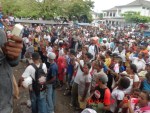
Rallies held across West Papua, Indonesia, and Australia have drawn tens of thousands of people on to the streets calling on UN Secretary-General Ban Ki-Moon to do more to protect West Papuans to Indonesian state violence, and to allow them exercise their universal human rights to self-determination.
Despite significant threats of violence prior to the rallies by Indonesian security forces against peaceful unarmed protestors, the mass mobilisations across West Papua significantly outnumbered security forces and were peaceful. In some centres, the police only sent a handful of undercover intelligence agents to monitor the situation.
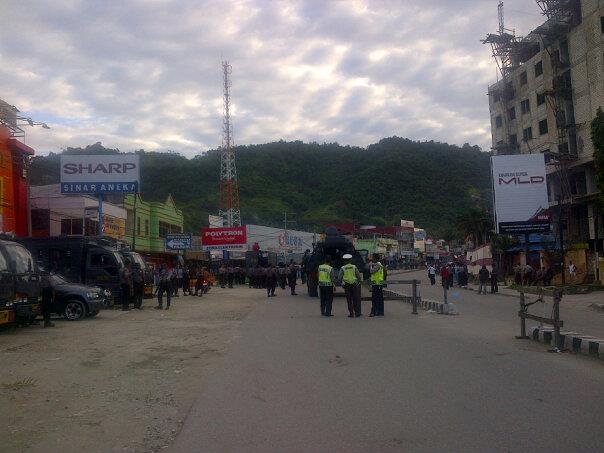
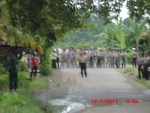
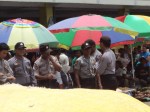
Security forces blocking access to Jayapura (photo Matias Murib)
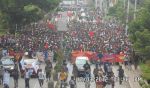
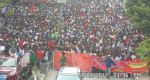
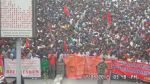
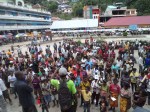
In Jayapura, over 5000 demonstrators marched from Taman Imbi and joined with a long march of several thousand people. Security forces blocked access to the centre of Jayapura with heavy weaponry, but the rallies avoided provocation. Jayapura was reported to be a ghost town as the rallies paralysed normal business and movement.
Speakers in Jayapura demanded that the UN Secretary-General listen to the people of West Papua and tabled seven key demand on the UN. Buchtar Tabuni, from the West Papua National Committee (KNPB) told the crowd that the UN must take responsibility for its role in the sham 1969 Act of Free Choice handover of West Papua to Indonesia, actions that violated international law.
“Ban Ki-Moon and SBY have to know the wishes of the sovereign independence of Papua on the land itself. KNPB will mediate the West Papuan people so they can determine their political choices through a mechanism that is democratic, peaceful, dignified and final in accordance with the principles and standards of international law”, said Tabuni.
Jayapura
Herman Wainggai, a West Papuan the West Papuan independence advocate based in the United States explained at the solidarity rally in Melbourne, Australia, “Our troubles began in New York in 1962, and I hope they will end there soon. We ask the United Nations to host talks between the Indonesian Republic and the Federated Republic of West Papua, just as the UN did between the Indonesians and the Dutch”
Ban Ki-Moon was visiting Indonesia to participate in The Jakarta International Defence Dialogue, hosted by the Indonesian Ministry of Defence on 21 March 2012, a move widely seen by human rights observers as giving legitimacy to Indonesian militarist objectives over West Papua and beyond.
West Papuan activists called on Mr Ban to use the opportunity to press Indonesia on human rights in Papua and its consistent denial of basic freedoms and rights to West Papuan people, including rights to life and of freedom of expression, and freedom from arbitrary detention.
“We would like Mr Ban Ki-moon to attend to our defence while he’s in Jakarta” said Herman Wainggai,
“The Universal Declaration of Human Rights establishes the right of all individuals to freedom of opinion and expression and the right to peaceful assembly and association. Also, Indonesia is a signatory to International Covenant on Civil and Political Rights (ICCPR), which guarantees the rights to freedom of expression and peaceful assembly and Indonesia’s constitution also protects these rights,” Wainggai told West Papua Media.
“So, it would be appropriate for the Secretary-General to negotiate the release of all political prisoners in Indonesia while he is visiting the new ‘Peacekeeping’ Centre in West Java,” said Wainggai.
Widespread Mass Actions
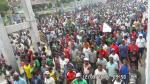
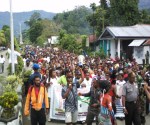
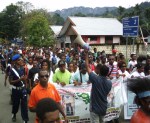
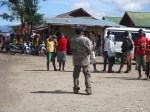
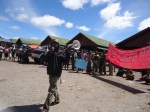
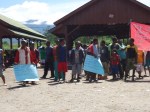
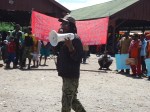
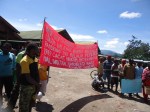
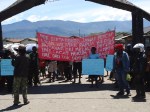
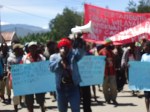
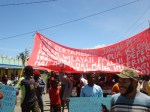
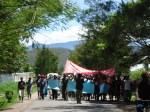
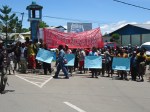
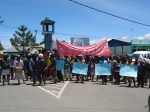
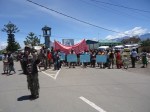
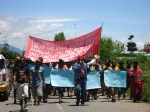
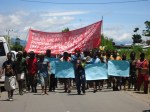
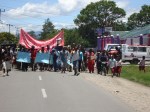
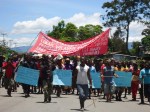
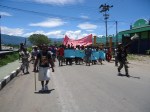
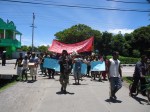
The rallies across Papua drew tens of thousands of people in total in Wamena, Biak, Serui, Yapen, Sorong, Nabire, Jayapura and Fak-Fak. Security forces engaged in their standard procedures of intimidation and disruption at all rallies, but protesters maintained non-violence discipline at each area.
On Yapen island, close to 6000 people in total held two long marches to support the demands of the day, all under threat of arrest. Local police had refused to issue a permit for the rallies to go ahead, claiming the rallies would upset the security and integrity of Indonesia. After a week of pamphleteering and socialising the rallies, police had no choice but to allow the rally to go ahead. The rally began in the village of Mantembu, where former political prisoner Yawen Wayeni was brutally disembowelled and filmed by Brimob police in a video leaked on Youtube in 2010.
Mantembu, Yapen Island
The same Brimob unit on Monday attempted to block the long march from leaving Mantembu, using over 50 police to block the narrow road, and attempted to seize all Morning Star flags. Negotiations ensued, led by Reverend Jhon Pairire and FRWP Doberay Governor David Abon, who got agreement from police for the rally to continue to Serui city. Police continued to intimidate Papuans all day, but Morning Star flags still appeared throughout the day despite Police.
Serui, Yapen Island
Manokwari saw more than 7000 people from across Papuan society and resistance raise the Morning Star flag and conduct long marches all over town after prayer, eventually settling down to listen to orations from a wide range of speakers. Speakers called for the freeing of all political prisoners in Papua in Indonesian prisons, including the President and the Prime Minister of the Federal Republic of West Papua. Brimob officers tried to seize the Morning Star flags early unsuccessfully, but soon stood aback training their weapons on the crowd, who studiously ignored the provocative intimidation according to stringers for West Papua Media.
Manokwari
In Sorong, our stringers reported that almost 1000 people took to the streets in a festive atmosphere. Organisers claimed that few security forces turned up other than about ten plain clothes intelligence agents. “It is clear that this drastically changed the atmosphere, it must be because of international pressure,” said our stringer by SMS.
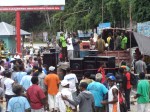
On the West Coast in Fak-Fak, almost 1000 people took part in prayers and listened to speeches in the main market square, with little interference by security forces present.
Fak-Fak
In Jayapura, stringers for West Papua Media reported a wide range of colourful, festive and dramatic demonstrations for Papuan aspirations, including the release of almost 300 balloons painted with banned Morning Star flags and the UN flag, which drifted across town and out to sea. This tactic has been used repeatedly as a tactic for distributed symbolic resistance in both Papua and Maluku for years. Isolated gunfire was heard when the balloons passed over military barracks, according to local sources, believed to be Indonesian soldiers attempting to shoot down the balloons.
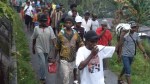
And in Wamena, in the Baliem Valley, a thousand people joined in a rally and march to support the call for the UN to take action by sending peacekeeping force to protect Papuan people against Indonesian security forces. Stringers for West Papua Media report that few security forces were in overt attendance, but there was an understanding that troops were close by at all times. The Baliem Valley and West Papuan highland people have borne the brunt of Indonesian violence since the occupation began, with sweeps against civilians by the Australian funded Detachment 88 counter terrorism group and Indonesian army still ongoing in Tingginambut, Mulia and the outer areas of the Baliem Valley.
by a Special Correspondent for West Papua Media in Abepura
March 19, 2012
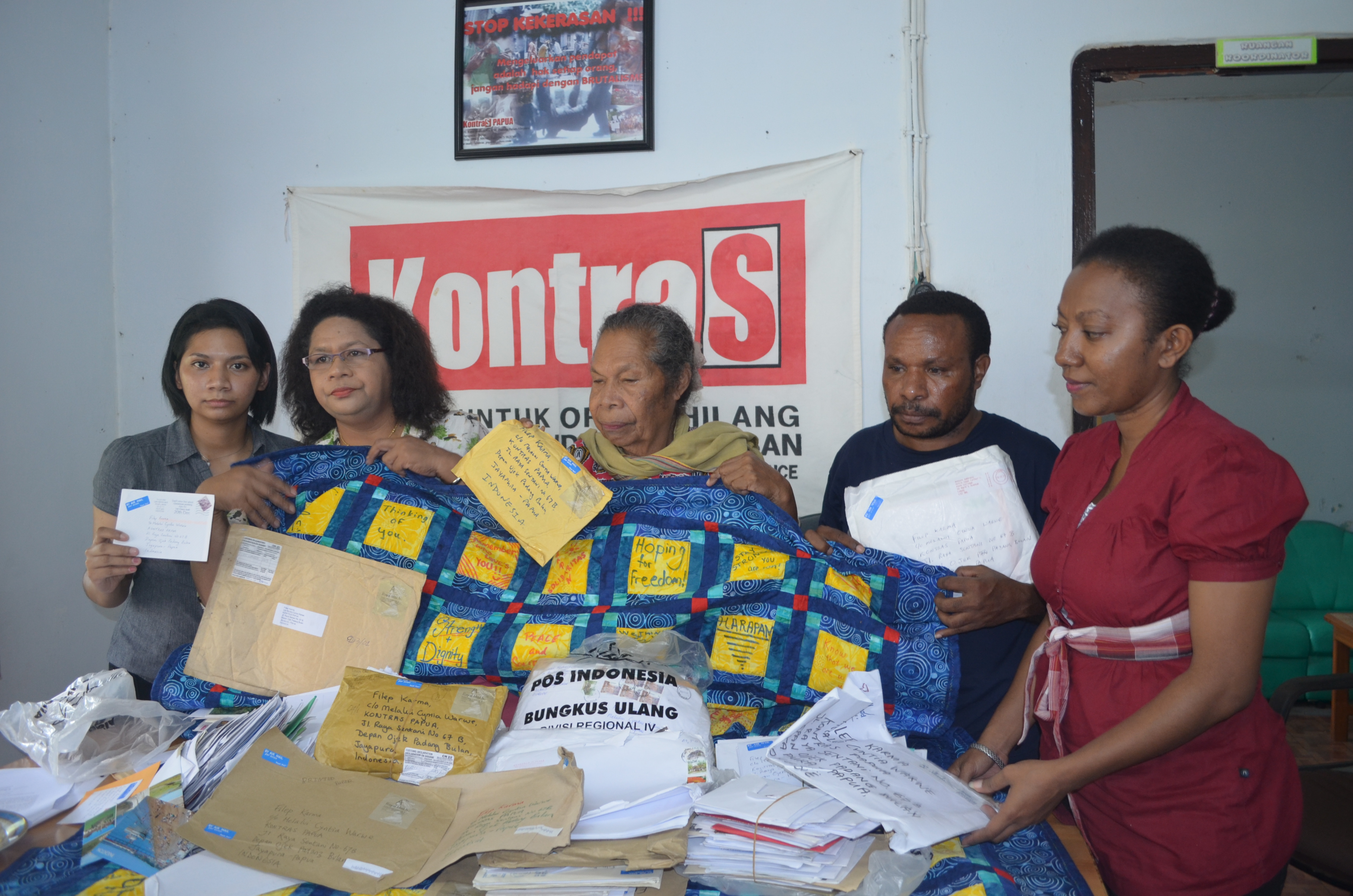
Kontras and Filep Karma's family with some of the nearly 7300 letters sent by international supporters of Karma (Photo: West Papua Media)
Filep Karma, is one of the political prisoners given sentences of 15 years of imprisonment by the government of Indonesia, by raising the Morning Star flag, on December 1, 2004, at Trikora field, Abepura. Ever since a period of 7 years, and 3 months of his prison sentence have lasted in Abepura prison. During captivity Filep Karma received letters of solidarity sent by the International community through the office of the Commission for missing people and victims of violence in Papua (KontrasPapua). Nearly 7292 letters of support have been sent in the period of 2011 untill 2012.
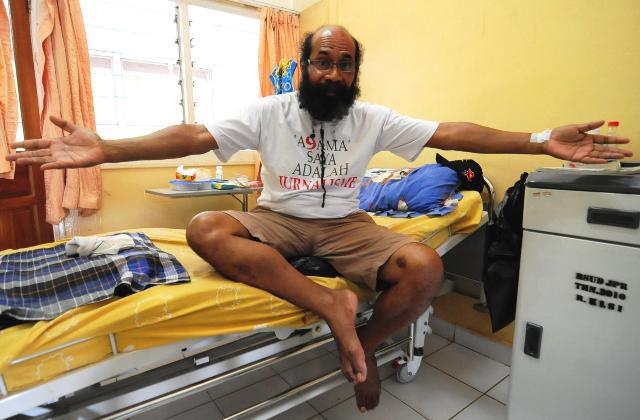
Filep Karma inside the prison hospital (Photo: West Papua Media)
United for the truth (BUK) and Kontras Papua held a Press Conference on March 19, 2012, and immediately submit a letter of support to the family representative of Filep Karma. Andrefina Karma, Filep Karmas second daughter said ” International Community support is strong solidarity for the freedom of my father, the people there once a month hold a simple campaign in front of the Indonesian embassy and called for the unconditional release of Filep Karma”, she said.
Letters that came from different parts of the world proved that there is support for political prisoners in Papua. Olga Hamadi, Director of Kontras Papua says” the government should not close her eyes for the injustice suffered by political prisoners in Papua, both in conditions of health and food at the prison, which received less serious attention”, she said. She also denied the statement by the Minister of Justice and Human Rights Republic of Indonesia during a visit to Papua saying that there are no political prisoners in Papua.
Filep Karma is one of figures of political prisoners who never made a compromise with the Government of Indonesia. He rejected any form of clemency, amnesty, and abolition that is given by the Government. ” If I receive clemency, that means I ask for forgiveness to the government, but I do not feel guilty at all, I am just making a peaceful protest. Indonesia is a democratic country, am I wrong to fight for the basic rights of indigenous Papuans?
“I will continue to undergo a period of detention up to 15 years in prison, if you want to release me, I ask to be released unconditionaly”, Filep Karma said, as he was undergoing physiotherapy treatment in DOK II general hospital.
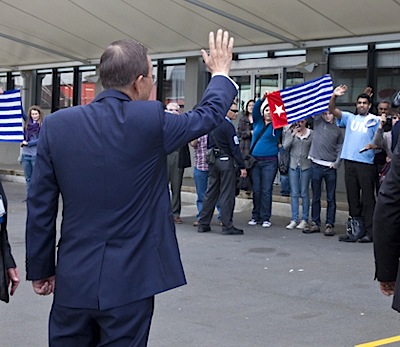
Ban Ki-moon waves to protestors for West Papua, PIF NZ Sept 2011
by John Pakage for West Papua Media
Opinion
President Susilo Bambang Yudhoyono (SBY) and UN Secretary General Ban Ki-moon held a bilateral meeting at the presidential palace in Bogor, West Java, on Tuesday (20/03/2012). In the meeting, human rights abuses in Papua were also discussed.
UN Secretary General Ban Ki-moon certainly knows in detail about the development of human rights abuses in Papua because he sought a diplomatic answer from the President of Indonesia.
“Papua is Indonesia and we are obliged to maintain its security, but if there are violations of human rights then there is law enforcement action,” said SBY.
Of course with this kind of diplomatic answer, SBY wants to hide the number of cases of gross human rights that have occurred, and are continuing to occur now in Papua. Only at few days before the arrival of Ban Ki-Moon to Indonesia, Forkorus Yoboisembut, Gladius Waromi Edison, Augustine M. Sananay Kraar, Selpius Bobii and Dominic Sorabut were sentenced 3 years in prison on Friday (16/3) with charges of treason for forming the state of West Papua.
The implementation of the Third Papuan People’s Congress went ahead with official permission from the Indonesian government, both from the central government and the police to hold a congress in Jayapura. But Indonesia’s military attacked and captured civilians at the Congress without first showing any arrest warrant, in accordance with Indonesian regulation.
Again and again, military and police forces shot live ammunition at civilians at the Congress, inconsistent with legal process, in stark contrast with Yudhoyono’s promises to Ban Ki-Moon at the Bogor Palace.
The multitude of human rights abuses in Papua, which is tightly closed by state policy that prohibits foreign media and international NGOs from entering Papua, gave rise to human rights lawyer Jennifer Robinson (lawyer for Wikileaks founder Julian Assange) calling on new Australian Foreign Minister Bob Carr, to immediately urge Indonesia to open Papua up, and allow incoming international NGOs into Papua to conduct human rights investigations independently (see Radio Australia, March 20, 2012).
Indonesia’s policy to cover up human rights abuses in Papua has been harshly rebuked by Human Rights institutions around the world; (see for instance a press release by Franciscans International, TAPOL, the Asian Human Rights Commission, Faith Based Network on West Papua (FBN) and West Papua Network.)
Legal rights agencies lament the unjust decision facing the five civilians who were detained while organising the Papuan Congress, sentenced to three years in prison. According to these institutions, the Congress was a form of free expression and a fundamental tenet of democracy for communicating opinions.
In addition, humanitarian agencies deplore the attitude of the Indonesian military who with full weaponry arsenal stormed and attacked the Congress participants. This Indonesian Military attack and killed several Papuan civilians. (See: Franciscans International, Release March 16, 2012.)
Ban Ki-Moon is certainly more aware now of what has happened in Papua since 1969 when Indonesia invaded Papua. So SBY’s diplomatic answer of “SBY diplomacy” might make the number one person in the world confused.
Ban Ki-Moon also mentioned that South Sudan is an example of an area of extended conflict that has embraced the process of ending its fighting. The UN successfully held a referendum for citizens to determine their aspirations – and they chose independence from the Sudan.
Of course the conditions of ongoing human rights abuses in Papua, covered up by the state policy of denying access to foreign media and international NGOs to Papua, could by its very nature invite a humanitarian intervention to end the conflict in Papua, with (or without) the Indonesian government.
A division of the Indonesian military has shot dead five terrorism suspects over the weekend, who they’ve accused of plotting to attack a popular bar in Bali. The Australian government supports the Indonesian Detachment 88 to fight terrorism, and this division was involved in the shooting.
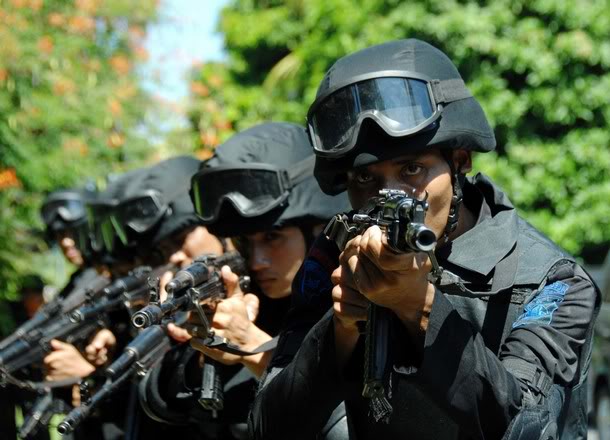
A daily Papuan perspective of Australian-funded Detachment 88 from Indonesia's occupation forces (West Papua Media)
But there are many critics who blame Detachment 88 for human rights abuses against civilians and question their quick resort to violence.
Featured in story
Nick Chesterfield, editor of West Papua Media group
Peter King, convenor of the West Papua Project at the Centre for Peace and Conflict Studies
































 West Papua Media Alerts