“We Want To Be Free”: An Interview With Four Women From The West Papuan Movement For Freedom

AWID Logo newraised-fist-teuredxt-wpma-logo

Source: West Papua Media

08/08/2013

In 2012 Alex Rayfield and Claudia King had the privilege of interviewing four extraordinary West Papuan women, all active in the nonviolent movement for freedom in West Papua, a Melanesian nation-in-waiting occupied for more than five decades by the Indonesian military. All four women had known deep pain as a result of the occupation of their homeland and the corrosive fear of being targeted for extermination.

Some wrestled with hate of Indonesians that at times threatened to overwhelm them. All had imagined, even desired, to wage armed struggle against the Indonesian government. But instead of being pacified by terror or succumbing to cravings for revenge these four young women refuse to give into hatred or relinquish their dreams of freedom (merdeka). All are engaged in efforts to realize their hopes for a restored Papua without resort to weapons or violence. How could this be possible? King and Rayfield travelled into Indonesia and West Papua to learn about why they joined the Papuan movement for freedom, what they long for, why they had chosen to struggle nonviolently, some of the challenges they faced and about the experience and role of women in the movement.

Since interviewing the four, one of the women, Fanny Kogoya, the Director of Friends of the Earth Indonesia, Papua (WALHI Papua) and a former central committee member of the West Papua National Committee (Komite Nasional Papua Barat or KNPB), has had to flee the country. Another KNPB member Rina Kogoya, Secretary of the Port Numbay (Jayapura) branch, has decided to remain in West Papua but has gone into hiding as the Indonesian police systematically try to destroy the organisation through a campaign of summary execution (22 KNPB members were killed in 2012 alone), arrest, torture and trumped-up charges of treason, hatred of the state, bomb making and murder. The other two women are Heni Lani, from the Alliance of Papuan Students (Aliansi Mahasiswa Papua or AMP) and Ice Murib, Chair of the Movement of Papua Women (Gerakan Perempuan Papua).

When and why you got involved in the movement?

Fanny Kogoya, Director, Friends of the Earth, Papua

My name is Fanny Kogoya. I am a Lani woman from the Dani Tribe, Wamena, West Papua. I am now the Director of the Papua office of Friends of the Earth Indonesia.

I first became active in the struggle in 2000. At that time I was 20 years old. I joined in a number of forum discussions with student activists from the Papuan Student Alliance (Aliansi Mahasiswa Papua). It was first semester of university but before I moved to Jogjakarta.

For years the Dani people experienced repression from the Indonesian military. Prior to 1998 – when Suharto was overthrown – the Dani’s homeland was in a military operations area (Daerah Operasi Militer). During reformasi, in 1998 and 1999 there were lots of demonstrations and my friends and I felt like we could do something. But when I was in high school, before 1998, we could not speak openly about freedom for West Papua. It was even difficult to buy or sell Papuan music. If you spoke about freedom during these times you were accused of being a part of the GPK (Gerekan Pengacau Keamanan) “the movement of security disturbers” [a police and military code for the OPM or Papua Freedom Movement]. As a child I often saw people beaten-up by the police, often without any reason at all. When I moved to Jogja I started to remember all of these things that had happened to me as a child and for the first time I was able to talk about that with other people. It was like a lid was lifted off of a boiling pot.

One of the things I we talked about was when the biologists were kidnapped by Kelly Kwalik [a legendary Papuan guerilla leader killed by Detachment 88 in December 2009]. Prabowo, one of the Kopassus [Indonesian Special Forces] commanders tried to release those hostages but what happened was that a whole lot of people were killed up in the highlands. I started reading about the history of West Papua’s integration with Indonesia, the so-called integration and I began to realise just how much wrong, how much injustice the Papuan people had experienced at the hands of others.

As a student I started to compare the policies, the government policies, with what was actually happening on the ground. On the one hand you had the constitution which talked about freedom and the Pancasila which talked about social justice but in reality there was very little political space for us Papuans. When I was living in Java I could compare the health and education system with what we had in West Papua and it was just so different. Things were so much better in Java. What is happening in Papua now is just like the New Order under Suharto and just like the reformasiperiod after Suharto. There is very little political difference for Papuan before or after Suharto. After Suharto we thought there would be more space for us but Papua has yet to experience a real democratic space. These kinds of things make me really emotional. I realized I had to resist. I can’t be silent. I have to resist.

When I was a student studying in Jogja I came to understand that I am a person who possesses land; that my life is very different from other Indonesians. The connection to land, to Papuan culture, to Adat, is quite different from what is in Java. Our relationship to our ancestors is different from those in Java. Papua is not Indonesia. Indonesia is very different from Papua.  Papua is something completely different from Indonesia.

Rini Tabuni, secretary of KNPB, Jayapura-Sentani

The first time I got involved in the struggle was in 2008. I had just finished my university studies. This was already 10 years on from Suharto and in the period of reformasi, so people felt freer to talk about the issue of freedom. The hopes embodied in reformasi gave me spirit [semangat] and encouraged me to get involved in the movement.

My mother would often speak about the things that she experienced in her life. She talked about what happened in Wamena in 1977 when there were massive military operations. My parents were pastors of the Kingmi church in Wamena at that time.

Actually my father was one of the victims of 1977. Indonesian soldiers cut open his chest with knives. They took out the contents of his stomach and they removed his heart. My grandfather saw this happening with his own eyes. As the soldiers were cutting open my father’s chest they were saying, “Where is your God now? Who is here to save you?” My grandmother and my grandfather then fled to the forest where my mother and I were hiding. They told us what had happened. And of course this event really traumatized my mother. Even now when she tells this story she always cries.

So that’s one reason I’m involved in the movement, that’s one reason why I struggle. After this we moved to Jayapura. We lived in Dock 5 with Benny Wenda’s people. In 2000 Benny started to become more active in the movement. Benny and all of my family had to flee. We ran to Papua New Guinea. After a little while, when it was safer, my older brother, who was working in the civil service, brought us back to Jayapura. Of course Benny got refugee status in England. We watched what he did from the outside; how he continued to struggle. That inspired those of us who lived inside Papua to continue to struggle in the movement. It was in this context that KNPB entered. My friends and I said let’s stay with this organization, let’s sit down with them and see what we can do together.

Heni Lani, Aliansi Mahasiswa Papua

My name is Heni Lani, I am from the Dani tribe of Wamena.

I was 18 years old when I got involved in the struggle. That was in 2003. But before that, as a girl, you know, I had experiences like Fanny and Rina. When I was in primary school the police came to my house and arrested my father. Even as a little girl, I could see the way the police treated my father was not respectful. It really made us angry. At that time my father was a principal of a primary school. Back then I had no idea that in addition to being a principal my father was also organising indigenous people in Wamena. So in the beginning I had no idea why my father had been arrested. And I guess that is what really made me angry. Two days after the police arrested my father he came home. For a week my father just stayed in the room with my mother. As children we had no idea what had happened.

I stayed with my family in Wamena until Middle-High School when I went to a Catholic boarding school. Every Saturday we’d have a chance to go home and be with our family. One Saturday night when I was at home, two police officers came around to my house. They were in plain clothes but they were carrying weapons. They arrested my father again. I still remember it. We were sitting down having dinner and the police came into my house. They grabbed my dad and they dragged him outside.

The next thing that really influenced me occurred when I was in Senior high school. Actually Rina and I were at the same school. One afternoon, around the time Benny Wenda was arrested,  I was hungry so I went outside the boarding school to buy some cake. I was still wearing my school uniform. I bought some cake from a street seller and I put it in a big plastic bag. This man was standing next to me and he said, “ hi younger sister, good day. What’s your name.” I told him “my name is Heni.” He asked me where I was from but because I didn’t know him I said, “Father would you like some cake?” He took some cake then I crossed the road.

I crossed the road and I noticed there were lots of police. Suddenly the police ran across the road and grabbed the guy I had just given cake to. The police dragged him by his hair and beard. It was only then I realized it was actually Benny Wenda. Benny Wenda shouted out in Lani, “quick, help me, grab this bag”. There were no other people from Wamena there so they did not understand what he was saying but I understood. Then he said it again: “help me, grab this bag”. But I didn’t do anything. I just stood there watching him cry out.

The next day in the Cendrawasi Post [the main daily newspaper in Jayapura, the capital of West Papua) there was a big photo of Benny Wenda on the front cover. The newspaper sellers were calling out “C-post, C-post, Benny Wenda arrested, Benny Wenda arrested.” I bought a paper and started reading it.  In the article it said in his bag were a whole lot of sensitive documents; the morning star flag, his passport, all sorts of things. After reading the C-post I realized, wow it really was Benny Wenda that I met yesterday. Before that I only knew his name. I had never met him before. I can’t tell you how guilty I felt, like I had done some really wrong. I didn’t go to school that day. For the next three days I was carrying this burden. I kept on thinking to myself, why didn’t I do anything? Perhaps if I knew it was Benny Wenda I would have gone and helped him, grabbed his bag to keep it from the police. That was the third experience that influenced my political development as an activist.

After school I started studying at University but I continued to stay at the Catholic dormitory. I would often witness demonstrations on the main road in Abepura. At our campus there was a small discussion group led by Jeffrey Pigawak. I started to attend and began to ask questions; why did the police do this and why did the police do that? I wanted to try and understand the things that I had witnessed as I was growing up. Bit by bit I became more active in the discussion group. That was between 2002 and 2003. In 2003 I made a decision that I would become more active. The first group I got involved in was the street parliament (Parlamen Jalanan), which was set-up by Filip Karma and Yusak Pakage.

On the April 5 2004 I got my political education from Filip Karma. I remember it was at the beach in Hamadi. Filep Karma told me all the things that happened in our history, the whole history of our struggle. He told me everything going right back to the time of the Dutch, about Angganeta Manufandu in Biak during the 30s and 40s, the role of Mama Yosepa in the highlands, all these things. Before I received my political education from Filip Karma it was like I was sitting in this small dark room with little rays of light coming through. These rays of light were like my father getting arrested and Benny Wenda getting arrested. When I got my education it was like the door of this room was flung open. It was as if I went outside for the first time and saw what was really happening. The day on the beach in Hamadi was the first time I saw the Morning Star flag. I grabbed it and held it. Finally, I realized, I’m not an Indonesian, I’m a Papuan!

All these events culminating with the political education I received from Karma and Pakage strengthened my commitment to this struggle. Since then my friends have been arrested, some have died in jail, some have fled to Papua New Guinea. It’s like we are migrants in our own land. So many people from Java, from Sulawesi, from Sumatra have come to our land. We don’t have space to do anything. I finally discovered that the reason my father was arrested was because they wanted to take his land to build a stadium. My father was defending his land but they took his land to build a stadium. My father had said if you want to take my land to build a school, well then okay, we can talk about it but they didn’t care. When I became involved in the movement my father told me all these things. So I have no reason to sit down and be quiet.

Ice Murib, Chair of the Papuan Women’s Movement

I first got involved in the movement in 2008 but something happened to me in 2006. I was in Jayapura in class three of senior high school at the time. The date was March 16 2006. There was a big action in Abepura. Lots of students were involved including Heni. My friends and I were in Kotaraja. We tried to get a taxi home but the road was blocked everywhere so we had to walk. It was quite a distance, maybe 20 kilometers. When we passed the road between the University of Cendrawasih and the Trikora football field,  I saw students burning tires, they were blockading the road, and I saw Heni speaking. Suddenly I heard shooting. Students were running everywhere. I joined them. We ran and ran. I still had my school clothes and I was running for my life. The police were arresting people. There were soldiers everywhere but I kept running. I ran all the way home. The following day I didn’t go to school. I heard they were looking for students. Their pictures were everywhere including Heni’s. Her face was posted on the wall, along with other people who were wanted by the police.

At that time I felt sick in my heart. I thought, this isn’t right, this isn’t just. That is why I joined the Alliance of Papuan Students from the Central Highlands. But you know, the events of March 16 2006 were not the only thing I have seen. I have also experienced some of the things that my friends Fanny, Rina, and Heni have experienced. My parents and grandparents were involved in the events of 1977 in Wamena. The repression then was so heavy…

At that time in Tiom my grandfather would see the military come and take pieces of iron. They would heat them up in water and use them torture people. The soldiers would stab people with these hot pieces of iron until they died. The police would go through and sweep the village, searching for people. Helicopters hovered above while the police and army went house to house searching for people.

One morning everyone hid in the church. The children, the women, and the men, they all tried to hide in the church. And then the Army came. Other people from other villages also came. The army and police asked people to come out of the church. My grandfather came out of the church and ran. He took my father who was still young and hid in the forest.

The army forced everyone to come out of the church. The men were forced to strip down, to take off all of their traditional clothes until they were naked. At that moment one of the soldiers came up to one of my grandfather’s friends and in front of including the children, he slit his throat. Other people were killed that day too. I don’t know how many but I can tell you that my grandfather’s friend’s throat was slit. And then they made everyone eat his head. We can eat pigs, but we can’t eat human beings. That is why my grandfather and father fled to the forest. Everyone was grieving.

In 2000 when I was in second grade middle school Morning Star flags were being raised all over the Baliem Valley. Every morning the members of satgas, a kind of unarmed militia set-up by Papuan Presidium Council, would raise the morning star flag at various posts throughout the valley. The president at the time, Gus Dur gave an order that the Morning Star flags had to come down. On the morning of October 6 2000 I went to school in Wamena city. The police and military were everywhere, travelling from post to post to try and take down the flags. I remember feeling confused. When I got to school it was so quiet, everyone had gone so I went home. As I tried to go home a man from Biak asked me, “Who are you? Where are you from? You’ve got to go home, you can’t be here, you have to go home.” I ran down the main road all the way home. As I ran I saw police and military everywhere. I pass a satgas post where the police and soldiers are trying to force the flag down. I see a woman trying to defend the flag. She had her  arms wrapped around it. I saw them beat her. They just beat her until the blood ran down her face. Along the side of the road people were being beaten and tortured. Of course seeing all of these things I was so scared.

So I just ran. I ran all the way home. But when I got home nobody was there except my two younger sisters. At that time they were about 4 years old and 1 ½ years old. I was asked them, “Where is everyone? Where did everyone go?” My sisters told me that my mother was sick and my father was taking her to the hospital. She didn’t know what she should do, everyone was fleeing to the forest, everyone was running. My sister looked at me and said, “What should we do?” Nobody was there. Nobody was coming to help them. Then one of my grandmothers came she told me, “you can’t stay here, you can’t stay here, you’ve got to go, it’s not safe here.” So I got some powdered milk for the baby, some clothes for them and some food. I also got some shirts and shorts for my sisters. I grabbed a couple of things of my fathers, some documents that were important. Then I wrapped my youngest sister who was 1 ½ years, in a sheet and I wrapped and put her in a noken (string bag).  I took my other sister who was 4 years old, by the hand. By this time it was already night and there was heavy rain. In the beginning I didn’t know where I should go. It was really quiet. We went to the forest, in the direction of a village. It was a fair way to that village and I felt really scared. I felt so little. I am taking my two younger sisters into the forest, it was the middle of the night and I didn’t know where my parents were and what had happened to them. Finally we arrived at the village and stayed in one of the houses there. I cared for, looked after my younger sisters. Early morning the next morning I could hear the planes flying overhead, looking for people. There was nothing we could do. We just had to stay in that room. We couldn’t do anything.

When my father came back to the house from the hospital he looked for us but couldn’t find us. Finally he found us and we stayed there in that village for a week. When my mum came back from the hospital we returned home to our house and the situation started to get a bit better.

Two years later in 2002 something else happened. There was a raid on the military post in Wamena. Some people stole a couple of guns. This happened one Saturday night. I remember we were getting ready to go to church. When the priest began preaching the army suddenly burst in and forced everyone out of the church and into the front yard where they pointed guns at us and told us to sit down. The soldiers kept asked us if we knew what happened. This man raised his hand and said something but it was dark and there was heavy rain.  I heard the noise of footsteps but I didn’t see anything. Then before I knew it a soldier hit him and dragged him off to a patrol vehicle. After that everyone was too scared to say anything. The soldiers continued to ask us what happened but everyone was too scared to say anything. Finally the army left. When the army went people started to tell stories. Some people said that the many who raided the military base was Yustinus Murib and his friends. And of course my father was scared for us to go to school because our clan name is Murib. My father told us, if people ask you what your family name is, don’t tell them it’s Murib. Just go home if they ask. Don’t say anything because it’s really dangerous for you.

These are some of the reasons why I got involved in the AMP-PT. I joined in demonstrations. In 2008 I also joined the demonstrations organized by KNPB. At that time, the highland students were being hunted down. Fanny and I had to flee. We lived in the forest for 5 months with other students, hiding from the police.

Later I stayed with Reverend Sofyan Yoman. This was around the time his book was banned. I was at his house when officers from the national intelligence agency (BIN) and the police came to his house. They wanted to arrest Reverend Sofyan but he said, “This is my land, this is my place. I am the master of my own land. If the president orders you to arrest me, you have to ask, you have to tell the president to come here because I am the president of my own land.” The police and the people from the national intelligence agency left. They didn’t know what to do!

I have witnessed all these things. They are part of the reason why I joined the movement.

Why are you struggling nonviolently? Where does the courage to do that come from?

Fanny Kogoya, Director, Friends of the Earth, Papua

We have to acknowledge that if you are going to struggle nonviolently there will also be victims just the same as if we were to take up arms. It would be a mistake to commit to nonviolent just to avoid suffering. Even though we’re struggling nonviolently the Indonesian state continues to respond violently. They arrest people, beat people, kill people. Often my activist friends say, “What’s the point. If we struggle nonviolently they’re going to beat us, arrest us … if we struggle violently they’ll do the same things”.

Often people join the armed struggle because of their experiences. They’ve had these traumatic experiences and they make a decision to join the armed struggle. Often it’s an emotional reaction. Of course in our culture we also have a history of fighting back, a history of tribal warfare. All Papuans have courage, we are a courageous people. So with these three things – our memories of suffering,  our history and culture and our courage – armed struggle is a real option for us. And there are many people who believe we can only get self-determination through violence.

But Papuans are also a very practical people, we’re not a theoretical people. We know civil resistance can also work. So my dream is to learn more about civil resistance and how it works. I want to go back to the victims of violence, whether they are people who have been involved in the armed struggle or not, and I want to say, “There’s another way, there’s a different way”. Of course it’s difficult to influence those in the jungle who are fighting as a part of the armed struggle but I can influence those in the city and in places where I live to struggle nonviolently.

We have to understand that the Indonesia military receives support from the Americans, from the Australians, from the Dutch. Papuans will never be able to match the weapons the Indonesians have. Unless all of these foreign countries that support the Indonesian state come and take all of their weapons away … but at this stage there is just no way we could ever compete.

So the realistic option that I have is to organize people to struggle nonviolently. If we struggle through civil resistance more people can be involved, old people, young people can be involved. Involving all types of people, the whole Papuan society, can give us a tremendous amount of strength.

Rini Tabuni, secretary of KNPB, Jayapura-Sentani

Actually everyone thinks we Papuans need to take up arms. There are so many reasons why people want to take-up arms and fight back. Some people want to take up arms because they don’t have any trust that the Indonesian government is going to resolve the conflict peacefully but a lot of people want to take up arms because of the experiences that we have, they don’t know any different. But we do. If we take-up arms against Indonesia the response will be so fierce, so sharp, so heavy. But I understand why people feel they have to reply a death for a death, why they want to respond with violence.

If I struggle through violence I am going to experience a number of problems. I’m going to lose a lot of my rights. I’m going to lose my best friends. And people are going to come and steal my rights, steal my land, and kill me. There are other people that are going to come and take over and possess our land. But now I see that there’s an opportunity to resist through nonviolent struggle. People at the grassroots need to know that nonviolent action can be really successful and I can give them evidence of that. We can learn from the examples of other countries. Lots of other countries have gained freedom through nonviolent struggle. People who have faced the same kind of problems as us have found a way through. When people know this they are going to be touched deeply. We can use our culture, our way of life to help our friends understand that actually they can struggle through nonviolent means. I can do this but I can only do all of these things because God is involved, because God’s hand is involved in all of this.

Heni Lani, Aliansi Mahasiswa Papua

The first thing that I have to do is acknowledge is that there is a part of me that sometimes wants to take-up arms. But then I imagine what would happen. I think about the numbers of people that will be wiped out.

Like Fanny and Rina said we also need to compare the strength of Indonesia with the strength that we have. The Indonesian army is trained 24 hours a day, 7 days a week. And their knowledge of military warfare is so far advanced from any knowledge of armed struggle that we have. I can only be brave enough to take up arms when we have the same military strength to face them. But I don’t feel brave to take up arms before then.

I choose to struggle nonviolently. I have experienced these terrible things that have made me strong. But not just I, everyone in Papua have memories of suffering. These experiences are a source of courage for us.

I feel certain that we have to struggle nonviolently. I feel strong when we resist with nonviolent strategies and tactics and our movement isn’t labeled with negative stigmas. People on the outside can see that we’re struggling nonviolently. I don’t feel scared to struggle nonviolently. One of the sources of strength of nonviolent resistance is that it is not only me who is struggling, it’s all of us Papuans working together. We also have amazing leaders, particularly religious leaders who have made us realize that also West Papua is going to be a better place if people struggle nonviolently. More people will be involved. We’re not just talking about forming a new nation we’re also talking about how we can live in the midst of that struggle and you know civil resistance is a better way, it allows us to live better in the midst of struggling for something better. Maybe because I’ve got an understanding and knowledge of civil resistance that I feel brave.

Ice Murib, Chair of the Papuan Women’s Movement

If we could get lots of arms, I think Papuans would struggle violently. But we really don’t have lots of arms. We have some. But it’s nothing compared to what the Indonesia military has.  I know that civil resistance can bring about change but sometimes I have doubts. Maybe we can’t do it through civil resistance because the Indonesian government is a type of tiger. It is a really bad type of tiger that we’re up against. And you know their thinking is, they should just kill us.

What are you struggling for? What do you want?

Fanny Kogoya, Director, Friends of the Earth, Papua 

Speaking personally, we’ve got to get freedom quickly and that has to be through political means. But if I speak from the position of a WALHI Director, we need the support of various groups around the world who love the environment. Papua has the third largest forest. We love the forest and if this forest is destroyed that will have a global impact. People need to realize that what is happening in Papua is not just happening to Papua itself, it is something that is happening to all of us. We need people to work with us. We need institutional support. And we want people to campaign about Papua. We want people to campaign to stop the violence and if we work together we will be successful.

We really need technical assistance with media. We also need to influence other countries, particularly the U.S. America has a big influence so the US should have a really clear and strong policy about Papua. That would be a really good thing. Obviously we want that policy to be in support of freedom. And of course if you look at the history of Papua the US has been really involved. I want to ask all Americans, all U.S citizens, to pressure their government to take responsibility for the fact that Papua is not free.

Rini Tabuni, secretary of KNPB, Jayapura-Sentani 

I want you to know that I want to be free. I want freedom. That’s it. I want to be free.

Heni Lani, Aliansi Mahasiswa Papua

The BIG thing that I want, is for all the Papuan people to be involved in the civil resistance struggle. We have to work together. People can help by doing little things, making shirts and stickers and little things like that. We can start from little things like that.

Tell your friends in Australia and the U.S., “Stop sending military weapons to Indonesia. Stop.” Because whenever we do things we face the military with those arms and those arms are sent by your countries and the military and D88 are being trained by your countries to kill us.

Ice Murib, Chair of the Papuan Women’s Movement

We want to be free. We want you to help us be free. Indonesia doesn’t care about us as people. So the only thing that we want is to be free. We want to be free to live our own life in our own land. 

What is the role of women in the movement?

Fanny Kogoya, Director, Friends of the Earth, Papua 

Women have a really big role in the movement. Sometimes women feel like they are the enemy, that the military and the state see women as the enemy. We have a double challenge that we’re facing. We struggle against Indonesia but we also struggle against patriarchy in the movement. Se we have two enemies: the way women are treated within the movement and the evil and injustice of the state. We are definitely fighting against some of the men within the movement who think we aren’t capable.

We need to struggle so that women are the same within the struggle. I never feel that women are better than men in the struggle. I’m just as great as they are, just as great as the men are. We need to get rid of this view that men are somehow better in the struggle. We need to erase that view. If men and women can have this same view then we will just have one enemy, not two.

In terms of being elected as the director of WALHI, there were actually 2 people going for that position, a man and a woman, but I got the position. I feel proud about that. We are also supported by men’s organizations as well. So you know, this is a sign of our strength.

Rini Tabuni, secretary of KNPB, Jayapura-Sentani

I agree with what Fanny said, we are not just struggling for freedom we’re also struggling for equality within the movement. We can’t retreat from these two things.

Heni Lani, Aliansi Mahasiswa Papua

And of course, the evidence is before you now. These four women here are all providing leadership. The same is true in AMP and KNPB. Women are in leadership positions and telling men what to do, so yeah, we’re already there, we’re already playing positions of leadership in the movement.

Everyone:

All this is just a fraction of what was happening. We could write down our whole history and send it to you but it would be a book! We carry all of the stories of what happened to us and what came before us in us. If we don’t do something, the next generation after us will experience even worse things.

Fanny: But for me, of all of these terrible things that I’ve experienced, the worst thing was the killing of Mako. Mako was a really good friend of mine. And because of Mako’s death we have to struggle. Mako Tabuni really supported me to take a leadership position in WALHI. I became the director on the 13th and Mako was shot down on the 14th. At 5 o’clock I was elected to the position of director, and then at 7 o’clock Mako shook her hand and said, well done, fantastic. And then 8 o’clock the next morning he was shot down.

There are many other things too, Kelly Kwalik’s killing, the killing of Arnold Ap, Theys Eluay’s killing, all those in the forest who have been killed.

Heni: But Indonesia can’t do anything without the assistance of countries like Australia and the US. So we need to put pressure on them. Stop sending arms to Indonesia.

Interview by Alex Rayfield and Claudia King. Photos taken by Javiera.

Article License: Copyright – Article License Holder: West Papua Media

Chronology of the arrest of seven activists involved in the Aimas, Sorong incident

May 31, 2013
Human Rights Report by GKI Justice, Peace and Integrity of Creation (JPIC) DeskIntroduction

In accordance with an agreement reached between the following mass organisations, the KNPB (National Committee for West Papua), the West Papua National Authority, the Students Executive Board of the Faculty of Social and Political Sciences of Cenderawasih University (BEM-FISIP Uncen), various NGOs  and the church, they would hold a demonstration on 13 May 2013 calling on the Regional Military Commander, the Chief of Police and the Governor of Papua to accept responsibility for  the acts of violence committed on 1 May 2013.  These acts of violence resulted in three deaths in Aimas, Sorong and the arrest of dozens of Papuans who were detained in prisons in Biak, Timika and a number of other places in Papua  where events had been held to commemorate the annexation of Papua by the Republic of Indonesia.

On 13 May, at 6.00 am, Uncen students closed the gate into their campus and people started making speeches. The co-ordinator of the event was  the Chairman of BEM-FISIP Uncen (Yason) who had since early morning been delivering speeeches in front of the campus.  The closing of the gate resulted in the Deputy Rector  of Uncen, Mr Homer, as well as other Uncen lecturers arriving to negotiate about re-opening the gate.   In response, the students said that the day was being devoted  to holding peaceful demonstrations in solidarity with people in civil society who had been shot dead by members of the TNI – Indonesian Army – and Polri, the Police Force in Sorong.

While the negotiations were under way, at 8.00am. the police led by the chief of the local area (Abepura), Kiki Kurnia pushed their way into the area in order to take control of the situation by intimidating the mass of people who had already gathered since early morning.  The commander of the police operation said that this was not permissible and they were told to disperse while remaining at the site.  Negotiations then took place with the chief of police of Jayapura City, Alfred Papare, with those who were responsible for continuing the peaceful demonstration, among others Viktor Yeimo (KNPB), Yason (BEM Uncen), Bovit (Garde-P) and Alfares Kapisa (WNPA)  As a result of the negotiations, twenty students representing the mass of people who had gathered went to the MRP (Papuan People’s Assembly) riding in a truck. As more and more people wanted to accompany the group, Victor Yeimo asked for an additional truck.

While negotiations were still proceeding and people were still making speeches, the chief of police ground operations started to provoke the crowd of people, using the megaphone to stir the emotions of the demonstrators, but these provocations only caused the demonstrators to smile.  Before the demonstrators started to get onto the trucks, those responsible for the action called on all the demonstrators to abide by the guidelines ‘SAFEGUARD SECURITY AND PEACE’.  Then the crowds were led to the two trucks and a pick-up. Things began to get tense when the Chief of Operations KIKI KURNIA prevented the demonstrators from using motorbikes.  The chief of operations ordered the police along the road to stop all those who were travelling in convoy by motorbikes to the MRP.   When they reached the Perunas Junction, the police began to attack those who were on motorbikes which led to chaos because the police began to attack the riders who abandoned their motorbikes leaving the bikes unattended.  The police then began to destroy the motorbikes which infuriated the owners of the vehicles.  There were furious arguments and objects began to be thrown at the police.  It is not clear who was responsible for doing that.

The police then began to act brutally and started beating those who were on board the trucks.  The chief of the operation then ordered Victor Yeimo to be arrested; he was beaten in the face which caused his face to start bleeding. Victor was pushed onto a Barracuda (armoured assault vehicle) and a short while later, he taken from the Barracuda and put onto a police van for detainees.

After Yeimo had been beaten and arrested, Marthen Manggaprouw was also arrested and beaten. and pushed onto a police detention truck.  The police then started beating two other students while pushing them onto the trucks.

Following the arrests, four of the detainees were taken to Polresta Jayapura and as soon as they arrived there, they were interrogated while being driven to  police headquarters. which they reached at 12 noon. Soon afterwards, another three students were arrested and beaten by the police and taken to police headquarters. So, altogether seven activists were arrested and beaten.

They are:

  • Yongky Ulimpa, 23 years old, studying at FISIP Uncen. He was beaten on the head with rattan causing swellings in his head.
  • Ely Kobak, 17 years old, a student. He was beaten in the face and rattan was tied round his neck  making it difficult for him to eat or drink.or to stand up straight.
  • Marthen Manggaprouw, 33 years old, a WPNA activist, who was repeatedly struck in the face and kicked from behind as well as in his private parts. He is still suffering  from pain in his penis.
  • Victor Yeimo, 33 years old,  who was struck in the face causing his face to start bleeding; he is  still in a lot of pain.
  • Markus Giban, 19 years old, a student. He was beaten in the face and lips  causing bruises and he has become doubled up with pain.
  • Nius Matuan, 22 years old, who was struck with an M16 rifle butt which damaged his left eyebrow, making him feel dizzy.
  • Wily Kombo, 22 years old, a student, who was kicked by a member of the Dalmas police unit.causing him to suffer serious bruising in his ribcage.

The seven activists, after having been beaten, were placed under detention. Victor Yeimo and Marthen Manggaprouw were interrogated by police officers while the other five were interrogated at Polresta.  Manggaprouw, who is secretary-general of WPNA, was told he was being interrogated for crimes against Article 106 (treason) and also for incitement. Victor Yeimo, after being interrogated was immediately taken away by police officers to the attorney-general’s office, in connection with an old case in 2011, and was taken to the Abepura Prison, to undergo investigation.

After the interrogations, six of the activists were allowed to go home just before  midnight, because there was no evidence that they had committed treason or incitement. Meanwhile, four activists – Marthen Manggaprouw, Yongky Ulimpa, Willy Kombo and Nius  Matuan were taken to a local military command post  KOREM 751 in Padang Bulan at 1.15 am. The other two were sent home. after having been given a check-up, because of the injuries they suffered.

Several of the activists are still suffering from the effects of the beatings they sustained.

According to Bintang Papua on 16 May, the police chief, Alfred Papare has declared that all the organisations involved – KNPB, Garda-P and others) will not be allowed to organise any more peaceful demonstrations.
[Translated by TAPOL, edited by WPM]

Yahukimo Police Shoot Student – Victim In Serious Condition

via KNPBNews.com

(note: WPM has independently verified this through separate sources, however this is an analysis Op-Ed rather than a straight news item)

May 21, 2013 (apologies for translation delay)

Yahukimo Police have shot a student, whilst he was with friends at the Blue Creek at Yahukimo following their school graduation. The incident occurred on Sunday 19 May 2013 at 04.00 (West Papuan time) when Yahukimo Police were using a Police Patrol vehicle went to the above location.

At the moment the Police arrived they came upon a group of students at the location. A group of five students had been drinking alcohol. The police without questioning the students fired warning shots in the direction of the students. The students fled afraid of the police gunfire. Four of them succeeded in fleeing but the fifth named Carles Suhuniap was hit in the right shoulder by further police gunfire whilst trying to flee. Wounded, he was arrested by the police who became smeared with his blood.

The victim was later evacuated to Jayapura where he is at this time being treated at the Dian Harapan Hospital in Jayapura. Of those students that successfully fled three have been named as Deni Asso, Andre Kiban and Gelgi Giban.

Media sources reported that the students after drinking alcohol at the time of the shooting incident, had not being doing anything untoward or acting negatively towards anyone in particular or causing any harm or threat to anyones’ property. They merely had an intention of going home. The police had no cause to shoot.

This incident was a human rights violation. The Police wanted an excuse to kill (dengan dalih menewaskan) the victim but rather he was not killed but left seriously wounded.

It is not just this incident as killing of community members in Yahukimo is happening regularly via para-military agents that are assigned to the hospitals in Yahukimo as sisters, medical aides and doctors. There have been many experiences of people entering the hospitals in Yahukimo as patients not in any critical or particularly serious condition, only to rather than get better and be released to instead come out as dead bodies. This has been happening and continues to happen in Yahukimo.

This is the problem in Yahukimo at this time. The regional government does not appear to be serious about addressing the problem. Covert killings are happening in Yahukimo and this is the mission of the State to kill the Papuan community throughout Papua. The situation is similar to that news reported by Bintang Papua last year with the news regarding 15 people from Paniai who were killed whilst drunk. These things are happening as part of a mission of the Republic of Indonesia in Papua.


Beheadings and dumped bodies pile up as Indonesian special forces rampage again in Tingginambut

Special Report by West Papua Media

May 27, 2013

Credible and disturbing reports are continuing to emerge from Tingginambut, Puncak Jaya, in the West Papuan highlands, detailing evidence of another violent rampage by the Indonesian army special forces (Kopassus) against civilians throughout May, allegedly by Kopassus officers stationed in the district which has been suffering war conditions since February.

The death toll is mounting, with six of the victims village chiefs and social leaders returning from invited attendance at the inauguration of new Papua Governor Lukas Enembe in Jayapura, and were intercepted, tortured and killed by Kopassus officers mounting a roadblock at Ilu on the Mulia road on May 8, 2013, according to preliminary evidence uncovered by human rights investigators in the field and provided to West Papua Media.

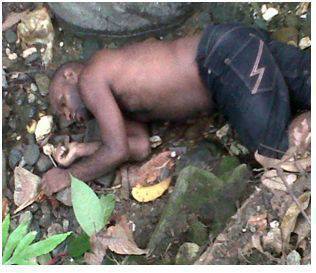
Photo: One of the victims, as yet unidentified. (supplied from human rights investigators)

At least 18 headless, mutilated or amputated bodies have since been confirmed found in roadside ditches and drains, and named as victims from around the Mulia and Pirime areas of Tingginambut, with unconfirmed but credible reports putting the total toll of the “mysterious killings” at over 41 people to date.  Activists from the West Papua National Committee (Komite Nasional Papua Barat or KNPB) have said that the discovery of so many bodies points to “a covert operation of killing and forced disappearances of indigenous Papuans in Puncak Jaya that has been operating since 1 April 2013 until now”.

Those confirmed dead are:

  1. Mili Tabuni (37),
  2. Sony Tabuni (35) ,
  3. Ella Enumbi. Born Mewoluk DOB 12 March 1986, Secondary school student at Mulia State School Class III, Male,
  4. Yerson Wonda,  Born at Wondagobak, Mulia, Male. Tertiary College Student in Technical Trade in Jayapura; Also worked as Secretary of KNPB Puncak Jaya Region at Puncak Jaya.
  5. Yos Kogoya (40) Former village head Mewoluk;
  6. Pauwuli Tabuni (35) Village Head of Regional District Tingginambut;
  7. Yaningga Tabuni (37) Village Head Regional District Yembuni Tingginambut;
  8. Tepaus Tabuni (40) Village Head of Regional District Tingginambut;
  9. Terius Enumbi (39) Shepherd of the Church of Kampung Kalome;  and
  10. Yemundan Enumby (35)
  11. Inoga Wonda,
  12. Deniti Telenggen,
  13. Telapina Morib,
  14. Aibon Tabuni,
  15. Yomiler Tabuni,
  16. Bongar Telenggen,
  17. Eramina Murib.
  18. Regina Tabuni.

West Papuan human rights activists in Puncak Jaya have also reported that women in villages under occupation by the TNI are being regularly raped by soldiers, with at least 12 documented cases since April and unconfirmed reports of many more.   Two female high school students among the dead were found to have been brutally raped and beaten in Tingginambut by Kopassus officers,   West Papua Media is not publishing the names of these sexual assault victims in line with ethical journalism practice.

Relatives of the a total of 30 missing adults are still searching across Puncak Jaya for their family members, though unconfirmed reports have emerged that Kopassus have arrested and detained at least 15 more people while searching for their family members.  Grave fears are being held for the safety of these detainees, with at least one case of torture believed to have occurred on family members.  According to statements from the West Papua National Committee (KNPB), a senior high-school aged youth of class III was arrested in the town area and is believed to have been tortured over a period of 2 weeks after which he was killed and beheaded, with his beheaded body placed in a sack and thrown under a bridge. His family is still hunting for his head, according the KNPB.

Wim Medlama, the spokesperson for the KNPB, told KNPBNews.com, “Every person in the community known for activist activities in Puncak Jaya has been interrogated such that the whole community is now terrified to even carry out their usual daily activities.”

TNI soldier aims .50 Calibre heavy machine gun at Papuan villagers in TIngginambut during recent sweep operations in May 2013 (Photo: supplied by indp human rights investogators)

Independent human rights investigator Yasons Sambon have just returned from Puncak Jaya interviewing surviving victims and witness who have pointed the finger at new Papua governor Lukas Enembe, detailing that six of the victims were returning as invited guests from Enembes inauguration in Jayapura.  Enembe’s electoral team provided the six with transport to attend the inauguration, but allegedly left them stranded in Jayapura after allegedly reneging on their transport home, however Enembe’s team finally covered their fares back to Wamena only after the Governor had arrived back in Jayapura from a visit to Jakarta..

On the afternoon of May 8, 2013, the six men,  (Yos Kogoya (40) Former village head Mewoluk; Pauwuli Tabuni (35) Village Head of Regional District Tingginambut; Yaningga Tabuni (37) Village Head Regional District Yembuni Tingginambut; Tepaus Tabuni (40) Village Head of Regional District Tingginambut; Terius Enumbi (39) Shepherd of the Church of Kampung Kalome;  and Yemundan Enumby (35) Society of Kampung Yembuni), left Wamena to return home by car to their villages in TIngginambut, Puncak Jaya, when they were stopped at the Ilu military infantry post on the Mulia road.  According to the testimony from surviving witnesses interviewed by Sambon, the victims were forced out of the car and were beaten and tortured whilst being interrogated by the soldiers and detained through the night.

The testimony provided by the witnesses reported that at 0800 the next morning (May 9), the victims were then confronted by” a number Kopassus officers in the middle of the road”, further adding that “Kopassus in Puncak Jaya were assigned to kill people in a way like the mafia”.  (Kopassus officers are regularly referred to across Indonesia as Mafia or gangsters, given their well-documented control of vast, well organised criminal cartels of drugs, money laundering, prostititution, illegal logging and mining, finance, human trafficking, and a myriad of other illegal business activities.)

Heavily armed Indonesian military look towards heir target, a small village near Mulia in the highlands of West Papua, during recent deployments (photo supplied by local human rights investigators)

“Then victim number 6 is tortured until killed by inhumane way, gunshot victims by Kopassus and cut the legs and head off, and waste (dumped) in different places,” the witness reported to Sambom.  Sambom described the witness as an ordinary villager who found the bodies of the chiefs, and who begged for his name not to be published for “fear he will be searched again by Kopassus and removed after being found as the the source of this news report”.

According to the sources interviewed by Sambom, “we found the victims dead, they (perpetrators) had dismembered the head and feet and hands in different places, we gathered all of the victim’s body.”   “Once we found them, we made a grave all in one place. Right now we’re done mourning, and sympathizers close to the family who came to pay respects had returned to their respective villages,” the village witness said.

“We now, all the people are afraid, because Kopassus kill again we are all scared,” he said.

Indonesian military interrogating villagers during a raid of unidentified village near Mulia, TIngginambut, during sweep operations, May 2013 (Photo supplied by indp human rights investigators)

The driver, who according to witnesses was a “newly posted” member of the State Intelligence Agency BIN provided by the pro-military Governor Enembe, has not been seen since, and witnesses have questioned if he was a participant in the murder of the Chiefs, or if he himself was murdered by the Kopassus officers seeking to cover their tracks.

According to sources from the KNPB, two more victims, Yerson Wonda – the Secretary of KNPB in the Puncak Jaya region  – and KNPB member and high school student  Ella Enumbi were also arrested by Kopassus at Ilu TNI post, then killed and their bodies beheaded. The body of Yerson Wonda and the head only of Ella Enumbi were thrown under a bridge in a sack, and their bodies were found on 26 April 2013.   KNPB News reported that “It is suspected that for two weeks following the date of their deaths that their bodies were hidden by Kopassus at the place of detention at the Kopassus Post at Purume (Pirime), Mulia. The family is still searching for the remainder of the body of Ella Enumbi.”

Sweep operations by Indonesian security forces have not lessened in intensity since December 2012, when a new phase of repression against local civilians and non-violent political activists began with the violent raids by joint Detachment 88 counter terror and TNI soldiers on the home villages of the KNPB political activists.  Several of those still missing include non-violent political activist members of the local chapter of the West Papua National Committee (KNPB), which has seen a massive and violent crackdown led by new Australian trained Papua Police Chief Tito Karnavian, the former head of the notorious counter-terror unit turned extrajudicial death squad, Detachment 88.

The area of the latest alleged TNI rampage is the same area in Sinak subdistrict, close to Mulia, where troops from General Goliat Tabuni’s West Papua National Liberation Army (TPN-PB) unit attacked Kopassus soldiers who had built a military post on a sacred burial ground in on February 21.  A massive influx of several thousand soldiers from the Indonesian Army’s (TNI) Kostrad (strategic reserve),  notorious locally based Indonesian battalions 753 and 756, several hundred Kopassus special forces soldiers, and members of the Australian-trained and funded Detachment 88 counter-tterror unit flooded into the area to hunt Tabuni’s unit.  Since the influx, constant operations have caused thousands of people to be displaced from their villages, whilst those remaining behind are subjected to arbitrary and brutal treatment from the military and police on a daily basis.  Hundreds of houses, livestock and food gardens have been destroyed in a collective punishment against civilians that breaches international laws on war crimes.
Disturbing footage from human rights investigators has also been released showing the brutal conduct of Indonesian troops terrorising unarmed civilians as they raid a unidentified village in Tingginambut during this years sweep operations.  The video can be viewed below.
The KNPB has reiterated a call made from local residents for human rights monitors to be present in the region.  “We urgently seek the help of KOMNAS HAM (National Human Rights Commission) in Papua, and any independent persons with humanitarian concerns to please immediately come to Puncak Jaya to investigate,” said Wim Medlama.  “These covert operations and mysterious killings are still to this moment continuing.”
Sambon also contacted General Tabuni by phone on May 23 and reported that Tabuni was shocked at the killings and denied involvement. “They are the people and the village head, not my TPNPB-OPM members who do not shoot” …  According to Tabuni, “the public spotlight is on me, why Goliath is silent? But the village head make themselves part of the Indonesian government, why should they be shot like that? I have no link related to this event. It is the responsibility of the Governor,” Tabuni said.

WestPapuaMedia

PAPUA – PRISON ISLAND: SPECIAL IN-DEPTH REPORT

Opinion/ Analysis

by contributors to the “Papuans Behind Bars” Project* (see end of article)

APRIL 16, 2013

An expression of people’s desire for freedom, cries of “Papua Merdeka” continue to ring out through the cities, mountains and forests of West Papua. The struggle is against fifty years of Indonesian rule, which throughout the last half-century has violently tried to subdue Papua, in its attempts to create a unified nation from the 17,000 islands that once made up the Dutch Empire.

Freedom as expressed by the word ‘merdeka’ is primarily a call for political independence, although the word is imbued with the clear hope that a new national sovereignty would also bring a wider liberation. Even when used outside the context of nations, ‘merdeka’ carries a sense of autonomy or self-reliance; from the same Sanskrit root Indonesian also inherited the word mahardika, meaning wisdom or nobility.

Those cries of freedom are also heard from the cells of Papua’s prisons, where its absence is arguably felt more strongly than anywhere else. The struggle for a national liberation suddenly becomes much more personal and immediate when deprived of your own individual liberty, by means of police handcuffs or a judge’s order.

Prison is used as a weapon against the people and their resistance to Indonesia, and over the years thousands of Papuans have found themselves locked away from the world behind prison bars. Many were arrested for expressing their aspirations for liberation, mostly relatively peacefully, but occasionally also for taking up arms. Others were merely unlucky enough to have been in the wrong place at the wrong time and got caught up in the structural violence of a justice system designed to spread intimidation throughout the entire population.

It is not always straightforward to know whether and how to relate to the macro-politics of nation states and aspirations of would-be nation states, and especially for those of us who are not in Papua and who are not forced into an existence defined by ever-present violence, repression, marginalisation and resistance. But by listening to the experiences of people caught up in that system, we can understand and be inspired by the ways that they have found to withstand oppression and create an impulse for their own freedom and that of their friends, families and communities.

Here are some of the stories from Papua Prison Island, tales of some of the individuals who have felt the full force of Indonesia’s law enforcement in recent years, who have been arrested at random or deliberately targeted as activists, who have been tortured or beaten in detention, whose trials were a farce, who have suffered major illnesses with no access to proper healthcare – but who have in many cases kept their strength, their dignity and sense of solidarity intact.

1. Repeated Targets: Buchtar Tabuni and Yusak Pakage

A political prisoner is forever marked out as an enemy of the state.  Those who survive the horrors of the prison system and emerge to continue their resistance after being released are particular targets for petty and personalised vengeance. This was the case in 2012, when two former political prisoners who have remained politically active, Buchtar Tabuni and Yusak Pakage, were rearrested and re-condemned, both under ridiculous pretexts.

The story can be traced back to December 2010 when Miron Wetipo, a prisoner who had recently escaped from Abepura prison, was shot dead. News reached the prison and the prisoners’ anger erupted spontaneously. As a riot commenced, two political prisoners stepped in to try to negotiate a resolution. Buchtar Tabuni, the then-leader of the West Papua National Committee (KNPB), was serving three years for organising a demonstration, and Filep Karma fifteen years for raising the Morning Star flag, a banned symbol of West Papua. Their attempts at mediation were ignored and instead they were blamed for starting the riot. Along with three other prisoners they were transferred from the jail to police headquarters for three months, where they were initially denied food and family visits and were at constant risk of violent reprisals from the cops.

Eventually the men were returned to the prison and the story could have ended there. Although Filep Karma’s sentence is set to run for several more years, Buchtar served the rest of his sentence and was released nine months later. He continued to be a prominent activist fighting for independence.

However, almost a year after his release on 6th June 2012, Buchtar Tabuni was arrested again. This piece of news only made minor headlines at the time, as everyone’s attention was focussed on a wave of seemingly-random shooting incidents that was causing panic at the time around Jayapura, as they were occurring nearly every day. After Buchtar’s arrest, the Jayapura police chief said in a press conference that he had been arrested in connection with a string of recent violent incidents, which would seem to imply the that he was accused of being involved in the shootings.

However, when Buchtar’s lawyer was able to see him, he established that the arrest was actually in connection with the prison riot 18 months before. But why should he be arrested suddenly now, if the case could have been brought to trial at any point in the nine months between the riot and Buchtar’s release while he was still in custody?

In fact, it appears that this arrest was part of a new wave of repression against the KNPB, an organisation which had been gaining in momentum across Papua over the past few years, mostly by organising open demonstrations in Papua’s urban centres. It was to become a decisive move against the popular organisation; Victor Yeimo, who took over from Buchtar as KNPB chair, claimed that 21 KNPB members were killed and 55 imprisoned during the course of 2012. Just over a week after Buchtar was arrested, KNPB deputy leader Mako Tabuni would be gunned down by a police marksman as he was buying betel nut on a street corner.

Buchtar’s trial for violent disturbance started in July. It was reported that several KNPB members received threatening text messages not to attend the trial. Yusak Pakage was undeterred, however. He was also a former prisoner, having been sentenced to ten years in prison at the same flag-raising event in 2004 where Filep Karma had also been arrested. In July 2010 he was granted a pardon and released, after which he was involved in the Papuan Street Parliament (Parlamen Jalanan).

Watching the farce of a trial, Yusak’s frustration built up until he kicked over a rubbish bin. Bright red spit from someone who had been chewing betel nut spilled out of the bin and stained the trouser-leg of a public official. Yusak was arrested. While he was being searched, police found that he was carrying a penknife. This became the pretext to charge him under an Emergency Law from 1951, which prohibits carrying weapons.

So for possessing this everyday object Yusak Pakage was sentenced to seven more months in prison. He has said that he believes he was targeted for having previously been a political prisoner, and it would be hard not to see it that way, as it is totally normal to carry not only penknives but also tools such as machetes and bows-and-arrows in Papua.

Having already spent years behind bars does not make prison less of an isolating experience. Yusak Pakage, whose name is known around the world due to Amnesty International having promoted his case as a prisoner of conscience, told a local reporter how he was saddened at how few visitors he received in prison, especially after his sister moved to another city. While he knew local human rights activists were supporting him in other ways, whether out of fear or lack of motivation, they didn’t come to visit.

But prison can also sharpen the sense of solidarity with those facing the same fate. After being released from his eight month sentence, Buchtar Tabuni’s first act was to go to the site of where his friend Mako Tabuni had been killed. A few days later he flew to Wamena to try to negotiate the release of other KNPB members which had been arrested in September, accused of possessing explosives. This trip was followed up by trips to Timika and Biak, where he also visited KNPB members in prison and tried to secure their release.

2. Left to Sicken and Die: Prisoners of the Wamena Arsenal case.

On December 2012, Kanius Murib passed away in Wamena, 59 years old. He had been in prison since 2003, but in the last few months of his life the prison guards allowed his family to care for him, as by that time he was suffering from severe mental illness and failing physical health. Arrested with nine other people and sentenced to life imprisonment, he was the third prisoner from that case to die in custody.

The accusation laid against the men was that they had carried out a raid on the weapons arsenal in a military base in Wamena on 4th April 2003. Not knowing who had carried out the attack, the military went on the rampage, sweeping through surrounding villages, meting out an undiscriminating collective punishment on the whole population, burning entire villages to the ground as they so often do when they take revenge. Several people were killed in these reprisals, and it is likely that many others starved to death in the mountains as they fled their homes.

Kanius Murib’s house was one of those burnt. He was arrested on 6th April. While still in military detention one week later he was dragged three kilometres to Ilekma Village, together with another man, Yapenus Murib. Kanius was handcuffed, Yapenus was pulled by ropes tied around his neck. This torture was more than a human body could take; he died shortly afterwards.

Seven more men were arrested, and also experienced similarly brutal torture. One was able to escape, so together with Kanius Murib seven were left to stand trial. All were convicted of treason and sentenced to between twenty years and life.

In December 2004 the other six men (Apotnalogolik Lokobal, Jafrai Murib, Linus Hiluka, Numbungga Telenggen, Kimanus Wenda and Michael Heselo) were woken up and forced to get in a truck. They were being moved to Gunung Sari Prison on Sulawesi Island, isolated from friends and family by 2000km of ocean. They remained there until 2007, when Michael Heselo fell ill in prison. Before his family could raise funds to come and visit him, he died in prison, aged 35.

Protests broke out in Papua, demanding that the five men remaining in Makassar should be brought back to Papua. The authorities acceded to the request and the prisoners were divided between Nabire and Biak prisons – still a long way from home, but at least they were in Papua. But prison continued to take its toll on the men’s health. In 2011, Kimanus Wenda started experiencing stomach pains and was vomiting all the time, and feared he had a tumour. Jafrai Murib, who would have been no more than 28 or 29 at the time, had a stroke, which left him almost paralysed.

Both men urgently needed medical care, and it is the prison’s responsibility to ensure inmates receive treatment, but the only attention they received was consultations with local doctors. The prison refused to pay for operations, or for their transfer to Jayapura, where better facilities were available.

This happens time and time again. Filep Karma has also had a history of sickness in prison – kidney problems left him in severe pain for some time. After a long campaign to get treatment for him, finally local activists went out on the streets collecting donations so he could be operated on in Jakarta. In this way they managed to pay for the flights for him and his family, and international groups helped to pay the hospital bill. It is a sign of the force of his character, which has brought him through ten years of prison maintaining a stubborn and uncompromising commitment to his principles, that even as the money was being found, Filep was talking of refusing to leave unless another prisoner, Ferdinand Pakage, could also get treated – he even started a hunger strike. Ferdinand Pakage had been blinded in one eye after a beating by a prison guard, and continues to suffer as a result.

For Kimanus and Jefrai, eventually local activists had no other choice but to go out on the streets and collect donations again. For doing what should have been the state’s responsibility, collecting money to care for sick prisoners, fifteen people were arrested on 20th July 2012. One of them was Yusak Pakage, just three days before he would be arrested again in the courtroom incident.

Eventually, after many months, enough donations were collected, in Papua, Jakarta and abroad, and prison authorities gave their permission for Kimanus and Jafrai to be transferred to Jayapura for treatment. In the end Kimanus was diagnosed with a hernia. But even after all that has happened, accessing health-care continues to be a struggle – the latest news is that Jafrai Murib was temporarily denied access to the physiotherapy he needs to recover from the stroke – as punishment for having a mobile phone in his cell.

3. In the mountains where no-one is watching: Prisoners in Wamena Prison

Wamena, where Kanius Murib and the others were arrested, is the main town of Papua’s Central Highlands, which support a higher population than other parts of Papua, but remain inaccessible. No usable road connects this high plateau to the coast, and news still doesn’t reach the outside world so easily. It is in these mountains that most of the bloodiest military operations have taken place in recent years. When prisoners are taken they are usually accused of treason and often given long sentences based on spurious evidence. As lawyers and human rights groups, already overstretched in the lowlands, have not always had the resources to come up here, there is often no-one to support them. Few details about their cases circulate, and it can be difficult to find any information about them. Here’s what we know:

Tenius Murib and Jigi Jigibalom were arrested in a military sweeping operation in November 2003. Still in the early hours of the morning, troops surrounded a house in Bolakme village and opened fire, killing ten people. The two survivors were arrested, tortured and accused of belonging to the Free Papua Movement guerrilla army. One of the accusations was that they had participated in the same raid on the weapons dump described above. They were sentenced to 20 and 15 years respectively.

Dipenus Wenda was arrested with three other men in March 2004, while they were giving out leaflets campaigning for a boycott of Indonesian elections. One of the four, Marius Koyoga, was shot dead while in police custody. The others went on trial for treason. Dipenus Wenda was sentenced to 14 years in prison.

In January 2005, Yusanur Wenda and between six and eight others were arrested in Wunin district (information is so limited we are not even sure how many people were prosecuted in this case). Also accused of belonging to the OPM, they were supposed to have burnt down public buildings and schools. For this Yusunur Wenda was sentenced to 17 years, and the others also received long sentences. Local activists asked at the time why the OPM would be interested in burning schools. But there is another explanation: a week before the arrests even took place, a website called West Papua News had published an account of the burnings. In their story, it was Kopassus special forces and police mobile brigade (Brimob), which had arrived by helicopter, and burnt down not only the public buildings but all the houses in the village as well.

In 2008, nine people were arrested while walking to a funeral in Yalengga village. They had been asked to carry a banned Morning Star flag so that the dead man could be buried beneath the Papuan flag. On the way they were intercepted by soldiers, arrested and tortured. Once again, the charge was treason, this time the sentence eight years. It is believed that these men were not even activists, yet they were condemned under laws intended for major attacks against the integrity of the Indonesian state.

At present, out of all these cases, only six convicted political prisoners remain in Wamena prison. Four are from the Yalengga case: Oskar Hilago, Wiki Meaga, Meki Elosak and Obeth Kosay, as well as Yusanur Wenda and Depenus Wenda. Over the years the others have all managed to escape. Some were among the 42 people who broke out of Wamena prison on 4th June 2012. Another mass escape had taken place in 2009, with 43 people managing to escape. Finally in November 2012, two young men who had allegedly been in possession of OPM documents, saved themselves the perils of Indonesian justice by finding a way to break out before their case came to trial. It seems that the only chance for justice in Wamena is to take it for yourself.

4. Allegiance to the Wrong Flag: Repression Against Symbolic Acts of Resistance

The charge of Makar, or treason, the infamous article 106 of Indonesia’s criminal code has been used as a catch-all to repress Papuan movements. It was the principle charge in all the Central Highlands cases mentioned above. Whether the accusation is a peaceful act of dissent or armed rebellion, the charge is likely to be the same, probably because most of the other criminal accusations which could be brought are seen as lesser crimes. With article 106 it is possible to condemn someone to 20 years in prison, or even life, as in the case of Jafrai Murib.

A flag has become a symbol both of what Indonesia cannot tolerate and the Papuan challenge to Indonesian authority. The Bintang Kejora (Morning Star) was first flown on December 1st 1961 at a point when the Dutch Colonial Government was preparing to hand over power to an independent West Papua, before Indonesia sent its armed forces to claim the area. After Suharto fell a special autonomy package granted by President Gus Dur expressly allowed the flag to be flown as a symbol of Papuan identity, but the military never accepted that policy. The special autonomy still stands in theory, but a Presidential Regulation forbade the Morning Star flag once more in 2007.

Many people have gone to prison because of this particular piece of cloth, or even displaying the symbol on clothing, bags etc. Filep Karma is the most well known, and also the most extreme case, sentenced to fifteen years in prison for raising the flag on December 1st 2004. Actually this was the second time Morning Star flag had landed Filep in prison. The first time came just weeks after Suharto fell, and the people of Biak occupied the port, flying the flag from the water tower. The people held the port for four days, but then the military stormed in. Filep Karma was shot in both legs but survived, one of 150 people arrested that day. For many, the punishment was even more severe: according to local investigators, 139 bodies were loaded onto two navy ships to be dumped at sea.

As he has long been a popular figure in Papuan resistance movements, large demonstrations accompanied both of Filep Karma’s trials. At the trial for the 2004 flag-raising, the reason for the demonstrations was the prosecution’s demand for a five-year sentence, which the crowd felt was extreme. Yet in the end the judge went much further, taking the unusual step of exceeding the prosecution’s demand and condemning him to fifteen years and Yusak Pakage to ten.

The ‘Jayapura Five’ were arrested at the Third Papuan People’s Congress in October 2011. Their act of supposed treason was an act of provocation – or at least they knew the huge risks they were taking when they convened a congress where representatives from all over West Papua would meet to discuss their political future. Unsurprisingly, but bravely, the congress decided to declare independence. The flag was raised, and Forkorus Yaboisembut, leader of the Papuan Customary Council, was declared as President of the Federal Republic of West Papua. Edison Waromi, who had been imprisoned under political charges for twelve years in 1989, and then six months in 2001 and two years in 2002, was chosen as Prime Minister. Another former political prisoner, Selpius Bobii, who had organised the conference was also jailed, as were August Makbrawen Sananay Kraar and film-maker Dominikus Sorabut. They were sentenced to three years in jail.

Also still in prison for raising flags are Darius Kogoya and Timur Wakerkwa, sentenced to three years and two-and-a-half years respectively for raising the Morning Star on 1st May 2012. And there have been many more prisoners in recent years for these symbolic acts of defiance: Septinus Rumere, an activist from Biak in his sixties, simply raised a flag outside his house in 2009 – he was sentenced to six months for treason. The Iba brothers were maybe hoping to get away with raising a flag which merely resembled the Morning Star in Bintuni in 2009, but they were sentenced to between two and three years anyway.

Another case highlights how the cruel reality of the prison system clashes with the ways indigenous people find to assimilate the pressures on their lives and express their desire for liberation. In Demta village, on West Papua’s northern coast, a group of villagers had built a meeting house they called Mammo and started believing in a king. Such messianic beliefs, sometimes known as cargo cults, have emerged in Melanesian cultures ever since they came into contact with colonialists, and can be seen as a reaction to these new patterns of domination. This group made a procession calling for repentance from humanity’s wickedness and obedience to the king. Alongside the flag of the king, the Morning Star was also raised. The next morning, after the Mammo had been burnt down by local Christians, people from the group went to the police to avoid a violent conflict building up. They were arrested and charged with treason. After two months their release was negotiated, even if the charges were not formally dropped.

People organising politically for the rights of indigenous people are also targetted. Edison Kendi and Yan Piet Maniamboi were arrested as organisers of a demonstration to mark World Indigenous People’s Day on Yapen island on 9th August 2012. Their trial was still ongoing as this piece was being written, with rumours that the prosecution is asking for 20 years imprisonment.

There have been no recent cases of people being imprisoned as a direct consequence of defending their land from the resource industries of logging, mining and plantations that are becoming ever-more rampant in West Papua, but the climate of repression is nevertheless opening doors to these industries, as there are plenty of reports from local people who feel too intimidated to taking a public stance against these development projects. After all, if raising a flag in your front garden can be considered treasonous, could not also standing in the way of a priority project for Indonesia’s economic development, such as the MIFEE agribusiness project or the Freeport goldmine?

5. When the law itself is violence, do guilty and innocent continue to mean anything?

While in recent years no long-term prisoners have resulted from the continuing conflict around the massive Freeport goldmine, it was a demonstration against that mine outside a university campus in Jayapura that led to a wave of arrests and intimidation in 2006. Twenty-three people spent an average of five years in jail after that demonstration, but by now most have been released. The exceptions are Luis Gedi and Ferdinand Pakage, who were sentenced to fifteen years each and are still inside, and Echo Berotabui, who succumbed to the despair and killed himself in prison.

On the day of the demo, 16th March 2006, minor clashes broke out, but then the police tried to storm the demo and they misplayed it. Four policemen and one air-force officer were killed that day. Once again, the state’s response was to react with widespread violence targeted against all and sundry. Seventy people were arrested, one or two were killed, and the campus emptied as students fled in panic.

As the weeks went on, the state’s handling of the case continued to be directed indiscriminately, more a thirst for revenge than an attempt to prosecute those who actually engaged in violence during the demonstration. Of the 23 people held and charged, all reported torture. People were forced under torture to make allegations against others. Luis Gedi was picked up on the street and forced to admit to killing policeman Rahman Arizona and to give another name as his accomplice. After being subjected to torture the name that he gave was Ferdinand Pakage. The police went to arrest Ferdinand and then they demanded to know where was the knife that had been used to kill Rahman. They made him go to the campus to try and find it. Then they shot him in the foot, and he told the police the knife was at his house. The police went there and seized his mother’s vegetable knife.

Similar stories continued throughout the trial process, with intimidation and a thirst for vengeance running high, police caring little whether the people they had in the dock were the perpetrators or not.

At one point, when 16 men had already been sentenced, police tried to force one of them, Nelson Rumbiak to appear as a witness for the prosecution in the trial of the remaining seven. When his testimony contradicted the police version of events, the police beat him up. As a response the remaining seven defendants refused to leave the prison to attend the next hearing, and convicted prisoners backed them up by throwing stones at the vehicle that came to take them to court. When another man was later arrested in connection to the same trial, all 23 prisoners wrote to the prison governor, saying that they would not testify for the prosecution, ‘even if they should be shot dead’.

Ferdinand Pakage lost an eye in prison in September 2008, after he was beaten by a guard who was holding his keys. The wound left behind has continued to cause problems over the years.

In the multiplicity of forms of struggle for Papuan independence, acts of violence do occur, but the state’s hysterical response means that ‘guilty’ and ‘innocent’ cease to be distinguishable. Dani Kogoya is believed to be a member of the TPN/OPM guerrilla army, and has been accused of co-ordinating an attack in Nafri near Jayapura, where one military officer and three civilians were killed. He was arrested in September 2012 and is being tried with four other people.

Dani has reportedly admitted his involvement in the killings, and expressed regret. Although that confession was made under duress, it is certainly possible that he was involved. What is definate is that neither he nor those accused of being in his gang will stand any chance of a fair trial. The ground has already been laid out: assuming his guilt a year previously police and military conducted a raid where Dani was supposed to have lived. The local community leader was forced to dig a hole while soldiers threatened him at gunpoint. At least fifteen people were held and tortured or maltreated. Dani’s eight-year-old daughter was reported to have been kidnapped and disappeared for a week. During his own arrest in 2012, Dani Kogoya was shot (police said that he was trying to escape), and his leg needed to be amputated. As the trial commenced, and the prosecution laid out its evidence, none of the witnesses they presented could testify to having seen Dani Kogoya carry out the attack.

Papua’s political prisoners stand almost no chance of receiving proper legal representation as the intimidation of lawyers is intense, claiming they are also committing treason. When the accusations are non-violent acts it is bad enough, but when violence has been involved the stakes are even higher. For example, in the case following the 2006 anti-Freeport demonstration, lawyers received death threats by text message against them and their family, and the house that one of them was staying in was pelted with stones. During Filep Karma’s 2004 trial, a severed dog’s head was left outside his lawyers’ office, alongside a note mentioning them by name.

6. Targeting the KNPB: how the state terrorizes social movements.

Late afternoon on 29th September 2012 at the West Papua National Committee’s (KNPB)Wamena secretariat, riot police and military showed up and arrested the people present. They claimed they had found two ready-assembled bombs on the premises. More raids would take place over the weeks and months to follow, in Wamena and also Timika, Biak and Jayapura, all involving members of the KNPB. Other KNPB members would be placed on the wanted list, effectively forcing them into hiding.

One of these arrests, in Wamena in mid-December was especially tragic. As three men were being arrested, police pressed them to give more names. They forced one of the men, Meki Kogoya, to phone another KNPB activist, Huburtus Mabel, and arrange a meeting for the next day. Being in custody, Meki was unable to turn up for the rendezvous, but the police were there and shot Huburtus Mabel, who died from his wounds and also Natalias Alua, who was left in a coma, but eventually recovered. Once again, they were allegedly trying to resist arrest.

However, beyond the names of the suspects, little information is known about this Wamena case. It is from Timika, where trial proceedings are in course, that there is much more news. It appears that twelve people were arrested early in the morning of October 19th, as the KNPB were preparing to organise public activities over the coming days. The police claimed to the press that they had found metal pipes and powders to be used in bomb-making.

Six of the activists were set free after five days, and the remaining six charged under an emergency law from 1951, which prohibits the carrying of weapons – a different article of the same law as that used to sentence Yusak Pakage for the penknife. Also used in the Wamena and Biak cases, this law is rapidly becoming the state’s preferred strategy for criminalising independence activists.

When the case came to court, the allegations were toned down somewhat. It appears that only one of the six was accused of possessing explosives, which he denies. The explosives in question are a kind commonly used for dynamite fishing – an ecologically destructive practice to be sure, but not an indication that they would be used against people. The others were accused of possessing panah wayar – a kind of barbed arrow used for fishing, and other tools. In Papua, bows and arrows are carried by almost everyone, as they are used for hunting and fishing and are a symbol of cultural identity. As the weapons charges seemed rather flimsy, the charge of treason was also added before the case came to trial.

It seems very strongly that this wave of arrests has been very deliberately planned to neutralise the KNPB. Even more so when coupled with a string of assassinations throughout 2012 and the politically-motivated use of the police wanted list.

The KNPB is an organisation which, since 2008, has tried to organise big demonstrations in cities across Papua. Their principal call has been for a referendum on independence to replace the flawed UN sponsored ‘Act of Free Choice’ in 1969, and they have closely aligned themselves with international initiatives to mobilise support for the Papuan cause amongst lawyers and parliamentarians. Papuan people responded and many thousands dared to come on the demonstrations, building a rapidly growing movement across West Papua.

To organise openly in this way was a bold step, relocating the focus of the struggle from the forest to the cities. Although many KNPB members see theirs as a revolutionary struggle, they also recognise the need for mass participation, and so there is a desire to focus on more non-violent forms of struggle. KNPB leaders have repeatedly stressed this point.

Actually it appears that there have been a couple of explosions that have taken place in Papua recently. Both were in Wamena – one in an empty police outpost and the other in an empty government building. It’s important to emphasize that these were empty buildings and there were no injuries – and also that those arrested in Wamena are not believed to be charged with causing these explosions. But it is also possible to imagine that some independence activists may end up choosing this kind of clandestine action. Especially as attempts to organise openly using peaceful methods which should be interpreted as legal are met with long prison terms or even police bullets.

Increasingly prominent in the political policing of West Papua is a group called Densus 88. Set up as an anti-terror squad after the 2002 Bali bombings, their focus has mainly been countering Islamic terrorism. There too, the sensationalism that surrounds their attacks on radical Muslims, and the frequency that they shoot-to-kill has raised accusations that they are causing the radicalisation of certain Muslim communities in response. In Papua, they are accused of carrying out assassinations, of activists and non-activists. A sign of their increasing prominence is that the latest chief of police in Papua was promoted to the position after running Densus 88.

In Papua, it is not really clear whether some activists are storing explosives or not, and if so what they intend to do with them. What is certain is that during the course of 2012 it has become much more difficult for groups who want to express their aspirations openly on the streets to do so. In early 2013, prominent Papuan advocate Benny Wenda made a major diplomatic tour around the US, Australia, New Zealand and Pacific Island States. Normally the KNPB would have been out on the streets to show support for his initiatives. But there have been no such demonstrations. It seems that right now, actions like this have become almost impossible.

7. Papua Prison Island

In 2013, the arrests continue: One person arrested and two others on the wanted list for organising a demonstration in Manokwari, four people arrested in Sarmi accused of being OPM members, another seven held near Jayapura and tortured by police demanding to know the whereabouts of independence activists, two of which have been kept in prison. Then there have been a number of cases in Paniai, in the western part of Papua’s highlands: six people were arrested and held for a month before being released for a lack of evidence, two teenagers were also arrested in a separate case and held for two weeks, and there have been two other reported cases of arrest and torture.

And these are only the political cases: with Papuans so extremely economically and socially marginalised in their own land, and with clear evidence of systematic racism in all parts of the state bureaucracy, we can only wonder what might be the stories of those condemned to prison for non-political crimes.

Prison is just one extreme form of how people are deprived of their freedom in West Papua. While some Papuans are being giving jail sentences, others are being cheated out of their ancestral land by plantation companies, forced to flee their villages due to military operations, or simply unable to find a way to make a living when the possibilities for work fall overwhelmingly to migrants from outside Papua. But none of these injustices are isolated. The prison system is one tool the Indonesian state uses to crush opposition and so maintain these patterns of oppression. Many of those held captive have been denied their personal liberty as punishment for seeking a wider liberation.

Meanwhile Indonesia’s latest strategy is to pacify Papua with promises of development programs, organised unilaterally from Jakarta, whilst glossing over the structural causes of oppression – for example ministers have denied that there are any political prisoners in Papua, only criminals. But economic development without freedom cannot bring peace, merely intimidate people into coercive obedience. It is encouraging that so many in Papua, including many prisoners, refuse to be intimidated.

—Much of the information for this article came from http://www.papuansbehindbars.org , a new project to document the cases of West Papuan Political prisoners. That site has profiles of current and former political prisoners and releases monthly news updates on arrests, trials etc. However, this is an opinion piece which does not represent the position of the Papuans Behind Bars project—

Create a website or blog at WordPress.com

Up ↑