‘OTSUS Plus’ a further blurring of Papuan History

Opinion / Analysis

By  Selpius Bobii in Abepura Prison,

11 October 2013

“ All leaders have notes of their mark in history, so I figure this forms mine in the history of Papua.” These were the words of the Papuan Governor Lukas Enembe to journalists following the acceptance of the draft Papuan  ‘Special Autonomy (OTSUS) Plus’ legislation.  The draft legislation was a result of work by the Cenderawasih University (UnCen) Academic Assistance Team together with the Papuan Provincial Government. The ceremony for the handing over of the draft OTSUS legislation (referred to as the ‘Papuan Governance Legislation’) took place at the Aston Hotel in Jayapura on 9 October 2013. (www.tabloidjubi.com/2013/10/10/draf-uu-otsus-plus-terus-digodok/).

To look more closely at the Governor’s comment, was he speaking out of some ambition to make a mark in history for the period he was governor in Papua whilst SBY was still President of Indonesia? Being noted as the governor present at the time the Otsus Plus legislation was forced onto the Papuan indigenous community. If we look back at what the indigenous Papuan community has had to endure we see the evidence that under leader after leader both at the national level and the Papuan regional level, that there has been nothing but a ‘blurring’ of history in Papua. The Otsus Plus legislation that is about to be applied in Papua will but add to that blurring of Papua’s history.

Until this time all policies in Papua have been set from Jakarta and the reins have always been held from Jakarta. Those in official positions within the provincial and kabupaten (regency) levels of government in Papua have acted as ‘bridges’ to enable the Central Government’s projects to be a ‘success’, in line with their ends of marginalisation, discrimination and making Papuans a minority.   Which on the broader scale have amounted to a process of annihilation of the ethnic Papuan race.

No matter who holds the power at the provincial level, they will never liberate the people of Papua from the discrimination, marginalisation, being made a minority and the annihilation of the ethnic Papuan people, which has been planned and carried out by the Republic of Indonesia (RI) constantly until now.  Since the time Papua was annexed by Indonesia, the efforts of Indonesia to this end have been nicely ‘wrapped’ so that they are systematic and ‘tidy’, but make no mistake they are planned and measured by the Central Government taking place through a number of strategies and tactics.

Governor Enembe has stated to journalists that all Papuans want “major changes” and one can only think that he perceives this draft legislation is the solution to awaken Papua and bring about those ‘major changes’.  However what if the Otsus Plus legislation does NOT bring about those expected major positive changes or in fact any changes that lead to a better situation for indigenous Papuans? The Otsus Plus legislation is not only NOT the solution to bring an end to the problems in Papua but in fact will clearly have the opposite effect and bring nothing but calamity and disaster for the indigenous peoples of Papua.

The legislation is intended to protect the rights of and empower the indigenous people of Papua, however all agree that the application of OTSUS this last 12 years by Indonesia (2001-2013) has been a total failure, and that it has neither protected or respected the basic rights of indigenous Papuans (including even the most basic right to life or their basic political rights).  The efforts of Indonesia to revise the Papuan Special Autonomy legislation so as to become the Papuan Special Autonomy Plus legislation is bound to meet exactly the same fate as the Special Autonomy legislation and completely fail!

Governor Enembe’s statement that the draft Otsus Plus legislation is the “desire and aspiration” of the Papuan community and “something to be struggled for”  brings much shame on Papua and is in fact a public lie.  As the Papuan community never wanted the Otsus Plus package that is now being forced on Papua and it has never been the ‘aspiration’ of the indigenous Papuan community.  The revision of Otsus to become Otsus Plus is rather the desire and aspirations of the political elite in Jakarta and in particular of SBY’s Cabinet. These efforts are being driven by SBY due to both Otsus and then the UP4B program (the Accelerated Development Unit in Papua and West Papua) having previously failed.

The results of the work carried out by the Uncen Academic Assistance team as follow-up to the draft Otsus Plus legislation – the initial document of which was prepared by President SBY through Feliks Wanggai – simply cannot be claimed to be something of the desires and aspirations of the Papuan people.  As the Uncen team is but part of the hands and feet of the Republic of Indonesia and has intentions to defend the oppression in Papua by RI and by so doing to extend the suffering of the indigenous people of Papua.

Having Uncen University involved in this way to give some false legitimacy to the legislation, was also practised by Indonesia in 1999 in order to force another of Jakarta’s projects onto Papua.  It was at that time that the Uncen Assistance Team was formed by RI to be involved in the initial draft Special Autonomy legislation.  Yet when the draft legislation was provided to the Central Government in Jakarta it was then cut right back. The final draft which was then totally according to Jakarta’s agenda was approved by the national Legislative Assembly and it was then applied under the order of the President in the year 2000 against firm opposition from the indigenous Papuan community becoming operative in 2001.

The draft legislation in this instance as prepared by the Academic Assistance Team together with the Papuan Provincial Government is merely intended to deceive the public, local, national and international. As the final draft legislation that will be presented for approval will actually be that prepared by President SBY’s Cabinet and in particular by the President’s Special Staff person in the area of Regional Autonomy Fileks Wanggai.
Sadly those lecturers at the Cenderawasih University who have been involved in the project have allowed themselves to be used as a ‘bridge’ to enable Jakarta’s project to pass through the system.  The draft Papuan Otsus Plus legislation has been handed to the Papuan Governor by the University rector Professor Dr Karel Sesa. From the time Papua was initially annexed into the Republic of Indonesia on 1 May 1963 the Uncen University has always played a role of securing and legitimising programs from Jakarta. They managed to destroy all their important records that were a part of the regime of the colonising Indonesia and in so doing to bring much suffering on Papuans. This role of legitimising Jakarta’s agendas was in fact from the start one of Indonesia’s  intentions in establishing Uncen University.

It is most ironic that despite the wave of rejection by the Papuan indigenous community of Otsus Plus, that the Uncen Assisting Team has been working together with the Papuan Provincial Government to ensure ‘success’ of Jakarta’s political package. In so doing they have pawned their very self-worth for positions of importance and wealth.  Their consciences have become blinded by their passion for wealth and positions of influence. Their expert knowledge has been used to support the colonial domination of Indonesia rather that to rescue the nation of Papua from the crisis of this era under RI’s colonial power. This is a matter of great shame and which brings much sadness.

The fate of the Papuan nation”s community is being played with by these persons politically prostituting themselves for the sake of personal gain. The strength of the nation of Papua to resist the destructive effects of RI’s ways and means has been weakened with the support of certain Papuans themselves working both within and outside the Indonesian government systems.  People working merely to chase personal importance and the interests of their own factions.  The consequence being that the indigenous Papuan community has become the victim of their conspiracies of interests at the local, national and international level.

This oppression must be bought to an end! The entire Papuan community must be aware of these realities and commit to walk together so as to realise the goal together.  Papuan activists in all locations need to consolidate and act as one, uniting agendas and stepping forward together. In particular youth and students in all locations need to strictly head only towards the struggle for the liberation of the nation of Papua. Whilst the international community in solidarity is asked to continue all efforts with actions, campaigns and diplomatic efforts to liberate Papua as their supportive efforts are so badly needed towards the end of upholding justice and the human dignity of Papua above all other interests.

To the Republic of Indonesia it is demanded that continuing discussion of the unilaterally prepared draft Otsus Plus legislation (referred to as the Papuan Governance legislation) stops  immediately. The unilateral application of political packages of any kind by Jakarta will never bring an end to the problems in the land of Papua. Rather RI needs to enter into dignified dialogue and non-conditional consultations between RI and the nation of Papua, facilities by a neutral third party and held in a neutral location so as to find a dignified solution to the problems.

There is no word for ‘give-up’ in the dictionary of the revolution of liberation; and neither is there a term ‘too late’ in the field of struggle. There is still time. The people of Papua have strength, have faith, have hope and have the Lord. We must be strong and stay able. We must rise up and go forward. We must oppose all forms of tyranny and oppression and be firm in our convictions that we will eventually be victorious. That will indeed be a most glorious moment when the times comes..

‘ Unity without limits! Struggle until victorious!’
Selpius Bobii is the General Chairperson of Front PEPERA &  is a Papuan Freedom Political Detainee in  Abepura Prison, Jayapura


Preliminary report into Waghete deaths and sweepings

Report compiled by Selpius Bobii in Abepura

September 26, 2013

On Monday 23 September 2013 in the town of Waghete which is the main town of the region (kabupaten) Deiyai (district Tigi) at 11.30 am local time, an action of violence by the Indonesian armed forces causing death and bloodshed of unarmed civilians occurred. The incident arose as a result of arbitrary sweeping carried out by joint forces of Paniai based BRIMOB (‘Mobile Brigade’ being an Indonesian National Police special operations force unit), Paniai regional Police together with Indonesian military Unit Timsus 753 (TNI) based at the Paniai Koramil (Regional military headquarters). The sweeping was carried out under the command of the Head of the Paniai Regional Police High Police Commissioner Sammy Rony.

The target of the sweeping which included confiscation of items was as follows:

  1. Sharp weapons including smaller knives, larger (machete type) knives, axes and bows and arrows;
  2. Hand shovels;
  3. Mobile phone cards for checking of any activist photos or other photos related to the Papuan Freedom movement such as the Morning Star Flag;
  4. Civilians with long dreadlocks or long beards, who are all suspected by the Indonesian armed forces of being members of the TPN/OPM (these persons were to be detained).
Waghete villagers mourning the police murder of priest’s son Alpius Mote

During the sweeping the Police detained 15 people based on nonsensical reasons, and at this time they are all incarcerated in the jail cells at the Paniai District Police Command headquarters. These include a female by the name of Alfrida Dogopia. They were detained under conditions of torture, intimidation and insult carried out by the TNI Timsus (Tim Khusus or Special Team unit from Kopassus special forces)unit, BRIMOB and Paniai regional police.

The local community responded to the above by protesting to the local police. The Head of the District Police commanded those under him to shoot any civilians that protested to the operation. Accordingly BRIMOB, ordinary police and the TNI joint forces responded to any behaviour of protest by civilians with extremely excessive violence by shooting civilians. The consequence was 3 civilians were shot by members of BRIMOB in the Waghete field (open grassed area in the town) at approximately 11.30 am local time.

The shooting victims were as follows:

  1. Alpius Mote, a student at the Deiyai Upper Secondary State School in Waghete, child of the local Church Minister Daud Mote. He was shot dead. The bullet entered on the right side of his chest and went through exiting his back.
  2. Alex Mote, a youth from Deiyai was shot. He is presently being treated at the Paniai Hospital.
  3. Yance Pekey, an English Teacher from the Deiyai State Upper Secondary School. News is that he was shot and beaten at the school offices and at this time is being detained at the Paniai Police District Headquarters.

The local community didn’t accept the actions of the joint armed forces and considered them to be extremely excessive. The body of the shooting victim was taken to the police offices by community members  at 19.00 hours and the police were asked to take responsibility for the death.  Until this moment the Waghete community is still struck by fear by the events that occurred.

According to the Head of the Paniai District Police High Police Commissioner Sammy Rony, the sweeping was carried out to make the area safe for civilians and intended against those who were in the practice of gambling, getting drunk and carrying sharp instruments. According to Rony property of local government was damaged as a result of the drunkenness. He said the disturbance had started five days before the shooting incident. “Since last Wednesday a group of people  have done damage to a number of houses of government officials in the town of Waghete, including that of the Deiyai Region Bupati (i.e. Head of the local regional (kabupaten) government) Dance Takimai and of the Kabupaten Secretary Basilius Badii” stated Rony.  He claimed that the damage to the officials’ houses was suspected to have been carried out by a group of supporters of a certain candidate for the bupati position that failed to be elected in the recent elections for the head of the Deiyai Kabupaten. “So in this there is an influence from alcohol and also problems regarding local elections” Rony stated to a journalist from Tempo, Jerry Amona.

According to the Head of the District Police Command the alleged culprits of the damage to the officials’ houses who were also suspected of intentionally starting the commotion at the time of the mobilisation of the joint police and Indonesian military armed forces to carry out the sweepings through the town of Waghete. “ Suddenly a group of people arrived and attacked our forces, hitting them with pieces of wood. I immediately gave the order to shoot” he stated (source: m.tempo.co/read/news/2013/09/23/058515978).

According to the spokesperson for the Papuan Provincial Police AKBP Sulityo Pudjo Hartono, the conflict between the civilians and the joint armed forces occurred at the moment the sweeping was being carried out to “make the area safe from a number of social sicknesses including gambling, drunkenness and carrying of sharp implements”. According to Hartono, the civilians didn’t accept the raids and there was even provocation with civilians throwing rocks at the armed forces, who responded by shooting into the air.  However according to Hartono, the civilians were becoming increasingly anarchist even to the point that one of the military was hit, so the joint forces fired in the direction of the civilians shooting one civilian. Hartono stated that the citizen shot critically aged 25 years was evacuated to the Paniai hospital, however he died before arriving at the hospital.

The spokesperson for the Papuan Provincial Police tried to justify the act of the police from a legal perspective, stating that the shooting of the forces was in accordance with procedure as the civilians were increasingly anarchist. He said if they hadn’t fired the actions of the civilians would have developed into something bigger (source: www.news.viva.co.id/news/read/446352-bentrok-aparat-dan-warga-di-papua–1-tewas).

However the a local activist at Waghete, Yohanes Mote, contradicted the statement of the Police that the community attacked the joint armed forces.  According to Mote, the community did not attack the police (BRIMOB and ordinary regional police) and TNI with arrows, wood or otherwise, but rather it was the police and TNI carrying out the sweeping with excessive use of agression that caused the disturbance amongst the community.

“I was there at the location at the time it happened. The community was not using arrows and did not attack in any way.  We were disappointed about the way the police were carrying out the checking operation to the point that they were even checking inside the koteka (i.e. traditional penis sheath worn by males) of men.   As there can be nothing possibly inside a koteka other than the male genitals. So why did they have to check inside the koteka? We want to ask why did the police not confiscate and ban the drinking of alcohol and gambling! It’s the alcohol and gambling that kills Papuans but they (armed forces) didn’t ban those, but rather acted to annihilate our people”  Yohanes Mote, human rights activist in Waghete.

To respond to this bloody tragedy, youth and students of Papua in Jayapura have united to form ‘In Solidarity and Concern for the Shooting of the State Upper Secondary School’ and carried out a demonstration on the office of the Papuan Parliament (DPRP) on 25 September 2013.  The student demonstration was received by the Chairperson of Parliamentary Commission (A) Ruben Magai together with a member of Parliamentary Commission (D) Nason Utty, where the students demanded the Head of the Indonesian National Police to remove from office the Head of the Papuan Provincial Police, the Head of the District Police in Paniai and the Head of the Sub-District Police Command, being those 3 persons being responsible for the Waghete incident. The students also demanded that those responsible for the shooting be forced to face transparent legal process and strongly urged the Papuan Parliament to immediately form an Investigative Team to look into the case at hand.  Together with a number of representatives from the student demonstration the DPRP this date formed an Investigative Team for the Bloody Tragedy at the Kabupaten of Deiyai.  It is planned that in the immediate future that this team will travel to Deiyai to gather accurate data from all parties involved at Deiyai (source; www.sindonews.com/read/2013/09/25/26/787221/gedung-dprd-papua-diduduki-mahasiswa).

In regard to this same incident, the community demanded that the Head of the Paniai Kabupaten Police who gave the instruction to shoot at the civilians and the member of BRIMOB who carried out the fatal shooting be required to face legal process as they have both committed serious human rights violations. It was requested that the Head of the Indonesian National Police that the Head of the Tigi Kecematan (i.e. Sub-District) Police, the Head of Paniai Kabupaten Police and the Head of Papuan Provincial Police all be stood-down from their positions as they were all assessed as not acting responsibly.

It is also hoped by the community together with the youth and students that the Deiyai Case Investigative Team that has been formed by DPRP in Jayapura would go immediately to the District of Tigi in Waghete to gather accurate data that can be trusted in relation to this incident.

Reported by: Selpius Bobii, General Chairperson – Front PEPERA –

(NOTE: WPM HAS CONFIRMED ALL FACTS IN THIS REPORT)


Local villagers demand “Shut Down Forest Destroying Oil Palm Companies in Nabire”

from AwasMifeee and Majalah Selangkah

September 4, 2013

A leader of the Yerisiam Ethnic Group in Nabire, on the north coast of West Papua, is once again calling for support and advocacy as two oil palm plantations move on to his people’s land.  Simon Petrus Hanebora’s press release, as reported by Majalah Selangkah, is a forthright accusation against the companies, claiming they are clearing land without the necessary permissions, and against local government bodies, believing their complicity is due to corruption. It is also a cry for attention and support, as the Yerisiam people’s see their forest being
cut down around them, and left to rot on the ground.

Aside from the Merauke mega-project, the oil palm industry in Papua seems about to explode, as new land for plantations becomes harder to find in Sumatra and Kalimantan. Initial data collected by awas MIFEE indicates that companies are processing applications for new plantations in Keerom, Jayapura, Sarmi, Nabire, Serui, Bintuni, Sorong, Fak-fak, Kaimena, Timika and Boven Digoel as well as Merauke. It appears that in many of these cases, local indigenous people are not informed and their opposition disregarded, in a similar way to what is clearly happening in Nabire.

Shut Down Forest-Destroying Oil Palm Companies in Nabire!

“Oil palm companies in Nabire Regency must be shut down now!” exclaimed the head of the Yerisiam ethnic group, Simon Petrus Hanebora in a press release sent to Majalah Selangkah.  He once again appealed for the developments affecting the Yerisiam ethnic group over the past year to be monitored.  Two oil palm companies, PT Nabire Baru and PT Sariwana Unggal Mandiri, have exploited and illegally logged the Yerisiam people’s customary land, with the local government turning a blind eye.

According to him, the effects of the two companies is already proving very worrying. “Wood, rattan and wildlife are cleared away or killed without any accountability,” he wrote in a press release sent to www.majalahselangkah.com. “And the plantation operations are fraught with problems.  A conflict has broken out between people who are in favour and those who are against the plantation, forest tenure rights have not been obtained, and there is also the problem of the
Environmental Impact Assessment from the Papuan Provincial Environmental
Impact Management Agency.  But the company’s operations carry on regardless,” he continued.

Areas that have been logged over include sacred sites and sago groves and reach right up to the shoreline. Thousands of commercially valuable cajuput trees and rattan have been abandoned and buried where they fell.  However the two  companies do always seek out ironwood or merbau (the most sought-after trees)

Letters to responsible institutions such as the Nabire District Representative Council, Nabire Forestry Service, Nabire Plantation Service, Papua Police Chief and Environmental Impact Management Agency have never been heeded, making it seem as if motives of private gain are lurking in the background.

“This is what makes us, the indigenous Yerisiam people, uncertain where next we should bring our grievances about this issue and stand up for our rights as indigenous people”, he wrote.

“We are circulating this press release so that the public can know what is going on and also to address the parties listed below, so that it can be followed up by a field investigation and advocacy.  It is to remind people that the situation in the Yerisiam indigenous people’s land right now is very troubling.” wrote the tribal chief, showing his concern for the fate of his people and the land of their ancestors.

This was followed by a statement of demands on behalf of the Yerisiam people.  The first demand was for the National Human Rights Commission from Jakarta, the Indonesian police chief, and associated bodies to carry out an investigation and advocacy around how the provincial and local governments, PT Nabire Baru and PT Sariwana Unggal Mandiri have deviated from the law, and so must now be held accountable for the thousands of logs felled and abandoned.

Secondly, to ask the Corruption Elimination Commission to investigate the Merauke Regency Leader, Representative council, Forestry and Plantation Services, and the two companies, because there is evidence of bribery and dishonesty, and because it seems that these institutions are providing legitimacy for oil palm plantations which are causing many real problems for the Yerisiam people.

Thirdly, asking the leader of the Nabire District Representative Council, to leave his post before the 2014 general election, because it appears that PT Nabire Baru and PT Sariwana Unggal Mandiri are being allowed to carry our underhand practices that cause suffering for the Yerisiam people, without any elected representatives that will speak out on their behalf.  This is an indication that political interests are at play, whether they are looking for financial gain or to attract the votes of company workers in next year’s election.

“We really hope that relevant parties such as those noted above will try to find a positive solution for the Yerisiam people. It is bad enough that the people of Pravi in Manokwari, Papua Barat Province, have become victims of the oil palm industry. Don’t let the same thing happen to the Yerisiam people,” he said.

Source: http://majalahselangkah.com/content/hanebora-perusahaan-kelapa-sawit-di-nabire-merusak-harus-ditutup-

English translation + introduction: https://awasmifee.potager.org/?p=551


Forum to Care for Papua’s Natural Resources Opposes ConocoPhillips Seismic Testing in Boven Digoel

AwasMifee

September 5, 2013

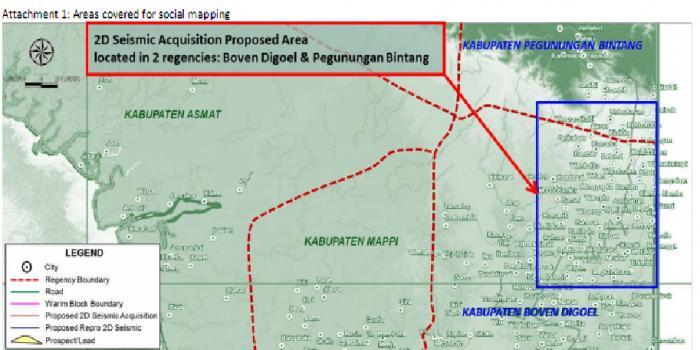
It is not just plantations – oil and gas companies are also threatening to turn Southern West Papua into an industrial landscape. ConocoPhillips is planning to restart exploration (seismic testing) in the Warim block in the near future, a remote forest area mostly located in Boven Digoel regency, several hundred kilometres inland from Merauke. The Forum to Care for Papua’s Natural Resources drew attention to this latest threat in a recent press release, summarised in this article from Majalah Selangkah:


Forum to Care for Papua’s Natural Resources Opposes ConocoPhillips’ Papuan Operations

https://awasmifee.potager.org/uploads/2013/09/20130903_075222_7180_l.png.jpeg

The Forum to Care for Papua’s Natural Resources has stated its clear opposition to ConocoPhillips commencing operations in West Papua.  In a press release issued in Yogyakarta, 31 August 2013 the forum explained various past, present and potential future impacts that arise when giant corporations move in and start operations anywhere in the land of Papua.

If ConocoPhillips moves in, they say, this will only aggravate symptoms of social breakdown and environmental damage, as such corporations are only interested in their own profits, and do not care about the environment and Papuan indigenous people.

As with other corporations in Papua, they claim that ConocoPhillips will only destroy the land which was used for extraction, destroy agricultural land, convert forest into an industrial area and reducing the land available for hunting and gathering peoples. In the long term, mining (including oil and gas exploitation) is a main contributor to turning land into wasteland, which is then almost impossible to restore.

According to the forum, mining in West Papua has caused land, water and air pollution such as dust, poisonous gases and noise. Coastal fish enclosures and coral reefs have been destroyed, floods and landslides have wiped out biodiversity. Acidic water flows into rivers and eventually to the sea, where it has destroyed coastal and marine ecosystems and resources. Mining causes various health problems, and local infrastructure such as roads are severely damaged. Mining also means new migrants move in to the area, either working for the company or starting their own business in the mining area.

They also say that mining creates symptoms of social distress such as prostitution, strong alcohol, gambling, and billiards. Land conflicts can occur, bringing with them a shift in socio-cultural values. Food sources such as forest gardens are polluted or damaged, meaning harvests fail. These are just some examples of the complex problems which the Papuan people in general suffer.
An Overview of ConocoPhillips

ConocoPhillips, according to data collected by the Forum to Care for Papua’s Natural Resources, is the third biggest US integrated energy company after Exxon and Shell based on market capitalisation and reserves. It operates in the oil and gas sector and is the USA’s second largest refiner, the fourth biggest globally.

ConocoPhillips has the fifth largest oil and gas reserves in the world. The company is known worldwide for its technological expertise in deep-sea exploration and production, reservoir management and exploitation, 3D seismic technology, high-grade petroleum coke upgrading and sulphur removal.

Operating in more than 40 countries, the company has around 38,300 employees worldwide and assets worth 164 billion US dollars. The company has four main activities around the world: Oil exploration and production; Refining, oil marketing, supply and transport; collecting processing and marketing natural gas; production and distribution of chemicals and plastics.

source: http://majalahselangkah.com/content/forum-peduli-sda-papua-tolak-conoco-philips-masuk-ke-papua

Since the report is somewhat short on details on ConocoPhillips’ actual plans in Papua, here’s a short article published by news website tempo.co in March with some more background information. In July the company reiterated its plans to carry out seismic testing in Boven Digoel and Pegunungan Bintang in 2014.
Govt Revises Conoco Phillips’ Contract in Papua

TEMPO.CO, Jakarta – The government will reimburse the standstill period of the exploration in Block Warim, Papua, to oil and gas company Conoco Phillips. The block, a sharing contract for which was signed in 1987, had not been worked on since 1997 because most of the area has been used as Lorentz National Park.

Head of public relations at the Upstream Oil and Gas Special Task Force (SKK Migas) Elan Biantoro said the Warim block has about 14,000 square kilometers left, some 30 percent of the block’s original size. Other than being used as a national park, some areas in the block were returned to the state because no reserves were found there.

“This block has actually been explored; the initial commitment has been fulfilled and wells have been drilled. After the contract revision is signed, seismic studies may be done this year or next year,” Elan said.

He added that the Warim Block is believed to have considerable amount of hydrocarbon potential. Other oil and gas contractors, he said, are developing areas near the block.

“Around (Block Warim) there are plenty of oil and gas blocks owned by Exxon Mobil,” he said.

BERNADETTE CHRISTINA

Source: http://en.tempo.co/read/news/2013/03/25/056469265/Govt-Revises-Conoco-Phillips-Contract-in-Papua

Malind Women’s views about Companies Operating in Kampung Baad, Animha District, Merauke.

Report

by

August 4, 2013

Since 2011, three sugar cane companies have been going around Kampung Baad, Animha district and Kampung Tambat, Tanah Miring district, talking about their plans and trying to win over community leaders. The companies involved are PT Anugerah Rejeki Nusantara (ARN) owned by the Wilmar International Group, and PT Papua Daya Bio Energy and PT Tebu Wahana Kreasi, owned by Medco Agro Group.

All three of these companies have made various kinds of promises and approaches as part of their attempts to get their hands on forest and swamp lands between the Kumb and Maro rivers: an area of 73,000 hectares in all. The majority of this land is around Kampung Baad and Kampung Tambat, two villages settled by Marind people belonging to the Baad tribe.

PT ARN has even brought traditional leaders from Kampung Baad on a trip to Lampung and West Sumatra provinces to visit sugar and oil palm plantations, supposedly so they could make comparisons. But still the people have not wavered in their refusal to give up their land. The women of Kampung Baad, or “mama-mama”, who are often only spectators in the process of negotiations about the land, also want to add their voice to the debate. What follows is a short selection of a group discussion with Christina Gebze and the other mama-mama of Kampung Baad.

So what would happen if the companies came to use the land?

“Where would we end up? We have to think about this now, because previously we always knew that there were always plenty of fish, kangaroos and cassowaries, but because people have taken them for their needs, they are mostly all gone. But if we sell our land, they will be even further gone! What are we going to eat, where can we farm? We only have the land, everything else will have gone, and that is going to make life tough for us”.

The companies say that they will rent the land and give money as compensation, how do you feel about that?

“I’ve heard them say things like that, but we don’t know how much land they are asking for, how many hectares, how many square kilometers, they don’t show us any documents. And women are never involved. According to our traditions, it is normally the men who participate in meetings. The women cannot even ask their husbands who go to the meeting. Normally, a woman’s responsibility is to cook, process sago, go fishing, and plant coconut, cassava and taro root.”

“We can’t sell the land. I’m scared to live off money we get for the land, because who is it who created the land? I didn’t do it with these hands of mine. If we give birth, that comes from an agreement between two people, but who does the land come from? It would be better not to sell the land.”

“Women should have rights because women also have a role in helping their kin. There is a forest grove over there which marks the land limit.”

The companies want to rent the land for 35 years?

“That’s a really long time. Maybe by that time we wouldn’t want to sell any more, but we can imagine that the wild pigs would all be gone, the deer would be gone, the kangaroos all gone. And if the land is sold, where could we plant our crops? Take a look at Kampung Zanegi, there is already no forest there.”

“According to Malind customary law we cannot destroy nature, but right now so much has been destroyed. It is such an indignity for us to see this, but now money changes everything, although it is strictly forbidden to damage nature. Malind people cannot kill, only with black magic, but that is a different matter.”

Could people still live according to customary law?

“Where could we carry out our customary practices? We prefer the land as it is, there is no need to sell it. Right now we can go and look for fish and plant our crops. If our land is sold, we will be confused, and what will happen to our grandchildren? The Baad people are rich because of all the trees from the Maro River to the village, but if they are sold then the people won’t have anything left. People are thinking about where we would run to, who would help us?”

What do you think is best for the children?

“If children go to school maybe they can help to raise people’s living standards. If we look around here we can see that school isn’t working, not one person from the Kumb river area has ever got a degree – or maybe there is someone, but no more than one or two people. Even though there has been a school here since the 1930s. If there were people with degrees then maybe they would know ways to help the people.”

“The kids need to be educated so that they can defend this place and so that the land is not sold. If this doesn’t happen, for sure all the land will get sold.”

Will the companies provide help with education?

“I don’t believe it. They say they will give help, they asked us to open bank accounts, but nothing has come of it.”

Original Indonesian Source: Pusaka http://pusaka.or.id/kehadiran-perusahaan-dalam-pandangan-perempuan-malind-di-kampung-baad-distrik-animha-merauke/ English Translation: https://awasmifee.potager.org/?p=458

Create a website or blog at WordPress.com

Up ↑