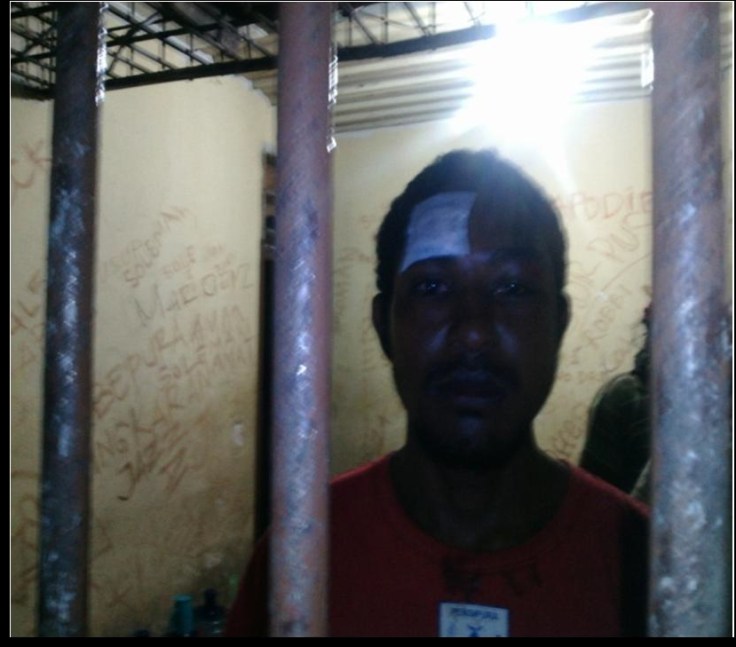
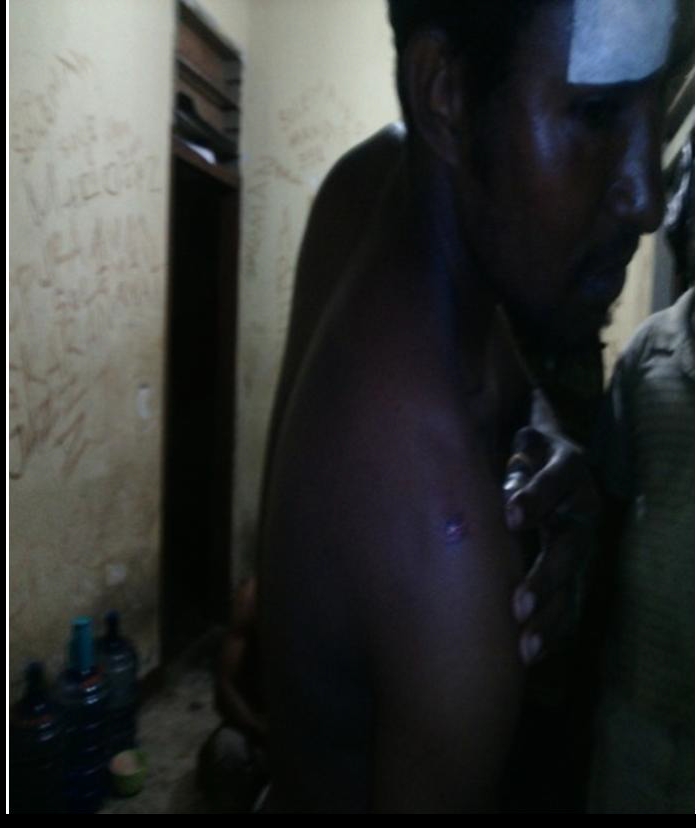
On June 5th, 2015, 14:20hours, a member of the Air Force heavily maltreated Amsal Marandof (22 Years old), leading to an injury above his right eyebrow. As Amsal’s elder sister named Ida Marandof (Around 26) wanted to intervene in the beating to help her brother she was severely beaten on the chest by one Air Force member causing the victim to loose consciousness.
Biodata of Victims: Name : Amsal Marandof Age : 22 Years Date/Place of Birth : Biak, 4 April 1994 Occupation : private sector Gender : Male Status : Single
Name : Ida Marandof Age : +/- 26 years Date/Place of Birth : – Occupation : private sector Gender : Female Status : Married
Case Narrative
On Wednesday June 5, 2015, around 14:20 pm, local Biak man Amsal Marandof went to his brother’s grave on the left side of the “Papan Kuning” road. Amsal was bringing a machete with him to cut the grass around the grave. When Amsal arrived there he saw 2 Army Air Force soldiers approximately 200 meters ahead of him, following activities on a piece of land that had previously led to a conflict between Amsal’s family and the Army Air Force. For that reason Amsal walked
over to them and intended to asked what they were doing at the location.
As The Victim approached 2 air force members, one security force member panicked and stepped backwards and fell down. Thereupon the Air Force member became angry and kicked Amsal into the face. The kick caused a bleeding injury above the victim’s right eyebrow.
The air force member’s aggressive behaviour made Amsal angry, so he fought back using the machete with the intention strike the Air Force member’s head and hit his helmet. Subsequently, Amsal panicked and retreated. After several minutes, many Air Force members came running out of their headquarters to chase after Amsal. One air force member ran towards him and pointed his gun at the Amsal. Other Air Force members threw wooden sticks and rocks at him shouting “You are an OPM member” (Papua Freedom Movement).
Thereupon the victim sought rescue at Arafat work shop. Around 50 Air Force members caught him in front of the workshop, where they kicked and punched Amsal.
When the victims’ elder sister named Ida Marandof (26) received information about the incident she directly went to the location to help her brother, by stopping the security forces (from beating him). As Ida Marandof intervened in the beating one of the Army Air Force hit her on the chest, causing the victim to lose consciousness, so Ida was immediately brought to the Air Force Base Hospital at Singamangaraja Street, Biak City. Amsal Marandof victim was brought to Biak
District Police Office where he was taken into custody.
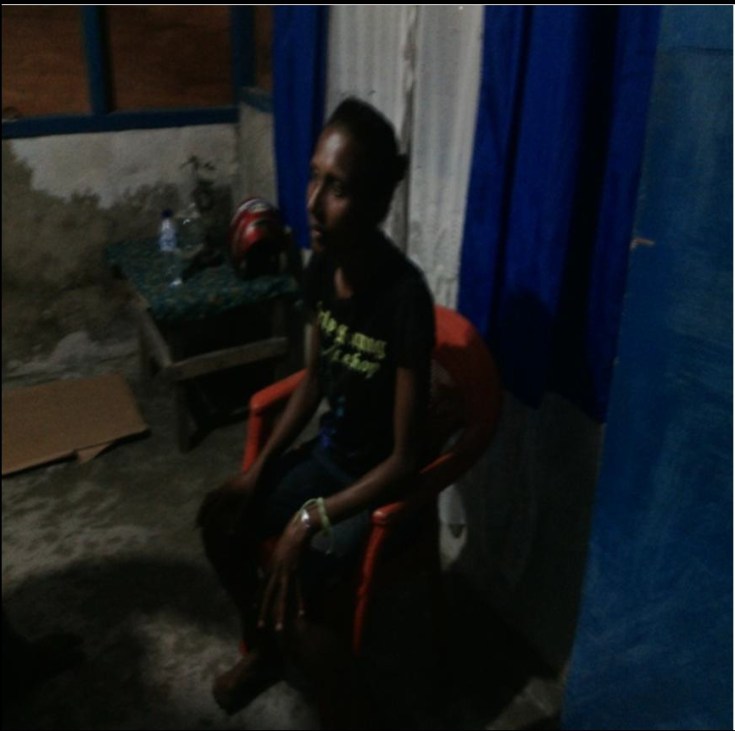
Ida received medical treatment and was supplied with oxygen. As she became conscious, a member of the Army Air Force questioned Ida, but she refused to answer.
After that the Air Force member gave Ida Marandof IDR100.000 (less than US$10) as transport cost and said “This problem ends here ya”. Subsequently Ida left the hospital, still feeling pain in her stomach.
Around 15.15 local Papuan time, local residents became angry and blocked the “Papan Kuning” road in front of the grave of Amsal and Ida Marandof’s brother. The demonstrators cut the trees and broke some bottles in the middle of the road which caused a traffic jam. Around 17:00 the road block was reopened by the community members and police. Pictures of Amsal and Ida Marandof revealing injuries caused by members of the Indonesian Airforce (JPIC/WPM)
Wound above Amsal Marandof’s right eyeAmsal’s body is covered with bruises caused by Airforce military membersIda Marandof during the interview
*Justice, Peace and Integrity of Creation (JPIC) Desk of the Gereja Kristen Injili di Tanah Papua (GKI – Evangelical Christian Church in Papua)
Statement by Yan Christian Warinussy, Executive Director of LP3BH
10 November 2015
Speaking on behalf of the LP3BH – Manokwari [Institute of Research,
Analysis and Development of Legal Aid] as well as the Co-ordinator of
the defence team of Alexander Nekenem and his colleagues, it is my
opinion that the Prosecutor, Syahrun SH from the Prosecutor’s Office
in Manokwari has violated the basic human rights of one of my clients.
A statement issued by the Court stated that the length of
detention of my clients should be prolonged for sixty days, from 30
September till 28 November 2015.
A copy of this decision was sent to the Director of the Prison in
Manokwari. But where should these extra days be spent, in which
prison?
Why is it that that Alexander Nekenem and his colleagues continue
to be held in custody at the Brimob Command Centre. Is this the prison
where Alexander Nekenem and his colleagues are to spend the rest of
their detention?
Furthermore, it is clear that the Prosecutor in this case has
violated the rights one of the colleagues of Alexander Nekemen. This
is all the more so in view of the fact that this colleague, Narko
Murib, was taken ill during a hearing in the case and should therefore
have been allowed to be absent from the Court and held in a custodial
cell at the State Prison in Manokwari.
The Chairman of the Panel of Judges instructed the Prosecutor to
take the afore-mentioned prisoner for examination and given whatever
medical treatment he required.
However, regrettably, the Prosecutor’s Office did not act to
ensure that Narko Murib was taken for a medical check-up. All that
happened was that his blood pressure was checked and he was given
some tablets to bring his temperature down.
As a result, Narko Murib was unable to attend the court hearing
on Tuesday, 10 November because he was still unwell.
Peace.
Yan Christian Warinussy is also the Recipient of the John Humphrey Freedom Award 2015 in Canada, Human Rights Defender in the Land of Papua, and Member of the Steering Commission of Foker LSM for the Land of Papua.
Translated by Carmel Budiardjo, Recipient of the Right Livelihood Award, 1995.
Indonesia: End Access Restrictions to Papua Official Obstacles for Foreign Media and Monitors Defy Presidential Order
(Jakarta, November 11, 2015) – Indonesian authorities continue to restrict access by foreign journalists and rights monitors to Indonesia’s easternmost provinces of Papua, raising serious concerns about the government’s commitment to media freedom, Human Rights Watch said today in a new report. The restrictions defy a May 10, 2015 announcement by Indonesia’s President Joko Widodo – popularly known as Jokowi – that accredited foreign media would have unimpeded access to Papua.
“Government access restrictions have for far too long made Papua Indonesia’s ‘forbidden island’ for foreign media and rights monitors,” said Phelim Kine, deputy Asia director at Human Rights Watch. “Blocking media access on overbroad ‘security’ grounds deters foreign news reporting about Papua, raising troubling questions about what the Indonesian government might be trying to hide there.”
The 75-page report, “Something to Hide?: Indonesia’s Restrictions on Media Freedom and Rights Monitoring in Papua,” documents the government’s role in obstructing access to the provinces of Papua and West Papua (collectively referred to as “Papua”), including government backlash since Jokowi’s announcement.
The decades-old access restrictions on Papua are rooted in government suspicion of the motives of foreign nationals in a region still troubled by widespread corruption, environmental degradation, public dissatisfaction with Jakarta, and a small pro-independence insurgency.
Human Rights Watch interviewed 107 journalists, editors, publishers, and representatives of domestic and international nongovernmental organizations for the report. Foreign correspondents describe an opaque and unpredictable permit application process in which they often never received a final response. Many have waited fruitlessly for months – and in some cases years – for approval.
Jokowi’s May 10 announcement has faced strong resistance by some senior government and security forces officials, Human Rights Watch said. The government has also not followed that announcement with a specific written directive, which opened space for non-compliance by state agencies and security forces opposed to loosening restrictions on foreign observer access to Papua. Various senior officials have since publicly contradicted the president’s statement. Even the Ministry of Foreign Affairs, which has announced that it has “liquidated” the 18-agency “Clearing House” that previously was used to vet journalists, has confirmed that prior police permission is still required for foreign media access to Papua. The Ministry of Foreign Affairs is in some cases also continuing to ask some journalists seeking to travel to Papua to provide, in advance, details of their likely sources and dates of travel.
Foreign correspondents have reported mixed results from their efforts to take advantage of the announced loosening of Papua access restrictions. For instance, after Jokowi’s announcement, the Indonesian embassy in Bangkok processed and granted in just 15 days a Papua reporting visa for Cyril Payen, a Bangkok-based correspondent for France 24 television. The embassy also assured him that he was not obligated to have any check-ins with police or immigration officials while in Papua. “Whether I was lucky or not, I don’t know,” Payen said. “They really opened up.”
However, a Jakarta-based foreign correspondent showed Human Rights Watch a copy of correspondence with the Ministry of Foreign Affairs from July 2015 in which a ministry official listed both a surat jalan, or travel permit, from the National Police’s Security Intelligence Agency, as well as a “letter of notification” specifying the journalist’s “purpose, time and places of coverage in Papua,” as prerequisites for access to Papua.
Foreign journalists who ultimately are granted Papua access permits often face surveillance and harassment after arrival in Papua. Several said that they were required to have an official “minder” from the State Intelligence Agency (Badan Intelijen Negara, BIN) for the full duration of their visits, significantly limiting their ability to report on issues deemed sensitive.
“President Jokowi needs to bridge the gap between rhetoric and reality by putting the guarantee of unimpeded foreign media access to Papua in writing,” Kine said. “He should make it clear to government officials and security forces alike that obstructing journalists is unacceptable in Papua and anywhere else in Indonesia.”
Indonesian journalists – particularly ethnic Papuans – are also vulnerable to restrictions on media freedom in Papua, Human Rights Watch said. Reporting on corruption and land grabs can be dangerous anywhere in Indonesia, but national and local journalists told Human Rights Watch that those dangers are magnified in Papua. In addition, journalists there face harassment, intimidation, and at times even violence from officials, members of the public, and pro-independence forces when they report on sensitive political topics and human rights abuses.
Journalists in Papua say they routinely self-censor to avoid reprisals for their reporting. That environment of fear and distrust is increased by the security forces’ longstanding and documented practice of paying some journalists to be informers and even deploying agents to work undercover in newsrooms as journalists. These practices are carried out both to minimize negative coverage and to encourage positive reporting about the political situation, and they generate distrust among journalists.
Representatives of international nongovernmental organizations, United Nations experts, and foreign academics have also faced official obstacles to visiting Papua. Since 2009, the International Committee for the Red Cross, the Dutch development organization Cordaid, and the Peace Brigades International have all limited or closed their Papua-based operations due to pressures from the Indonesian government.
In 2013, the Indonesian government blocked a proposed visit by Frank La Rue, then the UN special rapporteur on the promotion and protection of the right to freedom of opinion and expression. Diplomatic sources in Geneva told La Rue that the Indonesian government froze his requested visit due to his inclusion of Papua in his proposed itinerary. “[The Indonesian mission in Geneva] asked what areas I want to go to [and] I said Jakarta and bigger places like Bali, but for me, I said, it was very important to visit Aceh and Papua,” La Rue told Human Rights Watch. “They said ‘Great, we’ll get back to you.’ What it meant was that they postponed the dates and put the trip off indefinitely.”
“It’s clear from our research that removing access restrictions is not a silver bullet to resolve Papua’s deep-seated problems or dispel the suspicions of Indonesian officials toward foreign media and other observers,” Kine said. “But greater transparency and access are essential elements of a rights-respecting future for Papua to throw sunshine on abuses of power that for too long have remained hidden from view.”
For accounts from the report, please see below.
“Something to Hide?: Indonesia’s Restrictions on Media Freedom and Rights Monitoring in Papua” is available at: https://www.hrw.org/node/283014
For more information, please contact:
In Jakarta, Andreas Harsono (English, Indonesian): +62-815-950-9000 (mobile); or harsona@hrw.org
In Jakarta, Phelim Kine (English, Mandarin): +62-812 10877314 (mobile) or +1-212-810-0469 (US mobile); or kinep@hrw.org. Twitter: @PhelimKine
In San Francisco, Brad Adams (English): +1 347-463-3531 (mobile); or adamsb@hrw.org
In Sydney, Elaine Pearson (English): +61-400-505-186 (mobile); or pearsoe@hrw.org. Twitter: @pearsonelaine
In Washington, DC, John Sifton (English): +1-646-479-2499 (mobile); or siftonj@hrw.org. Twitter: @johnsifton
Accounts from “Something to Hide?”
Rohan Redheya, a Dutch freelance photojournalist who applied in The Hague for a journalist visa to Papua in July 2014, said that although the Indonesian embassy informed him that the approval process was “around two weeks,” the embassy never responded to his application. “I know many journalists who got ignored [by Indonesian visa issuance offices], and they simply never heard something again [after submitting a Papua access application].”
“The Clearing House system of consensus voting means any one person has veto power, which generally means that the opinion of the most paranoid person in the meeting carries the day. These restrictions fuel all manner of speculation about Papua: the notion that the Indonesian government has ‘something to hide’ finds purchase. But the Indonesian government finds itself in the illogical position where they hear of inflammatory reporting and this actually makes them impose restrictions, and then those restrictions prevent good journalists from writing of the complexities of the place.”
– Bobby Anderson, a social development specialist and researcher who worked in Papua from 2010 to 2015, describing the government’s “Clearing House” screening of foreign journalists seeking to report from Papua.
Marie Dhumieres, a French journalist, received a police permit to go to Papua in September 2015. A week later the police arrested and questioned three Papuan activists whom she interviewed. She published this tweet to President Jokowi, and the activists were soon released: “So Mr @jokowi, foreign journalists are free to work anywhere in Papua but the people we interview get arrested after we leave?”
“If you read all the news reports in all newspapers in Manokwari [in Papua], you will see that their sources are almost all, almost 100 percent, government officials. Their sources are always government officials, police officers, or military officers.”
– Agusta Bunay, a Papua Barat TV presenter, on self-censorship among journalists fearful of possible reprisals for independent reporting.
The creation of human beings is indeed one of the brilliant works of God, giving freedom to humans to choose between right and wrong, good and bad. It is the very intelligence of humans which differentiates us from other living things in the creation. We are indeed unique. Animals share the characteristic of humans that they tend towards using violence in order to defend themselves. Animals also have instincts.
Unlike human beings, animals don’t possess the means to be able to evaluate the appropriateness of actions.. The instinct of animals is but one of survival. Yet despite the “higher level intelligence” of humans, at times they will act not just out of an instinct to survive when threatened, but rather as a predator against their fellow humans. (Something like a group of lions which may seize by violence the territory of another lion group.)
Sadly there are far too many instances of such predatory behaviour being seen in Papua against the indigenous people of the land.
Humanity – one would have thought – should have ceased using violence against their fellow beings long before this point in human history. What’s more those nations that call themselves ‘civilised’. It is appropriate that human violence only be tolerated when one nation is faced with an threat to their safety by another nation. So then violence would only be used in a way that is legal under human law (to defend) against that which is carrying out the wrong.
However here in Papua violence is being systematically used not against criminals, but against the people.
The State versus the Community
A State has a certain authority recognised in the protection of its community. It is regarded as the ‘protector’ of the people. Instances of the use of violence by a State should only in the context of protecting its people from some threat of harm. Violence should never be used by the State against the community itself. However what has been occurring in Papua in recent times is totally paradoxical to that (notion).
Although it is forbidden to openly admit that the Indonesian State is opposing the very community that it is supposed to protect in Papua, the fact is that frequently the Papuan community does feel as if it is being regarded as the ‘opposition’ of the State. Particularly around instances when the State forces its own will onto the people. National policies applied in Papua largely can be said NOT to be representative of the Papuan context, nor the needs of the local community. Often heard on the streets in response is “What is asked for is one thing, what is given is another.” This is a reality. The policies are not in accordance with what is asked for, or even what is wanted and hoped for by the community.
It seems likely that violence has been adopted as the one and only ‘solution’ of the State of Indonesia to solving the problems in Papua. At those moments when the community is seen to oppose the will of the State, indeed this seems ever so clear. However Indonesia does not seem to recognise that the violence of its agents is having a counter productive result: among its ramifications is that the State will predictably lose legitimacy and the trust of the Papuan community. This is an important matter for the state, which will only be changed by the State having an approach of dialogue and treating people humanely.
Obviously we are all human beings and that we should as much as possible be using means that are humane and civilised. Would it therefore not be preferable that when a government (representing the power of the state) is adopting any policy that profoundly effects the community, that they would seek the opinion of that community to be affected, prior to that point? The government must not just hide from its obligations, seeking protection behind legalities of power, with statements like ‘This is in accordance with legal procedure’. They must stop the inherent power games against the community, claiming that ‘This is in accordance with a legal decision, so it must be implemented’.
The State must seek to bring about justice and peace for the people, not the opposite! The law is an instrument to be used to attain a civilised state of affairs and good for its citizens, not to be used to spill the blood of the people and create death and tragedy in their lives. The recent human history of Papua is indeed full with the spilling of blood and killing of the Papuan people. There has been absolutely no episode of life for Papuans in this era where there has been a real peace and a lack of violence in the land against its people. The violence itself has become like a little king, a ruler in Papua. Indeed it is no mistake to say that a ‘smooth’ genocide has befallen the indigenous community of Papua.
‘Smooth’ Violence
The State violence in Papua is clothed with a smooth, soft touch. Those that commit the acts of violence and create the anarchy wear security hats and are referred to as the so-called ‘protectors’ of the community. This is a fact of what is happening. Far from the ideals of ‘Peacekeeping and protection,’ it seems have been watered down to meaning ‘closing down (cultural) pride actions that might otherwise arise’.
It’s up to each of us to interpret what is really going on in relation to those wearing those ‘hats’ in light of the realities in Papua. The Writer sees it as a ‘smooth’ violence, a ‘refined’ violence being committed against the people. This really can damage the sense of peacefulness in the community. Even the justice spoken of in the Constitution of the Republic of Indonesia 1945 is damaged as a consequence of this neglect by the State of its people.
The State could try just once in a while seeking the opinions from the community regarding policies in Papua. If the majority of opinions sought were in agreement with the policies, by all means continue to apply them. However if the community does not agree, they must be discontinued. Unfortunately there is no such mechanism as this in existence; It is but utopian as the role of the community should already be represented by the Papuan Legislative Assembly (DPRD). They are the ones in the Indonesian structure which represent the community. There is no use regretting this as this is the mechanism which we chose democratically.
The DPRD has an incredibly obvious shortcoming. All manner of aspirations of the people that reach their desk are in one way or another overlooked. As the representative of the community that sits in the most respected of positions it feels indeed like there has been some sort of ‘cutting off’ of a limb. Both attention and partiality of the DPRD towards the Papuan community are severely dulled.
It is truly hoped that the games of violence in Papua – whether of the ‘smooth faced’ type or more crude forms of violence against the people – might be questioned. The hats of the ‘peacekeepers and protectors’ must be removed as the proliferation of Indonesian military forces in Papua is not the solution! Violence is not the solution and neither is money the solution. The solution lies in listening to the true desires of the community. Not the wishes of the Papuan government officials who have no genuine concern for the suffering of the Papuan indigenous community.
The Author is a Church Worker in Timika, Papua.
Translated, annotated and edited by West Papua Media for linguistic clarity. The religious views espoused in this Opinion piece are the author’s own and not necessarily those of West Papua Media.
THE INTENTIONAL ANNIHILATION OF THE INDIGENOUS PEOPLES OF PAPUA BY THE GOVERNMENT THROUGH THE TRANSMIGRATION APPROACH
Special analysis and investigation
By Santon Tekege
This piece was originally sent to be published for the International Day of Peace, September 21, however given its length, editing translation has taken several weeks.
Population growth charts of indigenous Papuans vs transmigrants under Indonesian occupation (Illustrative Graph: Awikaituma)
Introduction
I write these words with tears falling down my face. As an indigenous Papuan I feel like I have been expelled from my own land. It’s as if we have been removed far away from the land of Papua, like the land is being purged of all indigenous Papuans. My people have become observers of all the changes that we are being subjected to and of all the games and manoeuvres being played out by the Indonesian Government in Papua. I ask myself what I have done wrong, such that I as one of the owners of this land should have been pushed to the margins in this way. Marginalised and expelled from my own land.
The marginalisation of the indigenous Papuan population is happening not only as a result of the flood of non-Papuans arriving in the land week after week, but also is being contributed to by the low birth rates of indigenous Papuans at this time, whilst there is also an continuous increase in their death rate. The native peoples of the land of Papua are being annihilated intentionally by the Indonesian Government. Annihilated on the soil of their own ancestors.
Marginalisation of the Indigenous Papuan Community through Transmigration.
The plan of the central Indonesian Government at this time to restart the transmigration program to Papua, is a matter of great concern. Not only for Papuans themselves, but it should also be of great concern for others as in every location where Papuans are being increasingly pushed out to the margins there is a growing risk of conflict at some future date.
As has been previously reported in the national Indonesian media, Marwan Jafar – recently appointed by President Widodo as the Minister for Villages, Transmigration and the Development of Undeveloped Regions – has stated that there would be a new program that would take residents from the overpopulated regions of Java to the still underpopulated region of Papua. Jafar stated that he would carry out a large scale socialisation of the area in stages, and that he’d work closely with the Indonesian military and police to ensure safety for the new transmigrants so they felt safe to make the shift to a transmigration area (see Antara 5 November 2014).
In response, Cypri Jehan Paju Dale, a researcher who since 2012 has been carrying out research into social issues in Papua, has stated that a new transmigration program would worsen the already occurring marginalisation of the indigenous Papuan population. Dale together with an activist Pastor John Djonga in 2011 wrote “The Papuan Paradox”. He stated that at this time there is a real feeling of dread amongst Papuans. They are anxious as they can already see the reality that the numbers of non-Papuans is continuing to rapidly increase as Non-Papuans quickly become a growing majority of the population in Papua. Those anxieties already are very much present amongst Papuans, so to hear that the Government is going to relocate yet more transmigrants, causes people great concern indeed. They are well aware that this will make the already existing threat even more immediate and increase the level of injustices against indigenous Papuans.
By way of background, the transmigration program has been in operation in Indonesia since the 1950’s when today’s Indonesian was still partly under Dutch control. The program failed continuously throughout the Suharto era. He then went on to be removed as president in 1998. According to Dale’s research the extent of numbers of transmigrants that have been moved to Papua from other islands in the archipelago have changed the demographics of Papua such that in recent years the indigenous Papuan sector of the population has been reduced to below 50 percent of the total population.
As can be seen clearly on the map below, according to 2003 census data the relative proportions of indigenous Papuans and non-Papuans were at that time 52% and 48% respectively, from a total population of 1.9 million. By 2010 census data showed indigenous Papuans having reduced to 49% compared to non-Papuans 51%, from a total population of 2,833,381.
Demographic dispersal in Papua
In some kabupaten (local administration areas) the numbers of non-Papuans are now much higher than the numbers of indigenous Papuans. In Keerom kabupaten for example according to the 2010 census, the total of indigenous persons in the population was only 40.64%. Similarly in the Merauke kabupaten it was only 37.34% indigenous, in Mimika 41.36% , Nabire 39.90%, Sorong 40.03%, Fakfak 41.78% and in Manokwari 49.45%. In the main towns of every kabupaten in both provinces – Papua and West Papua – the non-Papuans now exceed the numbers of indigenous Papuans (refer to the map above for detail).
According to the Writer not only has there been a change in demographics but also an imbalance in economics of the Papuan and non-Papuan sectors of the society. With non-Papuans having taken control of all the economic centres in the main towns and cities, whilst the larger majority of the indigenous population continues to be spread throughout the interior living with very minimal facilities. The benefits of development seen through the Special Autonomy program in Papua have been and continue to be enjoyed primarily by non-Papuans (despite continuous claims that it is indigenous Papuans who are benefiting). This is what Papuans refer to as development that has been ‘snatched by the transmigrants’. There are very small number of Papuans who are enjoying those fruits of Special Autonomy, but they are a very small group only of the Papuan elite. By far the larger majority of indigenous Papuans are far from being able to access any benefits such as those that are being espoused to the wider public.
A key figure of the Amungme community in Timika kabupaten, Papua Mr Thomas Wanmang, has stated in an interview that his people have experienced many injustices as a result of the large influx of non-Papuans into their area. This includes those who have come through transmigration programs and others who have transmigrated independently of those formal programs. Wanmang claims that the transmigration process at this time is itself what is causing the increasingly serious lack of attention that is being shown by the government towards the indigenous sector of the Papuan population. “As Papuans we are being given nothing whatsoever. What’s happening is that those who have transmigrated here are being spoilt and treated like they are something special.” He stressed that the presence of the transmigrants is creating a sense of jealousy in Papuan circles. “As we as the owners of this land meanwhile can’t go forward.”
The Papuan Provincial Governor Lukas Enembe in an interview with Tabloid Jubi in Jayapura on 5 November 2014 firmly stated his rejection of the plan of Minister Marwan Jafar to reactivate the Transmigration Program. According to Enembe further transmigration would result in the needs of the indigenous population being increasingly ignored and of them becoming an increasing minority in their own land. In that interview Enembe admitted that the Papuan population had already become much smaller than the non-Papuan sector. He went on to say that it wasn’t the Papuan provincial government that had agreed to the new transmigration program but rather the new government of Jokowi. “Indigenous Papuans are now small in number and the government is not able to treat them any better than this. So why would yet more people be tranmigrated from Java? For this reason there is as yet no plan in place (by the Papuan Provincial Government) to bring more transmigrants here.”
The need for serious attention to the situation.
The invasion of Papua by peoples from other regions of the Indonesian archipelago has increasingly become a mechanism of colonialism, a way of taking control of a region through a policy of systematically populating the area with a new people. A human invasion into Papua which has been accompanied by a ‘securitisation’ of the region by the State which is so very excessive. A securitisation which includes the practice of torture and which controls and oppresses the Papuan people by every political means possible.
An awareness of the potentially negative effects of further transmigration on the indigenous Papuan population were obviously evident to Minister Marwan Jafar as reflected by his statement that the Ministers would work together with the Indonesian military and police to make Papua safe for transmigrants. This is even worse than the colonialism experienced by Papuans during the period when the Dutch held the colonial power in the archipelago. The numbers of the Dutch were largely limited to those on the islands of Nusantara. Whereas at this time Papuans have become a minority in all the major towns and cities throughout Papua.
Many at this time are saying that Indonesian has been extremely effective in colonising Papua. They have ‘achieved’ that by applying policies and practices that have involved major risks. Risks of future problems that are hard to even imagine at this time. It is for this reason that some parties have been lobbying President Jokowi to place a moratorium on transmigration to Papua. However it is very clear that Indonesia needs a continuing mechanism for the ongoing organised invasion of Papua such that the Papuan people become increasingly marginalised and become as if foreigners in their own native land. “There must be constant pressure created by policies towards indigenous Papuans and in particular in the areas of economics, education and health” Jafar explained.
The critical importance of dialogue at this time between Papua and the central government has been stressed by humanitarian organisations, churches, lecturers and university aged students. For so long dialogue has been called for. “Within the forum of dialogue all problems can be spoken of openly, be put on the table for resolution” Pastor John Djonga stated. Proper Dialogue, did not impose any limitations on the framework under discussion, for example final full independence (Merdeka harga mati) or non-negotiable final acceptance of remaining with NKRI.
“At the same time as stressing the importance of bringing an end to the problems of history which are indeed complex (WPM: Demand of “Rectification of History”), dialogue is also considered as one way which can bring about an appropriate solution to the many urgent problems that people are observing each day with their own eyes. Problems including marginalisation of Papuans, being made a minority in their own land, and injustices related to the transfer of a population to the land of Papua” he continued.
Pastor John Djonga has also urged the government to carry out an overall evaluation of the results of the practice of transmigration until this time. He points out one particular effect of the transmigration which has been the lack of regard of the Indonesian government for the ways of the indigenous Papuan community. He writes of the practice of the government which has been to take land from Papuans for giving to transmigrants. He explains that in Papuan culture the land is held communally, whereas the government persists in just approaching a very few people nominated by the tribal head, with the money given for the land is then split between those few only. He stresses “whereas in reality that land is the property of the entire community concerned. This creates the seed of division in a community that until that time was strong and united.”
Pastor Djonga himself acknowledges that it’s impossible to close ones eyes to the imbalance that now exists between the indigenous Papuans and the transmigrants. He points out that the newcomers arrive with high levels of motivation to improve their standard of living and willingness to work hard to do so. What’s more they come already having certain skills, whereas Papuans have an attitude of going along just as normal and they continue with their usual traditional way of life. With the consequence that the gap between the races is progressively widening.” However he says, the situation as it is in this regard cannot be blamed totally on the work ethic of the Papuans, as “for a long time now Papuans have not been receiving any serious attention from the government.” According to Pastor Djonga the government must not force further transmigration on the Papuan community. “Don’t let it get to the point that the government plants further seeds of problems. The transmigrants will also then be responsible for the consequences.”
Similar views have been expressed by Gunawan Iggeruhi, a 30 year old human rights activist in Papua, who said “it is better that the government listens first to the voices of Papuans before they go ahead and make policies that are totally rejected by the people of Papua.”
According to Iggeruhi, until this time Papuans have appeared on the surface to respond to the arrival of the countless transmigrants like it was nothing extraordinary, “however the reality is that Papuans inside are carrying constant wounds in their hearts over the massive transmigration.
“Wounds that have not been allowed to heal due to the incessant actions of the government against the Papuan people; actions which have become increasingly serious”. Iggeruhi continued, “to stop those wounds continuing to deepen the transmigration needs to stop and truly allow the real life of indigenous Papuans to be planted in this land so that they do not forever feel like they are treated as second class citizens.”
It is now visibly apparent that the proportion of indigenous Papuans is progressively decreasing each month in Papua. This is contributed to by the low birth rates together with the increasing death rates amongst Papuans. This is in comparison to the birth rates of Non-Papuans in the land which are rapidly increasing whilst the death rates of Non-Papuans are at a real minimum. These realities need to be considered together with other factors and in particular that the number of migrants coming to Papua continue to grow and that all towns, cities and in fact every corner of Papua have now been taken over by Non-Papuans. As a result the indigenous Papuan population is now on a path heading towards extinction. It has been estimated that if the current trends continue that indigenous Papuans may be no longer by the year 2040.
The claim that indigenous Papuans will be ‘wiped out’ by the year 2040
What has the life of indigenous Papuans been like since they became a part of the Republic of Indonesia, and how has that reflected in changing population statistics from prior eras to now? Results of research by Dr. Jim Elmslie & Dr. Camellia Webb Gannon from the University of Sydney’s Peace & Conflict Studies in Australia are very telling. Two years following the 1969 Act of Free Choice in 1971, indigenous Papuans comprised 96% of the population (887,000 out of the total 923,000 population). Whilst the Non-Papuan total at that time was stated as 36,000 (4% of the population). Within 53 years of Papua being part of Indonesia the total of Non-Papuans has reached 53% at 1.956 million, whilst the indigenous Papuan population has decreased to 1.7 million being 47% of the total population.
The data published by Dr Elmslie & Dr Webb-Gannon from Australia has since been re-analysed by a Mr Ir. Yan Awikaitumaa Ukago, M.M in Papua (10 August 2015), who used a method involving the use of non-linear segregation graphics mathematics (refer diagram above). According to Ukago “The growth of the indigenous Papuan population (shown by the red line in the diagram) tended to stagnate over a period of a decade and declined following 2005. Meaning that from 1971 until 2004 the numbers of Indigenous Papuans in Papua were still dominant (shown by the red area). However following that year the numbers of Non-Papuans (shown by the yellow area) became dominant. Reading from the diagram, the red line is the graphic representation of the growth rate of indigenous Papuans, whereas the yellow refers to the growth rate of the Non-Papuan sector of the population. It appears that the total of Non-Papuans at the start in 1971 was very few. However the population of that sector increased until in 2004 it was equal with that of Papuans (when the Papuan sector numbered 1.65 million (50%) and the Non-Papuan sector also numbered 1.65 million (50%). From 2005 onwards the growth rate of Indigenous Papuans tended to fall whilst that of Non-Papuans sharply rose and even more so in the era of Special Autonomy in Papua.”
Based on his segregation analysis (shown by the dotted lines in the diagram above), it is estimated that by the year 2025 the population of indigenous Papuans will have fallen to 1.5 million persons (36%) whilst the Non-Papuan population will have risen to 2.7 million persons (64% of the total population). Furthermore, under such conditions where there is no protection of the race, it is expected that the indigenous Papuans will become extinct by the year 2040. This means that “by 2040 the population in Papua will have reached 6 million but it will not be indigenous Papuans who will own the land” Ukago stated.
The decline in the population of indigenous Papuans was acknowledged by the previous Governor of the Papuan Province, Barnabas Suebu S.H, in his written address at the official appointment of the Merauke Bupati on 8 January 2011. According to then Governor Suebu “Indigenous Papuans are going to continue to decline in number as a consequence particularly of the migration of Non-Papuans, which is in turn the result of the growth of the (Indonesian) population which is the highest in the world (at 5.7%) per annum …. Accordingly the division into new kabupatens must not result in causing indigenous Papuans to become separated from and even forcibly removed from their ancestors’ lands.”
According to a population census carried out in 2010 in the West Papuan Province the number of indigenous Papuans in that province was 760,000, amounting to 51.67% of the total population in the province. That is, the populations of Papuan and non-Papuan in the western province were reported as being roughly equal. The head of the BPS (Badan Pusat Statistik or Indonesia’s Central Statistics Body, which carried out the census) Tanda Siriat stated that BPS applied six criteria in collecting data to determine who was categorised as ‘indigenous Papuans’.
Any person with both the mother and father were indigenous Papuans.
Any person with a father who was indigenous Papuan but the mother of non-Papuan descent.
Any person with a mother who was indigenous Papuan but the father of non-Papuan descent.
Any person who was non-ethnic Papuan but through Papuan traditional customary law and as acknowledged by the Papuan community was regarded as an indigenous Papuan.
Any person who was non-ethnic Papuan but who had been adopted or was acknowledged through family name as having been adopted into the indigenous Papuan community.
Any person who had been living continuously in Papua for more than 25 years.
Jim Elmslie’s “Slow Motion Genocide in Land of Papua”
Jim Elmslie in his book, “West Papuan Demographic Transition and the 2010 Indonesian Census: “Slow Motion Genocide” or not?” (University of Sydney, Centre for Peace and Conflict Studies) states that as at 1971 the indigenous Papuan population was 887,000. Then by 2000 it had risen to 1,505,405, a growth on average of 1.84% per year. Whereas he reports the total of Non-Papuans in 1971 was 36,000 which he claims rose to 708,425 by the year 2000, with an average yearly growth rate of 10.82%.
So that by mid-2010 according to Elmslie, the total of indigenous Papuans had reached 1,730.336 (47.89% of the population) whilst Non-Papuans had that same year reached 1,882,517 (52.10%). By the end of 2010 the respective populations had reached: Indigenous Papuans 1,760,557 (48.73%) and Non-Papuans, 1,852,297 (51.27%), giving the figure he states for the total population in 2010 of 3,612,854 (100%).
Elmslie estimates that by 2020 with these current trends that the overall combined population of Papua will have reached 7,287,463, comprising a forecast total of indigenous Papuans 2,112,681 (28.99% ) and Non-Papuans 5,174,782 (71.01%), indicating a slower population growth rate of indigenous Papuans than of Non-Papuans. In his analysis of the reasons for the difference Elmslie points out that apart from the impact of social factors and human rights violations, the primary cause is the transmigration of population from outside of Papua which is excessive.
The Head of the BPS in the Papuan Province Ir. J.A. Djarot Soetanto, MM has criticised Elmslie’s analysis of the situation when he claims the problem is intentional acts of genocide or the annihilation of indigenous Papuans. According to Soetanto that is untrue. He made a very different conclusion stating that the census data for Papua for the year 2010 pointed to a total combined population of 2,833,381 of which indigenous Papuans were still the majority with 76% as compared to Non-Papuans of only 24%.
It is the opinion of Yan Ukago that if indigenous Papuans were asked which of these two interpretations they believed was correct, that he has no doubt they would agree with the reports of the BPS census in each respective province, the conclusions of Jim Elmslie and the Papuan Governor’s statement as stated above. There’s a number of reasons for this. Firstly that Papuans are now so far removed from trusting the government in Papua which has tended to act in the interests of the central Indonesian government until now. Secondly the death rates of Papuans from babies through to adult ages has continued to rise and that is obvious to people from everyday observation. Thirdly every week Papuans see large number of Non-Papuans arriving from other parts of Indonesia by ocean going boats and planes. And then of course the fact that the history of the integration of Papua into Indonesia is regarded by Papuans as most unjust. Furthermore as Papuans’ human rights have been ignored until now such that they never feel free to live as human beings even on their own ancestors land.
It is the Writer’s observation that the butchery that has occurred against the Papuan community has actually become an intentional agenda of Indonesian government tradition. Those implementing that agenda have had two approaches. The first is overt. This has been carried out through military regional operations, shootings, creating so called local conflict, intentional creation of situations of violence, a range of stigmatism against indigenous Papuans including their alleged stupidity, the use of homebrew alcohol {WPM Eds: strong, often tainted or poisoned alcohol distributed by intelligence and military operatives believed by many Papuans to be a tool of genocide}.
The second is the covert approach of killing, which Papuans refer to as ‘slow motion genocide’. This continues to take place by way of kidnappings, killings, poisoning through food and drink, the intentional introduction of HIV/AIDS into Papua through prostitution, injection needles and tattoos, and HIV infection through {bad sexual health practices through the use of} alcohol. And so the list goes on. The overall impact of both approaches being the dramatic and continual decline of the indigenous Papuan population.
Conclusion
Many calls from the Papuan community are heard constantly as to the steps required to solve the problems of Papua. These are the offers of dialogue between Jakarta and Papua, a referendum and the third, independence for Papua. To dilute the lack of acceptance of the status quo, there have been efforts from the provincial governments and the Central Government to improve the quality of life of Indigenous Papuans.
The Indonesian Government would do well at this time to invite an international census team to independently carry out a census through the entire region of Papua, to verify whether the BPS or alternatively the KPU (General Election Commission) version is reflective of reality. Accurate data from an international source such as this could be just what they need to counter Elmslie’s data and analyses, as this matter has become really a thorn in the side for Indonesia. Elmslie’s data published by Sydney University is perceived as a threat to Indonesia’s sovereignty over Papua. (WPM Editorial note: The Writer is not implying Elmslie’s data is incorrect, rather making the case that the only way for Indonesian to counter this data is through the conduct of a free and unimpeded census by an international team.)
If Indonesia’s butchery is allowed to continue then sooner or later the Land of Papua will be surely have to be released from the Republic of Indonesia as a direct result of the treatment of the indigenous peoples of Papua already being classified as ‘slow motion genocide’. A genocide that has been allowed to happen through the application of a range of approaches by Indonesia that have killed and violated the human rights of the people of the land. As has been seen time and time again in the killings by the Indonesian Armed Forces that have become known locally as ‘Paniai Berdarah’ (‘berdarah’ referring to a flowing of blood), ‘Biak Berdarah’, ‘Wamena Berdarah.’ ‘Timika Berdarah’ and others. These conditions paint a picture of a land that exists at the threshold of extinction.
This means of course that a part of the Melanesian race is drowning in the bosom of Motherland (Indonesian state). If what is happening in Papua is a ‘slow motion genocide’, then surely we will see support come for Papua to be set free, not only from the Melanesian Spearhead Group (MSG) and Pacific Islands Forum (PIF), but also surely in time from the members of ASEAN and other nations. The Indonesian Government will undoubtedly view that support when it comes as if those nations want to see the land of Papua released by Indonesia to independence; however their efforts are really intended to try and save indigenous Papuans from extinction.
“I dedicate this writing on the International Day of Peace.”
Timika, Papua. 21 September 2015
Brother Santon Tekege is a Pastoral Support Worker in the Diocese of Timika, Papua. He chooses to publish under his own name, however his safety is monitored 24 hours a day by an international protection network. (please give at West Papua Media to support our monitoring efforts for writers and journalists at risk in West Papua.)




 West Papua Media Alerts