MIFEE: Latest News Reports

via AWASMifee

January 7, 2013

Representatives of the Lembaga Masyarakat Adat (Customary People’s Association), together with other people affected by the MIFEE mega-agriculture project, made a visit to Papuan provincial capital Jayapura just before Christmas. In meetings with Papuan media, they explained the new problems local communities in the Merauke Area are facing as different companies rush to develop oil palm and sugar cane plantations.

Here is a selection of articles published in local media Tabloid Jubi and Alliance for Democracy In Papua(ALDP).  Amongst the issues the delegation raises are the companies’ broken promises about the facilities they said they would provide or the compensation for the land, pollution, lack of information about the legal status of the land and coercive behaviour from the military that back up the companies.
When they have accepted work in exchange for giving up their forests, wages have been too low to provide for daily needs. They also ask for all company permits to be revoked, as local people have not been involved in decisions about development.

Company’s promise to build education facilities were lies.

Source: http://www.aldp-papua.com/?p=8009

A company’s promise to build health and education facilities for local land owners around its investment site in Muting, Elkobel and Ulilin districts in Merauke Regency, has still not come to fruition.  “It was all lies, we’ve waited until now but there has been no answer. Blueprints have been drawn up, but they remain no more than sketches,” said the head of the Malind Bian Customary People’s Association (Lembaga Masyarakat Adat LMA), Sebastianus Ndiken in Jayapura last Friday.

According to him, when the company was informing the indigenous clans that own the land in Muting District of its plans some time ago, they had promised employment and also to improve education, including giving scholarships to local youth. “We have already asked when this will be, but the company has said not yet, we have no idea when it will actually happen, but they have been operating on our land for some time,” he said.

Mr. Ndiken related that one of the companies operating in Muting is PT Agriprima Cipta Persada (ACP) After about four months of operation, we are starting to see logging of the people’s forests in the area. “Look, here’s the plans I’ve brought with me. It shows plans for a school. The plans are well-drawn, but the school has never materialised,” he repeated.

Amongst the big companies that are developing oil-palm plantations in Merauke are PT Korindo Tunas Sawaerma, PT Bio Inti Agrindo, PT Berkat Cipta Abadi and PT Papua Agro Lestari.

When they move in, the companies say they are only borrowing the land on a 35 year contract, and after that it will return to its owners. “We believed that. But now we have found out that one oil palm company, PT Bio Inti Agrindo, has already obtained a permit for commercial use (HGU). We realised that in principle, HGU rights mean that after 35 years of commercial use the land will be returned to the state. To us this means that the company has failed to settle the issue of our customary rights as the true owners of the land”, he explained.

He is asking for the company to immediately fulfil it’s promises. “We don’t want problems, don’t let what happened in Mesuji occur in the land of Malind Anim. [awasMIFEE note: at least nine farmers, maybe more, have been killed in clashes with oil palm companies in the Mesuji area of Sumatra in the last two years]. We want progress, but progress that doesn’t deceive the people”, he concluded.

The most recent data from the Merauke government was that 10 of the 46 companies with investment plans were actively pursuing their operations in early 2012.

The project location is the local indigenous people’s only source of wood, animals and staple foods. Merauke Regency covers 4.7 million hectares, of which 95.3 percent is classified as forest.

Customary People’s Association wants big companies out of Merauke.
Source: http://www.aldp-papua.com/?p=8004

The Malind Bian Customary People’s Association (LMA) has requested the government to revoke and cancel all location permits of companies in the plantation sector in Merauke Regency, including oil palm.

“We have witnessed ourselves how companies are felling our customary forests that we have always protected and looked after. Destroying the forest has also caused the loss of several varieties of traditional medicine,” said the head of the Malind Bian LMA Sebastianus Ndiken on Friday.

He told of how it is becoming increasingly difficult for people to find sago, animals to hunt, materials for traditional clothing and other traditional items that had previously been found easily in the forest. For them, the damage to the customary forest is also the loss of the Malind Anim culture.

“Companies come to the village but never give us full, clear and true information. The company also doesn’t involve indigenous people and landowners from the outset. Similarly, information about regulations and permits is not given openly,  clearly and in detail, including information about the potential impacts to our  customary land that could arise from those company permits”, he said.

There has never been full involvement of all clans in the process of informing about plans, consultation and verification of which clans own which land, Mr. Ndiken continued. The company only talks to the clan chiefs and community leaders, including district government officials, so the customary lands can be evicted and destroyed. The kind of involvement the LMA would like to see would include attending the process of compiling environmental impact assessments, and consultations and evaluations about those environmental impact assessments.

“The LMA which is comprised of representatives of indigenous communities, has frankly not been involved. Neither have landowners whose land has not yet been evicted and destroyed. This means that not all our desires and aspirations have been properly conveyed”, he said.

According to him, the government, which should have a duty and obligation to protect, respect and advance the people’s rights, is not on the side of the indigenous landowners.

Amongst the large companies operating in the oil palm sector in Merauke are PT Korindo Tunas Sawaerma, PT Bio Inti Agrindo, PT Berkat Cipta Abadi and PT Papua Agro Lestari.

When the companies moved in, the government said that customary land would only be borrowed for 35 years and then returned to its owners. “We believed that. But now we have been told that one oil palm company operating on our land, PT Bio Inti Agrindo, has obtained a permit giving the company commercial use rights (HGU). We realised that in principle, HGU rights mean that land is returned to the state after 35 years of commercial use. To us this means that the company has failed to settle the issue of our customary rights as the true owners of the land”, he
explained.

He also said that this means that the company has deliberately deceived and disregarded the people and erased their customary rights by gaining agreement for commercial use rights. “So we must make clear that if the company wishes to continue using customary land then it must ask for our agreement as landowners and must ensure that the land will be returned to the clans that are the customary landowners once the company’s tenure is finished”, Mr Ndiken said.

He said that the LMA is also demanding the immediate cancellation of all location permits on customary land. The companies must also take responsibility for restoring the forest and giving compensation to people along the Bian river as far as Kaptel. “The government also needs to take action and start tackling the disruption and environmental pollution that the company’s activities have caused.

Yeinan People Reject Oil Palm Company
Source: http://tabloidjubi.com/?p=7652

The Yeinan ethnic group in Merauke Regency, Papua, reject the oil palm company which wishes to operate in their area. This oil palm company is part of the Wilmar Group.

A Yeinan man, David Dagjiay, said to reporters in Abepura on Friday (21/12) that he was currently negotiating with PT Wilmar Group that are trying to start an oil palm plantation in the Yeinan area. “We are still trying to agree some trade-off where we could agree to the company’s presence. On the whole people reject oil palm companies”, he said.

PT. Wilmar Group plans to plant 40,000 hectares with oil palm. However, until now they have not commenced clearing because local landowners have not agreed to surrender their lands. According to David, the Yeinan people inhabit six villages: Poo, Torai, Erambu, Kweel, Bupul and Tanas.  “Out of these six villages, two have agreed to release their land to the company. The other four have not yet agreed”, he stated.

The people don’t want to be lied to. The Malind people have learnt from the  experience of oil palm companies already operating on Malind Anim lands in Merauke. Now they (the Malind Anim people, which includes the Yeinan), are suffering as a consequence of oil palm. They have lost their livelihoods. It is difficult to hunt deer in a forest when the trees have all been cut down by the company. People can also not consume river water nearby because it is contaminated by waste from the oil palm company.

David stated that there was already one company operating in Yeinan, PT Hardaya, which is planting sugarcane. “For us, one company is enough, no need for any more. We accepted the sugar cane company because sugar cane does not need a long time to grow. Oil palm on the other hand, needs a long time. Then it depletes the land leaving it barren and dry”, he said.

State Security Forces are still backing up companies in Merauke.
Source: http://www.aldp-papua.com/?p=8037

To secure logging areas in Merauke Regency, several companies are using the services of Indonesian state security forces.

“And that’s been kept secret, and we want to let people know that. They are involved from the moment when plans are first presented to the people right up until the development starts in the field”, said Paustinus Ndiken, the Secretary of Malind Bian Customary People’s Association in Jayapura.

According to him, the involvement of security forces personnel has meant that it has been easier for the companies to persuade people to surrender their land. “There have been times when they have also been there asking the people to give their land over to the companies, a prominent community member was once even beaten up while the company was presenting its plans. The situation was tense at that moment, I don’t know why, and then a customary leader was suddenly struck by a member of the security forces”, he stated.

He added that the people didn’t agree with police or military intervention in the process of discussions to transfer land rights. “If they want to keep the area secure, fair enough, but don’t get involved in this process – that’s the business of  customary landowners, the government and the companies and no-one else”, he said.

The head of the Malind Bian LMA, Sebastianus Ndiken said that the companies had contracted their land at low prices. In 2007, land was released for 50,000 rupiah per hectare ($6), later it rose to 70,000 Rupiah ($8) and is now 350,000 rupiah per hectare ($40). “We are being very strongly affected. We demand the price rise to 5,000,000 rupiah per hectare ($600). But the company doesn’t agree”, he related.

He also said that the companies had promised to build health and education facilities. “But these agreements have not been met, promises are still just promises”, he said.

David Dagijay, a Yeinan man from Merauke, said that the Malind Anim people do not want to be lied to. “We doubt that the company will ever build a school. Meanwhile, the land contract lasts for 35 years. Don’t let it become the company’s property after that”, he concluded.

The Yeinan area includes Toray, Poo, Erambu, Tanas and Kweel villages.  Yeinan is part of the larger Malind Anim ethnic group.

Workers Frustrated because wages are insufficient.
Source: http://www.aldp-papua.com/?p=8047

Hundreds of employees of PT Berkat Cipta Abadi in Merauke are frustrated because the company is not paying a fair wage for the work they are doing.  Employees are working for a daily wage of 62,000 Rupiah ($6.40).

“That is extremely low, while we are working in the heat. We ask for wages to rise to 80,000 or 100,000 rupiah a day”, said Melkias Masik-Basik, an employee of Berkat Cipta Abadi, in Jayapura.

He said that he has been working in the tree nursery for six months, without being absent a single day. “But it’s physical work. Yeah, this is money we would use for our daily needs”, said the 27-year-old man.

According to him, the company should pay the wages that have been established by law. Only receiving 60,000 a day means that Melkias gets on average 1.8 Million Rupiah a month ($190). If compared with what the company management recieves, it is far less. “That’s what is so frustrating for us, we want a raise”, he said.

PT Berkat Cipta Abadi (BCA) is involved in the oil palm plantation business. Apart from BCA, PT Korindo Tunas Sawaerma, PT Bio Inti Agrindo and PT Papua Agro Lestari are also operational. For Example PT Korindo puts thousands of people to work on oil palm plantations covering tens of thousands of hectares. Korindo is a joint venture between Korea and Indonesia which controls land between Boven Digoel and Merauke Regencies [awasMIFEE note: PT Berkat Cipta Abadi is also a subsidiary company of Korindo].

Neles Tuwong, an activist with the Justice and Peace Secretariat of Merauke Diocese adds that it is the company’s responsibility to provide security for its workers. “This on its own is a problem which must be overcome. I believe that landowners should be getting a bigger share”.

Violence and intimidation of journalists in Papua in 2012

27 December 2012
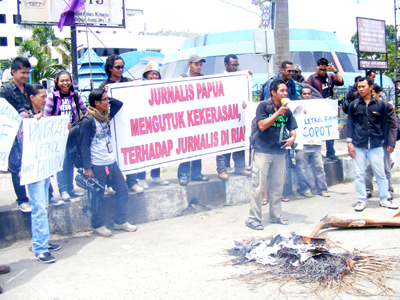
The Alliance of Independent Journalists (AJI) has recorded twelve cases of violence and intimidation against journalists Papua  during 2012,which is a significant increase as compared with 2011, when there were seven cases.
Journalists in Jayapura hold Demo to Reject Violence Against Journalists. (Jubi / Arjuna)

The first case was violence and intimidation against journalists in Papua and West Papua wanting to cover the trial of Forkorus Yaboisembut and his colleagues at the district court in Jayapura on 8 February when they were  physically intimidated, pulled and pushed as they were entering the courtroom. Those responsible were members of the police force in Jayapura. The victims were: Katerina Litha of Radio KBR 68 H  Jakarta. Robert Vanwi of  Suara Pemnaharuan, Jakarta, Josrul Sattuan of TV One, Irfan of Bintang Papua, and Cunding Levi of Tempo.

The second case was against Radang Sorong, a journalist with Cahaja Papua  and Paskalis  of Media Papua, from February until May in West Papua by the police chief of Manokwari, who were preventing journalists from reporting expressions of support for dialogue and a referendum in Papua. Three local journalists said that they had been  under pressure while writing critical reports about political matters, law and human rights violations and political prisoners. One of the journalists from Manokwari was instructed to restrict his reporting about political, legal matters and human rights violations.

The third case was in Abepura on 20 March when Josrul from TV One, Marcel from Media Indonesia, Irfan from Bintang Papua and Andi Irfan of Radio KBR 68 H Jakarta were attacked by members of KNPB, the National Committee of West Papua who were involved in an action outside the Post Office in Abepura. On a separate occasion, outside Polimak, Jayapura, Timbar Gultom of  Papua Pos was ordered to identify himself. When he replied that he  was from Papua Pos,  the people did not believe him and started chasing him. He was able to hide in a house nearby.

The fifth case  was when three journalists in the district of Jayapura, Yance of Radio Kenambai Ombar, Putu of KBR 68 H Jakarta and Suparti of Cenderawasih Pos were verbally intimidated and chased  by some members of the KNPB.on 20 March.

The sixth case was when a journalist from TV One, Josrul Sattuan was beaten by an unidentified person when he was trying to report on the situation in Jayapura following a series of  violent incidents and shooting incidents that occurred in various in places in Jayapura. The physical attack occurred at Abepura Circle on Thursday evening on 7th June.

The seventh case was when a journalist from Metro TV, Abdul Muin who was in Manokwari was attacked by someone from the Fishing Service in who intimidated him with an air gun.The victim told JUBI that the incident started when a member of the Fishing Service sent him a brief message on 8th June asking him and other journalists to cover an incident  of bombing a hoard of fish by a group of  people who were being held in the Manokwari Prison.

The eighth case occurred in Timika on 20 September.The victim was Mohammad Yamin, a contributor to  RCTI, Simson Sambuari of Metro TV, Husyen Opa of Salam Papua and the photographer for Antara News Agency, and David Lalang of Salam Papua.They were prevented from recording some events in the Pamako Harbour.

The ninth case involved Oktavianus  Pogau of suarapua.com and stringer for Jakarta Globe.  This occurred in Manokwari on 22 October. Okto were beaten up by several members of the police force, some in uniforms and others  not wearing their uniforms, who were battling with members of the KNPB in Manokwari.  The victims was thought to be part of a crowd of people involved in a demonstration, even though they had clearly identified themselves.

The tenth case was  when Sayied Syech Boften of Papua Barat Pos was attacked on 1 November by a person who identified himself as a member of the local legislative assembly, Hendrik G. Wairara. The victim was threatened and intimidated among others things by phone. The victim was warned to stop reporting about corruption in a project  involving the extension of the electrification system  and the maintenance of BBM machinery in Raja Ampat District. On the same day, the assistant of the chairman of the the local DPRD flew into a rage while he was at the editorial office of Papua Barat Pos.

The eleventh case occurred on 8 November when Esau Miram of Cenderawasih Pos  was intimidated as he was reporting on a gathering at the office of the Commander of the   XVII Nilitary Command and all the heads of departments in Papua.They were accused of being terrorists even though Esau had shown his  identity card as a journalist.

The twelfth case occurred on 1 December  when Benny Mawel of JUBI was interrogated by members of the police force  near Abepura Circle  for reporting about a large crowd of people who were carrying banners while marching from Abepura to Waena. Benny showed his journalist identity card, but a group of around ten people accused him of not being a journalist. As he was travelling on his motorbike  towards a repair centre, he was followed by some people there who starting asking whether he knew where Benny was.

Victor Mambor added the following: AJI reported two cases, the shooting of a Twin Otter  plane belonging to Trigana Air by an unidantified person in Mulia Airfield, Puncak Jaya on 8th April which killed Leiron Kogoya  who was first said to be a journalist of Papua Pos, Nabire and then the arrest and deportation of a Czech man, Petra Zamencnik who identified himself as a journalist with finecentrum.com. On 9 February, there was inconsistently about the status of the victim, whether he was a journalist or not, or whether he was involved in journalistic activities.

Suroso also confirmed that when the identity of Leiron  was checked, it turns out that  he was not at the time engaged in journalistic activities.but had gone to Mulia for personal reasons. Leiron had not registered himself as a journalist of  Papua Pos Nabire.  As regards Petr Zamencnik. he was unable to prove that he was a journalist. AJI Jayapura  sought confirmation with finecentrum.com about his status  and he was described as being the editor for financial affairs in the Czech Republic.

[Translated by TAPOL]

ELSHAM: Reverting to the DOM era: Papua back to being a Zone of Military Operations

PRESS RELEASE FROM ELSHAM PAPUA

December 19, 2012

ELSHAM PAPUA
Lembaga Studi dan Advokasi Hak Asasi Manusia
(Institute for Human Ri ghts Study and Advocacy of Papua)

Reverting to the DOM era: Papua back to being a Zone of Military Operations

There was a significant increase in the intensity of the conflicts and violence in Papua between August 2011 and December 2012. ELSHAM Papua reported on several incidents that had resulted in serious casualties and although the growing severity of the incidents was disturbing, these did not prompt the Government to react.  These events include the overwhelming offensive called “Operasi Aman Matoa I 2011”, terror actions and shootings by unidentified perpetrators (OTK), cases of internal displacements,  as well as cases of extrajudicial killing of civilians by the police.

“Operasi Aman Matoa I 2011” is the designation for an armed crime prevention operation that was set up in the areas of Puncak Jaya and Paniai. This operation was under direct command  of the Chief of Police, and was run by the Operations Task Force (Satgas Ops) through police telegram letter No. STR/687/VIII/2011 dated 27 August 2011.

The Operations Task Force for Operasi Aman Matoa I 2011 was led by Drs. Leo Bona Lubis, the Commissioner of Police. During the execution of Operasi Aman Matoa I 2011 in the Paniai Regency, a number of grave human rights violations were perpetrated, which include:

(a) the taking of the lives of two civilians, Salmon Yogi (20) and Yustinus Agapa (30) who died as a direct result of the armed conflict,
(b) the inflicting of injuries to at least four civilians: Yulian Kudiai (22), Melkias Yeimo (35), Yohanis Yogi (25) and Paskalis Kudiai (21), who became victim as a result of the armed conflict,
(c) great material loss due to the armed conflict in Eduda District which includes 78 houses that were burnt by the Operations Task Force; educational activities at 8 elementary school (SD) and 2 Junior High School (SMP) that had to be halted; religious and worship services could no longer be ensured in eight Catholic churches, seven Kingmi churches and four GKII churches; hundreds of machetes, knives, saws, hammers, bows and arrows were confiscated;
(d) villagers no longer felt secure in their own homes and they fled. As many as 37 people perished while in displacement: 13 toddlers, 5 children, 17 adults and 2 elders;
(e) communities from the Districts of Komopa, Keneugida, Bibida, East Paniai and Kebo have endured material loss due to their displacement.  The villagers were forbidden from going to their gardens by the members of the Operations Task Force. As a result, this primary source of livelihood for the communities was left neglected and unattended. Prior to the evacuation, 1581 heads of livestock were forcibly slaughtered, including  as many as 478 pigs, 3 cows, 11 goats, 132 rabbits, 381 ducks, and 576 chickens. After returning to their homes and villages, the residents experienced severe food shortage. Members of the Operations Task Force had also damaged the fences built by the residents, as they used those as firewood.

Violent acts committed by the security forces, both the military and the police, are still common and they are in flagrant violation of a number of international humanitarian standards and principles. Some of the cases that we note are as follows:

a. The heavy-handed assault carried out by the police against Persipura fans at Mandala Stadium on 13 May 2012, which led to 18 people suffering from respiratory problems due to tear gas that had been fired indiscriminately and six others being detained arbitrarily.
b. The shooting of four people in Degeuwo by the police on 15 May 2012, by which one person was killed and the other three were seriously wounded.
c. The assault against civilians in Honai Lama Wamena on 6 June 2012, by members of the Indonesian army (TNI) Battalion 756 Wimane Sili, which resulted in one person dead and 14 others seriously injured.
d. The arbitrary arrest and torture by the police of 10 people in the town of Serui, as they were commemorating the International Day for Indigenous People on 9 August 2012.
e. The forced disbanding by the police of a KNPB-led demonstration that was about to start in front of the campus of the State University of Papua in Manokwari on 23 October  2012. A total of 15 people were detained by the police, nine of them were tortured, and 2 others suffered gunshot wounds.

Summary executions by the police of pro-democracy activists who are active within the West Papua National Committee (KNPB) continue to occur. The extrajudicial shooting of Mako Tabuni (34), First Chairman of the KNPB on 14 June 2012, is clear evidence of acts of police brutality against civilians. A similar killing occurred in Wamena on 16 December 2012, when the police shot dead Hubertus Mabel (30), militant KNPB Chairman for the Baliem region.

Other violent acts such as terror acts and shootings by unknown assailants increased, both in 2011 and 2012. From 5 July to 6 September 2011, there were 28 shooting incidents where 13 people were killed and at least 32 people were wounded. Meanwhile, throughout 2012, there were 45 attacks by unknown assailants, killing 34 people, injuring 35 people and causing severe trauma to 2 people.

One of the worrisome events that received very little attention from the Government was the crisis which lasted from July to November 2012 in the Keerom where villagers fled their homes as they no longer felt secure because of activities conducted by the security forces. A joint effort between ELSHAM Papua and the Keerom Catholic Church enabled the return to their homes of 38 internally displaced people (IDPs) who had fled into the jungle.

Various cases of violence and human rights violations that occurred in Papua totally escaped the attention of the central Government and that of local Papuans. Conditions such as these indicate that the status of Papua as an autonomous region has turned into a status of “Special Operations Region”, similar to what was experienced in the decades between 1970 and 2000 when Papua was designated as a Military Operations Area (DOM). Legal impunity for the perpetrators of the violence becomes flagrantly visible as the perpetrators of such violence are practically never brought to justice, nor do they receive fitting sentences.

Prohibiting international humanitarian organizations, international journalists and foreign researchers from accessing the Papuan region inevitably gives way to the increasing acts of violence by security forces in that region. Elite units, such as Anti-Terror Special Detachment 88, are conducting activities that are contrary to their mandate as they themselves are the ones creating terror against activists of the pro-democracy movement in Papua.

Bearing in mind the socio-political conditions faced by Papuans today, ELSHAM Papua is calling for:

1. the Indonesian Government, to open access to international humanitarian agencies, international journalists and foreign researchers to the region so they can freely visit and monitor the human rights situation in Papua;
2. the police of the Republic of Indonesia, to immediately reveal to the public the identity of those responsible for the numerous attacks and mysterious shootings that have occurred lately in Papua;
3. the Indonesian Government and groups opposing the Government, to choose dialogue as a way to end the conflict and the ongoing violence in Papua;
4. the military and the police, to uphold and respect the universal principles of human rights that have been ratified by the Government of the Republic of Indonesia.


Manokwari Riots: Human rights investigation Report

Report of Human Rights Investigation by Monitoring Team from LP3PH (Institute for Research and Development of Legal Aid), Manokwari, as assembled from various local sources and members of the victim’s family.

December 6, 2012

Wednesday 5 December 2012, the weather was overcast without rain, seeming to restrain the usual busy activities of the local population, government and private company staff, white and blue collar workers, market traders, farmers, fishers, schoolkids and students, plus the security forces: army, police and intelligence.

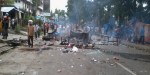
From early morning the atmosphere was tense: from about 07.00 to 09.oo [Papua time] groups of local people could be seen moving to blockade various major road intersections in Manokwari Town.  Primary official routes like Jl. Yos Sudarso, [near Sanggeng in front of the Bank Mandiri, Bank BRI and Bank Papua complex] as far as the three-way intersection on Jl. Merdeka & Jl. Gunung Salju [Makelew Fanindi complex] were blocked by mobs using wood, old tyres set on fire, tables, and tree branches, all thrown on the road. Various intersections of roads heading out to the residential areas of Fanindi beach [beside the Swissbel Hotel], Arkuki [beside the Bahagia store], Sanggeng market, and Jl. Serayu Sanggeng were blockaded by a populace brewing with anger.

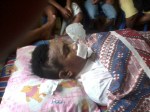
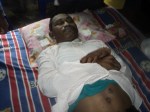
While the atmosphere in Manokwari has been tense there has never been any trouble between groups in civil society or between the local community and the security forces. Several witnesses said that ‘people are very emotional, they are making these protests because of the shooting of Timo Ap’. The police secretively shot and killed Timo Ap, and then took his body to his house in Wirsi, Manokwari.

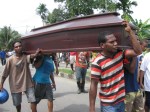
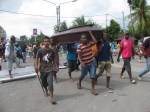
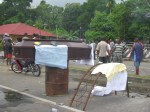
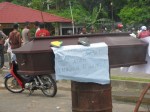
All Photos: LP3PH/West Papua Media

Chronology

A chronology of events has been put together as follows, from various civilian sources including the family of the victim Timotius Ap:

1)      More than 3 days ago the victim Timotius Ap, grandson of the late Timotius Ap, [former area head of Wirsi complex in West Manokwari], returned from Java to Manokwari: in Java he had been staying with family and working as a Marine;

2)      Timo Ap returned home to Manokwari with his wife Iwanggin;

3)     Timo was rarely present at the Wirsi house, he was mostly elsewhere due to being on the DPO [Wanted List], related to various cases that the Police accused him of;

4)     On Tuesday, 4 December 2012, as morning was turning to midday, Timo Ap was hanging out with his friends at Wirsi and wanting to eat areca nuts [?] but after eating them, his friends cannot account for his whereabouts;

5)     By the evening of 4 December, at around 09.00 Papuan time [21.00?] Timo was received and treated at the Dr Azhari Hospital [Navy Hospital] Manokwari;

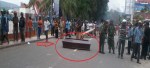
6)     Around 10.00 [22.00?] Papuan time on 4 December, a friend of the family brought a message to Timo’s aunt Nelestin Ap, to ‘please come to the hospital to see Timo, whether he is still alive or already dead’. So then Timo’s aunt and other relatives hurried to the Navy Hospital but on the way they passed police and medical vehicles taking Timo’s corpse home to his grandmother’s house at Jl. Simponi Rindu, Wirsi, West Manokwari;

7)     On arriving at the house, there was only the victim’s grandmother, in her 70’s, living alone. She had no idea that her grandson’s body was being brought to her house. ‘The employees bringing in the corpse said nothing at all to the grandmother’, and then those employees just left the coffin there and went off;

8)     After several minutes the aunt and several of the victim’s loved ones arrived, or came back from the hospital and cried hysterically upon seeing the body wearing only underpants and a clean T-shirt that he had been dressed in. His friends said that he had no other clothes apart from the clean T-shirt and underpants he had been dressed in. At the hospital he had been wrapped up in bandages around his chin and neck as though he were injured, but there appeared to be no injury to his neck, chin or head in general. His only wound was discovered to be on his stomach near the centre, where a surgical incision to remove the projectile [bullet] had been stitched up.

9)     By 11.30 the news had started to spread widely, that the victim Timo Ap had been shot dead by Police, and the local community began arriving to pay their respects and condolences.

10)  In the morning at about 06.00 [Papua time] various family members began blockading the route into Wirsi [Jl. Simponi Rindu]. Blockades then spread to various road junctions in Manokwari, while the local daily paper MEDIA PAPUA released in its Headline news that Timo Ap had been shot dead by the OPNAL [Professional Operations Team] of Polsek [Police sector] Manokwari town at Maripi beach, South Manokwari district at about 16.00 Papua time. This was due to his opposing the officers with an improvised pistol; he was killed with a shot to the head;

11)   From around 07.00 to 09.00, Papua time, the community closed off the main roads of Mankwari such as Jl. Yos Sudarso, Jl. Merdeka, the route to Sanggeng settlement, Jl. Siliwangi, Jl. Soedjarwo Condronegoro [?], Jl. Gunung Salju [heading to Ambun];

12)   At the same time, activities in Manokwari came to a complete standstill. The business centre, Hadi department store, Orchid Swalayan, the market, stalls and shops were closed en masse by their owners. Offices also shut their doors – the Manokwari Regency Government office of West Papua province, schools, banks: from early this morning until mid-morning as this report is written;

13)  At 10.00 Papua time, large groups began violent action, smashing shops along the length of Jl. Yos Sudarso and Jl. Merdeka as far as Jl. Siliwangi. Tens of buildings along the road suffered quite serious damage, and many cars and motorbikes were wrecked by the mob;

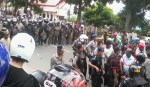
14)  Around 12.00, as the mob moved towards the town centre right in front of the West Papuan governor’s office, patrols of Brimob [mobile brigade], Dalmas Polres [area police] backed up with Indonesian Army forces were seen closing off the intersection that the crowd wanted to pass;

15)  A local man, Demianus Waney held a megaphone in front of the security forces, asking the crowd to disperse and go home…. ‘I say go home’… said Demianus Waney….. but hearing those words, the crowd became more worked up. In the process of their demonstrations against Demianus Waney, a number of buildings, restaurants owned by transmigrants around the harbour and PT Pelni [national shipping line] became targets of their anger;

16)  The police, Brimob and TNI [Indonesian army] started to rush forward but were stopped by an attempt at negotiation by a priest, who said he had been the victim’s priest [i.e. Timo Ap who had been shot and killed]. However at the same time Demianus Waney said that every avenue had been tried already, inviting the armed forces to action;

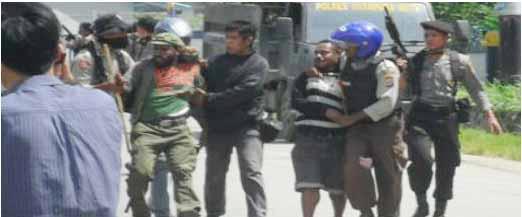
17)  The security forces then moved forward to break up the crowd. The police, Brimob and soldiers using trucks, paddy-wagons and Barracuda vehicles moved rapidly to take over the main road that had been controlled by the mob;

18)  Around 13.00, Papua time, the situation had become calm and back to normal.

“Victor, we are ready to wreak havoc and clash with all of you” : Reflections by an unrepentant leader

by Victor Yeimo

Witness: Participant Analysis

December 3, 2012

Police Captain Kiki Kurnia: “We’re Ready To Clash.”

“Victor, we are ready to wreak havoc and clash with all of you.”

Those are the words spat out by police captain Kiki Kurnia, who yesterday (December 1) led hundreds of fully-armed police officers to put a stop to the Long March of students and the people. I was very sad to hear these words so righteously issued by the police, who present themselves as being on the side of safety. Do the police want safety, or do they not?Yeimo-ditangkap

When I was the leader of the Long March headed for Expo Waena on December 1 in Sentani, police backed by the Indonesian military had already closed off access to the people of West Papua who would pray. Since the late afternoon (30/11), Theys H. Eluay field, which is the field of (great significance and sacredness to) the West Papuan national struggle, had been controlled by the military and by the national police, although all the civil society organizations had long since said that their prayers and celebrations would take place there.

On November 19, police entered a prayer room in Aula STAKIN in Sentani and tried to stop me as I was giving a reception after prayers, and then yesterday on December 1 the people wanted to worship and eat at the Theys H. Eluay field but were prohibited, blockaded and arrested by the full force of the military. The question is, why did the military and the police force deliberately take control of the field and then shamelessly hold a traditional stone cooking event (a Indonesian-appropriated Papuan Custom) with a handful of residents who were offered money?

If the police are tasked with security, why exactly is that security so insecure when facing inhabitants who are conducting prayers peacefully? Is the Theys H. Eluay field, owned by the traditional people of West Papua, only permitted for use by the Indonesian military and the police force? If the law is just, why wasn’t police captain Kiki Kurnia charged with incitement to violence? As he himself clearly  (attempted) incited the mass action I led to commit violence on the streets in front of Dian Harapan Hospital yesterday.

If the police prohibit students from campaigning to put a stop to AIDS on West Papua’s Independence Day, why must it be prohibited? Do the police not want HIV/AIDS awareness campaigns to take place? Isn’t his proof that the police are ensuring and championing ethnic cleansing in West Papua? Why do the police prevent worship on West Papua’s Independence Day? Why do the police see more political and economic motivations than the goodwill and intentions of the people who want to interpret December 1, 2012 as World AIDS Day, the opening of Christmas festivities and the Independence Day of West Papua?

I lead my people safely and with restraint. I have personally guaranteed that I will be arrested or shot if there is a criminal act committed by people, but why in the safe Long March were we forcibly dispersed and captured like animals? Actually, who was it that committed the crime? Was it the people, or the police?

The police did not only incite the violence that happened, but yesterday (1/12) the police, through (Adjunct Senior Commissioner) Alfred Papare, publicly lied. Myself and the masses did not throw rocks at the police, however it was covered by several media sources that the police chief said we did so. In an era of openness such as this, why is there a need for mutual deceit when everybody saw yesterday that the police had no reason to blockade, arrest and attack people with tear gas? After I “escaped” from Abepura Sub-District Command, I had not received a call from the Jayapura Chief of Police, the aforementioned Alfred Papare, as stated by Wakapolda Papua, Paulus Waterpau, to Tabloid Jubi.

Better for the Police to become the Social Services

The idea of Papua’s Chief of Police, Tito Karnavian, to give out groceries and distribute help the mountain people of Papua in Jayapura and the Jayapura municipality makes me wonder a little. Has the police chief already switched functions from a chief of police who must preserve security, only to become the head of the Department of Social Services who must give social support to the people? Is this country unhealthy? Money for providing support to the people is redirected into the Police Department and the Police Department takes over the functions of the Department of Social Services.

For me, the efforts of the police department to muffle and destroy the basis of the Papua Independence conflict are obviously speculative, as well as inappropriate. Go ahead, if the police department and the Republic of Indonesia believe that our ideology can be bought off with money. Tens to hundreds of millions have been redirected to the Asrama Rusnawa Uncen, since becoming the basis for conflict, and the police are very hopeful that students will regard them as righteous people, as kind people. Well, again, it is better that the Police Institution in Jayapura be renamed as the Department of Social Security or the Department of Education, so that matters concerning the improvement of the Asrama Rusnawa Uncen and student welfare can just be taken over by the police.

Does Indonesia believe that money can silence the aspiration and ideology of independence for the people of West Papua? I am convinced the people of Papua that are given money and material aid from the police are only making use of them, because within the individual West Papuan person there is a flesh-and-blood desire for Papuan Independence, however difficult it is. So, go ahead, half-dead police and a waste of money to the people of Papua. Go ahead and pan the sympathy and dreams of the people who have hated the occupation of this land. Almost half a century practicing the policies of the Republic of Indonesia, and all models of development cannot turn the people of West Papua into people of Indonesia. Papua will rise and awaken by itself alone.

Idea of Separatists and Terrorists is a project of the TNI and Police 

There are no separatists and terrorists in West Papua; only those who demand the right to self-determination as legally protected under international law. The idea of separatists and terrorists is created by the state to disgrace the legal struggle of the West Papuan people, and created by the Indonesian military and the police with a view to expanding their territory, and their wealth. For the sake of money alone, the circumvention of the state apparatus and the deception of the state apparatus, alias “bullshitting a lot” (direct translation).

My organization, the National Committee of West Papua (KNPB), struggles in peace and does not want to create chaos that will strengthen the funds of the military and the police force. Consequently, the national police force does not like peaceful action, because in a situation that is safe and peaceful, the military and the police force will be poverty-stricken. Many security institutions in Indonesia have hundreds of troops that must be paid by the state. Moreover in Papua, there are now many civilian militias formed by the state; thousands have been recruited, and must be paid. All are created with the objective of “stripping bare” the security responsibility from the Indonesian government in West Papua that fall under the name of “eradicating separatists and terrorists.”

Forgive me; my group and I will not accept food from the military or the police, so there is no need to criminalise or drop that bomb on the National Committee of West Papua to stigmatise us, so that the project money can be maintained. These ways have become commonplace, and we are bored of them. The people are smart, and getting smarter: they have already been taught these ruses by the colonialists. Ways such as this will finally tarnish the image of the Republic of Indonesia in West Papua. So it is best not to try to painstakingly search for such an image. Oh, and yesterday in Guyana, Member of Parliament told Benny Wenda: “Oppression alone will burn the spirit of the independence struggle.”

Why not kill me, or imprison me? Why was I released? Oh, it is certainly not because I cheated. I will see this for what it truly is. There are demonstrations in the streets. Now that I have planted the seeds of resistance here and the invaders sow these seeds with their own actions. I must thank the colonialists for continuously teaching us to aspire to true humanity by means of rebellion.

Victor Yeimo wrote this article immediately upon his release from police custody on Monday December 3. 

Translated by West Papua Media volunteer translators

Create a website or blog at WordPress.com

Up ↑