Jubi: Papuans Must Stand Up to Fight

 April 29, 2015

Students held the event ‘In Memoriam of Arnold Ap’ in front of Cenderawasih University Cultural  - Jubi

Jayapura, Jubi – Dozens of students, activists, journalists and young people who are members of Papua Cultural Care Generation held the event ‘In Memoriam of Arnold Ap’ in front of Cenderawasih University Cultural Museum to commemorate 31 years after the death of legendary Papuan musician Arnold Ap, who was killed by the military on 26 April, 1984.

The Papua Bersatu Untuk Kebenaran (BUK/Papua Unite for Truth) Coordiantor, Peneas Lokbere said long after the murder of Arnold Ap Papuans continued to be victimised in many ways.

“Papuans shouldn’t forget their culture. Papuans must stand up to fight. Arnold Ap was killed by the state, but the Papuans’ spirit to fight should not be stuck in here. The struggle must go on,” he said when delivering messages in the murder day of Arnold Ap last Sunday in Cenderawasih University Cultural Museum.

Meanwhile, Papuan human right activist Rosa Moiwend said the Papua young generation today should not forget their culture. Papuans must take their culture as their identity.  Kork (Frizzy Rasta Community) Coordinator Teddy Pekei added Papuans must rebuild their identity through its culture and arts. Arnold Ap has showed that every Papuans must grasp their culture as the foundation of Papua nation.
“Arnold Ap teaches us Papuans not to discriminate every tribe and nation in the land of Papua. He showed it through his songs that compiled from various Papuan languages,” he said.

After thirty-one years, the Government of Indonesia has not realising that the murder of Arnold Ap and Eddy Mofu by the security force is the planned-murder and paralysed towards Papuan identity and character of culture.

In commemorating the thirty-one years of death of Arnold Ap, the President Joko Widodo is urged to apologise to Papuan people for the crime and violation against the human rights and the paralyse of the character of Papuan culture by State’s apparatus (Military/Police) in Papua.

While the Papua Provincial Government is asked to support and assist the development of Mambesak (folk) music as part of Papuan culture and Papuans unification as well as to renovate Arnold Ap and Eddy Mofu’s grave where located in Tanah Hitam in respecting them. (Arnold Belau)

Breaking: Police Raid KNPB in Merauke ahead of May 1 demos

POLRES MERAUKE POLICE ARREST 15 KNPB ACTIVISTS and CHAIRMAN of the PRD MERAUKE.

by West Papua Media, with sources in Merauke

May 1, 2015

Information from KNPB has just been confirmed from independent credible sources.

On Friday May 1, 2015, at 01.06 WPB (Papua time) heavily armed police officers of Merauke Polres forced entry into the West Papua National Committee (KNPB) Secretariat office in Merauke, and arrested 15 KNPB activists, together with their Mother, PRD (Parleman Rakyat Daerah or Regional People’s Parliament) Chairperson Panggresia Yeem, who were still preparing for a rally today to commemorate the forced takeover of West Papua by Indonesia.

Earlier on Thursday night , the Merauke KNPB sent an alert that an attack was imminent:

“Police and military apparatus have surrounded the KBPB MERAUKE SECRETARIAT this night.  KNPB this News.  Tonight, hundreds of Police officers from Merauke police station and members of the military from Kodim Merauke came down at 20:00 WPB.  They are placed in the driveway exit of the secretariat and PRD Merauke.  The KNPB chairman Merauke reported via phone ‘that we were surrounded by military / police with full force being placed around the secretariat KNPB Secretariat building) in Merauke.”

An independent source confirmed to West Papua Media that police were heavy-handed during the arrest, allegedly causing damage and rough treatment, however it is unknown at this stage whether any injuries have been sustained.  An urgent call from West Papua Media to the Polres HQ went unanswered.

Those 16 arrested in Merauke overnight are:
1. MS. PANGGRESIA YEEM, PRD CHAIRMAN of MERAUKE
2. GENTO EMERICUS DOP, CHAIRMAN KNPB MERAUKE
3. YOSEP MUYAN, KNPB MERAUKE MEMBERS
4. YOSEP IMBANOP, Chairman of PARLIAMENT of MUJU District
5. The CHAIRMAN of the ONGKATMIT SECTOR, KNPB

6. ZAKARIAS Y SRAUN
7.EMANUEL MATEMKO
8.YOHANES KAYOP
9. IBRAHIM DEWAP
10. JAN OBAKAM
11.IKNASIUS WAMIN
12.THOMAS PISAKAI
13. FRANSISKU PISAKAI
14 . JULIANUS TABIET
15. ISAK SOSOCHOM
and 11 other KNPB members whose names are not yet available.

Heavily armed Police have just taken all 16 people, including the matriarch head of Merauke PRD for interrogation at the Police HQ in Merauke.

The raids come after the KNPB refused to accept the local police chiefs threats (see Jubi article below) against holding democratic gatherings to mark the May 1st Day of Mourning.

More information as it comes to hand.
West Papua Media

from our partner Tabloid Jubi’s West Papua Daily

April 29, 2015

Jayapura, Jubi – The chairman of the Merauke People’s Representatives (PRD) in Pancrasia Yem said they were not afraid and intimidated by threats from security forces in Papua, especially the Merauke Police chief.

Merauke Police Chief Adjunct Senior Commissionaire Sri Satyatama said police will not allow the West Papua National Committee (KNPB) to conduct activities including the prayer on 1 May 2015 and warned they would be disbanded if they ignored the ultimatum.

“The Police Chief’s statement is not big deal. He’s part of invaders. The invaders will keep doing anything to suppress any action taken by Papuans. KNPB and PRD Merauke Region will keep fighting.  We will do something on 1 May to express the injustice that had occurred in 1963,” he told Jubi on Tuesday (28/4/2015) from Merauke, Papua.

According to Yeem, KNPB and PRD Merauke Region will keep fighting to bring West Papuan people’s aspiration to decide self-determination in accordance with the mechanism of international law.  (Arnold Belau/rom)

West Papua Oil Palm Atlas: The companies behind the plantation explosion

From our hardworking partners at AwasMIFEE

April 30, 2015

West Papua Oil Palm Atlas:
The companies behind the plantation explosion.

-a comprehensive investigation into the oil palm industry in West Papua,
published by awasMIFEE and Pusaka, together with local Papuan
organisations Belantara Papua, Bin Madag Hom, Jasoil, SKP KAME and Jerat
Papua, and Sawit Watch.

Available for download: https://awasmifee.potager.org/?p=1205

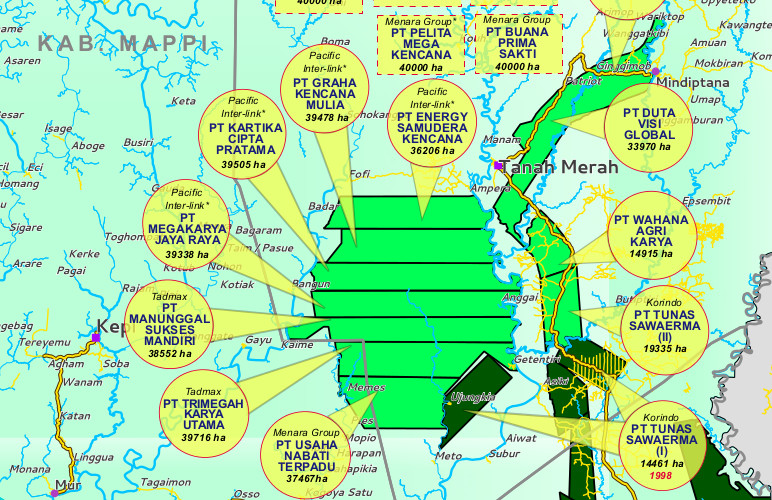
image

Indonesia’s oil palm industry is moving east. With large tracts of land
increasingly difficult to find in Sumatra and Borneo, plantation
companies are now focussing their attention on Indonesia’s eastern
frontier: the small islands of the Maluku archipelago and especially the
conflict-ridden land of West Papua.

In 2005 there were only five oil palm plantations operating in West
Papua. By the end of 2014 there were 21 operational plantations. This
rapid expansion is set to continue with another 20 concessions at an
advanced stage of the permit process, and many more companies that have
been issued with an initial location permit. If all these plantations
were developed, more than 2.6 million hectares of land would be used up,
the vast majority of which is currently tropical forest.

Almost without exception, these plantations have caused conflict with
the local indigenous communities who depend on the forest – lowland
Papuans are mostly hunters and gatherers to some degree. The conflicts
have centred around community’s refusal to hand over their land, demand
for justice in the cases where they feel the land has been taken from
them by deceit or intimidation, horizontal conflicts between
neighbouring villages or clans, action by indigenous workers who feel
they are exploited, or aggression by police or military working as
security guards for the plantation companies.

The West Papua Oil Palm Atlas, published by awasMIFEE, Pusaka and six
other organisations, is an attempt to provide a picture of this
developing industry. Who are the companies involved? Where are they
operating? Which areas will be the next hotspots? The aim is to be part
of a process to push for more open and accessible information about
resource exploitation industries in West Papua – currently local
administrations and companies are often reluctant to share information
about permits, meaning that communities often know nothing of plantation
plans until a company shows up, trying to acquire their land.

Indonesian law does recognise communal land rights for indigenous
customary communities, but in reality those communities often face
considerable pressure to give up that land, and are rarely given more
than US$30 per hectare in compensation. It is hoped that this
publication can become a tool for indigenous peoples and social
movements who wish to understand the oil palm industry and defend their
forest against these land grabbers, as they themselves should be the
ones to determine what kinds of development will benefit their communities.

For environmentalists and supporters of indigenous struggles around the
world, we hope that this will also be a useful insight into the dynamics
of the plantation industry and the threats it is causing in the third
largest tropical forest in the world. Using the excuse of the conflict
around the independence movement, the Indonesian government makes it
very difficult for international observers to access West Papua, and
this has probably also resulted in a lack of awareness internationally
about the ecological threats. Yesterday (29th April) human rights groups
throughout West Papua, Indonesia and in over 22 cities around the world
held demonstrations for open access to Papua, which has long been a
demand of many Papuan movements. Publishing this Oil Palm Atlas is also
an attempt to break the isolation of Papua, by focussing attention on
the issue of indigenous land rights, in a context where local
communities which choose to oppose plantation companies often feel
intimidated by state security forces which back up the companies.

Direct download link:

English:
http://awasmifee.potager.org/uploads/2015/04/atlas-sawit-en.pdf
Indonesian:
http://awasmifee.potager.org/uploads/2015/04/atlas-low-resolution-Final-id.pdf

Nabire youths arrested for cleaning memorial park

By our partners at MAJALAH SELANGKAH in Nabire

28 April 2015

Photo caption text: From left to right, , Marthen Iyai (28 yrs old), Martinus Pigai (17), Anton Pigome (24) detained in the Nabire Police station Tuesday (28/4/15). (Photo: MS)

A BRIMOB Police unit together with Nabire Regional Police on 28 April have arrested three Papuan youths whilst they were cleaning the Papuan Nation’s Flower Park in Ovehe in Nabire town centre, Papua province. Those arrested are Martinus Pigai (aged 17 yrs), Anton Pigome (24 yrs) and Marthen Iyai (28 yrs).

According to arrestee Anton Pigome, speaking with majalahselangkah.com from detention at the Nabire Police station at Tuesday midday: “This morning we were cleaning the ‘Papuan Nation’s Flower Park’ in Ovehe together with our older people. We were cleaning the park for a church service to mark 100 days since the passing away of Father Nato Gobay (see: Wakil Uskup Timika, Pastor Nato Gobay, Pr Wafat) and at the same time to communicate to the community there regarding Mubes Meepago ( Mubes Miras dan HIV Wilayah Meepago) as planned for 9 or 10 May 2015.  At approximately 8.00 am BRIMOB forces came in a vehicle and ordered us to get into the BRIMOB vehicle. They then took us to the Nabire Police station.”

Anton continued “ We were not beaten at the time of arrest, however we were shocked and confused why we would be arrested. We were just cleaning the park so why would we be arrested?”

Well known Papuan human rights activist Yones Douw said they confronted police. “After we heard the news we went directly to the Police station and demanded the three be released as they had done nothing wrong. They were just cleaning the area for the church service to mark 100 days since the death of Father Nato Gobay” stated Yones.

Yones explained after meeting Deputy Head of the Nabire Police Kompol Albertus Andreana, it had been agreed to release the 3 youths. “ When we momentarily met with the Head of Police earlier I stated that the 3 youth must be released. He had to leave and suggested we speak with the Deputy Head of Police which we did. They have promised to release the 3 this afternoon.”

According to Yones, the Police believed the park was being cleaned in relation to upcoming 1 May activities, being the anniversary of the date Papua was annexed into Indonesia. As that anniversary is now close the National West Papuan Committee (KNPB) has called for demonstrations to be held simultaneously throughout Papua to reject the presence of the Indonesian population in the Land of Papua.(See: Seruan KNPB Menuju 1 Mei 2015).

It needs to be pointed out that the ‘Papuan Nation’s Flower Park’ is the location of the past offices of the Regional Committee of Community Representatives (DPRD). After the DPRD offices were burnt down and moved to Kelurahan Bumi Wonorejo, the Papuan community used the place as a centre for political expression.

Majalahselanghkah.com noted that back on 1 December 1999 the ‘Papuan Nation’s Flower Park’ had once been used for a West Papuan Political Ceremony during which two flags were raised on high steel poles with the Papuan Morning Star flag on the right and the Indonesian Red and White flag on the left. Those raised flags were maintained for 8 months before joint armed forces of Police and Indonesian military took them down during what’s become known as ‘Bloody Nabire’ which occurred from 28 February to 4 March 2000. (IRIAN JAYA (WEST PAPUA, NEW GUINEA): THE QUEST FOR INDEPENDENCE–THE RECORD: REPORT ON THE NABIRE SHOOTING SITUATION- 28 February 2000 to 4 March 2000). At that time 3 people were shot dead and others were wounded. Those shot dead were Menase Erari, Maximus Bunai and Wellem Maniwarba. They were buried in the ‘Papuan Nation’s Flower Park’ and to this date the steel pole remains standing there.

Then again on 13 August 2013 there was an incident when access to the park was closed off by joint armed police and military forces (see: Taman Bunga Nabire Dipalang, Sejumlah Tokoh Mengadu ke DPRD). Human rights activists together with well known church and community figures, tribal and customary law leaders pressured DPRD to hold a meeting with the Regional Government, the district Commandant and the Head of Police to return the park to the community. Finally the closure to the park was lifted and until now the community has been able to use the park as a place for political expression.
(Yohanes Kuayo/Yermias Degei/Putri Papua/MS)

Chairman of AJI Jayapura: Importance of Open Access to Foreign Journalists into Papua

by Arnold Belau at our partner Tabloid Jubi

April 29, 2015

Pioneering West Papua journalist Victor Mambor, Chairman of Journalists Alliance (AJI) Papua, Editor of Tabloid Jubi, media freedom advocate and Journalism trainer (photo: Jubi
Pioneering West Papua journalist Victor Mambor, Chairman of Journalists Alliance (AJI) Papua, Editor of Tabloid Jubi, media freedom advocate and Journalism trainer (photo: Jubi)

Jayapura, Jubi – Chairman of Journalists Alliance (AJI) in Jayapura city, Victor Mambor, said it is very important to open access to foreign journalists into Papua in order to avoid misinterpretations of Papua.

 The issue was delivered by Victor in an interview with AJI Indonesia in Jakarta at the World Press Freedom Day (WPFD) 2015, Tuesday (29/04/2015).

Victor explained that the media in Papua continues to grow, but the challenges are also growing ranging from human resources, financial, ethical and positioning journalists.

In Papua, as the media grows, so too is the presence of journalists.

“However it is true that a journalist in skill and ethics cannot always grow in parallel. If there are challenges, there is still not much of a significant change. Journalists still face threats of violence with the same quality as in previous years,” said Victor.

Papua which is broad and extensive, has become the greatest difficulty faced by foreign journalists. The conditions make the confirmation process, covering both sides, and verification difficult. Often, news from Papua becomes incomplete and with bias ruling.

“Every year there are 4 or 5 foreign journalists who question to myself regarding the situation in Papua. Most of them could not enter Papua. From their information, I can conclude they are not well served when submitting an application for reporting in Papua. In fact, there is no decision ever made, permitted or not,” said Victor.

Victor said that the more closed the access is, the more questions the international community will ask about what is happening in Papua.

“The conflict in Papua could be clarified in a comprehensive manner to the public through information which is submitted by journalists,” said Victor, who is also the Chief Editor of Jubi News and Jubi Online.

He said, to open access for foreign journalists into Papua, the issue that is very important and must be carried is the clarification of regulations for foreign journalists in Papua.

“Besides the campaign for open access for foreign journalists in Papua, lobby stakeholders who are related to the issue that need to be carry out the goal of clarifying regulations for foreign journalists. This is the main problem, unclear regulations,” he asserted.

WPFD proclaimed to the UN General Assembly that in 1993, the recommendations of this matter, was adopted it in the 26th Session of the UNESCO Conference in 1991. Recommendations and the trial were also in response to the calls of African journalists in 1991 for principles of media pluralism and independence, which resulted in the Declaration of Windhoek.  [Editor : Dewi Wulandari]

 translated by WestPapuaMedia

Create a website or blog at WordPress.com

Up ↑