DAP chairman calls for the withdrawal of police and army from around Freeport

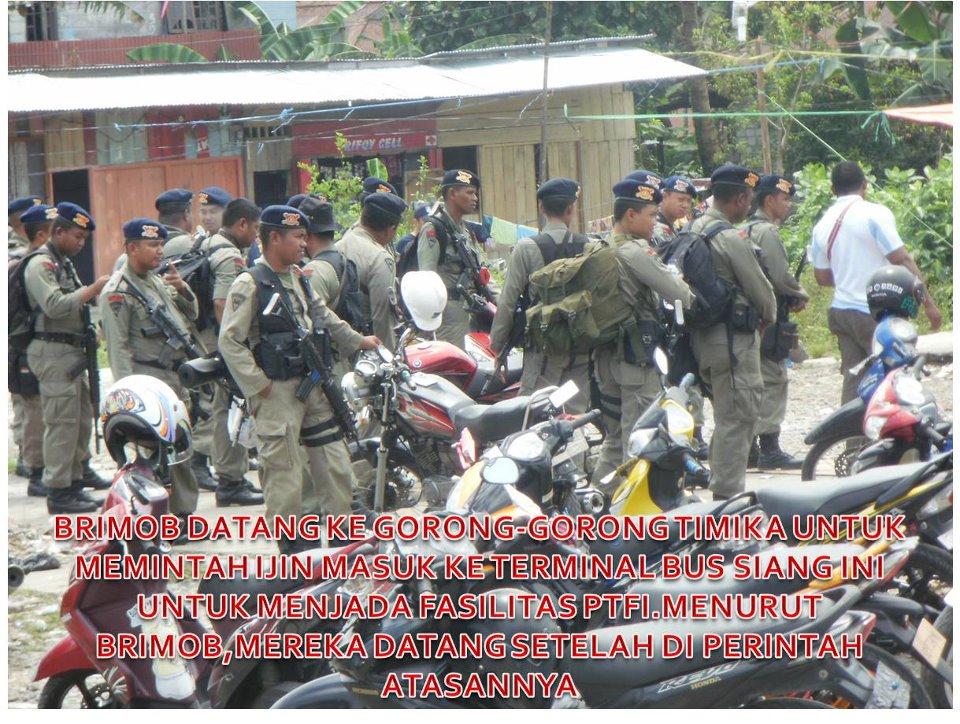
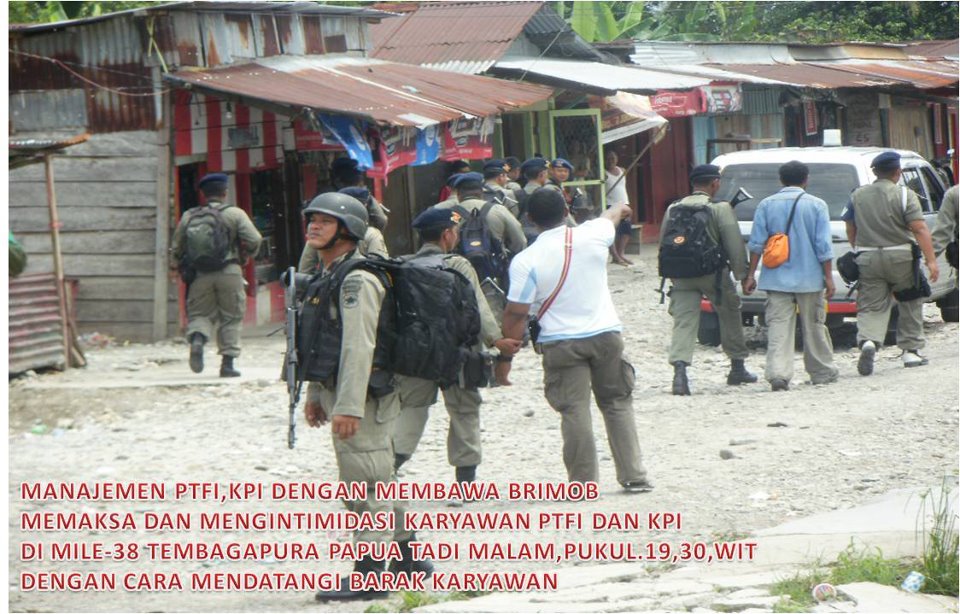
JUBI, 13 October 2011In connection with the shooting dead of Petrus Ayamiseba  who worked at the catering department for workers at Freeport, the Dewan Adat Papua  has declared that  it is essential to withdraw army and police troops from area around the Freeport mine.

Speaking on behalf of DAP, Dewan Adat Papua, Forkorus Yaboisembut said that the chief of the Indonesian police, the chief of police in Papua and the commnder of the XVII Cenderawasih Command should withdraw all their troopa who are currently deployed in the vicinity of the mine. He said that it was important for the police and the security forces to stop exerting pressure on the company. They should also be ordered to stop exerting pressure on the workers.

‘The security forces should stop interfering in any way with the company,’ he said. ‘The two sides involved in a dispute must find a solution together. If they are subjected to pressure, the dispute will never be solved,’ he said.

He also said that the Indonesian govrnment should urge the company to provide a clarification about its  revenues. ‘If the government can convince the company to review the wages that they  pay to the workers, the dispute can be speedily resolved,’ he said.

Meanwhile, the lawyer, Yan Christian Warinussy said that the shooting of Petrus Ayamiseba was a gross violation of human rights, and he hoped that the Papua branch of the National Human Rights Commission would speedily hold a meeting with  the chief of police in Papua, Police Inspector-General  Bigman Lukkaman Tobing to press for this shooting incident to be resolved in the human rights court. He said that if this does not happen,  the police will claim that this was nothing more than a criminal act.

He want on to say that the shooting to death was a breach of Law 39/1998 regarding safeguarding actions undertaken by the people.

Warinussy also said that  the company should halt all their provocative actions. ‘The company and the workers should sit down together to discuss the rights of the workers.’

Warinussy said that he was currently in Timika and was carrying out his own investigations and he said that he would be having a meeting with the chief of police in Mimika and with the company. The results would be conveyed to the chairman of the  Papuan branch of the National Human Rights Commission. Matius Murib.

Petrus Ayamiseba who was 36 years old died when he was struck by a burning rod of tin belonging to the police while he was taking part in a demonstration at the Gorong-Gorong Terminal.

During the incident, another person was also killed, namely  Jamil, a member of Brimob.

UN wants to send Special Rapporteur to Indonesia to investigate MIFEE


Bintang Papua, 12 October 2011The UN Commission to Combat Racial Discrimination and Protect the Rights of Indigenous People has sent a letter to the Indonesian ambassador to Geneva, Anwar Kemal, regarding several matters.

In the first place, to agree to invite the UN Special Rapporteur on Human Rights to visit Indonesia in connection with MIFEE, the Merauke Integrated Energy and Food Project in West Papua. In the second place to hold talks with CERD for this matter to be discussed at the forthcoming meeting of the Committee in Geneva from 13 February – 13 March 2012. And thirdly, to to make available comprehensive information regarding all the matters contained in the afore-mentioned latter.

This was made  public following a meeting by a number of NGOs in Jayapura on 12 October which was attended among others by Foker-NGO-Papua, Sawit Watch, Greenpeace, Justuce and Peace Commission/Jayapura, Walhi and Sorpatom in Jayapura on 12 October.

The Coalition of NGOs said that the response of the UN to the MIFEE project had exerted pressure on the Indonesian government to halt all activities related to the MIFEE project and to invite the UN Special Rapporteur on Human Rights to investigate this project before 13 January 2012.

The coalition said that MIFEE would have a strategically significant inpact on the availability of foodstuffs and energy resources in Indonesia.

This project will cover an area of 1.6 million hectares which will be used to produce millions of tons of rice, corn, beans and sugar as well as promote cattle-rearing. Dazzled  by this massive project, they have closed their eyes to a huge problem that will confront the population of Merauke whose land will be consumed by the MIFEE.project.

The MIFEE project is a highly ambitious mega  project of the Indonesian Government based on a slogan to produce food for the whole world. They intend to take control of an area of 1.6m ha of land for agri-business purposes. The resultant food will be exported, meaning that MIFEE is directed towards the export market. Thirty-six companies have already been attracted by the MIFEE project with investment capital to the value of Rp 18.9 trillion, along with domestic capital.

Research undertaken by various organisations has identified a number of problems.

First of all, this project which will cover a total area of  altogether 2m ha of land belonging to the indigenous people will have a direct impact on the traditional rights of the these people.

Furthermore,  this expansion will cut down forests belonging to indigenous people in order to grow  palm oil and will result in the influx of a huge number of people from outside the area, threatening the local people’s livelihoods and destroying their traditional economic practices.

These developments will exert huge pressure on the Malind people and their traditions in particular, and the Papuan people in general, turning them into a minority people in their own land.

In addition, these developments which are supported by various state forces will require the protection of the Indonesian army.

Fourthly, the decisions regarding exploitation of natural resources are hugely dependent on the central government and are being developed in accordance with national laws that ignore the indigenous people, despite the adoption of the Special Autonomy law in 2001, the aim of which was to decentralise decision-making to the provincial level with regard to a number of issues, while nothing has happened regarding the introduction regulations.for the implementation of this law.

Fifthly, it is understood that most of the MIFEE area has been classified as ‘forest’ and placed under the jurisdiction of the forestry department, whose interpretation of the forestry laws impinge on the rights of the indigenous people.

Finally, there are reports that local communities have been manipulated by investors and government officials so as to secure their signatures  to provide the legal basis for certificates affirming their right to the land of the indigenous people.

Three hundred Freeport workers ordered home

Bintang  Papua, 14 October 2011Freeport orders 300 workers to ‘go home’

Timika: Reports that workers at Freeport have intimidated and threatened  other workers for refusing to take part in demonstrations and not wanting to go on strike have led to around three hundred Freeport workers being order to go home [dirumahkan’], according to the management of Freeport-Indonesia. Sixty of the three hundred  are staff-level employees joined the strike that commenced on 15 September.

The president-director and CEO of Freeport, Armando Mahler in Timika said on Thursday that the decision to order them home  was taken because they  were involved in intimidating workers who remained at work  and did not join the strike. ‘At the time, many of of the workers felt afraid and threatened. They fled from their barracks and went into hiding. The families of some of the workers who continued to work were also warned that their homes would be burnt down,’  said Armando.

He went on to say that after the strike is over and operations at the Freeport return to normal, the management intends to conduct an investigation to determine what mistakes each of the workers who were ordered home  had made.

Additionally, the director-executive, vice-president  and chief office administrator of the Freeport, Sinta Sirait, said that the decision to order home hundreds of workers meant that the third summons [see below] issued to non-staff employees who had joined the strike was in accordance with the Joint Working Agreement which had been agreed with the workers trade union, the SPSI.

Sinta called on all sides to respect the terms of the agreement that had been reached and not treat it as nothing more than a lip service. ‘We urge the workers not to think that being ordered home and then returning to work is only about establishing good industrial relations with the company.’

Another  manager of the company, John Rumainum said that in a spirit of goodwill, the company had called on the workers to return to work. The first summons was issued on 26 September,  followed by the second summons issued on 29 September and the third summons issued on 4 October.

He went on to say: ‘Those workers who returned to work before the third summons will be exempt from any sanctions But those who returned to work after the third summons, would be treated in accordance with the regulations…

He then said that all the sanctions issued by the company  would be reviewed, once the workers had returned to work.

[Translated and slightly abridged by TAPOL]

[COMMENT: This report reveals the attitude of the company towards hundreds of its employees who were clearly seeking to improve their working conditions during a strike that has been marked by  persistent threats from the company that runs one of the foremost and most profitable mines in the world. TAPOL]

Photos: Indonesian Police open fire on student dormitory in Jayapura

By Nick Chesterfield/ westpapuamedia.info

October 13, 2011

Plain clothes Indonesian police agents in Jayapura opened fire late on October 12 outside a student dormitory, in another violent act of security force intimidation before the Third Papuan People’s Congress starts on October 16.

Local human rights sources and stringers for West Papua Media have reported that the Rasunawa dormitory, housing West Papuan students from Cenderawasih University (UNCEN) , came under attack at 11pm local time by five plain clothes police agents. The agents arrived in a new white Toyota Kijang with police license plate Ds. B 9481 PAA ( expiry June 2015).

Witnesses from the student dormitory, who have declined to be identified for their safety, have reported directly to West Papua Media that the agents arrived and started shooting immediately outside the dormitory. “For some reason, these five police goons (polisi preman) entered Rasunawaa and fired wildly, so that all the male resident of the three-story building came down and surrounded the five thugs”.

According to an activist with SONAMAPA WP (Papuan Students National Solidarity Organization) who was a witness to the altercation, the students interrogated the five men at the centre of the group. “They were feeling cornered and fired shots incessantly in the air, we think over 30 bullets were flying. ”

the Five Brimob Police shooters after being surrounded by Students

“We are still looking for eyewitnesses or if there is a gunshot victim from the incident or not – the investigation remains ongoing”.

This slideshow requires JavaScript.

In dramatic scenes, the West Papuan students successfully detained the men until an entire platoon of uniformed police arrived, who then arrested the Indonesian gunmen by force. Uniformed police, also from Jayapura, were reportedly fired upon by one of the five men. However,the platoon of police also opened fire to disperse the crowd in order to retrieve their men.

Photographs of the incident provided to West Papua Media by witnesses appear to show the police vehicle used in the incident. According to the SONAMAPA WP activist, the new vehicle registration means the car has just been imported directly from Jakarta

A formal report has been made to the Rector of UNCEN, and students have reported to West Papua Media that they hold grave fears for a continuation of the incident, and for the safety of the residents of the Rasunawaa UNCEN domitories.

with local sources

Greens call for release of West Papuans in custody

http://richard-di-natale.greensmps.org.au/content/media-release/greens-call-release-west-papuans-custody

 by RichardDiNatale in Media ReleaseWest Papua

Greens’ spokesperson for West Papua, Richard Di Natale, has expressed concern over the arrests of West Papuan activists and is calling for their immediate release.

“The Greens are concerned for West Papuan human rights defenders, Henok Dori, Noak Kandipi and Melkianus Bleskadit, who were all arrested on their way to a conference last week, and are still in custody in Jayapura and Manokwari,” said Senator Di Natale.

“We understand that some of their colleagues have been released and we call for these West Papuans to be released.”

The conference was a preparatory event for the important Congress being held this weekend. The Congress brings together different human rights, faith and student groups across West Papua to discuss strategies for bringing peace and justice to the troubled Indonesian province.

“West Papuans have a right to meet and discuss their own future. This congress is a peaceful assembly. We ask the Indonesian government to stand by its stated support for the rights of its residents to move freely and assemble peacefully.”

The situation in West Papua remains critical, with a striking worker at the Freeport McMoran copper and gold mine shot dead this week, and further reports today of police shooting at a student dormitory in Jayapura.

Media contact: Andrew Blyberg             0457 901 600

Create a website or blog at WordPress.com

Up ↑
