Residents in Merauke queued for clean water – Jubi Jayapura, Jubi – Papua Public Works Office said only 30 percent of the population in Papua have access to clean water, lower than the national average. The head of Papua Public Works Mikael Kambuaya told reporters in Jayapura, Tuesday (5/4/2016) that the national target for 2018…
[Translation of report received by Timika-based human rights activist.*]
April 5, 2016
Short Chronology
On Tuesday 5th April at 9am Papuan time, the Timika branch of the West
Papua National Committee (KNPB), together with other people from the
Timika area, held “Prayers for the Papuan People’s recovery” in the
Golgota GKII church in SP13. The event also was intended to show support
for progress towards “full MSG membership for the ULMWP”.
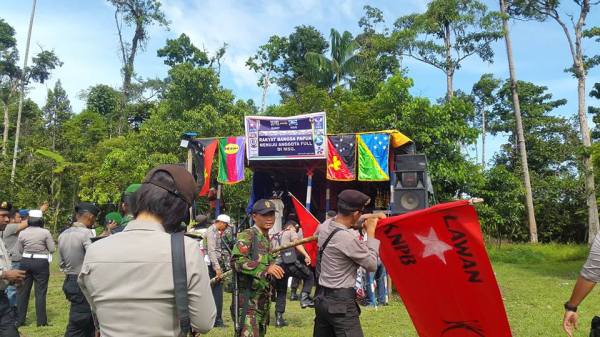
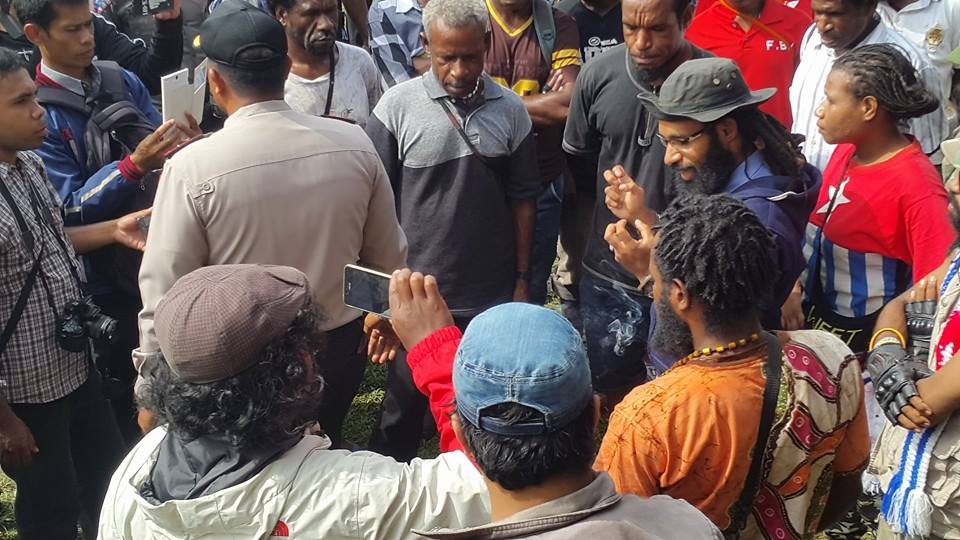
Steven Itlay,KNPB, being arrested in Timika by Indonesian Police, April 5, 2016 (photo WestPapuaMedia/local source)combined police and military, disbanding by force KNPB closing ceremony on April 5, 2016. (photo: KNPB/WestPapuaMedia local source)combined police and military, disbanding by force KNPB closing ceremony on April 5, 2016. (photo: KNPB/WestPapuaMedia local source)
However officers from the Mimika police, the Densus 88 unit, military
police (provost) and soldiers from the District Military Command used
armoured vehicles fitted with weapons. When they arrived at the site of
the event, all KNPB material was removed, including KNPB flags, flags
of supporting nations Fiji, Vanuatu, Kanaky, PNG and Solomon Islands,
and a banner which read “The Papuan People support ULMWP to progress to
full membership of the MSG”. However, the joint security forces
destroyed the stage which the organisers had prepared. Police officers
and soldiers continued to attempt to break up the prayer meeting, but
the people forbade them from stopping the religious service. The
community and KNPB still wanted to continue the event as planned.
When asked, Timika KNPB chair Steven Itlay said “we are still going to
continue with our prayers for the Papuan people as we had planned. The
prayer meeting was going well, but halfway through, the joint police and
military forces showed up to break up the event and commit acts of
violence against the assembled Papuan people and the KNPB.”
The chief of police from Mimika Police headquarters ordered his staff to
break up the prayer meeting and then arrest the chair of the Timika
KNPB. Steven Itlay and eight other KNPB members were arrested, kicked
and struck with rifle butts, and shots were fired. Afterwards the police
firmly prohibited anyone from taking pictures or video, even
confiscating mobile phones. All army-style clothes worn by KNPB security
were seized and brought to the Kuala Kencana police station. Many local
residents and KNPB members were arrested but their names cannot be
confirmed. This kind of approach brings shame on the authority of the
Indonesian state in the eyes of the international public and is part of
the continuing restriction of democratic space in West Papua.
Names of those arrested
The following are names of people arrested by the joint police and
military forces.
1. Mr. STEVEN ITLAY (Chair of KNPB Timika)
2. Mr. YANTO AWERKYON (Deputy Chair of KNPB Timika)
3. Mr. SEM UKAGO (Secretary of KNPB Timika)
4. Mr. SEPERIANUS EDOWAY (Chair of Yamewa Sector)
5. Mr. O.TINES TABUNI (Chair of Organising Committee)
6. Mr. YUDIMAN KOGOYA (KNPB member)
7. Mr. HUBERTUS DIMI (KNPB member)
8. Mr. NOAK DIMI (KNPB member)
9. Tn. YUNUS NAWIPA (KNPB member)
The community and KNPB believe that:
1. The Mimika Chief of Police must take responsibility for the brutal
treatment of the community and KNPB members, and show respect for our
democracy
2. Indonesia must be open to freedom of public expression for Papuan people
3. The international community should insist that Indonesia fully allows
free expression.
4. We indigenous Papuans are not just arrested and imprisoned, but also
shot dead, we are killed by weapons or by food and drink, and every day
indigenous Papuans are dying in the land of Papua.
5. We urge the UN, through its Committee on Decolonisation to take
action to save indigenous Papuans from Genocide!
By Neles Tebay VARIOUS mass media at home and abroad have covered the official opening of the office of the United Liberation Movement for West Papua (ULMWP) which took place on 15 February 2016 in…
Jayapura, Jubi – The United Liberation Movement for West Papua (ULMWP) was coy about Luhut Panjaitan’s plan to visit two Melanesian Spearhead Group country members, Fiji and Papua New Guinea.…
‘The Mahuzes’, a film about conflicts between indigenous people and agribusiness companies in Merauke, was released in Indonesian last year, and now it is available with English subtitles. It’s one of a series of documentaries produced as part of the ‘Ekspedisi Indonesia Biru’, a one-year road-trip on motorbikes by filmmakers Dandhy Laksono and Ucok Suparta, visiting diverse communities around the archipelago, often communities in struggle.
The Mahuzes follows one clan of Marind people in Muting village, where oil palm companies have started clearing land in the last few years on five massive plantations. The effects of these plantations are having a major impact – even the water from the Bian River has become undrinkable. The Mahuze clan is resisting – refusing to sell their land, erecting customary barriers to forbid the company from entering – but the company (PT Agriprima Persada Mulia) just pulls up their boundary markers. As well as these direct conflicts with the plantation companies, we see how they attempt to deal with the conflicts that inevitably arise when irresponsible companies show up with compensation money – there is an emotional peacemaking ceremony between the Marind and the neighbouring Mandodo people, but also anger in meetings that some elders in their own clan may have struck a secret deal with the company.
The Merauke Integrated Food and Energy Estate was originally launched as a massive industrial agriculture project in 2010, but it failed to reach the stated ambition in its original plan, and the cluster of oil palm plantations around Muting were some of the only developments that have actually started work in the last years. However, in May 2015 President Joko Widodo travelled to Merauke to relaunch the plan to convert over a million hectares of forest and savannah to mechanised rice production. The filmmakers also visit the site of the new rice development, revealing that once again the central government is ordering a mega project without due consideration of the local social and environmental conditions. One issue is the water – Irawan, who works for the water provider, explains that most of the water in the flat Kurik sub-district comes from rainfall. How could these conditions possibly support huge areas of irrigated rice-fields?
The Marind people’s staple food is sago, and sago palms grow abundantly in groves in the forest. As Darius Nerob explains in the film “If we plant rice, it’s 6 months before we can eat. But with sago, any day we need, we can just go and fell a tree… This tree can feed a family for half a year…. Even though the transmigrant program has existed for 33 years, Marind people have stuck with sago, they haven’t shifted to rice.”





 West Papua Media Alerts