Merauke District Council and Indigenous People’s Association take issue with military working on one-million hectare rice estate

From Tabloid Jubi

Translated by awasMIFEE

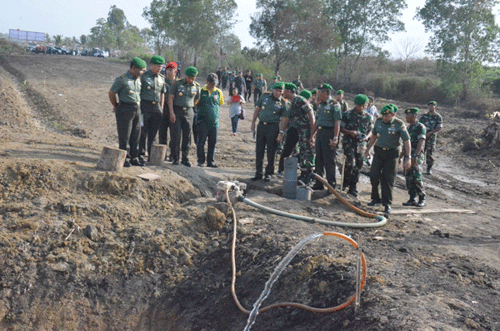
ProyeklahanA Member of Merauke Regency District Legislative Council, Hendrikus Hengky Ndiken, has expressed his complaints about the 1.2 million hectare rice estate recently announced by the Indonesian President Joko Widodo. He was disappointed by how land conversion work seemed to have been taken over by the military.

He said that local entrepreneurs who have joined the Gapensi umbrella organisation should be involved and given the opportunity to convert land for agriculture, in order to prevent the emergence of social inequality.

“I have to say sincerely, that steps taken by the military in converting agricultural land have infringed regulations. Because the Presidential Degree had signalled that an organisation had been formed to carry out the instructions,” he told Jubi on 6th November 2011.

Hengky added that he would support the military taking over land conversion if it was categorised as an emergency. “However this is currently not the case and space and opportunities should be given to entrepreneurs to do the work”, he said.

Separately, the head of the Merauke Regency Indigenous People’s Association (LMA), Ignasius Ndiken, said he also had problems with the military doing the work. “If the military does the work, that’s a problem. It would be better to pass the work over to local entrepreneurs,” he said.

“How is it possible that they have their land, but other people are doing the work? Who’s setting out the rules? The community have a claim to the land as customary landowners, but in fact they are not being given proper opportunities,” he said.

He added that although he feels local people should fully support the central government’s programme, indigenous Papuans seem not to be getting any direct benefit.

Source: Tabloid Jubi http://tabloidjubi.com/2015/11/06/program-sejuta-hektar-di-merauke-dprd-dan-lma-keberatan-tni-yang-kerja/

Photo: Bintang Papua http://bintangpapua.com/index.php/lain-lain/papua/papua-selatan/item/20843-pemilik-ulayat-tolak-400-ha-lahannya-dijadikan-sawah

Warinussy: Continued Brimob police Detention of Alexander Nekenem is Rights Violation

Statement by Yan Christian Warinussy, Executive Director of LP3BH

10 November 2015

Speaking on behalf of the LP3BH – Manokwari [Institute of Research,
Analysis and Development of Legal Aid] as well as the Co-ordinator of
the defence team of Alexander Nekenem and his colleagues, it is my
opinion that the Prosecutor, Syahrun SH from the Prosecutor’s Office
in Manokwari has violated the basic human rights of one of my clients.

A statement issued by the Court stated that the length of
detention of my clients should be prolonged for sixty days, from 30
September till 28 November 2015.

A copy of this decision was sent to the Director of the Prison in
Manokwari. But where should these extra days be spent, in which
prison?

Why is it that that Alexander Nekenem and his colleagues continue
to be held in custody at the Brimob Command Centre. Is this the prison
where Alexander Nekenem and his colleagues are to spend the rest of
their detention?

Furthermore, it is clear that the Prosecutor in this case has
violated the rights one of the colleagues of Alexander Nekemen. This
is all the more so in view of the fact that this colleague, Narko
Murib, was taken ill during a hearing in the case and should therefore
have been allowed to be absent from the Court and held in a custodial
cell at the State Prison in Manokwari.

The Chairman of the Panel of Judges instructed the Prosecutor to
take the afore-mentioned prisoner for examination and given whatever
medical treatment he required.

However, regrettably, the Prosecutor’s Office did not act to
ensure that Narko Murib was taken for a medical check-up. All that
happened was that his blood pressure was checked and he was given
some tablets to bring his temperature down.

As a result, Narko Murib was unable to attend the court hearing
on Tuesday, 10 November because he was still unwell.

Peace.

Yan Christian Warinussy is also the Recipient of the John Humphrey Freedom Award 2015 in Canada, Human Rights Defender in the Land of Papua, and
Member of the Steering Commission of Foker LSM for the Land of Papua.

Translated by Carmel Budiardjo, Recipient of the Right Livelihood Award, 1995.

Regent Urged to Protect Papuan Women Traders

Source: Regent Urged to Protect Papuan Women Traders

Jayapura, Jubi – The head of Community and Social Welfare of Secretariat Papua, Naftali Yogi, urged local governments to create regulations to protect Papuan women traders in improving their social economic conditions.

He said people’s welfare indicators are education, health, infrastructure and economic empowerment.

Especially populist economic empowerment for Papuan women traders, Governor Lukas Enembe already made the policy by building a market and providing them the opportunity to do business.
“It will become a model. The regents also need to follow up on the governor’s policy, because the approach is the development of a cultural approach, “he stated last week.

According to him, most of them work hard to fulfill the needs including education.
“There should be a concern of the government. The governor has started, the regents also have to do the same. Moreover, now 80 percent of special autonomy funds in the regencies / city. Only 20 percent in the province. All the funds have been distributed to regencies/city,” he said.

He said, there needs to be a serious concern of the government to empower those women, This is important, especially to decision-makers in the regencies/city.

The chairman of the MRP, Timothy Murib said, there needs to be a new regulation for the improvement of people’s economy particularly for Papuan women. Regulation over the years, did not help much populist economic development in regencies / city.
“Regulation that is now to be changed. It is expected there are activities that favour the economic development of indigenous Papuans to be better, as economic actors in their respective areas,” said Murib.

He hoped that all commodities in Papua are developed and become a serious concern in the future. yet of course must be supported by regulation of populist economic development of native Papuans. (Arjuna Pademme)

HRW: Indonesia: End Access Restrictions to Papua

Press release

For Immediate Release
***To download video:
http://media.hrw.org/index.asp?ID=FJGNG〈=ENG&showEmbargoed=true

Indonesia: End Access Restrictions to Papua
Official Obstacles for Foreign Media and Monitors Defy Presidential Order

(Jakarta, November 11, 2015) – Indonesian authorities continue to restrict access by foreign journalists and rights monitors to Indonesia’s easternmost provinces of Papua, raising serious concerns about the government’s commitment to media freedom, Human Rights Watch said today in a new report. The restrictions defy a May 10, 2015 announcement by Indonesia’s President Joko Widodo – popularly known as Jokowi – that accredited foreign media would have unimpeded access to Papua.

“Government access restrictions have for far too long made Papua Indonesia’s ‘forbidden island’ for foreign media and rights monitors,” said Phelim Kine, deputy Asia director at Human Rights Watch. “Blocking media access on overbroad ‘security’ grounds deters foreign news reporting about Papua, raising troubling questions about what the Indonesian government might be trying to hide there.”

The 75-page report, “Something to Hide?: Indonesia’s Restrictions on Media Freedom and Rights Monitoring in Papua,” documents the government’s role in obstructing access to the provinces of Papua and West Papua (collectively referred to as “Papua”), including government backlash since Jokowi’s announcement.

The decades-old access restrictions on Papua are rooted in government suspicion of the motives of foreign nationals in a region still troubled by widespread corruption, environmental degradation, public dissatisfaction with Jakarta, and a small pro-independence insurgency.

Human Rights Watch interviewed 107 journalists, editors, publishers, and representatives of domestic and international nongovernmental organizations for the report. Foreign correspondents describe an opaque and unpredictable permit application process in which they often never received a final response. Many have waited fruitlessly for months – and in some cases years – for approval.

Jokowi’s May 10 announcement has faced strong resistance by some senior government and security forces officials, Human Rights Watch said. The government has also not followed that announcement with a specific written directive, which opened space for non-compliance by state agencies and security forces opposed to loosening restrictions on foreign observer access to Papua. Various senior officials have since publicly contradicted the president’s statement. Even the Ministry of Foreign Affairs, which has announced that it has “liquidated” the 18-agency “Clearing House” that previously was used to vet journalists, has confirmed that prior police permission is still required for foreign media access to Papua. The Ministry of Foreign Affairs is in some cases also continuing to ask some journalists seeking to travel to Papua to provide, in advance, details of their likely sources and dates of travel.

Foreign correspondents have reported mixed results from their efforts to take advantage of the announced loosening of Papua access restrictions. For instance, after Jokowi’s announcement, the Indonesian embassy in Bangkok processed and granted in just 15 days a Papua reporting visa for Cyril Payen, a Bangkok-based correspondent for France 24 television. The embassy also assured him that he was not obligated to have any check-ins with police or immigration officials while in Papua. “Whether I was lucky or not, I don’t know,” Payen said. “They really opened up.”

However, a Jakarta-based foreign correspondent showed Human Rights Watch a copy of correspondence with the Ministry of Foreign Affairs from July 2015 in which a ministry official listed both a surat jalan, or travel permit, from the National Police’s Security Intelligence Agency, as well as a “letter of notification” specifying the journalist’s “purpose, time and places of coverage in Papua,” as prerequisites for access to Papua.

Foreign journalists who ultimately are granted Papua access permits often face surveillance and harassment after arrival in Papua. Several said that they were required to have an official “minder” from the State Intelligence Agency (Badan Intelijen Negara, BIN) for the full duration of their visits, significantly limiting their ability to report on issues deemed sensitive.

“President Jokowi needs to bridge the gap between rhetoric and reality by putting the guarantee of unimpeded foreign media access to Papua in writing,” Kine said. “He should make it clear to government officials and security forces alike that obstructing journalists is unacceptable in Papua and anywhere else in Indonesia.”

Indonesian journalists – particularly ethnic Papuans – are also vulnerable to restrictions on media freedom in Papua, Human Rights Watch said. Reporting on corruption and land grabs can be dangerous anywhere in Indonesia, but national and local journalists told Human Rights Watch that those dangers are magnified in Papua. In addition, journalists there face harassment, intimidation, and at times even violence from officials, members of the public, and pro-independence forces when they report on sensitive political topics and human rights abuses.

Journalists in Papua say they routinely self-censor to avoid reprisals for their reporting. That environment of fear and distrust is increased by the security forces’ longstanding and documented practice of paying some journalists to be informers and even deploying agents to work undercover in newsrooms as journalists. These practices are carried out both to minimize negative coverage and to encourage positive reporting about the political situation, and they generate distrust among journalists.

Representatives of international nongovernmental organizations, United Nations experts, and foreign academics have also faced official obstacles to visiting Papua. Since 2009, the International Committee for the Red Cross, the Dutch development organization Cordaid, and the Peace Brigades International have all limited or closed their Papua-based operations due to pressures from the Indonesian government.

In 2013, the Indonesian government blocked a proposed visit by Frank La Rue, then the UN special rapporteur on the promotion and protection of the right to freedom of opinion and expression. Diplomatic sources in Geneva told La Rue that the Indonesian government froze his requested visit due to his inclusion of Papua in his proposed itinerary. “[The Indonesian mission in Geneva] asked what areas I want to go to [and] I said Jakarta and bigger places like Bali, but for me, I said, it was very important to visit Aceh and Papua,” La Rue told Human Rights Watch. “They said ‘Great, we’ll get back to you.’ What it meant was that they postponed the dates and put the trip off indefinitely.”

“It’s clear from our research that removing access restrictions is not a silver bullet to resolve Papua’s deep-seated problems or dispel the suspicions of Indonesian officials toward foreign media and other observers,” Kine said. “But greater transparency and access are essential elements of a rights-respecting future for Papua to throw sunshine on abuses of power that for too long have remained hidden from view.”

For accounts from the report, please see below.

“Something to Hide?: Indonesia’s Restrictions on Media Freedom and Rights Monitoring in Papua” is available at:
https://www.hrw.org/node/283014

For more Human Rights Watch reporting on Indonesia, please visit:
http://www.hrw.org/asia/indonesia

For more information, please contact:
In Jakarta, Andreas Harsono (English, Indonesian): +62-815-950-9000 (mobile); or harsona@hrw.org
In Jakarta, Phelim Kine (English, Mandarin): +62-812 10877314 (mobile) or +1-212-810-0469 (US mobile); or kinep@hrw.org. Twitter: @PhelimKine
In San Francisco, Brad Adams (English): +1 347-463-3531 (mobile); or adamsb@hrw.org
In Sydney, Elaine Pearson (English): +61-400-505-186 (mobile); or pearsoe@hrw.org. Twitter: @pearsonelaine
In Washington, DC, John Sifton (English): +1-646-479-2499 (mobile); or siftonj@hrw.org. Twitter: @johnsifton

Accounts from “Something to Hide?”

Rohan Redheya, a Dutch freelance photojournalist who applied in The Hague for a journalist visa to Papua in July 2014, said that although the Indonesian embassy informed him that the approval process was “around two weeks,” the embassy never responded to his application. “I know many journalists who got ignored [by Indonesian visa issuance offices], and they simply never heard something again [after submitting a Papua access application].”

“The Clearing House system of consensus voting means any one person has veto power, which generally means that the opinion of the most paranoid person in the meeting carries the day. These restrictions fuel all manner of speculation about Papua: the notion that the Indonesian government has ‘something to hide’ finds purchase. But the Indonesian government finds itself in the illogical position where they hear of inflammatory reporting and this actually makes them impose restrictions, and then those restrictions prevent good journalists from writing of the complexities of the place.”
– Bobby Anderson, a social development specialist and researcher who worked in Papua from 2010 to 2015, describing the government’s “Clearing House” screening of foreign journalists seeking to report from Papua.

Marie Dhumieres, a French journalist, received a police permit to go to Papua in September 2015. A week later the police arrested and questioned three Papuan activists whom she interviewed. She published this tweet to President Jokowi, and the activists were soon released: “So Mr @jokowi, foreign journalists are free to work anywhere in Papua but the people we interview get arrested after we leave?”

“If you read all the news reports in all newspapers in Manokwari [in Papua], you will see that their sources are almost all, almost 100 percent, government officials. Their sources are always government officials, police officers, or military officers.”
– Agusta Bunay, a Papua Barat TV presenter, on self-censorship among journalists fearful of possible reprisals for independent reporting.

JUBI: Retired Police General Protects Illegal Mining Operation in Degeuwo

apologies for the delay in posting due to behind the scenes work.

by Victor Mambor and Abeth You from Tabloid Jubi, with additional reporting from West Papua Media

November 7, 2015

mining on the Degeuwo River (JUBI)
illegal gold mining on the Degeuwo River (JUBI)

Jayapura, Jubi – Paniai Regional Customary Council, John NR Gobai, said one of mining companies operated along the Degeuwo River, Paniai Regency, namely PT. Madinah Qurrata’ain, has appointed retired Police Inspector General RT as its chief executive.

The local people found out about it after a report said a police general who had been allowing the company to continue its operation employed a number of Mobile Brigade personnel of Papua Police.

“In Degeuwo, a retired police officer, a former Inspector General has been appointed, even whilst he was known for involvement with human rights issues. In our records, he held many important positions in the Indonesian Police Headquarters, including as the Coordinator of the Social Economy Experts of the former Indonesian Police Chief, General (retired) Sutarman in 2013,” Gobai told Jubi on Sunday (25/10/2015).

For that reason, Gobai asked the Papua Police Chief Inspector General Paulus Waterpauw to immediately withdraw the Mobile Brigade personnel that guard around the illegal mining area located in the customary territory of three tribes, Wolani, Mee and Moni. “The specific Police officers and Mobile Brigade personnel (involved at the mone) were actors behind the 2012 shooting incident of Melianus Kegepe, Mathias Tenouye and Selpius Kegepe. The bullets (that killed the teenagers) belong to Brimob,” he said.

The case referred to by Gobai was the May 15, 2012 incident when a small fight between teenagers at a allegedly Brimob-run illegal gambling ring at the mining camp in Degeuwo, was escalated by Brimob officers abused, then beat and shot the teenagers. Although the perpetrators were identified amid widespread calls for their arrest, they enjoyed complete impunity and continued to guard and moonlight at the gold diggings site on the Degeuwo River.

The gold diggings along the Derero and Degeuwo River catchments in the Paniai have long been flashpoints for major human rights abuses. Deeply entangled relationships between colonised indigenous people in Paniai and Occupation security forces have caused much conflict superficially assessed as horizontal between miners and migrants, however the conflict is vertically managed by local battalions of Brimob and Battalion 753 of the Indonesian Army. Each of the entanglements created major civilian displacement, with brutal human rights abuses culminating in major sweeps against civilians and/or non violent human rights defenders, and the wholesale destruction of villages. Each December a massive joint force of Brimob and the Indonesian army embark on a major anti-separatist military operation to bring in the remaining members of Jhon Yogi’s pro-independence West Papua National Liberation Army fighters, which never happens, but vast swathes of territory that conveniently are listed as mining concessions are seized by Brimob police and military.

Brimob also is closely involved in the area with an Australian company called Paniai Gold, and its subsidiary Derero River Gold, based in Melbourne and closely tied with global conglomerate West Wits Mining Limited..  During Operation Adil Matoa n 2011 and the follow up major offensive in December 2013 (Known locally as “the killing season”),  Survey and Exploration helicopters on lease to DRG were used by the same Brimob personnel to conduct ad-hoc bombing and incendiary raids on numerous Papuan villages.

Both Paniai Gold and its local partners have long given into Brimob demands for protection money and logisitcal support, and PT Madinah operates alongside the DRG digging and facilites.

John Gobai further said that Papuan entrepreneurs and traders would be ready to lead and work with the Papuan-run gold companies, such as PT. Salomo Mining. However PT. Madinah contributes much less to the local government and indigenous people, in providing any economic benefit.

“A good resolution for Degeuwo is that the Paniai Local Government coordinates with the Papua Provincial Government to determine the People’s Mining Area as proposed many times previously. ago. The Papuan Governor has approved that WPR (Wilayah Pertambangan Rakyat or People’s mining area) could accommodate the entire group as well as to assure all interest. Then, the People Mining Permit (IPR) would be issued on behalf of the land tenure owner to ensure the indigenous people to become the landowner or permit holder. So the mining workers work under the supervision of indigenous people and LPMA SWAMEMO would become their coach,” he said.

The Chairman of LPMA SWAMEMO (Walane, Mee and Moni Community Development Institution), Thobias Bagubau said LPMA had surveyed the aspirations of people living surrounding the illegal mining area along the Degeuwo River, Paniai Regency. The socialisation to collect the people’s aspiration was held on 21 – 30 September 2015 in the illegal mining areas, from block 45, 81, 99, Baya Biru to Gunung Botak.

“At that time we held a meeting with the indigenous people, involving the tribes of Wolani, Mee and Moni and other (migrant) tribes such as Dani, Sengir Talaud, Buton and Makassa, to listen their testimonies,” Thobias Bagubai told Jubi in Abepura on Thursday (22/10/2015). On that occasion, Bagubau said, he revealed his vision and mission in order to maintain or protect the environment, community and to reduce the conflict in there.

Create a website or blog at WordPress.com

Up ↑
