Breaking News: Mayora and Astra Offices Occupied in Merauke

From AwasMIFEE
August 12, 2013

anakwoboyu

Around 100 people from the SSUMAWOMA Malind Woyu Maklew Intellectual Forum are currently occupying PT Mayora and PT Astra’s company offices on Jalan Ternate, Merauke City.

The occupation started at 11.00 local time, involving youth and community members from the Malind Muli Woyu Maklew sub-ethnic group, from villages such as Wamal, Dokib, Wambi, Dodalim and Kimam.

Their demand is that the two companies stop their operations and drop their investment plans for sugar-cane plantations in Okaba, Ngguti, Tubang and Ilwayab. At the time of writing, two hours after the action started, the companies had yet to respond to the people’s demands. The action was being guarded by dozens of local police.

Recently it was reported that the companies had used Brimob military police and the accusation of separatism to force people in affected villages to accept an agreement with the company.

After villagers in Yowid village reported that they had been intimidated into signing PT Mayora’s document, the SSUMAWOMA forum recorded video testimony of the elders who had been forced to sign (which can be watched here: https://awasmifee.potager.org/?p=472 ).

Then yesterday ( Sunday 11/8) the SSUMAWOMA forum organised a meeting and press conference in the Payum beach area of Merauke city. As tabloidjubi.com reported the discussion, there was heated argument between the people attending, but in the end all present were agreed on the need to oppose the two companies.
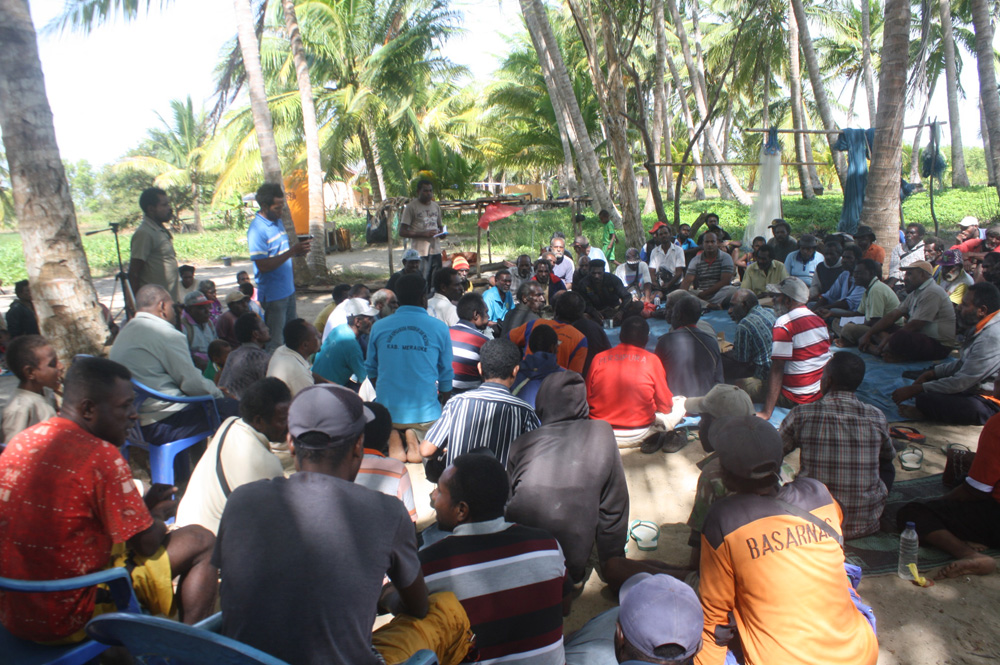
Masyarakat-Wambi-Distrik-Okaba-sedang-pertemuan-bersama

Aside from the intimidation experienced in Yowid, the discussion focussed on some of the other impacts that villagers are already experiencing as companies engage in the first phase of their plans, to survey the land and open negotiations with indigenous landowners. From Tabloid Jubi’s report:

A well-known Marind intellectual, Leonardus Moyuend, explained how villagers in the area were already feeling the pressure and can no longer sleep well. They also cannot go about their everyday activities as before, knowing about the companies’ plans to start operations around their villages. “To be honest, when the companies move in, it totally destroys the arrangement between one village and its neighbours,” he explained.

The problem, Leonardus continued, was that each village would make different claims about the boundaries of their land. “We never ad clear information from the government about this major program. If there is really a desire for companies to operate here, then all concerned parties such as the District Legislative Council, indigenous leaders from each village and other stakeholders should sit down with the government and investors and start discussions again from the beginning”, he said.

Instead what has been happening, he said, is that companies move in to the different villages on the quiet and then tell some of the people there that they are going to invest. “This is a really bad method the companies are using. It is the reason we have a strong commitment to resist the various areas of work they are focussing on”, he said.

He added that village elders had already given a mandate to local intellectuals to speak out and make interventions to oppose investment activities in their villages “We will never stay passive in the face of the companies’ efforts” he stated.

Meanwhile, an indigenous leader from kampung Wambi, Wilhelmus Bole Kaize said that he had already held meetings together with local indigenous people around ten times. The outcome was always that the people of that village opposed investment. The reason was because it would destroy the natural environment the people had taken care of through the years.

According to him, the area around Kampung Wambi should be used for tourism and culture. The outlook could be promising. In that way, there would be no more possibilities for corporate investors to move in. “We are completely agreed to resist the investors,” he said.

Three years after the MIFEE megaproject was launched, opening up Merauke Regency to plantation companies, initiatives by local people to organise to resist the companies appear to be on the increase. While the SSUMAWOMA forum is mostly concerned with the western part of the MIFEE area, a week ago on August 3rd another meeting brought together villagers from all over the central area of Merauke Regency. In that area companies such as Medco, Rajawali and Wilmar are operating and land is also being taken over for agriculture by transmigrants. That meeting also demanded that the government withdraw the permits for companies that are destroying the forest.

Johanes Mahuze, from Tanah Tinggi explained the predicament: “Real Marind people live with the land and the forest and wildlife are kept safe. We sit, we stand and we live from the land. We carry out our traditional rituals from the land and the forest, and the animals provide our food. If the land, forest and animals are all gone and we no longer own them, then the Marind Anim people are wiped out and become Plastic Marind, having to buy what we need for our traditions from the shops. We don’t want to become Plastic Marind”.

We will try to provide information on the outcome of the occupation action when we receive it.

Sources: Jubi http://tabloidjubi.com/2013/08/11/investor-bawa-konflik-bagi-masyarakat-di-kampung-kampung/#

Pusaka pusaka.or.id/musyawarah-waendu-meminta-pemerintah-menghentikan-izin-pemberian-lahan-untuk-perusahaan/

Action report received via email.


Women traders losing out in Papua

Tabloid JUBI
 
August 6, 2013
 
Jayapura: Papuan indigenous traders are very worried about the fact that they are not able to compete economically because of the arrival in Papua of immigrants  who are ‘taking over’ the trade in many simple commodities which has for a long time been where Papuan women  (mama-mama) are conducting their business activities.

‘If nothing is done about this, we can be sure that within the next ten years, the mama-mama will not be able to compete in the markets. Many shopping malls, shops, agricultural product businesses, self-service shops and hypermarkets  will be selling these commodities, with the help of lorries  which are transporting the commodities  everywhere, even along alleyways,’ said Robert Jitman, an activist in SOLPAP (Indigenous Papuan Traders Solidarity).

He said that he was seeking the help of the MRP (Majelis Rakyat Papua) to play a more active role with regard to building markets for the mama-mama to ensure that they can carry out their business activities.  He also said that he was seeking support from the MRP with regard to what happened to some mama-mama who were recently evicted from Jalan Irian.

Robert Jitman  stressed the importance of these markets in ensuring a self-supporting economy and said it is necessary for the government to take action as quickly as possible. He said that he wrote last month to the Governor of Papua, Lukas Enembe, to seek information about the fact that a permanent market  where the mama-mama can trade has not yet been built in one of the main roads in Papua, Jalan Percetakan Negara.

SOLPAP is also seeking an audit from the BPK (?) with regard to the allocation of funds for building the market for the mama-mama, which was allocated as long ago as 2009. He was also seeking to ensure the inclusion in SOLPAP of church leaders, NGOs, students and the press (Alliance of Independent Journalists).

The letter to Governor Enembe also suggested that there should be a special regional regulation (perdasus)  to protect and assist the mama-mama in conducting their trade in certain commodities and also suggested that a team be set up to ensure that the special market for the mama-mama is built.

[Translated by TAPOL}


Mayora’s Latest Trick: Threatened with OPM stigma, Village Leaders Intimidated into Signing Document

by AwasMIFEE

August 7, 2013

Kampung Yowid, like other villages in Tubang and Ilwayab districts, has taken a determined and united stance against plantation companies, which have recently been moving in to the area. But now indigenous leaders in Kampung Yowid have been intimidated into signing a document from PT Mayora, one of Indonesia’s leading food brands, which is trying to take over their land for a sugar cane plantation. The people were accused of being OPM separatists by the police mobile brigade members the company employs as guards, who also accused them of storing weapons in their indigenous meeting house (adat house). Knowing that villagers were scared and thinking they might have to run to the forest, some community leaders felt they had no option but to sign the document. The contents of the document are unknown – villagers were never given a copy. Now, as before, the community states its clear opposition to Mayora’s plantation plan.

Merauke, like the rest of West Papua, is a militarized zone bearing the scars of fifty years of conflict. Now, as plantation companies continue to push their way in, it is not the first time that companies have been accused of using the ‘separatist’ stigma as a way to threaten indigenous people to give up their ancestral land.  The people are quite reasonably afraid – they know that  elsewhere security forces have unleashed violent repression countless times after labelling people as separatists.

This kind of link between military might and corporate ambition also has a clear parallel in Suharto’s New Order regime: plantation companies seized huge swathes of peasant farmers’ land in Sumatra in the 1970s and 1980s, threatening to kill people as communists if they resisted. Many communities are still trying to reclaim this land through land occupations and other forms of resistance.

The elders of Kampung Yowid who were forced to sign have now testified on video of how they were the victims of Mayora’s manipulation. Below, the Woyu Maklew sub-ethnic group Intellectual Forum and JPIC-MSC have also provided further background information on what happened.

(ends)

Video: Statement from the Woyu Maklew Sub-ethnic group Intellectual Forum (subtitled video available at https://awasmifee.potager.org/?p=472%5D

Merauke, Friday (2 August 2013), the Woyu Maklew Sub-ethnic group Intellectual Forum wishes to make clear that PT Mayora has violated the rights of the Marind Woyu Maklew indigenous people. The traditional (adat) chief and village head were forced to sign a document which PT Mayora presented to them, after the village was threatened with the stigma of being considered OPM members. A few villagers which supported the company were used to terrorise the others into accepting PT Mayora’s
prescence in Yowid, Dokib, Wamal, Bibikem, Woboyu, Wanam and Dodalim villages.

According to Ambrosius Laku Kaize, Kampung Yowid’s adat chief, he was forced to sign after pressure from PT Mayora’s staff. “I was forced to sign, because the villagers of Kampung Yowid had been accused of being OPM members”, he said. Mr Kaize went on to explain how he, the administrative village head and the head of the Geb-Zami clan had all been similarly intimidated after PT Mayora made clear that the people of Kampung Yowid would be considered OPM if they didn’t sign the company’s letter.

The Woyu Maklew Sub-ethnic group Intellectual Forum’s monitoring has revealed that Marind people in the affected villages ( Yowid, Dokib, Wamal, Dodalim, Woboyu, Bibikem, Wanam and Uliuli) have not received reliable and truthful information about any policy for investment on their ancestral lands in general, and about PT Mayora’s presence in particular. This is an indication that the investment process is already violating the Marind indigenous people’s right to receive information without compulsion and before investment activities commence. Aside from that, Marind people from the Woyu Maklew sub-ethnic group have already made clear that they oppose all investment on their ancestral land, because they do not have the skills required to get work with companies.

PT Mayora has already brought insecurity into the lives of local people, by going around villages in the area escorted by fully-armed Brimob from Merauke Police Station, and now by inciting individuals from the villages, the company has also created an unsafe situation by sowing fear.
Further Background Information

On 21st May 2013, PT Mayora and PT Astra’s management met with Marind customary landowners in the Swiss-Bel Hotel on Jalan Raya Mandala in Merauke city. In this meeting, the people, through the Woyu Maklew Sub-ethnic group Intellectual Forum, expressed their opposition to the two companies. The reasons for this can be read in the forum’s letter here: https://awasmifee.potager.org/?p=352

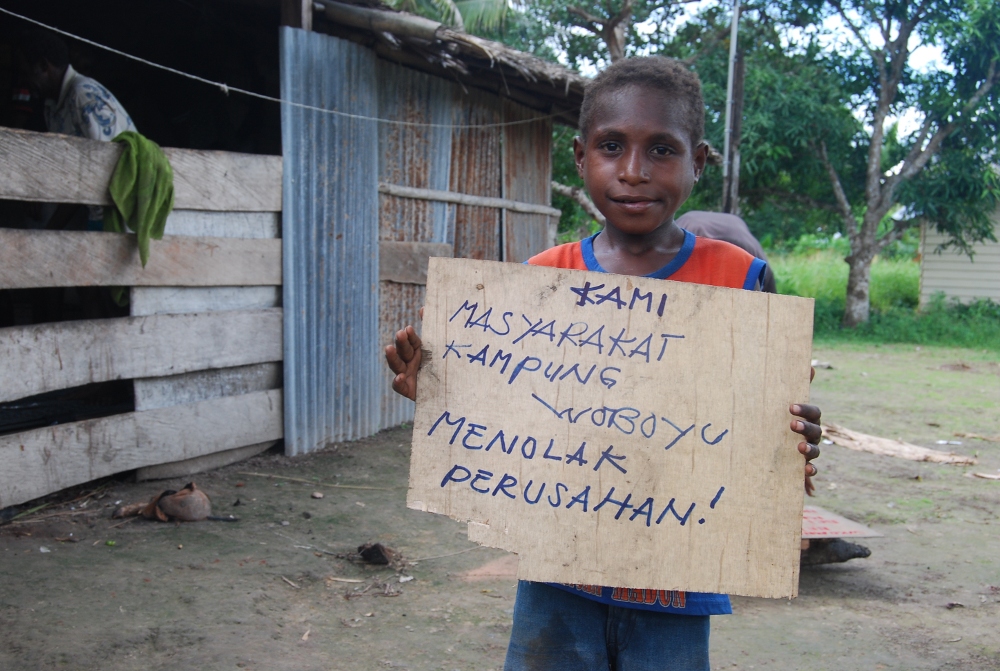
Villagers from Woboyu, Bibikem, Dadalim, Yowid, Wambi, Wanam, Wamal and Dokib villages have all made their opinion clear. In March and April this year each village has erected markers as a way to use customary law to prohibit the companies’ presence, also putting up signs with messages like “Oppose the  companies, because we don’t have much land, and because we want to defend the Marind culture and our children and grandchildren’s future”.

While most of the people have maintained their strong stance against Mayora and Astra, two villagers from Yowid who had been won over by the company, together with one of PT Mayora’s Brimob guards and the company’s staff, got hold of a leaflet about human rights in Papua. The leaflet had been put together by the Merauke branch of the West Papua National Committee (KNPB) and was a summary of news from the mass media about the human rights situation. The deputy adat chief admitted that it was him who had distributed the leaflet so that people could read about the human rights situation. After all, they have the right to know.

However he was shocked to see how PT Mayora reacted towards the community after seeing this leaflet. As the adat chief explains in the video, PT Mayora started claiming that villagers were OPM separatists. The company also reportedly claimed that the adat house was used for storing weapons or OPM equipment.

During their monitoring from the last part of July to 4th August, JPIC MSC Indonesia and the Woyu Maklew Sub-ethnic group Intellectual Forum found that the people of Yowid had been severely frightened as a result of Mayora’s accusations that they were OPM separatists. There was a plan for the women and children to seek refuge in the forest. On 27th July, a meeting was held in the adat house (the local name is Sawiya) to discuss the fear they were living under. In that meeting village leaders told of how they had been forced to sign the document. Others didn’t sign, but their signatures were forged by the pro-Mayora villagers.

They never received a copy of the document they signed, and this made the community even more nervous. They were concerned that word would spread amongst neighbouring villages that they had given away their land to the company. All villages in the area had agreed some time ago that no-one should sell their land, and anyone who betrayed that agreement would be sure to face harsh repercussions.

On 27th July 2013, villagers wrote a letter to the Merauke Regency leader, Papuan Provincial Investment Board and Indonesian National Land Agency explaining that Kampung Yowid continues to oppose PT Mayora.

Photo shows the community in Yowid making their opposition to
plantations clear earlier this year (Photo: AwasMIFEE)

.

-Mayora’s brands include Kopiko coffee and sweets, Energen cereal drinks, Torabika coffee, Bengbeng chocolate wafers and Slai O’lai biscuits. They are mostly sold in Indonesia, but selected lines are exported to around 50 countries worldwide.

Whoever shot at an ambulance must be caught, says Baptist leader

Tabloid JUBI
August 5, 2013
The director of Baptist Voice Papua, Matius Murib, said that the shooting of an ambulance which killed a nurse and seriously wounded two other people in Puncak Jaya has compelled him to speak out.He was deeply concerned about this  incident because the victims were ordinary civilians who know nothing about what is going on. He said that it was up to the police to investigate this incident and bring the perpetrators to justice so that we know who it was who was behind the incident.’I have raised this matter with the chief of police because the victims were civilians and not members of the security forces which means that the police must  investigate the incident and arrest those responsible.

‘What we must remember,’ he said, ‘is that the state of Indonesia is based on the rule of law.

‘The three victims of this incident were all civilians, not members of the security forces. ‘

He said that he had reported the incident to the chief of police who promised to look into the incident.

‘Even in a time of war, there are regulations that have to be complied with. Medical personnel, children, mothers and civil society  must be properly protected. There can be no justification for killing civilians.’

He pointed out that all the victims were medical personnel and are not members of the armed security forces. ‘It is absolutely clear that unarmed people  must not be targets for a firearms attack.Firearms should only be used against people who are armed.’

The name of the person who was killed is Herry Yoman, 32 years old.

Giving a detailed account of what happened, a police spokeman said  that at 11.20am, three people arrived at the Intensive Care Department of Mulia Hospital  and asked for an ambulance and medical personnel to collect the person who had been seriously injured in the District of Tingginambut.

‘As they were on their way back, passing through the Urgele Kampung, just 100 metres from an army post in Puncak Senyum, the ambulance was shot at by unidentified persons, as a result of which three people  were hit.

The police officer said that one person, Herry Yoman, a Dani, died after being shot in the jaw with some teeth torn out.

The other two people both of whom were Dani, were wounded in their arms.

[Translated by TAPOL]

Papuan politician criticises the security forces for failing to solve shooting incidents

Bintang Papua
 
August 3, 2013

Jayapura: While on the one hand, the human rights activist in Papua, Mathias Murib has urged the police chief in Papua, Drs Tito Karnavian, to investigate the shooting of three medical personnel who work at the Mulia General Hospital, a member of Commission A of the DPRP (provisional assembly) for Politics, Law and Human Rights has said that the intelligence activities of TNI/Polri (Indonesian Army and Police) in Papua are far from satisfactory. Every time a shooting incident occurs, all they say is that that it was perpetrated by ‘unknown persons’.

“There are large numbers of troops and intelligence agents spread all over Papua but they have achieved nothing. Moreover, a vast amount of money has been allocated to the security forces.”

These remarks were made by the chairman of DPRP’s Commission A for Politics, Law ad Human Rights, Ruben Magay S.I.P, speaking at the office of the DPRP in Jayapura.

According to Magay, who is  a member of Partai Demokrat, the activities of the TNI and Polri are highly questionable.

‘They always say that ‘unknown persons’ (OTK) are responsible and do nothing to give victims  a sense of justice.

There have been many shooting incidents against civilians, the most recent being the shooting of three medical personnel who work at the General Hospital whose names are Heri Yoman, 27 years old, who is reported to have died, as well as two nurses, Darson Wonda, 27 and Fritz Baransano, 42. both of whom were seriously wounded.when the ambulance in which they were taking a patient to the hospital was shot at by an armed gang in the District of Puncak Senyum, District of Tinggnambut on Wednesday, 31 July.

He said that incidents like this must be investigated by the intelligence forces and not simply blamed on ‘unidentified people’.

[Translated by TAPOL]


Create a website or blog at WordPress.com

Up ↑
