Concerns of JPIC in Papua regarding the situation in Papua

(Reflections on the situation in 2011)

From 13 to 16 February 2012, the secretariats of the Justice, Peace and Integrity of Creation (JPIC) in Papua (Franciscans JPIC in Papua, JPIC Archdiocese of Merauke, JPIC Agats Diocese, JPIC of Timika Diocese and JPIC of Sorong Diocese) held an annual meeting in Sentani. The outcome of this meeting is summed up in the following reflections on the situation in Papua with some recommendations.

The secretariats of JPICs in Papua confirm that the pro-investment policy of the Government of Indonesia and the torture and cruel treatment by the security forces have undermined law and the dignity of the indigenous Papuans, marginalising and threatening their right to life.

Situation in Papua in 2011

The indigenous Papuans have suffered from different investment policies of the Government in Papua. We found that the development policies on investment have caused the Papuans to lose their customary lands, identity, culture, livelihood, and they threaten the right to life. They have also become the source of horizontal conflict, as shown in the MIEFFE programme in Merauke, the palm oil plantation of PT. Merdeka Plantation Indonesia, PT. Merdeka Tapare Timber, PT Freeport Indonesia in Mimika, PT. Sawita Tandan Papua and PTPN 2 in Kerom.

The indigenous Papuans live in fear. The security forces use violence, torture, cruel and inhuman treatment against the Papuans which they justify with claims that their victims are supporters of the Free Papua Movement (Organisasi Papua Merdeka – OPM), as shown in the case of violence and torture against civilians during the 3rd Papuan Congress, the case of Tingginambut, the armed conflict in Puncak Jaya and Paniai and the conflict during the regional elections.

The indigenous Papuans are confused by the attitude of the Provincial Government which is not critical but rather tends to support the policy of the Central Government, as demonstrated in the case of the adoption of the policy on the Special Unit for the Acceleration of Development for Papua and West Papua (UP4B). This situation has put the future of the indigenous Papuans at risk. They are confronted with the difficulty to fight for their basic rights. The Papuan People’s Assembly (Majelis Rakyat Papua – MRP) and the Provincial Legislative Assembly of Papua (Dewan Perwakilan Rakyat Papua – DPRP) have been made powerless. MRP and DPRP only execute the orders of the Central Government and do not defend the interest of the Papuans.

The composition of the indigenous and non-indigenous Papuans is not in balance. The population census of the Indonesian Statistical Bureau (BPS) shows that the population of indigenous Papuans in the Provinces of Papua and West Papua is 1.760.557 or 48.73% of the total population, while the non-indigenous population is 1.852.297 or 51.27% of the total population of 3.612.854. It shows that the indigenous Papuans are a minority group in their own land while four decades ago they were the majority (96.09%).

Recommendations:

1. The Government of Indonesia should stop all investment that harms the right to life and the livelihood of the Papuan and conduct an independent evaluation of the companies investing in Papua. The Government of Indonesia should foster community-based development policies.

2. The Indonesian Military and the Indonesian Police should resolve the problems in Papua without using violence and they should bring to justice all perpetrators of the conflict in the area of PT. Freeport Indonesia.

3. In dealing with political demonstrations in Papua, the Government of Indonesia and the Police/Military should respect the right to freedom of expression of the Papuan people.

4. The Papuan People’s Assembly and the Provincial Legislative Assembly of Papua should genuinely represent the aspirations of the Papuans especially in addressing the issues that are causing the Papuans to become a minority in their own land.

These are our reflections and recommendations based on our wish to improve the future of Papua and to respect the human rights of the indigenous Papuans.

Abepura, 16 February 2012

P. Emanuel Tenau, Pr (Director of JPIC Diocese of Sorong) Br. Edy M. Rosaryanto, OFM (Director of Franciscans JPIC Papua). Ms. Veronika Tri Kanem (Program Manager of JPIC Merauke Archdiocese) Fr. Saul Wanimbo, Pr (Director of JPIC Timika Diocese) Fr. Hendrik Hada, Pr (Director of Agats Diocese)

Forkorus: international community must acknowledge the political rights of the people of West Papua

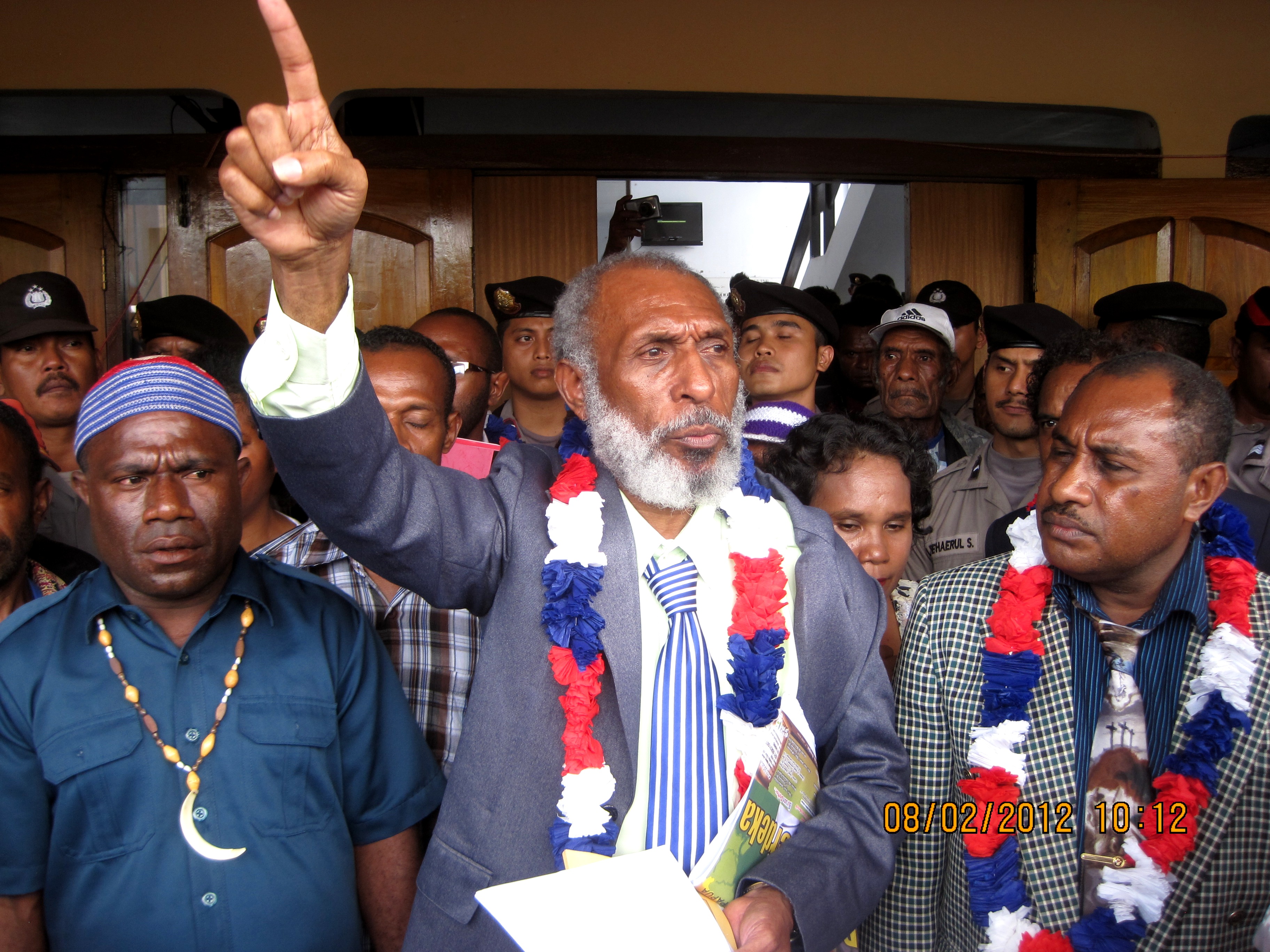
JUBI, 14 February 2011’The President of West Papua, Forkorus Yaboisembue has called on the international community which has raised the issue of basic human rights  to give evidence of its recognition of the political rights of the West Papuan people. If they fail to do this, he said, it means that the Papuan people are merely the colonial possession of a foreign power, while the world is only concerned with human rights, which, he said, is nonsense.

‘We call  upon the international community to discuss the issue of the right to self-determination, whereas this right of the Papuan people is being trampled underfoot. He was speaking after the court in Jayapura rejected the demurrer of the defendants submitted by the legal team of the Papuan defendants, Forkorus Yaboisembut, Edicon Waromi, Dominikus Surabut, Selpius Bobii and Agust Kraar.

Forkorus said that the international community has remained silent about the basic right of the Papuan people to self-determination, while it concerns itself only with the issue of human rights. The concept of human rights without any further evidence means that the international community is only toying with the problem, while there is plenty of evidence. Talking about human rights  while claiming that if these rights are recognised for all nations, this will be the way to safeguard peace in the world.’ This, he said, is utter nonsense.’

The international community, the USA, the European Union and the United Nations,never talk about the basic right of the Papuan people, who are campaigning all over the world and to other colonised people; this is is nothing more than empty talk.

Forkorus said that the world must give real proof of the concept of human rights by taking into account the importance of the political rights of the people of West Papua. The international community must prove its commitment to human rights because the Papuan people are bound by their right to speak out. This is an issue that lies deep in the hearts of all people including the people of West Papua. [The word used here is kesulungan the precise meaning of which escapes me, C Budiardjo]

‘When I say that I am a West Papuan, what then do you say? No one can force me to do anything. I have the absolute right to be a West Papuan.’

Edison Waromi who was standing beside Forkorus when he made this statement, said that the right of kesulungan [unchallengability ?] is recognised in the Bible to which the Papuan people are devoted. Quoting Verse 32, (8) of Deuteronomy in the Bible he said:  ‘It is God who determines the territory of all people’ which means that something determined by God cannot be challenged.’ The territory of West Papua  belongs to the people of West Papua.

When this was said, the crowd outside the courthouse cheered and applauded.

Unconfirmed reports of imminent major security crackdown in West Papua

West Papua flag

from West Papua Media sources in Jayapura

January 15th, 2012

Across West Papua, a series of remarkable and disturbing text messages has been circulating the claim that Indonesian security forces are preparing a major security assault across Papua in an operation that allegedly began on February 10.

West Papua Media has been unable to speak with any of the alleged participants in the meeting, nor any official representative of the organisations present, to verify these reports.  However local sources are reporting that security forces have intensified patrols and street presence in Jayapura at least  that would correspond to such an operation.

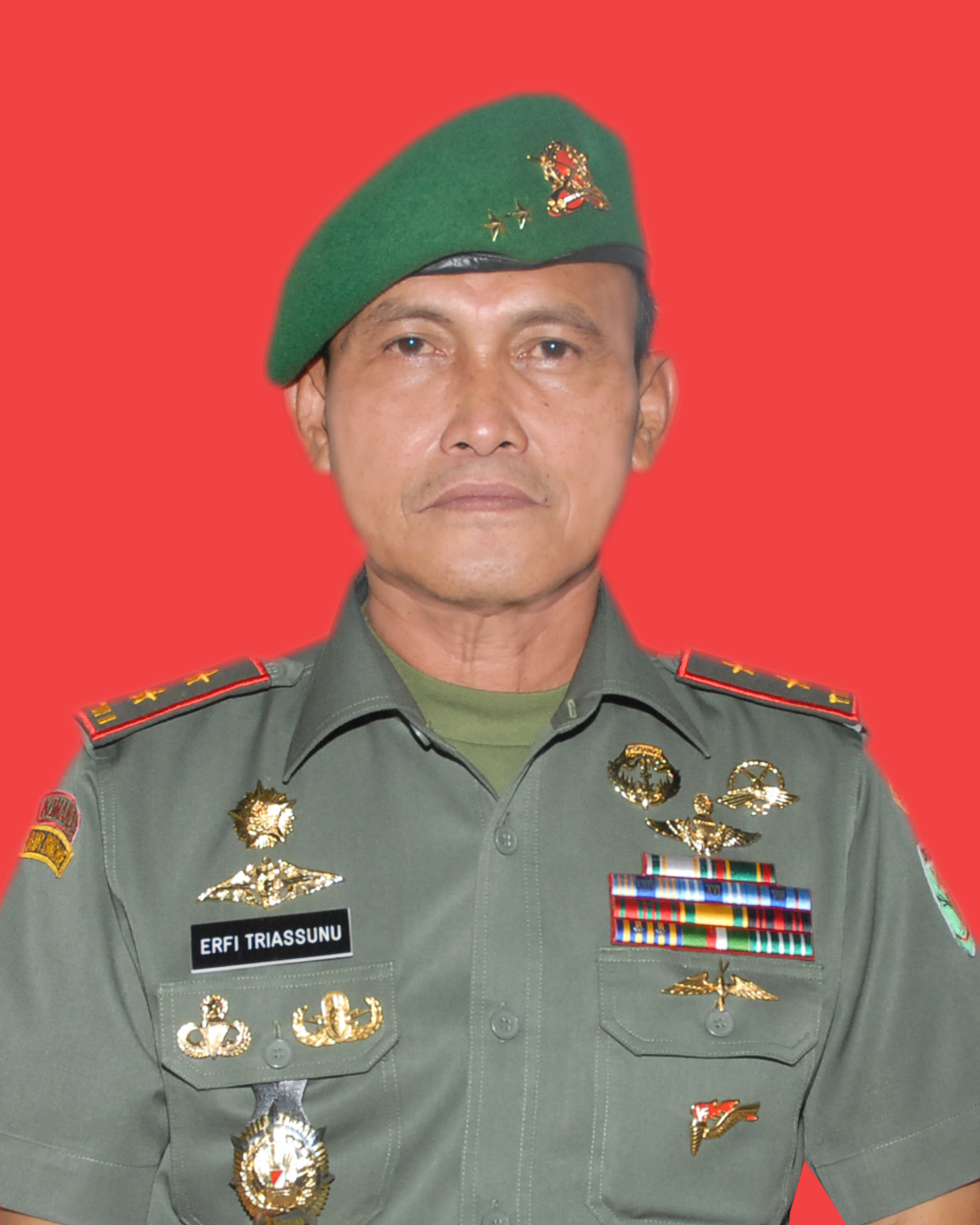
According to the messages a meeting was held at the Hotel Aston at 10am on February 9, between Polda Papua senior police officers.  Also at the meeting were the Papuan governor, the Commander of Cenderawasih Military District Erfi Triassunu, and officials from the Papua District Attorney, State Intelligence Body (BIN),  the army Strategic Intelligence Agency (BAIS), senior Kopassus officers, and leaders from Barisan Merah Putih – the main pro-Indonesia militia.  The meeting was  allegedly being held against the threat of disintegration of Indonesia  by separatist groups in Papua, according to the messages.

Erfi Triassunu - duplicitous

Participants allegedly raised the issue that “pro-merdeka” Papuan independence aspirations had been “globalized” and were attracting widespread international support especially after the brutal and heavy handed crackdown by Indonesian security forces on the Third Papuan People’s Congress on October 19, 2011, according to the source.

The  Memorandum assigned to officers present was to immediately raise “any safety risk to the smooth operation codes” – believed to indicate that security forces would be placed on high alert to prevent all expressions of self-determination.   It continued:

“The main focus is for the treason trial of Forkorus Yaboisembut and colleagues, who should not be given (political or public) space to defend themselves to their (Papuan) people and release pressure on the Makar defendants.  Any adverse condition in the control of the military from the Start Date (of) 10 February 2012 immediately increase security emergency.”

The messages then hinted darkly at the final conclusion of the meeting:  “Do not hesitate (in carrying out your duty if you have) to violate human rights for the sake of the sovereignty of Indonesia. ”

The text messages were said by local human rights sources to have come from a “very reliable source close to the military”.  It is not known at this stage if these text messages have been circulated deliberately by military intelligence as a possible tension building exercise.

West Papua has been subjected to many false SMS rumour “storms” in the past as sources believed by observers to be Indonesian intelligence officers have circulated false and inciting claims of imminent communal violence.  This includes a notorious case

Threats by SMS to human rights defenders and journalists are commonplace in Papua, widely believed to come from military sources.

Across Papua in recent weeks, SMS messages are also circulating claiming that “mysterious killings” are allegedly being perpetrated by Indonesian security forces against West Papuan civilians.  Reports have been circulating that a man allegedly from Yakuhimo, Puncak Jaya, was killed and his mutiliated body turned up in Sentani, and another allegedly was found in a marketplace in Abepura.  Additionally bodies have been reported as being found in similar circumstances in Timika and Wamena, but none of these reports have been able to be independently verified.

Westpapuamedia.

Treason Trials: Panel of judges reject demurrer by defendants

14 February 2012[Abridged in translation by TAPOL]

At the fourth hearing of the trial of Forkorus Yaboisembut and his colleagues which was held on 13 February, the panel of judges chaired by Jack Jacobus Octavianus SH announced that they could not accept the demurrer of the defendants which was submitted on  30 January, arguing that it was not in conformity with the law.

But the panel of judges failed to take into consideration the opening statement of the defendants which analysed the social, political and economic circumstances currently prevailing or the roots of the conflict in the Land of Papua at this time.

It was clear that the judges  only take into consideration  the thoughts and actions of the security forces such as the army, the police and the prosecutor and are only seeking those aspects of the law  which  restrict the right to freedom of expression of the majority of the Papuan people.

The defendants’ team of lawyers  went on to say that  the judges hearing the case are under pressure from forces outside the court of law as is clear from the fact that the head of the  Prosecutor’s Office along with the military commander of the Cenderawasih military command, the chief of police in  Papua and the prosecutor’s office  were approached prior to the hearing on 8 February and prior to the hearing held yesterday.

Our impression is, they said, that the powers that be in Indonesia  are very keenly following every aspect of the trial,  as is evident from the  extra tight security arrangements; the fact that access for the press to attend the trial  is very much restricted  while members of the public are not being allowed to enter the courtroom because it is packed with intelligence agents and members of various elements of the army and the police who are busy taking photographs and recording everything happening from very corner of the courtroom.

Forkorus, speaking on behalf of all the defendants, stood up and challenged the judges, saying that the judges will not be able to prevent him as the president of the NRFPB, the Federal Government of West Papua from reading out their rejection, a copy of which was then handed to the panel of judges

Responding to the statement of the defendants, Yan Christian Warinussy, a member of their legal team, said that the panel of judges should not at the forthcoming hearing try to restrict the defendants from expressing their views but should use those elements in the Criminal Code by simply noting the reports of the interrogations of the defendants (BAP).

The judges decision rejecting the defendants demurrer also called forth a strong statement from Yan Christian Warinussy who said that he did not agree with the viewpoint of the judges which only reflects the difference of opinion between the judges and the prosecutors and the legal team of the defendants, and he went on to say that it was wrong to say that their demurrer is not based on the law.

The team of lawyers also said that  the trial should be accessible to the international community and members of the diplomat corps in Jakarta so that they are able to follow developments in the trial.

The panel of judges then announced that the next hearing would take place on Friday, 17 February, when witnesses for the prosecution would be heard, most of whom are members of the police force which was involved in the attcks against the defendants and the mass of people, following the closure of the Papuan Peoples Conference (KRP III) on19 October last year.

From the trial of Forkorus and his colleagues

(From Tapol, and local sources in Jayapura)
Events surrounding the trial of

  • Forkorus Yaboisembut, President of the Federal Republic of West Papua,
  • Edison Waromi, SH, Prime Minister of the Federal Republic of West Papua,
  • Agustinus Kraar, human rights acctivist,
  • Dominikus Surabut, human rihts activist,
  • Selpius Bobii, human rights activist.

[This hearing was held to hear the response of the prosecutor’s team to the demurrer from the legal team of the defendants.

Friday, 10 February, 2012

The names of the twenty members of the legal team assisting the men on trial were listed.

At 6am, heavily armed members of the security forces took up their  positions in front of the Public Prosecutor’s office.

At 7am,  visitors and members of the legal team started arriving at the courthouse. Each visitor was required to register his/her name, while showing their identity card. Following this, each of the visitors was investigated.  Journalists and members of the legal team were also investigated. Some members of the legal team as well as some of the journalists attending the trial protested, but the protests were ignored and the investigations continued.

At 8.45am, Forkorus and his colleagues arrived. When the door of the truck in which they were travelling was  opened, security forces nearby approached the truck and pulled the doors.opne just like what happens when a bus stops. Seeing this, Forkorus and his colleagues protested and shouted: ‘You policemen, dont you dare touch us, dont approach us. Get back, all of you, right back. This country belongs to us,we are not criminals. Get back, the lot of you!’


The security forces paid no attention to this and continued to move closer to the truck, then started pulling down Forkorus and his colleagues from the truckLocal human rights activists, including Mama Josepha Alomang, started complaining to the security forces and called on the chief of police there to order his men to move away. As some of the police fell back, Forkorus and the others began to get down from the truck. As they were getting down, the visitors began to sing  hymns and to say prayers in front of the entrance to the courthouse.

The hearing of the trial began at 9am. The presiding judge asked the men whether they were in good health, but none of the five men made any response. The judge repeated his question three times, but the men still remained silent. On seeing this, the judge remained silent for a while, then asked the prosecutor to read out his response to the demurrer, in which he insisted that the charges against the men were in accord with Article 106 of the Indonesian Criminal Code, whereupon the chief prosecutor asked the judge to continue with the trial.  After this, the judge announced that the following hearing would take place on 14 February, to hear the reaction of the panel of judges to the demurrer.

Before the hearing drew to a close, Gustaf Kawar, a member of the legal team, protested against the investigations that had been undertaken by the police  of the persons attending the trial as visitors. He asked: ‘Is this an open trial or is it closed to the public? If it is an open trial, visitors should not be investigated and there should not be such heavy guarding round the courthouse.

The presiding judge said that this was in accorded with the proceedings required by the security forces, over which they have no control.

After the hearing closed, Forkorus and his colleagues  held a press conference  at which they protested against the charge of treason (makar) and protested against the heavy-handed guarding around the courthouse, the many arrests that continue to be made [in Papua], the many people in prison and the shooting incidents against  Papuan people.

As this was going on, some of those outside the courthouse unfurled banners saying PAPUA MERDEKA!. INDEPENDENT PAPUA!, shouted this slogan and handed out copies  of a press release. Many of those who were hoping to attend the hearing were unable to do so because it was raining very heavily.

Create a website or blog at WordPress.com

Up ↑