West Papuan independence advocates are questioning the UN Secretar
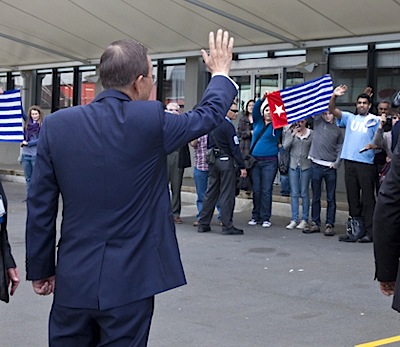
Ban Ki-moon waves to protestors for West Papua, PIF NZ Sept 2011
y-General’s presence—as a keynote speaker—at The Jakarta International Defence Dialogue, hosted by the Indonesian Ministry of Defence on 21 March 2012.
“We would like Mr Ban Ki-moon to attend to our defence while he’s in Jakarta” said Herman Wainggai, the West Papuan independence advocate based in the United States.
“The Indonesian government brands us as separatists, and then hosts international fora to escalate support for what it says are ‘non-war military operations’ against us”.
Forkorus Yaboisembut, President of the Federated Republic of West Papua, currently incarcerated, requests the Secretary-General to recognise the leadership of the Federated Republic of West Papua elected at the Congress in October in 2011.
“The United Nations recognizes West Papua’s right to self-determination, and is therefore responsible for organising properly constituted peace talks, with itself mediating between the Federated Republic of West Papua and the Indonesian government.”
Edison Waromi, Prime Minister of the Federated Republic of West Papua, also incarcerated last week for another three years (he was also a political prisoner 1989—1999, 2001, 2002, 2003-2004) says the Secretary-General must actively insert himself into the West Papuan issue.
“The 564,126 missing Papuans since 1962, more than half-a-million people, should galvanize UN intervention. And I believe the Secretary-General should also, while visiting Jakarta’s new Peacekeeping Centre this week, negotiate the release of all political prisoners in Indonesia.”
Many international observers believe that Indonesian political fears, that their republic will dissemble in the face of West Papuan self-determination, is misplaced.
“Holland didn’t fall over when Indonesia became independent, and neither will Indonesia when we do” said Wainggai. “Bali principles, Lombok treaties, Peace centres in West Java….these are all meaningless while Indonesia continues to escalate its troops and its judiciaries against us”.
Media Inquiries and Interviews
Please contact West Papua Media for direct contacts on the ground in the follwoing locations:
PUBLIC STATEMENT16 March 2012 Index: ASA 21/011/2012
Indonesia: Sentencing of Papuan activists a setback to free expression and assembly
Indonesian authorities must immediately and unconditionally release five men who have today been sentenced to three years’ imprisonment for taking part in a peaceful gathering in Papua province in October 2011. The court decision significantly erodes Indonesia’s respect for freedom of expression and peaceful assembly.
Forkorus Yaboisembut, Edison Waromi, August Sananay Kraar, Dominikus Sorabut, and Selpius Bobii were each sentenced to three years’ imprisonment by the Jayapura District Court. They were arrested on 19 October 2011 for participating in the Third Papuan People’s Congress, a peaceful gathering held in Abepura, Papua from 17-19 October 2011 and charged with “rebellion” under Article 106 of the Indonesian Criminal Code.
Amnesty International considers all five men to be prisoners of conscience. They join over 90 political activists in the provinces of Papua and Maluku who have been imprisoned solely for their peaceful political activities.
The rights to freedom of expression and peaceful assembly are guaranteed in Article 19 and Article 21 of the International Covenant on Civil and Political Rights (ICCPR), to which Indonesia is a state party, as well as in other international instruments. Moreover, these rights are protected under Indonesia’s Constitution. While the Indonesian government has the duty and the right to maintain public order, it must ensure that any restrictions to freedoms of expression and peaceful assembly are no more than is permitted under international human rights law.
Amnesty International has also received credible reports about threats and intimidation against the five and one their lawyers during their trial. Amnesty International expressed its concern about these reports in a letter sent to the Indonesian authorities in March 2012, pointing out that these allegations, if true, undermine the credibility of the judicial process in Indonesia, and specifically in the Papua region.
Amnesty is also concerned about the authorities’ lack of progress in investigating allegations of human rights violations committed by the security forces on the final day of the Congress. On 19 October police units supported by the military surrounded the venue and fired shots into the air to break up the gathering. As participants began to flee, police units from the Jayapura City police station and the Papua regional police headquarters arbitrarily arrested an estimated 300 hundred people and allegedly kicked and beat some of them. Most were released the following day. Three people were later found dead at the scene and over 90 people were reportedly injured. A National Human Rights Commission (Komnas HAM) investigation found evidence of human rights violations by the Indonesian security forces, including violations of the right to life, unnecessary and excessive use of force, and ill-treatment.
While 17 police officials subsequently received administrative sanctions for violating disciplinary procedures, these internal disciplinary hearings did not deal with the allegations of human rights violations that occurred.
Amnesty International calls on the Indonesian authorities to conduct an independent and impartial investigation into all allegations of human rights violations by the security forces during the Third Papuan People’s Congress. Should the allegations be verified, those responsible, including those with command responsibility, should be brought to justice in fair trials and the victims receive reparations.
Amnesty International takes no position whatsoever on the political status of any province of Indonesia, including calls for independence. However the organization believes that the right to freedom of expression includes the right to peacefully advocate referendums, independence or any other political solutions that do not involve incitement to discrimination, hostility or violence.
FORKORUS’ AND FOUR OTHERS’ SENTENCE VIOLATES HUMAN RIGHTS LAW
16 March 2012 – The Jayapura state court today found five Papuan leaders guilty of treason, sentencing them each to three years imprisonment. TAPOL, the Asian Human Rights Commission, the Faith-Based Network on West Papua, Franciscans International, and the West Papua Netzwerk seriously regret the verdict and question the fairness of the trial proceedings. The verdict is another example of the severe restrictions by the Indonesian authorities on the right to freedom of expression of the Papuans. We call upon Indonesian President Susilo Bambang Yudhoyono to order that all convictions which do not reflect international legal standards be overturned and the prisoners be immediately released.
Today’s verdict represents a setback in the relationship between Jakarta and Papua, suggesting that Indonesian authorities still see arrest and detention as the best ways to respond to expressions of Papuan aspirations. As a country widely applauded for its burgeoning democracy, Indonesia should be promoting peaceful political activity, not punishing it.
Forkorus Yaboisembut, Edison Waromi, Selpius Bobii, Dominikus Surabut and August Kraar were arrested in October 2011 for their roles in the Third Papuan People’s Congress, a peaceful gathering at which the leaders declared that Papua has been independent since 1961. As the gathering began to disperse, security forces fired shots into the crowd and carried out mass arrests and beatings. Three people were shot dead.
While the leaders of the Congress now face three years in jail for their peaceful actions, those responsible for the violent response to the Congress received a slap on the wrist, and investigations to determine who was responsible for the killings have led to neither justice nor accountability.
The five men were convicted of treason under Article 106 of the Indonesian Criminal Code. While the treason laws are intended to prosecute serious crimes against the state, alleged members of the armed resistance are rarely if ever brought to trial in Papuan courts; they are beaten, tortured or shot. Article 106 is instead used to charge those engaged in peaceful actions such as raising the Papuan national ‘Morning Star’ flag or organising and attending public events at which Papua rights and aspirations are asserted.
The denial made by the Coordinating Minister for Law and Human Rights of any political prisoners this month shows a lack of commitment to uphold human rights norms that are applicable to Indonesia according to international law, including that the peaceful expression of political opinions cannot be persecuted.
There are serious doubts about the fairness of the trial proceedings. Armed members of the security forces maintained a heavy presence during the trial sessions, and one of the senior lawyers for the defence, Gustav Kawer, is being threatened with prosecution, in violation of his right under Indonesian law and international standards to carry out his professional duties in defending clients in court. There have also been questions about the independence of the judges, who were reportedly visited by senior military, police and government officials just one hour before the trial began.
According to TAPOL’s data, the five men will join at least 27 other Papuan political prisoners currently in jail for treason under article 106. All those detained for peaceful political activities should be immediately and unconditionally released.
Recovering the State of West Papua, Sentenced to Three Years in Jail
by John Pakage for West Papua Media
Op-Ed
Forkorus Yoboisembut, Edison Gladius Waromi, Agustinus M. Sananay Kraar,
Selpius Bobii and Dominikus Sorabut were sentenced to three years in prison, Friday (16/3). They were charged with founding the independent state of West Papua.
However according to the accused, the Third Papuan Congress simply affirmed the Papuan independence that was in place before Indonesia entered Papua.
“The Congress merely renewed the independence of Papua that was previously in place before Indonesia came to Papua” stated Forkorus to Cermin Papua in Jayapura (16/3).
Therefore, according to Forkorus, it is Indonesia that should be accused of subversion, given how it used military force to enter Papua.
The public knows that the Third Congress took place with official Indonesian government permit, from both Jakarta and regional police, authorizing the holding of the Congress in Jayapura.
Even though this official permit was granted, Indonesian police and military still attacked and captured Congress participants that were present at the time, without first issuing any warrant as required by the law.
Before the conviction and sentencing, the Papuan Customary Council (Dewan Adat Papua) asked the government to liberate the five accused in accordance with the UN’s Human Rights regulation of 2007 which affirms the right to self-determination of indigenous nations, including the West Papuan nation.
Representing the accused, attorney Gustaf Kawer stated that since the Third Congress until today, Papua has yet to exit Indonesia, such that the Congress must be considered as an expression of the democratic right to free speech.
“Until now Papua is still part of the Unitary Republic of Indonesia; therefore though the accused are convicted of subversion, these accusations are unfounded” said Kawer.
Reacting to the three year prison sentencing, the accused rejected the decision and stated their intention to continue to seek justice.
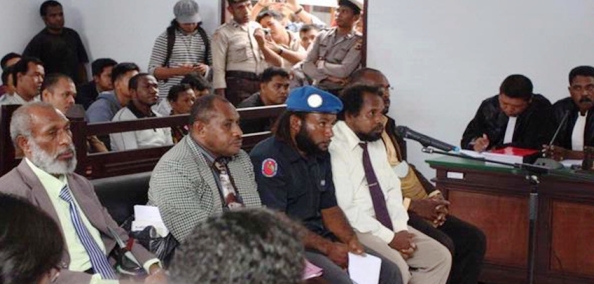
Papuan leaders accused of treason on trial in Jayapura, January 30, 2012
(Jayapura): Hundreds of security forces are on the streets around Jaypura, West Papua, in a show of force as an Indonesian court found five Congress leaders guilty of Makar (treason), and sentenced the defendants each to three years in prison.
The five defendants, Forkorus Yaboisembut, Edison Waromi, Selfius Bobii, Dominikus Sorabut, and Agus Kraar, were leaders and organisers of the Third Papuan People’s Congress held on October 19 2011, which was brutally broken up by Indonesian security forces after Forkorus – the Chairman of the Papuan Tribal Council elected as President of the Federated Republic of West Papua – unilaterally reaffirmed West Papua’s independence from Indonesia.
Today’s hearing at the Jayapura Class 1A District Court, the 15th hearing in a trial described by international observers of “descending into farce”, closed after the panel of judges led by Jack Johan Oktavianus declared that the defendants had committed treason under Article 106 of the Indonesian Criminal Code.
During the trial, several Indonesian Brimob paramilitary police officers who opened fire on the Congress gathering, admitted they had no proof that the accused had committed treason before they opened fire on unarmed civilians.
No member of the Indonesian security forces, who during the breakup of Congress were filmed committing acts of brutality and violence on unarmed civilians, were criminally charged and so far have not receive any sanction for the unprovoked attack.
On March 14, another defendant from the Third Papuan Peoples’, Gat Wenda, was also found guilty of makar charges, but was sentence to five months gaol, less time he has already served since his arrest.
Lawyers for the defendants, themselves under threat of prosecution and harassment by Indonesian security forces for their advocacy for the accused, have planned to appeal the decisions, saying “we think this decision is a disaster.”
In SMS messages sent from the legal team to West Papua Media, senior lawyer Olga Hamadi said “we think the judgement from the full bench is out of tune with what actually happened. We will appeal this to the High Court”.
Gustaf Kawer, another senior member of the legal team, also told West Papua Media via SMS that “the judges considered ambiguous and inconsistent testimony. (Yet) there is evidence of free expression and democracy that was ruled,” Kawar said, referring to the democratic rights and obligations adhered to by the Congress leaders.
A massive show of military hardware has caused major fear on the streets of Jayapura, with most poeple staying away from demonstrations for fear of an imminent military crackdown. 600 Heavily armed Brimob riot police and 300 Indonesian army soldiers are surrounding the streets around the court, backed up by several water cannon, 13 Barracuda armoured vehicles, and seven Army Panzers (assault vehicles).
Security forces today have, according to local civil resistance sources, used this show of force to actively prevent supporters of the accused to attend court.
The atmosphere has been described as highly tense with Papuan supporters of the convicted men outraged, but terrified, according to SMS messages from sources on the ground.
westpapuamedia
This is a developing situation – please stay tuned.