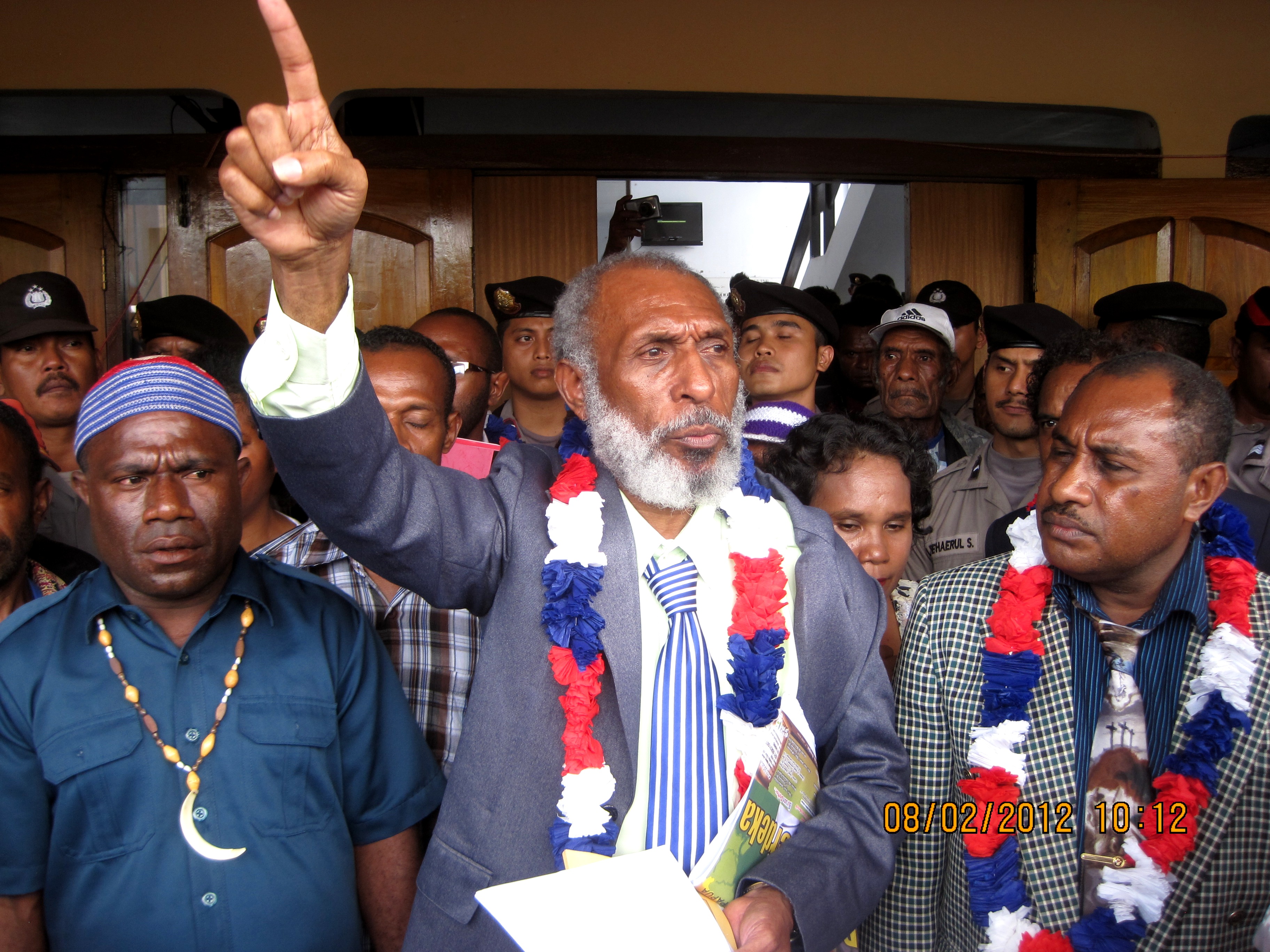
Treason Trials: Panel of judges reject demurrer by defendants

14 February 2012[Abridged in translation by TAPOL]

At the fourth hearing of the trial of Forkorus Yaboisembut and his colleagues which was held on 13 February, the panel of judges chaired by Jack Jacobus Octavianus SH announced that they could not accept the demurrer of the defendants which was submitted on  30 January, arguing that it was not in conformity with the law.

But the panel of judges failed to take into consideration the opening statement of the defendants which analysed the social, political and economic circumstances currently prevailing or the roots of the conflict in the Land of Papua at this time.

It was clear that the judges  only take into consideration  the thoughts and actions of the security forces such as the army, the police and the prosecutor and are only seeking those aspects of the law  which  restrict the right to freedom of expression of the majority of the Papuan people.

The defendants’ team of lawyers  went on to say that  the judges hearing the case are under pressure from forces outside the court of law as is clear from the fact that the head of the  Prosecutor’s Office along with the military commander of the Cenderawasih military command, the chief of police in  Papua and the prosecutor’s office  were approached prior to the hearing on 8 February and prior to the hearing held yesterday.

Our impression is, they said, that the powers that be in Indonesia  are very keenly following every aspect of the trial,  as is evident from the  extra tight security arrangements; the fact that access for the press to attend the trial  is very much restricted  while members of the public are not being allowed to enter the courtroom because it is packed with intelligence agents and members of various elements of the army and the police who are busy taking photographs and recording everything happening from very corner of the courtroom.

Forkorus, speaking on behalf of all the defendants, stood up and challenged the judges, saying that the judges will not be able to prevent him as the president of the NRFPB, the Federal Government of West Papua from reading out their rejection, a copy of which was then handed to the panel of judges

Responding to the statement of the defendants, Yan Christian Warinussy, a member of their legal team, said that the panel of judges should not at the forthcoming hearing try to restrict the defendants from expressing their views but should use those elements in the Criminal Code by simply noting the reports of the interrogations of the defendants (BAP).

The judges decision rejecting the defendants demurrer also called forth a strong statement from Yan Christian Warinussy who said that he did not agree with the viewpoint of the judges which only reflects the difference of opinion between the judges and the prosecutors and the legal team of the defendants, and he went on to say that it was wrong to say that their demurrer is not based on the law.

The team of lawyers also said that  the trial should be accessible to the international community and members of the diplomat corps in Jakarta so that they are able to follow developments in the trial.

The panel of judges then announced that the next hearing would take place on Friday, 17 February, when witnesses for the prosecution would be heard, most of whom are members of the police force which was involved in the attcks against the defendants and the mass of people, following the closure of the Papuan Peoples Conference (KRP III) on19 October last year.

From the trial of Forkorus and his colleagues

(From Tapol, and local sources in Jayapura)
Events surrounding the trial of

  • Forkorus Yaboisembut, President of the Federal Republic of West Papua,
  • Edison Waromi, SH, Prime Minister of the Federal Republic of West Papua,
  • Agustinus Kraar, human rights acctivist,
  • Dominikus Surabut, human rihts activist,
  • Selpius Bobii, human rights activist.

[This hearing was held to hear the response of the prosecutor’s team to the demurrer from the legal team of the defendants.

Friday, 10 February, 2012

The names of the twenty members of the legal team assisting the men on trial were listed.

At 6am, heavily armed members of the security forces took up their  positions in front of the Public Prosecutor’s office.

At 7am,  visitors and members of the legal team started arriving at the courthouse. Each visitor was required to register his/her name, while showing their identity card. Following this, each of the visitors was investigated.  Journalists and members of the legal team were also investigated. Some members of the legal team as well as some of the journalists attending the trial protested, but the protests were ignored and the investigations continued.

At 8.45am, Forkorus and his colleagues arrived. When the door of the truck in which they were travelling was  opened, security forces nearby approached the truck and pulled the doors.opne just like what happens when a bus stops. Seeing this, Forkorus and his colleagues protested and shouted: ‘You policemen, dont you dare touch us, dont approach us. Get back, all of you, right back. This country belongs to us,we are not criminals. Get back, the lot of you!’


The security forces paid no attention to this and continued to move closer to the truck, then started pulling down Forkorus and his colleagues from the truckLocal human rights activists, including Mama Josepha Alomang, started complaining to the security forces and called on the chief of police there to order his men to move away. As some of the police fell back, Forkorus and the others began to get down from the truck. As they were getting down, the visitors began to sing  hymns and to say prayers in front of the entrance to the courthouse.

The hearing of the trial began at 9am. The presiding judge asked the men whether they were in good health, but none of the five men made any response. The judge repeated his question three times, but the men still remained silent. On seeing this, the judge remained silent for a while, then asked the prosecutor to read out his response to the demurrer, in which he insisted that the charges against the men were in accord with Article 106 of the Indonesian Criminal Code, whereupon the chief prosecutor asked the judge to continue with the trial.  After this, the judge announced that the following hearing would take place on 14 February, to hear the reaction of the panel of judges to the demurrer.

Before the hearing drew to a close, Gustaf Kawar, a member of the legal team, protested against the investigations that had been undertaken by the police  of the persons attending the trial as visitors. He asked: ‘Is this an open trial or is it closed to the public? If it is an open trial, visitors should not be investigated and there should not be such heavy guarding round the courthouse.

The presiding judge said that this was in accorded with the proceedings required by the security forces, over which they have no control.

After the hearing closed, Forkorus and his colleagues  held a press conference  at which they protested against the charge of treason (makar) and protested against the heavy-handed guarding around the courthouse, the many arrests that continue to be made [in Papua], the many people in prison and the shooting incidents against  Papuan people.

As this was going on, some of those outside the courthouse unfurled banners saying PAPUA MERDEKA!. INDEPENDENT PAPUA!, shouted this slogan and handed out copies  of a press release. Many of those who were hoping to attend the hearing were unable to do so because it was raining very heavily.

Statement of the leaders of Churches in Papua to the Indonesian President – unofficial translation

The Alliance of Churches in Papua

(PERSEKUTUAN GEREJA-GEREJA DI TANAH PAPUA)

Sekretariat : Jln. PLN 07 Sentani, Kabupaten Jayapura, Papua; Telp: 0967591291; 0811489578


Statement on the solution to the problems in Papua

We wish you a Happy New Year 2012

(NON OFFICIAL TRANSLATION)

First  of all, we, the leaders of Churches in Papua would like to express our sincere thanks to the President of the Republic of Indonesia, Dr. H. Susilo Bambang Yudhoyono, who invites and welcomes us to this meeting.

Shalom,

We have heard the commitment of the Central Government under the your leadership to find a peaceful solution to the problems in Papua through an open dialogue with the People of Papua.  In his State Address on 16 August 2011, the Indonesian President reaffirmed that, “to reorganise Papua with heart, is a key for all efforts to have successful development.” On 9 November 2012, the Indonesian President reaffirmed again that, “A dialogue between the central government and our brothers in Papua is open. We need to dialogue, an open dialogue to find solutions and options, to find the best way to solve the problems in Papua”.

Based on the commitment of the Central Government to dialogue with the Papuan, let us, the leaders of Churches in Papua, to convey our statement concerning the solution to the problems in Papua as following:

First, the leaders of Churches in Papua support the initiative of the Central Government to find a solution and the best way to address the problems in Papua through an open dialogue with the Papuan;

Second, the leaders of Churches in Papua are ready to work together with individuals and groups as well as institutions that support a dialogue between the Central Government and Papuan as a way to solve the problems in Papua;

Finally, we appreciate the initiative of President Susilo Bambang Yudhoyono to receive and meet the leaders of Churches in Papua, on December 16th, 2011 and today, February 1st, 2012. We do not consider these two meetings as a dialogue between the Papuan and Central Government. Instead, we, the leaders of Churchesin Papua, understand these two meetings as a moral responsibility of the leaders of Churches and the leaders of the Government of Indonesian in their efforts to prepare a dialogue with honesty and dignity between the Central Government and the Papuan. We pray that the dialogue between the Central Government and the Papuan, through facilitation from a neutral third party and trusted by both parties, can take place in 2012. In this way, we may call year 2012 as the Year of Dialogue with Papua.

These are our prayers and wishes, the leaders of Churches in Papua.

Jayapura, January 30th  2012

Sincerely,

On behalf of the leaders of Churches in Papua

West Papua Media apologises for downtime due to security issues

West Papua Media personnel in Australia have been, since February 9,  facing an unprecedented physical security threat.  It is under control, but our reportage capacity is much reduced until this situation has been made fully safe, and fully investigated.

Please bear with us while we neutralise yet another threat to media safety and freedom.  We will be holding the abusers to account again before they can catch their breath.

A notice for those who are on the side of silencing human rights media:  All those who are cooperating with people who threaten violence or legal constraint on us will face the full force of exposure together with the perpetrators.  All those for whom the threats have allegedly been made on behalf of, even if those parties are not willing or aware parties, will also face full exposure, as is our legal right and duty to do, fully consistent with legal principle and obligation.  If we so choose.

If you wish to help us increase our capacity for reportage and thereby defend against ongoing threats to our safety and security, both on the ground in West Papua and outside for our editorial and support teams, then please give generously.  A Donation button appears at right, or please follow this link: https://westpapuamedia.info/donate-to-support-media-freedom-for-west-papua/


LP3BH: Military Intelligence Operations are still underway in Papua

Statement by Yan Christian Warinussy, Executive-Director of LP3BH,  Papua[Translated by TAPOL]

The appointment and deployment of Major-General Mohammad Erwin Syafitri (former deputy chief of BAIS, Indonesia’s joint strategic intelligence  agency) as commander of KODAM XVII Cenderawasih Papua is clear proof that the Land of Papua is still an area of operations of Indonesian military intelligence.

As a result, the top leadership of the military territorial command in this region has been placed under the command of a leader who has a background in intelligence or at the very least a history of involvement in Indonesia’s intelligence agency.

This is important in order to protect the collaboration between military activities or security and intelligence which acts as the front line for gathering information and deploying security forces in the area.

It is important to point out that in the opinion of human rights activists in Papua, the Land of Papua is still isolated from the international community, bearing in mind that access to the area has been made difficult for several humanitarian and human rights institutions such as the International Committee of the Red Cross and Peace Brigades International, as a result of which they have closed their offices in Papua and left Indonesia in November last year.

The same goes too with regard to the presence of international observers as well as foreign journalists. And for the past five years, it has been difficult for foreign diplomats based in Jakarta to gain access to Papua. This situation  has come about because of the powerful influence of the Indonesian army – TNI – and the Indonesian police, so as to make it more difficult for international observation of developments with regard to the rule of law and basic human rights in the Land of Papua.

As a human rights defender in the Land of Papua, I see a close connection with  the upsurge in demands being made by the Papuan people  to the Indonesian government to find a solution to a number of problems by means of a Papua-Indonesia dialogue, as an important theme which is continually being confronted by certain elements, such as the TNI and the Indonesian police, both of whom have their own vested interests in the Land of Papua.

Bearing in mind that President Susilo Bambang Yudhoyono stated on 9 November 2011 that he is ready to enter into dialogue with all forces in the Land of Papua, I have not yet seen  any response to this from TNI or from the Indonesian police, to indicate whether they agree with this or indeed whether they support the wishes of the President.

Although in this connection, the military commander and the chief of police of Papua said in their presentations to the Papuan Peace Conference on 5-7 July 2011 that they too support dialogue as the way to solve the conflict in the Land of Papua.

I believe that the Indonesian army and police must clearly reveal their attitude towards the question of dialogue.which is what the vast majority of Papuans support, along with their non-Papuan brothers here in Papua. Even the central government in Jakarta is supporting this, which is clear from the fact that President SBY  has appointed Deputy President Boediono to take the lead in efforts to prepare the way for this Papua-Indonesia dialogue.

The idea of dialogue has moreover won positive support from a number of countries around the world, including the USA, Australia, Germany, the UK and the European Union, all of whom are close allies of Indonesia and support the territorial integrity  of the Republic of Indonesia.

6 February 2012

Create a website or blog at WordPress.com

Up ↑