AlertNet: Indonesia re-thinks Papua food project – report

http://www.trust.org/alertnet/blogs/alertnet-news-blog/indonesia-re-thinks-papua-food-project-report

By Thin Lei Win

A member of the Koroway tribe walks up a ladder to his house at a forest near Merauke city in Indonesia's Papua province in this May 18, 2010 handout photo.A member of the Koroway tribe walks up a ladder to his house at a forest near Merauke city in Indonesia’s Papua province in this May 18, 2010 handout photo.

BANGKOK (AlertNet) –Indonesia’s government is considering moving its controversial food security project from Merauke, on the island of Papua, to East Kalimantan province, on Borneo island, due to lack of progress in the past two years, the Jakarta Globe reported.

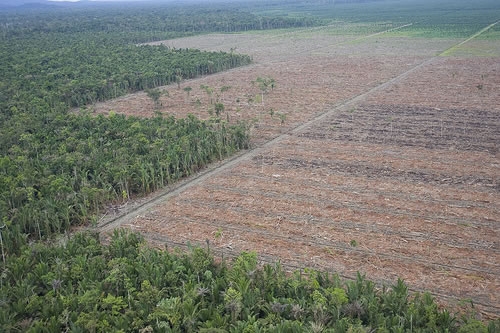
Under MIFEE (Merauke Integrated Food and Energy Estate) plans, 1.63 million hectares of forest which form the basis of life for some 200,000 indigenous people in the Merauke area would be used to grow rice, palm oil, soya bean and corn among other crops.

Earlier this month, AlertNet reported criticism from rights activists that MIFEE threatens indigenous people and the forests and ecosystems in the area.

They also said the government has failed to sufficiently consult the native residents over the impact, which will include losing their customary lands, an influx of migrants from the rest of Indonesia and decreased quality of the ecosystems which people rely on for food and for their livelihood.

The minister of agriculture, Suswono, said on Monday that 200,000 hectares of land available in East Kalimantan could be used for agriculture, according to the Globe.

“The principle of the food estate is finding enough land for an agricultural zone. It doesn’t have to be in Papua,” the Globe quoted the minister as saying.

“[The East Kalimantan site] may not as big as Merauke, but it is more feasible. It has been two years since we floated the plan, but there has been no progress at all.”

Indonesia annually imports 2 million tonnes each of rice and soybean, and the nation needs to be able to feed its people without importing food, he added

The Wire: Indonesia uses psychological warfare in West Papua

Indonesia uses psychological warfare in West Papua

 
Produced by Jessica Minshall
‘Irrational Demands for customary rights to land.’ That’s a statement from a power point presentation prepared by Indonesian special forces unit Kopassus – probably in 2009. This document forms one of many that have found their way into the hands of the West Papua Project at Sydney University’s Centre for Peace and Conflict Studies. They outline the psychological tactics and violence used against West Papuans who want independence from Indonesian rule. Featured in story – CAMELLIA WEBB-GANNON, Coordinator of the West Papua Project at the Centre for Peace and Conflict studies, and REX RUMAKIEK, Secretary General of West Papua National Coalition for Liberation.
http://www.thewire.org.au/daydetail.aspx?SearchDay=2011-08-15

Related articles

AWPA: Time to rethink ties with Kopassus.

The Australia West Papua Association (Sydney)
Media release   16 August  2011
Time to rethink ties with the Indonesian Special Forcesunit, Kopassus.
In light of the  leaked  Kopassus documents AWPA is calling on the Australian Government to rethink its policy of ties between the Australian military and the Indonesian Special Force Group, Kopassus. The leaked  documents show  lists of West Papuans  who are supposed to be supporting  separatism when in reality they are members of civil society organisations concerned about the human rights situation and the welfare of the people of West Papua.
Joe Collins of AWPA said “the level of spying by the Indonesian military  on West Papuans is oppressive, with  agents spying at  every level of West Papuan society.   There is an obvious systematic campaign to intimidate both  human rights defenders  and  the West Papuan peoples a whole “.
 It is now Forty eight years since Indonesia took over administration of West Papua from  UNTEA in 1963 and the West Papuan people still continue their struggle for justice and self-determination. The large peaceful rallies by thousands of West Papuans  at the beginning of this month  calling for a referendum indicate just how unhappy  West Papuans are with Jakarta‘s rule over their lives.
Jakarta should be asking the question, why?
In May the military began a “socialising programme “ in Puncak Jaya with the idea of   renovating  homes, churches and markets while in July the people of the region  suffered another military operation with reports of up to 600 members of the security forces  involved in sweeps through the region  resulting in  civilian and military casualties.  This is all reminiscent of the US programme in Vietnam to try and win the  “hearts and minds” of the Vietnamese people.
It is unfortunate that various sources in the security forces and government try to blame the troubles in West Papua on overseas involvement with one police official saying there are indications that there is “suspected foreign funding of the OPM “. Yet in December last year   cables released by WikiLeaks in relation to West Papuan human rights  revealed that US diplomats blame the government in Jakarta for unrest in West Papua due to neglect, corruption and human rights abuses.
To avoid the situation in West Papua deteriorating further Jakarta should  take up the offer of dialogue from  representatives of
civil society organisations in West Papua who have been calling on Jakarta for years to dialogue with the West Papuan people to try and solve peacefully all the issues of concern they have.  As Winston Churchill is reported to have said   “to jaw-jaw is always better than to war-war
AWPA is urging the Australian Government yet again  to put a moratorium on the training, funding and any ties between  the Australian military and the special forces unit  Kopassus, until a full inquiry is held into the activities of these units in relation to  human rights abuses in the archipelago.
Info. Joe Collins
Australia West Papua Association (Sydney)
Mob. +61(0)4077 857 97

Tempo: Papua MIFEE Project Faces Criticism

http://www.tempointeractive.com/hg/nasional/2011/08/15/brk,20110815-351921,uk.html

TEMPO InteractiveJakarta:The Merauke Integrated Food and Energy Estate (MIFEE) Program has been accused of disenfranchising local farmers in Papua. Berry N. Furqon, director of the Indonesian Forum for the Environment (Walhi), said that more than 100,000 ha of forest had been cut down for the project, including the sago forest on which the locals depend upon.

Abet Nego Tarigan, executive director of Sawit Watch, called on the United Nations to cancel the project. Abet said the MIFEE could endanger Indonesia as it allows companies rather than farmers to control the food supply.

The MIFEE project was inaugurated by Agriculture Minister Suswono on August 11 last year. The program sees plantations in Merauke managed by companies that also manage the local farmers. One million ha, divided in five clusters, has been allocated for the program.

As many as 32 companies have obtained principle licenses and will operate in a range of plantation sectors, namely palm oil, sugar cane and corn among others. Companies that have invested in the program include Wilmar, Sinarmas, Bakrie Sumatera Plantation, Medco, Bangun Cipta Sarana and Artha Graha.

NUR ROCHMI

————————————–

2) Indonesia Turns Back on Papua Food Bowl Plan
Faisal Maliki Baskoro | August 15, 2011

After two years with little progress, the government is considering shifting the location of its planned food estate to East Kalimantan from Papua because of the availability of land.

Suswono, the agriculture minister, on Monday said there was 200,000 hectares of land in East Kalimantan that could be used as an agriculture cluster. Under its plan, the Merauke Food Industrial Estate would have about 2 million hectares.

“The principle of the food estate is finding enough land for an agricultural zone. It doesn’t have to be in Papua,” he said. “[The East Kalimantan site] may not as big as Merauke, but it is more feasible. It has been two years since we floated the plan, but there has been no progress at all.”

Suswono said land clearance regulations were partly to blame for the slow progress.

“The construction of the Merauke food estate was obstructed by lack of regulation to clear necessary land,’’ Suswono said.

The government annually imports 2 million tons each of rice and soybean, and the nation needs to be able to feed its people without importing food, he said.

He said the government and potential investors would seek suitable areas for producing the two crops.

“The land in East Kalimantan is good for planting rice,” he said. To grow soybean, the ministry would need at least 500,000 hectares, and the government was still looking for land in Kalimantan.

While East Kalimantan has 200,000 hectares of land free, the West Kalimantan administration said it could provide 100,000 hectares of land, he said.

Suswono said farmland would not interfere with the preservation of forests. “We will be using open land, and probably convert production forests to farms. We will also empower local people to get involved in the program.”

Ecosystem in Merauke must be preserved, says agricultural expert


JUBI, 11 August 2011
The District of Merauke has a very rich ecosystem  which needs to be  preserved and protected. The problem is that when forests are cleared, this damages much of the ecosystem and virtually destroys it.
Drs Sudirman, an agricultural expert at the provincial administration of Merauke district, speaking during a technical guidance event  in Wasur, said that as the  population increases, land will be cleared everywhere  which will have a very damaging impact on the ecosystem in forested regions.
‘One example: When forests were cleared to make way for the MIFEE (Merauke Integrated Food and Energy Estate) project, recently, a significant part of the ecosystem was lost and much of is it already dead. It is the responsibility of everyone concerned  to think about the best way to deal with this problem so as to ensure that the ecosystem is not damaged.’ he said.
He said that the TH Wasur region in particular has a large number of species which means that it is the responsibility of everyone, including the original inhabitants of the district, to play their part in preserving  the ecosystem.

Create a website or blog at WordPress.com

Up ↑