JUBI: Defining “orang asli” in Papua

The following item is from the newspaper JUBI and was published earlier this month (apologies for not having the precise date).

BPS criteria regarding orang asli Papua is strongly rejected

In connection with the criteria that were used by the Central Bureau of Statistics (Biro Pusat Statistik, BPS) for West Papua in the publication of its data about the census which was held some time ago, DAP (Dewan Adat Papua – Papuan Traditional Counsel) regards the criteria as incorrect.

He said: ‘Those said to be OAP – orang asli Papua- indigenous Papuans – are persons whose father and mother are OAP, because in accordance with the word ‘asli’, it must mean that there has been no inter-marriage whatsoever,’ said Forkorus Yaboisembut, the chairman of DAP.

He said that according to DAP, the status of OAP includes only two
criteria, which is that both the father and mother are orang asli
Papua, or the father is OAP but the mother is from outside. Persons who mother is OAP but whose father is not, cannot be said to be OAP.

According to Forkorus: ‘Their lives would also need to be considered to
see whether they have struggled and done anything in favour of Papuan interests. A referendum could not be held about the future of Papua if they were not to vote for independence,’ he said. ‘It was very clear that someone cannot be declared to be OAP without the knowledge of DAP, bearing in mind that DAP occupies the position of the protector of Papuan traditional rights in Papua.’

For the first time last year, the BPS produced six criteria for determining who is OAP, as follows:

1. Persons whose father and mother are both OAP.
2. Persons whose father but not the mother is OAP.
3. The mother is an OAP but not the father.
4. Neither parent is an OAP but they have been acknowledged as OAP.
5. Neither parent is Papuan but they have been recognised according to ‘marga’ or ‘keret’ as OAP.
6. The person has been domiciled in Papua for 35 years.

According to this definition, the number of Papuans in the province of
Papua Barat (West Papua) was given as being 51,.67 percent, of the total population of 760,000.

In view of all this, DAP hopes that the BPS will speedily correct their
data, because it is not possible for instance to say that an OAP can
include people who have lived in the province for a very long time.

JUBI on deplorable human rights situation in West Papua

JUBI, 8 February 2011

The National Human Rights Commission [Komnas HAM] in Papua has called on the Indonesian government to take responsibility for a number of human
rights violations that have occurred in West Papua.

‘It is for the government to resolve these problems,’ said Matius Murib,’ who insisted that the government must take responsibility for this situation. He said that if the government fails to do anything, the number of violations will continue to increase. ‘There is no other way out of the problem,’ he said. It was, he said a matter for the central and also the provincial governments.

He said he has the impression that the state has simply washed its hands of the issue. Nothing is being done about it. The evidence is, he said, that the provincial government has issued no special regulation to strengthen the hands of the local Komnas HAM. There was a need for a regulation that would strengthen the legal position of Komnas HAM.

———————–

JUBI 8 February 2011

KontraS, the Commission for the Disappeared and the Victims of Violence,
has raised the issue of the formation of a Commission on Truth and Reconciliation and a Human Rights Court in Papua.

Speaking on behalf of the Commission, Harry Maturbongs said that these two bodies should be set up in accordance with the Special Autonomy Law for Papua, 21/2001.

He also said that people were still waiting for the solution to a number of past serious human rights violations, such as the Wasior case and the case of the assault on an ammunition dump several years ago.

[Apologies for the brevity of these translations, but the printouts are almost illegible. Tapol]

VIDEO: More Indonesian brutality against Civilians in Kapeso, 2009

WARNING: This video contains disturbing images of extreme brutality and will be disturbing to most viewers.  Please complain to the Indonesian security forces if you do not wish to see this.

Indonesian military brutality and torture of West Papuan civilians is revealed in a video released today exclusively by West Papua Media.

The footage shows troops from Indonesia’s elite counter-terrorism unit Detachment 88, who receive Australian and US military training, engaged in a raid in late May 2009 on the Papuan village of Kampung Bagusa, at Kapeso airstrip in Mamberamo regency.

The footage, filmed by a Detachment 88 officer on his mobile phone, shows the immediate aftermath of the raid. The bodies of at least five dead villagers are visible on the ground and there is sporadic gunfire clearly heard.

The incident occurred at the end of a month long occupation of the remote airstrip by an local religious group, and was transformed into a demonstration of widespread pro-independence sentiment by an off-shoot of the TPN or National Liberation Army. Local military and police commanders sent troops to clear the airstrip, including the elite Detachment 88 force. Negotiations between local people and security forces broke down in confused circumstances, and security forces attacked all present. The aftermath of this operation is depicted in the video.

The footage shows Detachment 88 troops urgently taking cover behind desks in a pendopo (traditional ceremonial shelter) whilst under alleged attack. Curiously, whilst troops are allegedly being shot at by unknown shooters off camera, the solider continues to narrate calmly and film proceedings whilst he is standing up, exposed to alleged fire. This does raise the possibility that the entire proceedings are staged for the benefit of the camera.

Disturbing scenes at the end of the footage appear to show two Papuan children tied up and being forced at gunpoint to crawl along the floor by the Indonesian military. The footage continues to show them in apparent pain while the soldiers taunt them.

To date, no satisfactory transparent investigation has occurred of the events surrounding the Kapeso occupation and subsequent shooting of civilians by security forces. West Papua is routinely closed by the Indonesian government to International Media and Human Rights Observers.

Regardless of the circumstances of alleged armed provocations, Indonesian security forces are again displaying excessive force to civilians and non-combatants and in particular to children. Indonesia has ratified the Convention on the Rights of the Child, but has so far refused to ratify the Convention’s Optional Protocol on the involvement of children in armed conflict.

The footage is sure to raise further questions about the activities of the Indonesian military in West Papua, as well the involvement of the Australian military in training and arming those seen in this footage. The video was passed to West Papua Media via a member of the Indonesian security forces who stated that the circulation of this form of ‘trophy footage’ is rampant amongst troops operating in the region.

PLEASE NOTE:  There is a translation error in the subtitles in this footage which is quite critical.  At approximately 00:54 (seconds), where soldiers are pursuing West Papuan people, the dialogue is incorrect.

From a correspondent:
“”jangan dibunuh” is translated as “don’t get killed” but should be “don’t kill them”. It’s common to issue orders in passive register like that. It is followed by “diborgol” ie “handcuff them”. It’s a big difference, since it is suggestive of how often extra-judicial killings do take place – the soldiers on scene have to be reminded to NOT kill the prisoners. “

The video can be viewed at the following link: http://www.youtube.com/watch?v=VD0eFA4scTo
or watching below:

For all media enquiries please contact Nick Chesterfield at West Papua Media on wpmedia_admin@riseup.net or +61409268978

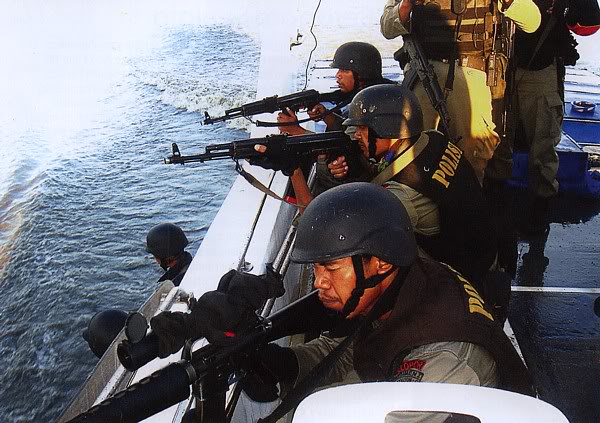
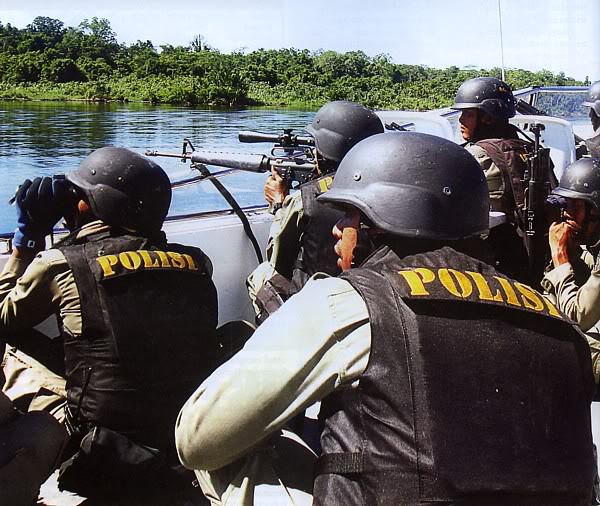
An Indonesian BRIMOB source today (Feb 9) sent West Papua Media these images of personnel from the Pelopor taskforce depicted in the footage above on their way via speedboat to conduct the operation to retake the airfield.  The individual officer in the foreground of the upper image has been identified as the cameraman and narrator of the footage.

West Papua Media apologises for the low-quality of the footage due to it being filmed on mobile phone in low resolution

A higher quality version of the footage is available to media upon application under strict conditions; unfortunately YouTube automatically loses quality during upload.  Please contact West Papua Media for arrangements

RNZI: PNG soldiers storm home of suspended West Sepik Police Commander

FORWARDING ON.
note: West Papua Media is also following this story closely, but has unable to access its sources on the ground in Vanimo.  We are gravely concerned as to their safety given the current climate of impunity against witnesses of the confused border security operation Sunset Merona..
RNZI may have better success, but this is not a competition.

Please continue to follow this story closely, updates will be made available when sources are able to safely file.

for background, see https://westpapuamedia.info/2011/01/28/png-troops-burn-down-border-west-papua-refugee-camps-as-refugees-flee-to-the-jungle/

RNZI: PNG soldiers storm home of suspended West Sepik Police Commander

Posted at 05:06 on 07 February, 2011 UTC

Papua New Guinea soldiers allegedly stormed the home of West Sepik’s suspended provincial police commander Chief Inspector Sakawar Kasieng and threatened his family yesterday.

The newspaper, The National, reports that the ten soldiers were taking part in a border security crackdown called Operation Sunset Merona in and around the provincial capital Vanimo.

The operation has been underway for three weeks with more than 100 people arrested and detained for alleged illegal movement across the border from Indonesia.

Mr Kasieng says that the soldiers pointed guns at his family, ordering them all to stay indoors without any explanation.

He has been told by police from Port Moresby that he is charged with treason, and is due to be questioned at the police command centre in Vanimo today.

Mr Kasieng was reportedly suspended last month after refusing to allow policemen on Operation Sunset Merona entry into his local police station headquarters after one of his men was allegedly beaten up by a group of visiting task force officers.

News Content © Radio New Zealand International
PO Box 123, Wellington, New Zealand

Verdict on violence in Papua unjust, says Kontras

Verdict on violence in Papua unjust, says Kontras
Bintang Papua, 3 February 2011
[Translated in full by TAPOL]
Jayapura: Although the three members of the armed forces who were sentenced  for acts of violence against civilians have accepted the verdict and are now serving their sentences in a military prison, some sources believe that the verdict is far from just.
The chairman of KontraS Papua, Johanis Maturbongs SH, is of the opinion that the sentence passed against the three soldiers at the military tribunal is far from just. The sentences of ten months for Sergeant Riski Irwanto, nine months for Private Yapson Agu  and eight months for Private Thamrin Mahangiri were far too lenient. This punishment cannot be compared to the trauma suffered by the victims of their acts of violence.
Cases of this nature should be tried before a civil court or a human rights court as stipulated in the Special Autonomy Law.
‘If such a case of human rights violations is heard before a military tribunal, the result is bound to be far from adequate.,’ said Maturbongs, a law graduate from Cenderawasih University. He said that things like this have been happening for a long time, and with violations that are even worse than this one, but nothing is known about what has happened.
He also said that the  National Human Rights Commission (Komnas HAM) in Papua should be far more active so as to ensure that such cases are read about in the public domain.
‘Our friends in Komnas HAM in Papua have not been working to full capacity. They need to work far harder with regard to human rights violations which occur in Papua,’ he said.
The same also applies to the legislature, which should do everything in its power to ensure that a human rights court is set up in  Papua.”


Create a website or blog at WordPress.com

Up ↑