9 people arrested for displaying West Papua flag face lengthy prison sentences

Article from AFP

Nine people have been arrested after displaying the West Papua flag in Indonesia’s remote Papua province.

Eight men and a woman unfurled the banned “Morning Star” flag on Saturday in a village in Jayawijaya district, local police chief I Gede Sumerta Jaya said.

“We arrested nine people and they’re being investigated. They had raised the Morning Star flag. We found the flag and a wooden pole,” he told AFP.

“They’re likely to be named suspects on charges of plotting against the state,” he added.

Anyone convicted of displaying separatist symbols faces possible life sentence in Indonesia, a sprawling archipelago with a history of secessionist rebellions.

Indonesia won sovereignty over Papua, a former Dutch colony on the western half of New Guinea island, in 1969 after a vote among a select group of Papuans widely seen as a sham.

Many Papuans accuse Indonesia’s military of violating human rights in the province and complain that the bulk of earnings from its rich natural resources flow to Jakarta.

Transcript of 2 day torture inflicted by Indonesian military on elderly West Papuan farmer

Engage Media
West Papuan farmer Tunaliwor Kiwo recounts the details of his torture by Indonesian soldiers on May 30 2010. The account of the chronology of the torture was in Lani language, translated into English.

Transcript of Kiwo's Torture Testimony (English) On Sunday, May 30th 2010 I was on my way from Tingginambut to Mulia using motorcycle, arrived at the TNI post Kwanggok Nalime Kampung Yogorini. I, “Anggen Pugu/Tunaliwor Kiwo with Telengga Kiro” was summoned by the TNI personnel at the post and without hesitation we came to that Nalime post, we thought they wanted to give a cigarette or something but turned out we were questioned and interrogated … they asked “Where do you live?” We live in Tingginambut village, the district’s capital … ”Do you have ID card (KTP)?” Yes we do have it and then we showed them.

Without further questions, I, Anggen Pugu Kiwo and Telengga Kiro were handcuffed with rope and dragged to the back of the post by pulling the edge of the rope behind me from the left side of the post to the back side, then instantly we received a huge slapped, from left ear and right was pulled … pushed … slammed on the ground. Then they tied our feet with barbed wire … Then pulled the edge of the rope that has been tied to our hands, dragged from the direction of Nagarak River.

A log has been prepared…then they started to beat me from the neck and bones were crushed … and that log was broken to pieces on my body, then they threw that broken log.

After that they took a plastic bag … then they put my head inside all the way to my legs and tied it, then opened it again … Then they replaced it with a large black plastic bag, put my head to it and pulled my neck, my mouth and nose were sealed till I couldn’t breathe and I tried to open my mouth but I couldn’t because it’s so tight and I almost couldn’t breathe anymore … I couldn’t … couldn’t breathe … then they opened it again.

And then they asked … you have to be honest … you have to be honest … But I don’t know anything, I’m just a regular person … over and over again … but they kept pushing me … you’re lying, you have to tell the truth that you’re OPM right? … we were constantly pushed that we were so confused to talk, we were numb and our voice was trembled, we couldn’t answer properly because we were nervous … eventually they kept torturing me … repeatedly … back and forth beating me from head to toe while my hands and feet were already in tied position … I’ve become powerless …

Then they went inside the post to get pliers to tweeze my toes … pulled them hard until they were severed, I was hysterical until I peed … then they switched to my other foot, I meant from left toes to right toes.

With same method they clipped my penis that it almost snapped … hysterically I cried “it hurts, let go of me” while they’re saying they will cut our genitals … I was still hysterical…tortured me since 9 am. Hands and feet were tied since morning.

Next they pulled the edge of rope that has been tied to my hands, they pulled and slammed from right to left and from left to right, causing many head bumps, legs were exposed to hard objects including the wall, rock etc, ruining my right knee that I’m not able to walk normally again, it’s crippled.

They have tortured me from 9 am to 6 pm and they dragged me to the kitchen located in the back of their post.

They kept my hands and feet tied then they tied each of my foot to a wood on the wall and kept my hands tied from behind and hung from above.

After that there was a soldier came, stepped on with his boots, stepped his foot on my face, pressed my nose and banged my head to the wall … then it bounced … He repeatedly stepped on me causing blood streaming from my nose, mouth, head; my mouth, chest and mustache were covered and because I was tied, I couldn’t wipe the blood so I had to blew it … fu … fu … fu … fu … so it didn’t cover my mouth. I was helpless, what can I do …

Then he rolled a cigarette … pretend to give it to me that I opened my mouth to take a drag … suddenly he pulled it back and stick the fire instead to my nose that it was burnt from the cigarette.

Then they filled up water in the bucket, it’s already midnight and my body was cramped … They poured cold water all over my body … I told them “it’s freezing” but they didn’t want to hear … they washed my body with cold water until I was shivering … cramp and the whole body was numb. I told them “it’s freezing” but they continued anyway.

Because of the tight rope that they tied since 9 am has caused my hands and feet to swell tremendously.

The next torture was to heat up an iron and or a wire then pressed it to my left and right thigh … I kept screaming…but they pressed it to my stomach … I screamed … they pressed it to my left and right chest … I kept screaming … but they didn’t care about my agony … unbelievable that they managed to torture me from 9 am in the morning to the evening, till the next morning … they dragged me outside …

They put me at the yard and then I told them that I’m the younger brother of Yustus Wonda, the provincial secretary, with broken voice I asked them to get him and pick me up … but instead they impersonated my voice and laughed at me …

That morning (day two) they started torturing me again using a block and severely beat me with it from head to toe, back and forth with hands and feet still in handcuffed position.

The other form of torture, they got in the house to get a military knife … then one by one they stepped on my face, mouth, nose … hen from the left side they put the knife on my neck, from the right side they try to point out cutting my neck and at that moment my nose got cut (pointing at his nose) … I thought I’d lose my neck but it still there.

They lay me down then put a wood board on top of my chest, face, stomach … then they axed the board from the left side; it fell and penetrated through the board they laid next to my left and right neck.

The next torture is: hands and feet remained tied but I had to fold my legs, the rope tied from the neck with feet kept tight while my hands were still handcuffed from behind then they stacked firewood available in the yard and stacked the whole thing as high as my body until I almost couldn’t breathe, then next to my right and left leg, they threw fuel to the firewood, I was burnt in the middle … I couldn’t move and the heat from the fire burnt me down since my hands and feet were still tied … I cried hysterically in pain.

They got me out and dragged me from the firewood stack then I stood with head on the ground and my face facing up. Then they put a test on me by axing the left side of my head and at the same time pulled the axe off the ground, which threw the soil covering my eyes and face. The torture was extraordinary and I was completely helpless from it … They did this during dawn around 5-6 am.

Around 8 am they dragged me then shaved my mustache and hair in hideous way, they cut my hair from every angle, using razor blade … it’s so random that it slit my mouth, ears and nose – all over my face was covered in blood because they shaved my mustache, hair until it went bald and bleeding.

The torture switched to the TNI soldier concocting this chili sauce using huge amount of chilies, red onions, garlic, detergent, salt – all mixed with water, then they poured my body from head to toe with that … I screamed because it hurts so much…but they winded up brutally soak me up, they made sure not a single body part they missed out until they finished the whole water.

Then they dragged me and basked me under the heat of sunlight next to the house until I didn’t realize that flies had surrounded my mouth, nose and ears. When the soldiers approached me the flies flew off but they returned and perched on my body until the sun started to disappear into the slope of mount Arimuli or Puncak Senyum. I realized it was later in the afternoon around 4.30 pm.

Then the commander of the post ordered the TNI medical personnel to clean me up. He sympathized for me and loosened the rope both on my hands and feet. My hands and feet were swollen, I couldn’t walk and he helped me to go down the river for bathing then he gave me soap and then I washed my body until it was clean. Because my pants were dirty, he made me wear his pants then helped me cling to him and walked back to the post. As soon as I arrived, he soaked alcohol to all over my painful body, cleaned them and rubbed the wounded parts with Betadine, he also gave injections to my left and right foot, left and right hand, left and right thigh, stitched my sliced nose as a result of the previous torture using yarn. I felt so cold so he helped me put on my clothes and jacket and then he lay me down on bed, I slept through until 6 pm.

After I woke up, I was told to lift my legs and hands to be tied again but it’s very difficult to lift them because they’re swollen and heavy, therefore my legs couldn’t get tied and my hands as well could not get tied from behind because of the tortures, which made my bones damaged, hands were numb so he had to tie me from the front, tried to tie it firmly but I was in pain then they tied it loosely and put me back to sleep.

One day before that, they put me to sleep on the ground so it’s easier to elevate my legs so when I lift one of my legs, I made a deep hole in the ground with my other leg when I tried to pull it.

After I was bathed, then they lay me down on a floor mat layered with the yellow plastic bag that is usually used to evacuate a body from a murder or traffic accident, so I lay on top of it and they put pillow for my head and covered my body with green TNI jacket so I wouldn’t feel cold and could sleep well.

Around 11.30 I accidentally awoke but I kept lying down and over heard my execution plan for the next morning. Time was ticking and they were busy boiling water and made coffee, tea and each of them ate instant noodle. They were rowdy because I was about to be executed; meanwhile I had to hear their conversation

At 3 o’clock they made contact through HT (Handy Talky) where their military unit was on duty at Kalome post, Tingginambut post, Puncak Senyum post, even the one at Mulia town also reported that they have shot one on the scene and the other one was still alive, when I heard that I thought it was Telengga Giro who got shot. Apparently what they meant was to shoot me (Kiwo).

Time pointed at 3 am past something. They said the car would be arrived at 8 am, so we’re going to shoot dead this person at 9 am sharp and brought him into the car. Yes, I am Kiwo and that time I was afraid and anxious.

I opened the rope that bound my hand slowly with my teeth yet I pulled it tightly so that it was looked tight because the end of the rope was tied to the wall and the other end was tied to my hand. Carefully I peeked and stood there but they saw me and I was reprimanded to keep sleeping. But I slowly raised my head until I heard it was 4am.

At 4pm (Papua time) I started to pray. This is what I said to God:

Thanks God if your will is my death in the hands of Indonesian military. Then, on Tuesday May 11th 2010 at 9am, I will be shot dead here so I surrender my life to Your hand.

God, please bring the men who tortured and killed me to the hand who will defend and replace my head and soul so that they will be shot dead as well if they shot me at 9am. Thanks Jesus.

But, if You plan my death in another way such as illness, then I will not die in the hands of TNI this morning, please make them blind and powerless and free me at 4- 6am before 9 this morning. I will escape this place. Thanks Jesus, in the name of Jesus. Amen.

Finally God gave me strength to lift my bed and a drum and throw that to a soldier who was on guard. I stepped on the porch at the station nearby; they thought I was their friend who was watching over me. And when I stepped out, they realized it. They shot with too many bullets yet none of them hit me.

I ran until the fell and rolled around. It happened many times. I tried to stand up and fell again until quite far in the distance. The second time I tried yet I failed. The third time I failed, finally I gave up. But I tried to stand and I could stand. If they chased me, I would definitely die. I was like a one year-old child who learns to stand up and fall again. That was what I experienced. I kept running until I saw the main road. I immediately crawled into the bushes. I opened the white short and held it in hand so that they would not get me. I got into Yamo River at 5, and at 6 I met my family.

My family was afraid to approach and shake my hand since they heard that I was murdered by the TNI soldiers. And there was a myth that a dead family member visits their family so they thought I was a shadow. Then I answered this is Kiwo, I’m still alive.

There were two young men delivered a letter to the TNI post, they told you to go home soon because all this time you were looking for Goliat Tabuni who you have killed. Yet, suddenly Kiwo appeared and still alive, so the plan to deliver the letter to the post by motorcycle was cancelled.

My family slaughtered a pig as a symbol of one family member went home and saved from death. Customary, they slaughtered a pig and checked all parts of my badly beaten body but there were only 2 broken ribs. All my bones from head to toe turned red. They cleaned it up and cooked and treated with the medicine sent from Mulia. Now I have recovered.

Until today, I have hesitation about my health. I worry that the disease will relapse. Since I am a civilian, an ordinary man, basically never steal others’ stuff, angry at others and hurt someone’s heart, therefore God helped me and I survived.

That’s the chronology of the torture I experienced and I thank you. My name is Anggen Pugu Kiwo. So that was the traces of wound that I experienced.

Click below to watch full torture footage

On a mission to expose abuses in West Papua

By Teoh El Sen

FMT INTERVIEW PETALING JAYA: Hunted by the military, human rights activist and documentary filmmaker Wensi Fatubun left his home in West Papua, Indonesia, and continued his fight abroad.

“I received an SMS threatening me to back off from my investigations or I’ll face death. I then found out that the Indonesian military was tracking me. I had to throw away my phone. Just five days after I left and reached Bangkok, my friend, a journalist, was dead,” said Wensi, 29, who spoke to FMT in an interview here recently.

The naked body of Wensi’s journalist friend, Ardiansyah Matra’is, was found in a river. Police there had claimed the death was suicide.

Wensi, who had worked closely with Ardiansyah investigating illegal logging and corruption, said he was sure his former colleague did not kill himself.

“I believe his death had something to do with the investigative work he has been doing, especially on the Merauke Integrated Food and Energy Estate (MIFEE). Before he died, a few journalists, including me received the same threatening SMS,” Wensi said, adding that such violence was not uncommon in Papua.

Wensi is on a roadtrip in Malaysia to spread awareness about the critical situation in Papua, and he would be travelling to the Philippines next to seek further support.

For almost 50 years since it was absorbed into Indonesia in 1963, West Papua, also called Irian Jaya (on the west side of the New Guinea island), has struggled for independence.

It has suffered various human rights violations mostly carried out by Indonesian security forces – intimidation, torture and brutal killing of villagers, activists and journalists; with human rights groups estimating tens of thousands of natives killed.

Worst poverty

The military is also alleged to be involved in illegal operations such as logging, prostitution and trading in endangered species to make a profit. Human Rights Watch claim Papua has the worst poverty in Indonesia, and the biggest HIV problem in the country.

Foreign media and NGOs are banned from going to West Papua.

Wensi said Ardiansyah’s death was tragic but it also strengthened his resolve to continue his simple yet difficult mission: to spread word about the abuses in Papua to other countries, and get help and support.

“I am not afraid. If I stayed in Papua, I could have been killed so I must continue this fight,” said Wensi, who worked as an investigator with a church-based organisation as well as assisted Human Rights Watch’s investigations into the human rights situation. He also trained young people to make documentaries.

Recently in October, the video of two Papuans tortured by soldiers shocked the world. The video depicted farmers Anggen Pugu Kiwo and Telengga Gire being violently interrogated by the military, who also burnt one of the men’s genitals. However, five men who were involved in a separate incident were charged.

Wensi said that such military oppression and torture happened to Papuans “every single day”.

“Before I became an activist, three of my friends were also tortured and interrogated by army personnel who wanted to know if there were part of a he separatist movement. One of them died this year,” said Wensi, who also trains young people to make documentaries.

He said that in West Papua, to be a journalist, activist or someone who fights for human rights means that you were a “separatist”.

“I am often called a separatist, an enemy,” said Wensi.

“Just last week, secret documents exposed by US freelance journalist Allan Nairn showed that US-backed Kopassus engaged in ‘murder and abduction’ and defined civilian dissidents as the ‘enemies’ in the province of Papua,” said Wensi.

Kopassus or Special Force Command is an Indonesian army special group that conducts missions for the government such as counter-terrorism and intelligence gathering.

Last July, the US government lifted a decade-long ban on US training and military assistance to Kopassus, which is considered a US ally in the fight against terrorism.

Asked how can Malaysians help Papua, Wensi said: “In any way you can. But mostly show solidarity with us whenever you read of news of military torture in my province. If in the past, Malaysia had joined Indonesia, it would now be suffereing the same fate as Papua.”

Below are exceprts of the interview:

Why did you choose to be an activist and not migrate to Papua New Guinea?

I chose to be an activist and filmmaker because I felt the need to be with the people and fight from the perspective of the people. I wanted to make documentaries as seen through the eyes of oppressed. I grew up in a village in Yodom and I saw with my own eyes a company, PT Korindo Group, take away the people’s land. As a result, the people have no place to hunt and farm. And after awhile the company leaves, but the people suffer because the richness of the land is all but gone.

Was there a specific incident that spurred your activism?

Well I saw my neighbours, my friends and my friends’ families arrested by militants. They were called Free Papua Movement (OPM). They were called separatists when in fact they were the intellectuals, the progressives. In 2005, three of my former school mates were tortured by army personnel, who claimed they were OPM members. They wanted to know “where my friends kept their weapons”. They poked a cigarrette butt into the eyes of one of them, who became blind. Another ran away and never came back. The third suffered a broken jaw and injuries to his backbone. For five years he could not walk or sit like a normal person. He died in July this year.

Why do you keep continuing this (fight) despite the dangers?

I feel that there are not many like us. Some of the activists and journalists in Wes Papua are siding with the government and the people there do not have a good idea of what is going on. The Human Rights Commission has written about these cases but there are no solutions. For example, in one incident, the people of one village had clashed with another but it was labelled as a ‘tribal war’ and gave a wrong impression that the natives are still primitive. A lot of people out there are not aware of the situation.

Were there incidents you could not forget?

The worst was when I interviewed a girl who was only 17 when she was raped by a soldier and she later carried his child. It was hard for me because she was so young. She dropped out of school later. Now she is waiting for justice but no one is doing anything. I could only tell her to wait and be patient. I know that the Indonesian police and military do not care, they are not doing anything. But she is still waiting. She was given two million rupiah for her pain and loss. That’s all. She kept crying when she was talking to me and all the while holding her ‘daughter’. I was very angry and sad and I felt like punching an Indonesian soldier.

What are some of the problems in Papua you would like to highlight?

A persistent problem which involves the military and the government is land grab. The big companies will come in and take away the land of the Orang Asli. One such mega project is the Merauke Integrated Food and Energy Estate (MIFEE). This is a 1.6-million-hectare integrated food-production zone where companies are supposed to grow, process and package their products. It has 32 foreign investors coming in to develop 32 districts in Merauke, southeast of Papua.

What they are doing do not benefit the Papuans at all. The people there don’t like this because this would mean the demolition of their buildings and their holy sites. The people have written many times to the president and held demonstrations but to no avail. The Indonesian government does not care. The leader of one group formed to oppose this project was arrested. Anybody who disagrees will be targeted. The authorities also intimidated me because of my opposition against the MIFEE project.

How were you intimidated?

I was told that the regent of Merauke Jhon Gluba Gebze had instructed his men to target me. I also received an SMS saying that I would be killed if I continued to oppose the MIFEE project. This was one of the reasons I left West Papua for Thailand. I was told by reliable sources that they had formed a five-men team to hunt me down.

What are the other issues in Papua?

So many. There are so many problems there. First and foremost, the military there is working together with large companies to exploit the land of the Orang Asli, the Papuans. If you come to West Papua,the moment you step off the plane, you would see the military. In every village, there would be 17 to 20 army personnel… this is not good.

Recently, there was a Youtube video depicting the torture of Papuans by military men. Does this happened often?

These things – beating and kicking villagers – happened every single day.

You mentioned that you interviewed victims raped by army men. How bad is that?

It’s not that good. Our interviews were conducted in the Budul village from 2006 to 2010. We managed to find that there were some 54 cases there and interviewed the women from 19 years of age.

You mentioned that prostitution and HIV are a big problem too?

Yes, I believe that in the whole of Indonesia, Papua is number one in prostitution. What is worst is that the police and the military are the pimps; they are the ones who facilitate prostitution. Prostitutes from Jawa, Surabaya, Sulawesi, and Manadao come to Papua and many are also infected with HIV.

In one case, I visited one of the villages in Assue. A prostitute told me that she knew she had HIV but everyday she had sex with 10 Papua men. And in the same area, there was a nurse who admitted to me that she had used a single needle for the whole village… and the result was disastrous. In less than a week, from three people who are HIV positive, our tests found 35 more had been infected.

The problem is that the people of Papua don’t know anything about HIV/AIDS. This is because they lack education. It’s a sad truth: we have health facilities in almost all Orang Asli villages but zero doctors. Papuans are just waiting for help. So in the meantime they used their own primitive methods to cure themselves.

What other cases or examples can you tell us of the human rights abuses in Papua?

There are so many. Okay, in one fishing village, three people were shot dead, and some villages were burnt because the local fishermen were against companies coming in with their large boats to fish in their area. Nine policemen were charged in court but were released because the excuse given was that they were shooting at separatists. There was also a border incident. The military erected some buildings at the border between West Papua and Papua New Guinea. But the people who opposed it were beaten and the women raped. The military also forced youngsters, aged between 16 and 20, to sell items to the people in Papua New Guinea. If the things are not sold, they would be tortured. I know of six teenagers who hid in Papua New Guinea because they were afraid to return. I interviewed one of them.

You said the military there is so cruel. Why?

I think the army is behaving like this because it is taking orders from its political masters. Besides, it does not like the Orang Asli. I once sneaked into a military meeting and saw the army slideshows. Based on these, I know that the military thinks that Papuans have no nationalistic feelings and must be beaten so that they love Indonesia.

Why are foreign journalists and NGOs not allowed in West Papua?

Foreign journalists and NGOs are not allowed inside because I believe the government does not want the world to know the true situation there. It does not want people to know how bad the situation was after the annexation of West Papua into Indonesia.

What is your hope?

My hope is that Southeast Asia will know about the situation in Papua. Help us. Show solidarity. If there is military torture, we can protest together. I must continue writing and producing more films so that more people can understand the situation in Papua.

West Papua deserves Barack Obama’s attention

The Guardian, UK

    brown In his autobiography Dreams from My Father, Barack Obama recalls a conversation with his stepfather who had just returned home after a tour of duty with the Indonesian military in West Papua. On asking him: “Have you ever seen a man killed?”, his stepfather recounted the bloody death of “weak” men. 

    Last month, video footage circulated online showing members of the Indonesian security forces brutally torturing Papuan civilians, including burning the genitals of an elderly farmer. It seems as far as West Papua is concerned, some things never change.

    Earlier this year, the US administration announced the re-establishment of military ties with Indonesia’s Kopassus special forces – the same forces implicated in the atrocities of East Timor. Leaked Kopassus documents released last week, have heightened fears that Indonesia’s claims of military reform – a condition of the US deal – are without foundation. The documents show that Kopassus continue to engage in “murder and abduction” and include a target list of “enemies of the Indonesian state”, including West Papuan church leaders, political and student activists.

    Last year I travelled to West Papua to film an undercover documentary about the independence struggle. I found a land where the remnants of the Suharto era very much live on into the modern day – far from the image of democracy that Obama painted in his speech to the Indonesian nation.

    Reports of human rights abuses by the security forces against the indigenous population have constantly trickled out of the territory. Human rights groups estimate that 100,000 Papuan civilians have been killed by the Indonesian security forces since West Papua was colonised in 1969. Papuans argue that the continued ban on foreign media and human rights groups from entering the region is evidence that the Indonesian authorities are hiding something far more sinister. Last year the International Committee of the Red Cross was expelled from West Papua, and it has not been allowed to return since.

    In West Papua it is not uncommon for people to receive prison sentences of up to 15 years for raising their national flag. Even events here in the UK can land Papuans a jail sentence. Last year, two men were jailed after taking part in a peaceful demonstration supporting the launch of a West Papua lobby group in the British parliament. Whatever definition of democracy the Indonesian government claims exists in West Papua, it is not one that any of us would be familiar.

    The challenges facing West Papua are vast. Despite being a land rich in natural resources, it remains the least developed and poorest part of Indonesia. Freeport, the world’s largest gold and copper mine, part-owned by British-Australian firm Rio Tinto, is located on tribal lands close to Puncak Jaya, the highest island peak in the world. BP also has its feet in West Papua, too, operating a natural gas plant in Bintuni Bay. It is an irony that in a land so rich, the Papuan people remain so poor.

    Obama’s refusal to publicly raise the West Papua issue during his visit to Indonesia disappointed many. The Indonesian government have shown no desire to enter into meaningful dialogue with the Papuan people, and bitterness and resentment are threatening to boil over. Many Papuans believe only UN intervention and a rerun of the 1969 referendum will solve the decades-long conflict.

    If the horrors of East Timor are to be avoided, then the US and other western governments need to give West Papua the attention it deserves. Obama’s mother, a cultural anthropologist who spent much of her life helping those marginalised in society, would expect nothing less.

Indonesian soldiers receive 5 month prison sentences for torture that shocked the world; human rights groups label trial a ‘farce’

AFP
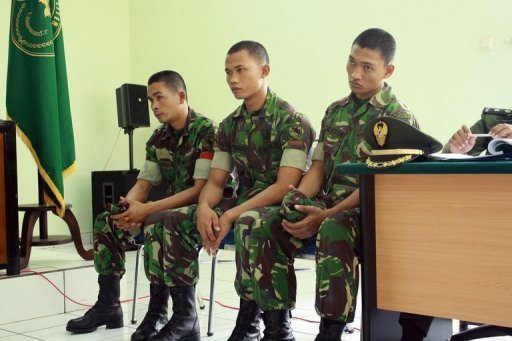
Indonesia on Thursday sentenced four soldiers to between five and seven months in jail for “minor disciplinary infringements”, after they were filmed abusing Papuan civilians.

The soldiers sentenced were not those filmed burning an elderly Papuan man’s genitals, but ones captured kicking a group of villagers around the head. The soldiers involved in the more horrific footage have not been located, leading to human rights groups demanding an international enquiry into allegations of widespread torture across West Papua.

A military tribunal gave three privates five months each for breaching the military code of conduct and their platoon commander seven months for allowing the abuse to occur.

“The defendants kicked the detainees’ heads and backs and hit their heads with helmets,” chief judge Lieutenant-Colonel Adil Karokaro told the tribunal in Papua provincial capital, Jayapura.

The sentences were heavier than military prosecutors’ recommendation of three months.

Critics of the Indonesian military say the case would never have gone to court had a video of the abuse, which occurred in the Punjak Jaya area of Papua in March, not appeared online.

Human rights workers labelled the trial a farce after senior military officials said it would deal with soldiers involved in the gruesome and far more serious torture of two Papuan detainees in May.

A video of the May incident also found its way to human rights workers, who released it online ahead of visits to Jakarta by the leaders of Australia and the United States, two key backers of the Indonesian military.

Indonesian President Susilo Bambang Yudhoyono promised “no immunity” for the perpetrators but no charges have been laid.

Human rights activists accuse the Indonesian military of killings, murder, torture and abuse of Papua’s ethnic Melanesian majority.

Papuan separatists have fought a low-intensity war for independence for decades, claiming that a vote by a small group of tribal elders which ceded the massive territory to Indonesia in the 1960s was a sham.

Peaceful Papuan political activists are regularly given lengthy jail terms for crimes such as possessing outlawed rebel flags. One such person is Filep Karma, currently serving a 15 year jail sentence for his part in a peaceful flagraising ceremony.

Create a website or blog at WordPress.com

Up ↑