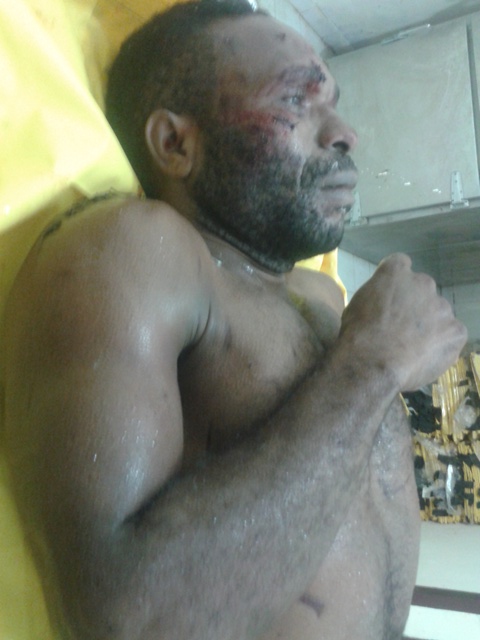
STATE VIOLENCE WHICH PARALYSES COMMUNITIES IS INTENSIFYING IN THE LAND OF PAPUA: Press Release by KINGMI Church and Papuan Alliance of Baptist Churches
PRESS RELEASE
LEADERSHIP WORKING FORUM OF PAPUAN CHURCHES
STATE VIOLENCE WHICH PARALYSES COMMUNITIES IS INTENSIFYING IN THE LAND OF PAPUA
As leaders of churches in the Land of Papua, we are deeply concerned about the state violence which is occurring in our sacred motherland. This is clear proof of the fact that the government and the security forces have failed to provide protection for the indigenous Papua people. These concerns of ours have already been conveyed by our communities in the following statements:
(a) The eleven recommendations made by the Consultation of the Papuan People’s Council (MRP) and the Indigenous Papuan Communities on 9-10 June 2010;
(b) The Joint Communique of Church Leaders on 10 January 2011;
(c) The Theological Declaration of Church Leaders on 26 January 2011, and
(d) The Prophetic Message by Papuan Church Leaders to the President of Indonesia on 16 December 2011, in Cikeas, Jakarta.
Similar concerns have been expressed by member countries of the United Nations (the USA, the United Kingdom, Switzerland, Canada, Norway, South Korea, Japan, France, Germany, Mexico, New Zealand, Australia Spain and Italy) on the occasion of the 23 May 2012 session of the Human Rights Council (UPR) in Geneva, Switzerland.
Based on the above facts, we believe that the Indonesian Government and the security forces are part of the problem of violence which has been created by the State, preserved by the state and allowed to continue in order to legitimise yet more acts of violence in the Land of Papua and to take advantage thereof in order to strengthen the security forces.
We regard these developments as a reflection of [Generative Politics] which was described in an article by Nugroho published by The Jakarta Post on 10 July, 2012. According to Nugroho, generative politics are political views and considerations which have paralysed and worsened the situation of Papuan communities and which have been pursued in accordance with the policies of the Indonesian Government for the past fifty years.
Herewith is a list of several incidents of violence that have systematically and structurally been perpetrated as a reflection of the generative politics mentioned above:
- On 2 March 2013, a priest named Yunus Gobay (male, 55 years old) was tortured and mal-treated and after being released, he paid ransom money to the police forces in the Police Command Post in the town of Enarotali, Paniai.
- The shooting incident in Sinak, District of Paniai, Tinginambut, Puncak Jaya on 21 February 2013 and the shooting incident in Udaugi on the border of the District of Delyai on 31 January 2013 when a number of civilians and members of the security forces were killed, which in our opinion happened because of the neglect of the unlawful sale of weapons.
- On 15 February 2013, Dago Ronald Gobay (male, 30 years old) was arrested in Depepre, district of Jayapura by the police and while being interrogated was tortured in the office of police intelligence in Jayapura.
- The attempt by the government and the security forces to forcibly disband a religious ceremony which was being held on the 4th anniversary of National Committee of West Papua (KNPB) on 19 November, 2012 in the STAKIN ASSEMBLY HALL, Sentani, on which occasion the security forces were under the command of the Police Chief of Jayapura, AKBP Roycke Harry Langgie and the deputy of the District Head (Bupati) of the District of Jayapura, Robert Djoenso D, SH.
- The unlawful murder of Mako Musa Tabuni, first chairman of the NKPB on 14 July 2012 in Perumnas, Jayapura.
- The murder of TPN/OPM General Kelly Kwalik by police from Densus 88 and a member of the Indonesian army (TNI) on 16 December 2009 in the town of Timika, and on the same day and month in 2012 another Papuan Hubertus Mabel was murdered by police of Densus 88 in Kuruku, the town of Wamena.
- Ferdinand Pakage was tortured in Abepura Prison by Herbert Toam, a warder at Abepura Prison, on 22 September 2008, as a result of which he was permanently blinded in the right eye.
- The torture and murder of Yawan Wayeni on 13 August 2009 by the police chief in Serui, AKBP Imam Setiawan.
- Two incidents of gross violations of human rights in Wasior in 2001 and in Wamena on 4 April 2003, the latter of which is related to the assault on an ammunitions dump; this incident has been investigated by Komnas HAM (National Commission of Human Rights), but the results of which have not been forwarded by the Attorney General to the Human Rights Court for a verdict.
These are just a few of the cases which are evidence of crimes which have been perpetrated by the Indonesian state and the security forces in a systematic, well-structured, widely-based and prolonged way and which are reflective of the generative politics (paralysis, destructive, eliminating) which, according to Nugroho in his Jakarta Post article of 10 July 2012, have been perpetrated by the Unitary State of the Republic of Indonesia in the Land of Papua for the past fifty years, since 1961.
Bearing in mind all the very disturbing facts given above and the living experiences of the indigenous Papuan people, we church leaders in the Land of Papua, make the following recommendations:
Firstly, the Indonesian Government and the security forces should return to the original aspirations of this country by investigating and putting an end to the unlawful sale of weapons and ammunition which is happening in the Land of Papua.
Secondly, the Indonesian Government should speedily take cognisance of the prophetic messages from the Church, the eleven recommendations of the MRP on 9-10 June 2010 and the Appeal by members of the UN Human Rights Commission at its session 23 May 2012.
Thirdly, we believe that the Indonesian Government is responding in a very discriminatory way to the aspirations of the Papuan people for peaceful dialogue. We therefore press the Indonesian Government to enter unconditionally into a dialogue based on the principle of equality between Indonesia and West Papua, with mediation by a neutral party, which is what happened in the dialogue between GAM (Gerakan Aceh Merdeka – the Aceh Liberation Movement) in Aceh.
Fourthly, the Indonesian Government should unconditionally release all political prisoners in Papua and should allow a visit to Papua by the Special Rapporteur of the United Nations, as well as by foreign journalists and human rights defenders. And it should forthwith end all its efforts to criminalise the political struggle of the Papuan people for self-determination.
Fifthly, the shooting to death of members of the TNI as well as civilians which occurred in the district of Sinak, Puncak Jaya and in the district of Tingginambut, Puncak Jaya on 21 February 2013 should be regarded as a separate incident. It was in no way connected to the election of the bupati (district chief) of the district of Puncak. This violent incident is part and parcel of state policy to build the necessary infrastructure for the TNI and Polri (the police) in the mountainous interior in order to establish the Puncak Jaya 1714 military command, to increase the budget for the security forces and to criminalise the peaceful struggle of the Papuan people at the international level.
Sixthly, the Chief of Police in Papua, Inspector-General (pol) Drs M Tito Karnavian, MA, has failed to investigate who it was who perpetrated acts of violence in the Land of Papua and has created the impression that he is allowing the illegal sale of weapons to go ahead. We urge the chief of police in Papua to implement the statement made by the chief of police, Inspector-General Bekto Suprapto in December 2010 that those who are responsible for the entry into West Papua of illegal weapons will be investigated.
Seventhly. we call on all Papuan communities and all components in society to study the laws in force regarding the TNI and Polri, in order to be able to control criminal actions as well as the policy of the Indonesian government and security forces in the Land of Papua.
Port Numbay (Jayapura), 6 March 2013
Chairman of the Synod of KINGMI Church, Papua:
The Rev. Dr Benny Giay.
Chairman of the Executive Board of the Alliances of Baptist Churches in Papua:
Socratez Sofyan Yoman
End of translation by TAPOL
Related articles
- Forkorus regrets the death of Indonesian soldiers and civilians (westpapuamedia.info)
- Thousands flee in fear of heavy civilian casualties as TNI begin Highlands reprisal offensive (westpapuamedia.info)
- Yoman rejects the Use of violence (westpapuamedia.info)
- Paniai sweeps intensify misery under Indonesian control as security forces ban music and torture priest (westpapuamedia.info)
- Breaking news: Police question Papuan leader over peaceful demo ‘treason’ (pacific.scoop.co.nz)
- Eight soldiers and four civilians reported killed in West Papua: Plus Comment (westpapuamedia.info)
- Jared Diamond: Don’t assist the Indonesian occupation (westpapuamedia.info)
- Addressing the situation in Puncak Jaya, Papua Degree Students of Action Simultaneously (voiceoflovetruthandjustice.wordpress.com)
- Media Wake Up Australian Media Report on West Papua (femonymous.com)
- West Papua Advocacy Team Urges Unrestricted Visit by UN Special Rapporteur (westpapuamedia.info)
Yoman rejects the Use of violence
Socrates reiterated that as a church leader that he was absolutely opposed to acts of violence.
‘We must engage in a peaceful struggle ,’ he said, speaking at the launching of his book titled: ‘OTSUS in Papua has Failed’
He went on to say that it was not about whether this violence was committed by Goliat Tabuni or anyone else . ‘There have been many acts of violence in Papua since 2004 and none of these incidents have been investigated and nothing is known about who was responsible for the violence. ‘It is said that the are large numbers of intelligence officers but nothing is known about these incidents. Is this some kind of project that is being defended or what is it all about?’
He said that the only way to deal with all the problems in the most easterly province of Indonesia is by means of mutually respectful dialogue, mediated by a third party.
He went on the call on young Papuans, men and women to get on with their education so as to be able to improve their standard of living, to be able to read and write, to become intellectuals, anthropologists , sociologists, scientists. Pursuing education will bring about a major change for the whole population, he said.
His book on OTSUS (Special Autonomy) is 408 pages long and has five chapters, which among others explain the background to OTSUS which is seen by Indonesia as the political solution for Papua.It also deals with the problem of the obliteration of the indigenous people, crimes committed by the state apparatus, the case of human rights violations on 19 October 2011 as well as the shooting dead of Mako Tabuni on 14 June 2012.
Published by Cenderawasih Press, it is the latest of a number of books written by Yoman.
Yoman was born on 15 December 1969 and is a highly vocal church leader. He also teaches as a number of colleges, including the Theology College in Jayapura. In October 2011, he had discussions with members of staff of the Secretary-General of the United Nations.
‘I will launch my latest book on 6 March, he said, adding that Papuans were not a nation of slaves.
[Translated by TAPOL]
Related articles
- Thousands flee in fear of heavy civilian casualties as TNI begin Highlands reprisal offensive (westpapuamedia.info)
- Jared Diamond: Don’t assist the Indonesian occupation (westpapuamedia.info)
- Eight soldiers and four civilians reported killed in West Papua: Plus Comment (westpapuamedia.info)
- West Papua Report February 2013 (pacific.scoop.co.nz)
- West Papua Advocacy Team Urges Unrestricted Visit by UN Special Rapporteur (westpapuamedia.info)
- West Papua: Is this the time to heed freedom’s call? (asopa.typepad.com)
Thousands flee in fear of heavy civilian casualties as TNI begin Highlands reprisal offensive
Major Reprisals begin with house to house searches, village and church burnings in Tingginambut by Indonesian Security Forces after TPN shoot dead 8 Indonesian special forces soldiers.
from the West Papua Media investigative team*
February 28, 2013
EXCLUSIVE: Special Investigative Report
Local communities around Sinak, Gurage, Mulia and Tingginambut in Puncak Jaya regency have felt the first effects of Indonesian military reprisals, after West Papuan independence guerrillas under General Goliat Tabuni confirmed that they had killed eight Indonesian special forces soldiers and four non-Papuan civilians on February 21 in two separate incidents.
The shootings were carried out after Kopassus officers continued to build military posts on a local sacred burial site, despite being requested not to by both community representatives and emissaries from the West Papua National Liberation Army (Tentara Pembebasan Nasional Papua Barat – TPN-PB) under Tabuni. TPN spokespeople have said that the shootings were done “to assert West Papuan sovereignty against Indonesian colonial occupation”, and to assert West Papuan cultural rights to defend their customary practices against ongoing military brutality.
A spokesman for the Goliat Tabuni’s TPN-OPM command, Nikolas Tabuni, told West Papua Media in a statement that the killings were not without cause.
Evidence of collective punishment emerges
Despite an effective information blockade imposed by thousands of Indonesian army (TNI) troops and Police, and unchallenged by a compliant Jakarta-based colonial media, detailed reports are beginning to filter through from independent sources in the area of the military offensive, painting a vastly different picture to that reported by Indonesian and international media since the shooting of the Kopassus soldiers.
At least 1000 members of various Indonesian security forces are currently occupying and laying siege to entire communities around Puncak Jaya, with thousands more troops being sent in from other centres in Papua, according to local church, human rights, and sources in contact with West Papua Media stringers across the conflict area.
According to these sources, the villages of Tingginambut, Trugi and Nelekom have been occupied by TNI forces since Sunday February 24, with villagers being forced to give all their food and houses to soldiers, and being subject to arbitrary and harsh interrogations. TPN sources have also stated that troops are using the villages as strategic hamlets to prepare for a hunt and destroy mission to flush out the forces of Tabuni, who have claimed they are well prepared for guerrilla defence.
In Nambut and Gurake (Gurage) villages in Sinak District, security forces began to carry out house to house sweeping operations on February 26, and in villages in Tingginambut, Puncak Jaya. According to our sources, the TNI Commander in the area has commanded “that the sweeping operation is to be continued until the culprits from last Thursdays killings are arrested”. The TNI have stated to local people they “need to see 11 persons sentenced,” according to the reliable source.
Two civilians were said to be arrested on February 27, according to Indonesian military reports, however independent sources could not confirm if any other civilians have been arrested.
As of February 26, at least 18 houses have been burned to the ground, 5 GIDI churches razed, 2 schools and a library have been destroyed by the combined Police/TNI forces in Tingginambut, according to reliable church sources who have safely relayed data from witnesses to West Papua Media stringers. Witnesses have also reported that soldiers are deliberately burning and destroying food gardens and shooting livestock, including over one hundred pigs. There are fears of a major humanitarian disaster unfolding with the reports of the destruction of food gardens and livestock, an act of collective punishment on a civilian population.
Thousands of people from the surrounding villages have fled to the high mountains and according to church sources, the entire community populations have fled throughout the area of Gurake, Sinak, Tinggi Neri, Trugi and Nelekom. Exact numbers are not currently known but local sources indicate that several thousand people, mainly subsistence farmers, live in the area.
Human rights workers have also reported from Mulia in Puncak Jaya that townspeople are greeting news of the offensive with panic and preparing to flee.
Reports are difficult to verify as the only media personnel allowed into the operations area are those with approval from the Indonesian army, and very few of these journalist have actually ventured into the area. Stringers for West Papua Media in Puncak Jaya and the Baliem Valley have reported that independent journalists and human rights workers have been prevented from travelling into the area by a de facto Military Operations Area being applied across the entire highlands, including the regional centre of Wamena.
Civilians are staying off the streets as reliable local sources report a massive combat army and police show of force, including house to house searches. On the morning of February 28, witnesses have reported to West Papua Media stringers that 8 Brimob trucks have left
Wamena heading to Puncak Jaya this morning, with large numbers of troops patrolling the streets across Wamena also..
Thousands more troops flooding in to attempt to destroy Tabuni’s TPN.
Thousands of heavily armed combat soldiers from Battalions 751 (Jayapura), 753 (Nabire) , and supported by the Wamena 756 Batallion, are reportedly being flown into Tingginambut over the next few days from several centres across Papua. They are joining together with over 1000 extra Brimob paramilitary police (in addition to the at least 1000 Polda Papua police already in the highlands), and allegedly several units of the notorious Australian-funded Detachment 88 anti-terror commando, to hunt for Tabuni’s forces. Several media reports in Indonesia are also claiming a Kostrad (Strategic Reserve) battalion is being deployed from outside Papua, though this has not been independently confirmed.
Local sources have reported that each TNI platoon is accompanied by a platoon of police, as the operation is officially under control of the Police as a “law enforcement” operation. However, the witnesses have reported that the TNI are clearly in command. TNI spokespeople in Jakarta have told Indonesian media outlets that there is no plan to increase non-organic troop presence in the area, but local sources are reporting a vastly different story.
West Papua Media sources in Wamena observing the airport have confirmed that two TNI Puma Helicopters are involved in the operation constantly ferrying troops between Wamena and Tingginambut, and stopping only for refuelling and crew changes. Three Hercules c130H aircraft have each made 3 drops to Wamena then the troops have entered by road from Wamena. Observers in Nabire have also noted daily departures of three trucks of troops from the notorious Battalion 753 Nabire, to the west of the highlands to reinforce the offensive in Tingginambut.
Human rights and church sources in Puncak Jaya and internationally have expressed deep concern about the potential for heavy civilian casualties to occur with the intensified military campaign, given extra impetus after the Indonesian President, General Susilo Bambang Yudoyhono, called for firm action on Tabuni.
Multiple narratives from Jakarta
The exact circumstances of the deaths of the eight Kopassus special forces soldiers are now mired in claim and counter-claim, with soldiers’ personal accounts of the attack conflicting with the official narrative picked up by Jakarta media. What is confirmed is that the eight commandos – Sertu (Chief Sergeant) Udine, Sertu Frans, Sertu Romadhon, Pratu (Private 1st class) Mustofa, Sertu Edy, Praka (Chief Private) Jojon, Praka Wempi and Sertu Mudin – were killed by a cascading attack led by guerrillas of Goliat Tabuni’s TPN group as they went to the Sinak airstrip to collect cellular monitoring equipment designed to track international phone communications in the area.
However, one survivor of the attack testified in the Jakarta Post that his group was attacked by men, women and children all carrying spears, machetes and knives. According to the TNI survivors as relayed to JP, the platoon of Kopassus was unarmed at the time of the attack, which happened as the soldiers were installing and moving communications monitoring equipment.
TPN forces also opened fire on a Puma helicopter that was evacuating the wounded commandos, lightly injuring three helicopter crew.
West Papua Media sources have provided a highly credible and technical but unconfirmed report that two “very large weapons” that were being moved into Sinak, and went missing during the raid by TPN. According to our sources, there is “extreme concern from the TNI around this particular issue.”
“Apparently they have been trying to find out the whereabouts of these weapons, which suggests they might be too heavy to quickly and easily move,” explained the source. Further investigation is still required, but credible observers in the area believe that these heavy weapons may be artillery pieces – the presence of which in Puncak Jaya represents a serious and dangerous escalation of TNI hardware to be used against civilians. West Papua Media believes any confirmed presence of artillery is connected with the TNI’s stated aim to destroy Goliat Tabuni’s group, but any use of these weapons will place a large number of civilians at risk. It is not the first time the TNI have used artillery against West Papuan civilians: the Bloody Wamena massacres of 2000 and 2003, as well as the aerial bombardment campaigns in the 1977 and 1984.
Indonesian outrage fuels civil society questions on Papuan motivations for resistance
The killings of the soldiers have generated outrage in Jakarta, with nationalist politicians calling for cordon and destroy missions in what human rights observers have said amount to collective civilian punishment by an occupying force.

Sjafrie Sjamsoeddin – indicted as a war criminal
Indonesian Deputy Defence Minister Lieutenant-General (LG) (Rtd) Sjafrie Sjamsoeddin - indicted as a war criminal by the UN for his role in East Timor - on Friday ordered the TNI to conduct heavy “tactical actions” in order to prevent the shooting from occurring again. “The tactical action includes to chase, apprehend and destroy,” the deputy minister said here on Friday. He said the latest shootings by the separatist rebels did not affect TNI`s strategic policies in Papua. TNI so far did not have a plan to send more troops to Papua, he added.
However SBY also claimed in an interview with MetroTV that “no violence” would be used to solve the situation. The situation on the ground has illustrated that security forces have no interest in making SBY’s words truthful.
Despite the nationalist rhetoric, there are many in Indonesia who are seeing this as a wake up call to end Jakarta’s use of state violence against civilians in Papua as it default policy.
The presence of the non-organic personnel from TNI special forces cause animosity among Papuan groups, who have launched attacks against them, according to the report. “If Jakarta wants to end violence, the militaristic approach has to stop, and all non-garrison troops from the military elite forces must be withdrawn from the two provinces because their presence and their irregular operations have triggered attacks on garrison troops and innocent civilians,” DPD deputy chairman Laode Ida said on Tuesday.
A coalition of Papuan human rights groups urged the National Commission on Human Rights (Komnas HAM) to conduct a thorough investigation into the soldiers’ killings, saying the presence of Komnas HAM could prevent human rights violations that occurred during TNI sweep operations after shooting incidents, according to a report in the Jakarta Globe.
“We encourage law enforcers to be professional in carrying out their tasks. They must ensure that their attempts to find the perpetrators do not turn into seeking revenge against all Papuans,” Ferry Marisan from the Institute for Policy Research and Advocacy (Elsam) said in Jayapura on Monday.
The TNI has loudly complained in Indonesian media of hurt feelings about the loss of its soldiers, with the National Human Rights Commission (Komnas HAM) leaders have been forced to apologise for “insensitive” remarks saying killing soldiers is not a human rights abuse. But not all observers are showing sympathy for the loss of the soldiers lives, pointing to the fact that the military are occupying Papuan land against the wishes of the local people.
“One has to remember that soldiers who were shot were Kopassus special forces who have been involved in ongoing human rights abuses right across Puncak Jaya, including village burnings, collective arrests and punishment, burning of villages, and acts of torture. Many observers suspect these soldiers were part of units involved in conducting many OTK (Unknown persons) shootings blamed on West Papuans,” a long time human rights worker in the highlands told West Papua Media by email. “These are not innocence, nor babes in the woods; Kopassus are the original wolves in the forest.”
Still, other observers believe the actions point to an assertion of tribal identity, as a complex motivator behind the declaration of Papuan sovereignty inherent in the armed resistance against Indonesia’s militarist policy in the highlands. An Australian church worker who worked for many years with highland communities in Puncak Jaya made the observation to West Papua Media that this was not simply an act of resistance to Indonesian colonisation, but an assertion of traditional and indigenous Papuan law and cultural survival against the onslaught of an occupying colonial army.
“This must be looked at from another perspective that is relevant. As many indigenous communities including Australian Aboriginal Peoples and traditional highland Papuan people, observe around the world, if outsiders came into their sacred lands, they would also feel compelled at whatever cost to themselves to spear the outsider to compensate (violations of) their traditional law if they belonged to the clan that was legally responsible (under customary law) to guard that site,” she explained.
“Indigenous Law is simply not negotiable on things like that. Things have only changed in Australia because non-Indigenous systems have for years now in Australia been locking up those indigenous peoples who have acted to maintain their law,” the former church worker explained.
“As I understand the TNI despite warnings were acting in a way that broke the Papuans’ traditional laws regarding adat (Customary law), and as the TPN are still holding strong to their traditional laws, so they acted in accordance with the laws they are living by. I can’t see any difference at that level as Melanesian peoples separated historically but only a short distance of water. The difference is that the TPN OPM represent groups that have not yet been overcome by the laws of a colonising power whereas RI does not recognise the traditional Papuan customary laws,” she said
A prominent Papuan human rights activist, Yasons Sambon, has reported that the killings are causing many military families to reconsider their support for the Indonesian colonial occupation of Papua. In an interview with the wife of one of the eight soldiers killed at Sinak, recorded on February 23 after the soldiers funeral in a car by the old market in Sentani, the widow called for Indonesia to abandon its occupation of Papua.
The wife of an Indonesian soldier from Sentani said in a regretful tone, “SBY would be better off giving independence to the people of Papua if it meant our husbands wouldn’t become victims. Our husbands have been murdered. What will be my fate, and the fate of my children, now that my husband has been murdered? We want to hold onto our husbands but they also have a duty to the country. They are murdered and it’s the women and children who become victims, because if they aren’t at work, then what will we eat?”
“It’s better if independence is given to the people of Papua so that we can be safe,” she said.
*from the West Papua Media Editorial team, with additional reporting from stringers in Wamena, Tingginambut, Jayapura, Nabire and sources in Jakarta.
Related articles
- Media Wake Up Australian Media Report on West Papua (femonymous.com)
- Eight soldiers and four civilians reported killed in West Papua: Plus Comment (westpapuamedia.info)
- Cause For Concern: Backlash In West Papua (pacific.scoop.co.nz)
- 8 Indonesian soldiers killed in Papua ambush, independence OPM blamed (pacific.scoop.co.nz)
- National Commission on Human Rights in Papua, 2010: Perpetrators of Violence Dominated Security Apparatus (voiceoflovetruthandjustice.wordpress.com)
- Victor Yeimo: 22 Members of KNPB killed in 2012 (westpapuamedia.info)
- Police fail to provoke violence as demo in Manokwari ignores protest ban (westpapuamedia.info)
- Australia concerned by soldiers’ killings in Papua (abc.net.au)
Ex Freeport worker murdered, mutilated in Timika OTK killing
by West Papua Media
January 23, 2013
Papuan civilians around Timika have again been made wary of military provocations that may potentially revive a bloody horizontal conflict, after a former Freeport mine worker’s mutilated body was found in a roadside trench on January 19.
Villagers from Kwamki Narama, just outside Timika, found the badly mutilated body of Hanok Rumansara, 40, from Biak, in a roadside ditch in front of the village. The autopsy on his body found Rumansara was riddled with over 23 stab wounds, plus a number of injuries cause by blunt objects, according to his human rights observers.
A human rights worker with Komnas Ham, going by the pseudonym Kobewas Kores, posted information on social media that Rumansara had been picked up by a motorcycle taxi (ojek) rider to take him to Kwamki Narama. Whilst on the road, a group of unknown persons (orang tak kenal or OTK) set up a road block, and was not seen again until his body was found, according to witnesses interviewed by human rights workers.
Indonesian police have claimed that though there is little information to work on, they are pursuing the culprits, according to citizen media website malanesia.com. Police have also claimed they have interviewed several witnesses and have secured arrows, bow, an axe and wood. However, Indonesian police have rarely showed a willingness to properly investigate OTK cases, which most credible observers in Papua laying the blame squarely on Indonesian special forces from either Kopassus or Densus 88.
A former worker at the contentious Freeport-McMoRan run giant Grasberg gold and Copper mine, Rumansara had reportedly been active in the ongoing Freeport industrial dispute, according to initial information. It is unclear why Rumansara had lost his job at the mine, but he was amongst hundreds of workers who failed to regain their jobs after the record-breaking seven month strike ended in December 2011.
Many Papuan ex-Freeport workers have been reportedly stranded from their home regions after not receiving any or enough severance pay from the management of the most lucrative gold mine on the planet. West Papua Media has no information at this stage to indicate that he was targeted in relation to his involvement at Freeport, or in the strike. If this were the case, it would represent a major escalation that would backfire significantly on the perpetrators, given the high political organisation of Freeport workers who are already tense given the recent gassing deaths of several workers.
However, Local human rights observers have questioned if the latest OTK killing – the first since community-led peace building put an end to a bloody military-fostered inter-tribal war from 20 May to 5 October 2012 – was a deliberate act of provocation to upset the current fragile peace. The 2012 horizontal conflict claimed over 2o lives in numerous OTK killings, as well as direct tribal violence, while police and Indonesian military conducted operations deliberately designed to incite violence.
‘Kobewas Kores’ believes that indeed there was an OTK killing, but they got their targeting wrong and killed a man from another part of Papua.
“Is it possible that the killing was deliberately done to give birth to a conflict breaking out in Kwamki Narama village? I think the scenario actually missed the target of an indigenous person to Kwamki Narama. In this case there are specially trained parties, the Indonesian military is trying to sow confusion in Timika and Papua in general,” Kobewas said.
West Papua Media
Related articles
- A Chronology of PT Minersave’s (Freeport’s) Entry into Intan Jaya Regency, West Papua (westpapuamedia.info)
- Four killed in OTK shooting in Raja Ampat (westpapuamedia.info)
- Growing international solidarity for West Papua freedom campaigns (westpapuamedia.info)
- Breaking News: Knpb Leader Victor Yeimo Among Arrests on December 1 Flagraising Day (westpapuamedia.info)
- Police fail to provoke violence as demo in Manokwari ignores protest ban (westpapuamedia.info)
- Buchtar Tabuni released from Abepura prison after completing sentence (westpapuamedia.info)
- Is West Papua being split up to marginalise the Papuan people? (workersbushtelegraph.com.au)
- Police kidnap pro-democracy activist in Biak: Reports (westpapuamedia.info)
- Victor Yeimo: 22 Members of KNPB killed in 2012 (westpapuamedia.info)
- Herman Wainggai: Open letter to the President of Indonesia on eve of demos in Papua (westpapuamedia.info)
Commonwealth Attorney-General should push for inquiry into human rights abuses while in Indonesia
![]() |
Media Releasewww.hrlc.org.au Commonwealth Attorney-General should push for inquiry into human rights abuses while in IndonesiaThe Commonwealth Attorney-General should push for a full, independent and public investigation into the alleged involvement of an Indonesian counter-terrorism unit in human rights abuses in West Papua, according to a leading human rights advocacy organisation. Nicola Roxon is in Indonesia this week for a series of meetings with her Indonesian counterparts on issues of law and justice. Ms Roxon’s visit comes just a month after the ABC’s 7.30 program aired evidence that an Indonesian counter-terrorism unit, which receives extensive training and support from the Australian Federal Police, has been involved in torture and extra-judicial killings in West Papua. The evidence included interviews with victims and witnesses, together with video of alleged incidents of abuse by the unit, known as Detachment 88. “The Attorney-General should advise her Indonesian counterparts that Australia will suspend support for Detachment 88 pending a full, independent and public investigation into the alleged involvement of its members in recent human rights abuses in West Papua,” said Phil Lynch, Executive Director of the Human Rights Law Centre. In 2008, the US cut off assistance to Detachment 88 due to human rights concerns. Previous allegations of torture and ill-treatment perpetrated by members of Detachment 88 – together with Indonesia’s special forces, known as Kopassus – have been verified by Human Rights Watch and brought to the attention of the Australian Government. “While Indonesia bears primary responsibility for protecting and ensuring respect for human rights within its provinces, Australia’s human rights obligations do not end at our borders,” said Mr Lynch. “Australia has a legal and moral duty to ensure that our military and security cooperation with Indonesia does not in any way aid, assist or otherwise support operations which may lead to human rights violations,” he said. According to the Human Rights Law Centre, as part of our commitment to human rights and the rule of law, Australia should develop a vetting procedure to ensure that units and members of military and security forces accused of human rights violations are precluded from receiving Australian support until those allegations are fully investigated and perpetrators held to account. “Ms Roxon should commit to making human rights safeguards central to all policies and practices relating to Australia’s police and security cooperation with Indonesia,” said Mr Lynch. “She should also commit to ensuring that human rights education is a significant and essential component of any training provided to Indonesian units and forces.” Mr Lynch said that, far from “meddling” in Indonesia affairs, such an approach would be consistent with Australia’s responsibility to show principled leadership and act as a force for peace, security and stability in the region.
|
Related articles
- Indonesian special forces hunt West Papuan environmentalist (westpapuamedia.info)
- Densus 88 sweeps force hundreds to flee from Baliem Valley villages (westpapuamedia.info)
- All the ingredients for genocide: is West Papua the next East Timor? (westpapuamedia.info)
- Australian Senate Estimates: Questions of AFP regarding training of Indonesian military (westpapuamedia.info)
- 7.30 Report (ABC): West Papua arrests highlight Australian Detachment 88 links (westpapuamedia.info)
- Statements from Indon parliamentarians on Papua should greatly concern Australian Govt, international community (westpapuamedia.info)
- Greens condemn mixed messages on West Papua (westpapuamedia.info)
- WEST PAPUA: ABC report raises questions for region’s leaders (westpapuamedia.info)
- Indonesian security forces engineering conditions to justify eliminating Papuan free expression (climate-connections.org)
Indonesian special forces hunt West Papuan environmentalist
By Nick Chesterfield, with local sources
West Papua Media
October 20, 2012
SPECIAL INVESTIGATION
Indonesian Special Forces officers have redoubled their efforts to hunt down non-violent womens’ and environmental rights activist Fanny Kogoya, after a failed attempt to capture her and Papuan student activists from the West Papua National Committee at a university dormitory on Tuesday night.
Fanny Kogoya was also elected the head of the Papua desk for the Indonesian branch of Friends of the Earth (WAHLI) on June 13, the day before her close friend Mako Tabuni, former KNPB leader,was extrajudicially executed by Detachment 88 troops in Jayapura.
Kogoya, also a women’s rights defender from the grassroots Papuan women’s network TIKI, has been been placed on a Papua wide wanted persons list (Daftar Pencarian Orang or DPO) by the Australian-trained and funded Detachment 88 anti-terror investigators. This is despite Kogoya having resigned from pro-independence activities, according to established credible sources in Jayapura. Kogoya is also accused by police of having knowledge of the whereabouts of activists from the pro-independence civil resistance group, West Papua National Committee (KNPB).
KNPB activists are in hiding after being ruthlessly hunted by security forces, in order to break the back of the civil resistance movement against Indonesian brutality in occupied West Papua. This harassment campaign has gained significant pace ahead of planned Papua-wide mobilisations against Indonesian colonial violence on October 23 – rallies widely expected to be subject to major Indonesian state violence.
The latest crackdown has seen brutal intelligence gathering techniques employed by security forces, including officers identified by witnesses as being from Detachment 88, arbitrarily targeting for beatings, kidnappings, arrests and torture on students and civilians from the highland tribes of Yakuhimo and Dani people – seen by many observers as the backbone of the KNPB effort to use civil power to defeat Indonesian state violence.
Confirmed reports from human rights activists in Jayapura have described heavily armed plain clothes officers – believed by witnesses to be members of either Kopassus or Detachment 88 – violently threatening highland students and civilians in a bid to hunt down members and associates of the KNPB.
Raids on student accommodation around Abepura and Jayapura have intensified ahead of a planned mass mobilisation across Papua on October 23rd by KNPB, which is calling for an end to these illustrated acts of Indonesian state violence – a move seen as makar (subversion) by the new Papua Police chief Tito Karnavian , the former head of the Australian- funded Detachment 88.
Attempts to contact Karnavian or his Papua Police spokespeople for comment for this article have been so far rebuffed and unsuccessful.
Additionally, witnesses and survivors have described a chronology of what is being described as a “fishing operation” by Indonesian intelligence officers. Attempts to capture Fanny Kogoya had been ongoing for several days, with police Avanzas permanently stationed outside houses and haunts of both Kogoya and her extended family and friends.
According to a detailed and disturbing testimony provided by Yakuhimo man and citizen media worker Simson Yohame to independent human rights monitors in Jayapura, the officers have heavily monitored highland students in the greater Jayapura area in a bid to isolate KNPB activists from their base.
Yohame, a friend of Kogoya, was himself kidnapped and tortured by suspected Detachment 88 officers on October 9 after accidentally leaving his motorbike helmet at a Javanese restaurant in Waena, near Abepura. He had been tailed for several days by intelligence officers, who suspected his friendship with Fanny would lead them to their quarry.
Upon leaving the restaurant, he was set upon by plain clothes police intelligence agents, whom he believed to be Detachment 88 officers. They bundled him in to the back of a black police Avanza car, whilst soldiers who were stationed outside the Yakuhimo regencies student dormitory at Waena stood guard. An intelligence officer from Makassar hit him repeatedly with a butt of a pistol, and other officers punched him systematically in the chest using a silat (traditional Javanese martial arts favoured by Kopassus) technique that can easily cause cardiac arrest.
He described being taken in a six car high speed convoy, initially to the back of an unknown facility close to the Jayapura police headquarters, before being subjected to psychological torture on a drive around the greater Jayapura area, and was hypnotized to disorientation. Yohame described the brutal interrogations where he was threatened with knives, swords and cocked and loaded firearms by Detachment 88, according to his testimony. Interrogators also subjected him to psyops by playing loud torture music and sound on headphones they held on his head, while they were sticking knives and pistols into his body.
Giving fascinating if chilling insight, Yohame has detailed the processes that Intel attempted to use to turn him to spy on his friend Fanny. He refused eventually, but not before documenting the techniques utilized.
After the torture, the Detachment 88 officers allegedly moved onto “Stage 3” as Yohame described it, a combination of the classic good cop / bad cop routine. “They (intel) began to ask me the core question: ‘Do you know Fanny Kogoya? This picture is FK, FK stay close to you. You do not deny it. If you deny we will kill you.’”
“I asked why are you looking for FK? Intel said to me that ‘because the cases of murder that Mako Tabuni was doing involved FK. FK participated in designing all events Mako and comrades were doing’. Yohame reported the police as saying.
The police continued: ‘FK loves the money Mako and his friends had over the years. FK is the girlfriend of Danny Wenda. Wenda is now the number 1 Papua Police DPO’,” the interrogators said.
The interrogators then changed tactics, offering a payment. “In addition, if you (SY) can inform on where FK is, we will pay you (SY) Rp 10 million for initial operations,”. They demanded the locations of Danny Wenda, the Chairman of KNPB, Victor Yeimo, Tinus Yohame, Buktar Tabuni, Victor Yeimo, Assa Asso, and also fellow Yakuhimo clansmen allegedly involved in KNPB, alternatively offering payment, and threatening to kill him if he denied knowledge of their whereabouts. Yohame was then trained in demonstration and civil resistance disruption and sabotage techniques, and fieldwork techniques employed by intelligence informants.
Yohame described how his tasking had traumatised him greatly, and he refused internally to carry out the actions. After his release having agreed to be an Indonesian agent, he was secretly informing Fanny Kogoya about the massive operation in effect to capture her and warning her to move outside the town to avoid arrest or disappearance.
Fanny Kogoya, who like other civil society activists on the DPO list is constantly moving from house to house, has so far eluded capture due to the diligence of the now underground non-violent independence movement in Papua.
—
For the whole night of October 12, a Cenderawasih University (UNCEN) dormitory in Waena was under siege by a large group of plain clothes armed and masked security forces, who surrounded the dormitories. During the night, the police overran the dormitories in their search for Fanny Kogoya, according to witnesses.
Three students who living at the UNCEN hostel – UL (32), IK (36), and PK (22) – said they had been beaten and terrorized by the police. “Police pry the door and entered. They say ‘we find the DPO who live here,’” the students explained in the human rights report. “They say the name of FK and Danny Wenda (DW).”
The Yakuhimo students at the dormitory were angered by the event, but held a peace blockade outside the gates of the Uncen campus in Waena, independent sources at the campus told West Papua Media. No reports were received of any forced dispersal, however tension is high and all West Papuan students are in fear that that they could be arrested or disappeared at any moment, according to human rights sources.

Yakuhimo students and supporters blockade outside Uncen Waena after the Detachment 88 raids, October 12 (West Papua Media)
These actions came after a campaign of arrests from late September of at least eight people in the highland town of Wamena after police targeted homes and offices of KNPB members, accusing them of involvement in bombings and terrorism, despite KNPB being committed to non-violent civil resistance tactics.
In a statement, UK based human rights group Tapol said that “The targeting of KNPB activists appears to have intensified after the killing of the KNPB leader Mako Tabuni, on 14 June 2012. Officers of Indonesia’s counter-terrorism unit, Special Detachment 88 (Densus 88), funded and trained by Australia, the US and the UK, are thought to have been involved in the killing of Mako Tabuni and the arrest of the KNPB members in Wamena.”
Tapol has called for Indonesian authorities to “end the campaign of terror, intimidation and violence against human rights defenders and political activists, particularly members of KNPB,” and to guarantee the safety of Fanny Kogoya, Viktor Yeimo, and others who have been targeted.
Tapol has also called on Jakarta to “end the deployment of Densus 88 to Papua, investigate all allegations of human rights violations by Densus 88 officers and other security forces personnel and bring those responsible to justice.”
Whilst tension remains high during the crackdown, KNPB activists have also warned their members not to be taken in by SMS messages that are being spread by intelligence personnel attempting to incite violence and horizontal conflict. Activists have circulated a list of mobile numbers that are responsible, and are urging all recipients to document any numbers that continue to spread these messages.
Many people have reported to West Papua Media of an upsurge in Special Forces activity, even around those who are not active on Papuan independence issues. There has been a significant increase on the presence of intelligence officers on the street. Selfius Bobii, the former Front Pepera leader serving out a three sentence at Abepura prison on a treason conviction for his role in the 3rd Papuan People’s Congress of October 2011, still maintains close and effective communications with a network of activists throughout Papua.
In an SMS sent to West Papua Media, Bobii described how the TNI “have stooped to making themselves out to be civilians, to carry out undercover operations in order muffle the independence aspirations.”
“Some are posing as Bakso (Beef offal noodles) Sellers on roadsides, some are posing as motorbike repair people and so on,” Bobii said.
Bobii described the following factual account: On 11 Oct at 2303 hours in Nabire, Yance Agapa was heading home and was given a lift by an ojek (motorbike taxi) rider to the front of the Indonesian Air Force Quarters in front of the ‘Glory’ internet cafe. When they arrived at Malompo he gave the driver Rp20000 (approx. AUD$2) who hurriedly put it into the pocket of the black jacket he was wearing. Then a pistol fell out of his jacket. Yance startled in fright to which the driver responded “Brother don’t be frightened because I’m from Ambon but my mother is from Sentani. I’ll tell you straight, I’m a member of DENSUS 88 sent from Central to get the government program happening. So let our people from the community know to be careful using hire motorbikes. “
West Papua Media has independently verified this account.
KNPB activists, most living underground currently, have expressed significant fears for their safety and survival from the crackdown. Yohame begged in his testimony, “the condition of our current times is so dire, (we need) all my friends and the international support groups to be able to monitor our current situation. Virtually all KNPB activists are threatened at this time. “
It is unclear whether these intensified crackdown tactics will work on those close to DPO suspects to give up not just Fanny Kogoya, but other non-violent activists who are simply attempting to raise their universal human rights of self-determination and freedom of expression.
Certainly these hunting parties have confirmed one thing: that Australian trained counter-terrorism troops are without any doubt being used to suppress peaceful political activity, outside their legal mandate of counter-terrorism. This should be deeply concerning for Australia in its quest for advocating internationally the Rule of Law – and at the moment that it has just taken up a position on the UN Security Council it might prove to be an inconvenient turning of a blind eye.
West Papua Media.
Related articles
- TAPOL Urgent Action: Fears for Papuan activists (westpapuamedia.info)
- Densus 88 sweeps force hundreds to flee from Baliem Valley villages (westpapuamedia.info)
- 7.30 Report (ABC): West Papua arrests highlight Australian Detachment 88 links (westpapuamedia.info)
- Police torture students after brutal attack on Abepura university dormitory (westpapuamedia.info)
- TPN denies involvement in “unknown persons” terror plot in Wamena (westpapuamedia.info)
- Breaking News: Police in Jayapura forcibly prevent commemoration of 3rd Papuan Congress brutality from going ahead, ban free speech (westpapuamedia.info)
- Reports of violent crackdown in West Papua on People’s Congress anniversary (pacific.scoop.co.nz)
- Indonesian security forces engineering conditions to justify eliminating Papuan free expression (climate-connections.org)
- KNPB ask police to prove what charges were against Mako Tabuni (westpapuamedia.info)
- AHRC: Police arbitrarily arrested five Papuan activists and copy documents related to their political activities (westpapuamedia.info)
Densus 88 sweeps force hundreds to flee from Baliem Valley villages
Sweeps engineered to justify annihilation of Papuan resistance by Australian-funded troops: Churches
by Nick Chesterfield, with Westpapuamedia stringers
October 15, 2012.
Special Investigation
Amid an intensification of armed security sweeps against West Papuan clanspeople around Wamena, Church leaders in West Papua have condemned Indonesian security forces for falsely engineering conditions to justify eliminating Papuan civil resistance to Jakarta’s colonial rule.
Credible reports continue to be received of an ongoing security sweep against highland villages that has reportedly resulted in hundreds of civilians fleeing to take refuge with pro-independence guerrillas in the mountains several days walk from Wamena.
Activists from the pro-independence West Papua National Committee (KNPB) are reportedly being targeted in a worrying crackdown against free expression. Carloads of heavily armed police and soldiers are cruising around the districts surrounding Wamena, pouncing on any civilians suspected of having affiliation to the KNPB, according to church sources in communication with West Papua Media stringers.
KNPB sources have expressed great fear that the latest offensive by Indonesian security forces against their members is an attempt to wipe out the Papuan people by eliminating their ability to organise acts of peaceful free expression and to campaign for a referendum to determine Papua’s future.
A joint taskforce led by officers from the Australian funded counter-terror unit Detachment 88, together with soldiers from the notorious Wamena based Army (TNI) Battalion 756, and Police paramilitary Brimob Gegana alleged bomb “disposal” officers have joined the sweep, which initially targeted the villages of Wesagaput, Tulem, Jibama and Jbele, outside Wamena.
“Residents have sought refuge and are temporarily displaced from their homes as a result of a meeting by district office of Jayawijaya and the TNI/POLRI police who carried out raids, and accused local activists for planting a bomb in a house at Jalan Irian. The situation is described as tense and locals are in grave fear,” a pastor who has fled to the hills with the residents told West Papua Media by SMS on October 10.
Repeated attempts over the weekend by West Papua Media to contact the Jayawijaya police commander, and the new Papua Police Commander, former Densus 88 chief Tito Karnavian, have gone unreplied.
It is not known the strength of the taskforce, but unconfirmed reports have claimed up to two Satgas companies are involved, totalling at least 200 armed troops. Historically police and military raids against villages in the Baliem Valley have resulted in signficant human rights abuses, village burnings and repeated incidents of brutality and torture (some infamously captured on mobile phones and leaked via YouTube).
Messages sent late on Thursday night from the pastor explained “We are now in the jungle, two other crew are still the main target by the security forces and they are still in Wamena town.” The source described how his own, and KNPB members, photos have been displayed on Wanted posters (Daftar Pencarian Orang, DPO) across a small airstrip and the main market of Wamena town. The pastor has joined with the residents in order to provide a measure of protection and communication, and to be on hand for any negotiations.
He continued, in Wamena “the security presence (is) blocking the airstrip, market and the surrounding area and makes it difficult for us to send fast reports.” The pastor reported that on October 10, he and KNPB members who were attempting to file human rights reports were chased by a military vehicle. It was an “Avanza with fully armed military personnel, I believed to be Densus 88, which forced us to flee into the into the jungle with some documents. At the moment, kaka with other committee members in the jungle and soon kaka will be without reception. Please pray for us.”
It is believed that the villagers have fled to the protection of National Liberation Army guerrillas further in the hills, a long utilised last resort in an area that has been subject to generations of significant human rights abuses by the Indonesian military.
The villages being targeted are the home villages of KNPB members arrested in brutal raids by Detachment 88 and TNI troops on September 29. The activists led by Simon Dabi, the Baliem KNPB chairman, are still under arrest by Detachment 88 counter-terror officers, controversially accused of involvement in a bombing campaign that has been widely blamed by church sources to be the work of Indonesian special forces new force – the shadowy “unknown persons” that are never investigated properly by Police. It is feared by most observers that the activists will not receive any chance of a fair trial, as no international observers are allowed.
According to human rights sources in Wamena, the raids have occured after Indonesian intelligence agents interrogating the arrested KNPB activists accused them of hiding bomb making materials in their clan members’ houses. Church sources in Wamena who have had contact with the detainees have reported to West Papua Media that Densus 88 interrogations appear to have focussed on the connection between KNPB and UK-exiled Papuan highland leader Benny Wenda, and have targeted members of the extended Wenda clan for specific repression.
“Targeting indigenous people based on their blood and clan relations is a clear violation of human rights, and has nothing to do with proper police work,” said a senior church leader in Wamena to West Papua Media‘s stringer. “The situation in Wamena is now incredibly dangerous for anyone thought to support KNPB,” he said.
Further reports emerged overnight claiming that more KNPB activists were arrested over the weekend in Wamena, however these reports have not been able to be verified.
Church sources have departed from their usually restrained language, and have vehemently condemned the current operation as a conspiracy by security forces to justify slaughter of West papuan people opposed to Indonesian violence.
A statement by the Moderator of the Papuan Baptist Church, Reverend Socratez Sofyan Yoman, demanded security forces immediately cease their engineering of bombings in Papua.
“The case of the bombings that occurred in two place (at the Honorary Council Workspace Jayawijaya on 1 September, and Wamena traffic police at Jalan Pos Irian on 18 September) are a Really Big Lie by Indonesian police. False allegations that security disturbances were carried out by the people of Papua, more specifically KNPB in Wamena, in our opinion is untrue. Major public fraud like this is unacceptable to the conscience and sense of logic,” said Rev. Yoman.
Rev Yoman explained that “Crimes Against Humanity in the form of police lying is part of a huge security operation and mission of the Government of Indonesia in Papua,” and included the murder of Moses Mako Tabuni on June 14, 2012 by Detachment 88. “The whole process by security forces is very embarrassing to us and disturbs our conscience, but at the same time really damages the reputation of the security forces in the eyes of the people of Papua, the Indonesian people and the international community.”
Sofyan Yoman outlined an 8 point scenario of the motivations for Detachment 88 to conduct these raids, when they know that Papuan people have nothing to do with thee terror tactics.
The operation aims are as follows, Yoman said:
“1. Destroy the peaceful struggle of God’s people in Papua who demand justice and respect for the dignity and fundamental rights of Indigenous Papuans;
2. Knocking out all the pillars of the struggle of the people and the nation of Papua, demanding a peaceful dialogue between the Indonesian government and the Papuan People be unconditionally mediated by a neutral third-party… that continues to gain sympathy and support of the international community, academics, humanitarian workers and the people of Indonesia;
3. Creating a sense of fear, silence, dilemma and trauma of the Papuan people to not take the fight against Crimes Against Humanity committed by the TNI and the police defending sovereignty of the Republic of Indonesia from 1961 to 2012;
4. Destroy the peaceful struggle of West Papua National Committee (KNPB), which has been the voice of the suffering of the people of God in the Land of Papua.
5. Justifying (menjastifikasi) the construction of more military and police bases in the Land of Papua;
6. Confirming the presence of Detachment 88 in Papua, to pursue and kill civilians by utilising separatist stigma and treason (makar) charges against Papuan people.
7. Build the image to the international community that the violence and crimes against humanity in Papua are (caused by) Indigenous Papuans and KNPB (instead of the Indonesian colonial system).
8. And of course, the security forces to obtain additional funding from the budget or Papua province and district / city on the grounds of security control area and the State.”
The sweep is also occurring in other parts of Papua currently. Detachment 88 officers on October 14 arrested a former senior National Liberation Army figure Gidi Wenda outside Sentani, near Jayapura. Several police Avanza cars full of armed Densus 88 officers made the raid at a house behind the headman’s office at 3am, according to human rights sources. Wenda has not been heard from since, nor seen at the Police HQ, and relatives are concerned for his safety.
Despite the crackdown, KNPB activists have vowed to continue to engage in free expression, and call for the international community to prevent Indonesia from killing more Papuan people. “We will demand the United Nations to immediately send a team of observers to our territory, because from day-to-day, we are getting (sic) extinct under Indonesian military operations, just as we demand the right of self-determination which has been guaranteed by international law,” KNPB Chairman Victor Yeimo said in a statement released on October 15.
Mass rallies have been planned across Papua on October 24, which are likely to meet with significant repressive measures by Indonesian security forces.
“We will continue to demand our rights even the world seems concerning with the political economy of the occupiers and oppressors,” said Yeimo. “Many of our activists have been killed, imprisoned and intimidated under Indonesian rule, and we will not give up until our demands are heard by the world,” he noted.
westpapuamedia
Related articles
- 7.30 Report (ABC): West Papua arrests highlight Australian Detachment 88 links (westpapuamedia.info)
- TPN denies involvement in “unknown persons” terror plot in Wamena (westpapuamedia.info)
- Wamena arrests as Australian-funded anti-terror troops conduct raid amid increasing repression on KNPB political activists (westpapuamedia.info)
- Detachment 88 implicated in new activist crackdown (abc.net.au)
- Australian-funded anti-terror troops conduct raid (pacific.scoop.co.nz)
- West Papua arrests trigger fresh Australian Detachment 88 link allegations (pacific.scoop.co.nz)
- All the ingredients for genocide: is West Papua the next East Timor? (westpapuamedia.info)
- Indigenous Papuans Arrested for the Celebrating the UN International Day of the World’s Indigenous Peoples. (westpapuamedia.info)
- So, who is the real terrorist? West Papua Responses to Australia, U.S. and Indonesia (westpapuamedia.info)
- KNPB pleads for international security (force) to prevent ongoing conflict in Timika (westpapuamedia.info)
TPN denies involvement in “unknown persons” terror plot in Wamena
from West Papua Media
October 4, 2012
A commander from the West Papua National Liberation Army (TPN) has categorically denied any responsibility or involvement in an alleged bombing campaign against security force targets in Wamena and Jayapura, joining a chorus of Papua observers raising doubts about the Indonesian police allegations against pro-independence activists
Troops from the Indonesian army (TNI) and Australian-trained Detachment 88 counter-terror unit conducted a violent raid on September 29 against activists from the West Papua National Committee (KNPB) in Wamena, arresting 8. The eight have been charged with various offences, including possession of explosive devices and Makar (treason).
Citizen journalists from SuaraPapua .com made contact with the Commander of the Kodap (Liberation Command Area) I of TPN, Colonel David Darko on Tuesday (2/10) afternoon, who confirmed the bombs in Jayapura, Wamena and throughout Papua, had no connection to the TPN OPM.
“So (the) TPN OPM states assertively, that we are not responsible for any action with bombs, because OPM is not a terrorist organisation, but an organisations of national struggle for Papua, (and for) basic rights to self-determination as any other nation on earth, ” Darko told SP. He said it was a struggle for the liberation of the people, and “The struggle by TPN-OPM is dignified and with full responsibility for the rights of the national struggle,” he said. This unequivocal statement, according to David Darko, is to give notice to all parties not to associate the OPM with bombs or terror.
The non-violent activists were allegedly arrested in connection with a small bomb blast at a Wamena police station. Detachment 88 anti-terror police claim they found explosive materials at the KNPB offices, but human rights observers across Papua have suggested the police themselves planted the materials and questioned the truthfulness of police claims.
Ferry Marisan, the director of the Institute for Human Rights Study and Advocacy in Papua (Elsham) told the Jakarta Globe, “It [the evidence] must have been fabricated by police, they placed the explosives in the office so the police would have a reason to arrest them.”
Victor Yeimo, the international spokesperson for KNPB currently in hiding after threats of arrest for subversion, ridiculed the police assertion that the arrested activists were involved in the attack on the police station, or in making or using bombs, or engaging in acts of terror. “West Papuan people are not involved with these bombs, and still do not know how to make bombs,” Yeimo told West Papua Media on September 30. KNPB has previously and publicly pledged its commitment to non-violence, saying that it is committed to the use of “civil power”
Members of the KNPB have also been subject to an escalating wave of repression by Indonesian security forces across Papua, since the beginning of an anti-violence civil resistance campaign earlier in 2012, in response to a series on mysterious “unknown persons” (OTK) shootings that had killed over 20 people since 2011. These shootings, widely believed across Papuan civil society to be the work of Kopassus Indonesian special forces creating violence to be used as a pretext for a declaration of martial law, peaked with the brazen daylight execution by Detachment 88 officers of KNPB Jayapura Chairman Mako Tabuni on June 6 this year.
Papuan civil society sources have claimed by SMS and email to West Papua Media that the current campaign of bombings and explosions is connected to the October visit of Indonesian President, General Yudhoyhono, to the UK. SBY, as the president is known, is believed to be signing off on major defence deals with UK arms corporations, and will be pressing for increased anti-terror cooperation. SBY is also being targeted currently by human rights activists connected with the KNPB in the UK, who have offered a GBP£50,000 bounty for a citizen’s arrest of the Indonesian President for Crimes Against Humanity. Civil society sources believe that the campaign of crackdown of KNPB activists accused of terror acts is being orchestrated to shut down Papua rights campaigning in the UK.
The TPN Commander Darko stated that the TPN was not allied with the West Papua National Committee (KNPB) in any political or organisational sense. “We also had nothing to do with the Committee at all as we are different from them,” Darko told SP.
The new Papua Police Chief, Inspector General Tito Karnavian – the former head of Detachment 88, conceded the TPN-OPM claim to not engage in terrorist bombings, but said to wait for the court process.
“This case is being handled, and let us see it in court. Whether they are involved or not. Let the court decide, ” he said. Honesty awaited the court because the reverse case would cause turmoil with the grassroots people of Papua, Karnavian explained to assembled journalists.
However, with Papua still closed to international journalists or independent human rights observers, few West Papuan activists believe that the flawed court system in Papua will be able to deliver a legitimate and fair trial.
westpapuamedia
Related articles
- Wamena arrests as Australian-funded anti-terror troops conduct raid amid increasing repression on KNPB political activists (westpapuamedia.info)
- Police torture students after brutal attack on Abepura university dormitory (westpapuamedia.info)
- No terrorists in Papua, says governor (westpapuamedia.info)
- So, who is the real terrorist? West Papua Responses to Australia, U.S. and Indonesia (westpapuamedia.info)
- All the ingredients for genocide: is West Papua the next East Timor? (westpapuamedia.info)
- Paniai offensive intensifies as troops conduct house to house searches: reports (westpapuamedia.info)
- KNPB ask police to prove what charges were against Mako Tabuni (westpapuamedia.info)
- WEST PAPUA: ABC report raises questions for region’s leaders (westpapuamedia.info)
- Activists threatened with twenty years jail for organising a nonviolent march about media freedom in West Papua (westpapuamedia.info)
- Indigenous Papuans Arrested for the Celebrating the UN International Day of the World’s Indigenous Peoples. (westpapuamedia.info)
Wamena arrests as Australian-funded anti-terror troops conduct raid amid increasing repression on KNPB political activists
by West Papua Media
September 30, 2012
Troops from the Indonesian army (TNI) and Australian-trained Detachment 88 counter-terror unit conducted a major raid on Saturday against activists from the West Papua National Committee (KNPB) in Wamena, according to several credible sources in the West Papuan highland town.
The raid on the secretarial office of KNPB Baliem Region at the Potikelek complex in Wamena, just before 6pm on Saturday night, resulted in the arrests of 8 KNPB members. Sources reported to West Papua Media that at least two platoons each of TNI, D88 and regular Police (arriving in 2 trucks, 11 vehicles and 14 motorbikes) were involved in the raid, with many detainees being subjected to brutal beatings and on-the-spot interrogations by security forces according to independent witnesses.
According to Simon Dabi, the Baliem region chairman of KNPB, the troops “said tomorrow they will return and burn the hut.”
“We are not aware of the reason for the arrests, but there’s a possibility it could be connected to a scenario that’s been created to make out KNPB activists to be terrorists, by connecting us to the recent bombing in Irian Road, Wamena,” explained a clearly exasperated Dabi, relayed through KNPB sources.
Those confirmed arrested are:
• KNPB Secretary General (Baliem Region) Janus Wamu (aged 26);
• Eddo Doga (aged 26);
• Irika (Ribka) Kosay (aged 19);
• Jusuf Hiluka (aged 52);
• Yan Mabel (aged 24);
• Amus Elopere (aged 22);
• Wioge (Nata) Kosay (aged 18);
• Melianus Kosay (aged 29);
Grave fears are currently held for the safety of the detainees, who were taken for interrogation to the Wamena Regional Police headquarters under the command of Jayawijaya Regional Police Chief Arivin. Simon Dabi told stringers that the arrest was carried out arbitrarily and without proper legal procedure and those arrested “are at present in an unsafe situation”.
West Papua Media repeatedly attempted to seek comment from the operation commander Kapolres Arivin, and written questions were submitted to clarify details of the raid, however, Arivin hung up twice upon answering and then switched his phone off.
The Papua-wide General Chairperson of KNPB, Victor Yeimo, also urged the Chief of Jayawijaya Regional Police to release the KNPB members. “I have just telephoned direct but the phone was unanswered, so I was only able to send an SMS to the Head of Regional Police to insist that the 8 young ones I am responsible for, be immediately released as their action (in arresting the 8) is uncivilized and improper” asserted Yeimo.
Yeimo ridiculed the police assertion that the arrested activists were involved in the attack on the police station, or in making or using bombs, or engaging in acts of terror. “West Papuan people are not involved with these bombs, and still do not know how to make bombs,” Yeimo told West Papua Media. KNPB has previously and publicly pledged its commitment to non-violence, saying that it is committed to the use of “civil power”
KNPB members have reason to be concerned for the safety of their colleagues. On September 23, 6 local youth members of KNPB were arrested, tortured and beaten in arbitrary arrests following an apparently suspicious death of an Indonesian colonist, and then all released without charge. “Having done no wrong, KNPB activists are constantly being chased, arrested, intimidated and killed by NKRI (the Indonesian state),” said Yeimo.
Members of the KNPB have also been subject to an escalating wave of repression by Indonesian security forces across Papua, since the beginning of an anti-violence civil resistance campaign earlier in 2012, in response to a series on mysterious “unknown persons” (OTK) shootings that had killed over 20 people since 2011. These shootings, widely believed across Papuan civil society to be the work of Kopassus Indonesian special forces creating violence to be used as a pretext for a declaration of martial law, peaked with the brazen daylight execution by Detachment 88 officers of KNPB Jayapura Chairman Mako Tabuni on June 6 this year,
After his appearance on a major report on Australia’s ABC TV describing the tactics of the Detachment 88 state terror campaign against Papuan non-violent activists, Victor Yeimo, found himself with other KNPB members on the Daftar Pencarian Orang (Wanted persons list) in a clear retaliation for speaking out to the international community.
In recent weeks, many non-violent activists engaging in peaceful acts of political expression across Papua have been targeted by security forces including those from D88.
Saturday’s so-called “anti-terror” raid in Wamena is the first major raid since the former head of Detachment 88 Tito Karnavian was appointed as the new police chief in West Papua. Karnavian loudly promised a new “hearts and minds approach” to reducing violence across Papua, and “vowed to take a grassroots approach to stopping the violence”. However, according to Papuan activists across the occupied territory, it seems that the only approach is the intensification of repression of grassroots people.
Westpapuamedia
Related articles
- Police torture students after brutal attack on Abepura university dormitory (westpapuamedia.info)
- So, who is the real terrorist? West Papua Responses to Australia, U.S. and Indonesia (westpapuamedia.info)
- KNPB urge police to stop brutality against Papuans (westpapuamedia.info)
- KNPB ask police to prove what charges were against Mako Tabuni (westpapuamedia.info)
- All the ingredients for genocide: is West Papua the next East Timor? (westpapuamedia.info)
- Activists threatened with twenty years jail for organising a nonviolent march about media freedom in West Papua (westpapuamedia.info)
- Fear, Grief and Hope in Occupied West Papua (intercontinentalcry.org)
- Bishop wants Papuans to hold dialogue before any dialogue with Indonesia (westpapuamedia.info)
- WEST PAPUA: ABC report raises questions for region’s leaders (westpapuamedia.info)
- KNPB: Buchtar Tabuni should be transferred to hospital for medical treatment (westpapuamedia.info)
So, who is the real terrorist? West Papua Responses to Australia, U.S. and Indonesia
Opinion
By Victor F. Yeimo
Chairman of the West Papua National Committee [ KNPB ]
September 9, 2012
(text edited/retranslated by West Papua Media for linguistic clarity)
Last week, Australia, the United States and Indonesia strengthened their economic, political and security ties while the people of West Papua were lamenting their oppression. That’s a sure sign that the practice of colonialism and capitalism will continue in West Papua. We do not know how much more blood will be shed as the people of West Papua will fall victim to the Indonesian military.
The world seems blind and deaf to the repression in West Papua. The world does not care about the Papuan struggle in upholding truth, justice, honesty and humanity. Instead, the world (community seems to be) trampling human values, truth, justice, honesty and all the rules of its international law. The world only cares about its political and economic interests.
West Papua has become the object of economic transactions and political interests of U.S and Indonesia. This dirty practice is still applied in the so-called “open era”. The lust of economic and political expansion of the states, without feeling of guilt, continues to increase the suffering of the West Papuans. The people of West Papua are not stupid.
People of West Papua fully understand how colonialism and exploitation scenarios work in this modern century. Labelling and stigmatisation of indigenous people as terrorists, and then kill and take control of land and its natural resources are the ways that are always used by the colonial countries and capitalists. Australia, Britain, the U.S. and Indonesia are implementing those ways in West Papua.
The peaceful resistance movement in West Papua is being silenced by the Indonesian military forces. The space of peace and democracy has closed and Indonesia has opened a space of violence, so that they can easily kill and destroy the West Papuan peoples’ struggle with the stigma of terrorism. Using that stigma to cement military cooperation between Indonesia, the U.S., Australia and other countries is considered essential. For them, it is important to kill Papuans and to occupy the land of West Papua.
Violence has been created by rulers who oppress and exploit the people and the land of West Papua. Terrorism is created for global rulers who have an interest in mastering the fields of exploitation. Terrorism was created by the colonial rulers who invaded to take control of someone else’s land. The territory of West Papua is controlled by Indonesia. The people of West Papua were massacred by Indonesia. Military power is funded, supported and trained by Australia, the U.S. and other pro-colonial and capitalist countries.
This is evidenced by the attitude of the Australian government and the presence of three ministers from Australia during the visit of the U.S. Secreatary of State Hillary Clinton to Indonesia while increasing support for the Indonesian defense forces. Meanwhile, thousands more Indonesian troops are being deployed to West Papua, and police in West Papua, led by the former head of Detachment 88 Anti-Terrorism Tito Karnavian, and detectives at the Criminal Investigation Unit of Papua Police are now controlled by members of Detachment 88.
Their goal is only one, to kill all members of the peaceful resistance movement in West Papua, to eliminate the people of West Papua, and to rule the roost on this land for the benefit and prosperity of colonialism and global capitalism.
So, who is the real terrorist?
Related articles
- Greens condemn mixed messages on West Papua (westpapuamedia.info)
- Is Australia funding Indonesian Death Squads? Densus 88 in West Papua (westpapuamedia.info)
- Paniai offensive intensifies as troops conduct house to house searches: reports (westpapuamedia.info)
- Carr must do more on West Papua: Greens (westpapuamedia.info)
- WEST PAPUA: ABC report raises questions for region’s leaders (westpapuamedia.info)
- Etan: Letter to Secretary of State Clinton on West Papua Concerns (netarumtelebe.wordpress.com)
- Gillard must raise West Papua with SBY in Darwin visit: AWPA (westpapuamedia.info)
- Indigenous Papuans Arrested for the Celebrating the UN International Day of the World’s Indigenous Peoples. (westpapuamedia.info)
- Police torture students after brutal attack on Abepura university dormitory (westpapuamedia.info)


