Sugar company Rajawali is destroying forest without permission in Malind district
by Ank @ Pusaka (Heritage) Foundation to empower community rights
15 April 2013
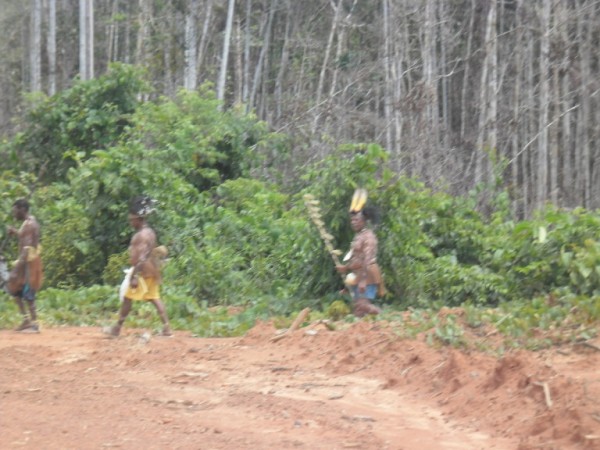
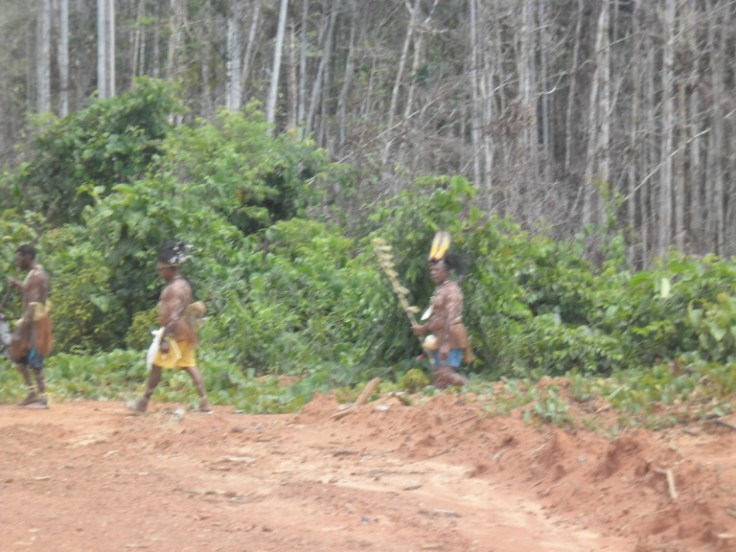
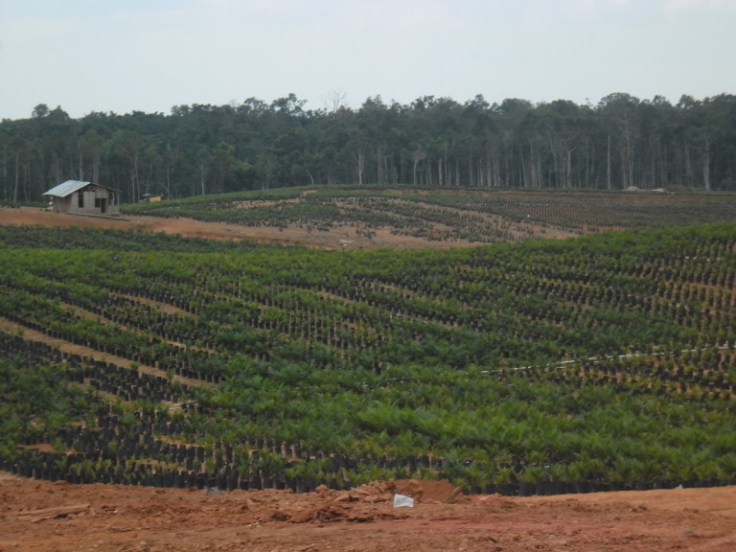
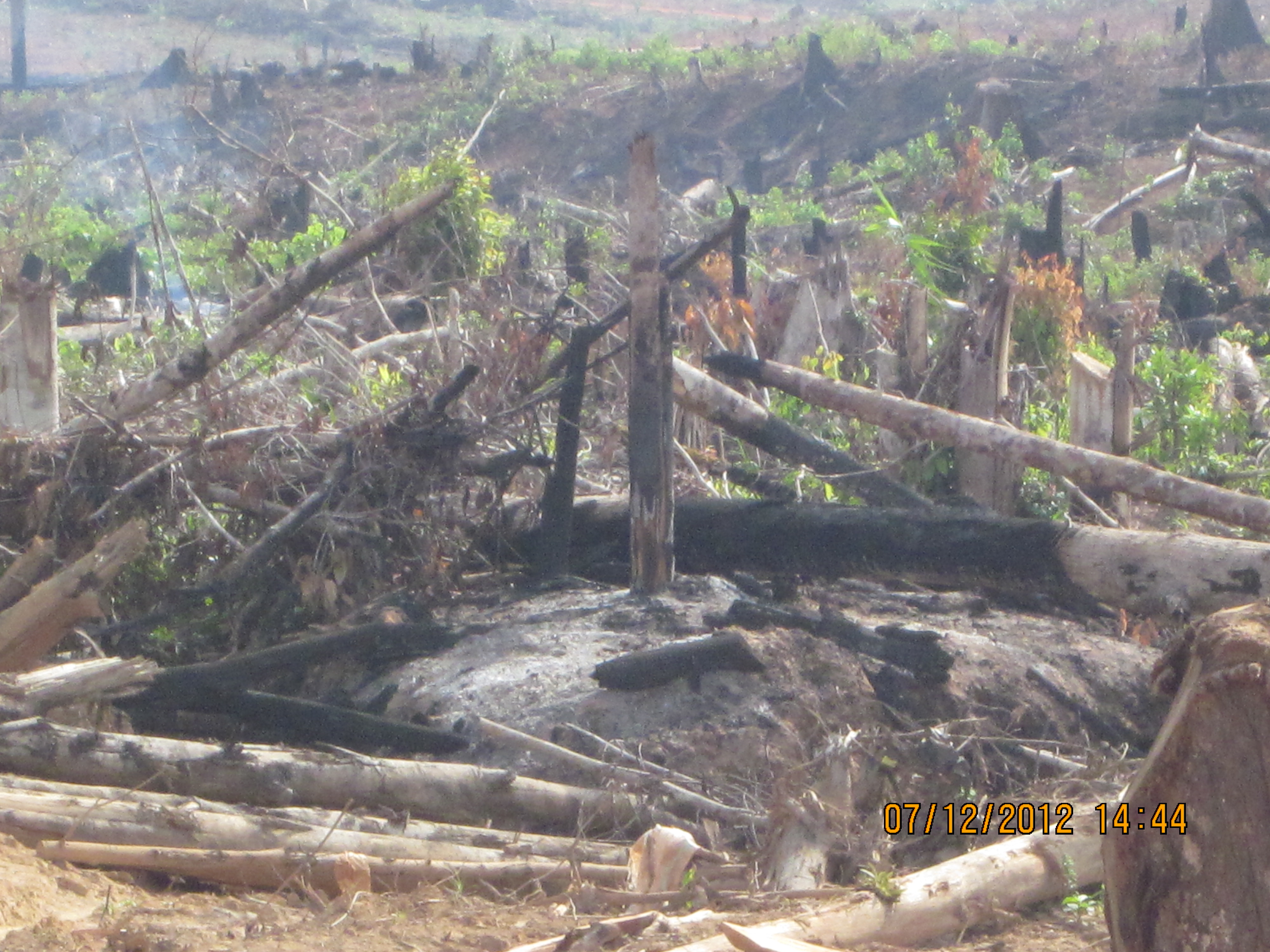
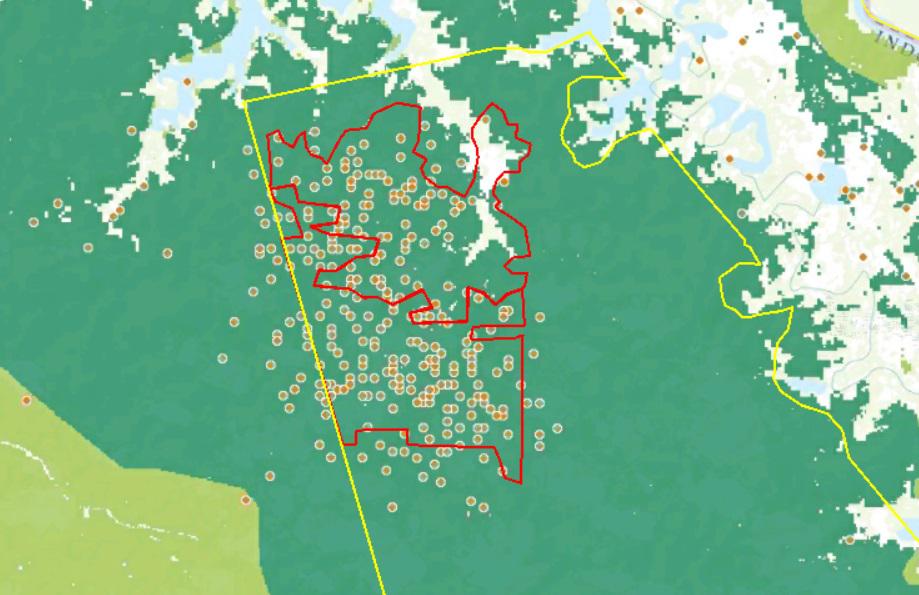
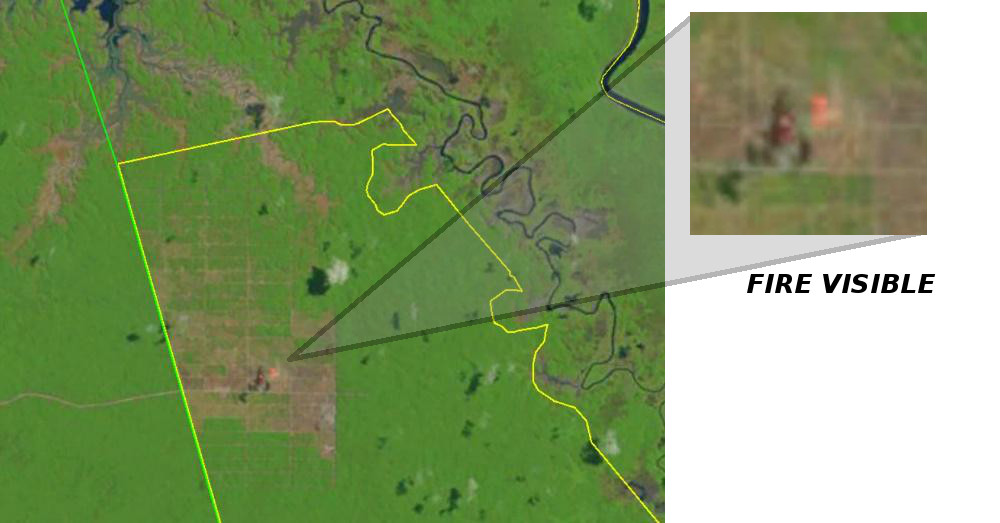
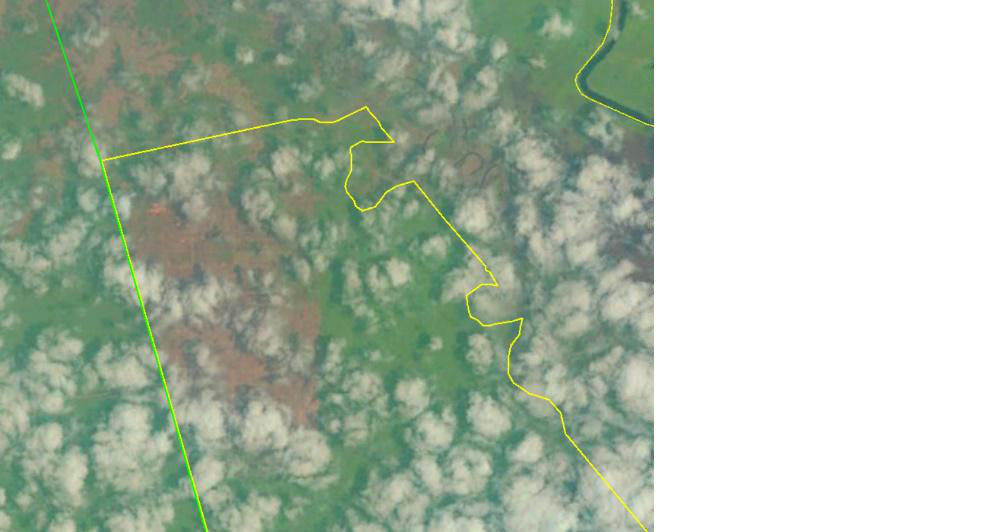
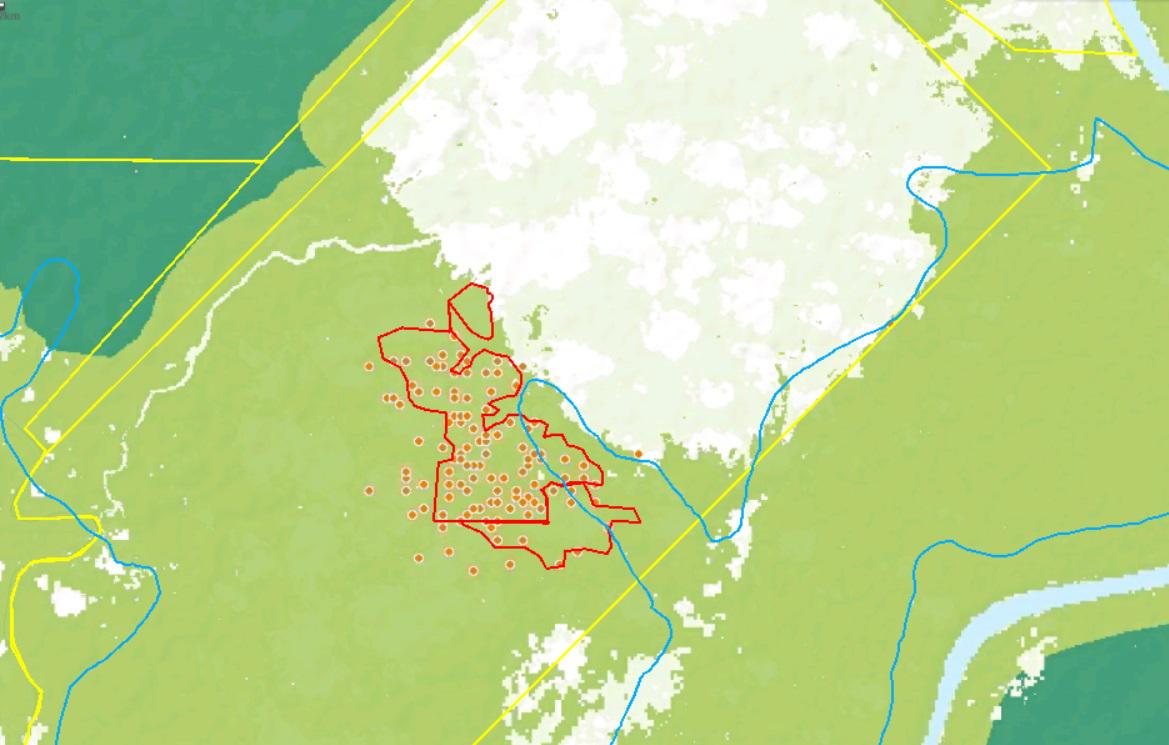
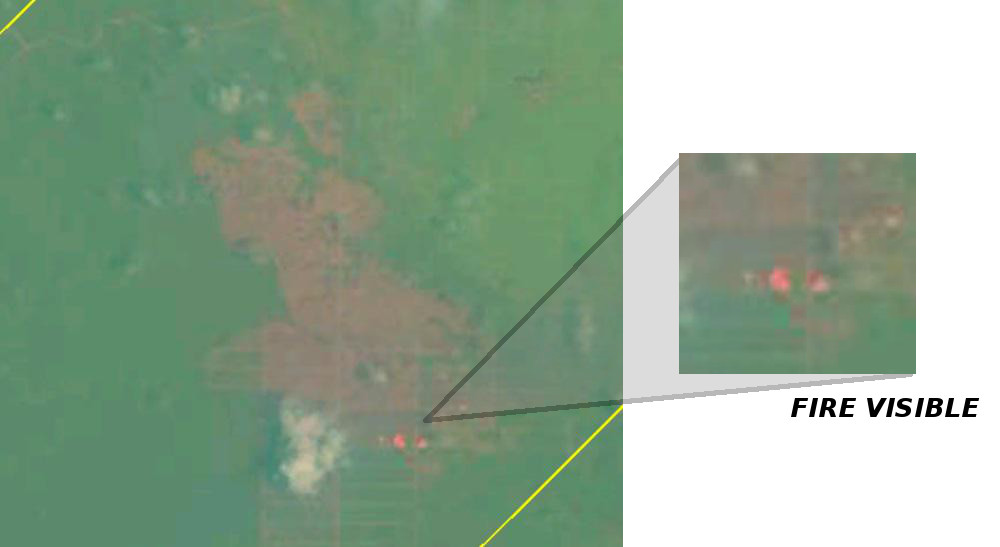
Merauke, Papua: Without the knowledge or consent of local landowners in Kampung Onggari, Malind district, Merauke, two subsidiaries of the Rajawali Group, PT Karya Bumi Papua and PT Cenderawasi Jaya Mandiri, are destroying ancestral forest, evicting areas of importance and swamps belonging to the people. It is believed that this has been occurring since the end of 2012.
Stephanus Gebze, a well-known figure and leader of one of the landowning clans in Kampung Onggari revealed that, “the Malind people of Kampung Onggari have never sat down and discussed this together, nor have we agreed to give permission or surrender our land to the Rajawali company”.
In 2010, the Rajawali company presented its project plans at the Malind district office, in Kampung Kaiburse, but community members from Onggari who were present stated their opposition to the company’s operations in Onggari, as they needed the forests and swamps to be able to support future generations of villagers. In 2011, Rajawali built a church in Onggari, but the people never agreed to give their forests and swamps over to the company. “We accepted the help to build the church as a contribution to us in Onggari. We cannot be coaxed into giving up our land just because a church was built for us”, said Paulinus Balagaize.
Several local people have already surveyed the site where clearing has taken place, known as Tiptidek, Kopti and Kandiput. They have found that their forests and swampland, known as Deg, Palee, Bob, have already been flattened. “These are the places we go hunting, fishing, collect wood and medicines. There are animal habitats and burial grounds of the Malind ancestors. The company has destroyed them all”, said Stephanus Mahuze, another prominent member of the Onggari community. expressing his disappointment with Rajawali for clearing the forest without permission.
The Onggari village government and other community leaders met with the leader of the Malind District, Martinus Dwiharjo, on Thursday 11th April 2013. They complained about how Rajawali was clearing the forest without permission. “This is harassment, and a violation of our traditional rights as Marind people”, said Stephanus Gebze.
The community is demanding that Rajawali’s activities are stopped until settlement is reached according to Marind customary law. There must be compensation for all the various losses the people suffer, including for grasses and other plants and disruption to animal life. The community wishes that these problems can be resolved peacefully and according to the Marind people’s traditional mechanisms.
Martinus Dwiharjo said that he had no knowledge that Rajawali had been clearing people’s land in Onggari. Martinus has offered to facilitate a meeting to resolve the issue with Rajawali as soon as possible, on
Tuesday 16th April 2013. Martinus also wishes to lend his support to resolve any questions about the location of the boundary between land belonging to the clans of Kampung Onggari and Domande. The majority of Kampung Domande’s land has already been given over to Rajawali.
Who knows how often Rajawali has overstepped the line? In November 2012, the people of Kampung Domande, Malind district, imposed a penalty on Rajawali according to their customary laws because the company had
cleared land on the Sanggayas burial ground. Fransiskus Kaize, the village head, explained this penalty consisted of a seven million rupiah fine, one pig and twelve kava plants. The Sanggayas Burial ground has
now been cordoned off with a coconut leaf fence to show that it is forbidden to destroy the surrouding areas.
When a company clears forest without permission, it is grabbing land, insulting indigenous traditions and breaking the law. It is only right that the Malind people of Onggari take action to uphold their customary law against such companies.
Available in English at https://awasmifee.potager.org/?p=334
TPN in Yapen arrest local Indon police chief for abuses on civilians
March 18, 2013
from West Papua Media, with local sources in Yapen
Ongoing repression on peaceful dissent and acts of torture on civilians by Indonesian police (Polri) in Yapen has drawn a sharp reaction from West Papuan pro-independence guerrillas, who have captured and carried out an arrest of the local Police chief for human rights abuses committed under his watch.
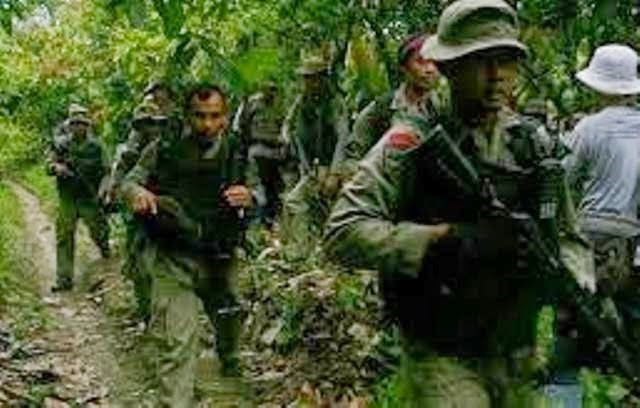
Details have emerged from the remote island district that the North Yapen Sector Chief of Police (Kapolsek), Bripka (Chief Brigadier) Saimima, was apprehended in Yobi village outside Serui just after 9pm local time on Wednesday March 13 by a small group of men led by local pro-independence West Papua National Liberation Army (Tentara Pembebasan Nasional or TPN) commander Ferdinand Worabay.
Local human rights sources have reported that the action, which is being treated as a hostage taking action by Indonesian security forces, was carried out as a lawful arrest under international law for crimes committed under the Kapolsek’s command, and is being claimed by TPN sources as a legitimate assertion of both Papuan sovereignty and the rule of law on alleged human rights abusers.
The apprehension of Bripka Saimima was carried in retaliation for his alleged involvement in continual violence against Papuan community members, carried out by Indonesian police officers on duty in the Yapen archipelago, according to TPN spokespeople.
There are unconfirmed reports from local human rights sources that at least 100 heavily armed police have been sent into the area to free Bripka Saimima. It is believed that a tense stand off between the highly mobile guerrillas and heavily armed police and army is continuing, though heavy exchanges of gunfire were reported in the area from 9.15 pm Thursday night (local time).
More unconfirmed reports on March 17 claimed that the Kapolsek has been freed after three days in TPN custody , though further details have yet to surface, and no reports of attacks on civilians have been received at time of writing. Most armed assaults by Indonesian security forces result in significant civilian casualties.
The captured police officer, Saimima, is well known in Yapen for his alleged human rights abuses. Whilst under the command of notorious torturer, the former Yapen Police Chief Roycke Henry Langie, Saimima was allegedly involved at a command level in the systematic torture, arbitrary arrests and repression of local nonviolent activists and civilians, including the brutal torture and disappearance of political activist Lodik Ayomi in October 2012.
According to TPN sources, another reason for his apprehension is the detention and torture carried out by Polres Yapen officers against members of the TPNheld at the Polres Yapen station.
Local activist sources have told West Papua Media that the demands surrounding the release of Saimima are nothing more than basic bail conditions for any criminal suspect. It is not known if Worabay’s men have demands to hand over Kapolsek Saimima to human rights prosecutors, an unlikely tactic given the lack of trust Papuan people have for human rights violations being successfully or honestly prosecuted under Indonesian law.
However, Worabay has attached clear political demands to the arrest. Worabay claimed responsibility for the arrest of the Kapolsek of North Yapen, telling West Papua Media stringers by phone that the objective of the hostage taking was to demand the release of all Papuan political prisoners in all prisons in Indonesia, including particularly a local activist Decky Makabori, who is imprisoned in Sarmi Polres.
Worabay also demanded that both Polri and the Indonesian Army (TNI) immediately halt the violence in Puncak Jaya, Paniai, Wamena and other districts, and for the Indonesian government to “immediately enter into dialogue with the transitional Government of West Papua.”
“If these demands are not responded to seriously in order to be resolved …. there will be effects on the situation which will be worse,” Worabay told WPM stringers.
Meanwhile, at 5am on March 15 in a separate incident on Jalan Pasir Putih (White Sands Road) in the Serui sea village, an exchange of gunfire occurred between police and members of Rudy Orarei’s local TPN Yapen unit. The TPN unit were surrounded and ambushed by three members of the Brimob from Yapen police headquarters, but Rudy Orarei returned fire from his house, according to local sources. Two police were injured in the shootout, with Orarei reportedly fleeing the police cordon into the bush. The area remains tense under heavy police occupation, according to witnesses.
Related articles
- Three Papuan Civilians Allegedly Seriously Tortured by Wamena District Police (westpapuamedia.info)
- Yapen TPN HQ raided by Kopassus as state repression intensifies across remote island (westpapuamedia.info)
- Protest demands expulsion of Yapen police and military chiefs for brutal policies (westpapuamedia.info)
- Unconfirmed reports of mass arrests and sweeping in Serui (westpapuamedia.info)
- Mass Rallies across West Papua challenge anniversary of Indonesian invasion (westpapuamedia.info)
- Peaceful protest against human rights violations in Yapen leads to arrests (westpapuamedia.info)
Paniai sweeps intensify misery under Indonesian control as security forces ban music and torture priest
by West Papua Media
March 6, 2013
Local residents in Paniai regency are bracing for more repression in sweep operations by Indonesian security forces after two separate incidents across the Paniai have intensified ongoing crackdowns on West Papuan independence sentiment, torturing a local priest and even banning the possession of traditional music.
The latest crackdown, imposed in Paniai after guerrillas from Paniai commander Jhon Yogi’s Paniai unit of the West Papua National Liberation Army (TPN-PB) were involved in armed engagements with the Indonesian army (TNI) and Police throughout February .
Reliable human rights sources in Paniai have reported to West Papua Media that an influx of joint TNI and police have “arrived with total war equipment” to bolster sweeps and raids across Paniai against civilians accused of holding pro-independence sentiments.
“In order to confront the TPN PB and on orders from President SBY, a brigade of TNI / Police have arrived with total war equipment. There were drops of TNI/POLRI in Paniai on 3 March 2013. The brigade arrived by 7 ‘Inova’ vehicles via the coast road,” the source told West Papua Media.
Helicopters belonging to illegal gold miners in Degouwo were again being used by Indonesian troops to support the operation, similar to the massive offensive against Paniai people during 2011 and early 2012, according to both human rights and church sources.
“A yellow and white helicopter owned by an illegal business in Degouwo at 13.00 WPB (west Papua time) made two drops of personnel and logistical war equipment. The first drop was to the Enarotali airport in Paniai district, and the second helicopter drop of the brigade forces together with war equipment was at Obano also, in the west of Paniai district,” the human rights source told West Papua Media.
Independent sources are also reporting that Indonesian colonial occupation forces are putting massive pressure on local civilians, with routine violations of civilian’s dignity, and arbitrary strip searches, that have created opportunities for brutality and torture on local people.
The notorious battalion 753 from Nabire has erected scores of “state of emergency tents” every 5-10 kilometres along the main road between Nabire and Paniai, according to witnesses. “TNI are carrying out very strict checking of everything. The TNI from unit 753 are undoing the clothes of every passenger in the area to check them including females. Advocacy and monitoring is requested,” said the human rights worker.
Military Destruction of traditional culture amounting to cultural genocide
Papuan independent media outlet Tabloid Jubi has reported remarkable accounts of the extraordinary measures Indonesian police commandos from Paniai police headquarters are taking to destroy traditional Papuan culture by banning music.
Father Saul Wanimbo, the Director of the Commission for Justice and Peace (SKP) in Timika diocese, told Tabloid Jubi that during police sweeps, local people are being forced to hand over their mobile phones. They analyse the memory cards on the mobile phones to find songs in Papuan language, and if the memory card is found to contain either one or many Papuan folk songs, police will smash the memory card with stones, according to Fr Wanimbo.
“The police are sweeping HP (Handphone) memory cards of Enaro society (people) for the last two months,” Wanimbo told Jubi, citing his own experiences and stories directly from Enaro residents from 1-20 Febrruary 2013. Wanimbo said that Paniai people have been so demoralised that they just accept the oppressive actions of the occupation forces.
Wanimbo said that the actions by Police were killing three values: “There is destruction of cultural values, murder of the people’s creativity, and character assassination.”
“The situation is conditioned in such a way so that people cannot resist. How can the people fight if the area has a variety of (security force) members lurking there,” Fr Wanimbo told Jubi. The police acts were morally and legally wrong, police could not arbitrarily violate people’s privacy for no apparent reason, and such actions must be done with a warrant, he said.
“Paniai Police must explain the meaning of this sweeps. Or the Papua Police chief must stop the actions of the Kapolresnya (local police command) men in Enaro. This is serious. We can say it’s the beginning of the genocide, ” he said.
Priest tortured by police who then demand bribe for his release
Meanwhile, again in the Paniai regional centre of Enarotoli, local human rights workers have documented a serious case of torture of a local priest. According to human rights workers attached to the Kingmi church, at 8.30 in the morning on March 2, Reverend Yunus Gobai (55 years) was arrested, threatened and tortured by local and Brimob commando police at the Enarotali (Kapolresnya) police compound in Paniai district.
According to the report received and confirmed by West Papua Media, as a result of beating Gobai’s nose was bleeding, his upper and lower lips were split and bleeding, and he sustained abrasions on his hands, swelling on his forehead and cuts on his head, after which he he was put in a cell at the Police Sector command (Polsek) in Enarotali.
Family members went to request his release from the Police station, but the Paniai police demanded a bribe or ransom money to free him, according to the report. Family members reported they were forced to gather money in order to pay the police, and a Paniai member of the DPRD directly handed over to police one million rupiah (about US$103) at Polsek Paniai. Reverend Gobai was then released at 1030am local time, and taken straight home to his village by his family, according to the report.
Rev Gobai is the former pastor and head of the council of the community of KINGMI Maranatha Nabire. According to his family, after Rev Gobai became pastor of the community he suffered from (an undefined) mental disturbance together with epilepsy. Gobai’s family reported that he would regularly be seen “shouting for no reason or running around shouting”.
Reverend Gobai was arrested after exhibiting these symptoms outside the police station in Enarotoli, causing his arrest, but police did not treat the issue as an illness and used unwarranted torture and inhumane treatment on the pastor, according to the report.
(WPM Editor’s Comment: Whilst the KINGMI report uses unclear terminology describing the pastor’s behaviour as “mental illness”, often random outbursts of unintelligible shouting and psychotic visions are perfectly normal and accepted behaviour of Christian pentecostal pastors, Muslim imans, Hindu holy people, and almost all other religious leaders and clerics across human history. To arrest and torture someone for this behaviour is to ignore the experience of humanity.)
Paniai is no stranger to unrestrained Indonesian security force violence and torture against local people, primarily made up of members of the Mee tribe. Previous offensives in the Paniai since December 2011 have displaced tens of thousands of civilians, and burnt down hundreds of villages. Paniai was the scene of widespread military operations between 1963-1969, 1977-1978, and again in 1981-1982. During this period U.S. supplied Bronco aircraft were used to bomb villages while helicopters strafed Papuans with machine gun fire.
West Papua Media
Related articles
- Paniai villages reportedly razed as Densus 88 resumes sweep operations in search of TPN’s Jhon Yogi (westpapuamedia.info)
- Thousands flee in fear of heavy civilian casualties as TNI begin Highlands reprisal offensive (westpapuamedia.info)
- Jared Diamond: Don’t assist the Indonesian occupation (westpapuamedia.info)
- Media Wake Up Australian Media Report on West Papua (femonymous.com)
- West Papua: Is this the time to heed freedom’s call? (asopa.typepad.com)
- Paniai Villages Razed As Densus 88 Resumes Sweep Operations (pacific.scoop.co.nz)
Thousands flee in fear of heavy civilian casualties as TNI begin Highlands reprisal offensive
Major Reprisals begin with house to house searches, village and church burnings in Tingginambut by Indonesian Security Forces after TPN shoot dead 8 Indonesian special forces soldiers.
from the West Papua Media investigative team*
February 28, 2013
EXCLUSIVE: Special Investigative Report
Local communities around Sinak, Gurage, Mulia and Tingginambut in Puncak Jaya regency have felt the first effects of Indonesian military reprisals, after West Papuan independence guerrillas under General Goliat Tabuni confirmed that they had killed eight Indonesian special forces soldiers and four non-Papuan civilians on February 21 in two separate incidents.
The shootings were carried out after Kopassus officers continued to build military posts on a local sacred burial site, despite being requested not to by both community representatives and emissaries from the West Papua National Liberation Army (Tentara Pembebasan Nasional Papua Barat – TPN-PB) under Tabuni. TPN spokespeople have said that the shootings were done “to assert West Papuan sovereignty against Indonesian colonial occupation”, and to assert West Papuan cultural rights to defend their customary practices against ongoing military brutality.
A spokesman for the Goliat Tabuni’s TPN-OPM command, Nikolas Tabuni, told West Papua Media in a statement that the killings were not without cause.
Evidence of collective punishment emerges
Despite an effective information blockade imposed by thousands of Indonesian army (TNI) troops and Police, and unchallenged by a compliant Jakarta-based colonial media, detailed reports are beginning to filter through from independent sources in the area of the military offensive, painting a vastly different picture to that reported by Indonesian and international media since the shooting of the Kopassus soldiers.
At least 1000 members of various Indonesian security forces are currently occupying and laying siege to entire communities around Puncak Jaya, with thousands more troops being sent in from other centres in Papua, according to local church, human rights, and sources in contact with West Papua Media stringers across the conflict area.
According to these sources, the villages of Tingginambut, Trugi and Nelekom have been occupied by TNI forces since Sunday February 24, with villagers being forced to give all their food and houses to soldiers, and being subject to arbitrary and harsh interrogations. TPN sources have also stated that troops are using the villages as strategic hamlets to prepare for a hunt and destroy mission to flush out the forces of Tabuni, who have claimed they are well prepared for guerrilla defence.
In Nambut and Gurake (Gurage) villages in Sinak District, security forces began to carry out house to house sweeping operations on February 26, and in villages in Tingginambut, Puncak Jaya. According to our sources, the TNI Commander in the area has commanded “that the sweeping operation is to be continued until the culprits from last Thursdays killings are arrested”. The TNI have stated to local people they “need to see 11 persons sentenced,” according to the reliable source.
Two civilians were said to be arrested on February 27, according to Indonesian military reports, however independent sources could not confirm if any other civilians have been arrested.
As of February 26, at least 18 houses have been burned to the ground, 5 GIDI churches razed, 2 schools and a library have been destroyed by the combined Police/TNI forces in Tingginambut, according to reliable church sources who have safely relayed data from witnesses to West Papua Media stringers. Witnesses have also reported that soldiers are deliberately burning and destroying food gardens and shooting livestock, including over one hundred pigs. There are fears of a major humanitarian disaster unfolding with the reports of the destruction of food gardens and livestock, an act of collective punishment on a civilian population.
Thousands of people from the surrounding villages have fled to the high mountains and according to church sources, the entire community populations have fled throughout the area of Gurake, Sinak, Tinggi Neri, Trugi and Nelekom. Exact numbers are not currently known but local sources indicate that several thousand people, mainly subsistence farmers, live in the area.
Human rights workers have also reported from Mulia in Puncak Jaya that townspeople are greeting news of the offensive with panic and preparing to flee.
Reports are difficult to verify as the only media personnel allowed into the operations area are those with approval from the Indonesian army, and very few of these journalist have actually ventured into the area. Stringers for West Papua Media in Puncak Jaya and the Baliem Valley have reported that independent journalists and human rights workers have been prevented from travelling into the area by a de facto Military Operations Area being applied across the entire highlands, including the regional centre of Wamena.
Civilians are staying off the streets as reliable local sources report a massive combat army and police show of force, including house to house searches. On the morning of February 28, witnesses have reported to West Papua Media stringers that 8 Brimob trucks have left
Wamena heading to Puncak Jaya this morning, with large numbers of troops patrolling the streets across Wamena also..
Thousands more troops flooding in to attempt to destroy Tabuni’s TPN.
Thousands of heavily armed combat soldiers from Battalions 751 (Jayapura), 753 (Nabire) , and supported by the Wamena 756 Batallion, are reportedly being flown into Tingginambut over the next few days from several centres across Papua. They are joining together with over 1000 extra Brimob paramilitary police (in addition to the at least 1000 Polda Papua police already in the highlands), and allegedly several units of the notorious Australian-funded Detachment 88 anti-terror commando, to hunt for Tabuni’s forces. Several media reports in Indonesia are also claiming a Kostrad (Strategic Reserve) battalion is being deployed from outside Papua, though this has not been independently confirmed.
Local sources have reported that each TNI platoon is accompanied by a platoon of police, as the operation is officially under control of the Police as a “law enforcement” operation. However, the witnesses have reported that the TNI are clearly in command. TNI spokespeople in Jakarta have told Indonesian media outlets that there is no plan to increase non-organic troop presence in the area, but local sources are reporting a vastly different story.
West Papua Media sources in Wamena observing the airport have confirmed that two TNI Puma Helicopters are involved in the operation constantly ferrying troops between Wamena and Tingginambut, and stopping only for refuelling and crew changes. Three Hercules c130H aircraft have each made 3 drops to Wamena then the troops have entered by road from Wamena. Observers in Nabire have also noted daily departures of three trucks of troops from the notorious Battalion 753 Nabire, to the west of the highlands to reinforce the offensive in Tingginambut.
Human rights and church sources in Puncak Jaya and internationally have expressed deep concern about the potential for heavy civilian casualties to occur with the intensified military campaign, given extra impetus after the Indonesian President, General Susilo Bambang Yudoyhono, called for firm action on Tabuni.
Multiple narratives from Jakarta
The exact circumstances of the deaths of the eight Kopassus special forces soldiers are now mired in claim and counter-claim, with soldiers’ personal accounts of the attack conflicting with the official narrative picked up by Jakarta media. What is confirmed is that the eight commandos – Sertu (Chief Sergeant) Udine, Sertu Frans, Sertu Romadhon, Pratu (Private 1st class) Mustofa, Sertu Edy, Praka (Chief Private) Jojon, Praka Wempi and Sertu Mudin – were killed by a cascading attack led by guerrillas of Goliat Tabuni’s TPN group as they went to the Sinak airstrip to collect cellular monitoring equipment designed to track international phone communications in the area.
However, one survivor of the attack testified in the Jakarta Post that his group was attacked by men, women and children all carrying spears, machetes and knives. According to the TNI survivors as relayed to JP, the platoon of Kopassus was unarmed at the time of the attack, which happened as the soldiers were installing and moving communications monitoring equipment.
TPN forces also opened fire on a Puma helicopter that was evacuating the wounded commandos, lightly injuring three helicopter crew.
West Papua Media sources have provided a highly credible and technical but unconfirmed report that two “very large weapons” that were being moved into Sinak, and went missing during the raid by TPN. According to our sources, there is “extreme concern from the TNI around this particular issue.”
“Apparently they have been trying to find out the whereabouts of these weapons, which suggests they might be too heavy to quickly and easily move,” explained the source. Further investigation is still required, but credible observers in the area believe that these heavy weapons may be artillery pieces – the presence of which in Puncak Jaya represents a serious and dangerous escalation of TNI hardware to be used against civilians. West Papua Media believes any confirmed presence of artillery is connected with the TNI’s stated aim to destroy Goliat Tabuni’s group, but any use of these weapons will place a large number of civilians at risk. It is not the first time the TNI have used artillery against West Papuan civilians: the Bloody Wamena massacres of 2000 and 2003, as well as the aerial bombardment campaigns in the 1977 and 1984.
Indonesian outrage fuels civil society questions on Papuan motivations for resistance
The killings of the soldiers have generated outrage in Jakarta, with nationalist politicians calling for cordon and destroy missions in what human rights observers have said amount to collective civilian punishment by an occupying force.

Sjafrie Sjamsoeddin – indicted as a war criminal
Indonesian Deputy Defence Minister Lieutenant-General (LG) (Rtd) Sjafrie Sjamsoeddin - indicted as a war criminal by the UN for his role in East Timor - on Friday ordered the TNI to conduct heavy “tactical actions” in order to prevent the shooting from occurring again. “The tactical action includes to chase, apprehend and destroy,” the deputy minister said here on Friday. He said the latest shootings by the separatist rebels did not affect TNI`s strategic policies in Papua. TNI so far did not have a plan to send more troops to Papua, he added.
However SBY also claimed in an interview with MetroTV that “no violence” would be used to solve the situation. The situation on the ground has illustrated that security forces have no interest in making SBY’s words truthful.
Despite the nationalist rhetoric, there are many in Indonesia who are seeing this as a wake up call to end Jakarta’s use of state violence against civilians in Papua as it default policy.
The presence of the non-organic personnel from TNI special forces cause animosity among Papuan groups, who have launched attacks against them, according to the report. “If Jakarta wants to end violence, the militaristic approach has to stop, and all non-garrison troops from the military elite forces must be withdrawn from the two provinces because their presence and their irregular operations have triggered attacks on garrison troops and innocent civilians,” DPD deputy chairman Laode Ida said on Tuesday.
A coalition of Papuan human rights groups urged the National Commission on Human Rights (Komnas HAM) to conduct a thorough investigation into the soldiers’ killings, saying the presence of Komnas HAM could prevent human rights violations that occurred during TNI sweep operations after shooting incidents, according to a report in the Jakarta Globe.
“We encourage law enforcers to be professional in carrying out their tasks. They must ensure that their attempts to find the perpetrators do not turn into seeking revenge against all Papuans,” Ferry Marisan from the Institute for Policy Research and Advocacy (Elsam) said in Jayapura on Monday.
The TNI has loudly complained in Indonesian media of hurt feelings about the loss of its soldiers, with the National Human Rights Commission (Komnas HAM) leaders have been forced to apologise for “insensitive” remarks saying killing soldiers is not a human rights abuse. But not all observers are showing sympathy for the loss of the soldiers lives, pointing to the fact that the military are occupying Papuan land against the wishes of the local people.
“One has to remember that soldiers who were shot were Kopassus special forces who have been involved in ongoing human rights abuses right across Puncak Jaya, including village burnings, collective arrests and punishment, burning of villages, and acts of torture. Many observers suspect these soldiers were part of units involved in conducting many OTK (Unknown persons) shootings blamed on West Papuans,” a long time human rights worker in the highlands told West Papua Media by email. “These are not innocence, nor babes in the woods; Kopassus are the original wolves in the forest.”
Still, other observers believe the actions point to an assertion of tribal identity, as a complex motivator behind the declaration of Papuan sovereignty inherent in the armed resistance against Indonesia’s militarist policy in the highlands. An Australian church worker who worked for many years with highland communities in Puncak Jaya made the observation to West Papua Media that this was not simply an act of resistance to Indonesian colonisation, but an assertion of traditional and indigenous Papuan law and cultural survival against the onslaught of an occupying colonial army.
“This must be looked at from another perspective that is relevant. As many indigenous communities including Australian Aboriginal Peoples and traditional highland Papuan people, observe around the world, if outsiders came into their sacred lands, they would also feel compelled at whatever cost to themselves to spear the outsider to compensate (violations of) their traditional law if they belonged to the clan that was legally responsible (under customary law) to guard that site,” she explained.
“Indigenous Law is simply not negotiable on things like that. Things have only changed in Australia because non-Indigenous systems have for years now in Australia been locking up those indigenous peoples who have acted to maintain their law,” the former church worker explained.
“As I understand the TNI despite warnings were acting in a way that broke the Papuans’ traditional laws regarding adat (Customary law), and as the TPN are still holding strong to their traditional laws, so they acted in accordance with the laws they are living by. I can’t see any difference at that level as Melanesian peoples separated historically but only a short distance of water. The difference is that the TPN OPM represent groups that have not yet been overcome by the laws of a colonising power whereas RI does not recognise the traditional Papuan customary laws,” she said
A prominent Papuan human rights activist, Yasons Sambon, has reported that the killings are causing many military families to reconsider their support for the Indonesian colonial occupation of Papua. In an interview with the wife of one of the eight soldiers killed at Sinak, recorded on February 23 after the soldiers funeral in a car by the old market in Sentani, the widow called for Indonesia to abandon its occupation of Papua.
The wife of an Indonesian soldier from Sentani said in a regretful tone, “SBY would be better off giving independence to the people of Papua if it meant our husbands wouldn’t become victims. Our husbands have been murdered. What will be my fate, and the fate of my children, now that my husband has been murdered? We want to hold onto our husbands but they also have a duty to the country. They are murdered and it’s the women and children who become victims, because if they aren’t at work, then what will we eat?”
“It’s better if independence is given to the people of Papua so that we can be safe,” she said.
*from the West Papua Media Editorial team, with additional reporting from stringers in Wamena, Tingginambut, Jayapura, Nabire and sources in Jakarta.
Related articles
- Media Wake Up Australian Media Report on West Papua (femonymous.com)
- Eight soldiers and four civilians reported killed in West Papua: Plus Comment (westpapuamedia.info)
- Cause For Concern: Backlash In West Papua (pacific.scoop.co.nz)
- 8 Indonesian soldiers killed in Papua ambush, independence OPM blamed (pacific.scoop.co.nz)
- National Commission on Human Rights in Papua, 2010: Perpetrators of Violence Dominated Security Apparatus (voiceoflovetruthandjustice.wordpress.com)
- Victor Yeimo: 22 Members of KNPB killed in 2012 (westpapuamedia.info)
- Police fail to provoke violence as demo in Manokwari ignores protest ban (westpapuamedia.info)
- Australia concerned by soldiers’ killings in Papua (abc.net.au)
Densus 88 shoot and arrest KNPB leaders near Wamena as tensions rise

Shooting victim believed to be either Hubertus Mabel or Natalis Alua (CONFIRMED PHOTO; unconfirmed identity) in Wamena hospital, 16 Dec 2012. Both Victims died from their wounds by sunset, according to human right reports. (Photo via Buktar Tabuni/KNPB)
compiled from reports of Tabloid Jubi, Victor Mambor and West Papua Media stringers in Wamena
December 17, 2012
A West Papua National Committee (KNPB) activist has been killed, and a farmer has died from his wounds in hospital, after being shot by members of the Australian-trained anti-terror unit Detachment 88 outside Wamena on December 16, following raids that arrested at least six activists on Sunday morning, according to multiple sources.
KNPB activist Hubertus Mabel (aged 30) died shortly after being taken by police to Wamena hospital after the shooting at 1030am in the village in Milima (or Kugima) in Kurulu district outside Wamena. Local farmer Natalis Alua (34) died in coma in hospital after being shot in the same incident, according to latest reports from human rights sources in Wamena.
According to journalist Victor Mambor, at this time Hubert was still alive and this was confirmed both by the police and Victor Yeimo (National KNPB Chairman). “Police told me that Hubert was shot in the leg at 09.30 (morning). Hubert was taken to hospital by police and then died at the hospital because of loss of blood…. At 6 (afternoon), Hubert claimed by police died in hospital.”

Hubertus Mabel’s body being prepared for burial, late December 16, 2012 (photo: KNPB/ West Papua Media)
“Some peoples in the Kugima Village, the place where Hubert was shot, told us police entered the village in full force. They brought two people who had been arrested before (Meky Kogoya and Wene Gombo) to the village to tell them where Hubert lived.”
At 9am, the same joint police/army and Densus 88 squad conducted a armed raid in the village of Kosi Hubi Holima, in Wamena. KNPB Wamena Chairman Simion Daby was arrested with human rights activist Baroy Sambon, Meki Jikwa (Kogoya), John Huby, Pie Huby, Herae Huby, and Ima Mebel, allegedly at the house of Meky Kogoya, who was accused by police of being responsible for a bombing incident in Wamena. They were all taken forcefully by police to Jayawijaya police headquarters.
It is believed that human rights worker Sambon was arrested as he was trying to alert international media to the situation, but this has not been verified.
The KNPB have repeatedly denied involvement in planning or carrying out acts of violence or bombings in Papua, a view supported by the Churches, human rights organisations and legal networks in Papua. Police have yet to provide any credible evidence that shows their involvement, despite millions of dollars being provided to Densus 88 by Australia for forensic evidence analysis.
There have been reports of an alleged West Papuan National Liberation Army (Tentara Pembebasan Nasional or TPN) retaliation against police over the shooting of Hubertus Mabel, but human rights workers have cast doubt on the involvement of TPN forces, instead accusing Indonesian security forces of acting up to continue to create a false scenario for conflict.
‘On 10.25pm, there was an exchange of fire between the TPN-OPM (the military wing of the OPM) and the TNI/Polri , Indonesian army and police, somewhere between Misi Market and Sinakma, Yusodarso Road. The situation in Wamena was said to be tense and there were calls for help,’ according to a local report as quoted by Jubi.A local resident, Yason, confirmed reports of the sound of gunfire which was still continuing. It is alleged that this was in response to the shooting of Hubertus Mabel. Another local resident named Vita told JUBI that the local police station had been burned down in response to the shooting of Hubertus Mabel. According to Vita, ‘Mabel and member of the KNPB was shot by the security forces as he was suspected of a bombing the Wamena, which led to the police station being burned down.’The local police chief later confirmed to JUBI that there had been an exchange of fire, but West Papua Media was unable to find any witnesses or evidence that any armed TPN unit was in the area.
Markus Haluk said that the “Alleged drunks burning kiosks in the market (is) scripted by the security forces to divert attention from the arrests and shootings of civilians and KNPB activists, and is a conscious Scenario consciously to burn the office and create psychological pressure against the leaders and members of the Papuan Customary Council Lani Pago Baliem Region.”
Local human rights workers believe this latest round of security force misbehaviour is due to the payment to the new Papua Police Chief Tito Karnavian (former Densus 88 commander) of Ten Billion Rupiah (approx US$1 million) from the Papuan Governors office, for the provision of “Phase 2″ security for the Papuan Gubernatorial Election campaign, which was also earmarked to maintain a peaceful environment in the lead-up to Christmas.
“Many parties are upset with these incidents,” said Haluk. “For catching, shooting in Wamena occurred on Sunday, when people were seeking to church to worship. While the arson of the DAP offices were do middle of the night, when the community was quiet for the night, ” he explained.
“On receipt of the funds, the Papua Police Chief conveyed the importance of maintaining the security and peace of Christmas and the election of Governor. Instead, he led police officers making arrests, shootings and arson of Balim Traditional Council offices,” an exasperated Haluk told West Papua Media.
Also, in news from the Paniai, Brimob paramilitary police have reportedly shot and captured Yakobus Utii in Enarotoli on Sunday, alleging that he was a senior figure in Jhon Yogi’s TPN command.
West Papua Media
Related articles
- Crackdown Across Papua: October 23 Knpb Demo Updates (westpapuamedia.info)
- Lanny Jaya KNPB leader arrested and maltreated (westpapuamedia.info)
- Indonesian special forces hunt West Papuan environmentalist (westpapuamedia.info)
- Victor Yeimo and others arrested as police crackdown on December 1 protests in Jayapura (westpapuamedia.info)
- Indonesian army units torch houses, shoot villager, during Wamena sweep operation (westpapuamedia.info)
- Breaking News: Knpb Leader Victor Yeimo Among Arrests on December 1 Flagraising Day (westpapuamedia.info)
- TAPOL Urgent Action: Fears for Papuan activists (westpapuamedia.info)
- Breaking News: Security Forces Attack Knpb Demo in Jayapura (westpapuamedia.info)
- Indonesia cannot kill our spirit for freedom: West Papuan leader (westpapuamedia.info)
- Indonesian security forces engineering conditions to justify eliminating Papuan free expression (climate-connections.org)
Indonesia cannot kill our spirit for freedom: West Papuan leader
21 October 2012
Alex Rayfield
West Papuan independence organisation, the West Papua National Committee (known by its Indonesian acronym KNPB) continues to defy the Indonesian security after a series of arrests and attacks on the group in Wamena, Timika and Jayapura.
Speaking from a safe house KNPB Chairman, Viktor Yeimo told West Papua Media that the police were vigorously repressing the group’s right to freedom to organise and right to nonviolently express their political opinion.
“I am in hiding but I have to try and keep organizing. KNPB have plans for peaceful demonstrations in Sorong, Manokwari and Jayapura. The police won’t allow us to make a peaceful action but we will still have a peaceful action.”
Early on Friday morning officers from the Indonesian police and Australian and U.S aided counter-terrorist group Detachment 88 raided KNPB’s Timika headquarters. Four Papuans, Steven Itlay, Chairman of the Timika region, Romario Yatipai, vice-president of KNPB’s parallel parliamentary structure the West Papua National Parliament, Marten Kalolik, and Denias Tekege were arrested. Laptops and cameras were also seized. The arrests in Timika follow raids and arrests of ten activists in Wamena, raids on villages and an attack on a student dormitory in Jayapura last Tuesday. Some of those arrested are teenagers. Others like Simson, a student activist from Jayapura were beaten by the police to extract information.
Virtually the entire KNPB leadership has now gone underground. In addition to Viktor Yeimo, Fanny Kogoya, ex-member of the KNPB central committee who resigned from KNPB after being elected Director of the Papua Desk of Friends of the Earth Indonesia, and Simeon Dabi chairman of the Wamena branch of KNPB are all on the run. Their faces are pasted in the streets of Wamena and Jayapura under the ominous heading, “Daftar Pencarian Orang”, the list of wanted persons. In Fanny Kogoya’s case her only ‘crime’ is that she was a close friend of Mako Tabuni, the KNPB activist killed by Detachment 88 in June.
Indonesian police accuse KNPB of being behind a series of shootings and bombings in West Papua that have rocked the country in recent months. It is an allegation that Yeimo vigorously denies.
“All this evidence is planted so they can justify their attacks. We never had any plan or any program to make acts of terror. We are not a military movement. If we were a military movement we would be the TPN (West Papua National Army) but we are a civilian movement. The Indonesians fear our movement, they want to make a public opinion that we are terrorists so they can kill us.”
Yeimo pauses.
“But they won’t succeed” he tells me quietly. “Indonesia won’t success to stop our movements for the right. Indonesia cannot kill our spirit for freedom.”
Related articles
- Densus 88 sweeps force hundreds to flee from Baliem Valley villages (westpapuamedia.info)
- 7.30 Report (ABC): West Papua arrests highlight Australian Detachment 88 links (westpapuamedia.info)
- Demos commemorating FRWP 1st anniversary held across Papua (westpapuamedia.info)
- Breaking News: Police in Jayapura forcibly prevent commemoration of 3rd Papuan Congress brutality from going ahead, ban free speech (westpapuamedia.info)
- Indonesian security forces engineering conditions to justify eliminating Papuan free expression (climate-connections.org)
- Wamena Bomb Scenario is false: Open letter from Wamena KNPB chief (westpapuamedia.info)
- TPN denies involvement in “unknown persons” terror plot in Wamena (westpapuamedia.info)
- Indonesian security forces engineering conditions to justify eliminating Papuan free expression (intercontinentalcry.org)
- West Papua arrests trigger fresh Australian Detachment 88 link allegations (pacific.scoop.co.nz)
- So, who is the real terrorist? West Papua Responses to Australia, U.S. and Indonesia (westpapuamedia.info)
Violence continues to intensify across Paniai, towns emptied as TNI/Polri conduct reprisals after TPN attacks.
October 21, 2012
By Nick Chesterfield at West Papua Media
Special Investigation
As a major crackdown by Indonesian security forces deepens against West Papuan civil resistance activists ahead of mass mobilisations across Papua, West Papua Media is examining Papuan nationalist motivations for resistance, revisiting a region that has been continuously wracked by security force violence connected to illegal gold mining and resource extraction.
The Paniai regency, which straddles the “neck” of the Papuan “bird of Paradise” landform, is the site of a new gold rush that has resulted in brutality against ordinary indigenous tribal and townspeople.
Intensifying acts of violence by Indonesian security forces has reportedly emptied towns in the Paniai district of West Papua, with civilians allegedly fleeing in their thousands to the jungle outside the Enarotoli region, according to human rights sources in Paniai.
Regular reports have been received over recent weeks from church human rights sources detailing a campaign of arbitrary brutality committed by soldiers from the notorious Nabire-based 753 Battalion of the Indonesian army (TNI) , together with Brimob paramilitary police, against indigenous people primarily from the Mee tribe. Random attacks on ordinary villagers, drunken altercations at gambling venues, and sporadic attempts by indigenous Mee people to claim any share of the vast sums of wealth flowing out of their lands, have all contributed to a sense of brutalization endured by the Mee people in recent months.
Engagements between forces of the Paniai command of the West Papuan National Liberation Army (Tentara Pembebasan Nasional) and both Brimob and 753 Btn troops have been used as justification for violence against civilians, and several incidents connected to TNI business activities across the regency have increased tensions.
Daily confirmed reporting from church human rights sources in the Paniai have detailed a litany of abuses by security forces, including, torture, unprovoked killings, shootings, and beatings over economic turf wars.
Torture over taxi turf
On October 1, a misunderstanding quickly escalated to a torture incident in Waghete, in the Deiyei district of Paniai, illustrating perfectly the mundane economic triggers of abuse carried out by security force members. A local district official Marion Dogopia, Head of Bouwobado District, Deiyai, was been driven in an official car (with yellow government plates) from Enarotoli to Waghete. In the car were Dogopia’s driver, and his Papuan Police officer bodyguard, Ones Pigome. The car turned into the Waghete bus terminal to pick up further family members, where a TNI Btn 753 soldier, moonlighting as a taxi driver, started an argument with the driver, according to a church human rights investigation seen by West Papua Media.
Across Indonesia, the TNI control the taxi and ojek (motorbike taxi) industry, which is used as both a good source of intelligence and a lucrative, effortless cash source for bored soldiers – who protect their turf ruthlessly. According to witnesses quoted in the human rights investigation, the soldier taxi driver – who was first in line at the taxi rank – angrily accused the official’s driver of being a taxi and picking up passengers at the bus station, a place where taxis are not allowed to operate. Despite the driver and Dogopia trying to calmly explain that the vehicle was a private vehicle and was not taking fares, the soldier refused to listen.
At this point, the municipal police officer Pigome, started to get angry at the soldier, and shouted and slapped the soldier, demanding he stand down. The soldier resisted and called out his colleagues from Battalion 753, who were loitering at an army post 50 metres away. According to witnesses, several dozen soldiers rushed over complete with their equipment and weapons, and pulled Ones Pigome out from his car. They severely beat the victim, kicked him, tore his clothes, and stomped him with their boots after he fell helplessly. As a result, Pigome sustained deep lacerations , contusions and swelling upon his head , face and body.
In a chilling reminder of the dangers faces to both journalists and witnesses to Indonesian state violence – and a sign of the fear that state abuse perpetrators in Papua have of being held to account by growing citizen media power – witnesses reported that several soldiers were standing guard while their colleagues were beating up Pigome, keeping watch after the voices of several 753 members could be heard saying “see who is taking photos or videos”. Witnesses reported that soldiers took their rifles up to low ready positions and intimidated citizens, so that nobody was allowed to take photos. The beating was reported to have lasted over an hour.
Despite the very public nature of the beating and ill-discipline in torturing another member of the security forces, no sanction against the offending 753 soldiers was reported. This further example of impunity has contributed to the tension and feeling that the TNI is out to cause indiscriminate violence to Papuans, as collective punishment for the temerity of any challenge to Jakarta’s colonial plunder.
Military contacts increase
Indonesian army officers from 753 have also recently been implicated in several other incidents.
On Thursday October 11, a joint Indonesian army and Brimob patrol sent to secure logistics from the TPN for local elections, was moving in a speedboat up the Kebo River from Enarotoli. According to reports, the army was using a civilian speedboat on Waneuwo Creek, Agadide District, and a TPN patrol saw this and opened fire on the boat, allegedly with a rocket propelled grenade according to MetroTV, though no evidence was provided for this claim. In the firefight, the boat carrying food and logistical supplies for the TNI was sunk, and two TNI soldiers sustained gunshot wounds in their hands and feet.
The military conducted reprisals immediately by opening fire indiscriminately on civilian fishing boats tied up at the Aikai fishing hamlet in Enarotoli. Civilians were then rounded up at gunpoint in the suburb of Bobaigo in Enarotoli, arrested without charge or justification – all are still being held at different police posts for interrogation. West Papua Media has been unable to ascertain the identities of those arrested.
Prior to the latest wave of violence, throughout August a series on attacks on military posts, local officials, ordinary people and transmigrant workers were widely blamed on the ubiquitous “unknown persons” (OTK) killed 5 people, and critically injured another 6. These OTK attacks, now wryly interpreted by Papuans to mean “Specially Trained Persons” (Orang Terlatih Khusus), were used as justification by security forces to conduct widespread reprisals against Papuan civilians. As is the usual case, police have been in no hurry to identify the perpetrators with evidence, or do anything other than cooperate in extra-judicial operations, according to independent sources in Enarotoli.
In August, the reprisal by security forces forced a closure of the town of Enarotali, with schools, public transport and food supplies paralysed. All health services in the District General Hospitals across Paniai were not running, as nurses, medical staff and patients were forcibly discharged by the security forces. Civilians were unable to engage in farming, causing crops and food supplies to suffer, and were unable to gather firewood in the forest or fishing in the lake. According to testimonies, the atmosphere was constantly coloured by the sounds of gunfire. This situation was experienced by people in the city Enarotali, Madi (Paniai regency capital) and surrounding areas in Paniai.
After a period of relative calm in September, this situation is again being repeated through the behaviour of 753 Battalion and the members of Brimob, who are intricately entangled in the illegal gold mining trade. West Papua Media reported in December 2011 on the ruthless Operation Matoa which was launched across the region to destroy the TPN forces of Jhon Yogi – resulting in the displacement of over 14,000 people, almost 150 villages burnt down and the failure of basic services for almost a year.
Violence over illegal gold control
Brimob paramilitary police, who were stationed in the Degeuwo and Derero River alluvial gold diggings, were providing a lucrative protection racket for the Australian-owned West Wits Mining and other foreign small scale mining companies, which was detailed in an original investigation by West Papua Media. During Operation Matoa, helicopters leased by West Wits were allegedly provided to Indonesian security forces, who used them to strafe and napalm villages in the TPN stronghold of Eduda. Then, as now, creating conflict to be suppressed is a powerful economic motivator for Brimob and 753 troops, who would otherwise be without “legitimate” reason to be around the gold diggings, and all the opportunities for profit that entails. Brimob troops are contracted in lucrative business interests across the alluvial gold mining sector as they provide security for diggings, and also provide site security for several joint operations
The TPN forces of Jhon Yogi have long been suspected by observers as entangled in a mutually beneficial relationship of violence with both Brimob police and 753 Btn, as they both vie for control of artisanal alluvial gold mining operations across the rich rivers and streams that lead into Lake Paniai.
One observer of the Paniai struggle spoken to by West Papua Media today questioned if the perpetrators of ongoing repression were “simply bored 19 year olds with guns, Mafioso soldiers protecting their turf, or entangled business relationships between all actors in a classic horizontal resource based conflict.
On October 12, another armed contact occurred between Yogi’s TPN troops and another joint Brimob/753 patrol on a road near Tanjung Toyaimoti, Agadide District, according to TPN sources. Citizen media sources reported that Jhon Yogi’s TPN unit was ambushed by the Brimob while Yogi’s men were on their way from Pasir Putih District to Komopa. The sources claim that TPN were startled by gunshots near the village and returned fire in a shootout for several minutes. Two TPN members were shot, one (Dabeebii Gobai, 26 years old) critically, and died the next day.
It is unclear how or why the vastly outgunned TPN unit was able, or allowed, to escape by Brimob officers, despite having several mobile units on call. The failure to capture Yogi has raised significant questions as to desire of Brimob to capture him.
A senior church source in Paniai questioned the conditions behind the conflict and the commitment for actors in the conflict to actually seek peace. According to the source, this situation has created a psychological trauma where “Paniai people are still living in the same uncertain circumstances (as when) the area was considered to be a military operations area (DOM) until 2002. … We predict that such incidents are likely to continue to occur because both parties have still not demonstrated an attitude to restrict their areas of movement nor invite each other to prioritise persuasive (unarmed dialogue-based) approaches. It is often difficult to accept such offers.”
He continued, “All parties in Paniai remain indifferent to these problems occurring, even though the victims are often civilians. Maybe it’s because violence is considered normal in Paniai?”
Westpapuamedia
Related articles
- Indonesian special forces hunt West Papuan environmentalist (westpapuamedia.info)
- Paniai offensive intensifies as troops conduct house to house searches: reports (westpapuamedia.info)
- Densus 88 sweeps force hundreds to flee from Baliem Valley villages (westpapuamedia.info)
- All the ingredients for genocide: is West Papua the next East Timor? (westpapuamedia.info)
- Indonesian security forces engineering conditions to justify eliminating Papuan free expression (climate-connections.org)
- Paniai offensive intensifies – troops conduct house searches (pacific.scoop.co.nz)
- So, who is the real terrorist? West Papua Responses to Australia, U.S. and Indonesia (westpapuamedia.info)
Indonesian special forces hunt West Papuan environmentalist
By Nick Chesterfield, with local sources
West Papua Media
October 20, 2012
SPECIAL INVESTIGATION
Indonesian Special Forces officers have redoubled their efforts to hunt down non-violent womens’ and environmental rights activist Fanny Kogoya, after a failed attempt to capture her and Papuan student activists from the West Papua National Committee at a university dormitory on Tuesday night.
Fanny Kogoya was also elected the head of the Papua desk for the Indonesian branch of Friends of the Earth (WAHLI) on June 13, the day before her close friend Mako Tabuni, former KNPB leader,was extrajudicially executed by Detachment 88 troops in Jayapura.
Kogoya, also a women’s rights defender from the grassroots Papuan women’s network TIKI, has been been placed on a Papua wide wanted persons list (Daftar Pencarian Orang or DPO) by the Australian-trained and funded Detachment 88 anti-terror investigators. This is despite Kogoya having resigned from pro-independence activities, according to established credible sources in Jayapura. Kogoya is also accused by police of having knowledge of the whereabouts of activists from the pro-independence civil resistance group, West Papua National Committee (KNPB).
KNPB activists are in hiding after being ruthlessly hunted by security forces, in order to break the back of the civil resistance movement against Indonesian brutality in occupied West Papua. This harassment campaign has gained significant pace ahead of planned Papua-wide mobilisations against Indonesian colonial violence on October 23 – rallies widely expected to be subject to major Indonesian state violence.
The latest crackdown has seen brutal intelligence gathering techniques employed by security forces, including officers identified by witnesses as being from Detachment 88, arbitrarily targeting for beatings, kidnappings, arrests and torture on students and civilians from the highland tribes of Yakuhimo and Dani people – seen by many observers as the backbone of the KNPB effort to use civil power to defeat Indonesian state violence.
Confirmed reports from human rights activists in Jayapura have described heavily armed plain clothes officers – believed by witnesses to be members of either Kopassus or Detachment 88 – violently threatening highland students and civilians in a bid to hunt down members and associates of the KNPB.
Raids on student accommodation around Abepura and Jayapura have intensified ahead of a planned mass mobilisation across Papua on October 23rd by KNPB, which is calling for an end to these illustrated acts of Indonesian state violence – a move seen as makar (subversion) by the new Papua Police chief Tito Karnavian , the former head of the Australian- funded Detachment 88.
Attempts to contact Karnavian or his Papua Police spokespeople for comment for this article have been so far rebuffed and unsuccessful.
Additionally, witnesses and survivors have described a chronology of what is being described as a “fishing operation” by Indonesian intelligence officers. Attempts to capture Fanny Kogoya had been ongoing for several days, with police Avanzas permanently stationed outside houses and haunts of both Kogoya and her extended family and friends.
According to a detailed and disturbing testimony provided by Yakuhimo man and citizen media worker Simson Yohame to independent human rights monitors in Jayapura, the officers have heavily monitored highland students in the greater Jayapura area in a bid to isolate KNPB activists from their base.
Yohame, a friend of Kogoya, was himself kidnapped and tortured by suspected Detachment 88 officers on October 9 after accidentally leaving his motorbike helmet at a Javanese restaurant in Waena, near Abepura. He had been tailed for several days by intelligence officers, who suspected his friendship with Fanny would lead them to their quarry.
Upon leaving the restaurant, he was set upon by plain clothes police intelligence agents, whom he believed to be Detachment 88 officers. They bundled him in to the back of a black police Avanza car, whilst soldiers who were stationed outside the Yakuhimo regencies student dormitory at Waena stood guard. An intelligence officer from Makassar hit him repeatedly with a butt of a pistol, and other officers punched him systematically in the chest using a silat (traditional Javanese martial arts favoured by Kopassus) technique that can easily cause cardiac arrest.
He described being taken in a six car high speed convoy, initially to the back of an unknown facility close to the Jayapura police headquarters, before being subjected to psychological torture on a drive around the greater Jayapura area, and was hypnotized to disorientation. Yohame described the brutal interrogations where he was threatened with knives, swords and cocked and loaded firearms by Detachment 88, according to his testimony. Interrogators also subjected him to psyops by playing loud torture music and sound on headphones they held on his head, while they were sticking knives and pistols into his body.
Giving fascinating if chilling insight, Yohame has detailed the processes that Intel attempted to use to turn him to spy on his friend Fanny. He refused eventually, but not before documenting the techniques utilized.
After the torture, the Detachment 88 officers allegedly moved onto “Stage 3” as Yohame described it, a combination of the classic good cop / bad cop routine. “They (intel) began to ask me the core question: ‘Do you know Fanny Kogoya? This picture is FK, FK stay close to you. You do not deny it. If you deny we will kill you.’”
“I asked why are you looking for FK? Intel said to me that ‘because the cases of murder that Mako Tabuni was doing involved FK. FK participated in designing all events Mako and comrades were doing’. Yohame reported the police as saying.
The police continued: ‘FK loves the money Mako and his friends had over the years. FK is the girlfriend of Danny Wenda. Wenda is now the number 1 Papua Police DPO’,” the interrogators said.
The interrogators then changed tactics, offering a payment. “In addition, if you (SY) can inform on where FK is, we will pay you (SY) Rp 10 million for initial operations,”. They demanded the locations of Danny Wenda, the Chairman of KNPB, Victor Yeimo, Tinus Yohame, Buktar Tabuni, Victor Yeimo, Assa Asso, and also fellow Yakuhimo clansmen allegedly involved in KNPB, alternatively offering payment, and threatening to kill him if he denied knowledge of their whereabouts. Yohame was then trained in demonstration and civil resistance disruption and sabotage techniques, and fieldwork techniques employed by intelligence informants.
Yohame described how his tasking had traumatised him greatly, and he refused internally to carry out the actions. After his release having agreed to be an Indonesian agent, he was secretly informing Fanny Kogoya about the massive operation in effect to capture her and warning her to move outside the town to avoid arrest or disappearance.
Fanny Kogoya, who like other civil society activists on the DPO list is constantly moving from house to house, has so far eluded capture due to the diligence of the now underground non-violent independence movement in Papua.
—
For the whole night of October 12, a Cenderawasih University (UNCEN) dormitory in Waena was under siege by a large group of plain clothes armed and masked security forces, who surrounded the dormitories. During the night, the police overran the dormitories in their search for Fanny Kogoya, according to witnesses.
Three students who living at the UNCEN hostel – UL (32), IK (36), and PK (22) – said they had been beaten and terrorized by the police. “Police pry the door and entered. They say ‘we find the DPO who live here,’” the students explained in the human rights report. “They say the name of FK and Danny Wenda (DW).”
The Yakuhimo students at the dormitory were angered by the event, but held a peace blockade outside the gates of the Uncen campus in Waena, independent sources at the campus told West Papua Media. No reports were received of any forced dispersal, however tension is high and all West Papuan students are in fear that that they could be arrested or disappeared at any moment, according to human rights sources.

Yakuhimo students and supporters blockade outside Uncen Waena after the Detachment 88 raids, October 12 (West Papua Media)
These actions came after a campaign of arrests from late September of at least eight people in the highland town of Wamena after police targeted homes and offices of KNPB members, accusing them of involvement in bombings and terrorism, despite KNPB being committed to non-violent civil resistance tactics.
In a statement, UK based human rights group Tapol said that “The targeting of KNPB activists appears to have intensified after the killing of the KNPB leader Mako Tabuni, on 14 June 2012. Officers of Indonesia’s counter-terrorism unit, Special Detachment 88 (Densus 88), funded and trained by Australia, the US and the UK, are thought to have been involved in the killing of Mako Tabuni and the arrest of the KNPB members in Wamena.”
Tapol has called for Indonesian authorities to “end the campaign of terror, intimidation and violence against human rights defenders and political activists, particularly members of KNPB,” and to guarantee the safety of Fanny Kogoya, Viktor Yeimo, and others who have been targeted.
Tapol has also called on Jakarta to “end the deployment of Densus 88 to Papua, investigate all allegations of human rights violations by Densus 88 officers and other security forces personnel and bring those responsible to justice.”
Whilst tension remains high during the crackdown, KNPB activists have also warned their members not to be taken in by SMS messages that are being spread by intelligence personnel attempting to incite violence and horizontal conflict. Activists have circulated a list of mobile numbers that are responsible, and are urging all recipients to document any numbers that continue to spread these messages.
Many people have reported to West Papua Media of an upsurge in Special Forces activity, even around those who are not active on Papuan independence issues. There has been a significant increase on the presence of intelligence officers on the street. Selfius Bobii, the former Front Pepera leader serving out a three sentence at Abepura prison on a treason conviction for his role in the 3rd Papuan People’s Congress of October 2011, still maintains close and effective communications with a network of activists throughout Papua.
In an SMS sent to West Papua Media, Bobii described how the TNI “have stooped to making themselves out to be civilians, to carry out undercover operations in order muffle the independence aspirations.”
“Some are posing as Bakso (Beef offal noodles) Sellers on roadsides, some are posing as motorbike repair people and so on,” Bobii said.
Bobii described the following factual account: On 11 Oct at 2303 hours in Nabire, Yance Agapa was heading home and was given a lift by an ojek (motorbike taxi) rider to the front of the Indonesian Air Force Quarters in front of the ‘Glory’ internet cafe. When they arrived at Malompo he gave the driver Rp20000 (approx. AUD$2) who hurriedly put it into the pocket of the black jacket he was wearing. Then a pistol fell out of his jacket. Yance startled in fright to which the driver responded “Brother don’t be frightened because I’m from Ambon but my mother is from Sentani. I’ll tell you straight, I’m a member of DENSUS 88 sent from Central to get the government program happening. So let our people from the community know to be careful using hire motorbikes. “
West Papua Media has independently verified this account.
KNPB activists, most living underground currently, have expressed significant fears for their safety and survival from the crackdown. Yohame begged in his testimony, “the condition of our current times is so dire, (we need) all my friends and the international support groups to be able to monitor our current situation. Virtually all KNPB activists are threatened at this time. “
It is unclear whether these intensified crackdown tactics will work on those close to DPO suspects to give up not just Fanny Kogoya, but other non-violent activists who are simply attempting to raise their universal human rights of self-determination and freedom of expression.
Certainly these hunting parties have confirmed one thing: that Australian trained counter-terrorism troops are without any doubt being used to suppress peaceful political activity, outside their legal mandate of counter-terrorism. This should be deeply concerning for Australia in its quest for advocating internationally the Rule of Law – and at the moment that it has just taken up a position on the UN Security Council it might prove to be an inconvenient turning of a blind eye.
West Papua Media.
Related articles
- TAPOL Urgent Action: Fears for Papuan activists (westpapuamedia.info)
- Densus 88 sweeps force hundreds to flee from Baliem Valley villages (westpapuamedia.info)
- 7.30 Report (ABC): West Papua arrests highlight Australian Detachment 88 links (westpapuamedia.info)
- Police torture students after brutal attack on Abepura university dormitory (westpapuamedia.info)
- TPN denies involvement in “unknown persons” terror plot in Wamena (westpapuamedia.info)
- Breaking News: Police in Jayapura forcibly prevent commemoration of 3rd Papuan Congress brutality from going ahead, ban free speech (westpapuamedia.info)
- Reports of violent crackdown in West Papua on People’s Congress anniversary (pacific.scoop.co.nz)
- Indonesian security forces engineering conditions to justify eliminating Papuan free expression (climate-connections.org)
- KNPB ask police to prove what charges were against Mako Tabuni (westpapuamedia.info)
- AHRC: Police arbitrarily arrested five Papuan activists and copy documents related to their political activities (westpapuamedia.info)
Densus 88 sweeps force hundreds to flee from Baliem Valley villages
Sweeps engineered to justify annihilation of Papuan resistance by Australian-funded troops: Churches
by Nick Chesterfield, with Westpapuamedia stringers
October 15, 2012.
Special Investigation
Amid an intensification of armed security sweeps against West Papuan clanspeople around Wamena, Church leaders in West Papua have condemned Indonesian security forces for falsely engineering conditions to justify eliminating Papuan civil resistance to Jakarta’s colonial rule.
Credible reports continue to be received of an ongoing security sweep against highland villages that has reportedly resulted in hundreds of civilians fleeing to take refuge with pro-independence guerrillas in the mountains several days walk from Wamena.
Activists from the pro-independence West Papua National Committee (KNPB) are reportedly being targeted in a worrying crackdown against free expression. Carloads of heavily armed police and soldiers are cruising around the districts surrounding Wamena, pouncing on any civilians suspected of having affiliation to the KNPB, according to church sources in communication with West Papua Media stringers.
KNPB sources have expressed great fear that the latest offensive by Indonesian security forces against their members is an attempt to wipe out the Papuan people by eliminating their ability to organise acts of peaceful free expression and to campaign for a referendum to determine Papua’s future.
A joint taskforce led by officers from the Australian funded counter-terror unit Detachment 88, together with soldiers from the notorious Wamena based Army (TNI) Battalion 756, and Police paramilitary Brimob Gegana alleged bomb “disposal” officers have joined the sweep, which initially targeted the villages of Wesagaput, Tulem, Jibama and Jbele, outside Wamena.
“Residents have sought refuge and are temporarily displaced from their homes as a result of a meeting by district office of Jayawijaya and the TNI/POLRI police who carried out raids, and accused local activists for planting a bomb in a house at Jalan Irian. The situation is described as tense and locals are in grave fear,” a pastor who has fled to the hills with the residents told West Papua Media by SMS on October 10.
Repeated attempts over the weekend by West Papua Media to contact the Jayawijaya police commander, and the new Papua Police Commander, former Densus 88 chief Tito Karnavian, have gone unreplied.
It is not known the strength of the taskforce, but unconfirmed reports have claimed up to two Satgas companies are involved, totalling at least 200 armed troops. Historically police and military raids against villages in the Baliem Valley have resulted in signficant human rights abuses, village burnings and repeated incidents of brutality and torture (some infamously captured on mobile phones and leaked via YouTube).
Messages sent late on Thursday night from the pastor explained “We are now in the jungle, two other crew are still the main target by the security forces and they are still in Wamena town.” The source described how his own, and KNPB members, photos have been displayed on Wanted posters (Daftar Pencarian Orang, DPO) across a small airstrip and the main market of Wamena town. The pastor has joined with the residents in order to provide a measure of protection and communication, and to be on hand for any negotiations.
He continued, in Wamena “the security presence (is) blocking the airstrip, market and the surrounding area and makes it difficult for us to send fast reports.” The pastor reported that on October 10, he and KNPB members who were attempting to file human rights reports were chased by a military vehicle. It was an “Avanza with fully armed military personnel, I believed to be Densus 88, which forced us to flee into the into the jungle with some documents. At the moment, kaka with other committee members in the jungle and soon kaka will be without reception. Please pray for us.”
It is believed that the villagers have fled to the protection of National Liberation Army guerrillas further in the hills, a long utilised last resort in an area that has been subject to generations of significant human rights abuses by the Indonesian military.
The villages being targeted are the home villages of KNPB members arrested in brutal raids by Detachment 88 and TNI troops on September 29. The activists led by Simon Dabi, the Baliem KNPB chairman, are still under arrest by Detachment 88 counter-terror officers, controversially accused of involvement in a bombing campaign that has been widely blamed by church sources to be the work of Indonesian special forces new force – the shadowy “unknown persons” that are never investigated properly by Police. It is feared by most observers that the activists will not receive any chance of a fair trial, as no international observers are allowed.
According to human rights sources in Wamena, the raids have occured after Indonesian intelligence agents interrogating the arrested KNPB activists accused them of hiding bomb making materials in their clan members’ houses. Church sources in Wamena who have had contact with the detainees have reported to West Papua Media that Densus 88 interrogations appear to have focussed on the connection between KNPB and UK-exiled Papuan highland leader Benny Wenda, and have targeted members of the extended Wenda clan for specific repression.
“Targeting indigenous people based on their blood and clan relations is a clear violation of human rights, and has nothing to do with proper police work,” said a senior church leader in Wamena to West Papua Media‘s stringer. “The situation in Wamena is now incredibly dangerous for anyone thought to support KNPB,” he said.
Further reports emerged overnight claiming that more KNPB activists were arrested over the weekend in Wamena, however these reports have not been able to be verified.
Church sources have departed from their usually restrained language, and have vehemently condemned the current operation as a conspiracy by security forces to justify slaughter of West papuan people opposed to Indonesian violence.
A statement by the Moderator of the Papuan Baptist Church, Reverend Socratez Sofyan Yoman, demanded security forces immediately cease their engineering of bombings in Papua.
“The case of the bombings that occurred in two place (at the Honorary Council Workspace Jayawijaya on 1 September, and Wamena traffic police at Jalan Pos Irian on 18 September) are a Really Big Lie by Indonesian police. False allegations that security disturbances were carried out by the people of Papua, more specifically KNPB in Wamena, in our opinion is untrue. Major public fraud like this is unacceptable to the conscience and sense of logic,” said Rev. Yoman.
Rev Yoman explained that “Crimes Against Humanity in the form of police lying is part of a huge security operation and mission of the Government of Indonesia in Papua,” and included the murder of Moses Mako Tabuni on June 14, 2012 by Detachment 88. “The whole process by security forces is very embarrassing to us and disturbs our conscience, but at the same time really damages the reputation of the security forces in the eyes of the people of Papua, the Indonesian people and the international community.”
Sofyan Yoman outlined an 8 point scenario of the motivations for Detachment 88 to conduct these raids, when they know that Papuan people have nothing to do with thee terror tactics.
The operation aims are as follows, Yoman said:
“1. Destroy the peaceful struggle of God’s people in Papua who demand justice and respect for the dignity and fundamental rights of Indigenous Papuans;
2. Knocking out all the pillars of the struggle of the people and the nation of Papua, demanding a peaceful dialogue between the Indonesian government and the Papuan People be unconditionally mediated by a neutral third-party… that continues to gain sympathy and support of the international community, academics, humanitarian workers and the people of Indonesia;
3. Creating a sense of fear, silence, dilemma and trauma of the Papuan people to not take the fight against Crimes Against Humanity committed by the TNI and the police defending sovereignty of the Republic of Indonesia from 1961 to 2012;
4. Destroy the peaceful struggle of West Papua National Committee (KNPB), which has been the voice of the suffering of the people of God in the Land of Papua.
5. Justifying (menjastifikasi) the construction of more military and police bases in the Land of Papua;
6. Confirming the presence of Detachment 88 in Papua, to pursue and kill civilians by utilising separatist stigma and treason (makar) charges against Papuan people.
7. Build the image to the international community that the violence and crimes against humanity in Papua are (caused by) Indigenous Papuans and KNPB (instead of the Indonesian colonial system).
8. And of course, the security forces to obtain additional funding from the budget or Papua province and district / city on the grounds of security control area and the State.”
The sweep is also occurring in other parts of Papua currently. Detachment 88 officers on October 14 arrested a former senior National Liberation Army figure Gidi Wenda outside Sentani, near Jayapura. Several police Avanza cars full of armed Densus 88 officers made the raid at a house behind the headman’s office at 3am, according to human rights sources. Wenda has not been heard from since, nor seen at the Police HQ, and relatives are concerned for his safety.
Despite the crackdown, KNPB activists have vowed to continue to engage in free expression, and call for the international community to prevent Indonesia from killing more Papuan people. “We will demand the United Nations to immediately send a team of observers to our territory, because from day-to-day, we are getting (sic) extinct under Indonesian military operations, just as we demand the right of self-determination which has been guaranteed by international law,” KNPB Chairman Victor Yeimo said in a statement released on October 15.
Mass rallies have been planned across Papua on October 24, which are likely to meet with significant repressive measures by Indonesian security forces.
“We will continue to demand our rights even the world seems concerning with the political economy of the occupiers and oppressors,” said Yeimo. “Many of our activists have been killed, imprisoned and intimidated under Indonesian rule, and we will not give up until our demands are heard by the world,” he noted.
westpapuamedia
Related articles
- 7.30 Report (ABC): West Papua arrests highlight Australian Detachment 88 links (westpapuamedia.info)
- TPN denies involvement in “unknown persons” terror plot in Wamena (westpapuamedia.info)
- Wamena arrests as Australian-funded anti-terror troops conduct raid amid increasing repression on KNPB political activists (westpapuamedia.info)
- Detachment 88 implicated in new activist crackdown (abc.net.au)
- Australian-funded anti-terror troops conduct raid (pacific.scoop.co.nz)
- West Papua arrests trigger fresh Australian Detachment 88 link allegations (pacific.scoop.co.nz)
- All the ingredients for genocide: is West Papua the next East Timor? (westpapuamedia.info)
- Indigenous Papuans Arrested for the Celebrating the UN International Day of the World’s Indigenous Peoples. (westpapuamedia.info)
- So, who is the real terrorist? West Papua Responses to Australia, U.S. and Indonesia (westpapuamedia.info)
- KNPB pleads for international security (force) to prevent ongoing conflict in Timika (westpapuamedia.info)
TPN denies involvement in “unknown persons” terror plot in Wamena
from West Papua Media
October 4, 2012
A commander from the West Papua National Liberation Army (TPN) has categorically denied any responsibility or involvement in an alleged bombing campaign against security force targets in Wamena and Jayapura, joining a chorus of Papua observers raising doubts about the Indonesian police allegations against pro-independence activists
Troops from the Indonesian army (TNI) and Australian-trained Detachment 88 counter-terror unit conducted a violent raid on September 29 against activists from the West Papua National Committee (KNPB) in Wamena, arresting 8. The eight have been charged with various offences, including possession of explosive devices and Makar (treason).
Citizen journalists from SuaraPapua .com made contact with the Commander of the Kodap (Liberation Command Area) I of TPN, Colonel David Darko on Tuesday (2/10) afternoon, who confirmed the bombs in Jayapura, Wamena and throughout Papua, had no connection to the TPN OPM.
“So (the) TPN OPM states assertively, that we are not responsible for any action with bombs, because OPM is not a terrorist organisation, but an organisations of national struggle for Papua, (and for) basic rights to self-determination as any other nation on earth, ” Darko told SP. He said it was a struggle for the liberation of the people, and “The struggle by TPN-OPM is dignified and with full responsibility for the rights of the national struggle,” he said. This unequivocal statement, according to David Darko, is to give notice to all parties not to associate the OPM with bombs or terror.
The non-violent activists were allegedly arrested in connection with a small bomb blast at a Wamena police station. Detachment 88 anti-terror police claim they found explosive materials at the KNPB offices, but human rights observers across Papua have suggested the police themselves planted the materials and questioned the truthfulness of police claims.
Ferry Marisan, the director of the Institute for Human Rights Study and Advocacy in Papua (Elsham) told the Jakarta Globe, “It [the evidence] must have been fabricated by police, they placed the explosives in the office so the police would have a reason to arrest them.”
Victor Yeimo, the international spokesperson for KNPB currently in hiding after threats of arrest for subversion, ridiculed the police assertion that the arrested activists were involved in the attack on the police station, or in making or using bombs, or engaging in acts of terror. “West Papuan people are not involved with these bombs, and still do not know how to make bombs,” Yeimo told West Papua Media on September 30. KNPB has previously and publicly pledged its commitment to non-violence, saying that it is committed to the use of “civil power”
Members of the KNPB have also been subject to an escalating wave of repression by Indonesian security forces across Papua, since the beginning of an anti-violence civil resistance campaign earlier in 2012, in response to a series on mysterious “unknown persons” (OTK) shootings that had killed over 20 people since 2011. These shootings, widely believed across Papuan civil society to be the work of Kopassus Indonesian special forces creating violence to be used as a pretext for a declaration of martial law, peaked with the brazen daylight execution by Detachment 88 officers of KNPB Jayapura Chairman Mako Tabuni on June 6 this year.
Papuan civil society sources have claimed by SMS and email to West Papua Media that the current campaign of bombings and explosions is connected to the October visit of Indonesian President, General Yudhoyhono, to the UK. SBY, as the president is known, is believed to be signing off on major defence deals with UK arms corporations, and will be pressing for increased anti-terror cooperation. SBY is also being targeted currently by human rights activists connected with the KNPB in the UK, who have offered a GBP£50,000 bounty for a citizen’s arrest of the Indonesian President for Crimes Against Humanity. Civil society sources believe that the campaign of crackdown of KNPB activists accused of terror acts is being orchestrated to shut down Papua rights campaigning in the UK.
The TPN Commander Darko stated that the TPN was not allied with the West Papua National Committee (KNPB) in any political or organisational sense. “We also had nothing to do with the Committee at all as we are different from them,” Darko told SP.
The new Papua Police Chief, Inspector General Tito Karnavian – the former head of Detachment 88, conceded the TPN-OPM claim to not engage in terrorist bombings, but said to wait for the court process.
“This case is being handled, and let us see it in court. Whether they are involved or not. Let the court decide, ” he said. Honesty awaited the court because the reverse case would cause turmoil with the grassroots people of Papua, Karnavian explained to assembled journalists.
However, with Papua still closed to international journalists or independent human rights observers, few West Papuan activists believe that the flawed court system in Papua will be able to deliver a legitimate and fair trial.
westpapuamedia
Related articles
- Wamena arrests as Australian-funded anti-terror troops conduct raid amid increasing repression on KNPB political activists (westpapuamedia.info)
- Police torture students after brutal attack on Abepura university dormitory (westpapuamedia.info)
- No terrorists in Papua, says governor (westpapuamedia.info)
- So, who is the real terrorist? West Papua Responses to Australia, U.S. and Indonesia (westpapuamedia.info)
- All the ingredients for genocide: is West Papua the next East Timor? (westpapuamedia.info)
- Paniai offensive intensifies as troops conduct house to house searches: reports (westpapuamedia.info)
- KNPB ask police to prove what charges were against Mako Tabuni (westpapuamedia.info)
- WEST PAPUA: ABC report raises questions for region’s leaders (westpapuamedia.info)
- Activists threatened with twenty years jail for organising a nonviolent march about media freedom in West Papua (westpapuamedia.info)
- Indigenous Papuans Arrested for the Celebrating the UN International Day of the World’s Indigenous Peoples. (westpapuamedia.info)
Wamena arrests as Australian-funded anti-terror troops conduct raid amid increasing repression on KNPB political activists
by West Papua Media
September 30, 2012
Troops from the Indonesian army (TNI) and Australian-trained Detachment 88 counter-terror unit conducted a major raid on Saturday against activists from the West Papua National Committee (KNPB) in Wamena, according to several credible sources in the West Papuan highland town.
The raid on the secretarial office of KNPB Baliem Region at the Potikelek complex in Wamena, just before 6pm on Saturday night, resulted in the arrests of 8 KNPB members. Sources reported to West Papua Media that at least two platoons each of TNI, D88 and regular Police (arriving in 2 trucks, 11 vehicles and 14 motorbikes) were involved in the raid, with many detainees being subjected to brutal beatings and on-the-spot interrogations by security forces according to independent witnesses.
According to Simon Dabi, the Baliem region chairman of KNPB, the troops “said tomorrow they will return and burn the hut.”
“We are not aware of the reason for the arrests, but there’s a possibility it could be connected to a scenario that’s been created to make out KNPB activists to be terrorists, by connecting us to the recent bombing in Irian Road, Wamena,” explained a clearly exasperated Dabi, relayed through KNPB sources.
Those confirmed arrested are:
• KNPB Secretary General (Baliem Region) Janus Wamu (aged 26);
• Eddo Doga (aged 26);
• Irika (Ribka) Kosay (aged 19);
• Jusuf Hiluka (aged 52);
• Yan Mabel (aged 24);
• Amus Elopere (aged 22);
• Wioge (Nata) Kosay (aged 18);
• Melianus Kosay (aged 29);
Grave fears are currently held for the safety of the detainees, who were taken for interrogation to the Wamena Regional Police headquarters under the command of Jayawijaya Regional Police Chief Arivin. Simon Dabi told stringers that the arrest was carried out arbitrarily and without proper legal procedure and those arrested “are at present in an unsafe situation”.
West Papua Media repeatedly attempted to seek comment from the operation commander Kapolres Arivin, and written questions were submitted to clarify details of the raid, however, Arivin hung up twice upon answering and then switched his phone off.
The Papua-wide General Chairperson of KNPB, Victor Yeimo, also urged the Chief of Jayawijaya Regional Police to release the KNPB members. “I have just telephoned direct but the phone was unanswered, so I was only able to send an SMS to the Head of Regional Police to insist that the 8 young ones I am responsible for, be immediately released as their action (in arresting the 8) is uncivilized and improper” asserted Yeimo.
Yeimo ridiculed the police assertion that the arrested activists were involved in the attack on the police station, or in making or using bombs, or engaging in acts of terror. “West Papuan people are not involved with these bombs, and still do not know how to make bombs,” Yeimo told West Papua Media. KNPB has previously and publicly pledged its commitment to non-violence, saying that it is committed to the use of “civil power”
KNPB members have reason to be concerned for the safety of their colleagues. On September 23, 6 local youth members of KNPB were arrested, tortured and beaten in arbitrary arrests following an apparently suspicious death of an Indonesian colonist, and then all released without charge. “Having done no wrong, KNPB activists are constantly being chased, arrested, intimidated and killed by NKRI (the Indonesian state),” said Yeimo.
Members of the KNPB have also been subject to an escalating wave of repression by Indonesian security forces across Papua, since the beginning of an anti-violence civil resistance campaign earlier in 2012, in response to a series on mysterious “unknown persons” (OTK) shootings that had killed over 20 people since 2011. These shootings, widely believed across Papuan civil society to be the work of Kopassus Indonesian special forces creating violence to be used as a pretext for a declaration of martial law, peaked with the brazen daylight execution by Detachment 88 officers of KNPB Jayapura Chairman Mako Tabuni on June 6 this year,
After his appearance on a major report on Australia’s ABC TV describing the tactics of the Detachment 88 state terror campaign against Papuan non-violent activists, Victor Yeimo, found himself with other KNPB members on the Daftar Pencarian Orang (Wanted persons list) in a clear retaliation for speaking out to the international community.
In recent weeks, many non-violent activists engaging in peaceful acts of political expression across Papua have been targeted by security forces including those from D88.
Saturday’s so-called “anti-terror” raid in Wamena is the first major raid since the former head of Detachment 88 Tito Karnavian was appointed as the new police chief in West Papua. Karnavian loudly promised a new “hearts and minds approach” to reducing violence across Papua, and “vowed to take a grassroots approach to stopping the violence”. However, according to Papuan activists across the occupied territory, it seems that the only approach is the intensification of repression of grassroots people.
Westpapuamedia
Related articles
- Police torture students after brutal attack on Abepura university dormitory (westpapuamedia.info)
- So, who is the real terrorist? West Papua Responses to Australia, U.S. and Indonesia (westpapuamedia.info)
- KNPB urge police to stop brutality against Papuans (westpapuamedia.info)
- KNPB ask police to prove what charges were against Mako Tabuni (westpapuamedia.info)
- All the ingredients for genocide: is West Papua the next East Timor? (westpapuamedia.info)
- Activists threatened with twenty years jail for organising a nonviolent march about media freedom in West Papua (westpapuamedia.info)
- Fear, Grief and Hope in Occupied West Papua (intercontinentalcry.org)
- Bishop wants Papuans to hold dialogue before any dialogue with Indonesia (westpapuamedia.info)
- WEST PAPUA: ABC report raises questions for region’s leaders (westpapuamedia.info)
- KNPB: Buchtar Tabuni should be transferred to hospital for medical treatment (westpapuamedia.info)
Activists threatened with twenty years jail for organising a nonviolent march about media freedom in West Papua
by Alex Rayfield
28 September 2012
Two West Papuan activists currently in police detention in Yapen Island in West Papua are being threatened with twenty years jail by the Indonesian police for organising a nonviolent march in support of the United Nations International Day of Indigenous People which this year celebrated the role of indigenous media.
Edison Kendi (37 years) and Yan Piet Maniamboy (35 years) from the pro-independence group West Papua National Authority were arrested by Indonesian police on 9August 2012.
The activists were leading a march of approximately 350 people in support of the International Day for Indigenous People. Police used force to break up the march. According to witnesses they beat up several Papuans and repeatedly discharged their weapons into the air. Sixteen people were arrested at the scene and a laptop, hard disk, modem, digital camera, documents and three Morning Star flags were later seized by police.

Banner at freedom of expression rally rejecting Indonesian rule in Papua on the International Day for Indigenous People. Photo via Alex Rayfield from West Papua Media stringers in Yapen.
Those arrested were subsequently released except for Edison Kendi and Yan Piet Maniamboy who remained in police custody. A local stringer told West Papua Media and New Matilda that Indonesian police investigators Sudjadi Waluyo and Arip Marinto have charged the two men with rebellion (makar) under section 155 of the Indonesian Criminal Code. Both defendants have been told that the police will seek jail sentences of 20 years each.
The controversial charge of makar has come under intense criticism from Papuan lawyers Yan Christian Warinusy from the Legal Aid Institute in Manokwari and Gustaf Kawer and Olga Hamadi from the Commission for the Disappeared (Kontras Papua). The lawyer argues that the charge of makar has been used as a tool of political repression to deny nonviolent activists their right to free speech. The law actually dates back to Dutch times and was used extensively by the former dictator to repress dissent in Indonesia. Suharto was overthrown by a nonviolent student movement in May 1998 but the law has remained on the statute books. Amnesty International and Human Rights Watch have also called for the makar provisions to be struck from the criminal code and all political pisoners in Papua to be released.
The WPNA march was organised to commemorate the International Day of Indigenous Peoples. Ironically the United Nations theme for this year was to celebrate indigenous media. Yapen is extremely isolated. International media is banned in West Papua and local media is censored. So the very fact that story got out in the first place is testimony to the growing power and skill of indigenous media activists in West Papua.
Kendi and Maniamboy told New Matilda and West Papua Media by text message from their jail cell that they want the international community to help them. “We don’t want Autonomy or to remain with Indonesia. We want to be free! Don’t continue to let us be killed and thrown in jails” they said. WPNA media activist and Governor of Jayapura (under WPNA’s parallel political structure), Marthen Manggaprouw said his organisation wants the Indonesian government to negotiate with the independence movement to resolve the conflict. “The basic rights of indigenous Papuans are not respected in West Papua. There is no democratic space for us Papuans. We are criminalised simply for expressing our opinion” said Manggaprouw.
The men number amongst some 100 West Papuan political prisoners currently languishing in Indonesian jails. Although the Indonesian constitution technically guarantees freedom of speech in reality basic rights are routinely denied to the indigenous Papuan population. Papuans calling for genuine political freedoms are vigorously repressed by Indonesian police and military.
This is the original article to one which appeared in New Matilda
Related articles
- All the ingredients for genocide: is West Papua the next East Timor? (westpapuamedia.info)
- Indigenous Papuans Arrested for the Celebrating the UN International Day of the World’s Indigenous Peoples. (westpapuamedia.info)
- So, who is the real terrorist? West Papua Responses to Australia, U.S. and Indonesia (westpapuamedia.info)
- Police torture students after brutal attack on Abepura university dormitory (westpapuamedia.info)
- Carr must do more on West Papua: Greens (westpapuamedia.info)
- WEST PAPUA: ABC report raises questions for region’s leaders (westpapuamedia.info)
- Third Degree Radio: West Papua Media’s model (westpapuamedia.info)
Doubts grow of OPM responsibility for Puncak Jaya aircraft shooting
Special Report by Nick Chesterfield at West Papua Media
Monday, April 9, 2012
Concern is mounting in Puncak Jaya that an Indonesian military unit of “unknown persons” seeking to create a security crisis in Puncak Jaya may be behind the April 8 shooting attack on a Trigana Air Twin Otter aircraft in which a Papua Post journalist was killed.
Civil Society representatives, media sources and representatives from the rebel TPN (Tentara Pembebasan Nasional or National Liberation Army) have all cast significant doubt on the Indonesian military claim that Papuan guerrillas were responsible for opening fire on the aircraft. The aircraft came under accurate small arms fire as it was approaching from the Noble airfield in Mulia, Puncak Jaya, forcing the plane to make an emergency landing.
Leiron Kogoya, 35, the Puncak Jaya correspondent covering local elections for the Nabire-based Papua Post, was fatally injured by a gunshot to his neck.
During the landing the injured pilot panicked, according to local media sources, and crashed the plane into the terminal building (shed). Four people sustained injuries from bullet fragments. A child, Pako Korwa, was wounded in the left finger, Jackie Korwa (mother) was wounded in the right shoulder; Dedy or Beby (pilot), was hit in the left ankle, and Willy Resubun (copilot) injured his right hand and fingers.
Papua Police’s public relations head, Commander Yohanes Nugroho Wicaksono, told Tempointeractif.com that the shooters were hiding in the hills 50 metres from the airport. Police had been unable to identify the perpetrators or the guns used in the incident. Yohanes guessed the shooter had used a M-16 or SS1 – the standard issue weapon for the TNI. “We’re still studying what particular type of gun was used,” he said.
Djoko Suyanto, the Coordinating Minister for Political, Justice and Security Affairs condemned the attack and demanded security forces immediately capture the perpetrators, but admitted that the case would likely remain unsolved. “Their actions must be stopped although it is difficult to do this because of the hills and dense forests,” Suyanto said.
A joint team of the Australian-created Detachment 88 counter-terrorism unit,

Australian funded Detachment 88/ Brimob unit near shooting site, Mulia, 2010 (West Papua Media sources)
Brimob snipers and members of the notorious Nabire-based Indonesian army (TNI) Battalion 753 AVT gave chase to the shooters – according to the police statement – but failed to locate the shooters. Perpetrators for “unknown persons” shootings are rarely located by Police in Papua, despite significant intelligence resources and funding provided to the counter-terror units by the Australian Government.

Australian funded Detachment 88/ Brimob unit near shooting site, Mulia, 2010 (West Papua Media sources)
A West Papua rights activist and former political prisoner Sebby Sambon has told Tabloid Jubi that the work is not that of the TPN, and was far from the areas of operation for troops of TPN leader Goliat Tabuni. “If it occurred near the TPN-OPM headquarters in Tingginambut, then accusations (that TPN may be involved) may make sense,” he said.
However, according to Sambon, TPN/OPM will not shoot civilians. “TPN / OPM (is there) to fight for the people. Period. It is not possible to shoot people.”
Sambon, who is in regular contact through the underground network with Tabuni’s men, said there is a group that was playing at Noble. “There is a play, therefore, forged evidence. TPN / OPM has made no orders to shoot civilian aircraft, Sambon explained.
Police have accused TPN of involvement without any evidence, according to Sambon. “Is it the TPN / OPM purely firing, or other parties who deliberately do this to create a “project” in Papua?”
“For every event at Noble (field), legal facts have never been substantiated,” said Sambon.
Indonesian press outlets are reporting that Indonesian police have conceded that the shooting is the work of “Unknown persons”, Polri Public Information Bureau chief Brigadier-General M Taufik told Vivanews.com that the police could not confirm whether the shooting was carried out by the Free Papua Movement (OPM). “So far we have not been able to ascertain whether or not they are the OPM, and we suspect they are a bunch of strangers,” he told Vivanews.com.
Yet a senior media source told West Papua Media on condition of anonymity, that both Police and military intelligence officers have been sending contradictory SMS messages about the shooting to journalists across Papua. “Two SMS messages about Trigana shooting were received from ASINTEL (Assistant Intelligence Commander of the Cenderawasih military district) and two from Kadivhumas (Public Affairs) Police.”
“Asintel told me that the shooter is OPM, but Kadivhumas Police told me that the shooter were “unknown persons”. This is common habits among journalists in Papua. TNI (Indonesian military) will send SMS to journalists to told them that the shooter is OPM. But the police already know who actually did the shooting in the Puncak Jaya and Freeport area. You know, TNI also has many groups that conducted operations in Papua,” the source told West Papua Media.
In a statement obtained by West Papua Media, Indonesian human rights organisation Imparsial suggested that the shootings were carried out as an “outrageous act” by elements that want to destabilize the security situation in Puncak Jaya and take advantage of the chaos. “Shoot civilian aircraft on the holy day of Easter, there are casualties. I guess there is a deliberate manufacture of the situation in Mulia, (so the area) seems to be harboring terrorists,” said the Executive Director of Imparsial, Poengki Indarti.
Indarti says that serious investigation must occur into events surrounding the shootings in Puncak Jaya. “I hope the government and security forces act seriously, because Papuans don’t want to dirty their hands with blood of others on Easter Sunday,” she said. “This act was orchestrated to make Mulia a (place) of terrorists, but it is not at all, “said Indarti again. Imparsial urged the police to immediately identify the imposters with sophisticated intelligence sent to Puncak Jaya.
The Alliance of Independent Journalists Papua Branch has also called for Kogoya’s death to be properly investigated by police, and for them not to fall back on the usual defence of “unknown persons”.
In a statement, the Chairman of the Alliance of Independent Journalists Jayapura, Victor Mambor said “The incident is very regrettable. Leiron Kogoya was confirmed as the journalist for Pacific and Papua Post Nabire, and was commissioned by the editors to cover the phase of the elections in Puncak Jaya district.”
“It is clear that Leiron Kogoya was killed while on journalistic assignment, because he flew on the plane ordered by the editors to cover the phases of elections in Puncak Jaya,” said Mambor. According to AJI Jayapura, the police are supposed to ensure the safety of civilians, including journalists carrying out their journalistic duty.
“To his fellow journalists in Papua, (this is a renewed warning) to always be alert and careful in carrying out journalistic duties, since the recent intimidation and violence against journalists in Papua is increasing in intensity.” said Mambor. Victor Mambor is also is editor in chief of tabloidjubi.com.
Journalists in Papua are regularly subjected to violence and intimidation by Indonesian security forces, including direct monitoring by intelligence officers in newsrooms. The Pacific Media Freedom Report 2011 documented cases where at least two journalists have been killed in West Papua, five abducted and 18 assaulted in 2011.
westpapuamedia
Related articles
- Gunmen Attack Plane in Indonesia; Journalist Dead (abcnews.go.com)
- Australia keen to follow developments in West Papua (westpapuamedia.info)
- Concerns of JPIC in Papua regarding the situation in Papua (westpapuamedia.info)


An AH-64 Apache attack helicopter hovers before takeoff from Balad Air Base, Iraq, January 3, 2008. (Photo: 

Inside the JCLEC Control Room. Photo: Marni Cordell
Students undertake computer-based training courses – this one tests their knowledge of the difference between intelligence and information. Photo: Marni Cordell
Australian Federal Police agent Brian Thomson at JCLEC, with an Indonesian colleague. Photo: Marni Cordell